|
2030 and Beyond
Will Your Business be a Winner or Loser
Four years from now, the businesses that dominate their markets and the ones that quietly disappear will have been separated by decisions their owners made today. 2030 is not a distant horizon — it’s the next planning cycle. The gap between winners and losers won’t be luck, and it won’t be who worked the hardest. It will be who built the sharpest strategy, the strongest operating system, and the leanest, most capable team.
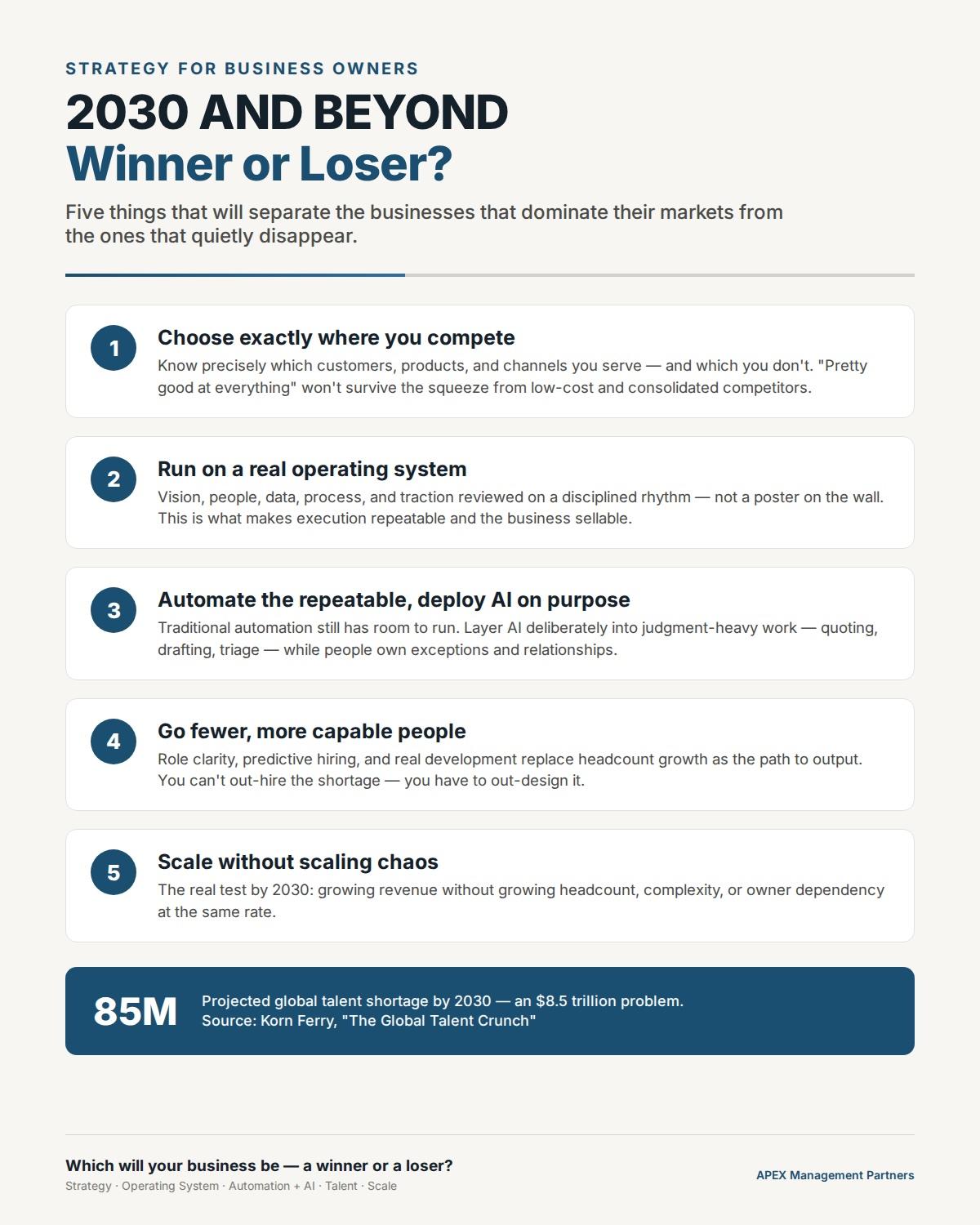
Know Exactly Where You Compete — and How You Win
Most owners can describe their industry. Far fewer can describe their strategy — the specific choice of where to play and how to win that Michael Porter and, more recently, Roger Martin have spent careers insisting is the whole job of a leader. “Strategy” is not a mission statement, a list of goals, or a plan to grow revenue. It’s a set of choices: which customers, which products, which geographies, which channels you will serve — and, just as importantly, which ones you won’t.
By 2030, “being pretty good at a lot of things” will not be a survivable position. The middle is getting squeezed from both directions: low-cost, AI-enabled competitors below you, and consolidated, well-capitalized platforms above you. Winners will be able to finish this sentence in one paragraph: “We win with [this specific customer] because we deliver [this specific value] better than anyone else, and we are structured to make money doing it.” If you can’t say that with precision today, that’s the first strategic work to do — not the org chart, not the software stack, not the AI rollout. Strategy comes first because it determines which operational investments actually matter.
Your Business Operating System Has to Carry the Weight
A clear strategy dies quickly without a system to execute it. This is where most small and mid-market companies actually lose — not from a bad idea, but from inconsistent execution: meetings that don’t produce decisions, metrics nobody reviews, priorities that shift every quarter, and processes that live only in the head of whoever has been there the longest.
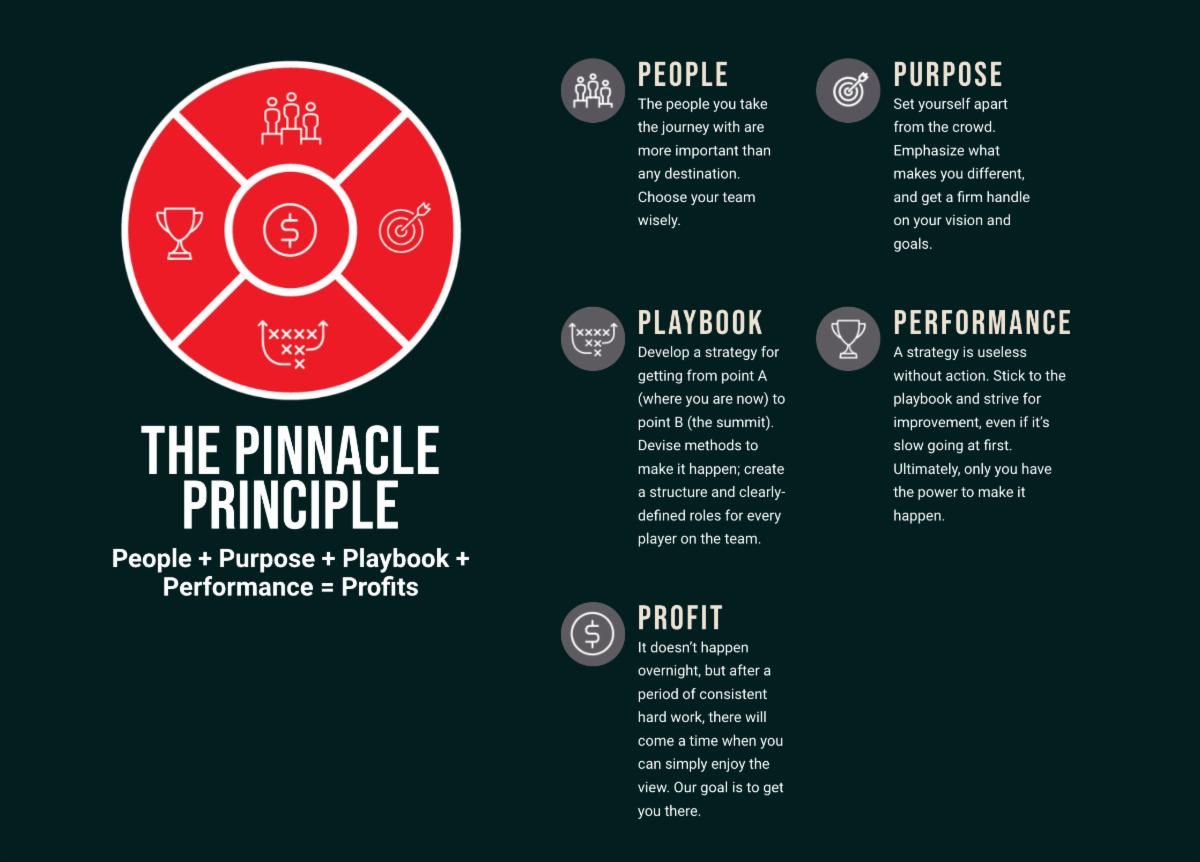
A real business operating system — the kind embodied in the Pinnacle Operating System and similar disciplined models — gives a leadership team a repeatable rhythm: a clear vision everyone can recite, the right people in the right seats, data reviewed weekly instead of guessed at monthly, issues resolved instead of re-discussed, core processes documented instead of reinvented, and quarterly traction toward measurable goals. Operational excellence isn’t a poster on the wall — it’s a systematic, ongoing effort to remove inefficiency and bottlenecks and continuously improve delivery, cost, and quality.
By 2030, the operating system is the difference between a business that can absorb a key employee leaving, a supply shock, or a new competitor — and one that can’t. It is also, not coincidentally, the difference between a business a buyer will pay a premium for and one that only sells with the owner’s personal Rolodex attached. If you’re thinking about eventual transition or exit, this is where transferable value actually gets built.
Productivity Has Two Engines Now — Automation and AI
For the last twenty years, productivity gains for smaller companies came primarily from traditional automation: better software, integrated systems, eliminated manual steps. That engine still matters and is nowhere near exhausted — most owner-run companies still have basic workflow automation left on the table.
AI’s biggest early lift often goes to your least experienced people, which means it can be a genuine answer to a talent-constrained labor market — but only if you deploy it deliberately, inside a documented process, rather than handing it to individuals as a novelty.
Winners in 2030 will have systematically automated the repeatable and instrumented AI into the judgment-heavy work — quoting, estimating, drafting, first-pass analysis, customer service triage — while keeping humans on exceptions, relationships, and decisions that carry real consequence.
Talent Management: Fewer, More Capable People
Here is the uncomfortable part for owners who built their growth model around adding headcount: the winning model for 2030 is not “more people.” It’s fewer people, each substantially more capable, supported by systems and AI that do the volume work. This isn’t a cost-cutting slogan — it’s a response to a labor market that increasingly won’t let you scale by hiring your way through it.
The numbers are stark. Korn Ferry projects a global human talent shortage of more than 85 million people by 2030. The World Economic Forum’s Future of Jobs Report 2025 finds that 63% of employers already cite the skills gap as the primary barrier to transforming their business, and that of every 100 workers globally, 59 will need reskilling by 2030 — with 11 of them unlikely to get it.
You cannot out-hire a shortage of this size. You can out-design it. That means:
-
Role clarity before headcount. Every seat should have a written scorecard of outcomes, not just duties, so you can tell in 90 days whether the person in it is winning.
-
Predictive hiring, not resume hiring. Assessments that measure fit and capability up front are cheaper than a bad hire discovered eighteen months in — especially when replacing that person is now harder than ever.
-
Fewer seats, higher leverage. Every process you automate or hand to AI should shrink the number of people required to hit the same output, freeing your best people for judgment work instead of volume work.
-
Development as retention strategy. In a market this tight, your most capable people are the ones competitors want most. A real growth path, real accountability, and real recognition are now retention tools, not nice-to-haves.
Scaling Efficiently Is the Real Test
Growth is easy to want and hard to do well. The businesses that win by 2030 will have proven they can scale revenue without scaling headcount, chaos, or owner dependency at the same rate — because their strategy is specific, their operating system is disciplined, their processes are automated wherever repeatable, their AI is deployed with intent, and their talent bar is genuinely higher than it was five years earlier.
The businesses that lose will look familiar: strategy that’s really just “we do a lot of things for a lot of people,” a leadership team without a shared operating rhythm, software bought but never fully adopted, AI treated as a toy instead of a system, and a talent strategy that amounts to posting a job ad and hoping — right into a market where 85 million qualified people simply won’t exist to fill the roles being posted.
The Question to Answer Now
2030 will not announce itself. It will arrive as a series of ordinary quarters in which some owners tightened their strategy, upgraded their operating system, automated aggressively, deployed AI deliberately, and got sharper about who they hired — and other owners kept doing what worked in 2020 for one quarter too long.
So the real question isn’t whether you’ll be a winner or a loser in 2030. It’s what you’re going to change about how you compete, how you run the business, and who you hire — starting with the next ninety days.
Question for You to Ponder
Are you ready to lead your business to its Pinnacle?
Outcome (if you act)
More valuable company, higher profit, and a better quality of life.
Call to Action
-
Ask me for a copy of the Path to Pinnacle
- Schedule a Meeting with Me
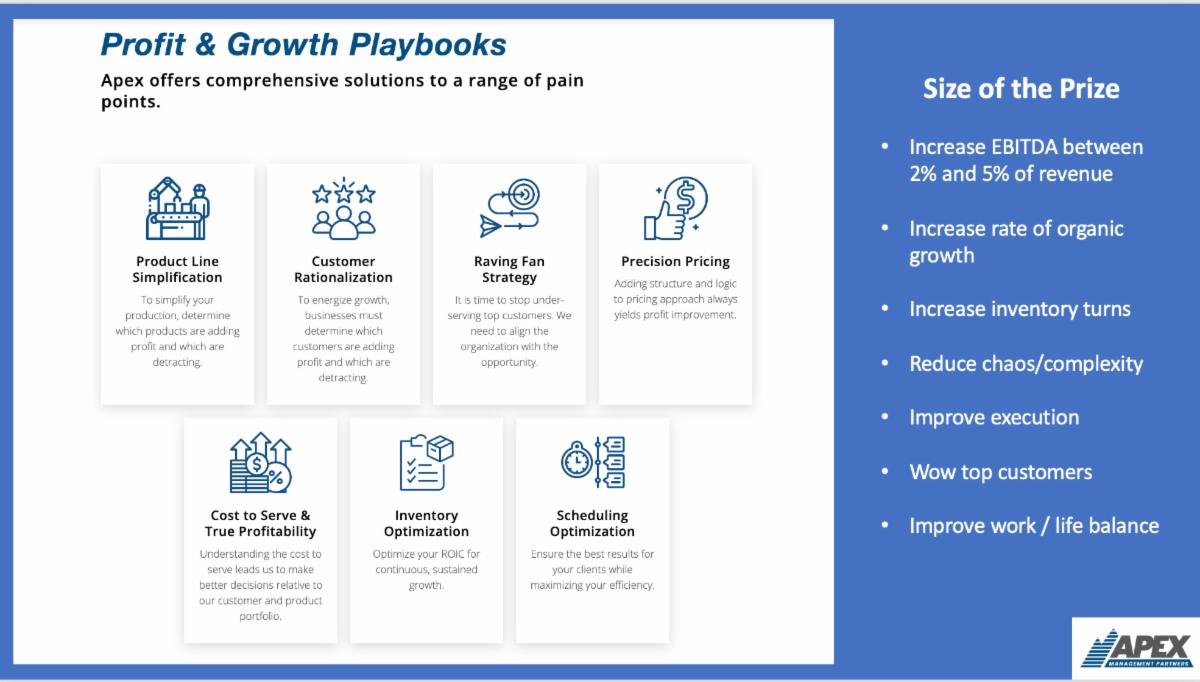
Our Mission: Accelerate Profitable Growth and Improve Execution
|