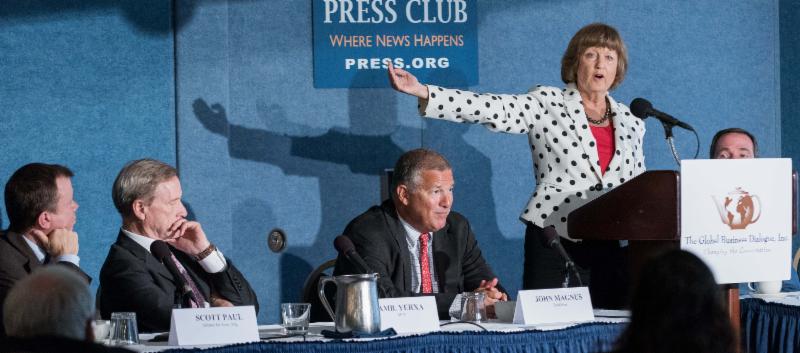
Jennifer Hillman at the lectern with panelists (left to right) Scott Paul (Alliance for American Manufacturers), Amb. Rufus Yerxa (National Foreign Trade Council), Ms. Hillman (Georgetown Law Center) and, just barely visible, Nick Giordano (National Pork Producers Council)
Jennifer Hillman is a Georgetown University law professor and a former member of the WTO Appellate Body. At GBD's June 29 event on the Section 232 or national security tariffs, it was she who brought out most clearly the WTO issues that have arisen and will arise as a result of these tariffs.
To review the basics, the tariffs at issue affect U.S. imports of steel and aluminum - 25 percent on steel and 10 percent on aluminum. For most countries, those tariffs went into effect on March 23. For products from Canada, Mexico, and the European Union, these special tariffs became effective on June 1.
Alas, that is not the whole story because some countries - South Korea, Australia, and Brazil, for example - escaped the tariffs by agreeing to quotas. And, in the meantime, several countries have retaliated against the U.S. measures, instituted proceedings against the United States in the WTO, or both.
Professor Hillman covered all of these issues and more. In a short, 15-minute presentation, she managed an exceptionally clear and an exceptionally comprehensive overview of the WTO issues surrounding these new tariffs. You will want to listen to or read her full presentation for yourself. Still, as is our custom, we'll share one or two elements of it here.
The question of whether what the United States has done is legal under the rules of the WTO, namely the General Agreement on Tariffs and Trade, is one of the two baskets of issues Ms. Hillman addressed. The other dealt with the question, were America's trading partners acting within the rules when they deemed the U.S. actions to be safeguard measures and responded with their own rebalancing or retaliatory measures?
With respect to both sets of issues, Ms. Hillman argued that the U.S. is on the wrong side of the rules of the WTO. She made that point repeatedly and emphatically in discussing the tariffs the U.S. has imposed under Article 232 of the Trade Expansion Act of 1962. Yet, in each case, she acknowledged, there is a question mark, an element that throws all of the others into doubt. But let's take these two baskets one at a time.
WTO CHALLENGES TO THE SECTION 232 TARIFFS
In the past, Ms. Hillman said, uses of Section 232 authority focused on the question:
"Is the United States overly reliant for critical materials on imports; and if so, are those imports coming from countries that we don't want to rely on in a time of war?"
If those were the tests being used today, she suggested, there would be no Section 232 tariffs on either steel or aluminum. But, she said:
"The Administration has gone to the one phrase, the one sentence in 232 ... that completely erases the notion of a distinction between national security and economic security and is basically saying anything we deem to be in our economic security must be in our national security and vice versa."
For the record, the sentence at issue from the 1962 Act is this:
"In the Administration of this section, the Secretary and the President shall further recognize the close relation of the economic welfare of the Nation to our national security ... ."
As Ms. Hillman explained:
"That may well be the definition under Section 232 under U.S. law; it is not the definition under international, and it is not the definition under WTO law."
That is not to say that the WTO ignores the issue of trade and national security. It does not. The issue is squarely addressed in GATT Article XXI, and we'll come back to that.
First, though, it is worth taking a look, as Ms. Hillman did, at the accusations that the EU and other key trading partners have leveled at the U.S. for imposing these new tariffs and quotas on steel and aluminum.
1. The tariffs violate Article I of the GATT, the bedrock MFN principle, which says that all trading partners need to be treated equally.
2. To say the least, these tariffs go well above the bound rates that the United States has agreed to. But Article II of the GATT says countries may not apply tariffs above their bindings. The example of steel could not be more dramatic. The U.S. bound rate is zero.
3. Article XI of the GATT forbids the use of quotas, but the U.S. has quotas on products from Korea, Brazil, and Australia.
4. And as for national security and Article XXI, the situation the United States is addressing doesn't fit any of those allowed for in the GATT article.
Against that background, Ms. Hillman posed the question, "Are these countries that are challenging these 232 tariffs likely to win?" Then she answered it:
"Hundred percent chance. They're going to win on the merits. There is no doubt, absolutely none, that these quotas totally violate those obligations."
With apologies for infusing a small bit of commentary into this overview of Ms. Hillman's presentation, listening to her was like watching successive values being factored into a mathematical expression, with the estimate of the product growing larger and larger. But then an unknown was added to the mix. And just possibly the value of that unknown could be zero, and you know what that would mean.
The unknown in this case is the question, does the WTO - a member, a panel, or the Appellate Body - have the right to pass judgment on any member's exercise of its rights under Article XXI? Is the matter justiciable?
It seems clear from our reading of Ms. Hillman's comments that she believes it should be. But there is no precedent - not yet; so it is not clear. There is a case pending involving Russia and the Ukraine. We'll deal with the details of that in a later entry. Here it is enough to note that it will be the first time that a WTO panel has to decide whether it has any role at all when an action is taken in the name of national security.
These passages suggest Ms. Hillman's view of the issue. She said:
So can the United States actually prevail on a claim of Article XXI? No-unless the United States gets away with what they're doing right now in Geneva. So for the first time ever, Article XXI is actually the subject of a challenge. For all of the existence, from 1995 onward, no one wanted to challenge under Article XXI. No one wanted to raise this defense. It was sort of considered the third rail, if you will of trade law, and the concern was, we really don't want panels of the WTO deciding what is or isn't essential security or putting a lot of definitions around that. ....
So what's happened in that dispute [between Russia and the Ukraine] right now is the United States and Russia, and no one else, have made the claim that this is totally non-justiciable. As soon as anybody says the word "Article XXI" out loud, the panel has to stop and go home. It cannot rule on anything. Nothing at all. As soon as you say those magic words, "Article XXI," that's it, the case is over. All right? That's the U.S.' position with Russia. So, they're right there, together.
Certainly, the panel could rule that there is in fact a role here for the WTO, and evidently most WTO members believe that it should. We shall leave for another time the question of what such a ruling might mean for the system and how different members might respond to it. Here we simply note that there is an important caveat to Professor Hillman's otherwise unequivocal judgment that the U.S. tariffs imposed under Section 232 of the Trade Expansion Act of 1962 violate the rules of the WTO.
U.S. CHALLENGES TO REBALANCING
Following America's imposition of tariffs on steel and aluminum, several countries responded with "rebalancing" tariffs of their own on U.S. exports.
At the time of Ms. Hillman's GBD presentation, Ambassador Lighthizer already spoken against those actions, but the United States had not formally challenged them in the WTO. Today (July 16, 2018), it did. A USTR press release issued earlier today begins:
The United States today launched separate disputes at the World Trade Organization (WTO) against China, the European Union, Canada, Mexico, and Turkey, challenging the tariffs each WTO Member imposed in response to President Trump's action on trade in aluminum and steel to protect the United States' national security interest.
Mentally, legally - pick your adverb - the above countries engaged in a two-stage process. First, they made the decision that the U.S. tariffs weren't really national security measures. Instead, they argued, the U.S. measures were safeguard actions to protect two U.S. industries, steel and aluminum. Safeguard measures are covered by a different GATT article, not Article XXI, but Article XIX. And under XIX, countries are entitled to compensation for lost markets.
To say the least, these issues are a little trickier, a little murkier, and you will want to read or listen to this part of Professor Hillman's presentation in full. But the key issue, and Ms. Hillman put her finger on it, is this. She said:
The big question is, do these countries [the EU, China et al.] have a unilateral right to make that decision? ...That they can deem this [U.S. action] to be effectively a safeguard? That, I think, is a much harder question for the WTO to answer.
|