SESSION 2026

2nd Legislative

Committee Week

Capitol Update: Quick highlights of health care issues discussed as the Florida Legislature moves toward the start of the 2026 Legislative Session.

House Health Facilities and Systems

Chair: Rep Adam Anderson, R, Tarpon Springs

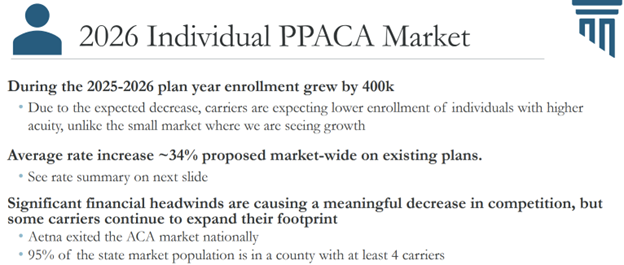
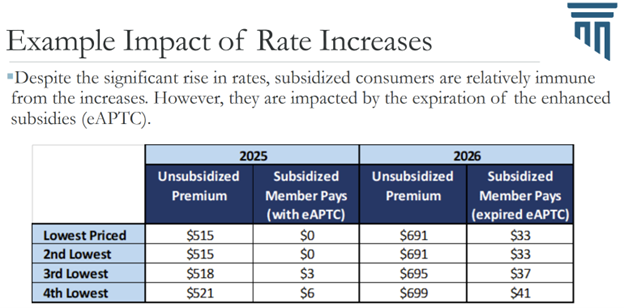
Briefing by the Office of Insurance Regulation on the health insurance market and the impact of the expiring American Rescue Plan Act-set Affordable Care Act premium tax credits.

House Civil Justice & Claims

Chair: Rep Traci Koster, R, Safety Harbor

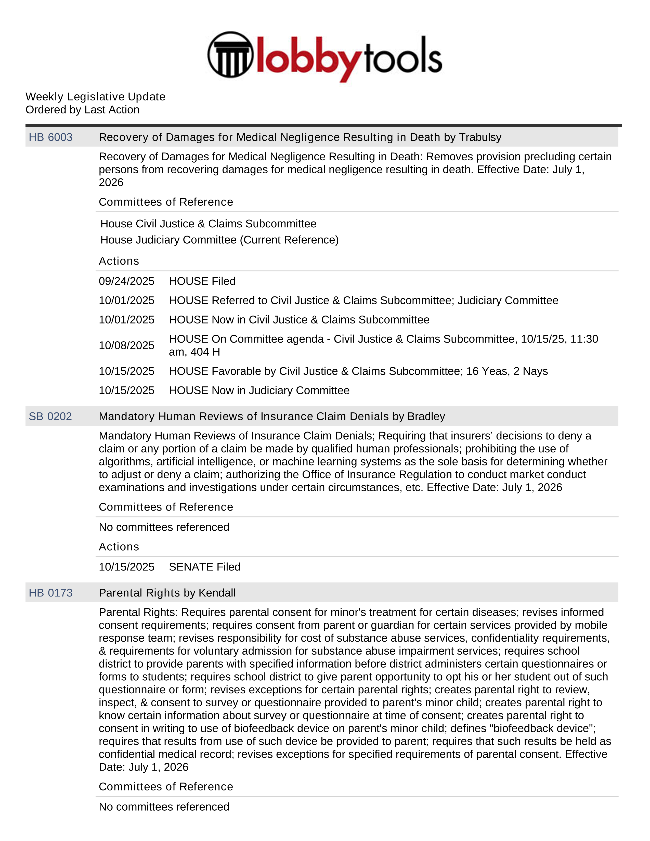
HB 6003: Recovery of Damages for Medical Negligence Resulting in Death


Andy Borom, an orthopedic surgeon in Tallahassee, said enacting HB 6003 would reduce health care access, as doctors already facing rising costs might opt to retire early rather than take on the risks the bill introduces.

Doctors in Florida, he said, already pay the highest number of medical malpractice claims in the country, an assertion supported by the Florida Hospital Association. A recent survey by a Florida-based personal injury firm found that Florida had the second-highest number of payouts between 2020 and 2024, behind New York.

“If your goal is to just throw another golden bone to the trial lawyers, you can feel free to do that,” Borom said. “But if you actually want physicians that are well-trained, well-experienced, to stay here in Florida and take care of you and your patients, you need to reconsider this.”

Proposed repeal of Florida's 'free kill' law again advances to penultimate House Committee

'If you're feeling a little déjà vu today, it's because you should be.'

Bills filed THIS week

SB 202 - Mandatory Human Reviews of Insurance Claim Denials (Bradley)

Mandatory Human Reviews of Insurance Claim Denials; Requiring that insurers’ decisions to deny a claim or any portion of a claim be made by qualified human professionals; prohibiting the use of algorithms, artificial intelligence, or machine learning systems as the sole basis for determining whether to adjust or deny a claim; authorizing the Office of Insurance Regulation to conduct market conduct examinations and investigations under certain circumstances, etc. Effective Date: July 1, 2026


SB 164 - Civil Liability for the Wrongful Death of an Unborn Child (Grall)

Civil Liability for the Wrongful Death of an Unborn Child; Revising the definition of the term “survivors” to include the parents of an unborn child; defining the term “unborn child”; prohibiting a right of action against the mother for the wrongful death of an unborn child or against a medical provider for lawful medical care provided in certain circumstances, etc. Effective Date: 7/1/2026 


HB 173 - Parental Rights (Kendall)

Parental Rights: Requires parental consent for minor's treatment for certain diseases; revises informed consent requirements; requires consent from parent or guardian for certain services provided by mobile response team; revises responsibility for cost of substance abuse services, confidentiality requirements, & requirements for voluntary admission for substance abuse impairment services; requires school district to provide parents with specified information before district administers certain questionnaires or forms to students; requires school district to give parent opportunity to opt his or her student out of such questionnaire or form; revises exceptions for certain parental rights; creates parental right to review, inspect, & consent to survey or questionnaire provided to parent's minor child; creates parental right to know certain information about survey or questionnaire at time of consent; creates parental right to consent in writing to use of biofeedback device on parent's minor child; defines "biofeedback device"; requires that results from use of such device be provided to parent; requires that such results be held as confidential medical record; revises exceptions for specified requirements of parental consent. Effective Date: July 1, 2026 


SB 190 - Impact of Perimenopause and Menopause on Women’s Health (Sharief)

Impact of Perimenopause and Menopause on Women’s Health; Requiring the Department of Health to establish a perimenopause and menopause policy workgroup; requiring the department, in collaboration with others, to develop and make publicly available on its website information relating to perimenopause and menopause, etc. Effective Date: 7/1/2026 


HB 153 - Reports of Child Abuse, Abandonment, or Neglect (Sirois)

Reports of Child Abuse, Abandonment, or Neglect: Requires central abuse hotline to electronically transfer certain reports to appropriate county sheriff's office or local law enforcement agency; requires certain persons to report certain knowledge or suspicion to central abuse hotline; requires central abuse hotline to accept certain reports & immediately notify DCF to ensure that onsite protective investigation is promptly initiated; creates rebuttable presumption; provides methods to rebut such presumption; requires department to maintain specified record; prohibits department from returning child to custody of child's parent unless certain actions are taken & determinations are made by court. Effective Date: July 1, 2026


IN the NEWS

Bill Seeks to Require Insurance Decisions by Humans


Bill Seeks to Require Insurance Decisions by Humans

Legislation filed Wednesday by Fleming Island Republican Sen. Jennifer Bradley would require a "qualified human professional" to review and approve insurance claim denials. The bill (SB 202) bars insurers from basing decisions to deny a claim or part of a claim solely on information from "an algorithm, an artificial intelligence system, or a machine learning system." The measure, which doesn't specify any particular type of insurance covered by the requirements, also would mandate that insurers that deny claims, "clearly identify the qualified human professional who made the decision to deny the claim or a portion of the claim" and affirm that an algorithm, AI or machine learning wasn't the sole basis for the decision. The bill is nearly identical to a measure (SB 794) Bradley filed earlier this year for the 2025 session that died without a floor vote. While a House companion bill is yet to be filed, that chamber showed some interest in the issue of insurance use of AI and algorithms just last week when the House Insurance and Banking Subcommittee listened to a panel of experts on AI use by insurers, possibly in preparation for taking up the AI claims denial issue. Scrutiny of the matter has increased nationwide, particularly in the health insurance industry, where companies are increasingly using AI and algorithms in decisions about claims and authorization of care.

Efforts to Raise Immunity Limits, Allow Fetal Death Lawsuits Renewed


Two closely watched initiatives related to the civil justice system have been revived ahead of the 2026 legislative session after failing to make it past the lawmaking finish line earlier this year. One high-profile bill (HB 145), refiled by Sarasota Republican Rep. Fiona McFarland, seeks to increase how much cities, counties, and state agencies can be required to pay in injury-related lawsuits. The legislation would raise Florida's sovereign immunity caps — currently set at $200,000 per person and $300,000 per incident — to $500,000 and $1 million for injuries occurring after Oct. 1, 2026, and to $600,000 and $1.2 million after Oct. 1, 2031. The Legislature initially set the sovereign immunity caps in the early 1970s and last changed them in 2010. The proposal also allows local governments to settle some claims beyond the statutory limits without legislative approval, eliminating the need for a "claims bill" in some instances. McFarland argues the higher limits are needed to deliver fairer compensation to Floridians injured by government negligence, despite potential higher taxes and added costs for local and state agencies like municipalities and school districts. The House overwhelmingly approved a similar proposal (HB 301) during the 2025 session, but its Senate counterpart (SB 1570) was never heard in committee.


Another prominent proposal that failed to pass this past spring but was refiled on Friday would allow parents to sue for the wrongful death of a fetus at any stage of development, including for mental anguish and loss of support, letting juries consider the potential lifetime earnings of the unborn child when calculating compensation lost. The measure (SB 164), again sponsored by Vero Beach Republican Sen. Erin Grall, would expand the state's Wrongful Death Act but prevent a wrongful death action for the death of an unborn child being brought against the mother of the unborn child and health care providers giving "lawful medical care." The bill also would bar the deceased unborn child's estate from recovering certain damages in such cases.

Bill Rolling Back Minors' Health Privacy Protections Back:


Legislation seeking to mandate parental consent for minors to receive treatment for sexually transmitted diseases and other medical procedures was refiled late last week by Sen. Erin Grall, R-Vero Beach. The bill (SB 166) aims to expand parental rights by requiring written consent for various medical procedures involving minors, including using biofeedback devices — tools that monitor physiological functions such as heart rate or brain activity. It would also eliminate a provision allowing doctors to prescribe birth control to minors without parental involvement if they determined the patient could face health risks otherwise. Exceptions to the consent requirement would apply only in emergencies or when court-ordered care was necessary. While similar legislation (HB 1505, SB 1288) passed the full House on an 80-28 vote during the 2025 session, it stalled in the Senate during its last committee hearing. Opponents argued the measure could put vulnerable children at risk if they don't have a supportive environment at home, while emphasizing that delaying treatment for sexually transmitted infections could lead to significant health consequences, such as infertility.


Crackdown proceeds on pot card holders with drug crime histories

A law passed this year has impacts on some previously authorized users.

Surgical Smoke Protection Bill Re-Filed: Hollywood Democrat Rep. Marie Paule Woodson is again sponsoring a measure (HB 93) that would require hospitals and ambulatory surgical centers by 2027 to use a smoke evacuation system during procedures likely to generate surgical smoke. Proponents argue surgical smoke contains harmful chemicals and particles that researchers have said can cause cancer cells to metastasize in the incision site of patients who undergo surgical cancer removal and also expose newborns to potentially hazardous substances during C-section deliveries. Woodson has filed the bill in years past, with the proposed law passing the full House in 2024. The estimated cost of implementing a smoke evacuation system is up to $2,000 per operating room for a surgical smoke evacuator, and recurring costs of $19 per surgery, per operating room, associated with disposable parts, according to the staff analysis on last session's bill (HB 103). Currently, 20 states have enacted similar legislation mandating the use of surgical smoke evacuation systems, with Delaware being the most recent to enact a law in August.