Quotes of the Day:
“While I believe the big powers—above all, the United States, China, and Russia—would refrain from any such large-scale attacks on each other short of a major war, the same cannot be said for North Korea or Iran if faced with a threat to the regime. Nor can any country expect restraint in the use of cyber threats by nonstate entities, such as terrorist groups, should they acquire the capability. While we worry about nuclear proliferation, in truth, cyber weapons are more likely to be used than nuclear weapons because they are potentially more damaging, much less risky for the attacker, and tougher to trace to the aggressor.”
— Exercise of Power: American Failures, Successes, and a New Path Forward in the Post-Cold War World by Robert Michael Gates
https://a.co/fQ6uXpk
"Freedom is the last, best hope of earth."
- Abraham Lincoln
"Luck enters into every contingency. You are a fool if you forget it -- and a greater fool if you count upon it."
- Phyllis Bottome
1. Ukraine War Update - March 14, 2022 | SOF News
2. RUSSIAN OFFENSIVE CAMPAIGN ASSESSMENT, MARCH 13
3. China Sees at Least One Winner Emerging From Ukraine War: China
4. US view of Putin: Angry, frustrated, likely to escalate war
5. Ukraine’s Fight Is About Europe’s Future
6. Possible Outcomes of the Russo-Ukrainian War and China's Choice
7. Opinion | It’s Time to Offer Russia an Offramp. China Can Help With That.
8. Russia Asked China for Military and Economic Aid for Ukraine War, U.S. Officials Say
9. The ‘No-Fly Zone’ Test
9. Here’s who stands to win from high gas prices
11. Leaked Kremlin war memo instructs Russian state media to feature Fox News host Tucker Carlson 'as much as possible,' says Mother Jones report
12. Putin's War in Ukraine Is Going So Bad He Is Firing Generals: Report
13. Putin's deserter death squads: Captured Russian soldier claims Moscow has a special unit which kills anyone who tries 'to run home'
14. After Ukraine, Japan reverts to old line on Russian-controlled islands
15. Ukraine War Could Put Food Security on Pentagon’s Plate
16.. 'For the first time in history anyone can join a war': Volunteers join Russia-Ukraine cyber fight
17. How Does It End? A Way Out of the Ukraine War Proves Elusive.
18. North Korea Shows How the Iranian Nuclear Deal Will Fail
19. IRGC Takes Credit for Attack in Erbil, Iraq
20. Houthis Claim Credit for Drone Attacks on Saudi Oil Refineries
21. Russia Doesn’t Need Trolls This Time
22. (Don’t Fear) Irregular Warfare: Getting IW Right in the Upcoming National Defense Strategy
23. Assessing the Foundation of Future U.S. Multi-Domain Operations
24. Making and Implementing Strategic Choices is Hard
25. US pays $2M a month to protect Pompeo, aide from Iran threat
26. Kyiv apartment block shelled but Ukraine peace talks begin with some hopes intact
27. General Valery Gerasimov’s Great Ukrainian Disaster
28. Could Putin actually fall?
29. The Return of Pax Americana
30. America’s Hesitation Is Heartbreaking
1. Ukraine War Update - March 14, 2022 | SOF News
Ukraine War Update - March 14, 2022 | SOF News
Curated news, analysis, and commentary about the Russian invasion of Ukraine, tactical situation on the ground, Ukrainian defense, and NATO.
Do you receive our daily newsletter? If not, you can sign up here and enjoy it five (almost) days a week with your morning coffee (or afternoon tea depending on where in the world you are).
Russian Campaign Update. The offensive by the Russians is continuing at a slow pace. The air campaign by the Russian is still not coming up to speed. The Russians are slowly massing their forces and appear to be using siege tactics to capture cities. Some regrouping of the Russian forces is taking place while the logistics system pushes supplies up to the forward units. They are conducting a lot of shelling with artillery, rocket, and missile fire causing a lot of structural damage to cities and many civilian deaths. They made limited gains in the Luhansk and Donetsk region. Russian reinforcements are being moved to Ukraine from various locations in Russia.
The mayor of Melitopol was kidnapped by Russians two days ago. A pro-Kremlin element has announced the broadcasting of Russian TV within the city.
Belarus? A lot of attention is focused on Ukraine’s northern neighbor. The Russians have launched air, missile, and ground attacks from Belarus. There is speculation that Belarus may enter the conflict on behalf of Russia. There is also concern that either Russian or Belarus (or both) troops will move south from Brest, Belarus into western Ukraine to interdict the west to east supply routes carrying weapons, supplies, food, and fuel into the interior of Ukraine.
Fight for the Skies. The Russians have started to hit targets in western Ukraine using long-range missiles that are most likely fired from Russia along the borders of Ukraine. Neither the Russian or Ukrainian air force are flying a lot of sorties over Ukraine. Both sides have a significant air defense network setup that makes flying fixed and rotary wing aircraft problematic.
Maritime Activities. There has been no significant naval activity in recent days. Russia has cut off Ukraine from international trade via the Black Sea. The Russian fleet has established a blockade of all of Ukraine’s ports. There is a Russian amphibious force that could land troops in the Odessa region.
Kyiv. The capital city of Ukraine is considered the primary objective of the Russians. The Capture of Kyiv would allow Russia to put in place its puppet government. The city has been under shelling attacks that are increasing over time. The Russians are concentrated in the suburbs in the west, northwest, and east.
Kharkiv. The second largest city of Ukraine is Kharkiv located in the northeast of the country. The Ukrainians are putting up stiff resistance. However, Kharkiv may soon find itself cut off from the interior of Ukraine and unable to be resupplied with ammunition, food, and fuel.
Mariupol. Located on the Sea of Azov, the coastal city of Mariupol is under siege by the Russians. This city is situated along the coastal road network that would provide Russia with a land bridge between Russia and the Crimea. The Russians have captured the eastern outskirts of the city and are making slow progress in the northern outskirts of the city. There is very little food or water left for those residents trapped in the city. About 400,000 residents are stuck in the city. Medecins Sans Frontieres (MSF) warns that people of Mariupol may soon be dying of dehydration, hunger, and lack of access to essential medicines.
Mykolayiv. Located on the west bank of the Dnieper River close to the coast of the Black Sea, Mykolayiv is a strategic objective for the Russians that is on the road to Odessa located further west along the coast of the Black Sea. Although under attack the city has not fallen to the Russians.
Missle Attacks in Western Ukraine. The Yavoriv Military Range near the western city of Lviv suffered up to 8 missile strikes in the early morning hours of Sunday (Mar 13). The attack was 20 kilometers away from the Polish border and 30 kilometers northwest of Lviv. Initial reports on early Sunday (Mar 13) was that there were least nine are dead and 57 more were injured. Some more recent updates say 35 people died and 134 were wounded. The Russians had warned that the western Ukraine supply lines carrying military material and equipment from westerns nations would be “legitimate targets”. The Russians claimed that it killed 180 ‘mercenaries’ in the missile strikes.
Negotiations. Talks were taking place between Ukrainian and Russian officials on Sunday (Mar 13) with a particular focus on the besieged city of Mariupol. The negotiations are unlikely to result in any position developments. On Monday morning a video conference between the two sides was scheduled to take place.
Refugees. As of March 12, over 2,700,000 refugees have left Ukraine according to data provided by the United Nations High Commissioner on Refugees (UNHCR). Almost two million internally displaced people are in western Ukraine. A number of cities have established humanitarian evacuation corridors where thousands are heading westward every day.
General Information
Arrests of Intelligence Officials in Moscow. Several senior intelligence officials have been arrested and removed from office in the past few days. President Putin is seeking to blame the security services for the stalled invasion of Ukraine. The head of the FSB’s foreign intelligence branch was arrested along with his deputy. A week ago Putin dismissed several of his senior generals. “Kremlin arrests FSB chiefs in fallout from Ukraine chaos”, The Sunday Times, March 12, 2022.
Is Putin Sane? The fact that Russia has thousands of nuclear warheads has national security gurus questioning the mental state of President Putin. A rational opponent can be deterred or maybe negotiated with. An irrational person could tend to brinkmanship – something that is a bit scary when that person has nuclear weapons at his disposal. “The Question the World is Asking: Is Vladimir Putin Rational?”, 1945, March 13, 2022. Learn more about Putin in this video – “Vladimiar Putin – KGB Agent”, by Mark Felton Productions on YouTube, March 13, 2022, 9 minutes. And more on Putin by an expert on Stalin in “The Weakness of the Despot”, The New Yorker, March 11, 2022.
US Journalist Shot By Russians. Brett Renaud, a 51-years-old reporter, was shot dead by Russians near Kyiv, Ukraine on Sunday, March 13, 2022. He died instantly from a gunshot wound to his neck. At one time Renaud was a contributor to New York Times. Two other journalists were wounded in the attack. “US journalist shot dead by Russian forces near Kyiv”, The Explainer, March 13, 2022.
The Coming Resistance
DIY Drone Warfare. The ability to build a drone to use against an aggressor (occupier) is just a few Google clicks away. For years Russia-backed separatists have weaponized hobby drones in eastern Ukraine. Other terrorist groups have done the same, capitalizing on the technological improvements in the field. A recent article about drones describes the basic core characteristics of small drones: design type, range, payload, engine and power source, and guidance method. “The Stark Reality of DIY Drone Warfare”, OSINT Editor, July 7, 2020.
Biden Admin Nixed SOF UW Training for Ukraine. The administration put cold water on a plan for an increase in the number of U.S. special operations forces (SOF) to conduct unconventional warfare training for Ukrainian soldiers in the months preceding the Russian invasion. The Biden administration didn’t want to provoke Russia. There was a plan to add a few hundred SOF personnel to those already in Ukraine. Senior military officials say the idea was ‘stopped cold’ over the administration’s worries about escalation. U.S. Special Forces and other SOF units have been conducting training in Ukraine since 2014. “Pentagon push to send more trainers to Ukraine was scrapped in December amid White House fears of provoking Russia”, Politico, March 13, 2022.
Cyber and Information Operations
Russia’s Blanket on the Truth. The Russian population, for the most part, believes that Russian troops are in Ukraine to save the Ukrainian people from Nazis, protect ethnic Russians, and dismantle sites where nuclear and chemical weapons are being manufactured. The Russian government has the media locked down so alternative news is hard to come by. “Misinformation colors how Russians are seeing the Ukrainian war”, The Hill, March 11, 2022.
Smartphone War. The landscape of war has shifted ever so slightly now that billions of citizens are in the digital age – linked by a device that is constantly in their hands. “The smartphone mindset is shaping understandings of secrecy, intelligence and war.” Read more on this topic in “Smartphones, digital citizens and open secrets in Russia – Ukraine war”, The Strategist, Australian Strategic Policy Institute, March 14, 2022.
Cyber and Arm-Chair Warriors. The number of cyberattacks being waged by – and on behalf of – Russia and Ukraine since the beginning of the invasion is “staggering”. Some 400,000 multinational hackers have volunteered to help counter Russia’s digital attacks. Russia’s cyber warriors are expected to retaliate against countries and companies that are assisting Ukraine. “For the first time in history anyone can join a war: Volunteers join Russia-Ukraine cyber fight”, CNBC, March 14, 2022.
Russia’s Digital Iron Curtain. President Putin is struggling to control the narrative about his war in Ukraine. The Kremlin has already moved to block Facebook and Twitter. However, a growing number of Russian internet users are managing to access outside sources and circumvent the restrictions. Some are turning to specialized circumvention technology, the use of virtual private networks (VPNs), and encrypted messaging apps. One of the fastest growing apps in use in Russia is Signal. “Russian internet users are learning how to beat Putin’s internet crackdown”, CNN.com, March 12, 2022.
World Response
Germany and Defense. The invasion of Ukraine by Russia caused a drastic shift in national security policy for the German people. The most immediate and important change is the increased spending on defense programs. Not only will this be used for weapons systems but it will also usher in changes in bureaucracy, doctrine, organization, and training. Read more in “Waking a Sleeping Giant: What’s Next for German Security Policy?”, War on the Rocks, March 9, 2022.
India’s Embassy. One nation has decided to move their embassy staff out of Ukraine to Poland. The government said that it was a temporary measure.
Air Travel Rerouted. The closure of European Union (EU) airspace to Russian airliners has caused Aeroflot and other carriers based in Russia to cancel or reroute the way aircraft travel. Russia has responded with closures to EU aircraft and that too has caused some big changes in routes. Some flights now have between one hour to four hours of extra flight time – which, of course, adds to the operating expenses. Some of the longer routes will cost carriers up to $12,000 extra per hour. (Business Insider, Mar 12, 2022).
Commentary
Ukraine – Hard Choices Ahead. The Ukrainians are experiencing tactical success on the battlefield. What remains to be seen is if they can translate this tactical success into operational and strategic success. Ultimately, the Russians, with a numerical advantage in personnel, tanks, aircraft, and other categories, are going to be able to grind the Ukrainian resistance down. At some point, the Ukrainian forces in the east may need to draw back to the Dnieper River or get cut off – with an interruption in their lines of supply. Kyiv is on the verge of encirclement and reinforcements are needed to prevent this – or it will be cut off from its lines of supply coming across the western border. And, of course, western Ukraine needs to be defended, or all of Ukraine loses the supplies coming from NATO countries. So, rather than trying to fight the invader everywhere, tough choices must be made by Ukraine to conserve forces to stay in the fight. “Losing and Winning at the Same Time: Understanding Russia’s war against Ukraine”, The Cove, Australian Army, March 13, 2022.
No Fly Zone? Want to put U.S. or allied aircraft over Ukraine? Answer these questions first posed by Peter W. Singer in “The ‘No-Fly Zone Test”, Defense One, March 13, 2022.
Western Strategy for Ukraine. Eliot A. Cohen outlines the three objectives the U.S.-led coalition of liberal-democratic states should pursue in “The Strategy That Can Defeat Putin”, The Atlantic, March 14, 2022.
SOF News welcomes the submission of articles for publication. If it is related to special operations, current conflicts, national security, defense, or the current conflict in Ukraine then we are interested.
Maps and Other Resources
UNCN. The Ukraine NGO Coordination Network is an organization that ties together U.S.-based 501c3 organizations and non-profit humanitarian organizations that are working to evacuate and support those in need affected by the Ukraine crisis. https://uncn.one
Maps of Ukraine
Ukrainian Think Tanks – Brussels. Consolidated information on how to help Ukraine from abroad and stay up to date on events.
Ukraine Conflict Info. The Ukrainians have launched a new website that will provide information about the war. It is entitled Russia Invaded Ukraine and can be found at https://war.ukraine.ua/.
Janes Equipment Profile – Ukraine Conflict. An 81-page PDF provides information on the military equipment of the Russian and Ukrainian armed forces. Covers naval, air, electronic warfare, C4ISR, communications, night vision, radar, and armored fighting vehicles, Ukraine Conflict Equipment Profile, February 28, 2022.
Arms Transfers to Ukraine. Forum on the Arms Trade.
UNHCR Operational Data Portal – Ukraine Refugee Situation
**********
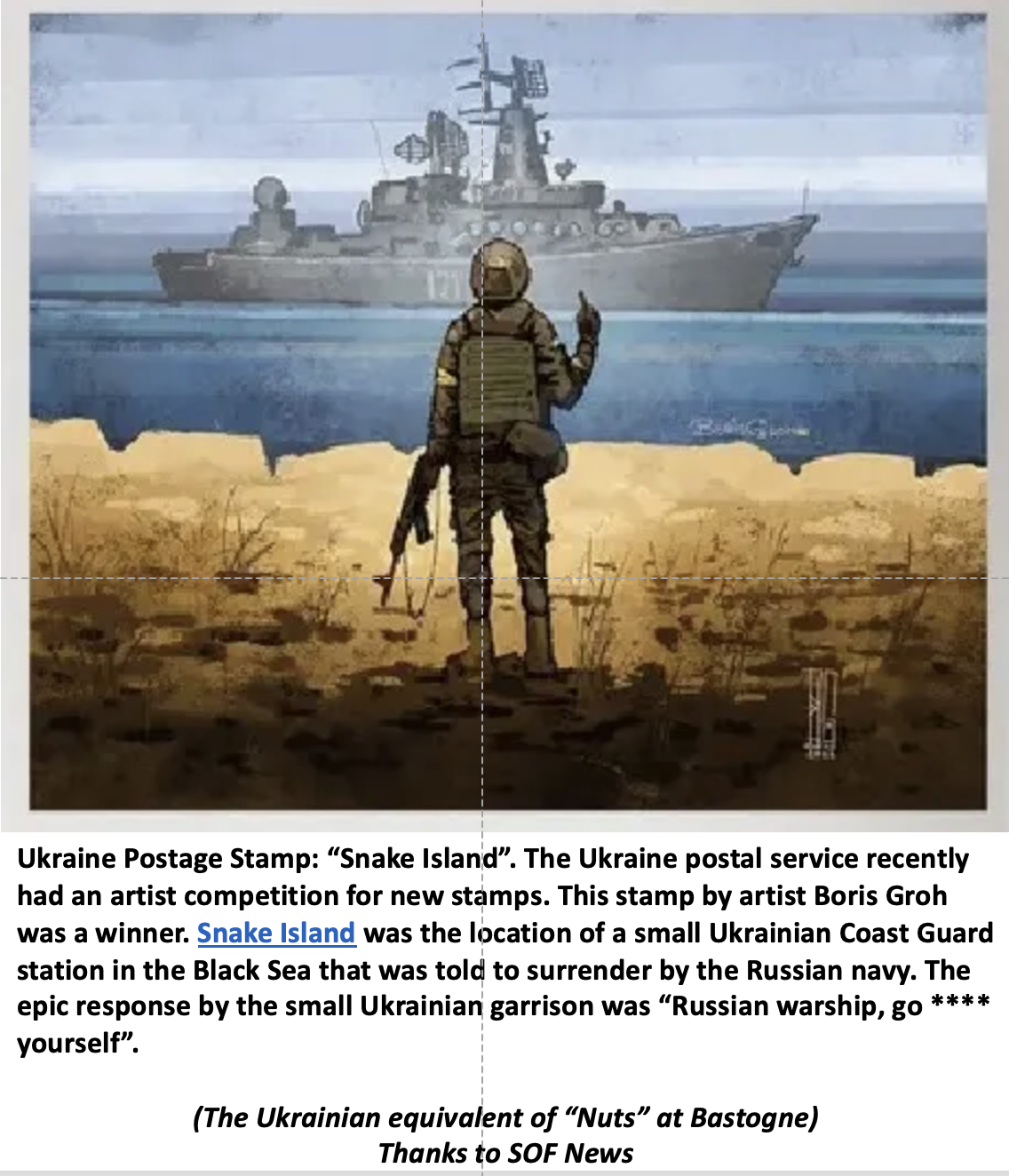
Photo: Ukraine Postage Stamp: “Snake Island”. The Ukraine postal service recently had an artist competition for new stamps. This stamp by artist Boris Groh was a winner. Snake Island was the location of a small Ukrainian Coast Guard station in the Black Sea that was told to surrender by the Russian navy. The epic response by the small Ukrainian garrison was “Russian warship, go **** yourself”.
2. RUSSIAN OFFENSIVE CAMPAIGN ASSESSMENT, MARCH 13
RUSSIAN OFFENSIVE CAMPAIGN ASSESSMENT, MARCH 13
Mason Clark, George Barros, and Kateryna Stepanenko
March 13, 4:00 pm EST
Russian forces again conducted few ground offensives on March 13, only securing new terrain in Donetsk and Luhansk Oblasts. The Ukrainian General Staff reported that Russian forces predominantly took measures to restore combat readiness and regrouped combat units as of noon local time on March 13.[1] Russian forces continue to assemble reinforcements and attempt to improve logistical support in both the Kyiv and southern operational directions. Russian forces may intend to resume larger-scale attacks on both axes of advance in the coming week, but will likely take longer to (or may never) cohere the combat power necessary to complete the encirclement of Kyiv.
Key Takeaways
- Russian forces did not conduct offensive operations northwest of Kyiv for the third day in a row.
- Russian forces did not conduct attacks toward northeastern Kyiv and prioritized reinforcing their lines of communication and logistics routes.
- Russian and proxy forces successfully captured several towns north of Mariupol in Donetsk Oblast on March 13, the only offensive ground actions of the day.
- Ukrainian protests in occupied Kherson are likely expanding.
- Russia is diluting its international deployments in Armenia and Nagorno-Karabakh to reinforce operations in Ukraine and pulling additional forces from Russia’s far east.
- Ukrainian intelligence reported Russia will deploy preexisting pro-Assad Syrian units to Ukraine, in addition to previously announced plans to recruit new Syrian and Libyan mercenaries. These forces are unlikely to enable Russia to favorably change the balance of forces around Kyiv in the next week but may provide a longer-term pool of low-quality replacements.
- Russian ballistic missiles killed 35 Ukrainians at the Yavoriv military training center near Poland in a likely effort to interdict Western aid deliveries to Ukraine—following up on the Kremlin’s March 12 announcement it will treat international aid shipments as military targets.
Russia is increasingly pulling forces from its international deployments to reinforce operations in Ukraine, though these deployments are unlikely to shift the balance of forces in the coming week. The Ukrainian General Staff reported on March 13 that 800 personnel from Russia’s 102nd Base in Armenia deployed to an unknown location in Russia on March 9-10 in preparation to deploy to Ukraine.[2] They also reported that Russia is recalling elements of its peacekeeping deployment in Nagorno-Karabakh to replenish losses in Ukraine.[3] Russia will likely draw further forces from its international deployments in Armenia, Tajikistan, and Syria to replace losses in Ukraine. The Ukrainian General Staff separately reported that Russia plans to deploy 1,500 troops from Russia’s 40th Naval Infantry Brigade (of the Pacific Fleet) to Belarus via rail at an unspecified time.[4]
Ukrainian intelligence provided further details on Russia’s initiative to deploy existing pro-Assad units to Ukraine and recruit additional Syrian and Libyan mercenaries on March 13. Ukraine’s Military Intelligence Directorate (GUR) reported that Russia is recruiting mercenaries from Syria and Libya and will pay them around $300-$600 monthly.[5] Russia reportedly opened 14 recruitment centers in Syria and will transport mercenaries to the Chkalovsky airbase in Moscow Oblast after they receive training. The GUR reported that Russia has already gathered “thousands” of Syrian troops, mainly those specialized in heavy artillery and sniper weapons, from the National Defense Forces and 5th Corps—two Russian-backed pro-Assad units. Russia can likely redeploy its established Syrian proxy forces in the National Defense Militia and 5th Corps on relatively short notice, dependent on its airlift capacity. However, even hurriedly trained Syrian and Libyan mercenaries will likely take weeks or months to deploy to Ukraine and will likely be of lower quality than the already poor Russian forces in Ukraine. Russia is unlikely to successfully mobilize the reinforcements and replacements necessary to favorably change the balance of forces around Kyiv in the next week but may successfully generate a longer-term pool of low-quality replacements.
The Kremlin may be seeking to take direct control of Belarusian units to deploy them in Ukraine but faces Belarusian resistance. Independent Ukrainian media reported on March 13 that Russian commanders are taking control of Belarusian units to suppress Belarusian soldiers’ efforts to resist going to war in Ukraine and reported “riots” in some Brest-based units.[6] ISW cannot independently confirm these reports through other sources at this time; if confirmed, the reports support ISW’s previous assessment that the Kremlin seeks to bring Belarus into the war but faces resistance from both Belarusian soldiers and Belarusian President Lukashenko. The Ukrainian General Staff additionally reported that Russian forces established a base for repairing and restoring military equipment in Kulichikha, Belarus, (17 km from the border) on March 13.[7]
Russian ballistic missiles struck the Yavoriv military training center, northwest of Lviv, and less than 10 kilometers from the Polish border, and killed at least 35 Ukrainian personnel on March 13.[8] The United States and NATO conduct the majority of their joint training with Ukrainian forces at Yavoriv, and Ukraine is likely using Yavoriv as a primary staging ground for military aid deliveries through Poland. The Kremlin announced on March 12 that it will treat Western aid deliveries to Ukraine as legitimate military targets and will likely conduct further strikes on western Ukraine in the coming week to interdict Ukrainian supplies.[9] Russian forces are increasingly using unmanned aerial vehicles (UAVs) in Ukraine, including an armed Forpost-R UCAV on March 13.[10] The Ukrainian air force and air defenses remain active, however, and claimed to shoot down two Ka-52s helicopters, one Su-34 fighter bomber, an unidentified Sukhoi jet, and two drones on March 13.[11]
Russian forces are engaged in four primary efforts at this time:
- Main effort—Kyiv (comprised of three subordinate supporting efforts);
- Supporting effort 1—Kharkiv;
- Supporting effort 1a—Luhansk Oblast;
- Supporting effort 2—Mariupol and Donetsk Oblast; and
- Supporting effort 3—Kherson and advances westward.
Main effort—Kyiv axis: Russian operations on the Kyiv axis are aimed at encircling the city from the northwest, west, and east.
Russian forces did not conduct offensive operations northwest of Kyiv in the past 24 hours for the third day in a row. The Ukrainian General Staff reported that Russian forces prioritized reconnoitering Ukrainian positions in preparation for resuming attacks on Kyiv.
Subordinate main effort along the west bank of the Dnipro
Russian forces did not conduct offensive operations northwest of Kyiv for the third day in a row.[12] The Ukrainian General Staff specified that Russian forces concentrated on reconnaissance and “clarifying Ukrainian positions” northwest of Kyiv, the first time the Ukrainian General Staff has specified reconnaissance as a Russian daily focus.[13] Fighting continued in Irpin, a western Kyiv suburb, and Russian forces killed American journalist Brent Renaud in the town on March 13.[14]
Subordinate supporting effort—Chernihiv and Sumy axis
The Ukrainian General Staff reported that Russian forces northeast of Kyiv “moved to the defense” in the last 24 hours and focused on replenishing supplies and conducting reconnaissance.[15] The General Staff reported that Russia deployed forward additional units from the Central Military District. Russian forces likely intend to reinforce their exposed line of communication in northeastern Ukraine against counterattacks prior to resuming offensive operations toward northeastern Kyiv.
Supporting Effort #1—Kharkiv:
Russian forces launched an unsuccessful attack on Izyum, southeast of Kharkiv, on March 13.[16] Russian forces likely seek to bypass Kharkiv from the southeast and advance towards Dnipro and Zaporizhia but are unlikely to make substantial advances without committing further combat power. The Ukrainian General Staff additionally reported at noon local time on March 13 that a BTG of the 6th Combined Arms Army withdrew to Belgorod to restore combat capability after fighting in the Kharkiv city area.[17]
Supporting Effort #1a—Luhansk Oblast:
The Ukrainian General Staff reported that Russian forces are gathering reserves in Luhansk Oblast for a renewed offensive on Severodonetsk.[18] The Russian Ministry of Defense claimed that Russian forces captured the eastern and southern outskirts of Severodonetsk on March 13.[19]
Supporting Effort #2—Mariupol and Donetsk Oblast:
Russian and proxy forces launched several successful assaults north of Mariupol in Donetsk Oblast on March 13.[20] The Ukrainian General Staff confirmed that Russian forces captured Staromlynivka, Yevhenivka, Pavlivka, and Yegorivka as of noon local time on March 13. Ukrainian forces repulsed Russian attacks on Volnovakha.[21] The Russian MoD claimed its forces advanced 14km on March 12.[22] Russian forces additionally heavily shelled civilian infrastructure in Donetsk Oblast on March 12-13.[23]
Russian forces continued sporadic assaults on Mariupol on March 13. Ukrainian forces claimed to kill 15 Russian servicemen and stated Ukrainian forces remain in high spirits despite poor communications.[24] Russian forces are unlikely to seize Mariupol through a direct assault without a greater concentration of forces (which they remain unlikely to have the ability to assemble). Russia will likely continue to shell the city and maintain gradual ground assaults to force the city to capitulate.
Supporting Effort #3—Kherson and west:
Russian forces did not conduct any offensive actions toward Mykolayiv or Zaporizhia on March 13.[25] The Ukrainian General Staff reported that Russian forces are gathering reserves, including additional VDV (Airborne) forces, south of Zaporizhia for a likely offensive toward the city but did not conduct any attacks on March 13.[26] Russian forces may intend to advance to encircle Zaporizhia but are unlikely to have the forces necessary to do so while Russian forces in the south remain committed to the encirclement of Mariupol.
Ukrainian protests in occupied Kherson are likely expanding. The Ukrainian General Staff reported Russian troops fired in response to a large protest (reported by independent Ukrainian media to be in the low thousands) in Kherson on March 13 but did not report any casualties.[27] Ukrainian residents also protested in occupied Berdyansk and Melitopol on March 13.[28] Kherson Mayor Igor Kolikhayev announced that he rejected a Russian attempt to force Kherson residents to pass a referendum announcing a ”Kherson People’s Republic.”[29] If confirmed, this Russian effort may indicate a possible Russian approach to governing occupied Ukraine—dividing it up into several separate proxy ”People’s Republics” modeled on the Donetsk and Luhansk People’s Republics.
Immediate items to watch
- The Kremlin likely seeks to pressure Belarus to join the war in Ukraine and will deploy Syrian fighters to Ukraine in the near future;
- Ukrainian counterattacks and operations by Territorial Defense Forces in northeastern Ukraine threaten Russia’s exposed line of communicating, requiring Russia to redeploy forces away from the offensive toward eastern Kyiv;
- Russian forces are undertaking another operational pause to prepare for renewed efforts to encircle Kyiv from east and west and/or to seize the city center itself following their failures of March 8-9;
- Russian troops may drive on Zaporizhia City itself within the next 48-72 hours, likely attempting to block it on both banks of the Dnipro River and set conditions for subsequent operations after Russian forces take Mariupol, which they are currently besieging.
3. China Sees at Least One Winner Emerging From Ukraine War: China
Unless it is seen as complicit in its aid to Russia.
The GEC and the PSYOP professionals have their work cut out for them to shape the narrative of Chinese complicity.
China Sees at Least One Winner Emerging From Ukraine War: China
Steven Lee Myers and Chris Buckley
March 14, 2022, 5:00 a.m. ET
The country’s leaders think it can shield itself from economic and diplomatic fallout and eventually be seen as a pillar of stability.
The Great Hall of the People in Beijing. China’s leaders have calculated that they can benefit from geopolitical shifts brought about by the war in Ukraine.
March 14, 2022, 5:00 a.m. ET
The war in Ukraine is far from over, but a consensus is forming in Chinese policy circles that one country stands to emerge victorious from the turmoil: China.
After a confused initial response to Russia’s invasion, China has laid the building blocks of a strategy to shield itself from the worst economic and diplomatic consequences it could face, and to benefit from geopolitical shifts once the smoke clears.
China’s leader, Xi Jinping, has avoided criticizing President Vladimir V. Putin of Russia, but he has also tried to distance China from the carnage. His government has denounced the international sanctions imposed on Russia but, so far at least, has hinted that Chinese companies may comply with them, to protect China’s economic interests in the West.
Mr. Xi reached out to European leaders last week with vague offers of assistance in negotiating a settlement, even as other Chinese officials amplified Russian disinformation campaigns meant to discredit the United States and NATO. Officials in Washington claimed, without providing evidence, that after the invasion Russia asked China for economic and military assistance, which a Chinese official denounced on Monday as disinformation.
In the end, China’s leadership has calculated that it must try to rise above what it considers a struggle between two tired powers and be seen as a pillar of stability in an increasingly turbulent world.
“This means that as long as we don’t commit terminal strategic blunders, China’s modernization will not be cut short, and on the contrary, China will have even greater ability and will to play a more important role in building a new international order,” Zheng Yongnian, a professor at the Chinese University of Hong Kong, Shenzhen, who has advised senior officials, wrote after the invasion in a widely circulated article.
At the heart of China’s strategy lies a conviction that the United States is weakened from reckless foreign adventures, including, from Beijing’s perspective, goading Mr. Putin into the Ukraine conflict.
In this view, which in recent days has been echoed in public statements and quasi-official analyses, Russia’s invasion has dragged American power and attention toward Europe, making it likely that President Biden, like his recent predecessors, will try but fail to put more focus on China and the broader Asia-Pacific region.
China’s leader, Xi Jinping, has avoided criticizing President Vladimir V. Putin over the war but has tried to distance China from the carnage.
“All the difficulties and all the balancing and all the embarrassment that we’re talking about, those are short-term,” said Yun Sun, the director of the China Program at the Stimson Center in Washington, who has studied Beijing’s actions in the lead-up to the war. “In the long run, Russia is going to be the pariah of the international community, and Russia will have no one to turn to but China.”
China’s path ahead is by no means certain. Drawing too close to Russia would risk entrenching animosity toward China in Europe and beyond, a possibility that worries Mr. Xi’s government, for all its bluster.
And if Germany, France and other allies build up their defenses as promised, the United States could ultimately be freed up to shift more of its military resources toward countering China. Mr. Biden has vowed to rally an “alliance of democracies,” while American military leaders say they will not let Ukraine distract them from China.
“We also feel very, very anxious because the Russia-Ukraine war will force Europe to lean to the U.S., and then China will be dragged deeper into a dilemma,” said Zhu Feng, a professor of international relations at Nanjing University. The United States’ allies in the Pacific, including Japan and Australia, “will also adopt a stronger military posture. So it all seems unfriendly to China.”
China’s initial stumbles after Russia’s invasion have also raised concern about Mr. Xi’s ability to navigate the war’s aftershocks.
He has repeatedly warned Chinese officials that the world is entering an era of upheaval “the likes of which have not been seen for a century.” Yet those officials seemed ill-prepared for the upheaval of Mr. Putin’s assault on Ukraine.
Up to the day of the invasion, they scoffed at warnings that Russia was poised for war, instead accusing the United States of stoking tensions. Since then, they have struggled to reconcile sympathy for Mr. Putin’s security grievances with their often-stated reverence for the principle of national sovereignty, including Ukraine’s.
Mr. Xi, in a video conference with President Emmanuel Macron of France and Chancellor Olaf Sholz of Germany, lamented “the rekindling of the flames of war” in Europe. Yet his diplomats have fanned the flames of Russian disinformation, accusing the United States of developing biological weapons in Ukraine.
In a video conference with President Emmanuel Macron of France, lower left, and Chancellor Olaf Scholz of Germany, Mr. Xi decried “the rekindling of the flames of war” in Europe.Credit...Li Xiang/Xinhua, via Associated Press
“This is just not good for China’s international reputation,” said Bobo Lo, an expert on China-Russia ties at the French Institute of International Relations. “It’s not just China’s reputation in the West; I think it also affects China’s reputation in the non-West, because it’s essentially associating itself with an imperial power.”
China could also face economic disruptions from the war and the Western efforts to punish Russia by restricting trade and cutting off its financial institutions. Chinese officials have denounced such measures, and while the United States and its allies have shown remarkable unity in imposing them, other countries share Beijing’s reservations about using powerful economic tools as weapons.
In any case, China’s economy is large enough to absorb blows that would cripple others. Chinese companies may even end up well positioned to take advantage of Russia’s desperate need for trade, as happened when Moscow faced sanctions over the annexation of Crimea in 2014.
China’s strategy reflects a hardening of views toward the United States since Mr. Biden came to office in 2021 — in large part, because officials had hoped for some easing after the chaotic and confrontational policies of President Donald J. Trump.
Russia-Ukraine War: Key Things to Know
Card 1 of 3
Expanding the war. Russia launched a barrage of airstrikes at a Ukrainian military base near the Polish border, killing at least 35 people. Western officials said the attack at NATO’s doorstep was not merely a geographic expansion of the invasion but a shift in Russian tactics.
American journalist killed. Brent Renaud, an award-winning American filmmaker and journalist who drew attention to human suffering, was fatally shot while reporting in a suburb of Kyiv. Mr. Renaud, 50, had contributed to The New York Times in previous years, most recently in 2015.
“In its China strategy, the Biden administration’s policy continuities with the Trump administration are clearly bigger than any differences,” Yuan Peng, president of the China Institutes of Contemporary International Relations in Beijing, wrote late last year. “Biden has repeatedly avowed that the United States is not in a ‘new Cold War’ with China, but China often feels the chill creeping in everywhere.”
Whatever happens in the war, China sees its deepening ties to Russia as a way to cultivate a counterweight to the United States. The partnership that Mr. Xi and Mr. Putin celebrated last month at the Winter Olympics in Beijing has become too important to sacrifice, whatever misgivings some officials have about the war.
Defense Minister Wei Fenghe saluted Mr. Xi in the Great Hall of the People earlier this month.Credit...Sam Mcneil/Associated Press
Arguing that the era of American dominance after the Soviet Union’s collapse in 1991 was a historical anomaly, both Mr. Xi and Mr. Putin have embraced geopolitical doctrines that call for their countries to reclaim their status as great powers.
Just as Mr. Putin depicts the United States as menacing Russia on its western frontier, Mr. Xi sees American support for Taiwan, the self-governing island democracy that Beijing claims as its own, as a similar threat off China’s coast.
In recent weeks, Chinese analysts have repeatedly cited the century-old writings of a British geographer, Sir Halford John Mackinder. Whoever controls Central Europe controls the vast landmass stretching from Europe to Asia, he argued. Whoever controls Eurasia can dominate the world.
A modern Russian proponent of such thinking, Aleksandr G. Dugin, has written extensively on what he sees as a growing clash between the liberal, decadent West and a conservative Eurasian continent with Russia as its soul.
Mr. Dugin, sometimes called “Putin’s philosopher,” has built a following in China, appearing in state media and visiting Beijing in 2018 to deliver a series of lectures. His host on that occasion was Zhang Weiwei, a propagandist-academic who has won Mr. Xi’s favor and who last year gave a lecture to the Politburo, a council of 25 top party officials.
“The West should not have become a hegemon in defining universal standards because the West or Europe, or the West in general is only part of humanity,” Mr. Dugin told a Chinese state television interviewer in 2019. “And the other part, a majority of human beings, live outside the West, in Asia.”
President Tsai Ing-wen of Taiwan meeting last year with Michael Mullen, a former chairman of the United States Joint Chiefs of Staff. Mr. Xi sees American support for Taiwan as a threat.
Such aversion to international standards for political or human rights, supposedly dictated by the West, has become a recurrent theme in Chinese criticism of the United States. It was the subject of a government position paper in December, intended to counter virtual summit of democratic countries held by Mr. Biden, and of a long statement that Mr. Putin and Mr. Xi issued when they met in Beijing last month.
As it turns to Beijing for support against Western sanctions, Russia will become increasingly beholden to China as its diplomatic and economic lifeline, while serving as its strategic geopolitical ballast, analysts say.
“The old order is swiftly disintegrating, and strongman politics is again ascendant among the world’s great powers,” wrote Mr. Zheng of the Chinese University of Hong Kong, Shenzhen. “Countries are brimming with ambition, like tigers eyeing their prey, keen to find every opportunity among the ruins of the old order.”
4. US view of Putin: Angry, frustrated, likely to escalate war
"Do not interfere with an army that is returning home. When you surround an army, leave an outlet free. Do not press a desperate foe too hard."
-Sun Tzu
Does an angry frustrated leader seek an off-ramp?
US view of Putin: Angry, frustrated, likely to escalate war
AP · by NOMAAN MERCHANT · March 14, 2022
WASHINGTON (AP) — More than two weeks into a war he expected to dominate in two days, Vladimir Putin is projecting anger, frustration at his military’s failures and a willingness to cause even more violence and destruction in Ukraine, in the assessment of U.S. intelligence officials.
Officials in recent days have publicly said they’re worried the Russian president will escalate the conflict to try to break Ukraine’s resistance. Russia still holds overwhelming military advantages and can bombard the country for weeks more. And while the rest of the world reacts to horrific images of the war he started, Putin remains insulated from domestic pressure by what CIA Director William Burns called a “propaganda bubble.”
ADVERTISEMENT
Putin’s mindset — as tough as it is to determine from afar — is critical for the West to understand as it provides more military aid to Ukraine and also prevent Putin from directly taking on NATO countries or possibly reaching for the nuclear button. Intelligence officials over two days of testimony before Congress last week openly voiced concerns about what Putin might do. And those concerns increasingly shape discussions about what U.S. policymakers are willing to do for Ukraine.
Over two decades, Putin has achieved total dominance of Russia’s government and security services, ruling with a tiny inner circle, marginalizing dissent, and jailing or killing his opposition. He has long criticized the breakup of the Soviet Union, dismissed Ukraine’s claims to sovereignty, and mused about nuclear war ending with Russians as “martyrs.” Burns told lawmakers that he believed Putin was “stewing in a combustible combination of grievance and ambition for many years.”
Putin had expected to seize Kyiv in two days, Burns said. Instead, his military has failed to take control of major cities and lost several thousand soldiers already. The West has imposed sanctions and other measures that have crippled the Russian economy and diminished living standards for oligarchs and ordinary citizens alike. Much of the foreign currency Russia had accumulated as a bulwark against sanctions is now frozen in banks abroad.
Burns is a former U.S. ambassador to Moscow who has met with Putin many times. He told lawmakers in response to a question about the Russian president’s mental state that he did not believe Putin was crazy.
ADVERTISEMENT
“I think Putin is angry and frustrated right now,” he said. “He’s likely to double down and try to grind down the Ukrainian military with no regard for civilian casualties.”
Russia’s recent unsupported claims that the U.S. is helping Ukraine develop chemical or biological weapons suggest that Putin may himself be prepared to deploy those weapons in a “false flag” operation, Burns said.
There’s no apparent path to ending the war. It is nearly inconceivable that Ukrainian President Volodymyr Zelenskyy, who has won admiration around the world for leading his country’s resistance, would suddenly recognize Russia’s annexation of Crimea or support granting new autonomy to Russian-friendly parts of eastern Ukraine. And even if he captures Kyiv and deposes Zelenskyy, Putin would have to account for an insurgency supported by the West in a country of more than 40 million.
“He has no sustainable political end-game in the face of what is going to continue to be fierce resistance from Ukrainians,” Burns said.
Avril Haines, President Joe Biden’s director of national intelligence, said Putin “perceives this as a war he cannot afford to lose. But what he might be willing to accept as a victory may change over time given the significant costs he is incurring.”
Intelligence analysts think Putin’s recent raising of Russia’s nuclear alert level was “probably intended to deter the West from providing additional support to Ukraine,” she said.
The White House’s concern about escalation has at times frustrated both Democrats and Republicans. After initially signaling support, the Biden administration declined in recent days to support a Polish plan to donate Soviet-era warplanes to Ukraine that would have required the U.S. to participate in the transfer. The administration previously delayed sanctions on the Nord Stream 2 pipeline and would not send Stinger air-defense missiles to Ukraine before changing course.
Questioned on Thursday, Haines said Putin might see the plane transfer as a bigger deal than the anti-tank and anti-aircraft weapons already going to Ukraine. Haines did not disclose whether the U.S. had intelligence to support that finding.
U.S. Rep. Mike Quigley, an Illinois Democrat who sits on the House Intelligence Committee, said the Biden administration had been “always a step or two late” out of fear of triggering Putin. He urged the White House to agree quickly to the transfer of planes.
“I think it comes off as quibbling,” Quigley said. “If anyone thinks that Putin is going to distinguish and differentiate — ‘Oh, well, they’re taking off from Poland’ — he sees all of this as escalatory.”
Meanwhile, as the violence worsens and more Russians die, the West is also watching for any sign of holes forming in Putin’s “propaganda bubble.” One independent Russian political analyst, Kirill Rogov, posted on his Telegram account that the war is “lost” and an “epic failure.”
“The mistake was the notion that the West was unwilling to resist aggression, that it was lethargic, greedy and divided,” Rogov wrote. “The idea that the Russian economy is self-sufficient and secure was a mistake. The mistake was the idea of the quality of the Russian army. And the main mistake was the idea that Ukraine is a failed state, and Ukrainians are not a nation.
“Four mistakes in making one decision is a lot,” he said.
Before the invasion, polling conducted by the Levada Center, Russia’s top independent opinion research firm, found that 60% of respondents consider the U.S. and NATO the “initiators” of conflict in eastern Ukraine. Just 3% answered Russia. The polling was in January and February, and the Levada Center has not published new polling since the war began.
Outsiders hope ordinary Russians will respond to the sharp decline in their living standards and find honest portrayals of the war through relatives and online, including by using VPN software to bypass Kremlin blocks on social media. Russian state television continues to air false or unsupported allegations about the U.S. and Ukrainian governments and push a narrative that Russia can’t afford to lose the war.
“Otherwise, it will lead to the death of Russia itself,” said Vladimir Solovyov, host of a prime-time talk show on state TV channel Russia 1, on his daily radio show last week.
___
Associated Press writer Lynn Berry contributed to this report.
AP · by NOMAAN MERCHANT · March 14, 2022
5. Ukraine’s Fight Is About Europe’s Future
Excerpts:
Make no mistake: Had Ukraine failed to resist and the state imploded in a couple of days as Putin had expected, Europe would eventually go back to business-as-usual with Russia, with the chattering class repeating old cliches about how Russia is actually entitled to its “security zone,” and how we should have worked from the start to ensure the “neutrality” of Ukraine.
EU leaders would go back to talking about climate policy and green energy, and Putin would continue to make money selling Russia’s gas and oil to Europe, with a large chunk of the revenue plowed into his military.
Today, thanks to the courage of the Ukrainian people, that is simply no longer possible.
This war is still in its early stages, but it should be clear to us all that it is a war for the future of Europe, and that there is no going back to the status quo ante. Putin’s unprovoked attack on Ukraine has set in motion forces that will deconstruct the power dynamic in Eurasia that for three centuries has pushed Europe from one conflict to the next. The end-point of this war has to be not only the preservation of Ukraine’s independence but also the restoration of an independent Belarusian state.
Only then will Europe free itself from the last vestiges of Russia’s imperial baggage. Only then will the Russian people have a chance to start transforming their country into a genuine nation-state, stripped of its imperial ambition and poised to undergo real political and economic reform.
Ukraine’s Fight Is About Europe’s Future
The unprovoked Russian invasion of Ukraine will go down in history as colonialism masquerading as a grand geopolitical design.
We are witnessing another manifestation of Russian imperialism pure and simple, notwithstanding many learned explanations by so-called “realists” that somehow the prospect of Ukraine’s membership in NATO, at best at some distant point in the future, provoked Putin to attack.
In reality, this invasion has been in the works for over twenty years of Putin’s rule. In the last several months Russia amassed military forces in full view, clearly determined to invade its neighbor. Putin seemed to have believed that he would get away with it once again, for in the past the West – regardless of our insistence on the sanctity of borders and human rights – stood idly by while the tzar of the Kremlin massacred the Chechens, severed parts of Georgia’s territory, occupied Crimea, started a war in Donetsk and Luhansk, entered Syria and slaughtered the inhabitants of Aleppo.
Today, as Putin’s military is dropping bombs and missiles on Ukrainian cities, killing civilians and creating landscapes more reminiscent of World War II that “post-modern Europe,” the West is finally waking up to the reality that unless and until Russia has been decisively defeated, Europe will not know real peace, only periods of armistice.
Ukraine’s stubborn resistance to the invasion is changing Europe in yet another way. It is reminding us about the seminal importance of patriotism and a shared national identity, one that is felt viscerally and is strong enough to make men and women lay their lives on the line for people they have never met.
No sentence has encapsulated this sense of patriotism and mutuality of obligation better than President Zelensky’s rebuff of an offer to exfil him from Kyiv: “I don’t need a ride; I need ammunition.”
In this one sentence lies the essence of a nation that understands what it means to be one. The Ukrainians are teaching us what those first principles truly are, i.e., love of country, national sovereignty, and national solidarity – the three concepts that have been all but exiled from Western political discourse. In this one tragic moment of Ukraine standing up to Putin, the entire baggage of post-modern Western theorizing about “globalization,” “transnationalism,” or “postmodernism” is being exposed for what it has always been: intellectual vapors disconnected from reality.
This war has also shifted the relative political influence among NATO members from Western to Central Europe. For two decades many in Central Europe, whether Estonians, Poles, or Romanians, have been warning the West about Putin, and in turn were often treated by their Western counterparts with condescension as unreconstructed “Russophobes.” And yet, they have understood very well what kind of a state today’s Russia really is.
It is uncanny that for Europe to come together it took one of its poorest nations to show its determination to stand up for the first principles and the values we all talk so much about, but all too often fail to uphold. Ukraine’s president, whom many used to dismiss as an upstart comedian, is showing us each day the true meaning of leadership.
Make no mistake: Had Ukraine failed to resist and the state imploded in a couple of days as Putin had expected, Europe would eventually go back to business-as-usual with Russia, with the chattering class repeating old cliches about how Russia is actually entitled to its “security zone,” and how we should have worked from the start to ensure the “neutrality” of Ukraine.
EU leaders would go back to talking about climate policy and green energy, and Putin would continue to make money selling Russia’s gas and oil to Europe, with a large chunk of the revenue plowed into his military.
Today, thanks to the courage of the Ukrainian people, that is simply no longer possible.
This war is still in its early stages, but it should be clear to us all that it is a war for the future of Europe, and that there is no going back to the status quo ante. Putin’s unprovoked attack on Ukraine has set in motion forces that will deconstruct the power dynamic in Eurasia that for three centuries has pushed Europe from one conflict to the next. The end-point of this war has to be not only the preservation of Ukraine’s independence but also the restoration of an independent Belarusian state.
Only then will Europe free itself from the last vestiges of Russia’s imperial baggage. Only then will the Russian people have a chance to start transforming their country into a genuine nation-state, stripped of its imperial ambition and poised to undergo real political and economic reform.
A 1945 Contributing Editor, Dr. Andrew A. Michta is Dean of the College of International and Security Studies at the George C. Marshall European Center for Security Studies in Garmisch, Germany. He is also former a Professor of National Security Affairs at USNWC and a former Senior Fellow at the Center for European Policy Analysis in DC. The opinions expressed here are those of the author and do not reflect the official policy or position of the George C. Marshall European Center for Security Studies, the U.S. Department of Defense, or the U.S. government.
6. Possible Outcomes of the Russo-Ukrainian War and China's Choice
Very interesting analysis from a Chinese scholar who surely must be connected to the government/party.
Possible Outcomes of the Russo-Ukrainian War and China's Choice - U.S.-China Perception Monitor
uscnpm.org · by US-China Perception Monitor · March 12, 2022
Update on March 13, 2022: The following article was submitted by the author to the Chinese-language edition of the US-China Perception Monitor. The article was not commissioned by the US-China Perception Monitor, nor is the author affiliated with the Carter Center or the US-China Perception Monitor.
Hu Wei is the vice-chairman of the Public Policy Research Center of the Counselor’s Office of the State Council, the chairman of Shanghai Public Policy Research Association, the chairman of the Academic Committee of the Chahar Institute, a professor, and a doctoral supervisor. To read more by Hu, click here to read his article on “How did Deng Xiaoping coordinate domestic and international affairs?”
Written on March 5, 2022. Translated by Jiaqi Liu on March 12, 2022.
English
The Russo-Ukrainian War is the most severe geopolitical conflict since World War II and will result in far greater global consequences than September 11 attacks. At this critical moment, China needs to accurately analyze and assess the direction of the war and its potential impact on the international landscape. At the same time, in order to strive for a relatively favorable external environment, China needs to respond flexibly and make strategic choices that conform to its long-term interests.
Russia’s ‘special military operation’ against Ukraine has caused great controvsery in China, with its supporters and opponents being divided into two implacably opposing sides. This article does not represent any party and, for the judgment and reference of the highest decision-making level in China, this article conducts an objective analysis on the possible war consequences along with their corresponding countermeasure options.
I. Predicting the Future of the Russo-Ukrainian War
1. Vladimir Putin may be unable to achieve his expected goals, which puts Russia in a tight spot. The purpose of Putin’s attack was to completely solve the Ukrainian problem and divert attention from Russia’s domestic crisis by defeating Ukraine with a blitzkrieg, replacing its leadership, and cultivating a pro-Russian government. However, the blitzkrieg failed, and Russia is unable to support a protracted war and its associated high costs. Launching a nuclear war would put Russia on the opposite side of the whole world and is therefore unwinnable. The situations both at home and abroad are also increasingly unfavorable. Even if the Russian army were to occupy Ukraine’s capital Kyiv and set up a puppet government at a high cost, this would not mean final victory. At this point, Putin’s best option is to end the war decently through peace talks, which requires Ukraine to make substantial concessions. However, what is not attainable on the battlefield is also difficult to obtain at the negotiating table. In any case, this military action constitutes an irreversible mistake.
2. The conflict may escalate further, and the West’s eventual involvement in the war cannot be ruled out. While the escalation of the war would be costly, there is a high probability that Putin will not give up easily given his character and power. The Russo-Ukrainian war may escalate beyond the scope and region of Ukraine, and may even include the possibility of a nuclear strike. Once this happens, the U.S. and Europe cannot stay aloof from the conflict, thus triggering a world war or even a nuclear war. The result would be a catastrophe for humanity and a showdown between the United States and Russia. This final confrontation, given that Russia’s military power is no match for NATO’s, would be even worse for Putin.
3. Even if Russia manages to seize Ukraine in a desperate gamble, it is still a political hot potato. Russia would thereafter carry a heavy burden and become overwhelmed. Under such circumstances, no matter whether Volodymyr Zelensky is alive or not, Ukraine will most likely set up a government-in-exile to confront Russia in the long term. Russia will be subject both to Western sanctions and rebellion within the territory of Ukraine. The battle lines will be drawn very long. The domestic economy will be unsustainable and will eventually be dragged down. This period will not exceed a few years.
4. The political situation in Russia may change or be disintegrated at the hands of the West. After Putin’s blitzkrieg failed, the hope of Russia’s victory is slim and Western sanctions have reached an unprecedented degree. As people’s livelihoods are severely affected and as anti-war and anti-Putin forces gather, the possibility of a political mutiny in Russia cannot be ruled out. With Russia’s economy on the verge of collapse, it would be difficult for Putin to prop up the perilous situation even without the loss of the Russo-Ukrainian war. If Putin were to be ousted from power due to civil strife, coup d’état, or another reason, Russia would be even less likely to confront the West. It would surely succumb to the West, or even be further dismembered, and Russia’s status as a great power would come to an end.
II. Analysis of the Impact of Russo-Ukrainian war On International Landscape
1. The United States would regain leadership in the Western world, and the West would become more united. At present, public opinion believes that the Ukrainian war signifies a complete collapse of U.S. hegemony, but the war would in fact bring France and Germany, both of which wanted to break away from the U.S., back into the NATO defense framework, destroying Europe’s dream to achieve independent diplomacy and self-defense. Germany would greatly increase its military budget; Switzerland, Sweden, and other countries would abandon their neutrality. With Nord Stream 2 put on hold indefinitely, Europe’s reliance on US natural gas will inevitably increase. The US and Europe would form a closer community of shared future, and American leadership in the Western world will rebound.
2. The “Iron Curtain” would fall again not only from the Baltic Sea to the Black Sea, but also to the final confrontation between the Western-dominated camp and its competitors. The West will draw the line between democracies and authoritarian states, defining the divide with Russia as a struggle between democracy and dictatorship. The new Iron Curtain will no longer be drawn between the two camps of socialism and capitalism, nor will it be confined to the Cold War. It will be a life-and-death battle between those for and against Western democracy. The unity of the Western world under the Iron Curtain will have a siphon effect on other countries: the U.S. Indo-Pacific strategy will be consolidated, and other countries like Japan will stick even closer to the U.S., which will form an unprecedentedly broad democratic united front.
3. The power of the West will grow significantly, NATO will continue to expand, and U.S. influence in the non-Western world will increase. After the Russo-Ukrainian War, no matter how Russia achieves its political transformation, it will greatly weaken the anti-Western forces in the world. The scene after the 1991 Soviet and Eastern upheavals may repeat itself: theories on “the end of ideology” may reappear, the resurgence of the third wave of democratization will lose momentum, and more third world countries will embrace the West. The West will possess more “hegemony” both in terms of military power and in terms of values and institutions, its hard power and soft power will reach new heights.
4. China will become more isolated under the established framework. For the above reasons, if China does not take proactive measures to respond, it will encounter further containment from the US and the West. Once Putin falls, the U.S. will no longer face two strategic competitors but only have to lock China in strategic containment. Europe will further cut itself off from China; Japan will become the anti-China vanguard; South Korea will further fall to the U.S.; Taiwan will join the anti-China chorus, and the rest of the world will have to choose sides under herd mentality. China will not only be militarily encircled by the U.S., NATO, the QUAD, and AUKUS, but also be challenged by Western values and systems.
III. China’s Strategic Choice
1. China cannot be tied to Putin and needs to be cut off as soon as possible. In the sense that an escalation of conflict between Russia and the West helps divert U.S. attention from China, China should rejoice with and even support Putin, but only if Russia does not fall. Being in the same boat with Putin will impact China should he lose power. Unless Putin can secure victory with China’s backing, a prospect which looks bleak at the moment, China does not have the clout to back Russia. The law of international politics says that there are “no eternal allies nor perpetual enemies,” but “our interests are eternal and perpetual.” Under current international circumstances, China can only proceed by safeguarding its own best interests, choosing the lesser of two evils, and unloading the burden of Russia as soon as possible. At present, it is estimated that there is still a window period of one or two weeks before China loses its wiggle room. China must act decisively.
2. China should avoid playing both sides in the same boat, give up being neutral, and choose the mainstream position in the world. At present, China has tried not to offend either side and walked a middle ground in its international statements and choices, including abstaining from the UN Security Council and the UN General Assembly votes. However, this position does not meet Russia’s needs, and it has infuriated Ukraine and its supporters as well as sympathizers, putting China on the wrong side of much of the world. In some cases, apparent neutrality is a sensible choice, but it does not apply to this war, where China has nothing to gain. Given that China has always advocated respect for national sovereignty and territorial integrity, it can avoid further isolation only by standing with the majority of the countries in the world. This position is also conducive to the settlement of the Taiwan issue.
3. China should achieve the greatest possible strategic breakthrough and not be further isolated by the West. Cutting off from Putin and giving up neutrality will help build China’s international image and ease its relations with the U.S. and the West. Though difficult and requiring great wisdom, it is the best option for the future. The view that a geopolitical tussle in Europe triggered by the war in Ukraine will significantly delay the U.S. strategic shift from Europe to the Indo-Pacific region cannot be treated with excessive optimism. There are already voices in the U.S. that Europe is important, but China is more so, and the primary goal of the U.S. is to contain China from becoming the dominant power in the Indo-Pacific region. Under such circumstances, China’s top priority is to make appropriate strategic adjustments accordingly, to change the hostile American attitudes towards China, and to save itself from isolation. The bottom line is to prevent the U.S. and the West from imposing joint sanctions on China.
4. China should prevent the outbreak of world wars and nuclear wars and make irreplaceable contributions to world peace. As Putin has explicitly requested Russia’s strategic deterrent forces to enter a state of special combat readiness, the Russo-Ukrainian war may spiral out of control. A just cause attracts much support; an unjust one finds little. If Russia instigates a world war or even a nuclear war, it will surely risk the world’s turmoil. To demonstrate China’s role as a responsible major power, China not only cannot stand with Putin, but also should take concrete actions to prevent Putin’s possible adventures. China is the only country in the world with this capability, and it must give full play to this unique advantage. Putin’s departure from China’s support will most likely end the war, or at least not dare to escalate the war. As a result, China will surely win widespread international praise for maintaining world peace, which may help China prevent isolation but also find an opportunity to improve its relations with the United States and the West.
中文
uscnpm.org · by US-China Perception Monitor · March 12, 2022
7. Opinion | It’s Time to Offer Russia an Offramp. China Can Help With That.
Is there a compelling reason for China to mediate? Would it have any effect in trying to mediate? What if it provides military aid or economic assistance to Russia (per the reported requests). Would it be an effective mediator if it is providing support to Russia? I wonder if the release of the intelligence by the US about the Russian request for aid from China is meant to undermine this effort and take China out of the picture? Using intelligence to attack the enemy's strategy? How "Sun Tzu" of us.
Excerpts:
The longer the war goes on, though, China may find itself in a position of diminishing returns in its close relationship with Russia. This makes the argument for Beijing to take on an active mediation role even more compelling.
What form could mediation take? Any serious resolution would have to involve the United States and the European Union as key actors in European security arrangements. Beijing could help to broker an immediate cease-fire as a prelude to talks among Russia, Ukraine, the United States, the European Union and China.
Beijing’s goal would be to find a solution that gives Mr. Putin sufficient security assurances that can be presented as a win to his domestic audience while protecting Ukraine’s core sovereignty and NATO’s open-door policy. Finding a landing zone for such an agreement is challenging but not impossible. Some creative diplomacy could solve this, such as a formula for NATO expansion that rules out Ukrainian membership in practice while preserving its sovereignty and NATO principles in theory.
Securing a multilateral resolution to the crisis in Ukraine will be a tough and risky challenge, but there is no country better placed to do so than China.
Opinion | It’s Time to Offer Russia an Offramp. China Can Help With That.
Guest Essay
It’s Time to Offer Russia an Offramp. China Can Help With That.
March 13, 2022, 6:00 a.m. ET
A virtual meeting between President Xi Jinping of China and President Vladimir Putin of Russia being shown on an outdoor monitor in Beijing last year.
By
Dr. Wang is the founder and president of the Center for China and Globalization, a nongovernmental think tank based in Beijing.
Casualties are mounting in Ukraine. Bombs continue to fall. More than 2 million refugees have fled the fighting.
Vladimir Putin seems to have assumed he could get a swift victory, underestimating the fierce resistance from Ukraine. Two weeks in, Russia is intensifying its assault on Ukraine, and Western nations in turn are intensifying their financial and economic punishments against Russia, including by triggering the financial “nuclear option” — banning some Russian banks from the SWIFT payment system. Meanwhile, Mr. Putin has put his actual nuclear forces on high alert.
We are now in an escalatory spiral. Mounting pressure on Mr. Putin will likely make the situation more dangerous as Russia’s leader feels pushed to take increasingly extreme measures — such as what we’ve seen in the past few days with the Russian army’s siege tactics and attacks on civilian areas.
And so, unpalatable as some in the West may find the idea, it is time to offer the Russian leader an offramp with China’s help. On Tuesday, President Xi Jinping of China held a virtual summit with President Emmanuel Macron of France and Chancellor Olaf Scholz of Germany, urging a diplomatic solution.
The United States and its allies might be reluctant to have China play any role in this crisis, given that they view Beijing as a strategic rival. That’s foolish and shortsighted; the conflict’s immediate dangers far outweigh any competitive considerations. Ukraine itself sees the potential of Chinese-led conflict resolution.
China has a significant economic interest in a quick resolution to the Russian-Ukrainian war. China enjoys strong ties with Russia and Ukraine and is both countries’ largest single trading partner, though each trades more with the E.U. bloc than with China. Russia and Ukraine are crucial components of the Belt and Road infrastructure program as well as conduits for China’s trade with Europe. China-Europe rail transports have experienced a hundredfold increase since the beginning of the 2010s, but the ongoing conflict threatens to disrupt these trade flows.
China is also uniquely positioned to act as a neutral mediator between a Western-supported Ukraine and Russia. Yes, Beijing and Moscow have a strong and growing relationship, especially in the economic realm. China’s demand for resources that Russia has in abundance — food and energy — as well as a mutual dissatisfaction with the current state of the U.S.-led world order have increasingly drawn the two countries together. This alliance was cemented when Mr. Putin and Mr. Xi met last month and issued a joint statement underscoring their deep ties and reaffirming a partnership with “no forbidden zones.”
Mr. Xi and Mr. Putin in Moscow during talks in 2019.Credit...Pool photo by Alexander Zemlianichenko
It is not in Beijing’s interests to rely solely on an anti-Western alliance with Moscow. Russia may possess a mighty military, but its economy is in long-term structural decline, with a G.D.P. not much larger than that of Spain. For all the talk of ties with Moscow, it is worth remembering that China’s economic interests with Russia are dwarfed by those it shares with the West. In 2021, trade between China and Russia may have jumped by 36 percent compared to the prior year, to $147 billion — but that’s still less than a tenth of the combined trade with the United States ($657 billion) and European Union ($828 billion).
Even if China isn’t joining in the sanctions, it is possible that Chinese businesses and banks will decrease involvement with Russia to avoid a backlash in other, more important markets. As Russia becomes isolated from the world economy, China will not want to shoulder Russia’s economic burden alone.
The prospect of a growing economic relationship between Moscow and Beijing may be threatening to the West, but from Mr. Putin’s perspective, it provides China with leverage over him in potential negotiations. As he and his country face increasing isolation, he can’t afford to lose China, too.
There are also political reasons China wants this conflict to end in a way that is appealing to all involved. The longer the war lasts, the more it will reinvigorate the Western alliance around the idea of a values-based confrontation between East and West, bringing the United States and the European Union into even closer alignment while driving military budgets up around the globe. That is not good for China, which would prefer to maintain lucrative economic ties with the West and focus its resources on domestic development.
At a time when China faces increasing global criticism for its human rights violations, mediating an end to this conflict could help improve the country’s standing with the West. Beijing has long striven to convince political and business elites in Europe and America that the rise of China does not present a threat. Support for Russian aggression — even perceived support — threatens to undermine that assertion. By contrast, playing a constructive role in ending the war could help cast China as a strategic and not just economic partner.
Ideologically, China has common ground with both Ukraine and Russia. China deeply values the principle of state sovereignty and has long opposed outside interference in what it considers internal affairs such as Taiwan. Last month, Foreign Minister Wang Yi of China once again called for a global respect of territorial integrity, saying, “Ukraine is no exception.” In this way, at least, Mr. Putin’s invasion directly undercuts one of China’s key values.
China — like Russia — is wary of pro-democratic Western influence globally. So far, Chinese media has avoided criticism of Russia and even adopted Moscow’s narrative of the war. The two countries share grievances over perceived Western hostility and hypocrisy. Framing the invasion as anti-West and anti-NATO helps justify Mr. Putin’s action to a domestic audience.
The longer the war goes on, though, China may find itself in a position of diminishing returns in its close relationship with Russia. This makes the argument for Beijing to take on an active mediation role even more compelling.
What form could mediation take? Any serious resolution would have to involve the United States and the European Union as key actors in European security arrangements. Beijing could help to broker an immediate cease-fire as a prelude to talks among Russia, Ukraine, the United States, the European Union and China.
Beijing’s goal would be to find a solution that gives Mr. Putin sufficient security assurances that can be presented as a win to his domestic audience while protecting Ukraine’s core sovereignty and NATO’s open-door policy. Finding a landing zone for such an agreement is challenging but not impossible. Some creative diplomacy could solve this, such as a formula for NATO expansion that rules out Ukrainian membership in practice while preserving its sovereignty and NATO principles in theory.
Securing a multilateral resolution to the crisis in Ukraine will be a tough and risky challenge, but there is no country better placed to do so than China.
Dr. Wang Huiyao (@huiyaowang) is the founder and president of the Center for China and Globalization, a nongovernmental think tank based in Beijing. He advises the Chinese government in that capacity.
8. Russia Asked China for Military and Economic Aid for Ukraine War, U.S. Officials Say
Attacking the enemy's strategy through the release of intelligence. Of course since all warfare is based on deception maybe we do not know of these reports for sure but only assess the requests to be likely to be likely. But attributing them to intelligence adds credibility to them. And it will make China and Russia wonder about leaks inside tier governments and perhaps blame each other and the seeds of distrust. A lot of goodness could come from releasing this kind of intelligence. Perhaps we are playing a superior form of political warfare versus the Chinese Three Warfares and Russia's New Generation Warfare.
Excerpts:
American officials, determined to keep secret their means of collecting the intelligence on Russia’s requests, declined to describe further the kind of military equipment Moscow is seeking. The officials also declined to discuss any reaction by China to the requests.
Russia Asked China for Military and Economic Aid for Ukraine War, U.S. Officials Say
March 13, 2022, 3:52 p.m. ETMarch 13, 2022
March 13, 2022
Jake Sullivan, the U.S. national security adviser, plans to meet with a top Chinese official on Monday in Rome to discuss the war and China’s role.
President Vladimir V. Putin reviewed a military honor guard with President Xi Jinping at the Great Hall of the People in Beijing in 2018.Credit...Pool photo by Greg Baker
March 13, 2022, 3:52 p.m. ET
WASHINGTON — Russia asked China to give it military equipment and support for the war in Ukraine after President Vladimir V. Putin began a full-scale invasion last month, according to U.S. officials.
Russia has also asked China for additional economic assistance, to help counteract the battering its economy has taken from broad sanctions imposed by the United States and European and Asian nations, according to an official.
American officials, determined to keep secret their means of collecting the intelligence on Russia’s requests, declined to describe further the kind of military equipment Moscow is seeking. The officials also declined to discuss any reaction by China to the requests.
President Xi Jinping of China has strengthened a partnership with Mr. Putin and has stood by him as Russia has stepped up its military campaign, destroying cities in Ukraine and killing hundreds or thousands of civilians. American officials are watching China closely to see whether it will act on any requests of aid from Russia. Jake Sullivan, the White House national security adviser, is scheduled to meet on Monday in Rome with Yang Jiechi, a member of the Chinese Communist Party’s elite Politburo and director of the party’s Central Foreign Affairs Commission.
Mr. Sullivan intends to warn Mr. Yang about any future Chinese efforts to bolster Russia in its war or undercut Ukraine, the United States and their partners.
“We are communicating directly, privately to Beijing, that there will absolutely be consequences for large-scale sanctions evasion efforts or support to Russia to backfill them,” Mr. Sullivan said on CNN on Sunday.
“We will not allow that to go forward and allow there to be a lifeline to Russia from these economic sanctions from any country, anywhere in the world,” he said.
Mr. Sullivan did not make any explicit mention of potential military support from China, but other U.S. officials spoke about the request from Russia on the condition of anonymity because of the sensitivity of diplomatic and intelligence matters.
The Biden administration is hoping to convince the Chinese to pressure Mr. Putin to change his course in Ukraine, something many current and former officials believe is unlikely. But some in the administration believe it could be possible to dissuade China from stepping up its assistance to Moscow. Beijing may be content to offer rhetorical support for Moscow, and not want to involve itself further on Russia’s side by providing military equipment to assist in the invasion of Ukraine.
Mr. Sullivan said China “was aware before the invasion took place that Putin was planning something,” but added that Mr. Xi or his aides might not have been aware of the full extent of the Russian leader’s plans. “It’s very possible that Putin lied to them in the same way he lied to Europeans and others,” he said.
9. The ‘No-Fly Zone’ Test
A useful checklist. We also want to make sure if we do have a No-Fly zone will we be able to sustain it for more than decade as we did in Iraq from 1991 through 2003? A no fly zone is a huge demand on airpower and detracts from readiness.
The ‘No-Fly Zone’ Test
Want to put U.S. or allied aircraft over Ukraine? Answer these questions first.
Many are calling for a “no-fly zone” over Ukraine. Few appear to be grappling with the details required to make it an actual policy proposal. If you’re proposing an NFZ, here are some of the questions you need to answer first:
1. What are the historic cases of NFZ success that you seek to emulate?
2. How will your proposal work differently from the failed versions (Iraq, Bosnia, Libya), which didn’t alleviate most of the civilian harm, nor end the fighting, and ultimately led to participation in the ground war itself?
3. What organization will operate your NFZ? If the UN, how will you get past the certain Russian and Chinese veto? If NATO—whose current unity is a clear Russian target—how to handle the alliance division that it would spark, and likely non-unanimity in approving and then implementing it?
4. Does your proposal call for shooting down aircraft, but not suppressing the ground-based Russian radar, surface-to-air missiles, electronic warfare, and command-and-control units and systems that would endanger the aviators who are enforcing it? If you do propose to attack these Russian targets, what do you expect to happen next?
5. What are the zone’s rules of engagement and geographic area? (Note: Simply adding a creative adjective like non-kinetic or limited does not answer this.)
6. How will the NFZ handle Russian aircraft that enter the zone? Shoot first to prevent civilian harm? Or wait for the bombs or missiles to drop, and then respond after the fact?
7. How will the NFZ handle the likely edge cases and deliberate provocations, such as our jets being lit up with targeting radar, making them potentially dead in seconds if they don’t fire first?
8. Most of the Russian aircraft that are striking Ukrainian targets launch their weapons from inside Russian or Belarusan airspace. Will you shoot down those too, or let them operate freely, as long as they fire from just across the border? A similar question applies if your plan includes suppression of Russian air defenses, which can strike at aircraft across the border?
9. The vast, vast, vast majority of Russian military activities that cause civilian harm are not air strikes but missiles, artillery, and especially MLRS rockets. Will your NFZ fly over all that activity with no action? How will you answer the inevitable criticisms about watching civilians die from overhead? If you do attack the overall Russian ground force, what do you expect to happen next?
10. In all past NFZ cases, only one side had airpower. But the Ukrainians still have an operative air force. Notably, its drones are striking Russian forces to valuable effect in the very same areas of the proposed NFZ. As well, Ukrainian civilians are flying hundreds of their own drones to provide reconnaissance to the military, spotting for Russian troops and targets. Will your zone also ban these official and unofficial Ukrainian forces? If so, will you shoot them down if the Ukrainians fly them to defend their cities? If not, will you run escort missions when Russians target them?
I want to aid Ukraine too, but to do so we need policy options that are both implementable and of actual military and political utility. These include rushing resupplies of ammunition, equipment, and all the other supplies in their logistics system that are already running low; more antitank weapons and SAMs, especially of longer-range types that Ukrainian forces are already trained to use; donating easily transferable and deployable counter-UAS systems as Russia increases its use of drones for ISR and strikes; and holding NATO exercises on Russia’s other borders to tie down its forces outside of Ukraine and thus divert potential reinforcements to the invasion.
What doesn’t help embattled Ukraine are bumper-sticker proposals and op-eds that may sound tough but simply wave “jazz hands” over all the actual elements needed to make them real.
10. Here’s who stands to win from high gas prices
The usual suspects. Did you guess them all?
Here’s who stands to win from high gas prices
by: Rachel Frazin, Zack Budryk, The Hill via Nexstar Media Wire
Posted: Mar 13, 2022 / 11:30 AM EDT
Updated: Mar 13, 2022 / 11:30 AM EDT
wrbl.com · by The Hill via Nexstar Media Wire · March 13, 2022
(The Hill) – Not everyone is suffering from high gas prices that have spiked further with Russia’s invasion of Ukraine and the international sanctions imposed on Moscow.
Some players, including the U.S. oil producers, stand to gain financially. And countries such as Saudi Arabia stand to gain both monetarily and politically.
On Friday, U.S. oil prices stood at around $106 per barrel, while international benchmark Brent crude cost $110 per barrel. Gas in the United States costs $4.33 per gallon on average.
Here’s a look at who is benefitting — or could benefit — from the spike.
Companies that drill for oil
As oil prices rise, producers can get more money for their product.
“Oil drillers and producers — it’s a grand slam for them right now,” said Patrick De Haan, head of petroleum analysis at GasBuddy, a gasoline price-tracking website.
He said the industry is essentially in the opposite position of where it stood in 2020 when the coronavirus pandemic crushed demand.
Claudio Galimberti, senior vice president of analysis at Rystad Energy, said all types of producers, except those in Russia, stand to gain.
“Biggest winners in this price environment are the producers – all of them, Shale, Canadian, onshore, offshore, etc. apart from the Russian ones, of course,” he said in an email.
The fact that these companies can profit has spurred left-wing criticism and some accusations of price gouging.
“American oil and gas companies should not exploit this moment to hike their prices to raise profits,” President Biden said last month.
Rep. Ro Khanna (D-Calif.) and Sen. Sheldon Whitehouse (D-R.I.) this week announced legislation that would impose a tax on major oil companies based on the difference in oil prices between pre-pandemic years and now. But the bill faces resistance from Republicans and moderate Democrats and faces an uncertain future.
De Haan dismissed the idea that companies should purposefully limit their profits.
“You’re asking producers to defy the logic behind supply and demand and economics. That would be akin to asking somebody on the housing market ‘oh would you please sell your house for $100,000 less to help out this person,’” De Haan said. “That’s not really the way America works.”
Shale producers
Shale oil producers are particularly well-suited to benefit from high gas prices given the relatively quick turnaround for extracting this type of oil.
Shale is a type of rock that can be found Colorado, Utah, Wyoming and other states that contains oil and gas. Producers often use a controversial technique called fracking to develop these fuels.
The process for extracting shale usually takes less time than does extracting conventional oil, meaning that shale producers can more easily ramp up production in response to the high prices.
“Shale is in [a] particularly good situation…mainly because of its short cycle and the fact that it can respond quickly to the price,” said Antoine Halff, an adjunct senior research scholar at the Center on Global Energy Policy at Columbia University.
“And also, that doesn’t entail making a bet on the long-term outlook for oil demand, so it’s not a long-term commitment,” added Halff, the former chief oil analyst at the International Energy Agency.
Still, he noted that shale producers so far have been hesitant to ramp up production.
“Prices have been rising prior to the invasion and there was no evidence of a steep supply response of the shale industry. Now it’s a different story because it’s not just an increase in prices, it’s also the fact that Russian barrels are off the market — at least off the western market — so there’s a supply gap,” Halff said.
Saudi Arabia and the United Arab Emirates
Saudi Arabia and the United Arab Emirates could benefit from the price spike if they decide to put more oil on the market.
Saudi Arabia usually has 1.5 million to 2 million barrels of oil per day of “spare capacity” – or barrels that can be quickly moved onto the market and sustained for a period of time. The UAE also has spare capacity.
“The United States also has spare capacity, but it takes time to ramp up, it takes at least six months,” Galimberti said. “For Saudi Arabia, it literally is just a matter of opening up the vault and the oil will start flowing.”
The UAE reportedly indicated this week that it wanted to move to fill the supply gap. UAE Ambassador to the U.S. Yousef Al Otaiba said this week that Abu Dhabi supports “production increases and will be encouraging OPEC to consider higher production levels,” according to the Financial Times.
But, Halff said that Saudi Arabia may want to get political wins out of Washington – like recognition of Crown Prince Mohammed Bin Salman as the country’s leader– before opening up its oil spigot, even if they could benefit financially from doing so.
“It’s no secret that they have been unhappy with the way they have been treated by the Biden administration and it’s probably fair to expect that they try to extract some concessions or some benefits from the Biden administration,” he said.
Kristine Berzina, a senior fellow and head of the geopolitics team at the Alliance for Securing Democracy, told The Hill that the crisis “in the short term certainly” benefits the Saudis.
“But I wouldn’t say that this is a long-term change for any of these countries, because anything, that crisis shows that reliance on autocrats and dictators for an important fuel of any kind is a bad idea,” she added.
Although OPEC nations benefited from the initial price spike in fall of 2021, it may soon grow to be too much of a good thing, according to Ben Cahill, a senior fellow in the Energy Security and Climate Change Program at the Center for Strategic and International Studies.
Compared to last year, “now I think we’re entering the danger zone, where prices have shot up so dramatically, that they do start to worry about demand destruction and pressure from their consumers,” he said. “Not just the United States but China and other importers too.”
“So I don’t really think that they want $100 [a barrel] plus oil,” Cahill said. “They feel like the market’s gotten a little bit out of control.”
Iran — if it can get a nuclear deal across the finish line
If Iran could get a nuclear deal with the U.S. and other nations across the finish line, it may be able to get its barrels on the market.
Even prior to the invasion of Ukraine, the U.S., Russia and western powers such as France, Germany and the United Kingdom had been working to revive a deal with Iran in an effort to prevent the Middle Eastern nation from acquiring a nuclear weapon.
The U.S. has sanctions on Iranian oil, but those could be lifted in the event of a deal.
“If they get the nuclear deal done, sanctions are likely to be lifted and you’re likely to see more Iranian oil on the market,” said Samantha Gross, who worked in international affairs at the Energy Department during the Obama administration.
In that case, the country would be able to benefit from selling its barrels for a high rate amid the supply crunch. And it could help ease high prices in the U.S. and other countries.
Elliott Abrams, who served as George W. Bush’s deputy national security adviser, argued that the current oil markets would increase the boon that a deal could bring to Iran.
“At $100 a barrel, you’re talking about billions and billions of dollars,” said Abrams, who was also the Trump administration’s special representative for Iran and Venezuela.
But Russia’s invasion of Ukraine has also injected new difficulties into the Iran negotiations.
During a White House press briefing this week, White House Press Secretary Jen Psaki noted that the U.S. was in talks with Iran, but stressed that the focus was on preventing it from getting a nuclear bomb.
“The most important reason why we are focused and have been focused on having these discussions with the Iranians…is to prevent Iran from acquiring a nuclear weapon,” she said.
“Certainly the discussion of oil is a part of that, but the most important reason is to prevent them from acquiring a nuclear weapon,” she added.
wrbl.com · by The Hill via Nexstar Media Wire · March 13, 2022
11. Leaked Kremlin war memo instructs Russian state media to feature Fox News host Tucker Carlson 'as much as possible,' says Mother Jones report
This is from that other great intelligence source - Mother Jones. :-) (note arcams( After listening to Mr. Carlson it sure does seem that many of his comments support Russia. If he is not deliberately complicit then he certainly is a useful idiot. I am sure the Russian psychological warfare school will have him as a poster child for how to get American to cause its own divide. I am sure one of the PSYWAR doctrinal principles going forward will be to find a Tucker Carlson like mouthpiece.
Leaked Kremlin war memo instructs Russian state media to feature Fox News host Tucker Carlson 'as much as possible,' says Mother Jones report
Fox News host Tucker Carlson.
Chip Somodevilla/Getty Images
-
A leaked Kremlin war memo told Russian state media to feature more Tucker Carlson, per Mother Jones.
- The memo cited how the Fox News host "sharply criticizes" the actions of the US in the war in Ukraine.
- On Thursday, an ABC correspondent accused Carlson of parroting Putin lines "almost word for word."
Get a daily selection of our top stories based on your reading preferences.
The Kremlin instructed Russian state media to feature Fox News host Tucker Carlson "as much as possible," according to Mother Jones.
A leaked 12-page war memo, titled "For Media and Commentators," told Russian media that it is "essential" to use more Carlson segments in their coverage because of his positions on the war in Ukraine, Mother Jones reported.
Carlson "sharply criticizes" the actions of the United States and NATO and their "negative role in unleashing the conflict in Ukraine," the memo said, per the media outlet.
He is also critical of the "defiantly provocative behavior from the leadership of the Western countries and NATO towards the Russian Federation and towards President Putin, personally," the memo continued.
The document was provided to Mother Jones by a Russian state media contributor who asked not to be identified. According to metadata reviewed by the media outlet, it was produced by a Russian government agency called the Department of Information and Telecommunications Support.
Mother Jones said that Carlson was the only Western journalist mentioned by name in the document.
Insider's Mia Jankowicz reported that Carlson, before the Russian invasion of Ukraine, echoed many of Putin's talking points during a Fox News segment. In a now-infamous speech, he posed this question to viewers: "Why do Democrats want you to hate Putin?"
After the invasion, he changed his tune, saying that Putin is to blame. But, on Wednesday, Carlson embraced Russian disinformation, repeating a line put out by the Russian foreign ministry, The Washington Post reported.
ABC News chief Washington correspondent on Thursday accused Carlson of "almost a plagiarism" of Putin, adding that the Fox News host copies him "almost word for word."
—Deadline White House (@DeadlineWH) March 11, 2022
Insider contacted Fox News for comment on Sunday afternoon but did not immediately receive a response.
12. Putin's War in Ukraine Is Going So Bad He Is Firing Generals: Report
Somehow I do not think these gentlemen will be reporting to a Dacha with their pension.
Putin's War in Ukraine Is Going So Bad He Is Firing Generals: Report
Putin Fires Generals After Ukraine Invasion Falters – Russian President Vladimir Putin reportedly fired as many as eight of his generals over a multitude of military losses in Ukraine, as Ukraine hangs on to control of Kyiv and Ukrainian troops and civilians continue pushing back against invading forces.
The news comes from Ukrainian Defense Secretary Oleksiy Danilov, who made the claim on Ukrainian television on Wednesday. Danilov said that Russia had removed eight generals from their posts “because they did not complete the task” and that new generals have been appointed.
“We clearly understand what is happening in the Russian federation. What’s more, I can tell they’re desperate,” he said.
Danilov also claimed that Russian propagandists are changing their rhetoric about Ukraine, as U.S. intelligence units “said in the forecasts that the victory will be ours.”
While Danilov expressed confidence in Ukraine’s ability to hold off the Russian invaders, he admitted that the fight will not be easy and could take time.
“Will it be difficult? Yes, it will be difficult. Do not underestimate the enemy,” he said. “We loop it in all directions, but it crawls and crawls like locusts. I know for sure that we will survive.”
Putin Running Out of Options
Jeffrey Edmonds, a Russian military expert at the Virginia-based think tank, told Insider that he is “highly skeptical” of Russian forces being able to secure Kyiv.
“They can level it, which is what their preferred technique is,” he said. “It remains to be seen if they try to actually control the city street by street or if they just level it in the hopes that the Ukrainians give up.”
Despite Putin’s military being significantly larger than Ukraine’s, a constant supply of Western military equipment, missiles, and rockets has made it difficult for Russian forces to take control of Kyiv, one of Europe’s largest cities.
President Putin watches the Zapad 2021 joint strategic exercises of the armed forces of the Russian Federation and the Republic of Belarus.
Roughly a million Ukrainians remain in the city, with many taking to the streets and fighting alongside the nation’s armed forces.
It means that Putin is beginning to run out of options and may soon be faced with the choice of retreating or continuing to suffer heavy losses as his forces continue and fail to take control of the nation’s capital city. An estimated 4,000 Russian troops have already died in the Ukraine conflict, which is around the same number of American troops who died in Afghanistan over 20 years.
Jack Buckby is a British author, counter-extremism researcher, and journalist based in New York. Reporting on the U.K., Europe, and the U.S., he works to analyze and understand left-wing and right-wing radicalization, and report on Western governments’ approaches to the pressing issues of today. His books and research papers explore these themes and propose pragmatic solutions to our increasingly polarized society.
13. Putin's deserter death squads: Captured Russian soldier claims Moscow has a special unit which kills anyone who tries 'to run home'
“It takes a brave man to be a coward in the Red Army.”
-- Joseph Stalin
But the Ukrainians need some advice and assistance on handling POWs and ensuring they comply with the laws of land warfare such as putting POWs on public display. Proper interrogation and release of information is one thing but release of photos and videos of POWs is not. Ukraine must retain and defend te moral high ground.
Putin's deserter death squads: Captured Russian soldier claims Moscow has a special unit which kills anyone who tries 'to run home'
- A captured Russian soldier has claimed Putin's forces threaten to kill deserters
- The man claimed his phone was taken away and didn't see news about Ukraine
- He said by the time soldiers understand the situation, only option is surrender
PUBLISHED: 12:06 EDT, 12 March 2022 | UPDATED: 04:44 EDT, 13 March 2022
Daily Mail · by Elmira Tanatarova For Mailonline · March 12, 2022
A Russian soldier captured by Ukraine has claimed Vladimir Putin has 'death squads' that kill deserters who refuse to take part in the brutal war.
The terrified 22-year-old said there 'really is' a team trained to pick off any troops fleeing the invasion for home - adding that it led many to surrender.
He warned anyone thinking about deserting the military they 'won't make it' as he revealed the latest tactic in the ever sickening conflict.
The man, who has not been named, also said Russian soldiers had their phone taken from them so they could not see international news coverage of the war.
His comments come after a raft of other prisoners of war in Ukraine outlined horrific tasks they were forced to endure during the fighting.
One claimed commander said he was told to shoot civilians and was part of a unit sent to capture the city of Kharkiv in just three days.
Others added they were falsely told they were entering the neighbouring country as 'peacekeepers' to 'free Ukraine from Nazis'.
A captured Russian soldier has claimed that Putin's military forces have a special squad set up for killing deserters who don't want to take part in the invasion of Ukraine
The latest Russian soldier to open up about the war said troops had tried to ask their commanders 'why the hell are we doing this'.
In a filmed questioning by the Ukrainian Security Service, he said: 'As we came in we realised the situation, that we're not going into a peacekeeping mission, but to fight.
'There were questions to commanders, sort of like ''why the hell are we doing this'', but to turn back and leave? We won't make it home.
'Echelons in the back, they kill deserters... it seems, with people I've spoken to, we're all military, they told them the same thing.
'There really is a squad that kills people who try to run home.' Adding he probably won't be able to return, the soldier claimed the troops were 'lied' to by the military.
He said: 'I understand... the trouble I got involved with at the place where I worked. I probably won't return.
'Well, not probably. I won't return to that place where I worked, in the army. They lied. They threw us a piece of meat.
'When people understood with their own heads... they took away our phones so we didn't see the news about the situation in Ukraine, what's happening.
'They were telling us, at every populated point, that there were no peaceful dwellers there, for example. But they were there.'
The soldier also said that he was thrown into military action, and 'they weren't particularly concerned if we wanted to take part in this or not'.
He added: 'When we surrendered, by around 15 kilometres, we understood that the rockets which were flying, they weren't flying into some military thing, they were flying to a peaceful population. Normal, ordinary, populated places.
'By the time we understood the situation, they didn't let us go back. They told us they'd kill us if we went back. The only thing we could really do, was surrender.'
Members of Pro-Russian separatists walk near a tank in front of a heavily damaged apartment in the pro-Russian separatists-controlled Donetsk, Ukraine yesterday
A man walks through debris in the aftermath of an aerial bombing, as Russia's advance on the Ukrainian capital continues, in the village of Byshiv outside Kyiv
It is the latest claim that senior Russian military commanders have threatened to kill deserters after a soldier from the 2nd Motor Rifle Division said they were afraid of death by firing squad is they returned home.
The soldier, speaking at a press conference in Kyiv on Thursday, said captured Russian soldiers 'are already considered dead'.
'I was given the opportunity to call my parents and they told me that a funeral for me had already been arranged,' he said. 'If we are exchanged, then we will be shot by our own people.'
Another captured Russian soldier described on Tuesday how he was shot at by his fellow troops when they tried to protect Ukrainian civilians.
His comrade, a lieutenant, was killed by his own side when trying to save a woman in her 20s, and her mother, after Russian soldiers were given orders to fire on civilians on February 24 in Kharkiv.
The captured soldier claimed he was shot in the foot, and the lieutenant killed, when other troops realised the pair weren't shooting at the civilians.
Eleven Russian soldiers captured by Ukrainian forces make a press statement on March 5 in Kyiv
A captured Russian soldier tells a press conference that he started to question what he'd been told after seeing his favourite boxers Oleksandr Usyk and Vasyl Lomachenko signing up to fight
Ukrainian forces detain servicemen of the self-proclaimed Lugansk People's Republic who were captured during the morning attack on the town of Schast'ye on February 24
Captured Russian soldiers speaking on March 2 said the invasion of Ukraine was in 'complete disarray', according to voice recordings obtained by a British intelligence company.
The intercepted radio messages indicated that troops are refusing to obey central command orders to shell Ukrainian towns and are complaining about running out of supplies of food and fuel.
Parts of the Russian military still use analogue 'walkie talkie' two-way radios, making them more vulnerable to interception.
The recordings are among around 24 hours of material obtained by intelligence firm ShadowBreak since the invasion of Ukraine began last week.
Other video recordings are said to show Russian soldiers retreating back into Russia after becoming frustrated.
It comes as Russia has made dire threats to the West that any military shipments to Ukraine will be seen as 'legitimate targets', prompting fears there could be an escalation of conflict that could suck in other countries.
Deputy foreign minister Sergei Ryabkov warned the US 'that pumping weapons from a number of countries it orchestrates isn't just a dangerous move, it's an action that makes those convoys legitimate targets'.
The warnings came after Joe Biden personally intervened to stop a shipment of Polish MiG fighter jets to Kyiv, fearing the move could lead to 'World War Three'.
A Russian army tank move on the outskirts of Mariupol, Ukraine, pictured yesterday as the invasion continues
A crater created by the impact of an aerial bomb that destroyed a cultural center and an administration building in he village of Byshiv, outside Kyiv today
Ukrainian President Volodymyr Zelensky has slammed the West for its inaction, saying today he 'doesn't see any bravery from NATO' as he pleaded for more involvement from allies in peace negotiations and offered to pay for more anti-missile systems. In response, the US made lukewarm promises of taking 'diplomatic steps' to help the Ukrainian government.
Zelensky, who claimed 1,300 Ukrainian troops have been killed so far and 500 Russians surrendered yesterday, also said Putin's forces can only take Kyiv if they 'raze the city to the ground', with Kremlin troops inching closer to the capital and conflict raging nearby today, endangering attempted evacuations.
But there appear to be signs of slight progress in negotiations, with Zelensky saying the warring countries have begun discussing 'concrete' proposals rather than just 'exchanging ultimatums', although he said any negotiations must begin with a ceasefire.
The conciliatory tone was not resonating in the Kremlin though, with Putin raging after a 75-minute call with Emmanuel Macron and Olaf Scholz that Ukraine was guilty of 'extrajudicial reprisals against dissidents, taking civilians hostage, using them as human shields, [and] putting heavy armaments in civilian areas near hospitals, schools, kindergartens'.
Scholz and Macron implored Putin to end the war and stop the brutal siege of Mariupol but a French official said he did not show any willingness for calling off his inhumane invasion.
Russian armoured vehicles are still slowly advancing on Kyiv's northeast after being stalled for days, and a military airfield south of the city in Vasylkiv has been hit by missiles, destroying the runway, a fuel depot and an ammunition store.
Smoke billows from burning containers after shelling in Vasylkiv, south west of Kyiv, Ukraine today
Daily Mail · by Elmira Tanatarova For Mailonline · March 12, 2022
14. After Ukraine, Japan reverts to old line on Russian-controlled islands
I wonder what kind of actionJapan may take on this issue.
After Ukraine, Japan reverts to old line on Russian-controlled islands
Shinzo Abe's nuanced language gone as outlook for negotiations dims
MIKI OKUYAMA, Nikkei staff writers
March 10, 2022 11:33 JST
TOKYO -- Russia's invasion of Ukraine has produced a noticeable shift in Japan's diplomatic effort to reclaim Russian-controlled islands lost in the waning days of World War II.
Prime Minister Fumio Kishida's government has reverted to long-standing basic principles on the Northern Territories, dropping the nuanced language used by predecessor Shinzo Abe, who had tried to speed up negotiations on a diplomatic solution with Russian President Vladimir Putin.
With progress toward a postwar peace treaty now looking unlikely, Kishida's government has brought back the descriptions of the islands as "inherent territories of Japan" that have been "under illegal occupation" by Russia. The islands form the southernmost end of the Kuril archipelago.
Kishida discussed the Ukraine situation with Abe in a 20-minute meeting Wednesday, later telling reporters that he had "received advice on diplomacy and national security" from his predecessor.
The Japanese government had used "inherent territories" for many years, until around 2018, when the Abe government began calling them "islands over which Japan has sovereignty," and saying that Russia's occupation was "without legal grounds" rather than "illegal."
When Abe met with Putin in Singapore that year, the two sides affirmed they would accelerate talks toward a treaty based on a 1956 joint declaration between Japan and the Soviet Union. This declaration stipulated that Moscow would "transfer" two of the four disputed islands, Shikotan and the Habomai islets, to Japan once a treaty was concluded.
The Soviet Union occupied the islands in 1945 after renouncing a neutrality pact with Japan. Moscow holds that the occupation is a legitimate result of the war, and that it is offering to hand over two of the islands in good faith.
Asked in parliament in 2019 whether it considered the islands an inherent part of Japan's territory, the Abe government declined to respond, on the grounds that it could hinder negotiations with Russia.
Senior government officials said the flip-flop in rhetoric owes to bureaucrats from the Ministry of Economy, Trade and Industry who pushed ahead with negotiations with no regard for diplomatic consistency.
Kishida said on Monday that he has "no memory" of differentiating between the "inherent territories" and "sovereignty" language.
Asked about not using "inherent territories," Foreign Minister Yoshimasa Hayashi told reporters Tuesday, "I used the 'islands over which Japan has sovereignty' expression from a diplomatic standpoint."
The decision to make the change now was "based on the fact that we're not in a position to talk about the prospect of peace treaty negotiations," he said.
On the return to the "illegal occupation" language that the government had previously avoided, Hayashi said that "the occupation of the Northern Territories is illegal in the sense that it lacks any legal basis."
Soon after taking office in October, Kishida had intended to follow Abe's strategy, pursuing greater economic cooperation with Russia to build rapport for peace treaty negotiations.
After an October call with Putin, Kishida said they had agreed to "firmly work on the peace treaty negotiations" based on past agreements, including the 2018 accord in Singapore.
But the situation has changed dramatically since Russia invaded Ukraine in February. With the U.S. and the European Union imposing sanctions on Russia, it became increasingly difficult for Tokyo to maintain a business-as-usual relationship with Moscow.
"I cannot speak on the outlook of peace treaty negotiations with Russia at this time," Kishida told reporters on March 3.
Japan has joined the push to exclude certain banks from the SWIFT international payment network, signaling its opposition to unilateral attempts to change the status quo by force.
Some lawmakers from Kishida's ruling Liberal Democratic Party as well as the opposition also want to scrap a cabinet position created in 2016 to oversee economic cooperation with Russia.
In a document approved by the cabinet on Tuesday, the government said it would not immediately eliminate the position, and will instead consider how to best demonstrate its stance to the rest of the world.
15. Ukraine War Could Put Food Security on Pentagon’s Plate
Excerpts:
Rep. Austin Scott, R-Ga., asked Ely Ratner, the assistant secretary of defense for Indo-Pacific security affairs, on Wednesday at a House Armed Services Committee to look at how a disruption in that food supply could impact national security.
“We need to be doing some type of analysis on what the political and economic disruptions look like when that food is no longer hitting the global supply,” Scott said. “All of our areas of responsibility need to be looking at what a reduction in food supply means for their particular areas.” Before Ratner could respond, Scott asked another question about Russia’s disputed claim to the Kuril Islands. But he is not alone in his concern.
Caitlin Welsh, director of the Global Food Security Program at the Center for Strategic and International Studies, said she frequently tried to get more attention from the Pentagon in conversations about food security while working in the State Department’s Office of Global Food Security.
The fear? Instability in Egypt, Iraq, Syria and Iran, which rely heavily on exports from Ukraine and Russia, Welsh said.
Ukraine War Could Put Food Security on Pentagon’s Plate
Global leaders from UN to Congress warn low supplies, high prices could spark conflict elsewhere.
Ukraine banned the export of wheat and other vital food commodities on Wednesday, triggering global fears for the food security of millions of people this year. Now the Pentagon has been urged to study how the disrupted food supply driven by Russia’s invasion of Ukraine will impact security around the world.
Global leaders from China to the United Nations have warned millions could suffer from Russia’s war as some food prices have already soared and supplies are disrupted or cut off completely for months or years to come. Some warn that suffering could spark violence in locations key to U.S. security concerns.
“Conflict and hunger are closely intertwined–when one escalates, the other usually follows,” said Gilbert F. Houngbo, president of the UN’s International Fund for Agricultural Development, or IFAD, in a statement last week. Dwindling supplies and spiking prices, he said, “could jeopardize global food security and heighten geopolitical tensions.” The Middle East and Africa receive 40 percent of Ukraine’s wheat and corn exports, he added.
Ukraine is responsible for about 6 percent of global calorie exports, said Joseph Glauber, a senior research fellow at the International Food Policy Research Institute, or IFPRI. But in Egypt, for example, half of its imported calories come from Ukraine and Russia combined. In Lebanon, Russia and Ukraine account for 34 percent of its imported calories.
“Because Ukraine is one of the world’s largest wheat suppliers, especially for the developing world, Russia’s actions could cause a spike in food prices and lead to even more desperate hunger in places like Libya, Yemen, and Lebanon,” Linda Thomas-Greenfield, the U.S. representative to the United Nations, said last month. “The tidal waves of suffering this war will cause are unthinkable.”
The Pentagon has not yet taken on a specific role in alleviating food security, Press Secretary John Kirby said on Friday, but the risk of escalation from it is "obviously…something that we are concerned about."
In 2021, Ukraine harvested nearly 43 million metric tons of grain, including wheat, barley, and rye, and 40 million metric tons of corn, reported the U.S. Department of Agriculture in January. But that’s expected to drop dramatically if farmers can not plant or harvest their crops in a war zone, opening the door for geopolitical uprisings, political instability, and power grabs by extremist groups, experts say.
On Wednesday, the department predicted that Ukrainian exports of this year’s wheat crop are expected to decrease by 4 million tons to 20 million tons, a 17 percent decrease because “the conflict in that country is expected to disrupt exports from the Black Sea region.”
Russian exports are also expected to drop by 3 million tons to 32 million tons because of the war and the impact of recent sanctions. Wheat prices surged so high that they hit a cap that triggered a halt in trading six days in a row before sliding back on Tuesday.
Rep. Austin Scott, R-Ga., asked Ely Ratner, the assistant secretary of defense for Indo-Pacific security affairs, on Wednesday at a House Armed Services Committee to look at how a disruption in that food supply could impact national security.
“We need to be doing some type of analysis on what the political and economic disruptions look like when that food is no longer hitting the global supply,” Scott said. “All of our areas of responsibility need to be looking at what a reduction in food supply means for their particular areas.” Before Ratner could respond, Scott asked another question about Russia’s disputed claim to the Kuril Islands. But he is not alone in his concern.
Caitlin Welsh, director of the Global Food Security Program at the Center for Strategic and International Studies, said she frequently tried to get more attention from the Pentagon in conversations about food security while working in the State Department’s Office of Global Food Security.
The fear? Instability in Egypt, Iraq, Syria and Iran, which rely heavily on exports from Ukraine and Russia, Welsh said.
“To the extent that those countries’ security is affected by riots, or protests that threaten regimes, that’s how our interests could be threatened,” she said.
Food instability and high food prices were one factor that led to the Arab Spring in the early 2010s, said Molly Jahn, a professor of agronomy at the University of Wisconsin-Madison.
“A period of high prices…can set into motion these large scale, long-lasting geopolitical influences,” she said. “Ukraine and Russia account for 30 percent of the world’s wheat exports. If those exports are disrupted, and particularly if it’s not possible to plant the wheat crop in Ukraine in May, we could see real disruption.”
IFPRI’s Glauber said that Russia’s invasion will exacerbate global food supply issues for corn and wheat that already existed. Wheat stockpiles were low because of a bad harvest last year in Canada and north Africa. Ukraine is also the world’s third largest exporter of corn, which has high demand right now to feed livestock in China, which is rebounding from a disease that decimated the hog population.
But it won’t just be bad for places that have wheat-heavy diets and rely on Ukraine and Russia, Glauber said. All wheat and grain, regardless of where it is sourced from, will be more expensive because of the conflict.
“If wheat prices are up in North Africa, they’re up everywhere,” Glauber said. “It’s not just a crisis for the Middle East or North Africa, it’s a crisis for any country that’s importing a lot of wheat.”
Tara Copp contributed to this report.
16. 'For the first time in history anyone can join a war': Volunteers join Russia-Ukraine cyber fight
Crowdsourcing cyber war.
'For the first time in history anyone can join a war': Volunteers join Russia-Ukraine cyber fight
KEY POINTS
- The number of cyberattacks being waged by — and on behalf of — Ukraine and Russia since the outbreak of the war is “staggering,” according to research.
- Ukraine authorities estimate some 400,000 multinational hackers have volunteered to help counter Russia’s digital attacks, said Yuval Wollman, president of CyberProof.
- Russia is expected to retaliate against countries and companies that are siding with Ukraine, especially in light of its military difficulties, said Wollman.
PUBLISHED MON, MAR 14 20221:47 AM EDTUPDATED 5 HOURS AGO
CNBC · by Monica Buchanan Pitrelli · March 14, 2022
Cyber warfare is being waged, not only between Ukraine and Russia, but on behalf of these countries by "digital soldiers" from around the world.
Rapeepong Puttakumwong | Moment | Getty Images
Cyber warfare related to the Ukraine-Russia conflict is surging as digital volunteers from around the world enter the fight.
The number of cyberattacks being waged by — and on behalf of — both countries since the outbreak of the war is "staggering," according to the research arm of Check Point Software Technologies.
"For the first time in history anyone can join a war," said Lotem Finkelstein, head of threat intelligence at Check Point Software. "We're seeing the entire cyber community involved, where many groups and individuals have taken a side, either Russia or Ukraine."
"It's a lot of cyber chaos," he said.
Grassroots, global uprising
In the first three days following the invasion, online attacks against Ukrainian military and governmental sectors increased by 196%, according to Check Point Research (CPR). They also modestly increased against Russian (4%) and Ukrainian (0.2%) organizations, according to the data, while simultaneously falling in most other parts of the world.
Since then, Ukrainian authorities estimate some 400,000 multinational hackers have volunteered to help Ukraine, said Yuval Wollman, president of cyber security company CyberProof and the former director-general of the Israeli Intelligence Ministry.
Source: Check Point Research
"Grassroots volunteers created widespread disruption — graffitiing anti-war messages on Russian media outlets and leaking data from rival hacking operations," he said. "Never have we seen this level of involvement by outside actors unrelated to the conflict."
Three weeks in, Ukraine continues to sustain a barrage of online attacks, with most aimed at its government and military, according to CPR's data.
Moscow has consistently denied that it engages in cyberwarfare or assists cyberattacks. On Feb. 19, the Russian embassy in Washington said on Twitter that it "has never conducted and does not conduct any 'malicious' operations in cyberspace."
CPR data shows attacks on Russia decreased over the same timeframe, said Finkelstein. There may be several reasons for that, he said, including Russian efforts to reduce the visibility of attacks or increased security to defend against them.
'IT Army of Ukraine'
One member of the group is Gennady Galanter, co-founder of information technology company Provectus. He said the group is focused on disrupting Russian websites, preventing disinformation and getting accurate information to Russian citizens.
"It's working," he said, clarifying that he's acting in his own capacity, and not for his company.
Still, Galanter said he has mixed feelings about participating. One tactic employed by the group is distributed denial of service attacks, which try to make targeted websites inaccessible by overwhelming them with online traffic.
The reality is that a lot of my friends in Russia, my relatives … they're completely misinformed.
Gennady Galanter
co-founder of Provectus
"It's hooliganism," he said, yet at the same time Galanter, who fled the Soviet Union in 1991 and whose wife is Russian, said he feels compelled to help do his part to "deliver truth and deny lies."
He's donated money, he said, but now, he added, "I'm doing this because I don't know what else to do."
Galanter said he's concerned current efforts may be insufficient against Russia's cyber capabilities. He also said he's worried the group's efforts may be dismissed as Ukrainian or Western propaganda or labeled a disinformation machine of the very type he says he's fighting against.
"The reality is that a lot of my friends in Russia, my relatives … they're completely misinformed," he said. "They have a deeply inaccurate view of what's going on — they just put to doubt what we say."
Galanter said his company shut down its operations in Russia and helped to relocate employees who wanted to leave. He said the company told employees: "The world has become pretty white and black. Those of you who share our perception of reality, you're welcome to join us."
"Just like these people are now, I was a refugee," he said. "What [Putin] wants to create is exactly what I escaped."
Moscow retaliation
Elon Musk tweeted on March 4 that the decision to redirect Starlink satellites and deliver internet terminals to Ukraine meant that the "probability of being targeted is high."
Russia is widely believed to be behind several digital attacks against Ukraine in the weeks prior to the invasion, but since then Russia has shown restraint, "at least for now," according to Wollman.
"What tools does the Kremlin have against sanctions? They don't have economic tools," said Wollman. "According to some, a cyber response would be the likeliest Russian countermeasure."
Spillover to other conflicts?
The Ukraine-Russia war could inflame other long-standing territorial conflicts as well. Two Taiwanese tech startups, AutoPolitic and QSearch, announced last week they are providing free technology assistance to Ukraine and to "Ukrainian online activists around the globe" to counter Russian propaganda on social media.
"Being a Taiwanese who lived under constant propaganda and threats of invasion from our cousin-neighbor, I feel a special bond with Ukrainians and acidic anger at their invaders," said AutoPolitic founder Roger Do, via a press release.
CNBC · by Monica Buchanan Pitrelli · March 14, 2022
17. How Does It End? A Way Out of the Ukraine War Proves Elusive.
Key topics:
Diplomacy: Deciphering Putin’s Bottom Line
A Worse Alternative: Long, Slow Slog
Abandoning Plan A, and Dividing the Nation
Worst-Case Scenario: Escalation
How Does It End? A Way Out of the Ukraine War Proves Elusive.
March 13, 2022, 6:09 p.m. ETMarch 13, 2022
March 13, 2022
March 13, 2022, 6:09 p.m. ET
Demonstrators gathered near the White House last month to protest Russia’s invasion of Ukraine.Credit...Kenny Holston for The New York Times
WASHINGTON — The United States accurately predicted the start of the war in Ukraine, sounding the alarm that an invasion was imminent despite Moscow’s denials and Europe’s skepticism. Predicting how it might end is proving far more difficult.
There are three separate back-channel efforts underway to start negotiations — by the leaders of France; Israel and Turkey; and, in a recent entree, the new chancellor of Germany. But so far, all have hit the stone wall of President Vladimir V. Putin’s refusal to engage in any serious negotiation. At the Pentagon, there are models of a slogging conflict that brings more needless death and destruction to a nascent European democracy, and others in which Mr. Putin settles for what some believe was his original objective: seizing a broad swath of the south and east, connecting Russia by land to Crimea, which he annexed in 2014.
And there is a more terrifying endgame, in which NATO nations get sucked more directly into the conflict, by accident or design. That possibility became more vivid on Sunday, when Russian missiles landed in Ukraine’s western reaches, an area unscathed until now by the 18-day-old conflict, about a dozen miles from the Polish border. Russia declared over the weekend that continued efforts to funnel weapons through that region to the Ukrainian forces would make the convoys “legitimate targets,” a warning that just because the weapons are being massed on NATO territory does not mean they are immune from attack.
In interviews with senior American and European officials in recent days, there is a consensus on one point: Just as the last two weeks revealed that Russia’s vaunted military faltered in its invasion plan, the next two or three may reveal whether Ukraine can survive as a state, and negotiate an end to the war. So far even the most basic progress, such as establishing safe humanitarian corridors, has proved elusive.
And now, what troubles officials is that Mr. Putin may double down and expand the fight beyond Ukraine.
In private, officials express concern that Mr. Putin might seek to take Moldova, another former Soviet republic that has never joined NATO and is considered particularly vulnerable. There is renewed apprehension about Georgia, which fought a war with Russia in 2008 that today seems like a test run for the far larger conflict playing out.
And there is the possibility that Mr. Putin, angered by the slowness of his offensive in Ukraine, may reach for other weapons: chemical, biological, nuclear and cyber.
Jake Sullivan, Mr. Biden’s national security adviser, mentioned that scenario on Sunday, appearing on CBS’s “Face the Nation.” “Part of the reason why Putin is resorting to the possibility of extreme tactics like the use of chemical weapons is because he’s frustrated because his forces aren’t advancing,” he said.
Mr. Sullivan said that Russia would suffer “severe consequences” if it used chemical weapons, without specifying what those would be. He sidestepped the question of how Mr. Biden would react. So far he has said the only thing that would bring the United States and its allies directly into the war would be an attack on NATO nations. Quietly, the White House and the senior American military leadership have been modeling how they would respond to a series of escalations, including major cyberattacks on American financial institutions and the use of a tactical or “battlefield” nuclear weapon by Mr. Putin to signal to the rest of the world that he would brook no interference as he moves to crush Ukraine.
Even with Ukrainians begging for more offensive weapons and American intervention, Mr. Biden has stuck to his determination that he will not directly engage the forces of a nuclear-armed superpower.
President Biden is determined to not directly engage the forces of Russia, a nuclear-armed superpower.Credit...Sarahbeth Maney/The New York Times
“The idea that we’re going to send in offensive equipment,” Mr. Biden said in Philadelphia to the House Democratic Caucus on Friday, “and have planes and tanks and trains going in with American pilots and American crews, just understand — and don’t kid yourself, no matter what you all say — that’s called ‘World War III.’ OK? Let’s get it straight here.”
Diplomacy: Deciphering Putin’s Bottom Line
Early last week there was a glimmer of hope that a real negotiation would begin that could establish humanitarian corridors for Ukrainians to escape the horror of intense shelling and missile attacks, and perhaps lead to peace talks. Dmitri Peskov, the Kremlin spokesman and a confidant of Mr. Putin, said that if Ukraine changed its constitution to accept some form of “neutrality” rather than an aspiration to join NATO; recognized that the separatist areas of Donetsk and Lugansk were independent states, and that Crimea was part of Russia; the military strikes would stop “in a moment.”
In an interview with ABC News the next day, President Volodymyr Zelensky of Ukraine seemed surprisingly open to the idea. He said he had “cooled down” on joining NATO, saying it was clear the Western alliance “is not prepared to accept Ukraine.” And while he did not say he could accept a carve-out of part of the country, he said that “we can discuss and find a compromise on how these territories will live on.”
But it is unclear whether Mr. Putin himself would take that deal. Separate conversations between the Russian leader and President Emmanuel Macron of France, Chancellor Olaf Scholz of Germany, Prime Minister Naftali Bennett of Israel and President Recep Tayyip Erdogan of Turkey all circled the same issues, but left his interlocutors wondering if they were being played for time as the war ground on.
A French government account of a call to Mr. Putin on Saturday by Mr. Macron and Mr. Scholz termed it “disappointing with Putin’s insincerity: He is determined to continue the war.” Wendy Sherman, the deputy secretary of state, said there was no evidence from the conversations so far that Mr. Putin has changed course; he remains “intent on destroying Ukraine.”
Each of those leaders checked in with senior U.S. administration officials before and after their talks with Mr. Putin, and they have been speaking with Mr. Zelensky as well. The United States has kept some distance — in part because no senior Russian officials will communicate with their American counterparts, including with the kind of talks that were routine in the run-up to the war.
The best hope, American and European officials say, is that Mr. Putin concludes that he must scale back his goals in the face of the economic sanctions — especially the crippling of Russia’s central bank and the prospect that the country will default quickly on its obligations. Yet should Mr. Zelensky actually strike a deal with Mr. Putin, that could lead to a hard decision for the United States: whether to lift any of the sanctions that it has coordinated with nations around the world.
A Worse Alternative: Long, Slow Slog
Despite his military’s logistical problems, Mr. Putin appears intent on intensifying his campaign and laying siege to Kyiv, the capital; Kharkiv, the country’s second-largest city; and other Ukrainian urban centers.
A Ukrainian soldier patrolling the destruction around Horenka, a suburb of Kyiv, on Sunday.Credit...Lynsey Addario for The New York Times
But even as Mr. Putin presses on with his strategy to pound Kyiv into submission, Russian air and ground forces are confronting Ukrainians motivated to fight, senior Pentagon and U.S. intelligence officials said.
William J. Burns, the C.I.A. director, told lawmakers last week that he was anticipating an “ugly next few weeks.”
“I think Putin is angry and frustrated right now,” Mr. Burns said. He is likely to “try to grind down the Ukrainian military with no regard for civilian casualties,” he added.
Indeed, even as Russia widened its artillery, missile and bombing strikes on Sunday, Russian and Ukrainian forces were girding for what is shaping up to be a climactic battle in Kyiv.
Mr. Putin has demonstrated in past conflicts in Syria and Chechnya a willingness not only to bomb heavily populated areas but also to use civilian casualties as leverage against his enemies. Senior U.S. officials said the coming weeks could see a long, drawn-out fight with thousands of casualties on both sides, as well as among the roughly 1.5 million citizens remaining in the city.
Russian and Ukrainian forces are now pitted in fierce street fighting in the suburban towns around the capital. Russian forces greatly outnumber the Ukrainian Army, but the Ukrainians have been ambushing them with Javelin anti-tank missiles supplied by NATO and the United States.
Russia-Ukraine War: Key Things to Know
Card 1 of 3
Expanding the war. Russia launched a barrage of airstrikes at a Ukrainian military base near the Polish border, killing at least 35 people. Western officials said the attack at NATO’s doorstep was not merely a geographic expansion of the invasion but a shift in Russian tactics.
American journalist killed. Brent Renaud, an award-winning American filmmaker and journalist who drew attention to human suffering, was fatally shot while reporting in a suburb of Kyiv. Mr. Renaud, 50, had contributed to The New York Times in previous years, most recently in 2015.
Lt. Gen. Scott D. Berrier, the director of the Defense Intelligence Agency, told lawmakers last week there was a limit to how long Kyiv could hold on as Russian forces edged closer from the east, north and south, tightening the vise. “With supplies being cut off, it will become somewhat desperate in, I would say, 10 days to two weeks,” General Berrier said.
Another senior U.S. official, speaking on the condition of anonymity to discuss confidential intelligence assessments, said it could take up to two weeks for Russian forces to encircle Kyiv and then at least another month to seize it. That would require a combination of relentless bombardment and what could be weeks or months of door-to-door street fighting.
“It will come at a very high price in Russian blood,” said retired Adm. James G. Stavridis, the former supreme allied commander for Europe. That high cost, he added, could cause Mr. Putin to destroy the city with an onslaught of missiles, artillery and bombs — “continuing a swath of war crimes unlike any we have seen in the 21st century.”
Abandoning Plan A, and Dividing the Nation
The Russian assault has so far failed to achieve any of Mr. Putin’s initial objectives. But on the battlefield, he is closer to some goals than others.
Beyond Kyiv, the northern cities of Kharkiv, Chernihiv and Sumy remain encircled, or nearly so, and continue to suffer heavy Russian shelling. Progress in the east and south, while slow, has been grindingly steady. But it also hints what a divided Ukraine might look like.
Emergency employees and volunteers carrying an injured pregnant woman from a maternity hospital damaged by Russian shelling last week in Mariupol, Ukraine.Credit...Evgeniy Maloletka/Associated Press
Russian forces are still subjecting Mariupol to siege and bombardment, but are close to securing that strategic southern port city and, with it, a land bridge from Crimea in the south to the Donbas region in the east that has been controlled by Russian-backed separatists since 2014.
And if Russia can seize Odessa, a pivotal Black Sea port city, and perhaps the remaining Ukrainian coast to the southeast, it would deprive Ukraine of important access to the sea.
Senior Pentagon officials said the key issue now is maintaining extreme pressure on Russia in hopes that Mr. Putin will cut his losses and settle for the Russian-speaking south and east.
Yet the Russian attacks in western Ukraine over the past two days underscore Mr. Putin’s continued determination to control the entire country, starting with Kyiv. It remains unclear how he would find the forces to occupy it, which could require a bloody, yearslong guerrilla war.
“The most probable endgame, sadly, is a partition of Ukraine,” said Mr. Stavridis, pointing to the outcome of the Balkan wars in the 1990s as a model. “Putin would take the southeast of the country, and the ethnic Russians would gravitate there. The rest of the nation, overwhelmingly Ukrainian, would continue as a sovereign state.”
Worst-Case Scenario: Escalation
The fear now is that the war could expand.
The more the fighting moves west, the more likely it is that an errant missile lands in NATO territory, or the Russians take down a NATO aircraft.
Mr. Putin has used chemical weapons before against political opponents and defectors, and he might be inclined to do so again. Using battlefield nuclear weapons would cross a threshold, which most American officials believe even Mr. Putin would not do unless he believed he was facing the need to withdraw his troops. But the possibility of a nuclear detonation has been discussed more in the past two weeks than in years, officials say.
And finally, there are cyberattacks, which have been strangely missing from the conflict so far. They may be Mr. Putin’s most effective way of retaliating against the United States for grievous harm to the Russian economy.
So far there are none of the procedures in place that American and Russian pilots use over Syria, for example, to prevent accidental conflict. And Mr. Putin has twice issued thinly veiled reminders of his nuclear capabilities, reminding the world that if the conflict does not go his way he has far larger, and far more fearsome, weapons to call into play.
18. North Korea Shows How the Iranian Nuclear Deal Will Fail
North Korea Shows How the Iranian Nuclear Deal Will Fail
Nuclear negotiations with North Korea have shown us that limited nuclear deals allow the proliferator the time and space to develop nuclear weapons.
Over thirty years ago, North and South Korea signed a “Denuclearization” declaration forswearing plutonium reprocessing, uranium enrichment, and the development, testing, or possession of nuclear weapons. To reach an agreement, the United States removed its own nuclear missiles from South Korea and canceled its annual military exercises. Secretary of State James Baker patted himself on his back. “American diplomacy [was] directly responsible for an end to six years of intransigence by the North.” The deal assuaged Washington but did not derail Pyongyang’s ambitions. Fourteen years later, North Korea conducted its first nuclear test. It was not the last time an American president would claim that a limited nuclear deal ended a proliferators’ nuclear desire.
Rogues know that brinksmanship against the United States works. Thirteen months after the United States declared victory, North Korea threatened to leave the Nuclear Non-Proliferation Treaty (NPT) over concerns about Pyongyang’s nuclear activities. The Kim regime’s nuclear escalation should have raised red flags in Washington, but failed to do so. Instead, diplomacy’s cheerleaders preferred to blame Americans for these failures. As a remedy, President Bill Clinton briefly considered military action but decided against it, and by the end of the year, all signs of progress evaporated. North Korea threatened to turn Seoul into a “sea of fire,” and Pyongyang again blocked inspections.
Clinton sought to keep North Korea inside the NPT at any price. “If North Korea could walk away from the treaty’s obligations with impunity at the very moment its nuclear program appeared poised for weapons production, it would have dealt a devastating blow from which the treaty might never recover,” U.S. negotiator Robert Gallucci explained.
It was a case of not seeing the forest for the trees. The scramble to preserve the limited deal blinded Washington to Pyongyang’s greater interest: preventing inspectors from sites that would demonstrate nuclear work. Just as with the Iran nuclear negotiations now, the goal appeared more for the president to show “the paper which bears his name upon it as well as mine” than to prevent an adversary’s empowerment.
Clinton eventually reached a deal—the 1994 Agreed Framework—that, in theory, put North Korea’s nuclear program in a box. But, it did nothing of the sort. Instead, the agreement ignored Pyongyang’s past NPT violations and provided Kim's regime a $4 billion payout.
Unfortunately, the George W. Bush administration repeated this pattern. Almost eight years after signing the Agreed Framework, North Korea admitted to pursuing a covert uranium enrichment program after U.S. intelligence confronted them. President Bush initially listed Pyongyang as a member of his “Axis of Evil,” but six years later, he paid the Kim regime $2.5 million for the political theater of blowing up the Yongbyon Nuclear Scientific Research Center.
Today, the same pattern repeats with only minor variations in the Iran negotiations. When, in July 2015, the P5+1—the United States, France, Germany, United Kingdom, Russia, and China—agreed to the Joint Comprehensive Plan of Action (JCPOA) with Iran, politicians sang its praises. We have “achieved something that decades of animosity has not -- a comprehensive, long-term deal with Iran that will prevent it from obtaining a nuclear weapon,” President Barack Obama declared. The Biden administration is repeating this pattern with its singular focus on returning to the expiring, limited nuclear deal.
Herein lies two interlinked problems with the limited Iran nuclear deal.
First, the JCPOA does not address past and future Iranian covert nuclear activities. The deal spelled out an inspections regime for Iran’s declared nuclear facilities. While JCPOA supporters claim the deal includes stringent International Atomic Energy Agency (IAEA) inspections—a debatable assertion—what is certain is that the IAEA did not know about Tehran’s undeclared nuclear activities before Israel stole Iran’s nuclear archive in 2018. That operation proved false Obama’s assertion that the accord has “the most comprehensive inspection and verification regime ever negotiated to monitor a nuclear program.” He added, “The bottom line is, if Iran cheats, we can catch them—and we will.”
Iran has also consistently blocked full inspections, especially of sites it defined as military. Indeed, this has always been among the red lines articulated by Supreme Leader Ali Khamenei. In February 2021, Iran reduced the IAEA’s ability to monitor Tehran’s nuclear program. While partisans will blame President Donald Trump’s withdrawal from the JCPOA, this agreement did not supplant Iran’s NPT commitments that it again violates. Countries do not reduce monitoring if they have nothing to hide. It is possible to hide a centrifuge cascade. The Institute for Science and International Security estimates that if Iran used its current stockpile of enriched uranium in a clandestine 650 IR-6 cascade, a configuration that could be placed in a small warehouse, it could make enough weapons-grade uranium for one nuclear weapon in about a month.
Second, the 2015 deal does not address Tehran’s cooperation with North Korea. The UN Panel of Experts determined that Iran and North Korea had resumed cooperation on long-range missiles in 2020. North Korea’s weaponization program has advanced since its first nuclear test in October 2006. Pyongyang can provide lessons learned or specific techniques to help Iran’s weaponization efforts. Certainly, the renewed resourcing of the Islamic Republic as a result of sanctions relief, waivers, and new foreign investment could allow Iran to fund this cooperation from a North Korean regime that is willing to sell weapons and missile technology to the highest bidder. At a minimum, Pyongyang could provide expertise and information that allow Tehran to shorten its weaponization timeline. The work could occur in North Korea or Iran if Tehran would not allow any off site work by Iranian scientists. All of this covert activity would be hard to detect and disrupt.
Nuclear negotiations with North Korea have shown us that limited nuclear deals allow the proliferator the time and space to develop nuclear weapons. President Joe Biden must reject the mistakes of his predecessors and insist on a longer and stronger deal that eliminates Iran’s pathway to a nuclear weapon.
Anthony Ruggiero and Michael Rubin are, respectively, senior fellows at the Foundation for Defense of Democracies and the American Enterprise Institute.
Image: Reuters
19. IRGC Takes Credit for Attack in Erbil, Iraq
IRGC Takes Credit for Attack in Erbil, Iraq | FDD's Long War Journal
The Islamic Revolutionary Guard Corps (IRGC) issued a statement today confirming it attacked Erbil Sunday morning under the pretext that it was responding to Israeli operations against Iranian interests.
“Following the recent crimes of the fake Zionist regime and the previous announcement that the crimes and evils of this vicious regime will not go unanswered, last night the ‘Strategic Center of Zionist Conspiracy and Evil’ was targeted by the powerful missiles of the Islamic Revolutionary Guard Corps,” the statement said.
A U.S. official also confirmed an area near the American consulate under construction in Erbil came under missile attack from Iran, according to a Wall Street Journal report.
Video on social media shows what appears to be several missiles launched from Iran a short time before the assault on Erbil. A second video shows the purported missiles launched from Iran striking the vicinity of the consulate causing several blasts.
Erbil has previously been targeted by Iranian-backed Iraqi militias including a so-called Mossad site allegedly established there by Israel. However, this would be the first time the Islamic Republic has successfully targeted Erbil with ballistic missiles since the death of Islamic Revolutionary Guards Corps Qods Force chief Qassem Soleimani. [See FDD’s Long War Journal report: Iran launches ‘ballistic missiles’ at U.S. bases in Iraq.]
Israeli airstrikes on March 7 in Damascus, Syria resulted in the death of two colonels belonging to the IRGC and two officers of the Syrian armed forces. The IRGC published a statement vowing it would respond to the death of its officers.
Despite the IRGC’s statement, the attack could have been targeting the under construction consulate which seems more plausible than an alleged Mossad base that has been claimed to exist in Erbil for some time now by Iran-backed actors in Iraq.
In late 2021, The New Times reported that an assault against a U.S. military base in southern Syria was Iran’s response to Israeli airstrikes against its forces operating in Syria. Quoting unnamed American officials, the report said, “Iran directed and supplied the proxy forces that carried out the attack.”
Sunday’s offensive could be a repetition of what occurred last year but with the important caveat that Iran did not use its proxies to carry out the strikes. By launching an attack within Iran’s borders, Tehran was sending a clear message who was responsible instead of using its proxies as plausible deniability.
The IRGC’s statement taking credit for assaulting a “strategic center of conspiracy and evil of the Zionists” doesn’t hold much water. By publishing a statement that it attacked an Israeli site instead of the American consulate under construction, Iran could be giving the U.S. administration a way out of responding since there was no reported damage to the site.
For the moment, the U.S. Department of State is downplaying the strikes saying it does not have “indications the attack was directed at the United States” and Israel has yet to officially comment on the events in Erbil.
Joe Truzman is a contributor to FDD's Long War Journal.
Are you a dedicated reader of FDD's Long War Journal? Has our research benefitted you or your team over the years? Support our independent reporting and analysis today by considering a one-time or monthly donation. Thanks for reading! You can make a tax-deductible donation here.
20. Houthis Claim Credit for Drone Attacks on Saudi Oil Refineries
Houthis Claim Credit for Drone Attacks on Saudi Oil Refineries | FDD's Long War Journal
On Friday, Yemen’s Houthis claimed responsibility for launching nine drones targeting Saudi Arabia’s energy infrastructure Thursday morning.
Houthi spokesperson, Yahya Sare’e, said in a video statement the group had launched a “large-scale operation” against Saudi Arabia called “First Siege Breaking Operation.”
“In retaliation to the escalate [sic] of the aggression through the unjust siege on our people and to prevent the entry of oil derivatives, our armed forces carried out a large-scale military operation ‘First Siege Breaking Operation’ with nine drones,” Sare’e stated.
Sare’e noted that three drones attacked the Aramco oil refinery in Riyadh and six drones targeted “Aramco facilities in the regions of Jizan and Abha and other sensitive sites…”
Saudi Arabia’s official press agency published a statement Friday confirming the assaults, adding that it caused a fire and that air defenses were able to intercept one of the drones targeting Jizan.
“The attack, thankfully, did not result in injuries or deaths, and neither the refinery’s operations nor the supplies of petroleum and its derivatives were affected,” the statement said.
Thursday’s strikes come several weeks after a “bomb-laden” drone launched by the Houthis targeted King Abdullah Airport in Jizan leaving sixteen injured, according to an ABC News article citing Saudi media.
Bahrain, Egypt, Jordan and the UAE have issued statements condemning the Houthi’s attack against Saudi Arabia.
Joe Truzman is a contributor to FDD's Long War Journal.
Are you a dedicated reader of FDD's Long War Journal? Has our research benefitted you or your team over the years? Support our independent reporting and analysis today by considering a one-time or monthly donation. Thanks for reading! You can make a tax-deductible donation here.
21. Russia Doesn’t Need Trolls This Time
Yep. We have met the enemy and he is us.
Russia Doesn’t Need Trolls This Time
Bioweapons conspiracy promoted by likely suspects.
During the Cold War, the Soviet Union invested heavily in its global disinformation and propaganda efforts. And back in 2016, the Russians had to go to the trouble of creating a troll farm to push their divisive messages to the American audience. But today, they needn’t go to such lengths: Plenty of prominent right-wing media figures in the United States are pushing out Vladimir Putin’s propaganda for him.
It didn’t happen overnight. Recall how the Russia-sympathizing, Q-adjacent, Trump-loving MAGA media machine first pilloried Robert Mueller’s investigation into Russia’s election meddling. Russia wasn’t responsible, they said—a computer server in Ukraine ran the operation. Then, in 2020, they accused Ukrainian officials of withholding dirt on Joe Biden’s family. Now they allege that the United States is funding bioweapons laboratories in Ukraine and our government is covering it up.
Podcast · March 11 2022
Sarah has questions for JVL. Thank you for subscribing. Leave a comment or share this…
Make a Venn Diagram of the people pushing each of those three narratives and you’ll find they overlap almost completely. It’s all the same people: fringe Internet figures, Fox News hosts, Steve Bannon and his acolytes, Marjorie Tayor Greene caucus members, and the millions of people who love them.
Most of these people claim to be free-thinking contrarians. But their accusations, questions, and conclusions about the United States, Russia, and Ukraine always seem to go one way: The United States and Ukraine are somehow wrong, and the Russians have their reasons for waging war. If you don’t believe that, it’s only because all the Democrats are lying to you. (Well, all the Democrats except for 2022 CPAC special guest Tulsi Gabbard, anyway.)
Before we dig into the Russian disinformation about supposed U.S. bioweapons in Ukraine, let’s put some facts on the record: Both the United States and the Soviet Union had biological weapons programs. The American program lasted for about a quarter-century and was shut down by President Nixon before the United States signed on to the Biological Weapons Convention. The Soviet bioweapons program dwarfed the U.S. program—and long after the USSR signed on to the Bioweapons Convention, the Soviet program continued its work in secret. The Americans did not operate bioweapons labs in Ukraine, but the Soviets did—although the research conducted in Ukraine, which involved plague, was not offensive but defensive. The United States does, however, now provide funding to some labs in Ukraine as part of the Biological Threat Reduction Program; such “biological defense” research is intended to help protect against disease outbreaks whether “deliberate, accidental, or natural.”
Russia has long promoted outlandish claims about supposed U.S.-funded biological weapons killing off pigs and unleashing killer mosquitoes. Old KGB agents used to lie that American research labs created the AIDS virus, too. The idea of U.S.-funded Ukrainian bioweapons labs began to circulate on fringe websites as Putin’s Ukraine invasion got underway. But it was a question by a U.S. senator—and a less than perfectly clear answer by an American official—that gave the conspiracy theories new life.
During a March 8 Senate Foreign Relations Committee hearing, Sen. Marco Rubio asked Victoria Nuland, the under secretary of state for political affairs, “Does Ukraine have chemical or biological weapons?” She answered that Ukraine has “biological research facilities” and expressed concern about Russian forces taking them over.
Rubio then reminded Nuland that Russian propagandists are pushing narratives about Ukrainians unleashing biological weapons in coordination with NATO. He asked her: “If there is a biological or chemical weapon incident or attack inside of Ukraine, is there any doubt in your mind that, 100 percent, it would be the Russians that would be behind it?”
Nuland replied, “There is no doubt in my mind, senator. And it is classic Russian technique to blame on the other guy what they are planning to do themselves.”
MAGA media figures seized upon this exchange as confirmation of something nefarious going on in Ukraine. Never mind that Nuland never said anything about Ukraine having bioweapons labs. Biological labs, bioweapons labs—whatever, samesies!
Donald Trump Jr. tweeted, “Well that went from conspiracy theory to senate testimony in about 6 days… It used to take six months to go from conspiracy theory to fact.” Fox News ratings king Tucker Carlson took the non-story to primetime. And, boy, did it play well in Russia. Carlson’s commentary is so Kremlin-friendly that, according to a memo obtained by Mother Jones, Russian officials have ordered their state-run media outlets to feature his clips.
Under oath in an open committee hearing, [Victoria] Nuland just confirmed that the Russian disinformation they’ve been telling us for days is a lie and a conspiracy theory and crazy and immoral to believe is, in fact, totally and completely true.
Woah, you don’t hear things like that every day in Washington. Talk about a showstopper and a dozen questions instantly jump to mind. What exactly are they doing in these secret Ukrainian bio labs? Ukraine is the poorest country in Europe. It’s hardly a hotbed of biomedical research. We’re assuming these weren’t pharmaceutical labs, probably not developing new leukemia drugs. From your answer, [Victoria] Nuland, we would assume because you all but said it, that there’s a military application to this research, that they were working on bioweapons. Again, your answer suggests that.
Why would we fund something like that in Ukraine, and why didn’t you secure the contents of these bio labs before the Russians arrived as you knew they would? And then why did you go out of your way to lie to the American public about all of this? If the “research materials” in these labs were to escape somehow and you seem very concerned about that, what would be the effect on Ukraine and then on the rest of the world? How can we prepare for the consequences of that, this thing that you’re worried about? Shouldn’t we be preparing? Because as it turns out, we’ve just spent the last two years living with the pathogen that began in another foreign bio lab funded by the United States government secretly.
Yes, one could have guessed that the same people who blamed Dr. Fauci for the coronavirus might try to find some other government bureaucrats to blame for Putin’s war. This time, according to Carlson, “Dangerous biological agents remain, thanks to the Biden administration, unsecured in a chaotic war zone.”
Republican Rep. Thomas Massie, another Fauci hater-turned-bioweapons truther, retweeted a piece about Nuland’s testimony from Glenn Greenwald, calling it a “serious admission, under oath, from a person who would know.” Referring to Nuland, Greenwald’s piece declared that the “neocon’s confession sheds critical light on the U.S. role in Ukraine, and raises vital questions about these labs that deserve answers.”
This is the big story in their minds. Not the Russian invasion and the unfolding humanitarian disaster but the Russian disinformation about bioweapons, which provides a cudgel for whacking the Biden administration—no matter how bogus the claims.
Liz Cheney aptly dubbed the Republican figures who keep aligning with Russia “the Putin wing of the GOP,” though there is some debate whether it’s the party’s dominant wing. Most Republicans seem to be uniting around the cause of the Ukrainians.
Too bad it’s not the Republicans running the party, though.
Sean Hannity shows the conundrum. He seemed pretty upset about Putin’s war and has suggested someone assassinate Putin. The Fox News talker sat down with Donald Trump last Thursday and, in perfect keeping with his role of being more a public relations adviser than a journalist, Hannity made repeated attempts to goad Trump into denouncing the Russian leader.
Hannity’s efforts were for naught, though. Trump wouldn’t do it, which should have been expected, given Trump’s long-established pattern of sidling alongside Putin. (Remember Helsinki?) As long as Trump is the acknowledged head of the Republican party, his admiration for Putin is something that Republicans, including Hannity, will have to continue to accept.
Which doesn’t seem to be much of a problem at all for the younger, very online MAGA Republicans.
GOP Rep. Madison Cawthorn, for example, is perfectly comfortable trashing Ukraine. He told donors that “Zelensky is a thug,” and “Remember that the Ukrainian government is incredibly corrupt and is incredibly evil and has been pushing woke ideologies.”
Hardly anyone blinks when the Daily Wire’s Candace Owens tweets stuff like: “WE are at fault” for Russia’s invasion and every American who “wants to know what’s *actually* going on in Russia and Ukraine” should read the transcript of Putin’s speech to the Russian Federation Security Council.
The only thing better for Putin would be to make Americans read him in the original Russian.
It’s not a coincidence that two major scandals of the Trump era–the Mueller investigation and Trump’s first impeachment–involved Russian interference and Ukraine. Or that Trump went on to pardon members of his inner circle ensnared in the Russia probe, such as his former campaign manager Paul Manafort and former national security advisor Mike Flynn. All of these characters belong to the same story.
Flynn is now on Telegram, pushing the predictable party line: “I was told that biolabs in Ukraine was a conspiracy theory yet here we are. They are now admitting it openly.”
Fellow Trump pardonee-turned-podcaster Steve Bannon, ever the political entrepreneur, is channeling the conspiracy into direct political action. His demand: “No Republican should vote for any money on Ukraine, zero dollars until we know exactly what is going on with the labs.”
None of this goes to say these men, or the others parroting similar lines, bear any responsibility for Putin’s war crimes in Ukraine. But it’s ghastly how eager they are to latch on to Putin’s version of events to score cheap points against Democrats and advance their own interests.
22.(Don’t Fear) Irregular Warfare: Getting IW Right in the Upcoming National Defense Strategy
As I understand, IW is going to be integrated into the new NDS and not treated in a separate annex. But more cowbell??? :-)
(Don’t Fear) Irregular Warfare: Getting IW Right in the Upcoming National Defense Strategy - Modern War Institute
In the classic Saturday Night Live sketch “More Cowbell,” legendary music producer Bruce Dickinson (played by Christopher Walken) takes on production of the classic rock band Blue Öyster Cult. In the sketch, the band has all the players one would expect—lead guitarist, rhythm guitarist and lead singer, bassist, and drummer. But it also contains an additional percussionist (Gene Frenkle, played by Will Ferrell) playing the cowbell on the group’s most famous song, (Don’t Fear) The Reaper. When the group first attempts to record the track, the lead singer stops the song midway through and questions the way it sounds. Dickinson responds, “It was sounding great, but I could’ve used a little more cowbell.” As the group attempts a second and then third recording, Frenkle’s cowbell playing—egged on by Dickinson’s calls for him to “really explore the studio space”—eventually becomes so distracting that a fight ensues among the band members. Only Frenkle’s impassioned plea to keep the cowbell on the song and Dickinson’s reassurance that with it “we’ll all be wearing gold-plated diapers” are enough to restore harmony within the band and generate a hit song.
While it may seem an odd analogy, there is much about this sketch that parallels the US experience with irregular warfare (IW) over the past twenty years—in particular, the notion that IW, like the cowbell, has somehow been a distraction from the harmonious conduct of national defense as opposed to an instrumental component of it. To the contrary, whether it is working with other nations to combat information manipulation and build military capacity, countering terrorist groups as described in the United States’ new Indo-Pacific Strategy, or helping to train and equip resistance forces prior to the Russian invasion of Ukraine, the activities inherent to IW are as relevant to national defense today as they have ever been. As the Department of Defense is on the verge of issuing a new National Defense Strategy (NDS), its drafters in the Pentagon would be wise to heed Bruce Dickinson’s advice: “Fellas, you’re gonna want that cowbell on the track.”
The 2018 NDS: “Dial it Back a Little”
The last NDS was published in 2018 and generated headlines for its statement that “inter-state strategic competition, not terrorism, is now the primary concern in U.S. national security.” This refocusing of defense priorities marked the end of an era: no longer was the “global war on terror” going to dominate DoD’s planning, resourcing, or activities. Instead, DoD would focus on the likes of China and Russia. In keeping with this emphasis, the unclassified summary of the NDS made no mention of IW—despite the fact that the United States was still actively engaged in irregular wars in at least half a dozen countries.
In an attempt to “dial it back a little,” the Pentagon eventually released an IW Annex to the National Defense Strategy. Its central idea was to prevent another boom-and-bust cycle of IW and to “institutionalize irregular warfare as a core competency for both conventional and special operations forces.” And yet, the same day that the summary of the IW Annex was released, the Army announced that it would shut down its well-respected Asymmetric Warfare Group. This followed in the wake of the Marine Corps’s previous divestments of capabilities to support IW operations, such as the Center for Advanced Operational Culture Learning.
To its credit, the IW Annex addressed the need to institutionalize IW through education, training, and doctrine. It also articulated requirements to more efficiently counter terrorism and update US IW capabilities to be effective against near-peer adversaries. But for all its strengths, the IW Annex is a secondary document and IW is currently not a strategic priority. It is, as Gene Frenkle offered to do when his playing become too distracting for his bandmates, an attempt to record the cowbell separately and overlay it lightly on the main track.
Treating IW Separately and Secondarily: “This Doesn’t Work for Me”
Some of the sharpest criticisms of the 2018 NDS were that it failed to answer key questions about what eventually became known as “great power competition”: What are we competing for? What does it mean to be winning or losing such a competition? The need for answers to those questions led the Joint Staff to publish Joint Doctrine Note (JDN) 1-19. But while this document lays out preliminary DoD thinking on concepts like the “competition continuum”—which envisions a “a world of enduring competition conducted through a mixture of cooperation, competition below armed conflict, and armed conflict”—it is not technically doctrine and, as a result, these key questions remain officially unaddressed.
The absence of firm answers to these questions from DoD has led to the emergence of two camps in the run-up to the next NDS. The first argues that the primary function of the US military is to deter state adversaries from warfare against the United States and, if deterrence fails, to fight and win wars against them. To do this, members of this camp say that the United States primarily requires revamped nuclear weapons and high-end conventional warfighting capabilities. In their formulation, IW is a military sideshow to be employed against low-end nuisances like terrorist groups and relegated to niche corners of DoD like special operations forces.
The second camp argues that such views fundamentally and unnecessarily truncate the spectrum of US adversaries and the capabilities required to address them. This camp posits not only that IW can serve as the lead element for countering nonstate actors such as terrorist groups, but that it can also serve as an instrumental part of concepts that are likely to be central to the 2022 NDS, such as integrated deterrence. IW can do this, for example, by shaping the thinking of adversaries’ leadership (or their support networks) through information operations and imposing real or potential costs on adversaries through support to foreign militaries and resistance elements—all of which have clearly been on display in Ukraine in recent weeks.
It is worth noting that the 2018 NDS did not call out nuclear or conventional deterrence as the primary concern of the US military; it stated that DoD’s primary concern was interstate strategic competition. The closest things to an official DoD explanation of what this entails are the discussion of competition below armed conflict in JDN 1-19 and the Joint Concept for Integrated Campaigning, both of which describe activities typically considered part and parcel of IW. These include security force assistance, intelligence sharing, operational preparation of the environment, and information operations. These IW activities have been echoed in non-DoD treatments of what competition entails, including a CSIS study that was led by two scholars who have gone on to serve as senior Pentagon officials.
As these documents make clear, only by considering the potential contributions of traditional and irregular warfare across the full spectrum of cooperation to competition to conflict can one generate a holistic and coherent view of the capabilities required of DoD today. It is not enough to have a powerful five-piece traditional rock band with a lightly overlaid cowbell track—a successful hit strategy requires the full integration of these components.
The 2022 NDS: “Really Explore the Space”
The best way to achieve the full integration of IW into our national defense is not to update the IW Annex or add a few mentions of IW in the text of the NDS. Rather, IW needs to be fully integrated into the heart of the NDS—in its force planning construct. As Assistant Secretary of Defense Mara Karlin recently stated, “Every national defense strategy has to look at the force-planning construct—what is it that the military should be sized and shaped to execute? This national defense strategy, like the others, will, of course, have a force-planning construct.” What will that force construct be? This remains one of the closely guarded secrets of the 2022 NDS.
Prior to the 2018 NDS, the United States relied on some variation of what was known as the “two-war” standard, which entailed being prepared to fight two simultaneous wars against regional powers. While this standard underwent consistent downgrades in the post–Cold War era, the 2018 NDS represented a marked departure from it. Instead of a two-war standard, its force planning construct is a “one-war” standard: the ability to deter and, if necessary, defeat the likes of China or Russia in a single conflict. As some analysts have noted, “The one-war standard reflects serious strategic thinking and is rooted in real budgetary constraints. It is a recognition that defeating a great-power adversary would be far more difficult than anything the U.S. military has done in decades, and that losing a great-power war would be devastating to America’s global interests.”
Serious strategic thinking notwithstanding, the one-war construct has a range of critics. Some analysts have argued that the construct is still too broad. They assert that the 2018 NDS did not go far enough in shedding the second war requirement, since it still contains a focus on competition—which includes activities other than deterrence and preparation for major war. These analysts argue for further shedding of IW missions to make budgetary room for more nuclear and high-end warfighting capabilities. Others, however, have concluded that the problem with the one-war construct is that it is too narrow and relies on flawed assumptions pertaining to the United States’ ability to deal with a second war by dominating the first or delaying or declining to fight the second.
None of these critiques of the one-war construct meaningfully account for IW. And yet IW activities are exactly what current Joint Staff concepts and several prominent studies have described as being best matched to the 2018 NDS’s focus on strategic competition. The 2022 NDS should, therefore, address concerns about the one-war construct by moving back to a two-war construct—but one that fully integrates IW. In other words, its force planning construct should include one high-end war against a near-peer adversary—likely, a scenario involving China as the pacing threat. And it should include a second, medium-scale IW campaign that focuses mostly on competition below armed conflict but includes the potential for transition to a kinetic irregular war.
There are several examples of what “medium scale” might look like. For competition, expanded activities to create resistance and proxy networks, such as those being supported by special operations forces in Europe as part of the Resistance Operating Concept, are one example. For conflict, the campaign to defeat the Islamic State in Syria and Iraq that was led by special operations forces but supported conventionally is another. In a two-war conventional/irregular construct, the US military would focus on nuclear and conventional capabilities to deter and win one high-end conflict, while simultaneously using IW activities to deter, shape, delay, and disrupt an opportunistic adversary in a second theater. In this construct, the two wars are not of equal significance—the high-end conventional fight is of greater strategic importance to the United States, and it stands to reason that a greater proportion of resources would go to developing capabilities for it. But the requirement to also execute a medium-scale IW campaign ensures that some resources are being dedicated to all four quadrants of the traditional/irregular and warfare/competition paradigm.
Rather than kneecapping US strategic options regarding nuclear weapons and high-end war, a harmonious blending of conventional and IW capabilities via a high/low two-war construct would enable DoD to “really explore the space” of military capabilities necessary to address the full range of contemporary threats and challenges. Such a construct would, for example, provide the Army justification for the maintenance of its security force assistance brigades, which are in high demand from the geographic combatant commands. It would also provide the Marine Corps with justification to diversify its force structure—for example, by dedicating two of its three Marine Expeditionary Forces to high-end requirements in the Indo-Pacific while orienting the third on IW activities and crisis response. And it would provide Special Operations Command the guidance it needs to shift its portfolio of capabilities to a balanced set across all the core activities of special operations forces.
Looking Ahead: “I Gotta Have More Cowbell”
The 2018 NDS marked a key shift in US defense priorities and its authors clearly sought to steer the US military in a radically different direction. But as is often the case with such attempts, they pulled the wheel too hard and oversteered by removing IW from the NDS and relegating it to secondary status in an annex. The 2022 NDS offers a critical opportunity to put DoD on a more balanced—and threat-appropriate—course by reintegrating IW into the NDS and, most critically, into DoD’s force planning construct via a high/low two-war standard. As Gene Frenkle exclaims to his bandmates: “I’m standing here staring at rock legend Bruce Dickinson. And if Bruce Dickinson wants more cowbell, we should probably give him more cowbell!” While I’m no rock legend, to the drafters of the next NDS, I nonetheless say: we need more cowbell.
Dr. Jonathan Schroden directs the Countering Threats and Challenges Program at the CNA Corporation, a nonprofit, nonpartisan research and analysis organization based in Arlington, Virginia. He is also an adjunct scholar at the Modern War Institute at West Point. You can find him on Twitter at @jjschroden.
The views expressed are those of the author and do not reflect the official position of the United States Military Academy, Department of the Army, or Department of Defense, or that of any organization the author is affiliated with, including CNA.
Image credit: Mass Communication Specialist 1st Class Eric Chan, US Navy
23. Assessing the Foundation of Future U.S. Multi-Domain Operations
Excerpts:
Future major operations are cross-domain. So campaigns are built out of airborne, air assault, air-ground and air-sea-ground attack, amphibious, and cyber-ground strike operations – all enabled by space warfare. This conception of MDO allows service forces to leverage unique historical competencies, such as Navy’s Composite Warfare Commander concept and the Air Force’s concept of multi-domain operations between air, cyberspace, and space. The MDO idea presented here may also be seen – loosely – as a way to scale up DARPA’s Mosaic Warfare concept[10]. To scale MDO to the operational level against the potential adversaries will also require combined forces for coalition warfare.
MDO is an evolution of geopolitics, technology, and the character of war – and it will only grow out of a complete and clear-eyed assessment of the same. Army/Joint forces require a future operational concept to expeditiously address emerging DOTMLPF-P demands. This idea of MDO could create a formidable Army/Joint force but it cannot be based on superiority, let alone supremacy. Great power war holds out the prospects for massive devastation and Army/Joint forces for MDO are only meant to deter sufficiently (not perfectly). Great power war will still be extended in time and scale, and Army/Joint forces for MDO are principally meant to help ensure the final outcome is never substantially in doubt.
Assessing the Foundation of Future U.S. Multi-Domain Operations
Marco J. Lyons is a Lieutenant Colonel in the U.S. Army who has served in tactical and operational Army, Joint, and interagency organizations in the United States, Europe, the Middle East, Afghanistan, and in the Western Pacific. He is currently a national security fellow at Harvard Kennedy School where he is researching strategy and force planning for war in the Indo-Pacific. He may be contacted at marco_lyons@hks.harvard.edu. The author thanks David E. Johnson for helpful comments on an earlier draft. Divergent Options’ content does not contain information of an official nature, nor does the content represent the official position of any government, any organization, or any group.
Title: Assessing the Foundation of Future U.S. Multi-Domain Operations
Date Originally Written: February 15, 2022.
Date Originally Published: March 14, 2022.
Author and / or Article Point of View: The author believes that U.S. adversaries pose a greater threat if they outpace the U.S. in both technological development and integration.
Summary: Both U.S. Joint Forces and potential adversaries are trying to exploit technology to lock in advantage across all domains. Through extensive human-machine teaming and better ability to exploit both initiative (the human quality augmented by AI/ML) and non-linearity, Army/Joint forces will lose the fight unless they perform better, even if only marginally better, than adversaries – especially at the operational level.
Text: The 2018 U.S. Army in Multi-Domain Operations (MDO) 2028 is a future operational concept – not doctrine – and not limited to fielded forces and capabilities[1]. A future operational concept consists of a “problem set,” a “solution set,” and an explanation for why the solution set successfully addresses the problem set[2]. Since 2018, there have been ongoing debates about what MDO are – whether they are revamped AirLand Battle or they are a next evolution of joint operations[3]. Before the Army finishes translating the concept into doctrine, a relook at MDO through historical, theoretical, and doctrinal lenses is necessary.
The historical context is the 1990-1991 Gulf War, the Korean War, and the European and Pacific Theaters of World War Two. The theoretical basis includes Clausewitzian war, combined arms, attrition, and Maneuver Warfare. The doctrinal basis includes not just AirLand Battle, but also AirLand Battle – Future (ALB–F), Non-Linear Operations, and the 2012 Capstone Concept for Joint Operations. ALB–F was meant to replace AirLand Battle as the Army’s operational concept for the 1990s, before the end of the Cold War and dissolution of the Soviet Union interrupted its development. Never incorporated into Field Manual (FM) 100-5, Operations, ALB–F emphasized the nonlinear battlefield and conceived of combat operations through information-based technologies[4].
This assessment presupposes the possibility of great power war, defines potential enemies as the Chinese People’s Liberation Army (PLA) and Russian Armed Forces, assumes the centrality of major theater operations, and accepts that the Army/Joint force may still have to operate in smaller-scale contingencies and against enemy forces that represent subsets of the PLA and Russian Armed Forces. By assuming the PLA and Russian Armed Forces, this conceptual examination is grounded in the characteristics of opposing joint forces, mechanized maneuver, and primarily area fires.
The Army/Joint force faces a core problem at each level of war. At the strategic level, the problem is preclusion, i.e., potential adversaries will use instruments of national power to achieve strategic objectives before the U.S./coalition leaders have the opportunity to respond[5]. At the operational level, the central problem is exclusion[6]. Anti-access/area denial is just one part of operational exclusion. Potential adversaries will use military power to split combined/joint forces and deny U.S./coalition ability to maneuver and mass. The tactical problem is dissolution. By exploiting advantages at the strategic and operational levels, potential adversaries will shape tactical engagements to be close-to-even fights (and potentially uneven fights in their favor), causing attrition and attempting to break U.S./coalition morale, both in fighting forces and among civilian populations.
The best area to focus conceptual effort combines the determination of alliance/coalition security objectives of the strategic level of warfare with the design of campaigns and major operations of the operational level of warfare. The Army/Joint force will only indirectly influence the higher strategic-policy level. The problem of preclusion will be addressed by national-multinational policy level decisions. The tactical level of warfare and its attendant problems will remain largely the same as they have been since 1917[7]. If Army/Joint forces are not able to win campaigns at the operational level and support a viable military strategy that is in concert with higher level strategy and policy, the outcomes in great power war (and other major theater wars) will remain in doubt.
The fundamentals of operational warfare have not changed substantially, but the means available have shrunk in capacity, become outdated, capabilities have atrophied, and understanding has become confused. Today’s Unified Land Operations (ULO) doctrine is, not surprisingly, a product of full-dimensional and full-spectrum operations, which were themselves primarily informed by a geopolitical landscape free of great power threats. Applying ULO or even earlier ALB solution sets to great power threats will prove frustrating, or possibly even disastrous in war.
Given the primary operational problem of contesting exclusion by peer-adversary joint and mechanized forces, using various forms of multi-system operations, future Army/Joint forces will have to move under constant threat of attack, “shoot” at various ranges across multiple domain boundaries, and communicate faster and more accurately than the enemy. One way to look at the operational demands listed above is to see them as parts of command and control warfare (C2). C2 warfare, which has probably always been part of military operations, has emerged much more clearly since Napoleonic warfare[8]. Looking to the future, C2 warfare will probably evolve into something like “C4ISR warfare” with the advent of more automation, autonomous systems, artificial intelligence, machine learning, and deep neural networks.
With technological advances, every force – or “node,” i.e., any ship, plane, or battalion – is able to act as “sensor,” “shooter,” and “communicator.” Command and control is a blend of intuition, creativity, and machine-assisted intelligence. Maximum exploitation of computing at the edge, tactical intranets (communication/data networks that grow and shrink depending on their AI-/ML-driven sensing of the environment), on-board deep data analysis, and laser/quantum communications will provide the technological edge leaders need to win tactical fights through initiative and seizing the offense. Tactical intranets are also self-defending. Army/Joint forces prioritize advancement of an “internet of battle things” formed on self-sensing, self-organizing, and self-healing networks – the basic foundation of human-machine teaming[9]. All formations are built around cross-domain capabilities and human-machine teaming. To maximize cross-domain capabilities means that Army/Joint forces will accept the opportunities and vulnerabilities of non-linear operations. Linear warfare and cross-domain warfare are at odds.
Future major operations are cross-domain. So campaigns are built out of airborne, air assault, air-ground and air-sea-ground attack, amphibious, and cyber-ground strike operations – all enabled by space warfare. This conception of MDO allows service forces to leverage unique historical competencies, such as Navy’s Composite Warfare Commander concept and the Air Force’s concept of multi-domain operations between air, cyberspace, and space. The MDO idea presented here may also be seen – loosely – as a way to scale up DARPA’s Mosaic Warfare concept[10]. To scale MDO to the operational level against the potential adversaries will also require combined forces for coalition warfare.
MDO is an evolution of geopolitics, technology, and the character of war – and it will only grow out of a complete and clear-eyed assessment of the same. Army/Joint forces require a future operational concept to expeditiously address emerging DOTMLPF-P demands. This idea of MDO could create a formidable Army/Joint force but it cannot be based on superiority, let alone supremacy. Great power war holds out the prospects for massive devastation and Army/Joint forces for MDO are only meant to deter sufficiently (not perfectly). Great power war will still be extended in time and scale, and Army/Joint forces for MDO are principally meant to help ensure the final outcome is never substantially in doubt.
Endnotes:
[1] U.S. Department of the Army, Training and Doctrine Command, TRADOC Pamphlet 525-3-1, The U.S. Army in Multi-Domain Operations 2028 (Fort Eustis, VA: Government Printing Office, 2018).
[2] U.S. Department of the Army, TRADOC Pamphlet 71-20-3, The U.S. Army Training and Doctrine Command Concept Development Guide (Fort Eustis, VA: Headquarters, United States Army Training and Doctrine Command, December 6, 2011), 5–6.
[3] See Dennis Wille, “The Army and Multi-Domain Operations: Moving Beyond AirLand Battle,” New America website, October 1, 2019, https://www.newamerica.org/international-security/reports/army-and-multi-domain-operations-moving-beyond-airland-battle/; and Scott King and Dennis B. Boykin IV, “Distinctly Different Doctrine: Why Multi-Domain Operations Isn’t AirLand Battle 2.0,” Association of the United States Army website, February 20, 2019, https://www.ausa.org/articles/distinctly-different-doctrine-why-multi-domain-operations-isn’t-airland-battle-20.
[4] Stephen Silvasy Jr., “AirLand Battle Future: The Tactical Battlefield,” Military Review 71, no. 2 (1991): 2–12. Also see Jeff W. Karhohs, AirLand Battle–Future—A Hop, Skip, or Jump? (Fort Leavenworth, KS: Army Command and General Staff College, School of Advanced Military Studies, 1990).
[5] This of course reverses what the Army identified as a U.S. advantage – strategic preclusion – in doctrinal debates from the late 1990s. See James Riggins and David E. Snodgrass, “Halt Phase Plus Strategic Preclusion: Joint Solution for a Joint Problem,” Parameters 29, no. 3 (1999): 70–85.
[6] U.S. Joint Forces Command, Major Combat Operations Joint Operating Concept, Version 2.0 (Norfolk, VA: Department of Defense, December 2006), 49–50. The idea of operational exclusion was also used by David Fastabend when he was Deputy Director, TRADOC Futures Center in the early 2000s.
[7] World War I was a genuine military revolution. The follow-on revolutionary developments, like blitzkrieg, strategic bombing, carrier warfare, amphibious assaults, and information warfare, seem to be essentially operational level changes. See Williamson Murray, “Thinking About Revolutions in Military Affairs,” Joint Force Quarterly 16 (Summer 1997): 69–76.
[8] See Dan Struble, “What Is Command and Control Warfare?” Naval War College Review 48, no. 3 (1995): 89–98. C2 warfare is variously defined and explained, but perhaps most significantly, it is generally included within broader maneuver warfare theory.
[9] Alexander Kott, Ananthram Swami, and Bruce J. West, “The Internet of Battle Things,” Computer: The IEEE Computer Society 49, no, 12 (2016): 70–75.
24. Making and Implementing Strategic Choices is Hard
Strategy is hard. Prioritization and making choices are among the hardest of all. And I do not think the PPBE process makes it any easier.
Try to prioritize and make choices among the "Three Warfares of the US:" nuclear warfare, conventional warfare, and irregular warfare.
Making and Implementing Strategic Choices is Hard
Bob Bradford and Jeffrey E. Baker
The Department of Defense (DoD) must make important strategic choices about the future. This requires understanding the future environment, determining future objectives, and shaping the department’s capabilities to meet future challenges. Each of these steps are difficult, but changing the allocation of resources is particularly challenging. For new/reprioritized capabilities to come into being, the Pentagon’s Planning, Programming, Budgeting, and Execution (PPBE) system will need to operate. McNamara’s whiz kids developed PPBE 60 years ago.[1] If it were an automobile, today the process would qualify for antique license plates.[2] However, PPBE endures not just for its stated purpose of helping leaders make informed strategic choices between requirements and ensuring those choices are resourced, but because it is embedded in DoD process and it is aligned with military culture.[3] While players in the budget game may not like the process, they have learned the game, and use it to support and defend parochial interests. PPBE reform has been a frequent point of discussion within the DoD, but any changes have been slow to materialize, on the margins, and incremental in nature.[4]
Uncertainty about the future and the penalty for being wrong help to make the status quo sticky.
It has been noted that PPBE is efficient in theory, but inefficient in practice.[5] While its design logically aligns resources to strategic goals, many obstacles make this aspiration hard to reach. Senior leader time is limited, and the pull of current events keeps leaders focused on today at the expense of tomorrow, which incentivizes a present bias.[6] Rarely will a senior leader be blamed for a failure of the force in the future, but if that same leader fails now, they will undoubtedly get blamed. Leaders tend to prioritize current readiness over modernization.[7] Uncertainty about the future and the penalty for being wrong help to make the status quo sticky.
Because choices include tensions between the present and the future, the prioritization of certain capabilities over others, and can advantage one favored program over another, these choices are hard and senior leader attention is stressed. Most choices devolve from the Secretary and the Office of the Secretary of Defense (OSD) to the services where they build their resource plan to meet their service’s own bureaucratic interests.[8] OSD only looks at small fractions of the service programs in any detail each year and scrutiny of individual items is limited. DoD’s Cost Assessment and Program Evaluation directorate is not resourced to do thorough analysis of every option.[9]
The tyranny of the calendar also stresses the system. Every summer, each service owes its resource plan to OSD. Each fall, OSD leads the program and budget review process to make sure programs are coherent. The defense budget gets consolidated with the rest of the President’s budget in December and January, and the President delivers a final budget to Congress by the first Monday in February of each year. While this calendar-driven process provides predictability, it fails to allow for emerging requirements that do not fall neatly into its timelines.
While the Joint Staff might help OSD focus the process and reduce parochialism, it has limited power and authority over resourcing. The bulk of DoD resources are in the military departments. The joint staff’s lack of control over the check book makes its role in PPBE one of advising and recommending changes and not directing or delivering results.
Beyond the challenges of timing and organization, the PPBE process itself has real limitations that make the status quo sticky.
Others argue for a larger role for the combatant commands.[10] Some feel the force employers should have a larger role in building the force. Currently, DoD work is split between Geographic Combatant Commands (GCCs) who fight the force, and military departments and services who build and prepare the force. GCCs are not staffed to develop requirements, organize, man, train, and equip units, or to acquire materiel solutions. Giving these tasks to them will necessarily distract from their warfighting focus in the near term.
Beyond the challenges of timing and organization, the PPBE process itself has real limitations that make the status quo sticky. Each phase of PPBE contains obstacles to aligning resources to strategy, and changes to strategic priorities are hard to make and implement.
PPBE insiders sometimes quip that the first P, Planning, is silent.[11] Because of the tyranny of the calendar and the expiration date of Congressionally appropriated funds, planners who want to be relevant must finalize a plan early and with enough detail to drive the programming and budgeting phases that follow. This is difficult, as choices about the future are hard and do not have an immediate impact. Additionally, different analysts foresee different futures, and different constituencies make different planning assumptions. All could be valid, and all imply different resource decisions. This push and pull can confound the assessment of options and make decisions messy. Because of these challenges, the military departments and services use the planning process to support their narrow interests and favorite programs.[12] Additionally, planners do not actually have to fit requirements within means. Generous assumptions and overly optimistic thinking result in problems later in the process.
Secretary of Defense Lloyd J. Austin III and Chairman of the Joint Chiefs of Staff Army Gen. Mark A. Milley testify before the House Appropriations Committee-Defense on the Fiscal 2022 Department of Defense Budget in the Pentagon Press Briefing Room, Washington, D.C., May 27, 2021. (SSgt Brittany A. Chase/DoD Photo)
The second P, Programming, is fundamentally a knapsack problem. The defense budget is the knapsack that contains all the capabilities needed now and in the future. The DoD must decide how to pack it with programs in a way that builds a force ready for current and future environments. For historical reasons, and because of its large size, the DoD decentralizes program development. The services and defense agencies each fill their portion of the knapsack based on their assumptions and priorities. These assumptions should be nested with OSD, but gaps and overlaps happen without close and consistent oversight. In the knapsack analogy, the knapsack might end up with two sleeping bags and no tent. Misalignments tend to arise when one service will have to depend on another service for a certain capability.
Once the budget is with Congress, many structural factors can defeat a coherent strategic logic.
The Budgeting phase aligns resources to actual budget activities, further hiding the connection between dollars and strategy. In the last months of formulating DoD’s portion of the budget, the department must deal with passback of requirements from the Office of Management and Budget and account for updates to economic assumptions. Increases in the labor rate or energy prices frequently require DoD to cut things at the last minute from a coherent and well-developed program that is aligned to strategy. A program developed over two years can be modified over a weekend to meet the deadline to submit to Congress.
Once the budget is with Congress, many structural factors can defeat a coherent strategic logic.[13] Members of Congress are elected locally, and local priorities can dominate strategic objectives. Congress has the budget for most of a year so as they deliberate both the domestic and strategic environment may continue to evolve; without updates to planning assumptions, the budget can become misaligned.
Finally, the execution phase of PPBE is very decentralized. Money is appropriated by service and component, and executed by local commands, Program Executive Officers, and others. Comptrollers at OSD and the military departments track expenditures, but this is more about whether funds were spent, rather than if allocations supported the plan and program. The lack of a formal feedback loop makes things difficult.
…organizations must develop a forward-looking orientation to scan the environment for weak signals that may provide insights into the future environment.
U.S. Army Chief of Staff Gen. Ray Odierno join troops from the Program Executive Office (PEO) Soldier during his visit to Fort Belvoir, Va., Nov 1, 2013. (SSG Steve Cortez/U.S. Army Photo)
The challenges of PPBE are daunting. The obstacles can arise to the level of wicked problems.[14] While it is not possible to solve wicked problems, John C. Camillus offered a framework for tackling them that DoD might consider. The first step is to involve the stakeholders, document opinions, and communicate. Next, the organization must define its identity. This identity consists of what is fundamentally important to the organization—its values, what the organization does better than others—its competencies, and how the organization envisions and measures success. Third, organizations must focus on action. Organizations should consider strategies that are feasible and look for robust actions that are likely to deliver results across multiple strategies. Lastly, organizations must develop a forward-looking orientation to scan the environment for weak signals that may provide insights into the future environment.[15]
The DoD needs a better and more responsive PPBE process.
The 2022 National Defense Authorization Act establishes a commission to examine PPBE, consider alternatives, and make policy recommendations.[16] Camillus’s framework might help the commission as it examines PPBE and alternatives. In addition to Camillus’s imperatives, the commission might also consider these items as it develops policy recommendations.
Designate a champion responsible for both strategy development and resource allocation within DoD. Under the current structure, the Secretary of Defense cannot always focus on PPBE. The division of labor between Deputy Secretary of Defense, the Under Secretary of Defense for Policy, the Under Secretary of Defense Comptroller and Director of Cost Assessment and Program Evaluation can lead to misalignment between strategy and resource allocation. Leader attention is required during all phases.
Build a shared understanding about the future environment. This vision should be shared across OSD, the Joint Staff, the services, and Combatant Commands. Work should also be done to address Congressional concerns and to help them share the Executive’s vision. A shared understanding should include a picture of the future environment, how the military will engage it, and the roles of each subordinate organization in achieving that mission. This shared vision should be the starting point for the PPBE process instead of starting from the previous year’s output. Without shared understanding, the path to the future will be disjointed and dominated by bureaucratic and parochial interests.
Enable OSD oversight and continual coordination throughout the process. In the current process, services and defense agencies are well into their program development by the time the Secretary issues the defense planning guidance. OSD has little visibility of what subordinate organizations are doing until the services present them in the summer. More frequent coordination will be a lot of work but can ensure visibility of hard choices and get them elevated for discussion and decision earlier in the process.
Build in adaptability. The PPBE process builds a five-year resource allocation plan that starts in two years. DoD rewrites this plan every year. But in the best case, there are two years between service program builds and Congressional appropriation. Much can change in these two years, and the system needs simpler and more flexible ways to reallocate resources when facts of life change.
As Strategy Bridge readers ponder important strategic choices about the future, they must also consider how to implement these choices in the real world. The DoD needs a better and more responsive PPBE process. Otherwise, the future force may lack its most important capabilities because they failed to compete favorably with a near-term requirement.
Bob Bradford and Jeffrey E. Baker are professors at the U.S. Army War College in the Department of Command, Leadership, and Management. They have both served many years within the U.S. defense enterprise. The views expressed are the author’s alone and do not reflect those of the U.S. Army, the Department of Defense, or the U.S. Government.
The Strategy Bridge is read, respected, and referenced across the worldwide national security community—in conversation, education, and professional and academic discourse.
Thank you for being a part of The Strategy Bridge community. Together, we can #BuildTheBridge.
Header Image: The Pentagon, United States Department of Defense. January, 2008 (David B. Gleason).
Notes:
[1] See for example, Alain C. Enthoven and K.V. Smith, “How Much is Enough? Shaping the Defense Program 1961-1969” (Santa Monica, CA: RAND, 1971).
[2] Arun Seraphin, “The Future of Defense Acquisition Reform Panel of the Defense Reform Symposium” (remarks, Institute for Defense Analysis, Alexandria, VA, September 2021) https://dmr-symposium.ida.org/index.html
[3] Carl H. Builder, The Masks of War: American Military Styles in Strategy and Analysis, (Baltimore: Johns Hopkins University Press, 1989).
[4] Robert F. Hale, “Financing the Fight: A History and Assessment of Department of Defense Budget Formulation Process,” (Washington DC: Brookings Institute, April 2021) https://www.brookings.edu/wp-content/uploads/2021/04/FP_20210429_financing_the_fight_hale.pdf 6-20.
[5] Michelle Shevin-Coetzee, “The Labyrinth Within: Reforming the Pentagon’s Budgeting Process,” (Washington DC: Center for a New American Security, February 2016), https://www.cnas.org/publications/reports/the-labyrinth-within-reforming-the-pentagons-budgeting-process 2-5.
[6] T. Donaghue and M. Rabin, “Doing it now or later,” American Economic Review 89 (1), 1999.
[7] Mark Milley, Chief of Staff, U.S. Army, “Statement before the Senate Committee on Armed Services,” April 7, 2016. https://www.armed-services.senate.gov/imo/media/doc/16-40_4-07-16.pdf
[8] Shevin-Coetzee, 7-8.
[9] Jordana Mishory, “CAPE Director Nominee Eyes Detailed Study of Office’s Workforce,” Inside Defense, (October 16, 2013) https://insidedefense.com/inside-pentagon/cape-director-nominee-eyes-detailed-study-offices-workforce
[10] William Greenwalt and Dan Patt,” Competing in Time: Ensuring Capability Advantage and Mission Success through Adaptable Resource Allocation,” (Hudson Institute: Washington, DC, February 2021)
[11] John Whitley and Gregory Pejic, “Senate Commission to Fix Defense Budgeting Is Right on the Mark,” War on the Rocks, September 24, 2021, https://warontherocks.com/2021/09/senate-commission-to-fix-defense-budgeting-is-right-on-the-mark/
[12] Thomas-Durell Young, “Stripping the Altars of Long-Term Defense Planning,” War on the Rocks, January 11, 2018, https://warontherocks.com/2018/01/stripping-altars-long-term-defense-planning/
[13] Mackubin T. Owens, “Military Force Planning and National Security,” The Oxford Handbook of U.S. National Security, eds. Derek S. Reveron et al. (Oxford: Oxford University Press, July 2018)
[14] Horst W. J. Rittel and Melvin M. Webber, “Dilemmas in a General Theory of Planning,” Policy Sciences, 4, No. 2 (Jun., 1973),155-169.
[15] Camillus, John C, "Strategy as a wicked problem," Harvard Business Review 86, no. 5 (2008): 98.
[16] National Defense Authorization Act 2022, Public Law 117-81, 117th Cong., 1st sess. (December 27, 2021), Section 1004, https://www.congress.gov/bill/117th-congress/senate-bill/1605/text?r=27&s=1
25. US pays $2M a month to protect Pompeo, aide from Iran threat
I am gald we are taking the terrorist threat seriously. And there can be no partisan considerations for security.
US pays $2M a month to protect Pompeo, aide from Iran threat
AP · by MATTHEW LEE · March 12, 2022
WASHINGTON (AP) — The State Department says it’s paying more than $2 million per month to provide 24-hour security to former Secretary of State Mike Pompeo and a former top aide, both of whom face “serious and credible” threats from Iran.
The department told Congress in a report that the cost of protecting Pompeo and former Iran envoy Brian Hook between August 2021 and February 2022 amounted to $13.1 million. The report, dated Feb. 14 and marked “sensitive but unclassified,” was obtained by The Associated Press on Saturday.
Pompeo and Hook led the Trump administration’s “maximum pressure” campaign against Iran and the report says U.S. intelligence assesses that the threats to them have remained constant since they left government and could intensify. The threats have persisted even as President Joe Biden’s administration has been engaged in indirect negotiations with Iran over a U.S. return to a landmark 2015 nuclear deal.
ADVERTISEMENT
As a former secretary of state, Pompeo was automatically given 180 days of protection by the State Department’s Bureau of Diplomatic Security after leaving office. But that protection has been repeatedly extended in 60-day increments by Secretary of State Antony Blinken due to “a serious and credible threat from a foreign power or agent of a foreign power arising from duties performed by former Secretary Pompeo while employed by the department,” the report said.
Hook, who along with Pompeo was often the public face of the Trump administration’s imposition of crippling sanctions against Iran, was granted the special protection by Blinken for the same reason as Pompeo immediately after he left government service. That has also been repeatedly renewed in 60-day increments.
The latest 60-day extensions will expire soon and the State Department, in conjunction with the Director of National Intelligence, must determine by March 16 if the protection should extended again, according to the report.
The report was prepared because the special protection budget will run out in June and require a new infusion of money if extensions are deemed necessary.
Current U.S. officials say the threats have been discusses in the nuclear talks in Vienna, where Iran is demanding the removal of all Trump-era sanctions. Those sanctions include a “foreign terrorist organization” designation of Iran’s Islamic Revolutionary Guard Corps that Pompeo and Hook were instrumental in approving.
The Vienna talks had been expected to produce an agreement soon to salvage the nuclear agreement that President Donald Trump withdrew the U.S. from in 2018.
But the talks have been thrown into doubt because of new demands made by Russia and a small number of unresolved U.S.-Iran issues, including the terrorism designation, according to U.S. officials.
AP · by MATTHEW LEE · March 12, 2022
26. Kyiv apartment block shelled but Ukraine peace talks begin with some hopes intact
Kyiv apartment block shelled but Ukraine peace talks begin with some hopes intact
- Summary
- Ukraine says Monday talks 'hard' after weekend progress
- Apartment block shelled in capital Kyiv
- U.S. says will warn China not to help Russia evade sanctions
- China calls suggestion Russia sought military help "disinformation"
LVIV, Ukraine, March 14 (Reuters) - Ukraine said it had begun "hard" talks on a ceasefire, immediate withdrawal of troops and security guarantees with Russia on Monday, despite the fatal shelling of a residential building in Kyiv.
Both sides reported rare progress at the weekend after earlier rounds have primarily focused on ceasefires to get aid to towns and cities under siege by Russian forces and evacuate civilians; those truces have frequently failed.
Firefighters tackled the remains of the blaze at the apartment block in the capital where a stunned young resident described the chaos of the previous night in a city targeted by the Russian advance but so far largely spared bombardment.
Officials said at least one person was killed and three were hospitalized. One body, mostly covered, still lay on the ground.
"We got out from the apartment and saw that the staircase was not there anymore, everything was on fire," Maksim Korovii told Reuters, describing how he and his mother had initially hid, thinking Russian forces were breaking down their door.
"We didn’t know what to do. So we ran out to the balcony. We managed to put on whatever clothes we had at hand and made our way from balcony to balcony and in the end we climbed down by the next building's entrance. Now we are trying to retrieve some of our things with the help of the firemen."
Russia denies targeting civilians, describing its actions as a "special operation" to demilitarise and "denazify" Ukraine. Ukraine and Western allies call this a baseless pretext for a war of choice.
Posting online ahead of the talks, Ukrainian negotiator Mykhailo Podolyak wrote: "Negotiations. 4th round. On peace, ceasefire, immediate withdrawal of troops & security guarantees." He later said discussions had started but were hard, because the political systems of Russia and Ukraine were too different.
Podolyak said he believed Russia "still has a delusion that 19 days of violence against (Ukrainian) peaceful cities is the right strategy."
Russia has accused Ukraine of using civilians as human shields, an allegation Kyiv has firmly denied.
THOUSANDS KILLED
Moscow said earlier Russia was in control and it saw no reason for United Nations peacekeepers to be sent to Ukraine, a prospect that had not been widely considered up to now.
While Russian troops have yet to enter the capital, thousands of people have died in other occupied or encircled towns and villages since the invasion on Feb. 24.
The Kyiv city administration said the Antonov aircraft plant there had been shelled. Reuters was not immediately able to verify that report.
Regional governor Oleksiy Kuleba said frontline towns near Kyiv were being evacuated on Monday for the fifth day. "The ceasefire in our region is holding, albeit it is very conditional," Kuleba said, adding that occasional explosions could be heard in the distance from the place he was stationed.
Podolyak said on Sunday that Russia was beginning to talk "constructively" and he expected some results in a matter of days. Russian delegate Leonid Slutsky was quoted by RIA as saying a draft agreement could be reached soon. read more
Ukrainian President Volodymyr Zelenskiy said a clear aim of his negotiators who were speaking daily to the Russians, was to "do everything" to arrange for him to meet Putin.
1/16
Firefighters look at a residential building that was hit by a shell as Russia's attack on Ukraine continues, in the Obolon district in Kyiv, Ukraine, March 14, 2022. REUTERS/Thomas Peter
"We must hold on. We must fight. And we will win," Zelenskiy said in a late night video speech.
Moscow had earlier widened its assault, with an attack on a base near the border with NATO member Poland.
Ukraine said 35 people had been killed at the base while Moscow said up to 180 "foreign mercenaries" died and a large number of foreign weapons were destroyed.
Kyiv said the base has hosted military instructors but NATO said it had no personnel in Ukraine. Reuters could not independently verify the casualty reports and it was not clear if any non-NATO foreign personnel had been there.
INVESTOR FEARS EASE
Global financial markets, which had been riven by fears the conflict could drag in NATO, rallied on hopes for peace talks. Stocks rose while oil prices gave up some of their massive recent gains.
Soaring energy costs, the conflict's impact on supply chains already frayed by the coronavirus pandemic, and sanctions have fuelled inflationary pressures worldwide.
Russian coal and fertiliser king Andrei Melnichenko said the war in Ukraine, a top producer of grains, must be stopped or there would be a global food crisis as fertilizer prices were already too high for many farmers. read more
"The events in Ukraine are truly tragic. We urgently need peace," Melnichenko told Reuters.
Melinchenko is among Russian businessmen sanctioned by the West, which has also frozen state assets and cut off much of the Russian corporate sector from the global economy in an attempt to force Putin to change course.
According to several U.S. officials, Russia has also asked China for military equipment.
Asked about this, Liu Pengyu, spokesperson for China's embassy in Washington, said, "I've never heard of that," while a foreign ministry spokesperson in Beijing accused the United States of "disinformation."
China found the situation in Ukraine "disconcerting", Liu |Pengyu said, adding, "We support and encourage all efforts that are conducive to a peaceful settlement of the crisis."
U.S. National Security Adviser Jake Sullivan, who is set to meet China's top diplomat Yang Jiechi in Rome on Monday, warned Beijing it would "absolutely" face consequences if it helped Moscow evade sanctions. read more
Air raid sirens sounded before dawn in many cities and regions of Ukraine, including Kyiv, Lviv, Odessa, Ivano-Frankivsk and Cherkasy.
The invasion has sent more than 2.8 million people fleeing across Ukraine's borders and trapped hundreds of thousands in besieged cities. read more
More than 2,500 residents of the southern port of Mariupol have been killed since the start of the invasion, presidential adviser Oleksiy Arestovych said. A pregnant woman pictured being evacuted from a bombed maternity unit there last week had died, according to the foreign ministry. Reuters was not immediately able to verify those reports. read more
Reporting by Reuters bureaus; Writing by Lincoln Feast and Philippa Fletcher; Editing by Clarence Fernandez, Raju Gopalakrishnan and Tomasz Janowski
27. General Valery Gerasimov’s Great Ukrainian Disaster
General Valery Gerasimov’s Great Ukrainian Disaster
How did we end up here? We all thought Putin's modernized Russian army was ten feet tall and led by a General who, in military thinking circles, is a veritable rock star. What gives?
Chief of the Russian General Staff, General Valery Gerasimov, in 2013 wrote a famous article that with Russia’s 2014 capture of Crimea was seen as a how-to-guide for overthrowing governments in nearby countries. Russia would use social media and covert interference to turn the population against its government, use economic measures to make it poor, and diplomatic measures to make sure it had no friends. Right at the end of this long, drawn out process, a small Russian invading force would attack, inspiring the populace to rise up and mount a coup that would install a pliant leader.
Good in theory, and many bought the idea across the world.
Gerasimov’s regime change ideas have failed dismally in Russia’s attack on Ukraine. Russian fifth columnists inside Ukraine were quickly disarmed, the special force airborne assault on Hostomel airfield near Kyiv failed, Russia’s army was halted, and Ukraine became more united and determined.
After its 2014 success, Russia kept conflict bubbling away in the Donbas. These long, hard years built a strong Ukraine nationalism not there when Crimea was captured. It seems Putin and Gerasimov have no idea what’s really happening today in Ukraine. (Note, Vitaly Gerasimov, a Russian General of similar name, was killed fighting in Ukraine recently)
Worse, Gerasimov had designed a modern Russian army under Putin’s leadership based on an active defense concept. This envisaged waging a fighting withdrawal that would bring an enemy deep into Russia to be destroyed, as was done against Napoleon’s and Hitler’s armies.
Gerasimov has now committed Russia’s army to a large scale offensive operation into another country defended by highly motivated soldiers. Russia’s army does not have the logistics systems to supply the fuel, munitions and food its advancing mechanized forces need. It's unsurprising army morale is a growing problem. Lastly, the invading force is too small, some 200,000 strong, to subjugate a country of 44 million angry people.
Today’s Russian army is not designed to fight a war of invasion – it’s too small, not properly equipped, poorly trained, and lacks the will to fight.
Wrong war, wrong army, wrong time, but this creates problems for Ukraine.
First, Gerasimov's active defense stresses firepower to both wear down an attacking force and the economic infrastructure of the attacking nation. This is firepower from tactical nuclear weapons, aircraft area bombing, rockets, artillery and cluster munitions.
The use of such firepower against the cities and critical civilian infrastructure looks like Russia's only path to some form of military victory. The model in play seems that of Mariupol: 500,000 people cut off, no power, no water and constant shelling to destroy habitations. This may bring Russia victory but leaves a wasteland and is against the laws of armed conflict.
Second, in making a wasteland, Gerasimov’s army will leave a ruined Ukraine behind. The rebuilding effort will be immense. Russian assets have been seized around the world. Rather than returning them to Russian control after the war finishes, should they be used to rebuild the ravages of the war Russia started?
Third, Gerasimov’s active defense doctrine stresses attacking critical infrastructure in Ukraine, including nuclear power plants. In its emerging wasteland policy, Russia may try to shut the nuclear reactors down it has captured in a way that prevents their being restarted because of radiation concerns.
Four, Russia’s use of offensive social media warfare continues. Russian cyber support for anti-vaxxers is now quickly shifting towards hating refugees. As done previously with Syrians, Ukrainian refugees will be actively depicted by Russian cyber trolls and bots as criminals, rapists and terrorists. Russian aims to create social discord in countries accepting them.
Fifth, there is a rising concern about Russian sabotage operations extending beyond Ukraine into NATO countries supporting the Ukraine resistance. Western leaders constantly state that if Russia attacks NATO, the alliance will attack back. This seems aimed at deterring Russian sabotage operations; it may not work.
Lastly, the front lines appear almost stabilizing. Even so, Russian forces are expected to make advances and encircle Kyiv, Kharkiv, Chernihiv and other major towns and then rely on a wasteland policy to bring their surrender. This still leaves vast tracts of Ukraine unconquered, including Lviv, which may become the capital of unoccupied Ukraine until the war ends. There is a looming disaster of food security.
Occupying powers should ensure food supplies for civilians under their control. Russian soldiers, however, have been ransacking supermarkets as their supplies run out and they get hungry. Russia will need to start and keep feeding the millions of civilians coming under its control. It seems unlikely it will be able to and perhaps may not want to.
Equally, the unoccupied parts will need external help as food runs out. NATO may need to set up major food supply transit routes deep into Ukraine. Hopefully, these will be under UN authorization, but this needs Russia’s support on the Security Council. If not, faced with millions starving, military power and no-fly zones may need to be used to bring relief. Moreover, this large-scale humanitarian problem will last well beyond war's end.
Stalin’s Soviet Union withdrew food supplies in Ukraine in the 1930s, starving some four million to death. Putin laments the USSR's fall. Hopefully, he won't allow a repeat of one of its darkest deliberate actions.
Dr. Peter Layton is a Visiting Fellow at the Griffith Asia Institute, Griffith University and an Associate Fellow Royal United Service Institute (London).
28. Could Putin actually fall?
Excerpts:
This kind of question is impossible to answer with anything like precision. The information environment is so murky, due to both Russian censorship and the fog of war, that it’s difficult to discern basic facts like the actual number of Russian war dead. We don’t really have a good sense of how key members of the Russian security establishment are feeling about the war or whether the people trying to organize mass protests are talented enough to get around aggressive repression.
And the near-future effects of key policies are similarly unclear. Take international sanctions. We know that these measures have had a devastating effect on the Russian economy. What we don’t know is who the Russian public will blame for their immiseration: Putin for launching the war — or America and its allies for imposing the sanctions? Can reality pierce through Putin’s control of the information environment? The answers to these questions will make a huge difference.
Putin built his legitimacy around the idea of restoring Russia’s stability, prosperity, and global standing. By threatening all three, the war in Ukraine is shaping up to be the greatest test of his regime to date.
Could Putin actually fall?
What history teaches us about how autocrats lose power — and how Putin might hang on.
Vox · by Zack Beauchamp · March 13, 2022
“Vladimir Putin’s attack on Ukraine will result in the downfall of him and his friends,” David Rothkopf declared in the Daily Beast. “If history is any guide, his overreach and his miscalculations, his weaknesses as a strategist, and the flaws in his character will undo him.”
But what events could actually bring down Putin? And how likely might they be in the foreseeable future?
The best research on how authoritarians fall points to two possible scenarios: a military coup or a popular uprising. During the Cold War, coups were the more common way for dictators to be forced out of office — think the toppling of Iran’s Mohammad Mossadegh in 1953 or Argentina’s Juan Perón in 1955. But since the 1990s, there has been a shift in the way that authoritarians are removed. Coups have been on the decline while popular revolts, like the Arab Spring uprisings and “color revolutions” in the former Soviet Union, have been on the rise.
For all the speculation about Putin losing power, neither of these eventualities seems particularly likely in Russia — even after the disastrous initial invasion of Ukraine. This is in no small part because Putin has done about as good a job preparing for them as any dictator could.
Over the past two decades, the Russian leader and his allies have structured nearly every core element of the Russian state with an eye toward limiting threats to the regime. Putin has arrested or killed leading dissidents, instilled fear in the general public, and made the country’s leadership class dependent on his goodwill for their continued prosperity. His ability to rapidly ramp up repression during the current crisis in response to antiwar protests — using tactics ranging from mass arrests at protests to shutting down opposition media to cutting off social media platforms — is a demonstration of the regime’s strengths.
“Putin has prepared for this eventuality for a long time, and has taken a lot of concerted actions to make sure he’s not vulnerable,” says Adam Casey, a postdoctoral fellow at the University of Michigan who studies the history of coups in Russia and the former communist bloc.
Yet at the same time, scholars of authoritarianism and Russian politics are not fully ready to rule out Putin’s fall. Unlikely is not impossible; the experts I spoke with generally believe the Ukraine invasion to have been a strategic blunder that raised the risks of both a coup and a revolution, even if their probability remains low in absolute terms.
“Before [the war], the risk from either of those threats was close to zero. And now the risk in both of those respects is certainly higher,” says Brian Taylor, a professor at Syracuse University and author of The Code of Putinism.
Ukrainians and their Western sympathizers cannot bank on Putin’s downfall. But if the war proves even more disastrous for Russia’s president than it already seems, history tells us there are pathways for even the most entrenched autocrats to lose their grip on power.
Christina Animashaun/Vox
Could the Ukraine war could cause a military coup?
In a recent appearance on Fox News, Sen. Lindsey Graham (R-SC) hit upon what he saw as a solution to the Ukraine war — for someone, perhaps “in the Russian military,” to remove Vladimir Putin by assassination or a coup. “The only way this ends is for somebody in Russia to take this guy out,” the senator argued.
He shouldn’t get his hopes up. A military revolt against Putin is more possible now than it was before the invasion of Ukraine, but the odds against it remain long.
Naunihal Singh is one of the world’s leading scholars of military coups. His 2017 book Seizing Power uses statistical analysis, game theory, and historical case studies to try to figure out what causes coups and what makes them likely to succeed.
Singh finds that militaries are most likely to attempt coups in low-income countries, regimes that are neither fully democratic nor fully autocratic, and nations where coups have recently happened. None of these conditions apply very well to modern Russia, a firmly authoritarian middle-income country that hasn’t seen a coup attempt since the early ’90s.
But at the same time, wars like Putin’s can breed resentment and fear in the ranks, precisely the conditions under which we’ve seen coups in other countries. “There are reasons why Putin might be increasingly concerned here,” Singh says, pointing to coups in Mali in 2012 and Burkina Faso earlier this year as precedent. Indeed, a 2017 study of civil wars found that coups are more likely to happen during conflicts when governments face stronger opponents — suggesting that wartime deaths and defeat really do raise the odds of military mutinies.
In Singh’s view, the Ukraine conflict raises the odds of a coup in Russia for two reasons: It could weaken the military leadership’s allegiance to Putin, and it could provide an unusual opportunity to plan a move against him.
The motive for Russian officers to launch a coup would be fairly straightforward: The costly Ukraine campaign becomes unpopular among, and even personally threatening to, key members of the military.
According to Farida Rustamova, a Russian reporter well-sourced in the Kremlin, high-ranking civilian officials in the Russian government are already unhappy about the war and its economic consequences. One can only imagine the sentiment among military officers, few of whom appear to have been informed of the war plans beforehand — and many of whom are now tasked with killing Ukrainians en masse.
Layered on top of that is something that often can precipitate coups: personal insecurity among high-ranking generals and intelligence officers. According to Andrei Soldatov, a Russia expert at the Center for European Policy Analysis think tank, Putin is punishing high-ranking officials in the FSB — the successor agency to the KGB — for the war’s early failures. Soldatov’s sources say that Putin has placed Sergei Beseda, the leader of the FSB’s foreign intelligence branch, under house arrest (as well as his deputy).
Reports like this are hard to verify. But they track with Singh’s predictions that poor performance in wars generally leads autocrats to find someone to blame — and that fear of punishment could convince some among Russia’s security elite that the best way to protect themselves is to get rid of Putin.
Rosgvardiya (Russian National Guard) servicemen detain a demonstrator during a protest in Moscow against Russia’s invasion of Ukraine on February 24.
Alexander Nemenov/AFP via Getty Images
“I don’t think Putin will assassinate them, but they may still have to live in fear and humiliation,” Singh says. “They’ll be afraid for their own futures.”
The conflict also provides disgruntled officials with an opening. In authoritarian countries like Russia, generals don’t always have many opportunities to speak with one another without fear of surveillance or informants. Wars change that, at least somewhat.
There are now “lots of good reasons for generals to be in a room with key players and even to evade surveillance by the state, since they will want to evade NATO and US surveillance,” Singh explains.
That said, coups are famously difficult to pull off. And the Russian security state in particular is organized around a frustrating one.
Contrary to most people’s expectations, successful military coups are generally pretty bloodless; smart plotters typically don’t launch if they believe there’s a real chance it’ll come down to a gun battle in the presidential palace. Instead, they ensure they have overwhelming support from the armed forces in the capital — or at least can convince everyone that they do — before they make their move.
And on that front, Russia experts say Putin has done a bang-up job of what political scientists call “coup-proofing” his government. He has seeded the military with counterintelligence officers, making it hard for potential mutineers to know whom to trust. He has delegated primary responsibility for repression at home to security agencies other than the regular military, which both physically distances troops from Moscow and reduces an incentive to rebel (orders to kill one’s own people being quite unpopular in the ranks).
He has also intensified the coup coordination problem by splitting up the state security services into different groups led by trusted allies. In 2016, Putin created the Russian National Guard — also called the Rosgvardiya — as an entity separate from the military. Under the command of thuggish Putin loyalist Viktor Zolotov, it performs internal security tasks like border security and counterterrorism in conjunction with Russia’s intelligence services.
These services are split into four federal branches. Three of these — the FSB, GRU, and SVR — have their own elite special operations forces. The fourth, the Federal Protection Services, is Russia’s Secret Service equivalent with a twist: It has in the range of 20,000 officers, according to a 2013 estimate. By contrast, the Secret Service has about 4,500, in a country with a population roughly three times Russia’s. This allows the Federal Protection Services to function as a kind of Praetorian Guard that can protect Putin from assassins and coups alike.
The result is that the regular military, the most powerful of Russia’s armed factions, does not necessarily dominate Russia’s internal security landscape. Any successful plot would likely require complex coordination among members of different agencies who may not know each other well or trust each other very much. In a government known to be shot through with potential informers, that’s a powerful disincentive against a coup.
“The coordination dilemma ... is especially severe when you have multiple different intelligence agencies and ways of monitoring the military effectively, which the Russians do,” Casey explains. “There’s just a lot of different failsafe measures that Putin has built over the years that are oriented toward preventing a coup.”
Christina Animashaun/Vox
Dreams of a Russian uprising — but can it happen?
In an interview on the New York Times’s Sway podcast, former FBI special agent Clint Watts warned of casualties in the Ukraine war leading to another Russian revolution.
“The mothers in Russia have always been the pushback against Putin during these conflicts. This is going to be next-level scale,” he argued. “We’re worried about Kyiv falling today. I’m worried about Moscow falling between day 30 and six months from now.”
A revolution against Putin has become likelier since the war began; in fact, it’s probably more plausible than a coup. In the 21st century, we have seen more popular uprisings in post-Soviet countries — like Georgia, Belarus, and Ukraine itself — than we have coups. Despite that, the best evidence suggests the odds of one erupting in Russia are still fairly low.
When Chenoweth looks at the situation in Russia today, they note that the longstanding appearance of stability in Putin’s Russia might be deceiving.
“Russia has a long and storied legacy of civil resistance [movements],” Chenoweth tells me. “Unpopular wars have precipitated two of them.”
Here, Chenoweth is referring to two early-20th-century uprisings against the czars: the 1905 uprising that led to the creation of the Duma, Russia’s legislature; and the more famous 1917 revolution that gave us the Soviet Union. Both events were triggered in significant part by Russian wartime losses (in the Russo-Japanese War and World War I, respectively). And indeed, we have seen notable dissent already during the current conflict, including demonstrations in nearly 70 Russian cities on March 6 alone.
It’s conceivable that these protests grow if the war continues to go poorly, especially if it produces significant Russian casualties, clear evidence of mass atrocities against civilians, and continued deep economic pain from sanctions. But we are still very far from a mass uprising.
Chenoweth’s research suggests you need to get about 3.5 percent of the population involved in protests to guarantee some kind of government concession. In Russia, that translates to about 5 million people. The antiwar protests haven’t reached anything even close to that scale, and Chenoweth is not willing to predict that it’s likely for them to approach it.
“It is hard to organize sustained collective protest in Russia,” they note. “Putin’s government has criminalized many forms of protests, and has shut down or restricted the activities of groups, movements, and media outlets perceived to be in opposition or associated with the West.”
Protesters clash with police in Independence Square in Kyiv on February 20, 2014. Demonstrators were calling for the ouster of President Viktor Yanukovych over corruption and an abandoned trade agreement with the EU.
Jeff J Mitchell/Getty Images
A mass revolution, like a coup, is something that Putin has been preparing to confront for years. By some accounts, it has been his number one fear since the Arab Spring and especially the 2013 Euromaidan uprising in Ukraine. The repressive barriers Chenoweth points out are significant, making it unlikely — though, again, not impossible — that the antiwar protests evolve into a movement that topples Putin, even during a time of heightened stress for the regime.
In an authoritarian society like Russia, the government’s willingness to arrest, torture, and kill dissidents creates a similar coordination problem as the one coup plotters experience —just on a grander scale. Instead of needing to get a small cabal of military and intelligence officers to risk death, leaders need to convince thousands of ordinary citizens to do the same.
“What these polls reflect is how many people actually tune in to state media, which tells them what to think and what to say,” Russian journalist Alexey Kovalyov tells my colleague Sean Illing.
The brave protesters in Russian cities prove that the government grip on the information environment isn’t airtight. But for this dissent to evolve into something bigger, Russian activists will need to figure out a broader way to get around censorship, government agitprop, and repression. That’s not easy to do, and requires skilled activists. Chenoweth’s research, and the literature on civil resistance more broadly, finds that the tactical choices of opposition activists have a tremendous impact on whether the protesters ultimately succeed in their aims.
Organizers need to “give people a range of tactics they can participate in, because not everyone is going to want to protest given the circumstances. But people may be willing to boycott or do other things that appear to have lower risk but still have a significant impact, ” says Hardy Merriman, a senior advisor to the International Center on Nonviolent Conflict.
You can already see some tactical creativity at work. Alexis Lerner, a scholar of dissent in Russia at the US Naval Academy, tells me that Russians are using unconventional methods like graffiti and TikTok videos to get around the state’s censorship and coercive apparatus. She also notes that an unusual amount of criticism of the government has come from high-profile Russians, ranging from oligarchs to social media stars.
But at the same time, you can also see the effect of the past decades of repression at work. During his time in power, Putin has systematically worked to marginalize and repress anyone he identifies as a potential threat. At the highest level, this means attacking and imprisoning prominent dissenters like Mikhail Khodorkovsky and Alexei Navalny.
Opposition supporters attend an unauthorized anti-Putin rally called by opposition leader Alexei Navalny in St. Petersburg, Russia, on May 5, 2018, two days ahead of Vladimir Putin’s inauguration for a fourth Kremlin term.
Olga Maltseva/AFP via Getty Images
But the repression also extends down the social food chain, from journalists to activists on down to ordinary Russians who may have dabbled too much in politics. The result is that anti-Putin forces are extremely depleted, with many Putin opponents operating in exile even before the Ukraine conflict began.
“Symbolic protest is usually not enough to bring about change,” Chenoweth explains. “What makes such movements succeed is the ability to create, facilitate, or precipitate shifts in the loyalty of the pillars of support, including military and security elites, state media, oligarchs, and Putin’s inner circle of political associates.”
Given the Russian president’s level of control over his security establishment, it will take a truly massive protest movement to wedge them apart.
What are the odds of regime change in Russia?
It can be difficult to talk about low-probability events like the collapse of the Putin regime. Suggesting that it’s possible can come across as suggesting it’s likely; suggesting it’s unlikely can come across as suggesting it’s impossible.
But it’s important to see a gray area here: accepting that Putin’s end is more likely than it was on February 23, the day before Russia launched its offensive, but still significantly less likely than his government continuing to muddle through. The war has put new pressure on the regime, at both the elite and the mass public level, but the fact remains that Putin’s Russia is an extremely effective autocracy with strong guardrails against coups and revolutions.
So how should we think about the odds? Is it closer to 20 percent — or 1 percent?
This kind of question is impossible to answer with anything like precision. The information environment is so murky, due to both Russian censorship and the fog of war, that it’s difficult to discern basic facts like the actual number of Russian war dead. We don’t really have a good sense of how key members of the Russian security establishment are feeling about the war or whether the people trying to organize mass protests are talented enough to get around aggressive repression.
And the near-future effects of key policies are similarly unclear. Take international sanctions. We know that these measures have had a devastating effect on the Russian economy. What we don’t know is who the Russian public will blame for their immiseration: Putin for launching the war — or America and its allies for imposing the sanctions? Can reality pierce through Putin’s control of the information environment? The answers to these questions will make a huge difference.
Putin built his legitimacy around the idea of restoring Russia’s stability, prosperity, and global standing. By threatening all three, the war in Ukraine is shaping up to be the greatest test of his regime to date.
Millions turn to Vox to understand what’s happening in the news. Our mission has never been more vital than it is in this moment: to empower through understanding. Financial contributions from our readers are a critical part of supporting our resource-intensive work and help us keep our journalism free for all. Please consider making a contribution to Vox today.
Vox · by Zack Beauchamp · March 13, 2022
29. The Return of Pax Americana
Excerpts:
All this will require the sort of money that democracies struggle to find in times of peace but don’t hesitate to spend under the threat of war. The United States should plan on spending roughly five percent of GDP on defense over the coming decade (compared with roughly 3.2 percent today), to allow it to respond to aggression in one theater without leaving itself naked in others. Key allies on both sides of Eurasia should commit to similar proportional increases.
But if the United States and its allies must move fast, a final lesson is that they must avoid going too far. The escalation of the Korean conflict, and the embrace of a version of containment that knew no geographic bounds, led to overextension and tragedy. There is a thin line between urgency and recklessness.
Washington should thus eschew directly military intervention in Ukraine. It should ignore impassioned calls to pursue regime change in Russia or China—an objective the democratic world lacks the power to achieve at a cost it can tolerate. The United States must also remain selective about where it competes most vigorously with Moscow and Beijing: eastern Europe and East Asia matter tremendously, whereas parts of Central Asia and Africa do not. Above all, the United States and its allies must remain patient. Truman acknowledged, in 1953, that the Cold War wouldn’t end anytime soon, but he argued that “we have set the course that we can win it.” That’s a reasonable standard for U.S. policy in the early 2020s.
Even an economically devastated, militarily constrained Russia will retain the ability to make geopolitical trouble. China will be a formidable rival for decades, even if it is prevented from overturning the balance of power in the Indo-Pacific and beyond. The free-world offensive during the Korean War was an emergency program, but it created enduring strategic advantages that largely determined the Cold War’s outcome. The Ukraine crisis can have a similar effect in another long twilight struggle if it motivates the United States and its allies to get serious about defending the world order that has served them so well.
The Return of Pax Americana
Putin’s War Is Fortifying the Democratic Alliance
March 14, 2022
The United States and its allies have failed to prevent Russia from brutalizing Ukraine, but they can still win the larger struggle to save the international order. Russia’s savage invasion has exposed the gap between Western countries’ soaring liberal aspirations and the paltry resources they have devoted to defend them. The United States has declared great-power competition on Moscow and Beijing but has so far failed to summon the money, the creativity, or the urgency necessary to prevail in those rivalries. Yet Russian President Vladimir Putin has now inadvertently done the United States and its allies a tremendous favor. In shocking them out of their complacency, he has given them a historic opportunity to regroup and reload for an era of intense competition—not just with Russia but also with China—and, ultimately, to rebuild an international order that just recently looked to be headed for collapse.
This isn’t fantasy: it has happened before. In the late 1940s, the West was entering a previous period of great-power competition but had not made the investments or initiatives needed to win it. U.S. defense spending was pathetically inadequate, NATO existed only on paper, and neither Japan nor West Germany had been reintegrated into the free world. The Communist bloc seemed to have the momentum. Then, in June 1950, an instance of unprovoked authoritarian aggression—the Korean War—revolutionized Western politics and laid the foundation for a successful containment strategy. The policies that won the Cold War and thereby made the modern liberal international order were products of an unexpected hot war. The catastrophe in Ukraine could play a similar role today.
Putin’s aggression has created a window of strategic opportunity for Washington and its allies. The democracies must now undertake a major multilateral rearmament program and erect firmer defenses—military and otherwise—against the coming wave of autocratic aggression. They must exploit the current crisis to weaken the autocrats’ capacity for coercion and subversion and deepen the economic and diplomatic cooperation among liberal states around the globe. The invasion of Ukraine signals a new phase in an intensifying struggle to shape the international order. The democratic world won’t have a better chance to position itself for success.
Shock Therapy
The United States has been talking tough about great-power competition for years. But to counter authoritarian rivals, a country needs more than self-righteous rhetoric. It also requires massive investments in military forces geared for high-intensity combat, sustained diplomacy to enlist and retain allies, and a willingness to confront adversaries and even risk war. Such commitments do not come naturally, especially to democracies that believe that peace is the norm. That is why ambitious competitive strategies usually sit on the shelf until a shocking event compels collective sacrifice.
Take containment. Now considered one of the most successful strategies in U.S. diplomatic history, containment was on the verge of failure before the Korean War broke out. During the late 1940s, the United States had undertaken a dangerous, long-term competition against a mighty authoritarian rival. U.S. officials had established maximalist objectives: the containment of Soviet power until that regime collapsed or mellowed and, in the words of President Harry Truman, support for “peoples who are resisting attempted subjugation.” Truman had begun to implement landmark policies such as the Marshall Plan to rebuild Western Europe and the signing of the North Atlantic Treaty. Yet before June 1950, containment remained more of an aspiration than a strategy.
Even as Cold War crises broke out in Berlin, Czechoslovakia, Iran, and Turkey, U.S. military spending plummeted from $83 billion at the end of World War II to $9 billion in 1948. The North Atlantic Treaty was new and feeble: the alliance lacked an integrated military command or anything approaching the forces it needed to defend Western Europe. Resource constraints forced Washington to write off China during its civil war, effectively standing aside as Mao Zedong’s Communists defeated Chiang Kai-Shek’s Nationalist government, and to draw a defense perimeter that initially excluded South Korea and Taiwan. U.S. statecraft combined sky-high ambitions with a bargain-basement approach to achieving them.
The reasons for this shortfall will sound familiar. U.S. officials hoped that the United States’ overall military superiority—especially its atomic monopoly—would compensate for weaknesses everywhere along the East-West divide. They found it hard to believe that even ruthless, totalitarian enemies might resort to war. In Washington, moreover, global visions competed with domestic priorities, such as taming inflation and balancing the budget. U.S. officials also planned to economize by splitting the country’s rivals—specifically, wooing Chinese leader Mao Zedong’s communists once they won China’s civil war and pulling that country away from the Soviet Union.
Putin has now inadvertently done the United States and its allies a tremendous favor.
That policy failed: Mao sealed an alliance with Moscow in early 1950. Just months before, another strategic setback—the first Soviet nuclear test—had ended the United States’ atomic monopoly. Yet even then, Truman was unmoved. When Paul Nitze, the director of the State Department’s Policy Planning Staff, crafted his famous memo, NSC-68, calling for a global diplomatic offensive supported by a massive military buildup, Truman politely ignored the paper and announced plans to cut the defense budget.
It took a brazen international land grab to shake Washington out of its torpor. North Korean Premier Kim Il Sung’s assault on South Korea, undertaken in collusion with Mao and the Soviet leader Joseph Stalin, changed everything. The invasion convinced U.S. policymakers that the dictators were on the march and the danger of global conflict was growing. The conflict also dispelled any hope of dividing Moscow and Beijing: Washington now faced a communist monolith applying pressure all around the Eurasian periphery. In short, the North Korean invasion made the Truman administration fear that the postwar world was hanging in the balance.
U.S. policymakers decided not just to defend South Korea but to mount a global campaign to strengthen the noncommunist world. The North Atlantic Treaty became the North Atlantic Treaty Organization, with a unified command structure and 25 active divisions at its disposal. The Truman administration dispatched additional forces to Europe, where U.S. allies accelerated their military preparations and agreed, in principle, to rearm West Germany. In the Asia-Pacific, the United States created a cordon of security pacts involving Australia and New Zealand, Japan, and the Philippines and deployed naval forces to prevent a Chinese takeover of Taiwan.
The Korean War thus turbocharged the emergence of the global network of alliances and the enduring military deployments that constituted the backbone of containment. It precipitated the revival and rearmament of former enemies, Japan and West Germany, as core members of the free world. Underpinning all this was an enormous military buildup meant to make Soviet aggression unthinkable. U.S. defense spending more than tripled, reaching 14 percent of GDP in 1953; the U.S. nuclear arsenal and conventional forces more than doubled. “The Soviets respected nothing but force,” said Truman. “To build such force . . . is precisely what we are attempting to do now.”
To be sure, the Korean War also showed the danger of going too far. The Truman administration erred spectacularly in trying to reunify the Korean Peninsula by force in late 1950, which provoked communist Chinese intervention and a longer, costlier war. The idea that a setback anywhere could lead to disaster everywhere prefigured the so-called domino theory and the United States’ tragic intervention in Vietnam. Sky-high, wartime defense spending eventually proved too onerous to be sustained. But overall, the Truman administration’s reaction to the Korean War was vital in stabilizing a fragile world and creating the situations of strength that allowed the West to triumph in the Cold War.
History Rhymes
The war in Ukraine differs in many ways from the Korean War, not least because U.S. troops aren’t directly involved. The Russia and China of the 2020s are not the Soviet Union and Maoist China of the 1950s, even if Putin and Chinese President Xi Jinping have taken on distinctly Stalinist tendencies of late.
Yet history certainly seems to be rhyming today. In the late 2010s, as in the late 1940s, Washington and its allies perceived growing threats but were struggling to contain them. To their credit, the Trump and Biden administrations identified great-power competition as the United States’ strategic priority. NATO deployed several thousand additional troops to eastern Europe after Russia’s invasion of Ukraine in 2014, and new coalitions started forming in the Indo-Pacific region to check Chinese power. Until the current war in Ukraine, however, balancing against Russia and China was often lackadaisical.
After plunging for most of the 2010s, defense spending across the democratic world started to rise—and modestly at that—only around 2018. Due to inflation, U.S. military spending actually declined six percent in real terms in 2021. This reflected prevailing public apathy: Americans questioned why the United States should defend far-flung friends such as the Baltic states and Taiwan; for their part, many voters in France, Germany, and the United Kingdom believed that their countries should remain neutral in the U.S.-Chinese cold war.
The decline in defense funding was compounded by a lack of strategic seriousness. The Trump and Biden administrations saddled the U.S. military with extraneous missions, including combating election fraud, illegal immigration, climate change, and pandemics. Western European militaries spent meager budget increases on pay raises and pensions. In East Asia, U.S. allies devoted defense dollars to missions that had nothing to do with containing China, such as conducting counterinsurgency in the Philippines or acquiring vulnerable prestige platforms. Nearly a quarter of Taiwan’s 2021 defense budget was earmarked for fancy warships and fighter aircraft that may not make it out of their bases in a war.
The Korean War turbocharged a global network of alliances.
Defense wasn’t the only area in which decisive rhetoric accompanied desultory policy. The Trump and Biden administrations talked about China as a century-defining challenge and then refused to back the single best initiative for countering Chinese economic influence: the Trans-Pacific Partnership (TPP), a massive free-trade deal originally negotiated by the United States and 12 Pacific Rim economies. Europe, meanwhile, was deepening its dependence on Russian gas. There were creative, energetic policies, such as the use of sanctions on technology to derail Huawei’s push for dominance of the world’s 5G networks, but nothing like the across-the-board urgency one might expect in a fight over the fate of the world order.
This strategic lethargy had many causes—economic hangovers from the Great Recession and the eurozone crisis, the legacy of grinding wars in Iraq and Afghanistan, and the impact of surging populism all took their toll. In the United States and across Europe, voters pushed governments to focus on nation building at home rather than competition abroad. Fundamentally, however, democratic societies that had grown complacent amid the great-power peace of the post–Cold War era struggled to comprehend just how grave the danger of major war had become.
Democratic populations believed that globalization had rendered old-fashioned conquest and imperialism obsolete. They assumed that Putin and Xi were savvy, cautious leaders pursuing limited objectives—staying in power, maximizing economic growth, and gaining a greater say within the existing order. Russian and Chinese paramilitary forces might engage in “gray zone” operations below the threshold of war. But if push came to shove, Moscow and Beijing would cut deals and de-escalate crises. And if they started acting more aggressively, there would be time for the West to pull itself together. Until then, the United States and its allies could focus on getting their own houses in order and squabbling among themselves.
Russia’s invasion of Ukraine shattered these comfortable myths. Suddenly, great-power war looks not only possible but perhaps probable. Western policymakers have rediscovered the value of hard power and have started taking Putin’s and Xi’s imperial aspirations literally. The idea that the United States can focus on China while pursuing “stable and predictable” ties with Russia has become laughable: the Chinese-Russian entente could violently challenge the balance of power at both ends of Eurasia simultaneously. As a result, moves previously thought impossible—accelerated German and Japanese rearmament, EU arms transfers to Ukraine, the near-total economic isolation of a major power—are well underway.
This flurry of activity came too late to spare Ukraine from Putin’s aggression. But it may have arrived just in time to consolidate a global alliance that unites democracies against Russia and China and thereby secures the free world for a generation to come. To make the most of this critical moment, the United States and its allies should heed three key lessons from the Korean War.
A Call to Arms
First, think big. Truman didn’t limit his response to North Korean aggression to the Korean Peninsula or even to Asia. Rather, he sought to fortify the larger free world. Today, Russian aggression has created similar possibilities by sharpening divisions between democracies that support the liberal order and powerful authoritarians trying to destroy it. Nearly eight out of ten U.S. residents view the Ukraine crisis as part of a broader fight for global democracy. In the short term, the crisis in Europe may pull U.S. attention away from the Indo-Pacific. In the long-term, however, Washington and its allies can use an outrage hatched by Moscow to get tougher with Beijing. Indeed, the United States’ overarching goal should be to build a transregional coalition of democracies that can confront Russia and China with a basic proposition: local aggression will trigger a swift and devastating global response.
Second, move fast. Truman knew that moments of allied solidarity and domestic unity could be fleeting, so his administration rushed to get a full-fledged containment strategy up and running in a matter of months. “By 1951,” the political scientist Robert Jervis observed, “all the elements we have come to associate with the cold war were present or in train.” Today, the United States and its allies should build on the coalition that has formed to handle the Ukraine crisis and be ready to redeploy it against China.
For example, the partnerships that severed Russia’s access to the global financial system and key technologies could serve as a model for similar sanctions against China if it invades Taiwan. The ongoing efforts to slash European reliance on Russian energy should be expanded into a broader push to decouple free-world economies from Russia and China in critical areas, including advanced technologies, rare earths, and emergency medical supplies. Creating overlapping technology coalitions in which democracies pool money and resources to race ahead in key areas, such as semiconductors or artificial intelligence, while denying critical inputs and capital to autocracies, will be critical. The centerpiece of this approach would be a U.S. move to rejoin the TPP (now called the Comprehensive and Progressive Agreement for Trans-Pacific Partnership, or CPTPP)—perhaps the best example of an initiative whose strategic value is incontestable and whose political costs should fall as the price of complacency rises. If the democracies don’t waste the moment, then a lasting result of the Ukraine crisis could be a tighter free-world economic bloc that makes it harder for autocratic regimes to coerce or seduce.
The United States should spend roughly five percent of GDP on defense over the coming decade.
Economic power goes only so far, however, so the democratic world also needs a rapid multilateral rearmament program to shore up a military balance that has been eroding in Europe and the Indo-Pacific. This will include enhanced forward deployments of well-armed forces—especially armor and airpower in eastern Europe and a thicket of shooters and sensors in the western Pacific—that can turn attempted land grabs into protracted, bloody quagmires. A rapid ramping up of detailed operational planning on how the United States and key allies, such as Australia and Japan, would respond to Chinese aggression is also necessary. The United States and its major allies should also allow for arms transfers to potential frontline states, such as Poland and Taiwan, conditional upon on them committing to major increases in defense spending and adopting military strategies suited to buying time for a larger multilateral response.
All this will require the sort of money that democracies struggle to find in times of peace but don’t hesitate to spend under the threat of war. The United States should plan on spending roughly five percent of GDP on defense over the coming decade (compared with roughly 3.2 percent today), to allow it to respond to aggression in one theater without leaving itself naked in others. Key allies on both sides of Eurasia should commit to similar proportional increases.
But if the United States and its allies must move fast, a final lesson is that they must avoid going too far. The escalation of the Korean conflict, and the embrace of a version of containment that knew no geographic bounds, led to overextension and tragedy. There is a thin line between urgency and recklessness.
Washington should thus eschew directly military intervention in Ukraine. It should ignore impassioned calls to pursue regime change in Russia or China—an objective the democratic world lacks the power to achieve at a cost it can tolerate. The United States must also remain selective about where it competes most vigorously with Moscow and Beijing: eastern Europe and East Asia matter tremendously, whereas parts of Central Asia and Africa do not. Above all, the United States and its allies must remain patient. Truman acknowledged, in 1953, that the Cold War wouldn’t end anytime soon, but he argued that “we have set the course that we can win it.” That’s a reasonable standard for U.S. policy in the early 2020s.
Even an economically devastated, militarily constrained Russia will retain the ability to make geopolitical trouble. China will be a formidable rival for decades, even if it is prevented from overturning the balance of power in the Indo-Pacific and beyond. The free-world offensive during the Korean War was an emergency program, but it created enduring strategic advantages that largely determined the Cold War’s outcome. The Ukraine crisis can have a similar effect in another long twilight struggle if it motivates the United States and its allies to get serious about defending the world order that has served them so well.
30. America’s Hesitation Is Heartbreaking
Eliot Cohen is just as hard on the Biden nationals security team as he was on the Trump national security team. He is calling balls and strikes as he sees them.
Excerpts:
In the movie The Untouchables, the cop Jim Malone tells Eliot Ness what bringing down the gangster Al Capone is going to require: “You wanna know how to get Capone? Here’s how you get him. He pulls a knife; you pull a gun. He sends one of yours to the hospital; you send one of his to the morgue … Now, do you want to do that? Are you ready to do that?”
Putin and his subordinates are, in fact, less politicians than gangsters, and need to be treated as such. Instead of talk of off-ramps, for example, there should be promises of war-crimes trials (names included) for those who kidnap mayors, shoot at fleeing civilians, and target maternity hospitals; instead of worry about escalation, there should be promises of the eradication of the Russian army in Ukraine should it use chemical weapons. Instead of carefully titrated military aid, there should be a massive effort to arm people who know why they are fighting and are good at it.
This is all bloody and brutal stuff. But, to quote Clausewitz again, “If one side uses force without compunction, undeterred by the bloodshed it involves, while the other side refrains, the first will gain the upper hand.” We are dealing with an enemy that is vicious but weak, menacing but deeply fearful, and that is likely to crack long before our side does—if only we have the stomach for doing what needs to be done.
America’s Hesitation Is Heartbreaking
As the leader of NATO and of the free world, the United States needs to think much bigger than it has thus far.
“When you’re at war, you’re at war,” the saying goes, and if so you have to accept the implications. So too in the present circumstance. The United States and its NATO allies are engaged in a proxy war with Russia. They are supplying thousands of munitions and hopefully doing much else—sharing intelligence, for example—with the intent of killing Russian soldiers. And because fighting is, as the military theorist Carl von Clausewitz said, “a trial of moral and physical forces through the medium of the latter,” we must face a fact: To break the will of Russia and free Ukraine from conquest and subjugation, many Russian soldiers have to flee, surrender, or die, and the more and faster the better.
Thus far the Biden administration has done an admirable job of winning the information war, mobilizing the NATO alliance, and imposing crippling (if not yet complete) sanctions on the Russian economy. It has, it appears, sped the delivery of some weapon systems (notably Javelin anti-tank missiles and Stinger man-portable surface-to-air missiles) to Ukrainian forces. But beyond those measures to prosecute this proxy war as a war, it is stumbling.
The recent dust-up about a Polish proposal to hand MiG-29 fighter planes to the United States to then pass to Ukrainian forces, the deficit being made good by spare U.S. F-16 fighters to Poland, is a prime example of this. On March 6, Secretary of State Antony Blinken told Face the Nation:
… that gets a green light. In fact, we’re talking with our Polish friends right now about what we might be able to do to backfill their needs if in fact they choose to provide these fighter jets to the Ukrainians. What could we do? How can we help to make sure that they get something to backfill the planes that they're handing over to the Ukrainians? We’re in very active discussions with them about that.
Two days later, the Pentagon spokesperson said, “We will continue to consult with Poland and our other NATO allies about this issue and the difficult logistical challenges it presents, but we do not believe Poland’s proposal is a tenable one … It is simply not clear to us that there is a substantive rationale for it.”
What followed were a set of petulant comments and leaks about how the United States had been blindsided by the Poles, that the planes would not do the Ukrainians much good, and that the proposed exchange would pose unacceptable escalatory risks.
Each of these criticisms was misplaced, and that is putting it kindly. More of the problem lies on the American rather than on the Polish side, it would appear, where the Department of State and the Department of Defense were not coordinated—the job of the National Security Council staff. For close observers of last summer’s Afghanistan fiasco, this foul-up was disturbingly familiar. When you are at war, you need to be disciplined in your decision making, and once again, the United States was not.
Whether the MiG-29s could be successfully operated by the Ukrainians (who have their own MiG-29s) with just a few weeks of familiarization is an unclear technical point. The Poles have just under 100 fighter aircraft, of which 28 are MiG-29s. They also have 48 F-16s. The swap, from that point of view, was not only doable but sensible: The Poles would be strengthened by the F-16s. But even if the Ukrainians would struggle to use the MiG-29s effectively, the point is that Ukraine is a friendly nation fighting for its life, and sometimes, in coalition war, you do things that make a statement and build morale even if they are not militarily optimal. The Allies sent convoys of equipment to the Soviet Union at horrendous cost during World War II, in order to keep Stalin in the war, for exactly this reason. And in the same vein, the snide remarks about uncontrollable Poles come from American officials whose border is not a front line with a war zone, and who have not been willing to take in refugees by the hundreds of thousands, let alone by the million. A wartime coalition leader has to act like one, reassuring besieged and risk-taking allies even if they are not always technically correct. Instead, American officials whinged.
But perhaps the most pernicious note here was the hand-wringing over escalation. On the face of it, that is an absurd notion. Javelins kill Russian soldiers. Stingers kill Russian pilots and soldiers. A MiG-29 is just one more weapon that would kill Russian pilots and soldiers. And having already hinted that the United States would supply more sophisticated surface-to-air weapons to Ukraine, the notion that transferring fighter planes would escalate the conflict is simply preposterous.
The American fear of escalation has been a repeated note throughout this conflict. But to the extent American leaders express that sentiment, or spread such notions to receptive reporters, they make matters worse, giving the Russians a psychological edge. The Russians can (and do) threaten to ratchet things up, knowing that the West will respond with increased anxiety rather than reciprocal menace. We have yet to see, for example, Secretary of Defense Lloyd Austin telling the world what a wretched hand the Russians are playing militarily, and how much superior ours is—a message he is particularly fit to deliver.
As for the nuclear question: We should not signal to the Russians that they have a trump card they can always play to stop us from doing pretty much anything. Nuclear weapons are why the United States should refrain from attacking Russia directly, not why it should fear fighting Russians in a country they invaded. Only a few years ago, the United States Air Force killed Russian Wagner mercenaries by the hundreds in Syria; American and Russian pilots tangled in the skies over Korea and possibly Vietnam. Nuclear deterrence cuts both ways, and the Russian leadership knows it. Vladimir Putin and those around him are ill-informed but not mad, and the use of nuclear weapons would threaten their very survival.
When the Ukrainians are willing to spill their blood, seemingly without limit, in a wholly admirable cause, American hesitation is heartbreaking. New Hampshire license plates bear the state motto Live Free or Die, attributed to the Revolutionary War General John Stark. The Ukrainians are acting on that belief, which previous generations of Americans acted upon as well.
And it is all completely unnecessary. In many ways, American decision makers are still acting on the basis of widespread prewar analysis of the Russian military that has proved utterly unjustified by events. The Russians do not have what is technically termed escalation dominance. NATO (and above all, American) air power could sweep the skies over Ukraine clear of Russian aircraft, and after a week or two of smashing Russian air defenses, devastate its ground forces. The Russian army is not advancing implacably; it is plagued by incompetence, poor supplies, corruption, terrible morale, bad tactics, and a cause in which its soldiers do not believe. Russian reserves are not like the Israeli reserves, the Finnish reserves, or for that matter the American National Guard: They are badly equipped and do not train. The truth is, with enough arms, the Ukrainians can break the invaders, and in some areas they have begun to do so.
It is not just the fact and the atmospherics of arms supply to Ukraine that matter now, but scale and urgency. The United States has said that it has begun shipping $200 million in aid. That sounds well enough, but when Javelin missiles cost in the low six figures each, that is less than it sounds—and at least an order of magnitude less than is necessary. As the leader of NATO and of the free world, the United States needs to think much bigger than it has thus far. The stream of arms going into Ukraine needs to be a flood.
This is a war of desperate importance not just to Europe but to international order and freedom everywhere. American officials need to rise to the moment. They cannot snipe on or off the record at allies, they cannot dodge the extent of what needs doing, and they most definitely cannot talk as though they are afraid of what Putin may do. That is the most ruinous error of all. They need to say, and say repeatedly, that a Russian war with NATO would only consummate the destruction that the Russian military is suffering at this very moment.
In the movie The Untouchables, the cop Jim Malone tells Eliot Ness what bringing down the gangster Al Capone is going to require: “You wanna know how to get Capone? Here’s how you get him. He pulls a knife; you pull a gun. He sends one of yours to the hospital; you send one of his to the morgue … Now, do you want to do that? Are you ready to do that?”
Putin and his subordinates are, in fact, less politicians than gangsters, and need to be treated as such. Instead of talk of off-ramps, for example, there should be promises of war-crimes trials (names included) for those who kidnap mayors, shoot at fleeing civilians, and target maternity hospitals; instead of worry about escalation, there should be promises of the eradication of the Russian army in Ukraine should it use chemical weapons. Instead of carefully titrated military aid, there should be a massive effort to arm people who know why they are fighting and are good at it.
This is all bloody and brutal stuff. But, to quote Clausewitz again, “If one side uses force without compunction, undeterred by the bloodshed it involves, while the other side refrains, the first will gain the upper hand.” We are dealing with an enemy that is vicious but weak, menacing but deeply fearful, and that is likely to crack long before our side does—if only we have the stomach for doing what needs to be done.
V/R
David Maxwell
Senior Fellow
Foundation for Defense of Democracies
Phone: 202-573-8647
Twitter: @davidmaxwell161
FDD is a Washington-based nonpartisan research institute focusing on national security and foreign policy.