|
Hooray!
The government has appointed health economist Anita Charlesworth to independently co-chair its new look National Cancer Board.
To get into my column two days on the trot takes a bit of doing and, yes… I am an unashamed fan-boy.
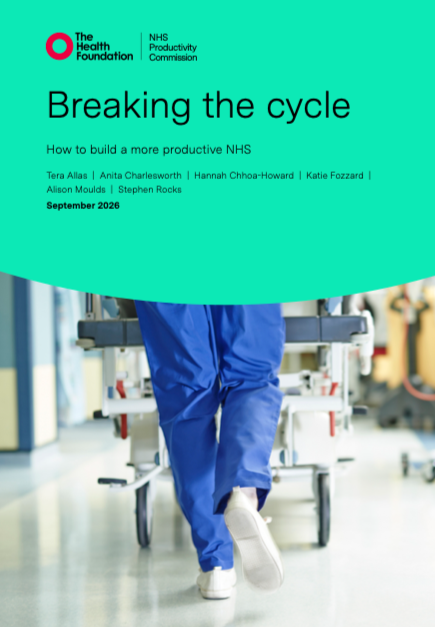
Her productivity report is out today, here.
However, back to her new job...
Anita & Co will scrutinise more than 100 commitments in the National Cancer Plan, identify where progress is slipping and advise ministers. It will meet quarterly... errr... really...
... four times a year?
Which raises an obvious question. What happens during the other 361 days?
Charlesworth knows her stuff. She has a formidable understanding of NHS finances, performance and productivity, but...
... what’s she supposed to do when she discovers something isn’t working? Write a report? Convene another meeting? Tell the Secretary of State?
Cancer patients don’t need another meeting.
Cancer patients need treatment.
Cancer patients don’t need performative. They need performance.
The latest figures explain why.
In July, 79.3% of patients received a cancer diagnosis, or had cancer ruled out, within 28 days, good, but...
... only 71.2% of patients covered by the 62-day standard started treatment on time.
The DH++ must think none of us has a calculator.
For every 100 patients covered by that treatment standard, 29 don’t start treatment within the deadline.
Nearly a third.
We know the score.
We know the target.
What we don’t know is who has the authority to close the gap, and…
… there’s the extraordinarily unwieldy Cancer Plan to deal with.
More than 100 commitments.
Some are genuine operational targets. Others involve developing, reviewing, exploring and implementing changes over several years. The plan runs through to 2035.
It’s a compost heap of commitments.
Unlike real compost, there’s no guarantee it will nourish anything.
Even if every commitment received equal attention, Anita & Co would have at least 25 to consider at every meeting, before…
… discussing money, workforce, capital, dependencies or why something hasn’t happened, and…
… here’s the extraordinary thing...
... when Parliament asked for an implementation plan, ministers said, no...
... the action tables at the end of each chapter were considered sufficient.
A list of promises is not a delivery plan.
Look at cancer detection...
... every day across the UK, roughly 160 women are diagnosed with breast cancer and around 160 men with prostate cancer.
Women have an established national breast-screening programme. For prostate cancer there is no population-wide screening programme, only...
... a very small genetically high-risk group has recently been recommended for targeted screening.
Old geezers like me? Most of us have no systematic screening programme at all.
Whatever your view of PSA screening, it is one hell of a contrast.
What can Anita & Co do about that, at four meetings a year?
Then consider the prostate-cancer journey.
A man has a PSA test. An abnormal result leads to referral. MRI. Perhaps biopsy. Histopathology. Staging. Consultation. Finally, treatment.
Each step belongs to somebody.
Each organisation has its own targets, workforce, budget and waiting list.
The patient experiences one journey. The NHS measures the stops, not the journey.
That’s where Anita & Co could make a difference.
Forget trying to manage 100 promises. Identify pathways. Instead, follow patients from first suspicion through diagnosis to treatment.
Find where they get stuck. MRI? Pathology? Expose it. Find out why and fix it.
Most important of all, publish everything,but …
… don’t confuse rearranging pathways with increasing capacity.
A quicker referral, or imaging achieves nothing if the patient merely joins another queue.
Anita & Co can follow the money as well as the patient.
-
What does delay cost?
-
Where is resource being wasted?
-
What is the value of earlier diagnosis compared with paying for complex treatment later... that's right up Anita & Co's street.
But... here’s the difficulty… the Anita & Co can scrutinise, expose problems and advise ministers..
but …
... as far as their published remit shows, it can’t direct a trust to recruit staff, buy a scanner or move its budget.
Those powers sit elsewhere. So in the 91 days between quarterly meetings…
-
Who chases the capital?
-
Who tackles workforce shortages?
-
Who unblocks the pathways?
-
Who is responsible when nothing happens?
The government wants all cancer waiting-time standards met by 2029... fat chance.
Getting there will require much more than a quarterly meeting. Anita & Co’s independent challenge could be valuable, but… scrutiny is not delivery.
Cancer doesn’t need another referee.
Cancer doesn’t need another scoreboard.
Cancer needs someone who can move the goalposts, blow the ref's whistle and kick poor performance into touch.
Anita & Co's four meetings a year might tell us why patients are waiting.
The test is what Anita & Co can make happen during the other 361 days.
|