Weekly highlights for the Manufacturing community.
Subscribe to get this newsletter in your inbox each Tuesday.
|
|
Michelin Approves Use of Polyester Tire Cord Recycled from Waste PET Bottles
French tire maker Michelin says it has successfully validated the use of Carbios’ enzymatic recycling technology for PET plastic waste as a high-tenacity reinforcing fiber in its tires –– potentially creating a long-term end-use application for waste plastic from billions of PET bottles. With some 1.6 billion car tires sold worldwide every year by all tire manufacturers combined, the amount of PET fibers used in these tires represents 800,000 tonnes of PET per year, according to Carbios. When applied to Michelin, the firms said jointly on April 23, “this represents nearly three billion plastic bottles per year that could be recycled into technical fibers for use in the company’s tires.” Read more at Plastics Today
|
Heavy-Duty Electric Truck Charging Site Opens in Oregon
A site called Electric Island," the first-of-its-kind heavy-duty electric truck charging site opened on April 21. Daimler Trucks North America (DTNA) and Portland General Electric (PGE) made the announcement. Electric Island will help accelerate the development, testing and deployment of zero-emissions (tank to wheel) commercial vehicles. First announced in December 2020, Electric Island opens with eight vehicle charging stations (a majority of which are available for public use) for the charging of electric cars, buses, box vans and semi-trucks. The site is built to immediately provide charging for EVs of all shapes and sizes and will serve as an innovation center, allowing both PGE and DTNA to study energy management, charger use and performance, and, in the case of DTNA, its own vehicles' charging performance. Read more at MHL News
|
BrainChip Simplifies Deep Learning with Launch of MetaTF
BrainChip Holdings Ltd. (ASX: BRN), a provider of ultra-low power, high-performance AI technology, introduced MetaTF, a versatile ML framework that allows people working in the convolutional neural network space to quickly and easily move to neuromorphic computing without having to learn anything new, today at Linley Spring Conference 2021. The MetaTF development environment is an easy-to-use, complete machine learning framework for the creation, training and testing of neural networks, supporting the development of systems for Edge AI on BrainChip’s Akida event domain neural processor. The MetaTF development environment leverages TensorFlow and Keras for industry-standard neural network development and training and includes the Akida Execution Engine (chip simulator), data-to-event converters, and a model zoo of pre-trained models. The framework leverages the Python scripting language and its associated tools and libraries, including Jupyter notebooks and NumPy. Read More at SemiConductor Digest
|
|
AMI Project Team Receives Award to Create Solutions to Accelerate the Adoption of Smart Manufacturing Practices Read the Press Release
|
Pre-register today for membership and receive your first year free.
|
|
|
Now what?! Setting strategies to scale digital transformation
Rather than relying on a single digital-manufacturing solution, businesses operating in the modern industrial landscape are utilizing (or at least piloting) about eight different digital-manufacturing solutions to enable them to capitalize on the buzzworthy elements of Industry 4.0—big data and analytics, cloud computing and IT/ OT convergence, etc. That’s according to a recent McKinsey study. And while businesses of all sizes, varied verticals and diverse maturity levels reap the benefits of these solutions to varying degrees, they all struggle with a common challenge: scaling successes. Pilots are plentiful; less common are clear roadmaps to move forward with rollouts and achieve positive impact at scale. Read more at Smart Industry
|
|
Digitally Transforming Forklifts
Global logistics provider GEODIS recently partnered with Phantom Auto to develop a forklift truck that can be controlled from a distance. This innovative program is aimed at improving comfort and safety while also creating job opportunities for people with physical disabilities and others that are historically underrepresented in the logistics industry. The first successful tests took place in France (Levallois and Le Mans) as part of a multi-year cooperation. The solution uses a Fenwick forklift combined with Phantom’s secure, network-agnostic, and interoperable remote operation software to enable remote workers to operate the vehicle, unlocking efficiency and equipment utilization gains. For example, one remote worker can operate multiple forklifts at a number of warehouses at different times of the day, all from one central location. Read more at New Equipment
|
|
5G Expands Autonomous Mobile Robot Capabilities
Over the past several years, autonomous mobile robots (AMRs) have proven themselves a force to be reckoned with in the material handling space. Serving as a viable replacement for both stationary conveyor belts and automated guided vehicles (AGVs) that require permanent wire strips or magnetic tracks be placed along the floor to guide their path, AMRs offer a degree of flexibility that was previously impossible. Moreover, like other non-fixed technologies such as wearables, 5G is giving AMR deployment a boost. 5G can allow AMRs to utilize navigation algorithms and virtual map sharing to coordinate their activities with one another and optimize workflows. In many cases, previous wireless connectivity has not been able to provide the seamless coverage and high data transfer speeds necessary to facilitate this level of bandwidth or reliability. Read more at Automation World
|
|
Building Better Work Models for the Next Normal
When the transition to virtual work began over a year ago, few people expected to still be conducting video calls from their living rooms all these months later. Work-life issues that preceded the pandemic have intensified, and the emergency measures implemented in early 2020 are finally wearing thin. As leaders grapple with plans for employees to return to offices, they will need to take a hard look at both the psychological and physical needs of their employees and consider how to address them going forward. Planning the return to shared physical workspaces offers an opportunity to transform lessons learned during the pandemic into a sustainable model of work. Read more at Sloan Review
|
|
Data Lake Houses Join Data Lake in Big Data Analytics Race
Edge computing is prominent in IoT discussions these days, particularly where artificial intelligence comes into play. Software architects see advantage in processing or pre-processing data on the edge of the Internet. But, for now, much of Internet of Things( IoT) analytics occurs on the cloud. Even as edge moves forward, correlating edge data with historical enterprise data troves – often referred to as big data – will be the norm. Certainly, IoT architects need to sift through expanding edge options. These options are expected to grow along with edge infrastructure that, according to IDC estimates, will increase by more than 50% by 2023. At the same time, IoT architects face options for cloud-based big data analytics that also continue to expand. The latest is data lake houses, which are closely related to cloud data warehouses. These systems strive to combine the best aspects of relational data warehouses with Hadoop data lake. Read more at IOT World
|
|
7 IT hiring trends for 2021
The COVID-19 pandemic has impacted nearly every industry, fundamentally altering the way most organizations conduct daily business — and that includes how they recruit, hire, and retain IT talent. Robert Half Technology surveyed more than 2,800 senior managers in the US to gauge the hiring and salary trends for 2021, as companies continue to contend with the pandemic, the resulting rise of remote work, and the need to fill key technical roles at a distance. From Robert Half’s report, it appears that many COVID quick fixes are likely to stick around after the pandemic subsides, with 74% of more than 1,000 workers surveyed in the US saying they “want to work remotely more frequently following the pandemic” — a desire that IT organizations are likely to have to keep in mind as the competition for top talent rages on. Read more at CIO
|
|
Start Planning Now for the Circular Economy
As the need for agility and resiliency increases, supply chains are searching for ways to evolve, become more efficient and more able to endure unexpected challenges. Whether caused by the ongoing growth of e-commerce, adjustments in shopping habits, or a change in product preferences, supply chains are always in flux and they need to be able to flex to accommodate those evolutions. Supply chains can fulfill that mission, and overcome their obstacles, by adopting a circular economy model. Built to endure everyday challenges, as well as the massive disruptions that have been occurring throughout the world, a circular economy model encourages continuous reuse of materials to minimize waste. It drives demand for natural resource consumption, attracting interest from a wide variety of companies spanning virtually every industry on the planet. Read more at MHL News
|
|
7 business skills every IT leader needs to succeed
The days when CIOs could glide into a long-term career based solely on their technical abilities are rapidly fading. “It’s no longer enough for IT leaders to be tech experts,” warns Bob Hersch, a principal at Deloitte Consulting. The best-in-class CIOs of today are also business savvy, using their knowledge to embed IT as a service capability. “This business-centric approach integrates IT into an overall business strategy,” he adds. The best way any IT leader can augment his or her current technical knowledge — and strengthen their long-term career prospects — is by committing to acquiring the following seven essential business skills. Read More at CIO
|
|
The One, True Lean Goal, Improving Customer Value: Efforts fail when managers focus on bringing down the cost of goods.
Take a moment and do a web search on the term “lean goals.” Go ahead—it’ll just take a moment. Do you see all those articles headlined, “The Three/Four/Five Goals of Lean”? If you take another moment to scan some of those articles, you’ll see that they point to a number of laudable goals: reduce waste, improve quality, reduce cycle time, reduce costs, improve processes, improve efficiency and establish flow. No one, least of all the authors, would argue that these aims aren’t important or that lean isn’t relevant to achieving them. We do wonder, though, if advocating for a variety of goals confuses the issue. Can they all be achieved at the same time? Are different methods needed for different goals? Are some goals more important than others? Must we pursue them all or can we go after some but not others? And what if some of the goals don’t seem relevant to my business or industry? Read more at Industry Week
|
|
Siemens & Google Cloud cooperate on AI manufacturing solutions
Google Cloud and Siemens announced a cooperation to optimize factory processes and improve productivity on the shop floor. Siemens intends to integrate Google Cloud’s data cloud and artificial intelligence/machine learning (AI/ML) technologies with its factory-automation solutions to help manufacturers innovate for the future. By combining Google Cloud’s data cloud and AI/ML capabilities with Siemens’ Digital Industries Factory Automation portfolio, manufacturers will be able to harmonize their factory data, run cloud-based AI/ML models on top of that data, and deploy algorithms at the network edge, claim the partners. This enables applications such as visual inspection of products or predicting the wear-and-tear of machines on the assembly line. Read more at Smart Industry
|
|
United Airlines, Nike, Siemens, 9 Other Businesses Partner to Pursue Trash-derived Airline Fuel
It’s well known that the convenience of airplane travel also carries a heavy environmental cost, and as global businesses in every sector face pressures from consumers and investors to establish aggressive climate goals, the airline industry is certainly not exempt. But a new initiative announced will help put a dent, albeit a small one, to start, in the volume of fossil fuels used by the commercial airline industry. United Airlines has announced it will form a partnership with 11 other businesses, including Nike and Siemens, called “Eco-Skies Alliance.” The group will help fund the investment in a low-carbon jet fuel that’s derived from trash, with a target to use 3.4 million gallons of the new juice this year. Read more at Thomas Net
|
|
Rockwell Automation and Comau Partner to Help Manufacturers Simplify Robotics Integration
Rockwell Automation and Comau, an industrial automation and robot manufacturer, announced that they are joining forces to provide factories worldwide with tools to help maximize manufacturing efficiencies through unified robot control solutions. Factory personnel will now be able to program their entire machine in a single environment, including Comau robot arms directly controlled through Rockwell Automation’s Logix-based controllers. Rockwell Automation’s Studio 5000 automation system design software provides a single software tool solution, which can eliminate the often time-consuming and difficult task of trying to coordinate traditionally separate machine control and robot systems to work together using two different software tools. Read more at Arcweb
|
|
-
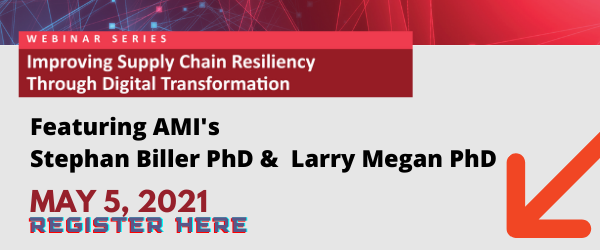
SME Virtual Event May 5, 2021 1-2:30PM EST Virtual: Improving Supply Chain Resiliency Through Digital Transformation - Digital Transformation is key to survive and thrive in the hyper-competitive market. Digital capability integration will provide a disruptive differentiation for those manufacturers who adopt and leverage digital technologies. Join us for a discussion and presentation on how the manufacturing supply chain can improve resiliency through digital transformation. This free webinar is open to anyone interested in accelerating improvement through digital transformation
-
DVIRC Annual Meeting - May 11, 2021 - DVIRC annual meeting for manufacturing executives, their employees, DVIRC Network Group members, and invited guests. Hear from industry experts, learn best practices, and connect with our vibrant manufacturing community. Scott Clemens will speak on economic updates, John Gronski, Major General (U.S. Army Retired) will speak on Being and Iron Sharpening Leader and AMI's Larry Megan, will present on improving local manufacture's productivity thru digitalization with a Low Investment manufacturing System (LIMS)
-
ASME Digital Twin Summit - May 12-13, 2021. Digital Twin is an analytics-driven approach to design, testing, manufacturing, and support of products and operations. The American Society of Mechanical Engineers (ASME) recognizes the importance of providing industrial organizations with the knowledge to strategically identify and implement predictive capabilities for applications spanning the enterprise and beyond. Our virtual event takes place May 12–13, 2021, and features keynotes and sessions by industry leaders, influencers, technical experts, and those looking to be on the cutting edge of digital twin capabilities.
-
Eastec May 11-13, 2021 Springfield, MA: A powerful face-to-face event series, where technology and advanced manufacturing unite.
-
Aerodef September 20-23 Long Beach, CA: Gain access to the smart technologies and intelligent people propelling aerospace and defense manufacturing.
-
SME Events- October/November AMI will participate in a series of four SME events, Houstex, Eastec, Southtec, and Westec.
-
The Manufacturing Technology Show: Nov 9-11 – Cleveland, Ohio. AMI will have a presence at the upcoming show. More details to follow
|
|
Share The Manufacturing News Consolidator with your network |
|
Why Less Is More in Data Migration
As the pandemic continues, companies are racing to transfer data from old, bloated IT systems to more nimble, modern setups in order to launch new online services and maintain operating systems remotely. But few of these large-scale initiatives proceed as planned or deliver promised results. Many multiyear IT data migration programs fail — often at a hefty cost. Companies can reduce their chances of running into trouble by accepting that “less is more.” Below we share three principles companies can follow to successfully shift data into new systems in months instead of years, fueling faster innovation: tagging essential data that must be migrated; leaving behind “nice-to-have” data; and lowering data quality standards, even if it’s only by less than 1%. Read more at Sloan Review
|
|
Semtech Accelerates Technology Deployments Aimed at Enabling a Better World
Semtech Corporation (Nasdaq: SMTC), a supplier of high performance analog and mixed-signal semiconductors and advanced algorithms, is amplifying its mission to make the planet a smarter, more connected and sustainable place by providing a new Internet of Things (IoT) platform. With solutions deployed globally, Semtech’s LoRa® devices and the LoRaWAN® protocol help reduce environmental impacts and remedy challenges facing the global community spanning wildlife protection, sustainable farming, combating COVID-19, water conservation to high-risk flood monitoring. “By investing in LoRaWAN and LoRa, we’re showing the world that Semtech is committed in our efforts toward sustainability, and developing technology solutions that improve environmental consciousness and conserve resources,” said Mohan Maheswaran, president and CEO, Semtech. “LoRa devices’ easy-to-deploy capabilities have the potential to bring connectivity to all, creating a smarter and safer planet.” Read more at SemiConductor Digest
|
|
Dell reportedly looking to unload its cloud unit
Hot on the heels of its pending spin-off of VMware, Dell is now reportedly looking to sell off its Boomi cloud business for $3 billion. Bloomberg first broke the news, citing people familiar with the matter. Dell is working with a financial adviser on the sale, sources told Bloomberg, and the idea is said to be in the early stages. One thing about Dell, it does not rush these decisions. The VMware spin-off, which has been discussed for years, started last summer and only now is coming to fruition. Boomi provides an integration platform as a service (iPaaS), which enables the connection of applications and data sources. The platform provides API, lifecycle management, and event-driven architecture features for cloud integration. Dell acquired Boomi in 2010. Read more at Network World
|
|
Ensuring the Continued Resiliency of U.S. Manufacturing
Last year, U.S. hospitals found themselves in a desperate scramble for ventilators and protective gear. This year, instead of ramping up to meet resurgent demand, U.S. automakers have been shutting down production lines due to a shortage of semiconductor chips. These incidents have delivered a stark reminder that manufacturing capabilities matter—not only to fuel the economy in good times but also to keep it functioning in moments of crisis. The decline of U.S. manufacturing has long been a jobs issue. But now gaps in the industrial base have become serious vulnerabilities. Thousands of smaller manufacturers have shuttered in the past two decades, leaving gaps in domestic supply chains and capabilities. The United States has become more dependent on imports—even for goods that are critical to national security, infrastructure systems, or the smooth functioning of key industries, as a 2018 Pentagon report warned. The supply chain disruptions of the past year led President Biden to order an immediate review of the nation’s supply chains. Read more at IEN
|
|
Ingenious Ingenuity Paves Way For Follow-On Mars Rotorcraft
NASA’s Ingenuity Mars Helicopter achieved a breakthrough for space exploration on April 19 when it hovered successfully over a site close to the Perseverance rover, marking the first time a vehicle has performed a powered, controlled flight on another planet. The short flight test effort aims to prove rotorcraft and other aircraft types could play a key role in future planetary exploration, surveying and collecting samples from areas inaccessible by other means. Encouraged by Ingenuity’s success to date, NASA is already designing follow-on vehicles. Read more at Aviation Week
|
|
Why Food Packagers Need to Trust AI
A survey by McKinsey states that the adoption of automated technologies in the food and beverage industry is relatively slow compared to other sectors, with only 48% of manufacturers considering themselves ready for Industry 4.0. Here, Claudia Jarrett, United States country manager of automation parts supplier EU Automation explains how and why food packages should put their trust in smart technologies and AI. As the term suggests, packaging automation involves the use of machinery to replace one, or multiple manual, elements of packing operations. Smart technologies are also an efficient way to streamline the entire packaging process. These machines can automatically fill, cap, seal, and label packages of varying sizes and shapes. Read more at New Equipment
|
|
Still Struggling with IIoT? Ask a Farmer
The many advances fueling modern farming are nothing short of phenomenal. Today’s agricultural equipment essentially translates to smart factories on wheels including autonomous operation, sensor backed data collection as well as the innate ability to recognize and address potential issues on the fly. However, even with so many smart pieces of equipment, the real value comes from the amazing level of interconnectivity driving enhanced decision-making capabilities despite the many fluctuating factors farmers face such as weather, diseases or pests. Read more at New Equipment
|
|
Plastics Locked Down and Laser Welded
Laser-based welding has several important advantages for plastics compared with conventional contact methods. Laser welding is a non-contact process at the point of welding that generally takes place at the interface of overlapped parts. Consequently, the weld zone is encapsulated. This results in an aesthetically pleasing weld, which is sterile and does not contaminate the surface of the parts being joined. It seems a little counterintuitive that parts already in contact with each other can be welded together, from the top down, without disturbance to their outer surfaces. With conventional plastic welding techniques, such as ultrasonic or hot stamping, contact with the outer surfaces of the parts to be welded together is inevitable. Non-contact laser plastic welding works on the principle of partial transmission, reflection, scattering, and absorption of laser light within the polymer chains being joined. By careful selection of the plastics and the laser’s optical properties, sufficient heat is generated at targeted locations to melt and fuse together the materials. Read more at Plastics Today
|
|
Anticipating the Challenges of Digital Transformation
The digitalization of business processes is driving the competition in manufacturing markets, and this is nowhere more obvious than on the plant floor. Automation, robotics, sensors, and different software solutions have completely changed how people interact with equipment and how components and products are created. Manufacturers with high operational costs have a significant incentives to pursue digital transformation. However, once that decision has been made those manufacturers are faced with a double-edged sword of risk and reward. While automation and digitalization promise a high return on investment, the transition process comes with big upfront costs and nobody can guarantee a smooth ride. Read More at American Machinist
|
|
Responsible for 20% of Industrial Fatalities, Construction Sector Needs to Increase Safety. BIM Could Help.
The construction industry is in the middle of a digital revolution, and building information modeling (BIM) leads the charge. Building and construction professionals worldwide have embraced this technology to reduce project times and maximize profits, but that’s not where its uses end. You can use BIM to improve construction site safety, too. Construction is a dangerous industry. Roughly 20% of all worker fatalities in 2019 were in this sector, and the industry faces frequent non-fatal injuries as well. Reducing these incidents is paramount, and BIM can help. Here’s how. Read more at Thomas Net
|
|
Delivering the Cure to Steady Automation
Achieving high-integrity, high-gloss automotive finishing depends heavily on adequate curing of coatings between multiple layers. Curing time is necessary for drying and for chemical reactions to complete before application of the next coating layer. Gas catalytic infrared radiation (IR) is emerging as a preferred heat source for curing, but maximum curing is limited to those areas that are directly in the line of sight of the IR beam. U.S. Autocure, an Arizona-based coating and automation specialist developed an automated system that delivers IR beams evenly across contoured automotive surfaces but had to overcome a major challenge: moving heavy metal booms and shutters smoothly, quietly, and in compliance with stringent safety regulations for spray booths. Read more at New Equipment
|
|
The IoT Security Challenge for Enterprises
As the proliferation of Internet of Things (IoT) devices throughout the enterprise continues, security issues won’t go away. On the positive side, tech professionals are quite aware, especially as they witness the skyrocketing growth in the number of connected devices throughout their organizations. By 2025, Statista estimates the total installed base of connected IoT devices globally will reach just more than 30 billion units, up from about 13 billion units this year, while IDC estimates there will be more than 55 billion connected IoT devices by that time. No matter the range of estimates, the number of IoT devices projected is massive. Read more at IOT World
|
|
Juniper: Managing the complexity of future networks
Like most of its competitors, Juniper Networks is leaning hard on developing all manner of software components—from automation to intent-based networking—in order to address the changing needs of enterprise-network customers. Moving into the software realm is no small task as Juniper has to integrate products from a number of acquisitions including Mist, 128 Technologies, Apstra, and NetRounds. At the same time it continues to develop its own Junos software and invest in key open-source projects such Software for Open Networking in the Cloud (SONiC) among other undertakings. Network World talked with Manoj Leelanivas, Juniper’s executive vice president and chief product officer about the company’s software directions and how it is preparing for challenges of the future. Here is an edited version of that conversation. Read more at Network World
|
|
Analysts Uncover More Servers Used in SolarWinds Attack
U.S. investigators say the Russian Foreign Intelligence Service, aka SVR, was responsible for the attack. Many of these command-and-controls servers were hosted within the U.S. by cloud infrastructure service providers, including Amazon Web Services, to help the attackers avoid detection and blend with normal network traffic, RiskIQ says in a new report. The 18 command-and-control servers identified by RiskIQ's Team Atlas were deployed as part of the second and third stages of the SolarWinds attack, researchers say. Many of these servers appear to have communicated with a weaponized version of the Cobalt Strike payloads that were delivered to victims' networks through droppers known as Teardrop and Raindrop, the RiskIQ report notes. Read more at Gov Info Security
|
|
This newsletter is brought to you by Advanced Manufacturing International, Inc.
Please contact us if you would like to add your news to "The Consolidator." |
|
|
|
Advanced Manufacturing International is an SMM-first non-profit organization striving to accelerate the digital transformation of small to medium-sized manufacturers with simple, secure, and ultra-low-cost solutions. If you are interested in accelerating the digital transformation of small-to-medium-sized manufacturers please contact us and subscribe to our newsletter. Learn more about AMI.
|
|
|
|
|
|
|