Please accept our apologies if this email reaches you in error.

If you would rather not receive our 40 Days of Resolution at Home email series, please email development@mvmediation.org, and we will remove you from the distribution list. We want you to continue to receive our monthly newsletter.

40 Days of Conflict Resolution

Tips for Home by Sara Barnes

Day 3: THE FIVE MOST COMMON APPROACHES TO HANDLING CONFLICT

Identifying the

Five Conflict Styles:

Avoid

Accommodate

Compete

Compromise

Collaborate


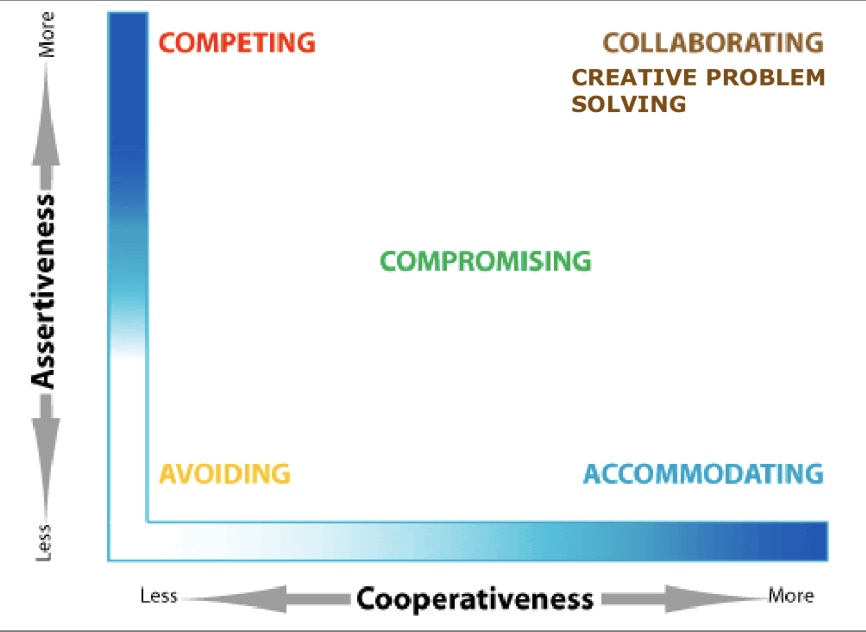
Avoid, Accommodate, Compete, Compromise, Collaborate describe the most common approaches to conflict. Though we all may have a basic nature, oftentimes our preferred approach is learned from others.

Our work is about moving away from the outer frame of the matrix graphic above and moving toward a process of well-discussed conflict, with participants making a forthright attempt to COMPROMISE and COLLABORATE.

Many people use the AVOID conflict resolution style.


They think it’s the safest option. When there is a major power imbalance between disputants or if there is not time or energy, simply avoiding the issue might make sense.


The problem is: the conflict doesn't go away.

Over time it can get worse. The ostrich with its head in the sand doesn't accomplish much except to hide from the problem.

We all know a COMPETITIVE conflict resolver. They want to win; the conflict is a battlefield and they are planning to win and you are going to lose. People who compete when there is conflict don't accomplish much except to dominate the other person. This causes resentment and overlooks the ideas of the other person. Taken too far, a bullying scenario can arise, driven by a need for power. Not a great way to truly resolve a conflict.

On the flip side, ACCOMMODATING conflict resolvers give in to the other person and don't assert their own ideas and needs. Someone who always accommodates others is a person who is not being heard and considered. This style, which is often overused, can lead to low self-esteem on the part of the accommodating person and a pattern of not truly communicating one's needs.

With a COMPROMISE approach, everyone loses a little and wins a little. At its best, the process can strengthen relationships and both people can appreciate learning about each other and coming up with a more fair outcome. At its worst, everyone feels they lost.


The problem with compromise is that it's based on a fixed value concept - in other words, a zero sum game. When people compromise they haven't been able - because of time or other constraints - to come up with new value through creative problem solving. The idea of conflict resolution is to create new value through negotiation and creativity.


Enter: COLLABORATION!

With time, intentional effort,

and respectful listening, a COLLABORATIVE approach is the strongest and most equitable. Applying this approach means disputants jointly define the conflict, put the topic in the middle of the table, and work together imaginatively and flexibly to create a solution. In a collaboratively resolved conflict, both participants see their ideas and voice reflected in the decision.


To work collaboratively on a conflict, ask: Why do you want what you want? Can we think of another, new way? Frame the conflict as a joint project and use creative thinking to invent a

win-win outcome.

Each of these approaches have their place and time, and no single one is always wrong or always right.


The idea is to expand your repertoire and to be able to

match your method to the conflict.

Join our 40 themed 40th Anniversary Campaign!


So many fun ways to get - and stay! - involved.


🗓️ Enroll in our monthly giving program and give $40 per month*

*with the option to opt out at any time.


💵 Become a one-time donor donating $40, $400, $4,000....

you get the point!


🎂 Donate the dollar amount equivalent to the year we were founded: $1,984.

Donate here


Martha’s Vineyard Mediation Center

15 Merchant’s Court #5, PO Box 761

Vineyard Haven, MA 02568 info@mvmediation.org | 508.693.2999

www.mvmediation.org