|
Quotes of the Day:
"In a global war, intelligence must be global. There is no substitute for accurate knowledge, and that knowledge cannot be obtained without espionage and reconnaissance."
– William J. Donovan, Director of the OSS, 1942
“It is the job of thinking people not to be on the side of the executioners.”
– Albert Camus
“Although a soldier by profession, I have never felt any sort of fondness for war, and I have never advocated it, except as a means of peace.”
– General Ulysses S. Grant
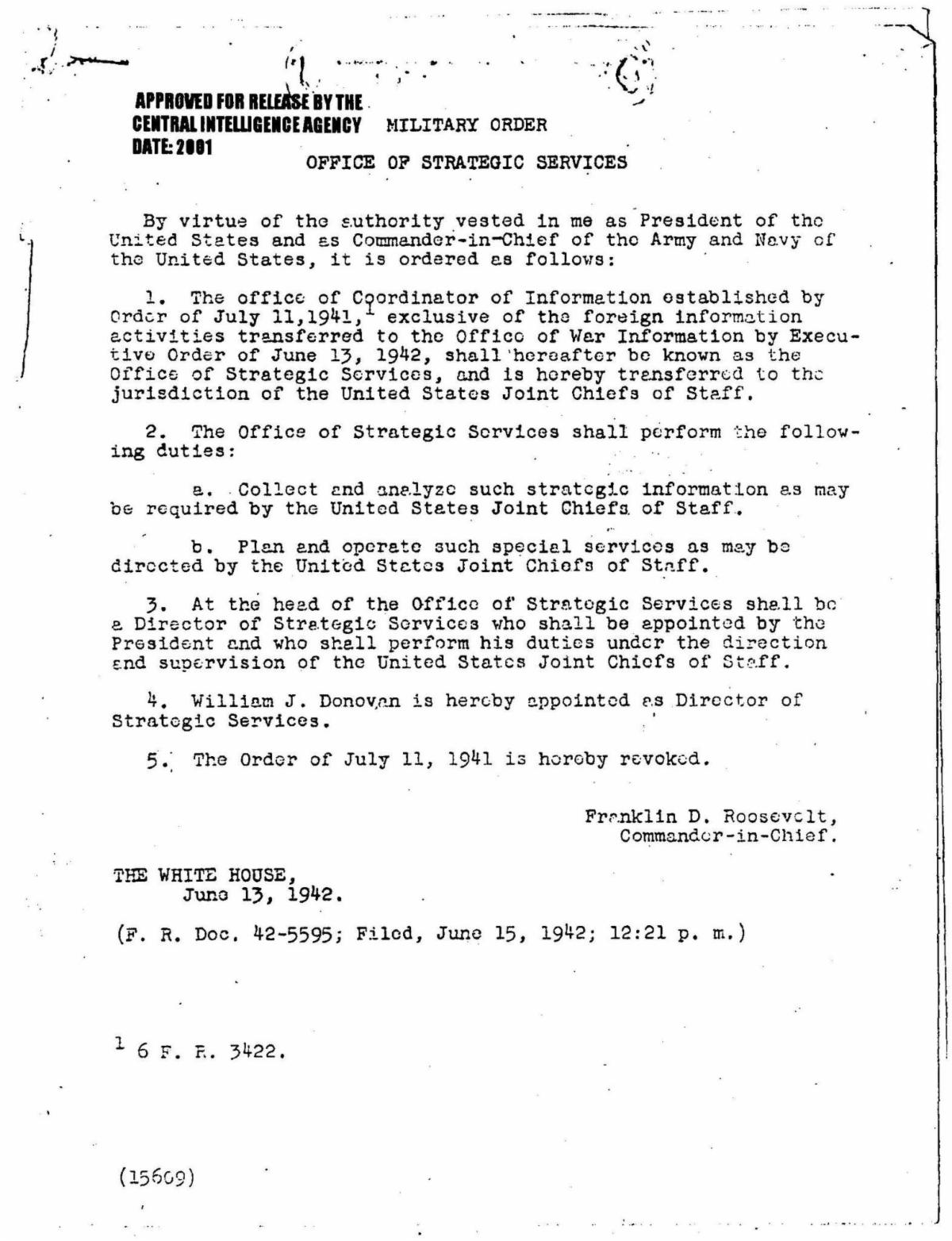
They do not write orders like this anymore.
https://drive.google.com/file/d/1iHcrZCOZykp8_3eHUJGpMPTHFTxaUuRO/view?usp=sharing
1. Israel Launches Attack on Iran’s Nuclear Facilities: Live Updates
2. Live Updates: Israeli Strikes Wipe Out Iran’s Top Military Chain of Command
3. OSS Anniversary – Office of Strategic Services (OSS)
4. New Army Reserve Unit Enlists Silicon Valley Executives to Upgrade Tech
5. The Unthinkable: Repeal the 2001 Authorization for the Use of Military Force Act
6. China and Taiwan Trade Cybersecurity Accusations
7. Forging a European third pole in the Indo-Pacific
8. U.S. Support for Ukraine Would be Cheap at Twice the Price
9. General Staff: Russia has lost 1,001,560 troops in Ukraine since Feb. 24, 2022
10. Israel Strikes Iran. What Comes Next?
11. Iran launches drones at Israel as Israel attacks Iranian nuclear sites and top commanders, IDF says
12. Pentagon Mulls Scrapping Aukus Agreement With Australia, UK
13. BOOM! LIGHTS OUT (Power generation for space)
14. Hegseth won’t rule out military actions against Greenland, Panama
15. ‘Rising Lion’: Israel Targets Iran’s Nuclear Weapons Program, Prepares for Retaliation
16. Addressing U.S. Army Pacific’s Urgent Watercraft Problem
17. Trump May Try To Strike A Deal With AUKUS Review, But He Won’t Sink It
18. U.S. Army deploys cutting-edge $13M smart rifle scopes that automatically shoot down enemy drones in combat
19. Defense Secretary Says Funding Request Addresses Adequate Support for Special Ops
20. How War Between Iran and Israel Could Escalate—and Drag in the United States – A Conversation With Daniel B. Shapiro
21. The Real Threat From Iran – Tehran’s Most Dangerous Option for Responding to Israel by Kenneth M. Pollack
22. Coordinated, Deliberate, Effective: Why Authoritarians Are Winning the Hybrid War
23. Trump Is Pushing Allies Away and Closer to Each Other
1. Israel Launches Attack on Iran’s Nuclear Facilities: Live Updates
Please go to the. link for live updates. Video at the link.
https://www.wsj.com/livecoverage/israel-iran-strike-conflict
LIVE UPDATES
Israel Attacks Iran’s Nuclear Facilities: Live Updates
WSJ
Israel launched a wide-ranging attack on Iran’s nuclear program and military leadership overnight, killing the head of the Islamic Revolutionary Guard Corps and striking dozens of targets in an operation that pushes the region into a new conflict with uncertain consequences.
Dozens of planes wrapped up the first wave of the attack before dawn Friday, Israel said. Iranian state TV reported explosions and showed smoke rising in the capital, Tehran.
The wave of strikes comes just days before U.S. special envoy Steve Witkoff was to meet his Iranian counterparts for a sixth round of nuclear talks. The U.S. has said Iran must give up the ability to enrich uranium needed to build a bomb. Iran has refused, leaving the talks at an impasse.
Here’s what to know:
Iranian state media said IRGC commander Hossein Salami was killed by an Israeli strike in Tehran, an attack on the country’s top leadership.
Israeli Prime Minister Benjamin Netanyahu and his defense minister, Israel Katz, decided Monday that the attack would begin Friday local time, an Israeli security official said.
Netanyahu said the military operation would last “as many days as it takes.” Katz declared a state of emergency and warned that Iran was expected to retaliate.
Secretary of State Marco Rubio said the U.S. wasn’t involved in the strikes and warned Iran not to target U.S. forces.
Netanyahu raised the possibility of strikes with President Trump in a phone conversation Monday, according to two U.S. officials. Soon after, the U.S. began moving some diplomats and military dependents out of the Middle East.
Oil prices climbed after the attack, and stock futures tied to all three major U.S. indexes fell Thursday evening.
2. Live Updates: Israeli Strikes Wipe Out Iran’s Top Military Chain of Command
Live updates at the link: https://www.nytimes.com/live/2025/06/12/world/israel-iran-us-nuclear?unlocked_article_code=1.Ok8.Nknh.o3GG7SEO27VY&smid=url-sharehttps://www.nytimes.com/live/2025/06/12/world/israel-iran-us-nuclear?unlocked_article_code=1.Ok8.Nknh.o3GG7SEO27VY&smid=url-share
Live Updates: Israeli Strikes Wipe Out Iran’s Top Military Chain of Command
NY Times · by Ronen Bergman · June 13, 2025
Pinned
Updated
June 13, 2025, 6:33 a.m. ET
Israel launched a stunning series of strikes on Friday morning against Iran’s nuclear program and killed three of the nation’s security chiefs, in a remarkable coup of intelligence and military force that immediately decapitated Tehran’s chain of command, prompted threats of severe retaliation and raised fears of a wider conflict.
Prime Minister Benjamin Netanyahu of Israel described the attacks as a last resort to prevent a nuclear-armed Iran, which Israel views as an existential threat. In addition to targeting Iranian nuclear facilities, Israel’s strikes killed top Iranian officials and nuclear scientists and hit Tehran’s long-range missile facilities and aerial defenses.
June 13, 2025, 6:21 a.m. ET
Adam Rasgon
Reporting from Jerusalem
Israel’s Air Force is continuing to take action to intercept drones that Iran has launched at Israel, the Israeli military said in a statement. The statement did not say how many drones Israel had intercepted, if any.
June 13, 2025, 6:16 a.m. ET
Shashank Bengali
President Trump has weighed in on the Israeli strikes, which came as his administration seeks to broker a new nuclear deal with Iran. “I gave Iran chance after chance to make a deal,” Trump said in a Truth Social post, but “they just couldn’t get it done.” Trump said that “the next already planned attacks” could be “even more brutal,” and warned that Tehran “must make a deal, before there is nothing left.”
Where Israel attacked Iran
By Martín González Gómez and Julie Walton Shaver
June 13, 2025, 6:05 a.m. ET
Euan Ward
Reporting from Beirut, Lebanon
Hezbollah, the Iran-backed militant group in Lebanon, condemned the Israeli attack but made no mention of any military response. Long considered Iran’s most powerful regional proxy, Hezbollah has been battered by a yearlong conflict with Israel and much of its arsenal of rockets has been destroyed. Although analysts say Hezbollah retains enough firepower to escalate if Iran decides to activate its allies, it remains unclear whether the group will risk further confrontation with Israel.
June 13, 2025, 5:58 a.m. ET
Isabel Kershner
Reporting from Jerusalem
People stocking up on food Friday morning in Jerusalem.Credit...Ronen Zvulun/Reuters
The streets of Jerusalem, normally bustling on a Friday morning with shoppers preparing for the Jewish Sabbath, were eerily quiet. There was none of the usual build up of traffic of Muslim worshipers heading for noon prayers at Al Aqsa Mosque either.
Many residents of this contested, holy city seemed dazed, after being woken up well before daybreak by siren-like alerts sent to their cellphones declaring a nationwide state of emergency as Israel launched its wide-ranging, surprise attack against Iran’s nuclear program.
June 13, 2025, 5:35 a.m. ET
Qasim Nauman
Iran is moving quickly to replace top military leaders killed in the Israeli strikes. Supreme Leader Ayatollah Ali Khamenei has appointed Maj. Gen. Abdolrahim Mousavi as chief of staff of the armed forces, Iran’s state news agency IRNA reported. Mousavi replaces Maj. Gen. Mohammad Bagheri, who was killed in the Israeli attack.
June 13, 2025, 5:33 a.m. ET
Ronen Bergman
Israel believes that it has killed Gen. Amir Ali Hajizadeh, leader the airspace unit of the Islamic Revolutionary Guards Corps, in a strike, along with other officials, according to three Israeli officials with knowledge of the operation.
3. OSS Anniversary – Office of Strategic Services (OSS)
OSS Anniversary – Office of Strategic Services (OSS)
https://sof.news/oss/oss-anniversary/
June 13, 2025 SOF News OSS 0
The OSS anniversary is observed on June 13th each year. The Office of Strategic Services was created on June 13, 1942, in the early days of World War II to provide an intelligence service to the United States. Prior to World War II the business of collecting and disseminating intelligence was in the hands of elements of the armed services and foreign policy experts. The OSS was America’s first true intelligence service and would be the forerunner for the Central Intelligence Agency (CIA) and U.S. Army Special Forces.
World War II UW – Parachute resupply of Jedburgh team during World War II (photo CIA archives)
The OSS was established under the jurisdiction of the United States Joint Chiefs of Staff. President Roosevelt appointed William Dovovan as the director of the OSS. Donovan organized the OSS so it could perform a variety of missions to include research and analysis, counterintelligence, espionage, covert operations, and paramilitary operations. Paramilitary operations were conducted by “Operational Groups” or OGs. They conducted military operations in remote areas and behind enemy lines. Jedburgh teams were formed up to operate in the European theater – many of the teams parachuted into France to support the Normandy landings in June of 1944. There were many other units and elements of the OSS that conducted a variety of mission around the world such as Detachment 101 that operated in Burma area of operations.
Mounted members of Detachment 101 in Burma during World War II (CIA image).
At the conclusion of World War II the Office of Strategic Services was disbanded. Many of its members went into civilian life while some remained in the U.S. military. Some former OSS members would soon find themselves in the U.S. Army Special Forces or the Central Intelligence Agency.
Some additional reading on the OSS anniversary:
The Glorious Amateurs: OSS Turns 75! CIA, June 18, 2017.
Director Pompeo Delivers Remarks at OSS 75th Anniversary, CIA, June 16, 2017.
Some History of the OSS in Albania during WWII, SOF News, November 14, 2016.
World War II UW – Marquis, SOE, OSS, and . . . Present UW. SOF News, November 11, 2016.
Operation CARPETBAGGER – Supporting the OSS in WWII, SOF News, August 15, 2106.
Order Establishing the Office of Strategic Services, President Franklin D. Roosevelt, June 13, 1942. Posted on The American Presidency Project, University of California Santa Barbara.
4. New Army Reserve Unit Enlists Silicon Valley Executives to Upgrade Tech
Excerpts:
The nerd brigade is reporting for duty.
The tech reservists will serve 120 hours a year as lieutenant colonels, advising on AI and commercial tech acquisition.
New Army Reserve Unit Enlists Silicon Valley Executives to Upgrade Tech
Executives from Palantir, Meta and OpenAI are joining a new innovation corps in the Army Reserve
https://www.wsj.com/tech/army-reserve-tech-executives-meta-palantir-796f5360?st=ou7cuW&reflink=desktopwebshare_permalink
By Heather Somerville
Follow
June 13, 2025 5:00 am ET
Kevin Weil of OpenAI is among Silicon Valley executives joining a new tech-focused Army Reserve program. Photo: Al Drago/Bloomberg
Key Points
What's This?
- Executives from Meta, Palantir and OpenAI are set to join a new Army innovation corps, bringing tech upgrades to the military.
- The tech reservists will serve 120 hours a year as lieutenant colonels, advising on AI and commercial tech acquisition.
- Deepening ties reflect Silicon Valley’s willingness to aid the military in the midst of tech competition with China.
The nerd brigade is reporting for duty.
They probably won’t win any push-up contests and might not be sharpshooters. Yet for part of the year, a set of brainy Silicon Valley executives will trade their corporate-branded vests for U.S. Army Reserve uniforms because they know a heckuva lot about AI.
The chief technology officers from Palantir and Meta Platforms—Shyam Sankar and Andrew “Boz” Bosworth, respectively—will join Kevin Weil and Bob McGrew of OpenAI pedigree to make up the inaugural cohort of a new Army innovation corps.
Their mission: swap C-suites for bases and bring some badly needed tech upgrades to the Army.
“It’s possible I watched too much ‘Top Gun,’” said Bosworth, 43. Standing more than 6-feet-2, he was too tall to realize his youthful ambitions of flying an F-16 jet fighter.
He welcomes the new assignment, he said, as a way to finally extend his family’s tradition of military service.
Bosworth said Mark Zuckerberg, chief executive officer at Meta, supported his decision to join the Reserve. “There’s a lot of patriotism that has been under the covers that I think is coming to light in the Valley.”
The tech recruits will be sworn in as uniformed officers in a public ceremony on Friday, the day before the Army’s 250th birthday.
Less than a decade ago, even working on technology that might be used in defense—never mind suiting up for service—was anathema in Silicon Valley. The new Reserve program reflects how the relationship between the Pentagon and the tech industry has deepened.
Meta and OpenAI adjusted their policies to work more with the military last year. Recently they each joined with the weapons maker Anduril Industries to develop products for the Pentagon. Palantir has been involved in national-security work for two decades. It has a AI and data project with the Army worth potentially more than $1 billion.
Many in Silicon Valley assert that their cutting-edge know-how can equip the military for a conflict with a tech-powerful adversary like China—while profiting the tech sector.
For the Army, the deepening ties can help it prepare for the wars of the future. They are expected to be waged, in part, with ground robots and drones, and rely on networks of sensors and artificial intelligence to coordinate it all.
Gen. Randy George, U.S. Army chief of staff Photo: Rod Lamkey/AP
“We need to go faster, and that’s exactly what we are doing here,” said Gen. Randy George, the Army’s chief of staff.
The Army, in a show of its own geekiness, has dubbed the tech-reservist program Detachment 201. The moniker refers to the hypertext transfer protocol status code 201, which indicates the creation of a new resource on a server.
Detachment 201 is the first deployment of tech elites. Brynt Parmeter, the Pentagon’s chief talent management officer who has been leading the creation of a tech-reservist program since last year, is pushing for other services in the armed forces to follow the Army.
The tech reservists will serve for around 120 hours a year. Because of their private-sector status, each will carry the rank of lieutenant colonel.
There will be other dispensations for the technology officers. They will have more flexibility than the average reservist to work remotely and asynchronously, and will be spared basic training.
Reservists are deployed based on their skills, so the tech unit’s members more than likely won’t find themselves in a firefight. “That’s not where they would fit,” George said. Instead, they will work on projects that, for instance, teach soldiers how to use AI-powered systems or use health data to improve fitness.
Also, the executives will advise the service on acquiring more commercial technology. They will help the Defense Department recruit other high-tech whizzes.
The recruits won’t work on projects involving their employers, George said, and will be firewalled from sharing information with their employers or participating in projects that could provide them or their companies with financial gain.
Palantir’s Shyam Sankar sees the Reserve program as a way to pay back the opportunity the U.S. gave him and his family. Photo: Tasos Katopodis/Getty Images
“I have always believed that America is a force for good in the world, and in order for America to accomplish that, we need a strong military,” said McGrew, 43. He left OpenAI in November and is taking time to “think deeply” before deciding on a new job.
Palantir’s Sankar, 43, who fled violence in Nigeria as a child, was eager to “put the uniform on, put the pebble in my shoe” to pay back the opportunity the U.S. gave him and his family. “If not for the grace of this nation, we’d be dead in a ditch in Lagos,” he said.
As part of their commitment, the reservists must complete physical-fitness tests and marksmanship training. “I’ve been giving them a hard time about that,” said George. He has been trying to scare them into thinking the physical tests will be “super hard.”
Weil, 42, OpenAI’s chief product officer and an ultramarathon runner, professed to be undaunted by the timed 2-mile test. Still, he expects “we’re going to get our asses kicked by real soldiers.”
Bosworth said he has enhanced his workouts in preparation for the service. He does more push-ups and pulls heavy weights behind him.
Sankar is less confident about the fitness demands. His biggest concern, he said: “Being humiliated in front of Army officers who are way more fit than I am. I may be an expert in tech, but I’m not an expert soldier.”
Write to Heather Somerville at heather.somerville@wsj.com
5. The Unthinkable: Repeal the 2001 Authorization for the Use of Military Force Act
I would think all those who are opposed to "forever wars" would have long ago been advocating for this.
Excerpt:
The repeal of the AUMF will bring a long overdue rebalancing of influence and relative power among all national security stakeholders and open the door to renewing the pursuit of statecraft informed by new perspectives. To expect a different result, we must first change what and how we think. This major disruptive step will create conditions for crafting new security policy approaches to advance U.S. interests in a time of sharpened competition, increasing episodes of crisis, and looming peer conflict. The landscape comprises multiple threat actors with different interests, ways, and means that require innovative approaches to national security unseen in our history. The American people deserve better from our government the security environment demands new approaches. The strength of our national power is the will of the American people, not just the few who are willing to serve in uniform. We must change by design, or we will be forced to change by circumstances of our own making.
The Unthinkable: Repeal the 2001 Authorization for the Use of Military Force Act
https://smallwarsjournal.com/2025/06/13/the-unthinkable-repeal-the-2001-authorization-for-the-use-of-military-force-act/
by Charlie Black
|
06.13.2025 at 06:00am
It is almost twenty-four years since the 9/11 terror attacks on the United States by Al-Qaeda which were planned from their sanctuary in Afghanistan. Soon thereafter, the U.S. began a global war that would unknowingly extend decades with remnant named operations underway today. Beginning soon after that infamous day to present, every U.S. president has exercised relatively unrestrained powers to execute what became known as the War on Terror. The U.S. military, in partnership with others, executed the will of the American people and took the fight abroad. Over time, the U.S. national security system, including the FBI, was optimized to hunt down terrorists almost anywhere on Earth. A generation of Americans conducted and endured our longest war, yet we seem less secure even with unprecedented Presidential power and ongoing counterterror operations.
This summer will mark the four-year anniversary of the pullout from Afghanistan, with an ever-strong Taliban regime once again promising sanctuary to terrorists who wish ill on the world. In the intervening years from initiating the war, much water has passed under the bridge, so to speak, yet the world remains a dangerous and unpredictable place. We have normalized permanent military presence across the Middle East to conduct opportunistic strikes to kill terrorists, which has not resulted in enduring security. Current operations are fueled by the inertia of path dependency entrenched over many years while the world evolved into a very different place and so did we. Looking objectively, the Authorization for the Use of Military Force 2001 (AUMF) is “the” sustaining social construction that prevents a necessarily critical relook at our approach to national security and the use of force to achieve political aims abroad.
Strategic Tragic Failures from Operational Success
What we say and importantly how we act in the world matters. Evidence shows that U.S. counterterror actions are often perceived as interventionist and may feed the jihadist narrative today more than two decades ago. In large measure, the persistent and favored use of special operations and remote air power has displaced well-framed, coherent, and transparent policy making, which too often has led to the misuse of military power. There is no doubt that the U.S. has proven itself capable of finding a terrorist anywhere in the world and killing them at a time and place of our choosing. However, thousands of successful tactical strikes have not scaled to strategic success. Stated another way, successful tactics without strategy ignore the ethical reflection needed to inform and achieve enduring policy outcomes. This is not to say we should not pursue efforts to disrupt terror safe havens abroad, rather we should reframe our thinking and align our efforts to maximize national power toward that goal. It also means being clear-eyed about the risks and gains of any given action. With the continuation of the AUMF, the current and subsequent Presidential administrations will prefer seemingly proven methods rather than embarking on novel approaches that have different risk-gain calculus and outcomes.
Although the U.S. military was slow to adapt and eventually found itself capable of non-state war, it now finds itself ill-prepared for large-scale combat or some hybrid derivative. More clearly, the civilian policy makers and senior military leaders have not demonstrated the reflective and critical choices needed to address the diversity of threats today. Using the wrong tool for new problems is not useful. The growth of the security bureaucracy encumbers agility, lethality, and strategic forethought. Operational and tactical success does not fill the gap of poor policy or strategy. The expansive drift from the intent of granted Congressional authority to address emergent challenges we face today and tomorrow lacks efficacy.
Although different in time, geography, and enemy, the counterterror war is similar to the American tragic strategic loss in Vietnam. Winning most battles and, in this instance, killing thousands of terrorists was and is irrelevant to winning wars when there is an incoherent and poorly crafted strategy. The Global War on Terror (GWOT) generation that made immense sacrifices for the nation must not be carried to the next. Both they and the American people deserve a more effective and resource-informed approach to national security. Toward that end, we must start anew to design a new approach to achieving our security at home and our interests abroad. This is a huge undertaking that will require structural change to overcome the path dependency of a large bureaucracy, which has proven itself unable to change itself. Today, there are some signals that the Trump Administration may move in that direction.
Unintended Consequences
A clear-eyed, objective assessment of the past five years of military combat operations will reveal a combination of legacy efforts that are now strategically disconnected from U.S. meandering policy aims. Success in achieving military objectives does not equate to desired outcomes. Defense programming is a “Frankenstein”, the aggregate of competing priorities among many stakeholders in and out of government. What does $800 billion buy us in terms of security? How many Americans or elected representatives have a clear sense of where the U.S. military is conducting operations under AUMF and associated authorities? Our service members are at risk while the average American is unaware. Our service members who courageously answer the call every day would benefit from increased awareness among our citizens and dispassionate debate in Congress about the consequences of our past choices.
One example of an unintended consequences is the 2017 ambush and tragic loss of U.S. personnel in Niger which surprised many members of Congress. The overreliance on outdated authority is a strong constraining and path-dependent force that has unwittingly created a narrow military playbook. Today’s military commanders rely heavily on existing authorities granted before many in uniform were in service. Despite the military’s attempts to achieve objectives, it is not working well. By many measures, we are not safer for adhering to operating models that are often perceived as successful despite the consistent pundit narrative, military posture statements, or Congressional hawks.
The Unthinkable – Repeal the AUMF
It is time to repeal the 2001 Authorization for the Use of Military Force Against September 11 Terrorists (AUMF) and rebalance war powers between branches of government as intended by our founders. This is not to say there should not be a new set of strategic choices and authorizations by Congress. For many in the national security community, repealing the AUMF is unthinkable and thus tends to invoke strong opinions. We all should critically revisit the founding principles of our republic that ensure the American people get a voice about delegated war powers including limitations in scope, scale, and time.
The U.S. has long moved past the killings of Osama Bin Laden, Abu Bakr al-Baghdadi, and Qasem Soleimani, all terrorists who had significant American blood on their hands. Some might argue that the original authority enabled the U.S. to combat terrorists “over there,” and thus prevented an attack on the homeland. There are common and strongly held beliefs on opposing sides of the political aisle to retain the AUMF because it would make us vulnerable – this is a fallacy. There is strong contrary evidence, however, that long-term overseas counterterror, including over-the-horizon strike, has not made us safer. The AUMF is an anchor that narrows perceived choices, creates opportunity costs, and prevents us from meeting emergent challenges.
Renewed Cooperation for National Security
The security environment we face is a dynamic phenomenon characterized by infinite interactions among many actors from the international, regional, national, and local levels. While the U.S. should judiciously use force to address threats, it must also balance those efforts with other elements of national power with a shared purpose. The DoD mission is to defend the U.S., and should do so in ways that conform to the world as it is, not as we wish it were. Repealing the AUMF is the first step to restructure our thinking and realign national security enterprise roles, responsibilities, and resources.
Alternatively, sustaining the status quo supports the argument for more DoD resources. Simply look at the desire by many to use special operations forces to combat drug cartels. What lessons are yet to be learned from our recent experiences? A plausible future is a new cycle of tactical military action without strategic outcomes. As Jennifer Kavanagh and Bryan Frederick wrote in Why Force Fails, every U.S. Administration in the past twenty years has increasingly demonstrated a bias for military intervention. Never in the history of the republic, including the Cold War, has the U.S. military sustained the scope and scale of combat or high-risk military operations as today. The prolonged use of force was never an expectation or intended outcome when granted by Congress.
Change by Design or By Circumstance
The repeal of the AUMF will bring a long overdue rebalancing of influence and relative power among all national security stakeholders and open the door to renewing the pursuit of statecraft informed by new perspectives. To expect a different result, we must first change what and how we think. This major disruptive step will create conditions for crafting new security policy approaches to advance U.S. interests in a time of sharpened competition, increasing episodes of crisis, and looming peer conflict. The landscape comprises multiple threat actors with different interests, ways, and means that require innovative approaches to national security unseen in our history. The American people deserve better from our government the security environment demands new approaches. The strength of our national power is the will of the American people, not just the few who are willing to serve in uniform. We must change by design, or we will be forced to change by circumstances of our own making.
Tags: 9-11, American Foreign Policy, Authorization for the Use of Military Force 2001, Counterterrorism strategy, Global War on Terror, War on Terror
About The Author
- Charlie Black
- Charlie Black is the Co-Founder and Managing Partner at Xundis Global, LLC which specializes in helping clients navigate complexity and change. He is a scholar-practitioners who holds a PhD in Humanities from Salve Regina University and is a retired Marine Corps Infantry and Special Operations Officer with over thirty-five years of diverse experience. He currently serves as a Senior Non-Resident Fellow at the University of South Florida’s Global National Security Institute and previously served as a Senior Non-Resident Fellow 2018-2022 at the Joint Special Operations University. His scholarly works focus on global complexity, the future of special operations, human insecurity, and integrated statecraft. He holds a Senior Professional position at John Hopkins University Applied Physics Lab and is a frequent speaker on complexity, national security and leadership as culture making.
6. China and Taiwan Trade Cybersecurity Accusations
Excerpts:
Beijing will also be keen to publicize real or manufactured instances of Taiwanese cyberespionage or cyberattacks against the mainland. Such incidents will enable China to justify more aggressive actions against what its propaganda characterizes as a rogue separatist DPP regime running Taiwan. China has previously used the actions of Taiwanese or U.S. officials to launch military drills or other threatening actions against Taiwan. For example, China launched extremely disruptive live-fire exercises around Taiwan in 2022 when then-U.S. Speaker of the House Nancy Pelosi visited the island. If Beijing can point to a real or manufactured Taiwanese-linked cybersecurity incident on the mainland, then this too could serve as a pretext to stage more threatening military drills or other measures, such as further economic restrictions.
Beijing is likely to publish more incidents in state media this year in which it claims Taiwan has attacked it or conducted cyberespionage activities. These claims will serve a domestic and a foreign policy purpose, with the former justifying Beijing’s national security-led approach to data protection and digital technologies, and the latter buttressing its hostile diplomacy against Taiwan.
At the same time, China is likely to continue its cyberattacks and cyberespionage against both the United States and Taiwan, seeing these as useful ways to pressure both governments into accepting China’s demands that neither will seek to change the current stalemate that prevails across the Taiwan Strait. China calculates that in the longer term this stalemate can be broken in its favor; Beijing is convinced that time is on its side as U.S. power weakens while Chinese capabilities grow.
In the meantime, given the current U.S. administration has signaled it continues to back Taiwan despite its more overt isolationist and transactional foreign policy, it is unlikely that China will carry out a cyberattack that would severely cripple either the U.S. or Taiwanese economy and infrastructure, thus precipitating a major security crisis in the Taiwan Strait.
China and Taiwan Trade Cybersecurity Accusations
The two governments continue to publicly accuse each other of cyberattacks against critical infrastructure, in possible preparation for real-world hostilities.
https://thediplomat.com/2025/06/china-and-taiwan-trade-cybersecurity-accusations/
By Neil Thompson
June 12, 2025
Credit: Depositphotos
On May 20, Taiwan’s President Lai Ching-te gave a speech to mark the completion of his first year in office, a period that has seen cross-strait tensions increase. Lai has toughened Taiwan’s stance toward Beijing, which has responded with greater military and gray zone pressure against the self-ruled island. The growing China-Taiwan tensions include both sides trading public accusations of cyberwarfare against each other’s critical infrastructure and private sectors.
Beijing recently accused Taiwan’s ruling Democratic Progressive Party (DPP) of sponsoring an unnamed foreign hacking organization to target a Chinese technology company. Chinese police said up to 1,000 military, energy, and government networks were also targeted by Taiwan. Earlier in March, the Chinese government alleged that Taiwanese intelligence officers had targeted Beijing’s infrastructure. Taipei has denied all of China’s cyberwarfare accusations and accused the mainland government of spreading disinformation about Taiwan.
China too faces many allegations from foreign governments and cybersecurity researchers that it has conducted multiple cyberattacks against Taiwan. A Chinese cyberthreat actor called Earth Ammit targeted supply chains in Taiwan’s drone and satellite sectors last year; a report in May also uncovered that Earth Ammit had infiltrated the island’s heavy industry, software, media and health care sectors. In January, Taiwan’s government estimated that the daily average number of Chinese attacks had doubled to 2.4 million in 2024, with a particular focus on government and telecommunication companies’ systems.
Shadowboxing: Gathering Intelligence for an Invasion
In part, China’s stepped up cyberattacks against Taiwan and its willingness to publicly blame the island for alleged cyberattacks against Chinese targets are straight from Beijing’s traditional playbook of pressuring Taipei below the threshold of military action. Beijing has made significant progress in isolating Taiwan diplomatically, with 70 countries endorsing China’s position that it is entitled to take “all” the efforts it needs to unify the island with the mainland.
But despite China’s growing military capabilities to launch a surprise attack, the majority of Taiwanese do not believe an invasion is imminent before 2030. This is because China’s long-term strategy has long been based on the notion it can divide Taiwan and undermine resistance there using economic coercion, military posturing, and psychological warfare to induce the island to surrender. Chinese cyberwarfare serves the dual purpose of weakening Taiwanese morale while helping China to gather intelligence for a worst-case invasion scenario.
This does not mean there is not a military aspect to China’s efforts to infiltrate Taiwanese digital networks beyond intelligence gathering or gray zone tactics to signal Beijing’s displeasure at recent actions by Taipei. China is likely attempting to cement its ability to sabotage or otherwise disrupt Taiwanese critical infrastructure in the event of a conflict with the island.
In that sense, China is replicating tactics also used against the United States. In 2023, senior U.S. officials, including the then-director of cybersecurity at the National Security Agency, Rob Joyce, warned that Chinese cyberoperations against the U.S. had taken a more aggressive turn. Instead of traditional information-gathering, U.S. cybersecurity teams said they had detected malicious code aimed at disrupting ordinary utilities in the United States, including Guam. China’s aim appeared to be to use malware to disrupt U.S. infrastructure in order to delay U.S. military deployments or resupply missions in the event of a Chinese attack on Taiwan. Cybersecurity researchers identified similar Chinese efforts aimed at Taiwan’s critical infrastructure in March.
China Not Yet Prepared to Invade Taiwan
Nevertheless, while China may be developing its offensive military cyberwarfare capabilities – as it is doing with other branches of its armed forces – U.S. intelligence does not believe it is yet ready to launch an invasion of Taiwan. U.S. Secretary of Defense Pete Hegseth warned at the Shangri-La Dialogue in Singapore in late May that Washington believes Beijing is an “imminent” threat to Taiwan, but also that China’s President Xi Jinping has given the People’s Liberation Army until 2027 to achieve the ability to successfully attack the island. Even after this point in time, China would not necessarily use its military to attack unless Xi felt it was important to do so; for example, if Beijing believed Taiwan was preparing to formally declare itself independent from the mainland.
A more important factor in China’s calculations over whether or not to risk an invasion of Taiwan is its perception of how strong U.S. military backing for the island remains. Therefore, Chinese intelligence gathering against the United States, including cyberespionage, is at least as relevant to Taiwanese security as the increase in Chinese cyberattacks against the island, or Beijing’s efforts to install malware in Taiwanese critical infrastructure.
While the current White House has pressured Taiwan with tariffs and demanded it move some semiconductor manufacturing to the United States, it does not appear that the U.S. plans to abandon its alliance with Taipei. As a result, a Chinese invasion does not appear likely in 2025, and the increased cyberattacks reported between China and Taiwan are likely to stay below the severity that would reach the threshold of an armed conflict.
Cyberthreats to Taiwan Will Remain Elevated
China-Taiwan tensions are likely to remain elevated in 2025, and with them a growing level of plausibly deniable cyberattacks and cyberespionage efforts by Beijing. Xi remains determined to unify Taiwan with China, in part due to his family’s political history and in part because he sees it as a personal political legacy. Moreover, the Chinese leader is in his early 70s and keen to escalate psychological pressure on Taipei to achieve reunification before old age impedes his abilities.
As a result, it is unlikely Beijing will reduce its present efforts to attack Taiwan’s government’s digital infrastructure this year. China will also continue more long-term efforts to infiltrate malware to disrupt critical infrastructure or gather information on Taiwanese strategic thinking.
Beijing will also be keen to publicize real or manufactured instances of Taiwanese cyberespionage or cyberattacks against the mainland. Such incidents will enable China to justify more aggressive actions against what its propaganda characterizes as a rogue separatist DPP regime running Taiwan. China has previously used the actions of Taiwanese or U.S. officials to launch military drills or other threatening actions against Taiwan. For example, China launched extremely disruptive live-fire exercises around Taiwan in 2022 when then-U.S. Speaker of the House Nancy Pelosi visited the island. If Beijing can point to a real or manufactured Taiwanese-linked cybersecurity incident on the mainland, then this too could serve as a pretext to stage more threatening military drills or other measures, such as further economic restrictions.
Beijing is likely to publish more incidents in state media this year in which it claims Taiwan has attacked it or conducted cyberespionage activities. These claims will serve a domestic and a foreign policy purpose, with the former justifying Beijing’s national security-led approach to data protection and digital technologies, and the latter buttressing its hostile diplomacy against Taiwan.
At the same time, China is likely to continue its cyberattacks and cyberespionage against both the United States and Taiwan, seeing these as useful ways to pressure both governments into accepting China’s demands that neither will seek to change the current stalemate that prevails across the Taiwan Strait. China calculates that in the longer term this stalemate can be broken in its favor; Beijing is convinced that time is on its side as U.S. power weakens while Chinese capabilities grow.
In the meantime, given the current U.S. administration has signaled it continues to back Taiwan despite its more overt isolationist and transactional foreign policy, it is unlikely that China will carry out a cyberattack that would severely cripple either the U.S. or Taiwanese economy and infrastructure, thus precipitating a major security crisis in the Taiwan Strait.
Authors
Guest Author
Neil Thompson
Neil Thompson is a geopolitical risk analyst at Emergent Risk International (ERI) covering East and Southeast Asian affairs. ERI is a global strategic intelligence advisory firm focused on business-centered risk and resilience.
7. Forging a European third pole in the Indo-Pacific
Anecdotal I know, but we attended an event at the Polish embassy this week and they had a number of representatives from their MFA whose focus is on Asia/Indo-Pacific and they have personnel assigned to the embassy in Washington who focus solely on Asia/Indo-Pacific issues. And they were all extremely knowledgeable about the issues (the head of their Asia/Indo-Pacific Unit at their MFA is a former Ambassador to Beijing - we had a great discussion). A number of people from European countries are very focused on the Asia/Indo-Pacific.
Forging a European third pole in the Indo-Pacific - Asia Times
Europe posturing as US-China rivalry counterweight but must offer much more to be strategically relevant
asiatimes.com · by Marcus Loh · June 12, 2025
At the 2025 Shangri-La Dialogue in Singapore, European leaders signaled an ambitious new intent to play a bigger role in Indo-Pacific affairs.
French President Emmanuel Macron called for a “strategic balance” in Asia, while European Commission Vice President Kaja Kallas described Europe as a “partner, not a power.”
Officials from Germany, Sweden, and Finland echoed these views. The proposition is that Europe could serve as a stabilizing third pole, positioned between China’s assertiveness and the United States’ fluctuating and uncertain commitments.
This framing has intuitive appeal. Europe is viewed as technologically capable, geopolitically distant and less hegemonic than either the US or China. Yet the Indo-Pacific remains a maritime-first theater, where strategic relevance is defined not by sentiment but by presence and sustained investment.
European strategic limits
The Indo-Pacific region accounts for over 60% of global maritime trade and encompasses some of the world’s most contested flashpoints, including the South China Sea, the East China Sea and the Taiwan Strait.
China now fields the world’s largest navy, with 355 ships in 2025 and a projected 440 by 2030. The US retains dominance in tonnage and strike capability but is capable of building only 1.5 ships annually, compared to China’s at least eight.
By contrast, European capabilities remain insufficient for sustained operations in the Indo-Pacific. Only France, the United Kingdom and Italy operate aircraft carriers. The UK has two Queen Elizabeth-class carriers, but only one is deployable at a time due to maintenance cycles.
As of 2025, the UK’s Royal Navy fields just 16 operational F-35Bs, well short of the 24 typically required for a full carrier air wing. France’s sole carrier, the Charles de Gaulle, when docked, removes its carrier-based airpower from the theater. Italy’s Cavour and Trieste remains reliant on AV-8B Harriers, with fewer than 10 next-generation aircraft available as of 2024.
All three navies face shortfalls in escorts and support vessels. While a US carrier strike group typically includes four to six escorts and one to two support ships, European deployments often manage only two to three escorts. It is therefore unsurprising that less than 5% of Europe’s naval assets are deployed to the Indo-Pacific.
Indo-Pacific opportunities for Europe
Europe’s current naval presence may be limited but three avenues offer Europe the opportunity to make meaningful, near-term contributions to Indo-Pacific security.
First, Europe could pursue full membership in the ASEAN Defense Ministers’ Meeting Plus (ADMM-Plus), the region’s foremost multilateral security forum.
Established in 2010, ADMM-Plus comprises ASEAN and eight dialogue partners: The United States, China, Japan, India, Australia, Russia, New Zealand, and South Korea. The forum has conducted more than 20 joint exercises and supports expert working groups in areas such as maritime security, counterterrorism and cyber defense.
However, bloc cleavages are deepening. Japan, Australia, New Zealand, South Korea are much more dependent on US defense systems, while Russia, in the aftermath of its war in Ukraine, is increasingly dependent on China.
ADMM-Plus may be due for a strategic evolution, one in which Europe could act as a stabilizing third pillar of Indo-Pacific security.
Europe’s full membership as dialogue partners would enable it to contribute meaningfully to regional capacity-building, particularly in maritime domain awareness, counter-piracy and cybersecurity, areas where it possesses deep technical expertise.
Second, Europe can increase its strategic relevance in the region by linking defense exports to local industrial development. Southeast Asian states increasingly expect arms deals to include technology transfers, job creation and long-term economic value. This was reflected in ASEAN chairman Anwar Ibrahim’s SLD25 statement that “trade is part of our strategic architecture.”
Recent European defense deals have embraced this logic. Sweden’s Gripen sale to Thailand included training and maintenance infrastructure. France’s 7.5 billion euro (US$8.6 billion) Rafale agreement with Indonesia and Germany’s 1.2 billion euro submarine contract with Singapore similarly offered industrial participation.
To move beyond fragmented, bilateral arrangements, however, the EU should use instruments such as the European Peace Facility (EPF) and Security Action for Europe (SAFE), a 150 billion euro defense investment fund approved in May 2025. These mechanisms can support coproduction, joint ventures and localized assembly aligned with both European supply chain interests and Southeast Asia’s development needs.
Finally, programs like SAFE are designed to strengthen Europe’s defense industrial base by financing large-scale joint procurement and infrastructure.
But scaling this capacity cost-effectively may require trusted partnerships beyond Europe’s borders. ASEAN offers that potential, particularly if it is more closely integrated into European defense supply chains.
Sign up for one of our free newsletters
Security supply chains
If structured to meet SAFE’s eligibility criteria – such as majority EU ownership or controlled IP – these arrangements could support the program’s objectives of efficiency, resilience and industrial depth while enabling Southeast Asian states to modernize affordably under transparent, rules-based frameworks.
All in all, Europe’s growing Indo-Pacific aspirations are diplomatically significant but strategically incomplete. To play a central role, Europe needs to embed itself in regional institutions such as ADMM-Plus, align defense engagement with economic development and integrate trusted regional partners into its defense industrial supply chains.
These moves won’t match American force projection or offset Chinese naval expansion, but they could anchor Europe as a durable, strategic partner in a region looking for options beyond the familiar two superpower poles.
Marcus Loh is chairman of the Public Affairs Group at the Public Relations and Communications Association (PRCA) Asia Pacific. He also serves on the executive committee of SGTech’s Digital Transformation Chapter, contributing to national conversations on AI, data infrastructure, and digital policy.
A former president of the Institute of Public Relations of Singapore, Loh has played a longstanding role in shaping the relevance of strategic communication and public affairs in an evolving policy, technology and geoeconomic landscape.
Thank you for registering!
An account was already registered with this email. Please check your inbox for an authentication link.
asiatimes.com · by Marcus Loh · June 12, 2025
8. U.S. Support for Ukraine Would be Cheap at Twice the Price
Beware the CRInK - adversarial cooperation per the 2025 Annual Threat Assessment.
Excerpts:
America’s adversaries and competitors have lined up to support Russia’s invasion – Iranian attack drones, North Korean troops, and Chinese semiconductors and machine tools all contribute to Russia’s side of the fight. This collaboration is most concerning in the context of Moscow’s and Beijing’s self-declared “no-limits” partnership. In return for its support, we can expect to see China turn Russia’s lessons-learned into leapfrogging innovation in every aspect of autonomous systems, ways to counter autonomous systems, electronic warfare, and cyber operations.
It's essential that the U.S. do the same. We are capable of incredible innovation when threatened, but we tend to wait until after we have lost the first battle to wake up and bring our uniquely American dynamism online in support of our defense. Any future war will likely move far too quickly for us to have the luxury of this approach. Fortunately, we have friends in Ukraine who are learning quickly, and who want to share those lessons with their American partners. As a member of the Ukrainian war cabinet said to us, “sharing lessons learned is how we can repay you for all you have done for us.” We would be foolish to walk away from the offer.
U.S. Support for Ukraine Would be Cheap at Twice the Price
11 June, 2025
Former Ambassador at Large for Cyberspace and Digital Policy
Nate Fick is former Ambassador at Large for Cyberspace and Digital Policy at the Department of State. He is a long-time technology executive and a combat veteran.
Director, Defense Innovation Unit, DoD
Doug Beck is the Director of the Defense Innovation Unit (DIU), reporting directly to the Secretary of Defense. In this role, Doug oversees efforts to accelerate the Department's adoption of commercial technology throughout the military.
OPINION – On a recent visit to Kyiv, we stood near midnight in an operations center surrounded by young Ukrainian drone pilots remotely flying reconnaissance missions along the front lines. It looked more like a high school video gaming club than an elite military unit, except that the effects of their expertise were both very real and deadly serious.
The following night, we toured the warehouse factory where the drones were being manufactured. Dozens of people, working around the clock, sat at benches building surveillance and strike drones that are cheaper and better than any others in the world. These scenes brought to mind sci-fi author William Gibson’s sentiment that the future is already here – it’s just not evenly distributed.
related
Ukraine’s battlefields are a glimpse into likely aspects of our own future. They have become the best place on the planet to understand the revolution in military technology, especially drones that fly and float, the tactics and procedures of their use, how to defend against them, the constantly evolving electromagnetic environment in which they operate, and the stunning potential of tactical data combined with cutting-edge AI and a tech savvy fighting force.
Ukrainians are building these systems themselves because some of the very best of what the U.S. and our allies have provided to Ukraine simply doesn’t work against Russian forces that are adapting quickly, and because the sheer number of systems required is orders of magnitude greater than anything our ponderous defense production system can deliver right now. For example, the Replicator Initiative, DoD’s best effort to break bureaucratic barriers to deliver autonomous systems to warfighters, will produce several thousand drones within 18 – 24 months. In Ukraine, these garage factories can produce – and military on the front lines can consume – several thousand drones in a day.
Need to stay ahead of the latest geopolitical and technological developments impacting our world? Apply now to attend The Cipher Brief Threat Conference happening October 19-22 in Sea Island, GA.
Put aside the essential nature of a rules-based international order where European borders cannot be redrawn by force. Put aside the importance of American alliances and commitments. Put aside even the fact that Russia’s military has been decimated at a cost of zero American military combat casualties and less than five percent of what the U.S. spent in Afghanistan and Iraq. Ukraine has become the proving ground, and increasingly the foundry, for the future of security-related technologies. We need that learning, and we need it more quickly and at a greater scale.
What’s happening in Ukraine won’t stay in Ukraine.
America’s adversaries and competitors have lined up to support Russia’s invasion – Iranian attack drones, North Korean troops, and Chinese semiconductors and machine tools all contribute to Russia’s side of the fight. This collaboration is most concerning in the context of Moscow’s and Beijing’s self-declared “no-limits” partnership. In return for its support, we can expect to see China turn Russia’s lessons-learned into leapfrogging innovation in every aspect of autonomous systems, ways to counter autonomous systems, electronic warfare, and cyber operations.
It's essential that the U.S. do the same. We are capable of incredible innovation when threatened, but we tend to wait until after we have lost the first battle to wake up and bring our uniquely American dynamism online in support of our defense. Any future war will likely move far too quickly for us to have the luxury of this approach. Fortunately, we have friends in Ukraine who are learning quickly, and who want to share those lessons with their American partners. As a member of the Ukrainian war cabinet said to us, “sharing lessons learned is how we can repay you for all you have done for us.” We would be foolish to walk away from the offer.
This opinion piece was published on LinkedIn and is being published in The Cipher Brief with the author's permission.
9. General Staff: Russia has lost 1,001,560 troops in Ukraine since Feb. 24, 2022
An incredible report.
General Staff: Russia has lost 1,001,560 troops in Ukraine since Feb. 24, 2022
kyivindependent.com · by The Kyiv Independent news desk · June 13, 2025
This audio is created with AI assistance
Russia has lost 1,001,560 troops in Ukraine since the beginning of its full-scale invasion on Feb. 24, 2022, the General Staff of Ukraine's Armed Forces reported on June 13.
The number includes 1,220 casualties that Russian forces suffered just over the past day.
According to the report, Russia has also lost 10,934 tanks, 22,791 armored fighting vehicles, 51,821 vehicles and fuel tanks, 29,105 artillery systems, 1,416 multiple launch rocket systems, 1,184 air defense systems, 416 airplanes, 337 helicopters, 40,507 drones, 3,337 cruise missiles, 28 ships and boats, and one submarine.
As Russian losses in Ukraine hit 1 million, Putin’s war economy heads toward breaking point
Russian losses in Ukraine hit a massive, and grim milestone on June 12 — 1 million Russian soldiers killed or wounded during the 39-month-long full-scale war, according to figures from Kyiv. Although hugely symbolic, the number is unlikely to prompt a change in tactics from Moscow as it gears up for
The Kyiv IndependentChris York
kyivindependent.com · by The Kyiv Independent news desk · June 13, 2025
10. Israel Strikes Iran. What Comes Next?
Israel Strikes Iran. What Comes Next?
Analysis and reactions from Mike Pompeo, Naftali Bennett, Roya Hakakian, Matti Friedman, Michael Oren, Eli Lake, and others.
By The Free Press
06.13.25 — The Front Page
https://www.thefp.com/p/israel-strikes-iran-what-comes-next?r=7i07
Smoke rises from Israel’s wave of strikes on Tehran, Iran, early in the morning of June 13, 2025. (SAN/Middle East Images/AFP via Getty Images)
0:00
-12:20
Listen to Article
12 mins
Produced by ElevenLabs using AI narration
59
118
Given the major news out of the Middle East, we’re publishing an extra edition of The Front Page this morning. Don’t worry, TGIF’ers: Nellie will be landing in your inboxes in a few hours’ time. But first, the news:
At 5:46 p.m. yesterday we published an essay by Michael Oren, former Israeli ambassador to the U.S., that asked if an Israeli attack on Iran’s nuclear program was imminent. A little more than two hours later, Israel began that strike.
We went live immediately afterward with Oren and former Israeli prime minister Naftali Bennett.
You can watch that conversation here.
The conventional wisdom was that Israel could not successfully attack Iran’s highly protected nuclear program on its own, and that it would not do so without American support. But it appears to be trying exactly that.
As of press time, here’s what we know:
- Israel killed three of Iran’s top generals: Hossein Salami, Mohammad Bagheri, and Gholamali Rashid, as well as top nuclear scientists in Tehran and at stealth nuclear facilities.
- There were multiple strikes at Iran’s main enrichment facility in Natanz.
- Israel hit a nuclear research facility in Tabriz, and two adjacent military bases.
- It hit heavy water reactors in Arak and Khondab, where Iran produced plutonium.
- Israel targeted defense and industrial compounds in Kermanshah and Isfahan, and radar facilities in Piranshahr.
- Israel destroyed an oil refinery in Tabriz.
-
Iran launched over 100 drones at Israel, which the IDF were working to shoot down.
As former Pentagon official and Middle East scholar Michael Doran noted on X, the sheer geographic range of the strikes is “stunning.” He added: “Israel’s campaign against Iran is another one for the history books. As in the opening of the Six-Day War—when Israel crippled three Arab air forces in a matter of hours—Israel has struck first, deep, and hard. It hit targets across Iran, a huge country, with precision and total surprise. The scale and reach of the operation are staggering. . . . This was more than a military action. It was a demonstration of intelligence dominance and operational mastery—and total justice.”
Israel is bracing for a response. As we went to press, Israelis across the country were preparing for what Ayatollah Khamenei called “a bitter and painful fate” in retaliation for their strikes. Prime Minister Netanyahu told Israelis to prepare for extended stays in safe rooms and bomb shelters—places they have become accustomed to during onslaughts from Hamas, the Houthis, and Hezbollah in the many months since October 7, 2023.
Many, many questions hang over this unfolding operation. Among them: How involved was America in supporting this operation?
What are we to make of the varied Republican responses to Israel’s strike—and in particular, the statement from Marco Rubio, which said nothing about coming to Israel’s defense in the event of an Iranian strike on the American ally?
How exactly will Iran respond? Will Israel’s defenses thwart Iran’s promised response?
Will Iranians use this moment to rise up against the regime?
We spent the late hours last night beginning to ask these questions—and in the coming days, we’ll be reporting the answers.
The most fundamental question of all, of course, is what happened on the ground. It seems that June 13, 2025, could go down in history as a seismic event in the saga of the Middle East. Today, we offer several answers to that key question.
First up: Our Israel correspondent, Matti Friedman, writing from a bomb shelter, gave us a sense of the mood in Israel—a country bracing for Iran’s response:
Read
Matti Friedman: A Siren. And a New Middle East.
Meantime, from Washington, D.C., our Eli Lake analyzes why Israel decided to strike and the extent to which the country is acting alone:
Read
Why Israel Hit Iran Now
We’ll bring you much more analysis of these historic events in the coming days, but in the meantime, we texted and called and emailed some of the people in a position to understand the story better than anyone else.
We start with former secretary of state Mike Pompeo, who the Iranians have been trying to assassinate ever since he left office. He texted this:
Israel has now done the necessary. The world is safer. More work remains. Do not let the Iranian regime recover. Americans should support this mission, as should the Gulf Arab nations. We all agreed Iran could not have a nuclear weapon. Now, they don’t have a near-term way to get one. Israel’s campaign will prove pivotal more broadly—Russia and China picked a loser. These assholes are still trying to kill me. Those who don’t see that this is in America’s interest are vile idiots.
Roya Hakakian was born in Iran and wrote the phenomenal book Journey from the Land of No: A Girlhood Caught in Revolutionary Iran.
“Everywhere I go,” wrote the great Greek poet, George Seferis, “Greece wounds me.” For Seferis, the wounds were metaphorical, inflicted by longing. But for millions of Iranians, the wounds of loss have been further compounded by 47 years of literal wounds. A nation with 2,500 years of civilization has been reduced to a pariah state—its brightest minds have been executed, assassinated, or are languishing in prisons. Its women have been driven into the shadows or are routinely hauled off into vans by immoral thugs who assume themselves guardians of morality. Its youth, who have peacefully poured into the streets demanding a future other than martyrdom, have been hanged, fled the country, or are plotting their escape. In every other part of the world, the sight of a crane is the sign of new construction. In Iran, it often signals an imminent hanging. All marks of beauty, like music, or the simple joys of life, like pet dogs, are banned. And yet—and yet—a resilient people have fiercely fought on for decades. For all the wounds the regime has inflicted, it deserves this eve of bloodletting. May it stop quickly to make way for the arrival of the long-awaited season of woman, life, freedom.
Our friend and CNN contributor Scott Jennings was in Israel and wrote this to us:
Well, my first visit to Israel was made even more memorable last night. From the banks of the Sea of Galilee I watched jets stream across the sky from west to east and monitored the news for updates on what steps Israel took to, once again, defend Western civilization against the worst people in the world.
I’ve traveled the country this week. Listened to stories from the victims of October 7. Looked into homes destroyed by Hezbollah rockets in the north. Peered through Hamas-made bullet holes in a kibbutz in the south, along the Gaza Strip.
So what does Israel’s strike against Iran mean?
The usual suspects will find fault in Israel doing what’s necessary (looking at you, Ben Rhodes). But most people, and most world leaders, will be thankful that someone is doing the work of defending all of us against the barbarians who are literally at the gate.
For Americans, most military action and terrorism happens far, far away. For the Israelis, it happened in their homes on October 7 and in their skies numerous days each week. As of this writing, drones are headed our way from Iran.
Their fight is our fight. But they are the ones that bear the brunt of it. They deserve our thanks.
Naftali Bennett, who served as Israeli prime minister from 2021–2022, told us via livestream:
The plan first and foremost is to neutralize Iran’s ability to destroy my country. That’s the plan.
We were foolishly fighting the tactical battles instead of hitting the octopus on its head. I’m pleased that we’re doing it right now. We have no other choice, because Iran is really on the cusp of acquiring roughly 10 bombs. They have enough enriched uranium for that. . . . If Iran did acquire nuclear weapons, the whole region would cascade into a nuclear race, and that would be hell for the world and for the United States.
We’re looking at tough days ahead. But we have to do this. The world will be safer. Israel will be safer. Millions of people’s lives will be saved by what’s happening now.
Our friend, the brilliant Middle East analyst Haviv Rettig Gur, emailed to say:
On October 7, Israelis discovered that they had totally misjudged and misunderstood their enemy, the redemptionist Islamist ideology that faced them, whether in its Sunni or Shia form, on a half-dozen fronts. They had believed this enemy could be deterred by the usual means. They learned the hard way that it couldn’t.
What’s true for Hamas, Israelis soon concluded, was also true for Hezbollah, the Houthis, Iranian proxies in Syria and Iraq, and the Iranian regime itself. The 200,000 missiles and rockets Hezbollah had buried under 300 villages in south Lebanon were not there for decoration or for deterrence. They were there, Israelis now believe, to be used. The only question was when.
A fundamental change in Israeli thinking took hold. Its basic premise is simple. Indeed, simplicity is the point.
If a threat cannot be deterred, it must be removed.
This new Israel, intellectually humbled and no longer leaving anything to chance, will not let Iran develop nukes. It’s as simple as that.
The historian Michael Oren, who served as Israel’s ambassador to the United States between 2009–2013, said this:
Some time ago, I wrote a book about the Six-Day War.
Well, there’s a new book to be written. The book is the Middle East War of 2023–2025 and the utter transformation of the Middle East.
What can happen as a result tonight? We were facing a situation where there might have been a new Iranian nuclear deal similar to the JCPOA of 2015. Sanctions would have been lifted on Iran. Iran would have been enriched. And with that money, Iran would rebuild Hezbollah, rebuild Hamas. And very quickly, we’d find ourselves in a situation very similar to that which existed on the eve of October 7, 2023.
Instead, we have a situation where Iran will be cowered, will be defanged, and Syria will be independent, and Syria could possibly make peace with Israel and join the Abraham Accords under discussion. And Lebanon, free of Hezbollah, would regain its sovereignty and could make peace with Israel. Saudi Arabia would make peace with Israel and the Middle East. I don’t want to be Pollyannaish. But the Middle East would be unrecognizable from the Middle East we have known during our lifetimes.
Mark Dubowitz is the head of the Foundation for Defense of Democracies and has been sanctioned by the Iranian foreign ministry:
Last night was historic.
For years, the Islamic Republic has raced toward a nuclear weapon while exporting terror and brutalizing its own people. It gambled that the world wouldn’t stop it. It lost.
This operation shattered the myth of regime invincibility. It exposed deep vulnerabilities in both Iran’s nuclear infrastructure and its leadership. And it opened a window—Iranian protesters now have a chance to rise against a regime shaken to its foundations.
But this is also a moment of real danger. Iran still has 3,000 ballistic missiles, global terror networks, and possibly undeclared nuclear assets. It will look to retaliate—against Israelis, Jews, Americans, and Iranians who stand in its way.
What matters now is U.S. resolve. President Trump must send an unmistakable message: that any Iranian retaliation will be met with overwhelming American force. The regime must understand that what was hit tonight is only the beginning—and that the full weight of American and Israeli power can, and will, be brought to finish the job if necessary.
The Free Press earns a commission from any purchases made through all book links in this article.
11. Iran launches drones at Israel as Israel attacks Iranian nuclear sites and top commanders, IDF says
Video at the link: https://www.cbsnews.com/news/iran-israel-drone-attack-retaliation-strikes-on-nuclear-sites-and-commanders/
But I am not finding any reports on the results of the Iranian attack other than what is in the first two paragraphs of this article. I am sure they will be forthcoming and hopefully the Israelis successfully defended themselves.
Iran launches drones at Israel as Israel attacks Iranian nuclear sites and top commanders, IDF says
CBS News · by Joe Walsh Senior Editor, Politics
Tehran launched more than 100 drones at Israel on Friday morning, Israel's military said, not long after Israel announced it had begun a major operation against Iran, with a wave of airstrikes targeting Iranian nuclear facilities, scientists and senior military commanders.
Israel Defense Forces (IDF) spokesman Brigadier General Effie Defrin said in televised remarks that Iran had launched the drones, and that Israel's air defenses were already "working to intercept the threats." Later Friday, an Israeli military official told reporters that while the threat wasn't over, Israel had managed to intercept many of Iran's UAVs.
The U.S. was not involved in Israel's strikes, Secretary of State Marco Rubio said, adding a warning that "Iran should not target U.S. interests or personnel."
President Trump said in a post Friday morning on his Truth Social media platform that he had given Iran "chance after chance" to make a deal with the U.S. on its nuclear program, but that despite his warnings to Tehran that the alternative would be "much worse" than anything seen before, "they just couldn't get it done."
"There has already been great death and destruction, but there is still time to make this slaughter, with the next already planned attacks being even more brutal, come to an end," Mr. Trump said. "Iran must make a deal, before there is nothing left."
An Iranian-made Shahed-136 explosive drone is launched from a mobile launching unit in a file image taken from a propaganda video distributed by Iran's Islamic Revolutionary Guard Corps (IRGC). IRGC/Handout
Israel has intercepted virtually every Iranian weapon launched in previous large-scale attacks by the Islamic republic. The retaliatory action by Iran was long anticipated and well planned for, Defrin said.
Israel says it destroyed Iran's air defenses, killed top commanders
Earlier Friday, Israeli Prime Minister Benjamin Netanyahu announced that the IDF had begun "Operation Rising Lion," with a massive wave of airstrikes against dozens of Iranian nuclear sites, military commanders and research scientists, saying the goal was to "roll back the Iranian threat to Israel's very survival."
Like Netanyahu, IDF spokesman Brigadier General Effie Defrin, in a video statement delivered Friday, called the attack on Iran preemptive, saying Israeli intelligence had uncovered an Iranian "plan to destroy Israel that has taken shape in recent years." He said that plan involved Iran "racing towards a nuclear bomb," working to double or triple its ballistic missile stockpile, and continuing to "finance, arm, and operate its proxies throughout the Middle East against the State of Israel."
"I can confirm that the senior security leadership of the Iranian regime has been eliminated in the strike: the Iranian Chief of Staff, [Mohammad] Bagheri; the Commander of the Revolutionary Guards, [Hossein] Salami; and the Head of the Emergency Command, [Gholamali] Rashid," Defrin said, adding that other commanders had been killed and that Israeli would provide further updates. He said Israel had "targeted and struck the Iranian regime's aerial defense arrays."
The IDF said its operation would continue for days, but that the first wave consisted of 200 Israeli fighter jets dropping "over 330 different munitions," to hit more than 100 targets in Iran.
"The breadth and scale of these strikes — against senior Iranian officials and other military facilities in addition to nuclear sites — suggest this operation is intended to not just dissuade Iran from pursuing nuclear weapons, but also cripple any potential military response and even to destabilize the regime," Matthew Savill, Director of Military Sciences at the Royal United Services Institute, a British military think tank, said in a statement. "Israel has once again demonstrated its considerable conventional military superiority, and the size of the force allegedly assembled for this series of attacks represents the overwhelming bulk of their longer-range strike aircraft. They have the ability to conduct multiple such rounds of strikes, but operating for an extended duration over this considerable range will stretch even the Israeli Air Force."
Savill said Iran's response "might be delayed or split into multiple phases, but their main weapon will be ballistic missiles, which have the best chance of inflicting damage on Israel, whereas drone and cruise missile attacks will face more extensive Israeli defenses. Israel operations have therefore targeted air defenses and ballistic missile sites to forestall this."
Other possible targets for Iranian retaliation would be dependent on whether Iran believes the U.S. or others were involved in the Israeli operation.
"If Iran believes the U.S. or others were involved, then regional targets include the U.S. Fifth Fleet in Bahrain, and air facilities in Qatar, though both would widen the conflict to drag in others," Savill said.
NATO chief urges de-escalation, says nuclear clash "not close"
Iranian state media said the Israeli strikes had hit several cities, including in the capital of Tehran and the city of Natanz, a key center for Iran's uranium enrichment program. The IDF said it struck Iran's uranium enrichment site in the Natanz area.
"The underground area of the site was damaged," the IDF said in a statement. "This area contains a multi-story enrichment hall with centrifuges, electrical rooms, and additional supporting infrastructure. In addition, critical infrastructure enabling the site's continuous operation and the Iranian regime's ongoing efforts to obtain nuclear weapons were targeted."
The United Nations' nuclear watchdog agency, the IAEA, said in a series of social media posts that its Director General Rafael Grossi had been in contact with Iranian authorities on Friday who told him the country's highly-sensitive and highly-secured Fordo nuclear site "has not been impacted" by the Israeli strikes.
The IAEA also said Iran's "Bushehr Nuclear Power Plant had not been targeted and that no increase in radiation levels has been observed at the Natanz site."
Rescue teams work outside a heavily damaged building, targeted by an Israeli strike in the Iranian capital Tehran, June 13, 2025. AFP via Getty
On Friday, during a visit to Sweden, NATO Secretary-General Mark Rutte told reporters that "this was a unilateral action by Israel. So I think it is crucial for many allies, including the United States, to work as we speak to de-escalate."
Despite the ongoing attacks, Rutte said he believed the region was "not close" to a possible nuclear conflict.
While there have been no claims that Iran has yet built a nuclear weapon, Israel is believed to have multiple warheads, though it has never formally confirmed nor denied its status as a nuclear-armed nation.
Iranian officials quickly threatened retaliation to the attack, with Supreme Leader Ayatollah Ali Khamenei saying Israel "should await a harsh response."
The IDF said in a statement before Iran's retaliatory strikes that it had prepared for "a campaign on the frontline and on the home front."
Netanyahu said Israel's strikes against Iran, "will continue for as many days as it takes to remove this threat."
Shortly after Israel's strikes, the U.S. Embassy in Israel ordered American personnel to shelter in place.
A day beforehand, the Trump administration ordered non-emergency U.S. personnel to leave Iraq and allowed U.S. military family members to leave the Middle East voluntarily.
Risk of an escalating regional conflict
Israel has carried out strikes against Iranian proxies in recent years, while Iran has backed foes of Israel, including the militant group Hamas.
In April of last year, Iran launched missiles and drones at Israel after a strike on Iran's consulate in Damascus was widely attributed to Israel, but the Israeli military intercepted the vast majority of the weapons.
Six months later, Iran launched more missiles at Israel, which retaliated with strikes on Iranian sites.
Friday's back-and-forth could escalate to be among the most severe clash between Israel and Iran, which have been adversaries for decades. Mr. Trump warned earlier in the week that the strikes could snowball into a "massive" conflict.
Farea Al-Muslimi, a research fellow at the Chatham House think tank, said in a statement Friday that the Iran-backed Houthi's in Yemen could play a role in the Iranian response to Israel.
"With Iran currently weakened and humiliated, this marks the first time the Houthis will be called upon to repay decades of Iranian investment and support," Al-Muslimi predicted. "Following the killing of Hassan Nasrallah in Lebanon and the collapse of the Assad regime in Syria, the Houthis have effectively become Iran's first line of defense against Israel — an increasingly central role."
Al-Muslimi said the Houthi response could extend beyond retaliatory strikes on Israel itself.
"Strikes in the Red Sea will likely resume, the ceasefire with the United States may unravel, and we shouldn't be surprised if Saudi Arabia and the UAE are dragged back into direct conflict in Yemen," Al-Muslimi said. "Attacks by the Houthis on U.S. military bases in the Gulf, the Horn of Africa, and naval forces at sea are also highly plausible."
Israeli attack casts doubt on fate U.S.-Iran nuclear talks
The Israeli strikes and Iranian counterattack came amid efforts by President Trump to strike a new deal with Iran to limit the country's nuclear ambitions — an idea Israel has long been dubious of.
The U.S. and Iran were set to hold talks Sunday, multiple U.S. officials told CBS News. There was no immediate comment from any high-ranking Iranian officials that those plans would change after Israel's attack, but some reports in Iranian media outlets indicated Iran would likely no longer participate in the negotiations.
"With Israel's actions, the sixth round of negotiations with the United States will probably not be held," Iranian lawmaker Aladdin Boroujerdi, a member of parliament's National Security and Foreign Policy Commission, said, according to Iranian media.
Michal Ben-Gal, Seyed Bathaei, Jennifer Jacobs and Olivia Gazis contributed to this report.
Joe Walsh
Joe Walsh is a senior editor for digital politics at CBS News. Joe previously covered breaking news for Forbes and local news in Boston.
CBS News · by Joe Walsh Senior Editor, Politics
12. Pentagon Mulls Scrapping Aukus Agreement With Australia, UK
I wonder if the French are saying to the Australians, see, I told you so. You should have stuck with us.
But on a slightly more serious note: Does AUKUS make good strategic sense for the US, UK, and Australia? If so, then we must continue to work the agreement. If not, then we must scrap it. But we have to acknowledge the mistake and absorb the consequences.
Pentagon Mulls Scrapping Aukus Agreement With Australia, UK
https://www.bloomberg.com/news/articles/2025-06-11/pentagon-mulls-scrapping-aukus-agreement-with-australia-and-uk?sref=hhjZtX76
The Virgina-class USS Idaho was christened in a ceremony on March 16.
By Anthony Capaccio and Ben Westcott
June 11, 2025 at 5:27 PM EDT
Updated on June 12, 2025 at 8:09 AM EDT
The Pentagon launched a review of a Biden-era pact to develop nuclear-powered submarines with Australia and the UK, as the Trump administration looks to shift the burden to allies and ensure the US’s own supply of warships.
The study would seek to determine whether the Aukus arrangement — signed under President Joe Biden in 2021 — is “aligned with the president’s America First agenda,” the Defense Department said in a statement on Wednesday. The review would be aimed at making sure that allies contribute more to collective security and that America’s defense industrial base can meet domestic needs, the department said, in remarks that will fuel concerns in Canberra and London that President Donald Trump might withdraw from the deal.
The announcement comes days ahead Group of Seven meetings in Canada, where Australian Prime Minister Anthony Albanese and British counterpart Keir Starmer are expected to cross paths with Trump. The UK and Australia signed the Aukus security partnership with the US as part of a pivot by Washington to counter China’s growing military influence in the Indo-Pacific region.
The Australian and British governments sought to play down the significance of the review, with both saying it made sense that the new administration would review a previous government’s policies. A spokesperson for Australian Defense Minister Richard Marles said that the country’s engagement with the US had shown “clear and consistent support for Aukus.”
The UK government separately described Aukus as “one of the most strategically important partnerships in decades,” adding that it would deliver jobs and economic growth in communities across all three nations. The deal called for the US to sell Australia as many as five of its Virginia-class nuclear-powered attack submarines, SSNs. Canberra and London would later deliver a next-generation submarine — to be dubbed the SSN Aukus — together.
Explainer: What’s at Stake If Trump Scraps Aukus Security Pact
But US submarine production has been plagued by delays and cost overruns, and some Trump administration officials have questioned the program. A top US lawmaker last year revealed that the new Virginia-class submarine was two years behind schedule and was projected to run $17 billion over the planned budget through 2030.
Read More: New US Subs Running $17 Billion Over Budget, Lawmaker Says
Skeptics include Defense Undersecretary for Policy Elbridge Colby, who last year posted on social media that “it would be crazy to have fewer SSNs in the right place and time.”
Any major revisions or even scrapping of the Aukus pact would deal a major blow to the Australian defense sector, which had already begun to reorganize to accommodate the anticipated submarines. Marles, who is also Australia’s deputy prime minister, earlier this year delivered a A$500 million ($325 million) payment to the US as part of the Aukus agreement.
Meanwhile, Starmer earlier this month announced the UK’s own plans to build as many as 12 new submarines as part of the Aukus partnership.
— With assistance from Alex Wickham
(Updates with UK reaction in fourth paragraph.)
13. BOOM! LIGHTS OUT (Power generation for space)
An EOD perspective to assist in protection of power generation capabilities.
Power generation is the COG for all military operations (and life in general).
Excerpts:
It is important for EOD and defending forces to train and integrate today to develop exploitation and disposal strategies. Unfortunately, if EOD is not part of the plan, exploitation that could have informed better ways to interdict future drone or even missile attacks may be unrealized because of the urgency of the moment.
Military EOD brings capability depth. Hopefully, the hypothetical situation outline above demonstrates that EOD should be part of the planning for drone defense, particularly in reference to where we would want damaged airframes and payloads to go. Rendering safe the explosive ordnance threat is the core competency of EOD, and it is the only Department of Defense capability available to mitigate a drone’s explosive payload.
Local bomb squads do not have the capacity for multi-day disposal operations or perhaps the expertise for a multi-explosive ordnance multilocation problem. As for exploitation, law enforcement bomb squads’ approach to evidence collection is oriented toward ensuring a successful prosecution in a court of law, not generating a target list for interdiction. Training with local bomb squads and first responders is essential to increase technical capacity. BOOM! And just like that, your lights are back on, and your device is communicating with its satellite orbiting the Earth because EOD was part of your planning. There was no panic, just another react-to-contact battle drill with a teammate. EOD cleared the way for your support team to reestablish the flow of electricity because they were both integrated into a well-exercised plan. Your commander avoided a mass casualty event because the drones were channeled away from personnel before engagement. Time increased for EOD to exploit the airframes, guidance systems, and explosive payloads. Thus, enabling space and air defense capability evolution and strategic assets to target the enemy’s drone manufacturing and logistics infrastructure.
BOOM! LIGHTS OUT
Power generation is the center of gravity for space capabilities, and it is vulnerable to the effects of explosive ordnance, for example, drone delivered bombs.
warroom.armywarcollege.edu · by Frederick L. Corcoran III · June 13, 2025
Explosive ordnance from drones poses a significant threat to U.S. space and air defense, targeting vulnerable power generation. Attacks sever communication links, rendering space-enabled devices useless and halting intelligence. Terrestrial strikes are the most probable threat, with future drone swarms creating widespread "dudfields." Fred Corcoran says Army EOD integration into homeland defense plans is crucial. Without EOD in planning efforts, critical intelligence from exploited systems may be lost, and unmanaged explosive payloads could cause mass casualties.
Power generation is the center of gravity for space capabilities, and it is vulnerable to the effects of explosive ordnance, for example, drone delivered bombs.
BOOM! And just like that the enemy has made your lights go out and severed the link between your space-enabled device and constellation of supporting satellites orbiting the Earth.
Power generation is the center of gravity for space capabilities, and it is vulnerable to the effects of explosive ordnance, for example, drone delivered bombs. Without electricity, your space or air defense capability is a brick. The more austere the environment, the greater the risk to the power generation infrastructure. This is why Army explosive ordnance disposal (EOD) needs to train with the Space Force and Air Defense Artillery today, long before Golden Dome, comes online.
Like space literacy, there is a requirement for explosive ordnance literacy and the integration of EOD doctrine with space and air defense doctrine. Where stuff lands matters. On a battlefield operating at the speed of light, two hours of downtime can affect the outcome of a battle. Collection of critical intelligence ceases, directly affecting maneuver in the multidomain fight. If you kill the power generation source or degrade the transmission of energy, there is no electricity for your space or space-enabled device.
The U.S. Space Force’s Space Warfighting A Framework for Planners describes offensive counterspace operations as orbital warfare, space link interdiction (electronic/cyber warfare), and terrestrial strike. Physically attacking space capabilities in orbit (orbital warfare) are high risk due to increased space debris affecting all spacefaring nations. In 2025, mutual assured destruction prevents outright explosive ordnance attacks on orbit as everyone is still living with the aftermath of a 2007 People’s Republic of China (PRC) anti-satellite test. This resulted in a hazardous debris ring of more than 30,000 pieces orbiting the Earth. Terrestrial attacks using explosive ordnance is the most likely threat.
In space, down time is measured in mere nano seconds. Compare this with ground operations. How far can enemy infantry move during a two-hour blackout because a disrupted drone, now unexploded ordnance (UXO), litters a power generation or transmission source for a space capability? The enemy will use explosives because they work, as demonstrated in the Afghanistan and Iraq wars. In the future, explosives will be deployed at a exponentially greater capacity, as seen with the recent Russian attack using 267 drones against Ukraine targets. While Ukraine reported 138 brought down and 119 disappeared, those scattered drones have now created minefields or “dudfields.”
This represents a whole new and unfamiliar set of hazards to ground operations. Army EOD work is extremely high risk and does not operate in a sterile environment. Consider a drone that drops on top of the generator powering a unit’s space or space-enabled capability. An EOD technician cannot approach and treat this problem as an unexploded artillery round. Power generation sites, portable or fixed, have hazards such as electrocution and hazardous materials associated with the production and transmission of power.
Proponents of the Golden Dome argue this will protect the United States energy infrastructure and other external national interests by rendering enemy space operations futile. But this understates where the joint force physically engages enemy targets. Efforts to counter space-based threats may detract from other hazards. In a historical example, on March 10, 1945 an unguided Japanese Fu-go Ballon Bomb with an incendiary and fragmentation explosive ordnance payload came down on a high-power transmission line between generating stations sending an electrical surge to the Hanford production piles, part of the Manhattan Project causing a temporary shutdown of power. However, this event had the potential to cause a strategic materiel delay during World War II. The balloon bomb is not the lesson but the power grid’s vulnerability is.
The Army and Navy are the only service EOD capabilities with colonel/captain-level group commands organized to deal strategically difficult problems; the Navy EOD manpower will literally be stuck in the water clearing ports and bridges leaving the Army with everything above the high-water mark. The power grid is simply too vulnerable to pursue a single solution against one set of hazards. Infrastructure fratricide from poor engagement strategies can turn a quick aerial victory into an unmitigated tragedy. Fast forward 80 years and now these aerial explosive ordnance threats have evolved to have precision guidance systems that mitigate electronic warfare effects. It will be three-dimensional chess keeping the power on and the ones and zeros flowing for space and space-enabled capabilities. Army EOD support to the Space Force and U.S. Space Command (USSPACECOM) is critical to ensuring the energy flows and the communication pipe stays open between the surface and sky—the sensors and shooters.
We may find too late the enemy has made a technology leap because of a risk adverse, BIP, disposal strategy.
War drives innovation. Today, the term du jour is “drone” for unmanned aircraft system (UAS). Tomorrow, it is a localized artificial intelligence autonomous “terminator” operating in three-dimensional space. There will be game changing technologies, like the World War II proximity fuze, for the drone’s guidance system immune to changes or disruptions in the light and electronic spectrum and able to maneuver its payload toward a target while avoiding electromagnetic pulse (EMP) countermeasures. How can warfighters assess that the enemy has employed new capabilities? Rendering safe the explosive ordnance payload will allow guidance system exploitation. If the course of action is to blow-in-place (BIP), the guidance system is a jigsaw puzzle—good luck BIP’ing nano technology and reassembling the fragmentary puzzle! Amateurs cannot come close to the brisance, or crushing effect, of state-manufactured explosives. The next drone war will be a battle to reduce weight while achieving effective kills. We may find too late the enemy has made a technology leap because of a risk adverse, BIP, disposal strategy.
The future problem is when the Golden Dome engages the threat it absolutely must know where its rounds land. The civilian airspace and urban centers of the United States demand this level of confidence. Training, exercising, and integrating all the moving parts of the aerial defense systems, including those elements exploiting the result of the engagements, to protect space architecture is critical to learning and evolving. Excitement about new technology is not a capability.
What goes up must come down. In the future fight against the drone, the “down” has the potential to exacerbate the situation. When pilots eject from a failing aircraft, they do their best to ensure they minimize collateral damage—ride the plane in versus allowing an unmanned craft crash into an occupied structure, neighborhood, or school. Drones and their crash into the ground must limit collateral damage and enable exploitation. Even if the drone does not explode, being hit by 10lbs falling from one hundred feet will hurt.
Consider a hypothetical attempted attack on the container yard of the Port of Long Beach with a drone-transported anti-personnel minefield to degrade port activities. Even if there were air defense capabilities in place and they were able to successfully defeat the attack, there is still a large problem if smashed drone swarm airframes and explosives are scattered payloads all over the Memorial Care Long Beach Medical Center because it was in the avenue of approach. Instead of limiting unexploded explosive ordnance (UXO) to a container yard or preplanned kill zone with limited risk to the human population, the danger is now spread across a densely populated urban environment, necessitating evacuation and disruption of medical care.
It is important for EOD and defending forces to train and integrate today to develop exploitation and disposal strategies. Unfortunately, if EOD is not part of the plan, exploitation that could have informed better ways to interdict future drone or even missile attacks may be unrealized because of the urgency of the moment.
Military EOD brings capability depth. Hopefully, the hypothetical situation outline above demonstrates that EOD should be part of the planning for drone defense, particularly in reference to where we would want damaged airframes and payloads to go. Rendering safe the explosive ordnance threat is the core competency of EOD, and it is the only Department of Defense capability available to mitigate a drone’s explosive payload.
Local bomb squads do not have the capacity for multi-day disposal operations or perhaps the expertise for a multi-explosive ordnance multilocation problem. As for exploitation, law enforcement bomb squads’ approach to evidence collection is oriented toward ensuring a successful prosecution in a court of law, not generating a target list for interdiction. Training with local bomb squads and first responders is essential to increase technical capacity. BOOM! And just like that, your lights are back on, and your device is communicating with its satellite orbiting the Earth because EOD was part of your planning. There was no panic, just another react-to-contact battle drill with a teammate. EOD cleared the way for your support team to reestablish the flow of electricity because they were both integrated into a well-exercised plan. Your commander avoided a mass casualty event because the drones were channeled away from personnel before engagement. Time increased for EOD to exploit the airframes, guidance systems, and explosive payloads. Thus, enabling space and air defense capability evolution and strategic assets to target the enemy’s drone manufacturing and logistics infrastructure.
Frederick L. Corcoran III is a retired U.S. Army lieutenant colonel and Force Management Officer with deployments to Afghanistan, former EOD officer with deployments to Egypt and Kuwait and current Department of the Army Civilian for the U.S. Army Space and Missile Defense Command. He holds a bachelor’s degree in forensic science from Jacksonville State University, an MBA from George Mason University, and a MSS from the U.S. Army War College.
The views expressed in this article are those of the author and do not necessarily reflect those of the U.S. Army War College, the U.S. Army, or the Department of Defense.
Photo Description: Transmission towers at sunset in East Texas
Photo Credit: Matthew T Rader via Wikimedia Commons
warroom.armywarcollege.edu · by Frederick L. Corcoran III · June 13, 2025
14. Hegseth won’t rule out military actions against Greenland, Panama
We seem to be getting what we need in Greenland. Would we be getting this support without the President's negotiating tactics or are they responsible?
We will never know.
Excerpts:
Appearing before the House Armed Services Committee, Hegseth asserted the department “plans for any particular contingency” and said, “I think the American people would want the Pentagon to have plans for anything.”
...
Hegseth, in his first appearance before the committee, avoided directly responding to the claims, but said the United States government has significant interest in protecting the areas from Chinese influence or manipulation.
Earlier this week, Denmark’s Parliament approved legislation to allow new U.S. military bases on Danish soil, broadening an existing previous military agreement between the countries.
But Greenland Prime Minister Jens-Frederik Nielsen in recent months has vowed to oppose any U.S. efforts to take over the Danish territory.
Hegseth won’t rule out military actions against Greenland, Panama
Defense News · by Leo Shane III · June 12, 2025
Defense Secretary Pete Hegseth on Thursday would not rule out the possibility of a future military invasion of Greenland and Panama, suggesting to lawmakers the Pentagon may have plans for such a future strike.
Appearing before the House Armed Services Committee, Hegseth asserted the department “plans for any particular contingency” and said, “I think the American people would want the Pentagon to have plans for anything.”
Pressed by Republican lawmakers to dismiss the possibility of such a U.S. military attack on Greenland or Panama, Hegseth reiterated that the “Pentagon has plans for any number of contingencies” and that officials “look forward to working with Greenland to ensure that it is secured from any potential threats.”
Democrats on the panel scoffed at those answers.
“I don’t think the American people voted for President Trump because they were hoping we would invade Greenland,” said committee ranking member, Rep. Adam Smith, D-Wash. “The message this sends to the rest of the world is one that the U.S. is purely in it for itself, and does not care about alliances.”
RELATED
Space Force commander fired after email DOD says ‘undermined’ JD Vance
"The concerns of the U.S. administration discussed by Vice President Vance on Friday are not reflective of Pituffik Space Base," the fired commander wrote.
The issue of possible U.S. military intervention to take over Greenland, Panama, Canada and other allied territories has been a point of concern for months among critics of President Donald Trump.
On social media and in White House comments, Trump has stated multiple times that Denmark should surrender control of Greenland for the good of global security, and that Canada should become the 51st state in the American union.
Administration officials have downplayed those comments.
Hegseth, in his first appearance before the committee, avoided directly responding to the claims, but said the United States government has significant interest in protecting the areas from Chinese influence or manipulation.
Earlier this week, Denmark’s Parliament approved legislation to allow new U.S. military bases on Danish soil, broadening an existing previous military agreement between the countries.
But Greenland Prime Minister Jens-Frederik Nielsen in recent months has vowed to oppose any U.S. efforts to take over the Danish territory.
The Pentagon, meanwhile, is likely to shift Greenland from U.S. European Command to U.S. Northern Command, the military body responsible for defense of the American homeland, Mexico and Canada.
The change itself only involves redrawing the maps of U.S. combatant commands and handing over responsibility for the military forces in Greenland, but it has caused angst among some in Denmark who think the administration is trying to draw the territory closer to America.
About Leo Shane III and Noah Robertson
Leo covers Congress, Veterans Affairs and the White House for Military Times. He has covered Washington, D.C. since 2004, focusing on military personnel and veterans policies. His work has earned numerous honors, including a 2009 Polk award, a 2010 National Headliner Award, the IAVA Leadership in Journalism award and the VFW News Media award.
Noah Robertson is the Pentagon reporter at Defense News. He previously covered national security for the Christian Science Monitor. He holds a bachelor’s degree in English and government from the College of William & Mary in his hometown of Williamsburg, Virginia.
15. ‘Rising Lion’: Israel Targets Iran’s Nuclear Weapons Program, Prepares for Retaliation
‘Rising Lion’: Israel Targets Iran’s Nuclear Weapons Program, Prepares for Retaliation
https://www.fdd.org/analysis/2025/06/12/rising-lion-israel-targets-irans-nuclear-weapons-program-prepares-for-retaliation/
fdd.org · by Aaron Goren · June 13, 2025
Latest Developments
-
IDF Strikes Targets Across Iran: Israel launched multiple waves of strikes against Iranian targets associated with the regime’s nuclear program in the early hours of June 13. Announcing the operation, dubbed “Rising Lion,” Israeli Prime Minister Benjamin Netanyahu described it as “a targeted military operation to roll back the Iranian threat to Israel’s very survival,” emphasizing that it “will continue for as many days as it takes to remove this threat.” Netanyahu stressed his gratitude to President Donald Trump “for his steadfast stance,” adding “he said time and again, Iran must never have a nuclear weapon.”
-
Nuclear Program Struck, High-Level Figures Reportedly Targeted: Netanyahu described a comprehensive set of targets struck during the operation, including “the heart of Iran’s nuclear enrichment program, the heart of Iran’s nuclear weaponization program, Iran’s main nuclear enrichment facility in Natanz, Iran’s leading nuclear scientists working on the Iranian bomb,” and “the heart of Iran’s ballistic missile program.” Israel also reportedly eliminated the head of Iran’s Islamic Revolutionary Guard Corps (IRGC), Maj. Gen. Hossein Salami, in a strike on the IRGC’s headquarters in Tehran. Several other high-level Iranian military leaders and top nuclear scientists, including Fereydoun Abbasi-Davani and Mohammad Mehdi Tehranchi, are believed by Israel to have been eliminated in the opening wave of strikes against the Islamic Republic.
-
Israel Prepares for Response: Air raid sirens sounded throughout Israel as the IDF announced an “immediate change in the Home Front Command’s defense policy.” Israelis in all parts of the country were told to limit themselves only to essential activities and not attend schools and workplaces, with the exception of essential businesses and gatherings. Following the strikes, the U.S. State Department directed all U.S. government employees in Israel and their families to shelter in place until further notice.
FDD Expert Response
“This Israeli attack couldn’t have happened without full coordination between the United States and Israel. The days ahead carry real risk — but the cost of inaction was far greater. Israel did what had to be done: defend itself, the West, and ultimately the Iranian people from the genocidal ambitions of the mullahs. Nuclear talks were heading to collapse under Tehran’s defiance, and sanctions alone couldn’t stop Iran’s race toward multiple nuclear weapons.” — Mark Dubowitz, CEO
“A response from Iran is highly likely, and it may not come from Tehran alone. Iran’s network of proxies and regional clients, including Hezbollah, Iraqi militias, and the Houthis, could coordinate a multifront retaliation. One of the most effective tactics to inflict maximum damage on the Israeli home front would be to overwhelm its air defense systems. Israel will remain on high alert, with only a brief window to detect, assess, and respond to this looming threat.” — Joe Truzman, Senior Research Analyst and Editor at FDD’s Long War Journal
“While acting in self-defense, the state of Israel has likely done the world and region an incalculable service in eliminating a key threat to peace — the Islamic Republic’s nuclear weapons program. When the dust settles in the coming days, as the world thanked Jerusalem for stopping Syria’s and Iraq’s nuclear weapons programs, so too will they breathe sighs of relief that this more than two-decade atomic threat may be no more.” — Andrea Stricker, Nonproliferation and Biodefense Program Deputy Director and Research Fellow
FDD Background and Analysis
“IAEA Declares Iran in Breach of Nuclear Nonproliferation Obligations,” FDD Flash Brief
“‘Not Acceptable to Us’: Iran Rejects U.S. Nuclear Proposal; IAEA Prepares to Censure the Regime,” FDD Flash Brief
“‘They Cannot Do Anything About This’: Khamenei Belittles U.S. Nuclear Proposal,” FDD Flash Brief
fdd.org · by Aaron Goren · June 13, 2025
16. Addressing U.S. Army Pacific’s Urgent Watercraft Problem
An issue that is too easily overlooked. I don't think most of us can really appreciate the complexity of prioritization of resources and activities within the Army (and all the services).
Excerpt:
The Trump administration is right to emphasize the importance of lethality and the role of the U.S. Army in the Pacific, particularly when it comes to long-range precision fires. But if these forward-positioned forces are to survive and continue to present a lethal threat to PLA planners and forces, soldiers and their units in the Pacific must be mobile. And in the maritime-dominated domain of the Pacific, that means the Army needs watercraft. That makes the poor condition of the Army’s watercraft fleet a serious problem that requires urgent attention.
Addressing U.S. Army Pacific’s Urgent Watercraft Problem
By Cameron McMillan & Bradley Bowman , Logan Rolleigh
June 12, 2025
https://www.realcleardefense.com/articles/2025/06/12/addressing_us_army_pacifics_urgent_watercraft_problem_1116063.html
The Army is considering canceling its new logistics ship, the Maneuver Support Vessel-Light (MSV-L), as part of a service overhaul, according to reporting from last month. The report follows testimony from the former commander of U.S. Army Pacific, General Charles A. Flynn, in May in which he warned Congress that “the threat of a Chinese invasion of Taiwan is no longer distant or theoretical.”
Despite this reality, serious gaps in Army capability and capacity in the Pacific remain. Indeed, as the Army eyes this threat and attempts to transform the force, Washington must act quickly to modernize and expand the Army’s watercraft fleet. That means adopting Government Accountability Office (GAO) recommendations, investing in manpower, equipment, and forward-stationed maintenance capabilities and shipyards to improve watercraft readiness, and taking advantage of commercial contracting opportunities.
To be clear, the goal is not for the U.S. Army to conduct large-scale contested amphibious invasions in the Pacific. Rather, a watercraft fleet of sufficient size and readiness can help enable the mobility of Army combat forces in the Pacific to facilitate survival and lethality.
As Flynn outlined in his testimony, the Army can offer crucial capabilities in the Indo-Pacific, including “long-range precision fires, theater logistics, prepositioned stocks, missile defense, intelligence, command and control, construction, and medicine.” Secretary of Defense Pete Hegseth reiterated some of these priorities in his April 30 memo on Army Transformation and Acquisition Reform. To fulfill this critical role, the Army must be able to move to and around key islands in the region, as outlined in the service’s updated fighting concept — the Multi-Domain Task Force (MDTF).
MDTFs are tailored units designed to provide a wide range of capabilities and need to move quickly over vast stretches of ocean and on difficult terrain. But lacking large-scale organic transportation and sustainment capabilities, MDTFs are reliant on already stretched air and maritime resources, including Army watercraft.
Despite this fact, the size of the Army’s watercraft fleet has shrunk dramatically even as the need for them has grown. In 1971, the service had over 2,000 vessels, according to an October 2024 GAO report. By 2018, that number had shrunk to 134. Last year, that number was 70, GAO says.
To make matters worse, the service has struggled to maintain the readiness of the remaining fleet. The Army’s fully mission capable readiness rate goal is 90 percent, but for watercraft, the actual rate dropped from “75 percent in 2020 to less than 40 percent” late last year.
Poor maintenance capabilities are exacerbated by the high demand for these platforms. Between fiscal years 2023 and 2025, demand for watercraft increased by 56 percent, according to GAO. Considering those requirements were for peacetime operations, readiness rates would likely plummet further during large-scale combat operations, as modern warfare involves contested logistics and high attrition rates.
Given the likely cancelation of the MSV-L program, it is important that the service adopt four lines of effort to ensure it has sufficient watercraft capacity and readiness.
First, the service should fully implement the recommended improvements to maintenance procedures that GAO outlined. These include basic reforms such as addressing inefficiencies in the Army Watercraft Governance Board and switching from handwritten records to the online Army-wide data enterprise system.
Second, and most importantly, Congress should ensure the Army has sufficient readiness and capacity for its Landing Craft Utility (LCU) fleet. These transport platforms can carry multiple Abrams tanks, Stryker armored fighting vehicles, HIMARS multiple rocket launchers, or shipping containers. However, the current LCU fleet is aging rapidly, and despite attempts to lengthen their service life, maintenance levels have not been able to keep pace with the increase in demand.
As the GAO report made clear, the Army needs help maintaining the LCUs it already has. That will require more manpower, equipment, and forward-stationed maintenance capabilities to sufficiently maintain and sustain the current fleet in addition to the Army’s own internal efficiency reforms. Effectively maintaining the current LCU fleet is the most effective way to address the watercraft shortfall. Congress should also work with the Pentagon to assess the current size of the Army’s watercraft fleet to determine whether it is sufficient to meet operational requirements.
But these efforts will take time. Third, in the meantime, the Army should explore innovative options for transportation and logistics, including unmanned watercraft and contract commercial transport. By incentivizing creative manufacturers to design and produce unmanned vessels that can transport troops, vehicles, and other equipment around the island chains, the Army can pursue innovative options to increase its watercraft capacity, readiness, and survivability in the future. Innovative options could include 3D printing and advanced manufacturing to enable units to create parts and repair watercraft on location more quickly. Additionally, the Army should work to incorporate local commercial transport options, including commercially available offshore support vessels for surge capacity. But the service should ask tough questions about whether commercial contractors will be able or willing to perform necessary tasks once a war starts.
Last, the Army should work to establish maintenance capabilities in shipyards in forward areas of the theater. The U.S. Navy already utilizes local shipyards for their mid-deployment refitting and other repairs in ports all across the world. If the Army accomplished this for its intra-theater transport fleet, it would ensure the rapid repair and refitting of these vessels without returning to distant U.S. ports.
The Trump administration is right to emphasize the importance of lethality and the role of the U.S. Army in the Pacific, particularly when it comes to long-range precision fires. But if these forward-positioned forces are to survive and continue to present a lethal threat to PLA planners and forces, soldiers and their units in the Pacific must be mobile. And in the maritime-dominated domain of the Pacific, that means the Army needs watercraft. That makes the poor condition of the Army’s watercraft fleet a serious problem that requires urgent attention.
Cameron McMillan is a research analyst at the Foundation for Defense of Democracies’ Center on Military and Political Power, where Bradley Bowman is senior director and Logan Rolleigh is an intern.
17. Trump May Try To Strike A Deal With AUKUS Review, But He Won’t Sink It
Excerpts:
There’s a delicate dance to be had here between the Trump administration, the Australian government, and in particular, their respective defense departments, about how to achieve the most effective outcome.
It’s highly likely whatever decision the U.S. government makes will be portrayed as the Trump administration “doing a deal.” In the grand scheme of things, that’s not a bad thing. This is what countries do. We talk a lot about the Trump administration’s transactional approach to international relations. But it’s actually not that different to previous U.S. administrations with which Canberra has had to deal.
So I’m reasonably sanguine about the AUKUS review and any possible negotiations over it. I believe the Trump administration will come to the conclusion it does not want to spike the Australia relationship. Australia has been on the United States’ side since federation. Given this, the U.S. government will likely make sure this deal goes ahead. The Trump administration may try to squeeze more concessions out of Australia as part of “the art of the deal,” but it won’t sink the pact.
However, many people will undoubtedly say this is the moment Australia should break with AUKUS. But then what? What would Australia do instead to ensure its security in this world of heightened great power competition in which Australia’s interests are increasingly challenged?
Walking away now would leave Australia more vulnerable than ever. I think that would be a great mistake.
Trump May Try To Strike A Deal With AUKUS Review, But He Won’t Sink It
The Trump administration may try to squeeze more concessions out of Australia as part of “the art of the deal,” but it does not want to spike the relationship entirely.
https://thediplomat.com/2025/06/trump-may-try-to-strike-a-deal-with-aukus-review-but-he-wont-sink-it/
By John Blaxland
June 13, 2025
The U.S. Navy submarine USS North Dakota (SSN-784), the 11th ship of the Virginia class, underway during bravo sea trials in the Atlantic Ocean, Aug. 18, 2014.
Credit: U.S. Navy
The Pentagon has announced it will review the massive AUKUS agreement between the United States, United Kingdom, and Australia to ensure it’s aligned with U.S. President Donald Trump’s “America first” agenda. The U.S. undersecretary of defense for policy, Elbridge Colby, is reportedly going to oversee the review.
The announcement has raised concern in Australia, but every government is entitled to review policies that their predecessors have made to consider whether or not there’s a particular purpose.
The United Kingdom has launched a parliamentary inquiry into AUKUS too, so it’s not actually unreasonable for the U.S. to do the same.
There’s a degree of nervousness in Australia as to what the implications are because Australia understandably has the biggest stake in this.
But we need to consider what Colby has articulated in the past. In his book, “The Strategy of Denial: American Defense in the Nature of Great Power Conflict,” he made the case the U.S. could “prepare to win a war with China it cannot afford to lose – in order to deter it from happening.” So, with a deterrent mindset, Colby sees the need for the United States to muscle up militarily.
He’s spoken about the alliance with Australia in very positive terms on a couple of occasions. He has called himself an “AUKUS agnostic,” though he has expressed deep concern about the ability of the submarine industrial base in the U.S. to manufacture the ships quickly enough. And that leads to the fear the U.S. Navy would not have enough submarines for itself if Washington is also sending them to Australia.
As part of the deal, Australia would eventually be able to contribute to accelerating the production line. That involves Australian companies contributing to the manufacture of certain widgets and components that are needed to build the subs. Australia has already made a nearly AU$800 million (US$500 million) down payment on expanding the U.S. industrial capacity as part of the deal to ensure Australia gets some subs in a reasonable time frame.
There’s also been significant legislative and industrial reforms in the U.S., Australia, and U.K. to help facilitate Australian defense-related industries unplug the bottleneck of submarine production.
There’s no question there’s a need to speed up production. But we are already seeing significant signs of an uptick in the production rate, thanks in part to the Australian down payment. And it’s anticipated the rate will significantly increase in the next 12–18 months.
Even still, projects like this often slide in terms of timelines.
Why the U.S. Won’t Spike the Deal
I’m reasonably optimistic that, on balance, the Trump administration will come down on the side of proceeding with AUKUS.
There are a few key reasons for this. First, we’re several years down the track already. Second, there are more than 100 Australian sailors already operating in the U.S. system. Third, industrially, Australia is on the cusp of making a significant additional contribution to the U.S. submarine production line.
And finally, most people don’t fully appreciate that the submarine base just outside Perth is an incredibly consequential piece of real estate for U.S. security calculations.
Colby has made very clear the United States needs to muscle up to push back and deter China’s potential aggression in the region. In that equation, submarines are crucial, as is a substantial submarine base in the Indian Ocean.
China is acutely mindful of what we call the “Malacca dilemma.” Overwhelmingly, China’s trade of goods and fossil fuels comes through the Malacca Strait between Malaysia and Indonesia’s island of Sumatra. The Chinese know this supply line could be disrupted in a war. And the submarines operating out of Perth contribute to this fear. This is a crucial deterrent effect the United States and its allies have been seeking to maintain. And it has largely endured.
Given nobody can predict the future, we all want to prevent a war over Taiwan and we all want to maintain the status quo. As such, the considered view has been that Australia will continue to support the U.S. to bolster its deterrent effect to prevent such a scenario.
Could Trump Be Angling for a Deal?
As part of the U.S. review of the deal, we could see talk of a potential slowdown in the delivery rate of the submarines. The Trump administration could also put additional pressure on Australia to deliver more for the United States. This includes the amount Australia spends on defense, a subject of considerable debate in Canberra. Taking Australia’s overall interests into account, the Albanese government may well decide increasing defense spending is an appropriate thing to do.
There’s a delicate dance to be had here between the Trump administration, the Australian government, and in particular, their respective defense departments, about how to achieve the most effective outcome.
It’s highly likely whatever decision the U.S. government makes will be portrayed as the Trump administration “doing a deal.” In the grand scheme of things, that’s not a bad thing. This is what countries do. We talk a lot about the Trump administration’s transactional approach to international relations. But it’s actually not that different to previous U.S. administrations with which Canberra has had to deal.
So I’m reasonably sanguine about the AUKUS review and any possible negotiations over it. I believe the Trump administration will come to the conclusion it does not want to spike the Australia relationship. Australia has been on the United States’ side since federation. Given this, the U.S. government will likely make sure this deal goes ahead. The Trump administration may try to squeeze more concessions out of Australia as part of “the art of the deal,” but it won’t sink the pact.
However, many people will undoubtedly say this is the moment Australia should break with AUKUS. But then what? What would Australia do instead to ensure its security in this world of heightened great power competition in which Australia’s interests are increasingly challenged?
Walking away now would leave Australia more vulnerable than ever. I think that would be a great mistake.
This article was originally published on The Conversation. Read the original article.
Authors
Guest Author
John Blaxland
Dr. John Blaxland is director of the Australian National University (ANU) North America Liaison Office and professor of International Security and Intelligence Studies in the Strategic and Defence Studies Centre (SDSC), Coral Bell School of Asia Pacific Affairs, College of Asia and the Pacific at the ANU.
18. U.S. Army deploys cutting-edge $13M smart rifle scopes that automatically shoot down enemy drones in combat
A misleading headline. The smart rifle scope does not cost $13 million. A $13 million contract was awarded to procure the system. The headline editor needs to have a little more attention to detail.
But the Army is moving out smartly as it is "transitioning in contact." I hope we realize the enormity of the effort that the Army is undertaking and actions such as these are showing results and will have immediate effects should we have to go to war.
Excerpt:
In May, the Army awarded Smart Shooter a $13 million contract to begin delivering these scopes to troops under its Transformation In Contact (TIC 2.0) program. The goal is to quickly get new, useful tech into soldiers’ hands.
U.S. Army deploys cutting-edge $13M smart rifle scopes that automatically shoot down enemy drones in combat
Israeli-made SMASH 2000L smart scope uses AI to guarantee hits on aerial threats during combat
By Jasmine Baehr Fox News
Published June 10, 2025 10:58pm EDT
foxnews.com · by Jasmine Baehr Fox News
Video
Trump announces the restoration of Army base names changed under Biden administration
During an address at Fort Bragg on Tuesday, President Trump announced that several Army base titles would be restored to their original names after changes made during the Biden administration.
NEWYou can now listen to Fox News articles!
The U.S. Army is giving its soldiers a high-tech edge in the fight against drones, and it’s called SMASH.
During a live-fire training exercise on June 6 in Germany, a soldier with the 3rd Squadron, 2nd Cavalry Regiment used the SMASH 2000L smart scope mounted on an M4A1 rifle to target drones in the sky.
The demo was part of Project Flytrap, a multinational training event.
DEADLY DRONE WARS ARE ALREADY HERE AND THE US IS HORRIBLY UNPREPARED
U.S. Soldiers assigned to 3rd Squadron, 2nd Cavalry Regiment set up the Wingman and Pitbull portable counter-unmanned aerial system devices during Project Flytrap at Joint Multinational Readiness Center, Hohenfels Training Area, Hohenfels, Germany, June 7, 2025. The Wingman is a vest-mountable device capable of detecting nearby UAS threats, which then notifies the end-user to activate the Pitbull radio frequency jammer when a drone is in range. (U.S. Army photo by Spc. Elijah Magaña)
The SMASH 2000L, made by Israeli company Smart Shooter Ltd., is no ordinary sight. It uses cameras, sensors, and artificial intelligence to track targets and decides the perfect time to fire, according to reporting from Army Recognition.
Once a drone is locked in, the system controls the trigger and only fires when a hit is guaranteed.
In May, the Army awarded Smart Shooter a $13 million contract to begin delivering these scopes to troops under its Transformation In Contact (TIC 2.0) program. The goal is to quickly get new, useful tech into soldiers’ hands.
UKRAINE’S SURPRISE ATTACK SHOWS IT MAY TAKE A ‘MAJOR DRONE STRIKE’ TO CHANGE US DEFENSE POLICY, EXPERTS SAY
A U.S. Soldier assigned to 3rd Squadron, 2nd Cavalry Regiment peers through the scope of a Smartshooter SMASH 2000L attached to an M4A1 carbine rifle during Project Flytrap at Joint Multinational Readiness Center, Hohenfels Training Area, Hohenfels, Germany, June 6, 2025. The Smartshooter attachment provides the weapon operator with unmanned aerial system lock-on functionalities that fire automatically at its targets. (This photo has been blurred for operational security purposes) (U.S. Army photo by Spc. Elijah Magaña)
The smart scope weighs about 2.5 pounds and fits onto standard-issue rifles. It has already been used by NATO partners and tested in combat zones.
In the ongoing Ukraine war, both sides use less expensive drones to drop explosives or spy on troops. In Israel, terrorists have flown quadcopters into military positions. These small drones are fast, quiet, and deadly.
A U.S. Soldier assigned to 3rd Squadron, 2nd Cavalry Regiment peers through the scope of a Smartshooter SMASH 2000L attached to an M4A1 carbine rifle during Project Flytrap at Joint Multinational Readiness Center, Hohenfels Training Area, Hohenfels, Germany, June 6, 2025. The Smartshooter attachment provides the weapon operator with unmanned aerial system lock-on functionalities that fire automatically at its targets. (This photo has been blurred for operational security purposes) (U.S. Army photo by Spc. Elijah Magaña)
Until now, stopping drones often meant using big, complex systems but SMASH changes that. With SMASH, a single soldier can knock a drone out of the sky without needing backup.
CLICK HERE TO GET THE FOX NEWS APP
The Army did not immediately respond to Fox News Digital's request for comment.
Jasmine is a writer at Fox News Digital and a military spouse based in New Orleans. Stories can be sent to jasmine.baehr@fox.com
foxnews.com · by Jasmine Baehr Fox News
19. Defense Secretary Says Funding Request Addresses Adequate Support for Special Ops
The buried lede is that the SECDEF's team examined SOF training and found no degradation of standards.
Excerpts:
When asked how his department was able to determine the specific financial needs of the SOF community, Hegseth said it requires direct contact.
"We start by listening to those units; [we ask] what they're facing, what they need, what their families need and then [we] resource it," Hegseth said.
He also said that the quality of SOF training has to be commensurate with adequate funding and that overall morale and high adherence to standards in the SOF community are necessary for mission accomplishment.
"There's a reason we've looked at [the] schoolhouses of some of our most elite of special operations forces and ensured that standards have not eroded," Hegseth said, adding that the overall goal is to ensure SOF standards go up "to the highest possible level," and that meeting those standards is necessary for qualifying to be a SOF operator.
Defense Secretary Says Funding Request Addresses Adequate Support for Special Ops
defense.gov · by Matthew Olay
During a hearing before the House Armed Services Committee today, Defense Secretary Pete Hegseth said President Donald J. Trump's proposed defense budget for fiscal year 2026 includes funding to meet the increased worldwide demand for the military's special operations forces community.
Hegseth Testimony
Defense Secretary Pete Hegseth testifies before the House Armed Services Committee in Washington, June 12, 2025.
Share:
×
Share
Download: Full Size (1.07 MB)
Credit: Benjamin D. Applebaum, DOD
VIRIN: 250612-D-LS763-1005
During remarks he gave at the annual SOF convention in Tampa, Florida, May 6, 2025, Hegseth noted that presidentially directed SOF missions have increased by 200% over the past three years.
"Not only [has SOF] been used more than anybody else over the last 20 years, but — even in just the last four or five years — the amount of times we call on the … special operations community has increased," Hegseth told the committee.
"So, the funding needs to match that, which you will see in this budget," he added.
Though the specific amount of spending for the SOF community in the president's budget request has yet to be disclosed, it would presumably be more than the fiscal year 2025 budget.
When asked how his department was able to determine the specific financial needs of the SOF community, Hegseth said it requires direct contact.
"We start by listening to those units; [we ask] what they're facing, what they need, what their families need and then [we] resource it," Hegseth said.
He also said that the quality of SOF training has to be commensurate with adequate funding and that overall morale and high adherence to standards in the SOF community are necessary for mission accomplishment.
"There's a reason we've looked at [the] schoolhouses of some of our most elite of special operations forces and ensured that standards have not eroded," Hegseth said, adding that the overall goal is to ensure SOF standards go up "to the highest possible level," and that meeting those standards is necessary for qualifying to be a SOF operator.
"And guess what it does for those units?" Hegseth asked rhetorically.
"It increases morale [and] increases unit cohesion because [the SOF operators] know they're as capable as they can possibly be," he said.
The secretary has voiced his support for SOF on numerous occasions.
House Testimony
Defense Secretary Pete Hegseth testifies before the House Armed Services Committee in Washington, June 12, 2025. Also appearing were Chairman of the Joint Chiefs of Staff Air Force Gen. Dan Caine, right; and Bryn MacDonnell, special assistant to the secretary of defense performing the duties of undersecretary of defense (comptroller)/chief financial officer.
Share:
×
Share
Download: Full Size (1.53 MB)
Credit: Benjamin D. Applebaum, DOD
VIRIN: 250612-D-LS763-1010
At the conference in Tampa last month, he underscored the significant contribution SOF makes to national security — both at home and abroad — despite the ever-increasing operations tempo of missions.
"The best gift I can give you is getting up every day, working as hard as I can with my staff … to ensure you have everything you need," he told the thousands of operators in attendance.
"Your commander in chief, your secretary of defense, and your country are behind you because we are beyond grateful for what you [and] your families give on behalf of this nation."
defense.gov · by Matthew Olay
20. How War Between Iran and Israel Could Escalate—and Drag in the United States – A Conversation With Daniel B. Shapiro
How War Between Iran and Israel Could Escalate—and Drag in the United States
Foreign Affairs · June 13, 2025
Q&A
A Conversation With Daniel B. Shapiro
June 13, 2025
Damage from an Israeli strike in Tehran, June 2025 Majid Asgaripour / West Asia News Agency / Reuters
Print Subscribe to unlock this feature or Sign in.
Save Sign in and save to read later
On the evening of June 12, Israel launched a series major of strikes against Iran. The targets included Iranian nuclear facilities, missile sites, and multiple senior military and political officials. In a televised speech, Israeli Prime Minister Benjamin Netanyahu declared success. Iranian officials, meanwhile, swore revenge. Leaders across the region braced for unrest.
To better understand what Israel's strikes might mean, Foreign Affairs senior editor Daniel Block spoke with Daniel B. Shapiro. Shapiro served as Deputy Assistant Secretary of Defense for the Middle East until January—charged with, among other things, considering scenarios in which tensions between Israel and Iran escalated into all-out war and preparing U.S. options for responding. Now a Distinguished Fellow at the Atlantic Council, Shapiro has also served as U.S. Ambassador to Israel and Senior Director for the Middle East and North Africa on the National Security Council. Their conversation has been edited for length and clarity.
Just how big of a deal are these attacks? How much more serious are they then were the Israeli attacks on Iran in April and October of last year?
The full extent of Israel's strikes on Iran has not yet been revealed. But they are orders of magnitude beyond what Israel achieved in its April and October 2024 attacks. It is already clear that Israel was able to strike key nuclear sites, such as the Natanz enrichment facility, locations associated with possible weaponization research, ballistic missile launch sites, and numerous senior regime leaders and figures involved in Iran’s nuclear program. That is far more extensive than almost anyone forecast.
As the details emerge, the degree of Israel’s penetration of Iran’s system will further embarrass the regime. Iran will be highly motivated to respond, but its ability to do so meaningfully in the near term will be hampered by the leadership chaos the strikes have sown. What’s still unclear is the extent of the damage to non-official sites, or the civilian casualties. But Iran will probably try to match any losses they suffered in the civilian sphere, in addition to attacking Israeli military, intelligence, and leadership targets.
So far, the Trump administration has firmly distanced itself from these strikes. Why do you think that is?
Trump had sought additional time from Netanyahu for nuclear talks, and Netanyahu did not give it to him. By distancing himself from Netanyahu’s decision, Trump is seeking to deter Iran from directing any response against the United States. Trump may also hope that he can keep nuclear negotiations alive. But his dream of a diplomatic resolution which ends Iranian nuclear enrichment appears dead. Iran is now far more likely to try to sprint to a nuclear breakout, leaving Trump with the dilemma of whether he will need to act militarily to prevent it.
Daniel B. Shapiro
What do you make of U.S. Secretary of State Marco Rubio's statement promising to protect Americans, but notably omitting Israel?
Rubio’s statement was intended to signal to Iran that the United States was not involved, and that Israel acted unilaterally. The omission of Israel is a further indication that Washington does not want to be seen as having endorsed the Israeli action. But it is inconceivable that U.S. officials did not have prior knowledge.
Rubio’s statement does not mean the United States won’t assist in Israel’s defense. It will.
Why did Israel decide to strike now, despite Trump’s apparent wishes?
Netanyahu has long promised Israelis that he won’t let Iran develop a nuclear weapon. It has been central to his political career. And I think he sensed that Israel might never have a better opportunity to strike Iranian nuclear facilities. Israel decimated Iran’s Lebanese proxy, Hezbollah, in September 2024. It then destroyed Iran’s Russian-provided S-300 air defense batteries—Tehran’s most sophisticated—in October. Those two successes, combined with the fall of Iran’s key regional ally, the Assad regime in Syria, have left Iran with far less ability to defend its nuclear sites or retaliate.
How can we expect the Iranian response to unfold? And how will Israel’s defense play out?
Iran may try to launch as many as several hundred ballistic missiles at Israel. This is in keeping with how it responded to past Israeli actions. After Israel killed a key Iranian leader in Damascus in April 2024, Iran lobbed over 300 munitions, including over100 medium range ballistic missiles, at Israel. In October, after Israel decimated Hezbollah in Lebanon, Iran launched double the number of ballistic missiles. In April, Israel was able to avoid serious damage thanks to both its own air defenses and those of a U.S.-led coalition. But the October attack scored a few dozen hits that caused relatively minor damage. And earlier in June, Iran specifically pledged to strike Israel’s own nuclear facilities in response to this kind of attack.
By concentrating its defenses on certain sensitive sites and civilian populations, Israel, with U.S. support, will probably attempt to prevent its air defenses from being saturated and minimize damage, as it did against Iran’s two previous attacks. The United States has positioned two THAAD (Theater High-Altitude Area Defense) batteries in Israel to help. This system supplements Israel’s Arrow missile defense, as well as nearby U.S. naval vessels with missile defense capability.
The conflict is also unlikely to be over even if Iran quickly backs down.
Israel will also almost certainly face additional attacks from the Houthis in Yemen. Hezbollah, even in its weakened state, might be called upon to retaliate as well. But the Houthis are unlikely to be able to generate a major barrage. And Hezbollah’s reduced capabilities will limit its impact, as might pressure from the new Lebanese government.
Will Israel respond to Iran’s retaliation with more strikes?
Netanyahu said Israeli strikes would continue until Israel is satisfied that the threat of a nuclear Iran is gone. So we may looking at something more like a campaign, rather than a one-off attack. Whether Israel will then feel the need to respond to Iran’s attempts at retaliation is going to depend very much on the level of damage and casualties it sustains. So a successful defense against Iranian missiles could have a deescalatory effect, whereas significant casualties will almost certainly lead Israel to seek to strike Iran again.
Last October, Israel sought to coordinate its response to an Iranian attack with Washington, which gave U.S. President Joe Biden opportunities to shape and limit the Israeli response. But Israel showed little interest in such coordination this time, and Trump may also find it is not worthwhile. This could mean Iran finds it more difficult to move down the escalation ladder.
The conflict is also unlikely to be over even if the Iranian military quickly backs down. Israel should expect an ongoing series of asymmetric attacks, such as cyber operations and terrorist attacks against its embassies, travelers, and businesses.
What is the likelihood that Iran attacks U.S. forces?
Much depends on messaging from the United States. Trump has made clear that Washington was not involved in the Israeli strikes, and warned Iran not to target U.S. forces. If Iranian leaders understand that by engaging the United States or others in the region, it faces the risk of a direct U.S. attack that would compound the damage Israel has already caused, it is more likely to limit its response to attacks against Israel. It may well downgrade its cooperation with the International Atomic Energy Agency and try to rebuild and further bury and harden its remaining nuclear infrastructure. But Iran may choose not to attack actors other than Israel, in order to keep them out of the war.
Let’s say that Iran does attack the United States, prompting U.S. retaliation, or that Washington decides to get directly involved to prevent an Iranian nuclear breakout. How might an American attack on Iran play out?
Some of the assets that would facilitate an American strike are already available. The USS Carl Vinson carrier strike group continues to be deployed to the region. Before a strike, a second carrier strike group might sail toward the area. Additional aircraft, such as fighter squadrons, tankers, and search and rescue helicopters, would likely also be deployed to bases in the region. The United States also has unique capabilities it could employ if it intended to target Iran’s deeply buried enrichment facility at Fordow.
How would Iran handle direct United States involvement?
Iran would not absorb American strikes without retaliating. Iran possesses an arsenal of thousands of close-range ballistic missiles and drones that it could launch at American bases in Bahrain, Kuwait, Qatar, Saudi Arabia, and the United Arab Emirates. It used such missiles to attack U.S. forces following Washington’s assassination of IRGC Qods Force Commander Qasem Soleimani in 2020.
Iran will now likely make a desperate run to nuclear breakout.
Shia militia groups in Iraq and Syria, armed with Iranian drones, could fire at U.S. bases as they did for several months following October 7, 2023. They might also target the U.S. Embassy in Baghdad. Troops and personnel at these locations may need to spend significant periods in shelters. Air defense assets at specific locations could be outnumbered by incoming munitions. There would be a risk of American casualties. The United States would need to press the Iraqi government to prevent Shia militias from joining the fight, which it has done successfully since mid-2024. American forces would have to be prepared to strike militias that attack them, as they did several times last year. And the United States and regional governments would need to push the Houthis not to resume attacks in the Red Sea. They would need to be prepared to resume strikes if the Houthis resume them. Washington would also need to prepare for asymmetric attacks both in the region and in the United States itself.
Could Iran or its partners decide to attack Arab states, as they have in the past?
The Gulf states will likely condemn the Israeli attack in order to dissuade Iran from hitting their territory and assets. But if the United States gets involved, Iran might well fire close-range ballistic missiles at civilian locations or energy infrastructure in the Gulf states, in order to exact a price for what they would see as complicity with a U.S. attack.
Iran would also consider an effort to shut down the Strait of Hormuz to oil and gas tankers using a naval blockade, sea mines, limpet mines deployed by fast boats, or some combination thereof. Saudi Arabia and the UAE possess significant air defense assets, but all of these countries would still be vulnerable to strikes.
What does this war mean for the future of Iran’s nuclear program?
Most estimates suggested Israel, on its own, could set back the Iranian nuclear program by several months. Public reports estimate U.S. strikes, meanwhile, could set the Iranian nuclear program back by up to a year. But those timelines assume Iran immediately starts rebuilding, and they do not take into account additional delays that could occur based on economic or political factors. Those estimates also do not account for the impact of deterrence or potential restrikes.
But it is likely that Iran will now make a desperate run to nuclear breakout. Trump, in turn, will be faced with a decision about whether to intervene militarily to prevent an Iranian nuclear weapon. That decision will split his advisers and political base, given his long-stated determination to keep the United States out of Middle East wars.
Foreign Affairs · June 13, 2025
21. The Real Threat From Iran – Tehran’s Most Dangerous Option for Responding to Israel by Kenneth M. Pollack
Excerpts:
Iran already has enough highly enriched uranium to build several nuclear weapons. This is containerized and believed to be stored at three different locations, and it is unclear whether Israel will be able to get all of it in the ongoing military strikes. Iran also has large quantities of uranium feedstock (called “yellow cake”) that could be enriched to weapons grade. The Israelis (and the U.S. government) believe that they know about all of Iran’s functional centrifuge cascades, but the International Atomic Energy Agency believes that Iran has built many more centrifuges, the whereabouts of which are unknown. Even if they are not part of operational cascades, they could be integrated into them fairly easily, and Iran can build still more. Without IAEA inspectors in country to enforce the terms of the NPT and the JCPOA, Israeli and other Western intelligence services may have a very hard time finding new, secret Iranian nuclear sites. It may also have trouble destroying those sites even if they are identified, since Iran will likely harden them even beyond the level of its current facilities.
Discussions of Israeli options for stopping Iran’s nuclear program often refer to the 1981 Israeli strike on Iraq’s Osirak nuclear reactor. The mythology of that strike holds that the operation critically set back Baghdad’s nuclear program, saving the world from having to deal with a nuclear-armed Saddam Hussein. But in reality, as analysts learned from Iraqi documents and scientists after the 1991 and 2003 wars, Saddam responded by pouring additional resources into his nuclear program, making it many times more dangerous than it had been before the Israeli operation. He likely would have produced an Iraqi bomb sometime between 1992 and 1995 had the Gulf War and the subsequent inspection regime not ended his program.
Accordingly, the real challenge—for Israel, the United States, and any other government intent on preventing nuclear proliferation in the Middle East—is to find ways to prevent Iran from following the path that Iraq did following the Osirak strike. If anything, the situation is more dangerous now than it was then, since Iran’s nuclear program is so much more advanced, its scientists so much more knowledgeable, and its nuclear infrastructure so much more capable than Iraq’s was in 1981. This creates the Catch-22, in which the best way to prevent Iranian reconstitution would be an aggressive pursuit of a new nuclear deal with Tehran, at precisely the moment when Iran’s leadership will be least interested in one given their likely outrage at the Israeli attack. And without such a new deal, Israel may have succeeded in setting the Iranian nuclear program back in the short term—perhaps for a year or two—only to ensure the threat of a nuclear-armed Iran not long thereafter.
The Real Threat From Iran
Foreign Affairs · by More by Kenneth M. Pollack · June 13, 2025
Tehran’s Most Dangerous Option for Responding to Israel
June 13, 2025
Damage from an Israeli strike in Tehran, June 2025 Majid Asgaripour / West Asia News Agency / Reuters
KENNETH M. POLLACK is Vice President for Policy at the Middle East Institute, a former CIA Persian Gulf military analyst, and former Director for Persian Gulf Affairs at the National Security Council.
Print Subscribe to unlock this feature or Sign in.
Save Sign in and save to read later
Last night, the government of Israel decided to roll the dice on a military solution to Iran’s decades-long pursuit of a nuclear weapons capability. Given the remarkable capabilities of the Israel Defense Forces, the operation could do tremendous damage to the Iranian nuclear program. But then comes the hard part.
Iran has limited options to respond directly. The danger, however, is that Israel has opened a Pandora’s box: the worst Iranian response might also be the most likely, a decision to withdraw from its arms control commitments and build nuclear weapons in earnest. Containing those furies over the long term is likely to be the real challenge for both Israel and the United States. If the two parties fail, the Israeli gamble could ensure a nuclear-armed Iran rather than preventing one.
TEHRAN’S BAD OPTIONS
It’s very early in this latest battle between Israel and Iran, too soon to know how long the fighting will last or how much damage the Israelis will do. Still, Iran now faces some significant constraints on its ability to fight back, end, or even retaliate against the Israeli campaign.
Iran’s first problem is distance, and its second problem is Israel’s defenses. Because of both, Teheran has little ability to use its air force against Israel. What’s more, with roughly 700 miles of Iraq, Syria, and Jordan separating them, Iran cannot mount a ground attack against Israel—which would be suicidal against the far more competent Israeli army in any event. Consequently, if there is going to be a direct Iranian military retaliation, it will almost certainly be shouldered by Iran’s missile and drone forces, which have proved to be of limited capability against Israeli defenses.
Iran’s leaders might have learned from the embarrassing fizzles of attempted retaliations against Israel in April and October of last year that another such response will just make them look weaker. But both of those exchanges suggest the opposite: that Iran will feel compelled to respond against Israel, even if only for the sake of honor and to try to impose some cost on Israel for its attack. The Iranians have been working hard to improve their missile and drone capabilities in the intervening months, and there are reports that they have had help from Russia, which might make them believe that they can do better than before. Accordingly, a retaliation using missiles and drones is a very real possibility, although whether it will be one big salvo, several smaller ones, or constant, staggered attacks is hard to say. Israel may have its own aircraft and drones looking for Iranian launchers to try to prevent such attacks and could also be striking known Iranian storage sites.
Whatever the exact approach, it seems unlikely that another missile or drone attack would have much impact on Israel. Israel still has formidable missile defenses, its population is well sheltered, and Iranian munitions have small payloads and are relatively few in number. Even if more Iranian missiles and drones manage to penetrate Israeli defenses this time, they probably would not do much damage or kill many people, especially compared with what the Israeli strikes are likely to do to Iran.
Iran already has enough highly enriched uranium to build nuclear weapons.
Another option would be a cyber-strike. Iran has worked hard on its cyber-capabilities in recent years and mounted some potent attacks, including against Israel. In the summer of 2023, Iran began shutting down electricity to Israeli hospitals—that is, until Israel began shutting down much larger numbers of Iranian gas stations.
This back-and-forth illustrates the uncertainties on both sides. It’s not entirely clear what cyberweapons Iran has up its sleeve or what vulnerabilities it may have discovered in Israel’s infrastructure. But the Iranian leadership doesn’t know what cyberweapons Israel has up its sleeve or what vulnerabilities it has discovered in Iran’s infrastructure. Moreover, Israel has tended to trump Iran in the cyber-realm, and Iran’s populace is more unhappy and prone to revolt than Israel’s, which could add to Iran’s caution.
Although Iran is routinely ranked as a leading state sponsor of terrorism, a terror attack on Israel, especially in the short run, would be equally hard. Israel’s counterterror defenses are formidable, and terror attacks, especially large damaging ones, can’t be conjured up overnight. They take months of planning, reconnaissance, preparation, and infiltration. Unless Iran has a long-planned terrorist operation that it has been holding in reserve, this, too, would be difficult to implement as a response to the Israeli campaign.
Then there is the prospect of a long-threatened and long-feared Iranian attack on oil exports in the Gulf, or even an effort to close the Strait of Hormuz. This also seems of low likelihood. First, this move would have such an enormous effect on oil prices and the global economy—and through them, on every national economy—that Iran would quickly go from being a sympathetic victim to a dangerous nemesis in the eyes of most other countries. Moreover, despite the fact that the Trump administration did nothing to protect Gulf oil exports from Iranian attack in its first term, closing the Strait of Hormuz would be such a severe threat to oil exports that the U.S. and other Western powers (and conceivably even China) would be virtually certain to use force to reopen the export routes. Although it might take the American military a number of bloody weeks to crush Iran’s military forces and reopen the straits, the Iranians do not seem to be under any illusion regarding the ultimate outcome. And Tehran would have to worry that such a reckless threat to the world’s economies would convince Washington that the Iranian regime had to be removed. That fear is surely greater with U.S. President Donald Trump—who ordered the death of Iranian general Qassem Soleimani in January 2020—back in office.
LETTING THE GENIE OUT OF THE BOTTLE
The most threatening possible response from Iran is one that would play out not in the coming hours or days, but over the long term. Tehran could withdraw from the Non-Proliferation Treaty (NPT) of 1968, which is the legal basis for the 2015 Joint Comprehensive Plan of Action (or JCPOA), announce that it will build nuclear weapons as the only way to deter such “unprovoked” attacks on Iran, and then dare Israel, the United States, and other countries to stop it from doing so.
Iran already has enough highly enriched uranium to build several nuclear weapons. This is containerized and believed to be stored at three different locations, and it is unclear whether Israel will be able to get all of it in the ongoing military strikes. Iran also has large quantities of uranium feedstock (called “yellow cake”) that could be enriched to weapons grade. The Israelis (and the U.S. government) believe that they know about all of Iran’s functional centrifuge cascades, but the International Atomic Energy Agency believes that Iran has built many more centrifuges, the whereabouts of which are unknown. Even if they are not part of operational cascades, they could be integrated into them fairly easily, and Iran can build still more. Without IAEA inspectors in country to enforce the terms of the NPT and the JCPOA, Israeli and other Western intelligence services may have a very hard time finding new, secret Iranian nuclear sites. It may also have trouble destroying those sites even if they are identified, since Iran will likely harden them even beyond the level of its current facilities.
Discussions of Israeli options for stopping Iran’s nuclear program often refer to the 1981 Israeli strike on Iraq’s Osirak nuclear reactor. The mythology of that strike holds that the operation critically set back Baghdad’s nuclear program, saving the world from having to deal with a nuclear-armed Saddam Hussein. But in reality, as analysts learned from Iraqi documents and scientists after the 1991 and 2003 wars, Saddam responded by pouring additional resources into his nuclear program, making it many times more dangerous than it had been before the Israeli operation. He likely would have produced an Iraqi bomb sometime between 1992 and 1995 had the Gulf War and the subsequent inspection regime not ended his program.
Accordingly, the real challenge—for Israel, the United States, and any other government intent on preventing nuclear proliferation in the Middle East—is to find ways to prevent Iran from following the path that Iraq did following the Osirak strike. If anything, the situation is more dangerous now than it was then, since Iran’s nuclear program is so much more advanced, its scientists so much more knowledgeable, and its nuclear infrastructure so much more capable than Iraq’s was in 1981. This creates the Catch-22, in which the best way to prevent Iranian reconstitution would be an aggressive pursuit of a new nuclear deal with Tehran, at precisely the moment when Iran’s leadership will be least interested in one given their likely outrage at the Israeli attack. And without such a new deal, Israel may have succeeded in setting the Iranian nuclear program back in the short term—perhaps for a year or two—only to ensure the threat of a nuclear-armed Iran not long thereafter.
KENNETH M. POLLACK is Vice President for Policy at the Middle East Institute, a former CIA Persian Gulf military analyst, and former Director for Persian Gulf Affairs at the National Security Council.
Foreign Affairs · by More by Kenneth M. Pollack · June 13, 2025
22. Coordinated, Deliberate, Effective: Why Authoritarians Are Winning the Hybrid War
CRInK - adversarial cooperation.
Coordinated, Deliberate, Effective: Why Authoritarians Are Winning the Hybrid War
GERMANY
06.10.2025
dvidshub.net
Photo By Karlheinz Wedhorn | Security professionals from around the world convene for the Marshall Center's Seminar...... read more
Photo By Karlheinz Wedhorn | Security professionals from around the world convene for the Marshall Center's Seminar on Irregular Warfare/Hybrid Threats in Garmisch-Partenkirchen, Germany. On June 10, 2025, Day 5 of the seminar, participants heard from an expert panel on hybrid threats, who explained how hybrid tactics are the preferred tools of adversarial regimes, precisely because of their effectiveness. | View Image Page
GERMANY
06.10.2025
Security experts convened at the Marshall Center’s Seminar on Irregular Warfare/Hybrid Threats to discuss how state actors like Russia and China are redefining conflict through coordinated campaigns of disinformation, cyber aggression, and legal manipulation.
“It’s not coincidental. It follows a well-coordinated campaign,” said Ambassador Arndt Freytag von Loringhoven, former NATO assistant secretary general for Intelligence and Security and German ambassador to Poland. “These efforts are timed, resourced, and tested. They’re meant to trigger divisions and amplify mistrust, and they often succeed before we even notice.”
His gray zone examples included Russian misinformation campaigns exploiting migration fears in Germany, fake videos aimed at sowing public anger, and AI-enabled cyber-attacks on German officials.
But the digital and psychological front is only part of the story. These hybrid operations are often conducted parallel to more traditional threats, amplifying their impact and limiting response options.
“What worries me the most is the military build-up alongside the hybrid campaign,” said von Loringhoven. “Hybrid threats confuse us, they distract us, but it’s the tanks and missiles that still do the damage. And the two reinforce each other.”
May-Britt Stumbaum, Ph.D., professor at the Marshall Center’s College of International Security Studies, reinforced that hybrid methods are not fringe tactics, they are the preferred tools of adversarial regimes, precisely because of their effectiveness.
“Hybrid is the way to go, and it’s been extremely successful,” Stumbaum said. “Why send troops when you can manipulate a population, win elections, and gain influence from within?”
Stumbaum, who also holds a Habilitation, a post-doctoral qualification in Germany, further described how Beijing uses a whole-of-society approach to advance the Communist Party’s strategic goals — leveraging the tech sector to imbed technology in the People's Liberation Army and exploiting algorithmic manipulation across social media.
Despite China’s head start in hybrid warfare, Stumbaum offered a measured outlook.
“We have the counters, but we’re just getting started. They are ahead, but it doesn’t mean they will win. It means we need to move faster, think smarter, and cooperate better.”
Following lectures by von Loringhoven and Stumbaum, the pair joined a panel discussion moderated by Bernard Finel, Ph.D., dean of the Marshall Center’s College of International and Security Studies.
Through candid exchanges and pointed questions, panelists underscored that hybrid threats are not only evolving, they’re converging. From intellectual property theft and cyber-enabled coercion to the strategic use of social media outrage, the conversation highlighted how authoritarian states exploit legal, commercial, and cultural openness in democracies.
While there was broad agreement on the need for stronger frameworks and coordination, the panel’s real value lay in its clarity: the West is behind, and catching up will require sustained cooperation, hardened institutions, and the political will to rebalance openness with resilience.
NEWS INFO
Date Taken: 06.10.2025 Date Posted: 06.12.2025 03:29 Story ID: 500301 Location: DE Hometown: GARMISCH-PARTENKIRCHEN, BAYERN, DE Web Views: 47 Downloads: 2
PUBLIC DOMAIN
This work, Coordinated, Deliberate, Effective: Why Authoritarians Are Winning the Hybrid War, by Patrick Loch, identified by DVIDS, must comply with the restrictions shown on https://www.dvidshub.net/about/copyright.
dvidshub.net
23. Trump Is Pushing Allies Away and Closer to Each Other
But having allies work more closely together is a good thing for us and our allies. It is what makes the silk web of alliances stronger.
Trump Is Pushing Allies Away and Closer to Each Other
Important U.S. allies are trying to bolster their ties as the Trump administration shifts priorities and reshapes the world order.
https://www.nytimes.com/2025/06/11/world/canada/g7-trump-us-allies-world-order.html
Listen to this article · 7:09 min Learn more
President Emmanuel Macron of France, left, and Prime Minister Keir Starmer of Britain during a meeting last month in Tirana, Albania.Credit...Pool photo by Leon Neal
By Matina Stevis-Gridneff and Jeanna Smialek
Matina Stevis-Gridneff reported from Ottawa, and Jeanna Smialek from Brussels
June 11, 2025
Leer en español
Sign up for the Canada Letter Newsletter Back stories and analysis from our Canadian correspondents, plus a handpicked selection of our recent Canada-related coverage. Get it sent to your inbox.
New trade deals. Joint sanctions against Israel. Military agreements.
America’s closest allies are increasingly turning to each other to advance their interests, deepening their ties as the Trump administration challenges them with tariffs and other measures that are upending trade, diplomacy and defense.
Concerned by shifting U.S. priorities under President Trump, some of America’s traditional partners on the world stage have spent the turbulent months since Mr. Trump’s January inauguration focusing on building up their direct relationships, flexing diplomatic muscles and leaving the United States aside.
This emerging dynamic involves countries such as Britain, France, Canada and Japan — often referred to by international relations experts as “middle powers” to distinguish them from superpowers like the United States and China.
“These are industrialized democracies, allies of the United States, supporting multilateral rules and institutions,” said Roland Paris, a professor of international relations and the director of the Graduate School of Public and International Affairs at the University of Ottawa.
“And as the international order has been disintegrating, and the United States has been indicating that it’s less willing to underwrite it, what we’ve seen is a shift in the role of middle powers,” he added.
That role, Professor Paris said, is characterized by the pursuit of “opportunistic and self-interested initiatives that are still collaborative,” including a slew of smaller agreements over trade and defense involving European countries and Canada.
The efforts of these countries to come closer together as the United States recalibrates its global role and how it treats longtime allies will be on display over the next few days as the Group of 7 industrialized nations’ leaders meet in Alberta, Canada, for their annual summit.
The Canadian government, which is presiding over the Group of 7 this year, has also invited the leaders of several other important powers from the developing world, including India, Brazil and Mexico.
Image
Kananaskis Country in Alberta, Canada, where the leaders of the Group of 7 industrialized nations will meet starting on Sunday.Credit...Todd Korol/CP, via Reuters
The organizers are planning bilateral and smaller meetings without the United States, and the event will be the first time since Mr. Trump took office that he will confront a large array of traditional U.S. allies that are all on the receiving end of hostility by his administration through tariffs or other kinds of conflict. (In Canada’s case, besides tariffs, Mr. Trump has also threatened the country’s sovereignty.)
As a result, experts see the United States as increasingly separate, even isolated, from the structure it has built up and presided over for the past few decades.
Want to stay updated on what’s happening in East Asia, North America and Northern Europe? Sign up for Your Places: Global Update, and we’ll send our latest coverage to your inbox.
“Should we, in some ways, talk about a G6-plus-one?” said Jacob Funk Kirkegaard, a Brussels-based senior fellow at the Peterson Institute for International Economics.
“In this situation, where the traditional, core western political and military institutions are being subject to neglect, or contempt, by the Trump administration, the European Union, but also the U.K., Canada, Japan, are going to be looking to strengthen other channels,” he added.
Our economics reporters — based in New York, London, Brussels, Berlin, Hong Kong and Seoul — are digging into every aspect of the tariffs causing global turmoil. They are joined by dozens of reporters writing about the effects on everyday people.
Here’s our latest reporting on tariffs and economic policy.
That has, in fact, been happening in an intensified way.
European countries and Canada have been particularly active in seeking new, deeper ways to collaborate.
The European Union and Britain held a summit in May that was billed as a reset of relations after Britain’s exit from the bloc in 2020. They reached a deal that included an extension of fishing rights for E.U. countries in British waters, more access to European markets for British meat sellers and a major defense and security agreement.
Canada and Britain have also been pushing to increase military collaboration with the European Union, as it rolls out a 150 billion euro, about $171 billion, lending program to boost defense investment. Both nations are working toward completing the prerequisites needed to fully participate in the program as a military supplier.
The situation with the United States “calls for the E.U. to try to reinforce its political and trade negotiations with other nations,” said Ignacio García Bercero, a nonresident fellow at Bruegel, a Brussels think tank, and a former top trade negotiator at the European Commission.
The flurry of activity among such nations is not limited to trade. They are also working together on diplomatic issues where American support has wavered.
This week, Britain, Canada, Australia, New Zealand and Norway together imposed a travel ban and froze financial assets of two far-right Israeli cabinet ministers in a rare coordinated action by Western powers over the conduct of the war in Gaza.
In May, Britain, France and Canada had also issued a harshly worded statement on Israel decrying the humanitarian situation in Gaza.
The push for greater cooperation has not been limited to traditionally allied nations. The European Union, for instance, has been working to expand its trade deals with economies around the world, from India to South American nations.
“We negotiate,” Maros Sefcovic, the E.U. trade commissioner, said in a recent post on social media, in what has become a regular refrain for the bloc. “We do not isolate.”
Still, leaders around the world remain adamant that the United States — with its immense economy and developed military technologies — cannot simply be written out of the trading and defense system. Instead, they are working to diversify so that they will be less reliant on the United States.
“These kinds of initiatives are partly investments to embrace new systems that will be with us for a very long time,” Professor Paris said.
“I think in the short run, there’s no easy way to de-risk Canada’s relationship with the United States, and I don’t think there’s any interest in reducing our trade with the United States,” he added.
The goal, ultimately, was not to replace the United States as a partner but to make the relationship with America less risky.
This is particularly true of Canada, which is so permanently and deeply bound to the United States that it would be essentially impossible for it to abandon that relationship altogether in favor of closer ties with Europe.
Ultimately, the growing hostility of the Trump administration to its traditional trading and military partners could produce an enduring shift among longtime allies to the exclusion of the largest and most powerful economy in the world.
“These are countries that share the broad policy goal of predictable, rules-based international affairs — obviously a goal that is no longer shared by the Trump administration,” Mr. Kirkegaard said.
“America first means America first,” he added, “even if it means America more alone.”
Matina Stevis-Gridneff is the Canada bureau chief for The Times, leading coverage of the country.
Jeanna Smialek is the Brussels bureau chief for The Times.
A version of this article appears in print on June 12, 2025, Section A, Page 7 of the New York edition with the headline: Allies Bond Together As U.S. Pulls Back. Order Reprints | Today’s Paper | Subscribe
De Oppresso Liber,
David Maxwell
Vice President, Center for Asia Pacific Strategy
Senior Fellow, Global Peace Foundation
Editor, Small Wars Journal
Twitter: @davidmaxwell161
Phone: 202-573-8647
email: david.maxwell161@gmail.com
|