|
Quotes of the Day:
"Don't be overwise; fling yourself straight into life, without deliberation; don't be afraid – the flood will bear you to the bank and set you safe on your feet again."
– Fyodor Dostoyevsky
"Nothing is more important than empathy for another human being's suffering. Nothing. Not career, not wealth, not intelligence, certainly not status. We have to feel for one another if we're going to survive with dignity."
– Audrey Hepburn.
"In the first place, very little thinking was ever done in English; it is not a language suited to logical thought. Instead, it's an emotive lingo, beautifully adapted to concealing fallacies. A rationalizing language, not a rational one."
– Robert A. Heinlein – Time Enough For Love
1. Trump, South Korea strike 15% tariff deal ahead of deadline
2. Lee to face tough diplomatic test in 1st summit with Trump following trade deal
3. Seoul official says 'MASGA' and Lutnick helped S. Korea reach tariff deal with U.S.
4. S. Korea averts worst-case scenario with tariff deal, despite woes to exports under strained FTA
5. Korean firms likely to announce new U.S. investment plans as follow-up to U.S. tariff deal
6. The Korea-U.S. alliance: A strategic pillar
7. As tariff deal reached, alliance challenges loom in S. Korea-U.S. relations
8. S. Korea says trade deal with U.S. ensures no further market opening to rice, beef
9. US lowers tariffs on Korea to 15% in return for $350 bil. in investments
10. 'Make American Shipbuilding Great Again' project touted as key contributor to tariff deal
11. DPRK AGITPROP AGGRESSION. DAVID MAXWELL, GORDON CHANG (John Batchelor Show interview)
12. What's in the U.S.-South Korea Trade Deal?
13. N. Korean man who crossed border in early July expresses wish to defect to South: official
14. S. Korea permits private-level inter-Korean exchanges without restrictions
15. Lee-Trump summit expected in US within 2 weeks
16. The worst has been avoided - The Korea Times
17. Seoul’s moment to lead on North Korean human rights
18. The 'Impossible' Price of a Peace Deal With North Korea
19. North Korea-Russia alliance more than a 'brotherhood of arms'
20. US tariff deal clears way for Korea’s stablecoin dream
21. The real threat on Korean Peninsula: Chinese, North Korean political warfare
1. Trump, South Korea strike 15% tariff deal ahead of deadline
Yes, a relief, but....
Seems kind of one sided. I wonder about the blowback from the people of Korea who many perceive that it is not fair to them? Especially among those who harbor anti-American sentiment.
World News July 31, 2025 / 1:38 AM
Trump, South Korea strike 15% tariff deal ahead of deadline
https://www.upi.com/Top_News/World-News/2025/07/31/korea-Trump-South-Korea-15-percent-tariff-deal/1541753935972/
By Thomas Maresca
U.S. President Donald Trump said Wednesday that negotiators struck a deal to impose a 15% tariff on South Korean goods. Photo by Yuri Gripas/UPI | License Photo
SEOUL, July 31 (UPI) -- U.S. President Donald Trump announced Wednesday that the United States will impose a 15% tariff on South Korean goods in what he called a "full and complete trade deal" between the two countries ahead of an Aug. 1 deadline for negotiations.
The deal calls for $350 billion in South Korean investments "owned and controlled by the United States and selected by myself," Trump wrote on his Truth Social platform.
Seoul will also purchase $100 billion of U.S. liquified natural gas and will announce further investments when South Korean President Lee Jae Myung visits Washington "within the next two weeks," Trump said.
The arrangement comes just ahead of the Aug. 1 deadline for countries to make deals with Washington before facing higher "reciprocal" tariffs. South Korea was facing a 25% levy if it had not reached an agreement.
"We have overcome a major hurdle," South Korean President Lee Jae Myung wrote on Facebook Thursday. "Through these negotiations, the government has eliminated uncertainty in the export environment and aligned U.S. tariffs with those of our major export competitors, creating an environment where we can compete on equal or superior terms with major countries."
Lee said that $150 billion of the announced investment is earmarked for South Korean companies to enter the United States shipbuilding sector. Seoul had touted its world-class capacity as a key negotiating card, as the Trump administration is looking to revive the moribund American shipbuilding industry to counter China's massive naval growth.
The 15% tariffs will apply to South Korea's automobile industry -- its largest export sector to the United States -- U.S. Commerce Secretary Howard Lutnick wrote in a post on X.
"[South Korea] will also not be treated any worse than any other country on semiconductors and pharmaceuticals," he added.
The major South Korean exports of steel and aluminum will remain at the global rate of 50% that Trump has set, however.
Seoul was able to hold off Washington's push to further open up its rice and beef markets to U.S. imports, which farmers' groups in South Korea strongly opposed.
"In the course of the consultations with the United States, there was a strong demand for the opening up of our agricultural and livestock markets," Kim Yong-beom, the presidential chief of staff for policy, said at a press briefing Thursday.
"However, given food security and the sensitivity of our agriculture, it was agreed that the domestic rice and beef markets would not be further opened," Kim said.
While South Korea avoided higher tariffs with the new deal, it still represents a major increase over the existing U.S.-Korea Free Trade Agreement, under which roughly 95% of goods were duty-free.
"The 15% tariff by the United States is a different trading environment and challenge than in the past," Kim said. "The government will actively support our companies in enhancing their competitiveness and diversifying their export markets."
The South Korean trade deal follows others the Trump administration has made in recent weeks, including 15% reciprocal tariffs on Japan and the European Union, 19% on the Philippines and Indonesia and 20% on Vietnam.
2. Lee to face tough diplomatic test in 1st summit with Trump following trade deal
Excerpts:
In a breakthrough, Seoul and Washington clinched a deal that lowered baseline and auto-specific tariffs to 15 percent in return for a US$350 billion Korean investment pledge in the U.S. and $100 billion in energy purchases. Seoul officials said the deal does not include further opening of the sensitive rice and beef market.
"We have cleared a major hurdle," Lee wrote on Facebook. "Through this agreement, the government has eliminated uncertainties in the export environment and created conditions for our companies to compete on equal or superior terms with major countries."
(News Focus) Lee to face tough diplomatic test in 1st summit with Trump following trade deal | Yonhap News Agency
en.yna.co.kr · by Kim Eun-jung · July 31, 2025
By Kim Eun-jung
SEOUL, July 31 (Yonhap) -- South Korea's tariff deal with the United States has eased trade uncertainty for the export-driven economy, but President Lee Jae Myung now faces a tougher test of navigating complex alliance and security issues when he meets U.S. President Donald Trump in the coming weeks.
Lee confronted a significant challenge immediately after taking office in early June, as the Trump administration threatened to impose 25 percent reciprocal tariffs and other sectoral duties -- a move that could have dealt a heavy blow to South Korea's export-driven economy.
In a breakthrough, Seoul and Washington clinched a deal that lowered baseline and auto-specific tariffs to 15 percent in return for a US$350 billion Korean investment pledge in the U.S. and $100 billion in energy purchases. Seoul officials said the deal does not include further opening of the sensitive rice and beef market.
"We have cleared a major hurdle," Lee wrote on Facebook. "Through this agreement, the government has eliminated uncertainties in the export environment and created conditions for our companies to compete on equal or superior terms with major countries."
A composite photo of President Lee Jae Myung (L), provided by his office, and an AP photo of U.S. President Donald Trump (PHOTO NOT FOR SALE) (Yonhap)
Lee said the agreement, which includes a $150 billion commitment dedicated to the shipbuilding industry, reflects U.S. interest in revitalizing its manufacturing sector and Seoul's determination to support Korean companies' entry into the American market.
The deal also allowed the new administration to avoid a flashpoint, as any further opening of the rice and beef markets could have triggered strong protests from farmers and deepened divisions within his Democratic Party, potentially ending his political honeymoon.
With trade uncertainty eased, the Lee administration is expected to shift its focus to security issues at the upcoming summit, as the Trump administration has pressed allies to pay more for their defense and join Washington's efforts to address an increasingly assertive China.
Trump said the details of Seoul's investment plan will be unveiled when Lee visits the White House for a summit "within the next two weeks," which would mark their first one-on-one meeting since Lee took office.
On the timing of the Lee-Trump summit, Kim Yong-beom, the presidential chief of staff for policy, said Trump told U.S. State of Secretary Marco Rubio to arrange a date as early as next week.
"The specific date and format will be discussed through diplomatic channels between South Korea and the U.S.," he said, noting Foreign Minister Cho Hyun is scheduled to meet Rubio in Washington soon.
President Lee Jae Myung presides over a meeting with senior aides and secretaries at the presidential office in Seoul on July 31, 2025. (Pool photo) (Yonhap)
South Korea is seeking to strengthen security ties with Washington as North Korea deepens military cooperation with Russia and advances its nuclear weapons program, while also striving to maintain stable relations with China, its largest trading partner.
Earlier this month, Trump said South Korea pays the U.S. "very little" for its military support, reinforcing speculation that his administration may demand a sharp increase in Seoul's contribution to the cost of stationing the 28,500-strong U.S. Forces Korea
In addition, the Pentagon recently said South Korea and other Asian allies are subject to a new "global standard," calling for defense spending equivalent to 5 percent of gross domestic product, a target similar to that set for North Atlantic Treaty Organization allies.
North Korea is also expected to be a key agenda item at the upcoming talks, amid speculation that Trump may seek to revive his personal diplomacy with North Korean leader Kim Jong-un following their three summits in 2018 and 2019.
Earlier this week, Kim Yo-jong, the North Korean leader's influential sister, dismissed the prospect of denuclearization talks but noted that the personal relationship between Trump and Kim is "not bad." In response, a White House official said Trump is open to engagement with Kim to pursue a "fully denuclearized" North Korea.
Trump's engagement with the North's leader, if realized, could go along with President Lee's North Korea policy, which aims to mend inter-Korean ties after the hard-line stance taken by former conservative President Yoon Suk Yeol.
In a conciliatory gesture last month, Seoul suspended loudspeaker propaganda broadcasts against the North along the inter-Korean border and urged activists to stop flying leaflets toward the North.
After Pyongyang rejected Seoul's dialogue offer, the presidential office said it will maintain close coordination with Washington on North Korea policy, including possible talks -- a move seen as an effort to prevent South Korea from being sidelined by Trump's direct dealings with the North.
ejkim@yna.co.kr
(END)
en.yna.co.kr · by Kim Eun-jung · July 31, 2025
3. Seoul official says 'MASGA' and Lutnick helped S. Korea reach tariff deal with U.S.
Does MASGA resonate? Will it catch on? In Korea? In the US?
I think MASGA is the win-win for the ROK and the US. We desperately need our shipbuilding revitalized and South Korea can very much contribute to that. And it will be good for ROK companies and will contribute to ensuring the alliance remains strong.
Excerpt:
The Seoul-proposed initiative, dubbed "Make American Shipbuilding Great Again (MASGA)," includes a US$150 billion investment by South Korea in the U.S. shipbuilding industry, part of a $350 billion investment package Seoul pledged in exchange for the U.S. reducing its reciprocal tariff rate on South Korea to 15 percent from the initial 25 percent.
(LEAD) Seoul official says 'MASGA' and Lutnick helped S. Korea reach tariff deal with U.S. | Yonhap News Agency
en.yna.co.kr · by Kim Na-young · July 31, 2025
(ATTN: ADDS details throughout, photo)
By Kim Na-young
SEOUL, July 31 (Yonhap) -- South Korea's offer to help revitalize the United States' shipbuilding industry was a key to reaching a tariff deal with the Donald Trump administration, Seoul's trade minister said Thursday, also highlighting a "key role" U.S. Secretary of Commerce Howard Lutnick played in securing the last-minute deal.
"I think the proposed investment fund for shipbuilding cooperation was a real game changer," Trade Minister Yeo Han-koo said in a press briefing, held virtually in Washington shortly after the announcement of the Korea-U.S. tariff deal. Yeo has played a leading role in South Korea's monthslong tariff negotiations with the U.S.
"As you know, President Trump has a huge interest in the shipbuilding sector ... so the Ministry of Trade, Industry and Energy devised a proposal on shipbuilding cooperation in close coordination with the presidential office," added the South Korean official.
This undated file photo, provided by Hanwha Philly Shipyard, shows its Philadelphia-based shipyard. (PHOTO NOT FOR SALE) (Yonhap)
The Seoul-proposed initiative, dubbed "Make American Shipbuilding Great Again (MASGA)," includes a US$150 billion investment by South Korea in the U.S. shipbuilding industry, part of a $350 billion investment package Seoul pledged in exchange for the U.S. reducing its reciprocal tariff rate on South Korea to 15 percent from the initial 25 percent.
"We thought about what only South Korea can do and Japan and the European Union, who struck trade deals with the U.S. earlier, cannot do ... and the answer was shipbuilding," Yeo told the press briefing.
Seoul's "massive" investment pledge includes a $200 billion fund for advanced industries, including semiconductor, battery and biopharmaceuticals, according to the Korean government.
To support the government's efforts to strike a trade deal, Hanwha Group Vice Chairman Kim Dong-kwan visited Washington this week, along with other Korean business leaders, including Samsung Electronics Co. Chairman Lee Jae-yong and Hyundai Motor Group Executive Chair Euisun Chung.
Hanwha Group has Hanwha Ocean Co., a major shipbuilder, under its wing. Hanwha Ocean acquired Philly Shipyard in Philadelphia last year and is expected to play a key role in the U.S. shipbuilding revitalization initiative.
Yeo said loans and guarantees are expected to take up a chunk of the $350 billion investment pledge, with the Korea Trade Insurance Corp. and the Export-Import Bank of Korea playing key roles, though the details require further discussions.
The trade minister said his negotiations with Lutnick played a big role in creating momentum for last-minute tariff negotiations with the U.S., calling the U.S. commerce secretary a "deal maker."
"I remember the moment when Lutnick reached out to us shortly after the U.S. reached a trade agreement with Japan, calling for a meeting," said Yeo. "Our trade negotiations quickly gained speed from that point on."
"Lutnick also gave us a lot of pointers on how we should approach Trump when we have to directly negotiate with him," he added, noting they had held around 10 rounds of meetings in Washington, at the commerce secretary's residence in New York and in Scotland, where Lutnick was accompanying Trump on a trip for trade negotiations with the European Union and China.
Meanwhile, Yeo called for continued efforts to bolster the "fundamental" competitiveness of Korean industries, saying Seoul may see further pressure from the U.S. administration to eliminate its non-tariff trade barriers in the era of trade protectionism, despite Thursday's tariff deal.
This photo, provided by the Ministry of Trade, Industry and Energy, shows Industry Minister Kim Jung-kwan (L), Trade Minister Yeo Han-koo (C) and U.S. Commerce Secretary Howard Lutnick during their meeting on trade issues in Washington on July 24, 2025. (PHOTO NOT FOR SALE) (Yonhap)
nyway@yna.co.kr
(END)
en.yna.co.kr · by Kim Na-young · July 31, 2025
4. S. Korea averts worst-case scenario with tariff deal, despite woes to exports under strained FTA
(LEAD) (News Focus) S. Korea averts worst-case scenario with tariff deal, despite woes to exports under strained FTA | Yonhap News Agency
en.yna.co.kr · by Oh Seok-min · July 31, 2025
(ATTN: ADDS more details, comments from para 15)
SEOUL, July 31 (Yonhap) -- South Korea's latest tariff agreement with the United States, as favorable as those secured by major trading rivals, is expected to provide immediate relief, though the country needs to brace for the impact of evolving trade norms on key sectors and the broader economy, experts said Thursday.
Earlier in the day, the two nations announced a bilateral trade agreement that sets a 15 percent tariff on South Korean exports to the U.S., against the initially expected 25 percent, and includes a pledge for US$350 billion in South Korean investment in the U.S. shipbuilding, energy and other sectors.
The deal also applied the 15 percent tariffs on automobiles, down from the current 25 percent, while South Korea avoided additional U.S. market access demands in such sensitive sectors as beef and rice. The new arrangement is set to take effect Friday (U.S. time).
"We have overcome a significant hurdle," President Lee Jae Myung said in his Facebook post. "The agreement eliminates uncertainty in our export environment and creates conditions to compete on equal or better terms with major countries."
Earlier this week, the U.S. and Japan reached a framework trade agreement establishing 15 percent tariffs, while the European Union also locked in a 15 percent levy. The export structures of Japan and the EU to the U.S. closely resemble that of South Korea.
A TV screen at Seoul Station in the center of the capital on July 31, 2025, shows a report that U.S. President Donald Trump's administration has agreed to impose 15 percent tariffs on South Korea, 10 percentage points lower than what was proposed, under a trade deal that would charge America no tariffs. (Yonhap)
Despite offering some relief, the new tariff scheme is expected to further dampen South Korea's exports to the U.S. and elsewhere, at least in the short term, the experts noted.
In the first half of this year, South Korean shipments to the U.S. fell 3.7 percent on-year to $62.18 billion, as car exports plunged 16.8 percent and sales of machinery dipped 16.9 percent.
"Exports to the U.S. have continued to decline, with particularly steep drops in automobiles and steel, both subject to item-specific tariffs. Our trade surplus with the U.S. is also shrinking," industry ministry official Seo Ga-ram said.
"The impact of U.S. tariffs is being felt even more acutely in the field than the figures suggest. Slowing exports from China to the U.S. have also dragged down our component exports to China," he added.
South Korea's overall exports edged down 0.03 percent from a year earlier in the first six months of 2025 to $334.7 billion, which still marked the third-highest level of exports in any first half, after those of 2022 and 2024.
However, officials note that the better-than-anticipated first-half figure was, at least in part, due to front-loaded demand ahead of anticipated tariff increases.
Cars are parked to be shipped overseas at a port in the South Korean city of Pyeongtaek on July 31, 2025. (Yonhap)
A potential slowdown in exports is feared to weigh further on the domestic economy amid sluggish consumption.
"Starting from the third quarter, the impact of U.S. tariffs is likely to become more pronounced," said Lee Dong-won, an official at the Bank of Korea (BOK). "Economic growth may slow further under the 15 percent tariff scheme."
In the second quarter, the country's real gross domestic product (GDP) rose 0.6 percent, rebounding from an unexpected 0.2 percent contraction in the first quarter.
When revising this year's economic growth forecast to 0.8 percent in May, the BOK had assumed a base reciprocal tariff of 10 percent and item-specific tariffs of 25 percent on autos and steel products. The BOK is scheduled to release its latest growth outlook for the year next month.
South Korea's Finance Minister Koo Yun-cheol (L) shakes hands with U.S. Commerce Secretary Howard Lutnick in Washington on July 30, 2025, ahead of their talks on the U.S.' tariff scheme, in this photo provided by Koo's office. (PHOTO NOT FOR SALE) (Yonhap)
Companies are scrambling to assess the impact of the new agreement, amid growing concerns that the trade advantages South Korea had secured under its bilateral free trade agreement (FTA) with the U.S. may have effectively been nullified, particularly in the automotive sector.
South Korean automobiles had entered the U.S. market tariff-free under the KORUS FTA, while Japanese and European vehicles faced a 2.5 percent tariff.
"We pushed for 12.5 percent until the very end," said Kim Yong-beom, the presidential chief of staff for policy. "But insisting on 12.5 percent would have destabilized other frameworks."
The presidential official added, "The FTA itself is already under considerable strain."
Since 2012, when the KORUS FTA took effect, bilateral goods trade between the two nations has increased by 68 percent. South Korea's investment in the U.S. has tripled, while U.S. investment in South Korea has doubled, according to Seoul government data.
But Trump has cited the bilateral FTA as an example of unfair trade.
"It is unfortunate that the U.S. did not take the existing FTA into consideration," said Jung Cheol, chief of the Korea Economic Research Institute.
"But detailed working-level discussions on specific provisions are expected to continue, and the KORUS FTA remains a valuable channel for direct communication with the U.S., which we should fully leverage," he added.
This photo, taken from U.S. President Donald Trump's Truth Social platform on July 31, 2025, shows his post saying that he has agreed to impose 15 percent tariffs on South Korea, 10 percentage points lower than what was proposed, under a trade deal that would charge America no tariffs. (PHOTO NOT FOR SALE) (Yonhap)
Concerns also remain over the possibility of expanded item-specific tariffs.
The U.S. is pushing for levies on semiconductors and pharmaceuticals. Steel, which is one of South Korea's key export items, is already subject to a 50 percent item-specific tariff.
"The overall U.S. trade environment appears to have fundamentally changed," Trade Minister Yeo Han-koo has said. "The U.S. is expected to continue putting pressure not just on us but on other trading partners to remove non-tariff barriers.
"The latest agreement helped reduce uncertainty for domestic companies, but we cannot afford to be complacent. It is needed that we push for structural improvements, enhanced competitiveness and diversification of export destinations.
graceoh@yna.co.kr
(END)
en.yna.co.kr · by Oh Seok-min · July 31, 2025
5. Korean firms likely to announce new U.S. investment plans as follow-up to U.S. tariff deal
(LEAD) (News Focus) Korean firms likely to announce new U.S. investment plans as follow-up to U.S. tariff deal | Yonhap News Agency
en.yna.co.kr · by Chang Dong-woo · July 31, 2025
(ATTN: UPDATES with comments from presidential official, business community's response in paras 18-19, 29-30)
By Chang Dong-woo
SEOUL, July 31 (Yonhap) -- South Korean companies could announce new investment plans in the United States as a follow-up to the tariff deal between Seoul and Washington, experts said Thursday, with the anticipation for such new commitments growing ahead of an envisioned summit between the leaders of the two countries.
While no specific details have been confirmed, potential announcements would align with the deal that lowers tariffs on South Korean exports to the United States to 15 percent, down from the originally planned 25 percent, in exchange for a US$350 billion investment package pledged by Seoul.
U.S. President Donald Trump has said he will hold a summit with South Korean President Lee Jae Myung at the White House in two weeks, during which the leaders would likely discuss implementation and follow-up steps.
Lee said South Korea's investment pledge under the agreement would support bilateral cooperation in key economic areas. Of the total, $150 billion will be dedicated to helping revitalize the U.S. shipbuilding industry.
Yoon Sang-ha, head of the international macroeconomics team at the Korea Institute for International Economic Policy (KIEP), said the presence of top conglomerate leaders in Washington during the trade negotiations strongly suggests that some form of a coordinated investment package may be announced at the proposed summit.
A South Korean trade delegation, comprising Finance Minister Koo Yun-cheol (C), Industry Minister Kim Jung-kwan (L) and Trade Minister Yeo Han-koo, attends a press conference at the South Korean Embassy in Washington, D.C., on July 30, 2025 (U.S. time), after South Korea and the United States reached a deal that called for the imposition of 15 percent tariffs on South Korea, 10 percentage points lower than what was proposed. (Yonhap)
"Large business group leaders often accompany summits like this, and many of them have flown to the U.S. to back the negotiations," Yoon said. "It is likely they will bundle together their existing plans with new strategies to address the evolving global trade environment and unveil them in some package format."
Samsung Electronics Co. Chairman Lee Jae-yong, Hyundai Motor Group Executive Chair Euisun Chung and Hanwha Group Vice Chairman Kim Dong-kwan visited Washington this week while the tariff negotiations were under way, suggesting close coordination between the Seoul government and the industry leaders ahead of the last-minute trade deal. The U.S. is set to begin imposing reciprocal tariffs Friday (U.S. time).
In terms of the overall size of the commitment, Yoon said he believes Seoul "handled it fairly well," especially considering Japan's $550 billion and the European Union's $600 billion pledges.
South Korea's Hanwha Group, which acquired Philly Shipyard in Philadelphia last year, is expected to play a key role in a U.S. shipbuilding revitalization initiative backed by both governments.
A spokesperson for Hanwha Ocean Co. said that while the company does not yet have an official position on the trade deal, it plans to expand or upgrade facilities at Philly Shipyard have previously been discussed at the group level.
"In that sense, we believe this trade agreement could have a positive impact," the spokesperson said. "Hanwha Philly Shipyard has already signed a liquefied natural gas (LNG) carrier construction contract, and we expect such projects to move forward more actively."
Hyundai Motor Group has already pledged to invest $21 billion in the U.S. by 2028, largely focused on mobility technologies.
Industry watchers speculate the group could announce additional investments at the upcoming summit to align with the broader economic vision outlined in the new deal.
This file photo, provided by Hanwha Ocean, shows the Hanwha Philly Shipyard in the U.S. city of Philadelphia. (PHOTO NOT FOR SALE) (Yonhap)
When asked whether Hyundai plans to make new investment announcements, a company official said no decision has been finalized.
"We are still organizing our position," the official said. "I am not sure yet whether there will be any new announcements at the summit, but if there is something to share, we will do so at that time."
Yoon of KIEP emphasized that many details surrounding the pledged investments remain vague and need to be discussed further between the governments.
The South Korean presidential office earlier explained most of the financial commitment will likely consist of loans and guarantees.
When asked of how the two countries plan to utilize the $350 billion, Kim Yong-beom, the presidential chief of staff for policy, replied, "No one knows for now.
"It is better that things remain vague. Since the U.S. president says he will select the projects, once a business opportunity arises, detailed discussions will follow on whether it qualifies for investment, is eligible for loans or can be guaranteed," Kim said in a briefing.
Yoon said there was a lack of clarity about where and how exactly the money will be used, but this is not unique to Korea. Japan and the EU face similar questions.
"Because there is no binding mechanism under international law, we may actually have some flexibility going forward in how we implement these investments," he added.
On the 15 percent sectoral tariffs for automobile exports, South Korean officials expressed disappointment that the rate was not reduced further.
"It is a regrettable outcome," said Kim. "We pushed hard for a 12.5 percent rate but were told the president (Trump) wants all (auto) tariffs unified at 15 percent."
Previously, South Korea had enjoyed zero tariff on auto shipments to the U.S. under the countries' bilateral free trade agreement (FTA). In contrast, Japan and the European Union, which lacked such FTAs, had been subject to a 2.5 percent U.S. auto tariff.
An auto industry official, however, said the 15 percent automobile tariff does not represent a loss in comparative terms.
"The important thing is that we did not lose competitiveness compared to Japan or the EU," the official said. "While we lost the benefits we had under the FTA, at least we are not at a disadvantage relative to other major exporters."
Yoon noted that if the 15 percent rate becomes fixed down the road, Korean automakers may respond by shifting more production to the U.S. to minimize cost burdens.
"To deal with the 15 percent tariff, companies will logically consider strategic options, such as expanding production volumes within the United States."
The South Korean business community welcomed the tariff deal.
"The business community welcomes the conclusion of the South Korea-U.S. trade negotiations," the country's leading business lobbies said in a joint statement. "We hope this agreement will serve as a catalyst for a significant improvement in bilateral relations, including enhanced economic cooperation."
Hyundai Motor Group Executive Chairman Euisun Chung (L) looks on as Georgia Gov. Brian Kemp autographs a vehicle during a ceremony in Ellaville, the U.S. state of Georgia, on March 26, 2025, to open the South Korean carmaker's first dedicated EV factory, Hyundai Motor Group Metaplant America, in this photo released by Hyundai. (PHOTO NOT FOR SALE) (Yonhap)
odissy@yna.co.kr
(END)
en.yna.co.kr · by Chang Dong-woo · July 31, 2025
6. The Korea-U.S. alliance: A strategic pillar
I of course concur with my good friend Shin Kyoung Soo.
Excerpts:
The Korea-U.S. alliance is not a legacy of the past. It is a living, evolving partnership rooted in sacrifice and shared purpose. A timely summit between our two leaders would help resolve bilateral issues, reaffirm extended deterrence and set a bold course for the future.
We face real threats, but we also have real opportunities. We must stand united against common dangers and move toward a peaceful, prosperous and free Indo-Pacific.
The Korea-U.S. alliance: A strategic pillar
It's necessary for peace and prosperity
washingtontimes.com · by The Washington Times https://www.washingtontimes.com
By Major General (Ret.) Shin Kyoung Soo - Monday, July 28, 2025
A version of this story appeared in the daily Threat Status newsletter from The Washington Times. Click here to receive Threat Status delivered directly to your inbox each weekday.
OPINION:
“Now is the time for a summit between the two leaders.”
As we look toward the future of the Korean Peninsula and the broader Indo-Pacific, the Korea-U.S. alliance remains central to our security, stability and prosperity. This year, this alliance is being tested by growing threats but holds great potential for renewed cooperation.
The Korean Peninsula continues to be one of the most volatile parts of the world. North Korea is accelerating the development of nuclear weapons and long-range missiles, including intercontinental ballistic missiles and hypersonic systems, while deepening its military ties with Russia. Recent reports indicate that North Korean troops and weapons have been sent to support the war in Ukraine. Pyongyang’s continued missile launches and drone incursions near the Demilitarized Zone raise the risk of miscalculation and unintended conflict.
At the same time, China’s military buildup and increasingly assertive diplomacy are reshaping the regional security landscape. A recent example is the construction of a “fishing facility” in the West Sea, which many view as an effort to assert territorial control, echoing Beijing’s aggressive actions in the South China Sea. This is a clear challenge to the rules-based international order.
South Korea has responded decisively. We are modernizing our military forces by acquiring F-35 stealth fighters, upgrading preemptive strike capabilities and enhancing missile defense. Cyberdefense readiness is also being strengthened. Notably, combined military exercises with the United States remain robust, demonstrating our shared resolve and readiness. At the same time, trilateral cooperation with Japan is expanding, providing greater strategic depth to our collective deterrence posture.
Our new administration has reaffirmed that South Korea’s foreign and security policy remains firmly grounded in the Korea-U.S. alliance. President Lee Jae-myung has emphasized the importance of a strong defense posture, backed by the alliance, to deter North Korea’s growing threats while keeping the door open to dialogue. This balanced approach — deterrence through strength and diplomacy — reflects the principles of President Trump’s foreign policy, which prioritizes national interest and strategic clarity. A summit between Mr. Trump and Mr. Lee would offer a timely opportunity to deepen this alignment and address shared challenges.
The Korea-U.S. alliance is not only about defense. It is also an engine of economic growth. From 2020 to 2024, Korean companies invested more than $110 billion in the United States, supporting hundreds of thousands of American jobs. This economic partnership continues to expand into critical sectors such as semiconductors, artificial intelligence and clean energy.
Public opinion in South Korea strongly supports the alliance. A recent survey shows that 96% of Koreans support maintaining the alliance, 71% support the current level of U.S. troop presence and 85.8% view the United States as South Korea’s most vital future partner. Significantly, 74.2% now consider the United States to be South Korea’s most important economic partner, surpassing China for the first time. Meanwhile, the perception of China as a security threat has increased from 64% to more than 71% in just one year.
Advertisement
South Korea’s strategic importance cannot be overstated. Gen. Xavier Brunson, commander of U.S. Forces Korea, aptly described South Korea as a “fixed aircraft carrier.” Camp Humphreys in Pyeongtaek, the largest U.S. overseas military base, was built with more than 95% Korean funding. The U.S. 7th Air Force, based in Osan and Gunsan, plays a key role in maintaining regional air dominance. Any reduction in U.S. forces on the peninsula would send shock waves throughout the Indo-Pacific and embolden revisionist powers.
South Korea covers about half the cost of U.S. troop stationing. Given our economic strength and shared values, we should consider voluntarily assuming the full price, not because we are asked to but because we believe in the alliance and the principle of shared responsibility. Moreover, South Korea’s growing defense industry, especially in naval shipbuilding, armored systems and aerospace, offers tremendous opportunities for industrial cooperation with the United States.
The Korea-U.S. alliance is not a legacy of the past. It is a living, evolving partnership rooted in sacrifice and shared purpose. A timely summit between our two leaders would help resolve bilateral issues, reaffirm extended deterrence and set a bold course for the future.
We face real threats, but we also have real opportunities. We must stand united against common dangers and move toward a peaceful, prosperous and free Indo-Pacific.
• Maj. Gen. (retired) Shin Kyoung Soo is the secretary-general of the Korea-U.S. Alliance Foundation and a former South Korean defense attache to the U.S.
Advertisement
Copyright © 2025 The Washington Times, LLC. Click here for reprint permission.
washingtontimes.com · by The Washington Times https://www.washingtontimes.com
7. As tariff deal reached, alliance challenges loom in S. Korea-U.S. relations
Many questions remain. But with the $350 billion investment fund to be controlled by POTUS and $150 billion investment in shipbuilding I think the $1 billion in military cost sharing is quite insignificant.
When will the Korean press ever explain the OPCON transition process correctly?
Excerpts:
It also remains to be seen whether the Trump administration will request that Seoul renegotiate the defense cost-sharing deal signed under the Biden administration last year for the upkeep of the USFK.
...
The long-standing issue of the transition of wartime operational control (OPCON) to Seoul could also be discussed in the lead-up to the upcoming summit.
The allies have been working on a "conditions-based" OPCON transfer, under which South Korea would need to demonstrate the capability to lead combined Korea-U.S. forces, possess sufficient strike and air defense capabilities, and a regional security environment conducive to such a transfer.
Although Seoul and Washington agreed on the OPCON transfer in 2015, it was postponed after they agreed in 2014 to a conditions-based handover, rather than a timeline-based one, due to North Korea's evolving nuclear and missile threats.
Given the Trump administration's policy focus on deterring an assertive China, concerns have grown that progress on the OPCON transfer could lead to a drawdown of the USFK, a development that would have serious security implications for Seoul in its deterrence efforts against Pyongyang.
Earlier this month, Ahn stated during his confirmation hearing that the Lee government aims to retake OPCON during its five-year term. Lee's office later clarified that the remarks were his personal opinion.
(News Focus) As tariff deal reached, alliance challenges loom in S. Korea-U.S. relations | Yonhap News Agency
en.yna.co.kr · by Kim Seung-yeon · July 31, 2025
By Kim Seung-yeon
SEOUL, July 31 (Yonhap) -- With the tariff deal concluded, South Korea may face the task of resetting key alliance issues with the United States, as the Donald Trump administration is pressing its allies to take on a greater share of defense and security responsibilities.
The tariff agreement reached Thursday commits South Korea to investing US$350 billion in the U.S. in exchange for lowering the reciprocal tariff rate from the originally proposed 25 percent to 15 percent. Contrary to earlier predictions, alliance issues were not included as conditions in the tariff deal.
When President Lee Jae Myung holds his first summit with Trump in the coming weeks, as announced by both sides, those issues are expected to come to the fore, including increasing South Korea's defense spending, redefining the role of U.S. troops stationed in Korea and the transition of wartime operational control to Seoul.
A key emerging issue is the "modernization of the alliance," a term increasingly cited by Washington. It is widely seen as a call for U.S. allies to shoulder more of the defense burden and to support its strategy to counter China.
A TV screen at Seoul Station in the capital shows a live news broadcast following the South Korea-U.S. agreement on U.S. tariffs on July 31, 2025. (Yonhap)
This raises the question of whether the U.S. will make an explicit push to expand the role of the 25,800-strong U.S. Forces Korea (USFK) for operations beyond the Korean Peninsula, a concept known as "strategic flexibility."
The issue also came up during the first phone talks between South Korea's new Defense Minister Ahn Gyu-back and U.S. Defense Secretary Pete Hegseth earlier in the day.
Seoul's defense ministry said the two defense chiefs "agreed to continue consultations to 'modernize' the South Korea-U.S. alliance in a mutually beneficial manner." It marked the first time the phrase was mentioned in the bilateral defense talks.
The foreign ministry said the issue will be discussed at the upcoming meeting between Foreign Minister Cho Hyun and U.S. Secretary of State Marco Rubio, set for Thursday afternoon (U.S. time).
"South Korea and the United States recognize the need to modernize and further advance their alliance. To that end, the two sides are currently engaged in close discussions on the matter," ministry spokesperson Lee Jae-woong said during a regular press briefing Thursday.
This composite photo shows Defense Minister Ahn Gyu-back (L) and U.S. Secretary of Defense Pete Hegseth. (Yonhap)
Also drawing attention is how South Korea will respond to the expected U.S. call to increase its defense spending -- similar to what Washington has demanded of its European allies in the North Atlantic Treaty Organization (NATO).
In his call with Ahn, Hegseth expressed a desire to ensure that the bilateral alliance remains "strategically sustainable" and that the allies' defense posture contributes to deterrence against "shared threats," according to a Pentagon readout.
In an interview with Yonhap News Agency earlier this month, U.S. State Department deputy spokesperson Mignon Houston said the Trump administration believes South Korea should make the "highest-level efforts" to strengthen its own defense capabilities.
"We also want to see our partners do the same in terms of bringing the highest level of support and commitment they can to their defense capabilities," she said.
The Pentagon has called on Asian allies to spend 5 percent of their gross domestic product (GDP) on defense, a target in line with what NATO members have agreed to.
South Korea's defense budget this year stands at around 61.2 trillion won ($44.2 billion), accounting for about 2.32 percent of its GDP, according to Seoul's defense ministry.
It also remains to be seen whether the Trump administration will request that Seoul renegotiate the defense cost-sharing deal signed under the Biden administration last year for the upkeep of the USFK.
Foreign Minister Cho Hyun departs for Tokyo for talks with Japanese Foreign Minister Takeshi Iwaya, at Gimpo International Airport, in western Seoul, on July 29, 2025. (Yonhap)
The long-standing issue of the transition of wartime operational control (OPCON) to Seoul could also be discussed in the lead-up to the upcoming summit.
The allies have been working on a "conditions-based" OPCON transfer, under which South Korea would need to demonstrate the capability to lead combined Korea-U.S. forces, possess sufficient strike and air defense capabilities, and a regional security environment conducive to such a transfer.
Although Seoul and Washington agreed on the OPCON transfer in 2015, it was postponed after they agreed in 2014 to a conditions-based handover, rather than a timeline-based one, due to North Korea's evolving nuclear and missile threats.
Given the Trump administration's policy focus on deterring an assertive China, concerns have grown that progress on the OPCON transfer could lead to a drawdown of the USFK, a development that would have serious security implications for Seoul in its deterrence efforts against Pyongyang.
Earlier this month, Ahn stated during his confirmation hearing that the Lee government aims to retake OPCON during its five-year term. Lee's office later clarified that the remarks were his personal opinion.
elly@yna.co.kr
(END)
en.yna.co.kr · by Kim Seung-yeon · July 31, 2025
8. S. Korea says trade deal with U.S. ensures no further market opening to rice, beef
Even if we were to open Korea to US beef, it is unlikely US beef would sell. The anti-US beef sentiment is one of the earliest results of a modern concerted social media backed information campaign to create opposition to the US. An irrational concern for the health risks of US beef remains in the South due to this information campaign. So this was a wise concession for the US to make.
(2nd LD) S. Korea says trade deal with U.S. ensures no further market opening to rice, beef | Yonhap News Agency
en.yna.co.kr · by Kim Eun-jung · July 31, 2025
(ATTN: UPDATES with more comments, details in paras 5, 15-16)
By Kim Eun-jung
SEOUL, July 31 (Yonhap) -- South Korea has fended off the United States' demand for further market opening to rice and beef in its latest trade deal with Washington and also secured guarantees that Korean chips and pharmaceuticals will not face higher tariffs than those of other countries, the presidential office said Thursday.
The agreement, struck in last-minute negotiations ahead of Friday's deadline, reduces both reciprocal and auto-specific tariffs from the initial 25 percent to 15 percent.
Kim Yong-beom, the presidential chief of staff for policy, said the deal includes a US$350 billion Korean investment pledge in the U.S., with $150 billion earmarked for the shipbuilding industry, as well as $100 billion in U.S. energy purchases.
A photo of President Lee Jae-myung (L), provided by his office, and an EPA photo of U.S. President Donald Trump (PHOTO NOT FOR SALE) (Yonhap)
"Tariffs that had been scheduled for imposition on semiconductors and pharmaceuticals will also be set at a level not disadvantageous compared to other countries. It has been stipulated that Korea will receive most-favored nation treatment," Kim said in a briefing.
However, the deal does not cover sectoral duties on steel and aluminum, also major Korean export items, leaving in place the 50 percent tariffs on Korean products.
While rice and beef remained key sticking points, the Korean negotiation team did not agree to further open its markets in those sectors.
Farmers' groups had strongly opposed lifting the ban on U.S. beef from cattle aged 30 months or older, a source of massive protests in 2008 during the mad cow disease scare.
"The U.S. strongly pushed for opening agricultural and livestock markets during negotiations, but both sides agreed not to further open Korea's rice and beef markets given the food security concerns and sensitivity of the agricultural sector," Kim said.
He noted that U.S. demands concerning proposed regulations on online platforms and restrictions on the export of high-precision map data were also excluded from the deal.
Regarding a summit Trump mentioned would take place "in the next two weeks" to announce further details, Kim said diplomatic channels would arrange the schedule, noting Foreign Minister Cho Hyun is soon to meet U.S. Secretary of State Marco Rubio in Washington.
Kim Yong-beom, the presidential chief of staff for policy, announces that South Korea has clinched a trade deal with the United States during a press briefing held at the presidential office in Seoul on July 31, 2025. (Yonhap)
The deal was considered as averting the worst-case scenario as the baseline and auto-specific tariffs matched those on South Korea's major trading partners, including Japan and the European Union, while fending off further opening of the sensitive agricultural market.
Still, companies are scrambling to assess its impact amid concerns that the trade advantages South Korea had enjoyed under its bilateral free trade agreement (FTA) with the U.S. may have been effectively nullified, particularly in the auto sector.
South Korean cars had entered the U.S. market tariff-free under the KORUS FTA that took effect in 2012, while Japanese and European vehicles faced a 2.5 percent tariff.
"We pushed for 12.5 percent (for the auto tariff) until the very end. But insisting on 12.5 percent would have destabilized other frameworks," Kim said. "The FTA itself is already under considerable strain."
U.S. brand pick-up trucks are parked in an auto shop in Gwacheon, south of Seoul, on July 31, 2025. (Yonhap)
Under the terms, South Korea will remove the annual cap on U.S.-made vehicles deemed to meet Korean safety standards if they comply with U.S. safety requirements, according to Kim. The system had limited each U.S. automaker to 50,000 vehicles per year.
Since no U.S. automaker currently exports more than that threshold, Seoul officials said the impact on the domestic auto market is expected to be limited.
Kim also downplayed Trump's remarks that Seoul had agreed to accept American agricultural products as a "political statement," stressing that no concessions were made on rice and beef.
"What's important is the discussions held with the ministers in charge of the negotiations. There was no discussion on agricultural or livestock products, and nothing was agreed upon in that regard."
Touching on the $150 billion commitment to shipbuilding industry cooperation, Kim called it a "significant step" toward strengthening bilateral ties. The initiative will cover the full cycle of the sector, from vessel construction and maintenance to repair, overhaul and shipbuilding equipment.
"Combining the world-class design and construction capabilities of Korean shipbuilders with the software strengths of U.S. companies is expected to generate significant synergy in next-generation fields, such as autonomous vessels," he said.
The rest of the $200 billion fund, he said, will be pledged in the form of equities, loans and guarantees to strategic sectors, including semiconductors, nuclear power, secondary batteries and biotechnology, which is expected to help support the entry of competitive Korean companies into the U.S. market.
Kim also stressed that the $100 billion in U.S. energy imports was "manageable."
"While there may be some adjustments, such as shifting a portion of imports from the Middle East to the U.S., it remains within the usual amount of energy imports our economy requires," he said.
On U.S. Commerce Secretary Howard Lutnick's comment that "90 percent of the profits will go to the American people," Kim interpreted the remark as referring to a "reinvestment concept."
He explained that the U.S. government would handle project deal-sourcing and other guarantees, ensuring profits remain reinvested in the U.S. rather than being cashed out immediately.
"I believe we will be able to present our position to ensure that this fund is managed in a way that does not harm our interests," Kim said.
ejkim@yna.co.kr
(END)
en.yna.co.kr · by Kim Eun-jung · July 31, 2025
9. US lowers tariffs on Korea to 15% in return for $350 bil. in investments
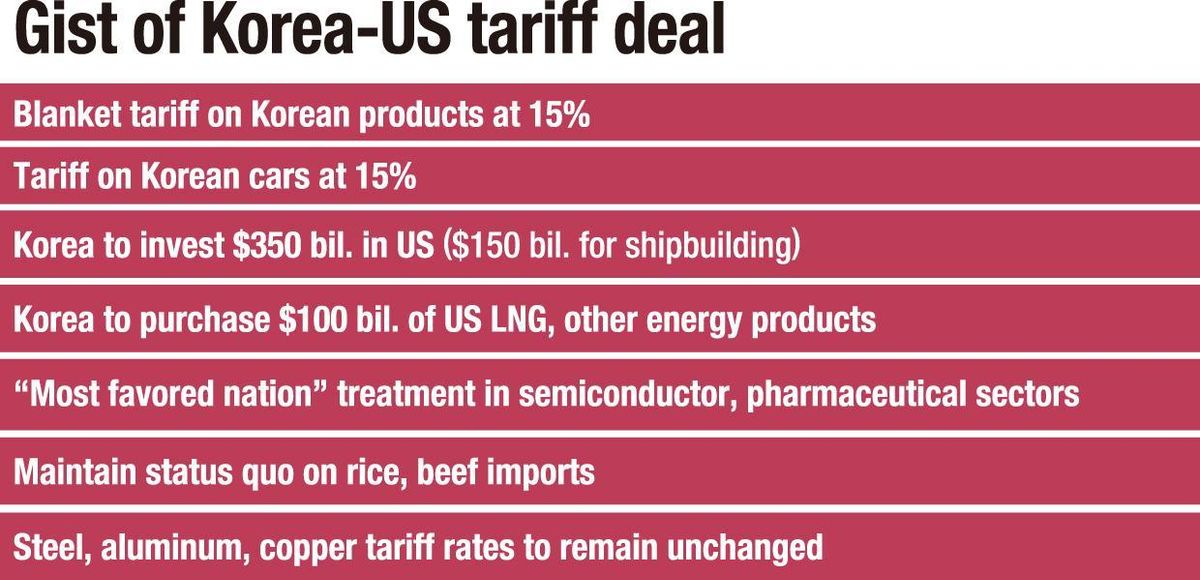
Useful graphic of the key points of the trade deal is at the link.
US lowers tariffs on Korea to 15% in return for $350 bil. in investments
https://www.koreatimes.co.kr/foreignaffairs/20250731/us-lowers-tariffs-on-korea-to-15-in-return-for-350-bil-in-investments
By Anna J. Park and Park Jae-hyuk
Published Jul 31, 2025 8:06 am KST
Updated Jul 31, 2025 5:29 pm KST
Last-minute deal comes as Korean negotiators meet Trump
Korea and the United States agreed to lower the latter's planned blanket duties on Korean products from 25 percent to 15 percent, Thursday, in return for a $350 billion investment in American industries.
The revised tariff rate is at the same level that Japanese and European products will face in the U.S. market.
The two nations also agreed on a 15 percent tariff on Korean car imports to the U.S., down from the 25 percent which has been already imposed. In addition, Korea will purchase $100 billion worth of liquefied natural gas (LNG) and other energy products from the U.S.
The tariff deal was signed after an unexpected meeting between U.S. President Donald Trump and negotiators from the Korean government at the White House on Wednesday (local time), two days before the beginning of Washington’s imposition of the “reciprocal” tariffs on Korean imports.
"I am pleased to announce that the United States of America has agreed to a Full and Complete Trade Deal with the Republic of Korea. The Deal is that South Korea will give to the United States $350 Billion Dollars for Investments owned and controlled by the United States, and selected by myself, as President," he wrote on his social media platform, Truth Social.
Earlier, Japan pledged $550 billion in investment and the European Union, $600 billion.
U.S. President Donald Trump signs a trade deal with Korea at the White House in Washington, D.C., Wednesday (local time). Captured from White House's X account
Saying that Korea will purchase $100 billion of energy products including LNG, Trump added that a forthcoming meeting with President Lee Jae Myung at the White House within the next two weeks will be a venue for the announcement of Korea’s investment of “a large sum of money.”
Shortly after the U.S. president’s announcement, Lee confirmed a deal had been reached.
In a statement shared via Facebook, the Korean president emphasized that the deal was a high-stakes task with tight deadlines and complex international conditions.
“The agreement eliminates key uncertainties facing Korean exporters and ensures U.S. tariff rates on Korean goods are equal to or lower than those faced by Korea’s major export competitors,” he emphasized, adding that Korea can compete on favorable terms in the U.S. market compared to key countries.
Lee also noted that $150 billion out of the $350 billion will be allocated to a dedicated shipbuilding cooperation fund, as Seoul proposed a cooperation initiative dubbed "Make American Shipbuilding Great Again" (MASGA). The Korean government said the cooperation is expected to boost the U.S.' shipbuilding industry as well as helping Korean shipbuilders further advance into the American market.
The remaining $200 billion will be spent on enhancing cooperation between the two countries in other strategic sectors such as semiconductors, rechargeable batteries, biotech and energy.
U.S. Commerce Secretary Howard Lutnick, who was main negotiator from the U.S., said the tariff on Korean cars was set at 15 percent, down from the earlier 25 percent levy.
While Trump said Korea "will accept American product including Cars, Trucks, Agriculture, etc,” Korea's presidential office denied any agreement to lower trade barriers to U.S. beef and rice imports, explaining that about 99.7 percent of the Korean agricultural market is already open to trade with the U.S.
The office also said the latest deal did not include easing regulations on U.S. tech firms, nor Korea’s participation in the Alaskan gas development project and its purchase of LNG from the U.S. state. Currency rates and matters related to defense cost sharing and purchase of U.S. weapons were not on the table either, according to the government.
Additionally, both governments confirmed that 50 percent sectoral tariffs on steel, aluminum and copper will remain unchanged. The U.S. did not lower its metal tariffs in its previous tariff agreements with Japan and the European Union either.
Korea and the U.S. will continue discussions to confirm further details about the tariff deal. They also agreed to keep talking about issues related to nontariff barriers.
10. 'Make American Shipbuilding Great Again' project touted as key contributor to tariff deal
MASGA
'Make American Shipbuilding Great Again' project touted as key contributor to tariff deal
https://www.koreatimes.co.kr/business/companies/20250731/make-american-shipbuilding-great-again-project-touted-as-key-contributor-to-tariff-deal
By Park Jae-hyuk
Published Jul 31, 2025 10:00 am KST
Updated Jul 31, 2025 6:14 pm KST
Seoul highlights $150 bil. investment in US shipbuilding as Washington remains silent
The government said Thursday its proposal to create a $150 billion fund aimed at revitalizing the American shipbuilding industry played an important role in securing a trade deal with the United States in Washington on Wednesday (local time), just before the Aug. 1 deadline.
Shortly after meeting U.S. President Donald Trump at the White House to finalize the deal, Deputy Prime Minister and Finance Minister Koo Yun-cheol told reporters in the U.S. capital that the so-called “Make American Shipbuilding Great Again” (MASGA) project was a key contributor.
“Recognizing Korean shipbuilders’ capabilities, Trump also requested immediate construction of new vessels in the U.S.,” Koo said.
The proposed $150 billion investment is part of a $350 billion fund to be invested by Korea in the U.S. in return for reducing “reciprocal” and auto tariffs to 15 percent. Before the deal, Washington had planned to start imposing 25 percent “reciprocal” tariffs on Korean imports on Aug. 1. It had already levied 25 percent item-specific tariffs on Korean cars.
A national security multi-mission vessel is under construction at Hanwha Philly Shipyard in Philadelphia, Pa., July 16. Courtesy of Hanwha Ocean
According to the government, the MASGA project includes construction of new shipyards in the U.S., training American shipyard workers, rebuilding supply chains related to shipbuilding and maintenance, repair and overhaul (MRO) of U.S. vessels.
President Lee Jae Myung wrote on social media that the project will help Korean firms expand their presence in the U.S. shipbuilding market. The finance minister added that Korean shipbuilders will ultimately be the main beneficiaries of the cooperation.
Industry Minister Kim Jung-kwan also told reporters in Washington that the U.S. is likely to ease regulations on foreign investments in its shipbuilding sector, citing the country’s strong intention to cooperate with Korean shipbuilders.
He added that U.S. Commerce Secretary Howard Lutnick praised the Korean negotiators for introducing the MASGA project to satisfy U.S. demand for shipbuilding partnership.
However, further details about the shipbuilding cooperation remain unknown. It is also unclear how Korea will raise the $150 billion.
The U.S. government has not commented on the shipbuilding cooperation.
Saying that Korea will accept American vehicles and agricultural products, Washington only highlighted Seoul’s plan to invest $350 billion in the U.S. and import energy products including liquefied natural gas.
Hanwha, which operates a shipyard in Philadelphia, said it will join the MASGA project for the development of both countries' shipbuilding industries.
"With the expansion of the Philly Shipyard, construction of new shipyards and additional MRO projects, we will lead the revival of the U.S. shipbuilding industry," the conglomerate said in a statement.
HD Hyundai said it will cooperate with the government for the MASGA project, once it is informed of further details.
On behalf of the shipbuilders, the Korea Offshore & Shipbuilding Association issued a statement welcoming the trade deal.
“The shipbuilding industry is proud of our contribution to the tariff deal,” the association said. “We expect the MASGA project to revive the U.S. shipbuilding industry and help us in finding new opportunities.”
Read More
How can Korea 'Make American Shipbuilding Great Again'?
China remains obstacle to US Navy ship maintenance at Gunsan yard
Despite the remaining uncertainty, shares of Hanwha Ocean and HD Hyundai Heavy Industries soared on Thursday due to optimism that the cooperation will help the Korean shipbuilders expand in the U.S. market.
Hanwha Group Vice Chairman Kim Dong-kwan also visited Washington earlier this week to support Korean negotiators, along with other conglomerate leaders including Samsung Electronics Executive Chairman Lee Jae-yong and Hyundai Motor Group Executive Chair Chung Euisun.
Trade Minister Yeo Han-koo, who was among the Korean negotiators, declined to comment on the business leaders’ roles, though he thanked them for their support.
11. DPRK AGITPROP AGGRESSION. DAVID MAXWELL, GORDON CHANG
My latest interview on the John Batchelor Show with Gordon Chang on Korea. https://audioboom.com/posts/8756661-dprk-agitprop-aggression-david-maxwell-gordon-chang
12. What's in the U.S.-South Korea Trade Deal?
What's in the U.S.-South Korea Trade Deal?
https://www.wsj.com/livecoverage/stock-market-today-dow-sp-500-nasdaq-07-31-2025-2/card/what-s-in-the-u-s-south-korea-trade-deal--lZipTqpNFVx5xxvLy4B6?page=1
50 min ago
By
Timothy W. Martin
and
Gavin Bade
A 15% headline tariff on South Korean goods. The deal removes uncertainty for Seoul, and tariffs are the same or lower than those on major trading peers, said President Lee Jae Myung.
Plus the same rate for cars. Autos from the likes of Hyundai face a 15% tariff—similar to the levies on Japanese and EU vehicles—and down from a proposed 25%, according to a senior Seoul official.
Duty-free treatment for the U.S. President Trump said U.S. exports to South Korea “will not be charged a tariff.”
A $350 billion U.S. investment commitment. South Korea has pledged some $200 billion of funding for chips, nuclear power, batteries and biotech, and $150 billion for shipbuilding, the Seoul official said. Trump said investments would be “owned and controlled” by the U.S.
Status quo for rice and beef. Seoul won't open its market further to U.S. rice or beef—moves that would have sparked significant backlash inside South Korea.
Safeguards for semiconductors and pharma. Trump has threatened extra tariffs on these industries, but South Korea has received “most-favored nation” treatment, the official said. This means South Korea won't face higher tariffs than other countries on those products.
Hyundai Motor Co. Ltd.
KR:005380 (S. Korea: KRX)
₩213000.00 KRW-10000.00-4.48%
KOSPI Composite Index
KR:180721 (Korea Exchange)
3245.44-9.03-0.28%
13. N. Korean man who crossed border in early July expresses wish to defect to South: official
N. Korean man who crossed border in early July expresses wish to defect to South: official | Yonhap News Agency
en.yna.co.kr · by Park Boram · July 31, 2025
SEOUL, July 31 (Yonhap) -- A North Korean man who crossed the inter-Korean border into South Korea in early July has expressed his wish to defect to the South, the unification ministry said Thursday.
South Korean troops secured the man on the night of July 3 in the mid-western part of the Demilitarized Zone separating the two Koreas after he crossed the heavily fortified Demarcation Line.
"During its participation in a joint government information investigation (into the man), the ministry has confirmed his intention to defect," a unification ministry official told reporters.
North Korean defectors are entitled to government support to resettle in South Korea, whose Constitution recognizes the entire Korean Peninsula as its territory and all Koreans as its nationals.
This graphic shows the inter-Korean border. (Yonhap)
pbr@yna.co.kr
(END)
en.yna.co.kr · by Park Boram · July 31, 2025
14. S. Korea permits private-level inter-Korean exchanges without restrictions
Will we see a Sunshine Policy on steroids?
S. Korea permits private-level inter-Korean exchanges without restrictions | Yonhap News Agency
en.yna.co.kr · by Park Boram · July 31, 2025
SEOUL, July 31 (Yonhap) -- South Korea has begun allowing its nationals to contact North Koreans without restrictions, provided such contacts are declared in advance, Unification Minister Chung Dong-young said Thursday.
Chung said he signed off on the disposal of ministry guidelines governing declarations of contacts with North Koreans the previous day, speaking to reporters on his way to the office earlier in the day.
Such guidelines had served as the basis for the government to reject civilians' bids for contact with North Korean nationals, contributing to the near-freeze in private-level inter-Korean exchanges in recent years.
The change allows ordinary South Koreans to engage freely with North Koreans, provided they declare such contacts to the ministry in advance, a requirement stemming from the fact that the two Koreas technically remain at war, with only an armistice having halted the 1950-53 Korean War.
"This (permits) full-range contacts at the private level," Chung said. "Free contacts between the peoples make mutual understanding possible, which can then lead to coexistence."
The minister said a National Security Council meeting scheduled for early August will include a review of a potential adjustment to the large-scale South Korea-U.S. military exercise Ulchi Freedom Shield.
Earlier this week, Chung told reporters that he plans to propose adjusting the joint military exercise, scheduled for mid-August, to President Lee Jae Myung as part of efforts to improve ties with North Korea.
Unification Minister Chung Tong-young speaks during his inauguration ceremony in Seoul on July 25, 2025. (Yonhap)
pbr@yna.co.kr
(END)
en.yna.co.kr · by Park Boram · July 31, 2025
15. Lee-Trump summit expected in US within 2 weeks
The military cost sharing agreement is currently $1 billion. Should defense cost sharing pressure be a significant issue at the Summit?
After the $350 billion POTUS controlled investment fund?
After the $150 billion shipbuilding investments?
After the $100 billion in energy purchases?
Lee-Trump summit expected in US within 2 weeks - The Korea Times
The Korea Times · by ListenListenText SizePrint
- Foreign Affairs
Lee-Trump summit expected in US within 2 weeks
President Lee Jae Myung delivers a special lecture to senior government officials at Government Complex Seoul, Thursday. Yonhap
By Anna J. Park
- Published Jul 31, 2025 4:22 pm KST
- Updated Jul 31, 2025 4:47 pm KST
The Korea Times · by ListenListenText SizePrint
By Anna J. Park
Published Jul 31, 2025 4:22 pm KST
Updated Jul 31, 2025 4:47 pm KST
Lee, Trump to discuss security issues, further tariff details
President Lee Jae Myung is set to have a bilateral meeting with U.S. President Donald Trump soon, as the two nations agreed on the meeting while reaching a deal over the U.S. tariff on Korean goods, Thursday.
It will be the first face-to-face meeting between the two leaders. They are expected to discuss further details about the tariff agreement as well as security issues that were not addressed in the deal.
Trump announced the upcoming summit via his Truth Social account, disclosing plans to host Lee in Washington in the coming days.
Mentioning the agreements of Korea's $350 billion investment and $100 billion worth of liquefied natural gas and other energy purchases, the U.S. president said further details of the tariff deal would be finalized and announced during the upcoming summit.
“This sum will be announced within the next two weeks when the President of South Korea, Lee Jae Myung, comes to the White House for a Bilateral Meeting,” Trump wrote. “I would also like to congratulate the new President on his electoral success.”
Kim Yong-beom, presidential chief of staff for policy, speaks during a press briefing at the presidential office in Seoul, Thrusday. Yonhap
Kim Yong-beom, presidential chief of staff for policy, speaks during a press briefing at the presidential office in Seoul, Thrusday. Yonhap
Korea's presidential office also confirmed the summit plan, saying both governments are expected to finalize the date and format of the summit imminently.
“I believe the exact date will be decided soon through diplomatic consultations between Korea and the U.S.,” Kim Yong-beom, presidential chief of staff for policy, said during a press briefing.
Lee was initially considering taking vacation during the first week of August, and with diplomatic and logistical arrangements still in motion, observers speculate that the summit may take place between Aug. 11 and 15. However, late next week still remains a possibility.
U.S. President Donald Trump speaks at an event to promote his proposal to improve Americans' access to their medical records in the East Room of the White House in Washington, Wednesday (local time). AP-Yonhap
U.S. President Donald Trump speaks at an event to promote his proposal to improve Americans' access to their medical records in the East Room of the White House in Washington, Wednesday (local time). AP-Yonhap
Kim explained that the specific sectors and amounts of Korea’s investments in the U.S. would likely be further discussed at the summit. He also confirmed that security and defense-related issues such as the purchase of U.S. weapons would likely be addressed during the summit.
“This trade deal was negotiated primarily under U.S. Secretary of Commerce Howard Lutnick and focused on commercial and investment issues,” Kim said. “Issues like defense spending and arms procurement are separate and are expected to be discussed during the summit."
His comments were in response to earlier speculations that the two nations might link trade and security issues, especially defense costs, together as a "package deal" — which was clearly not the case this time.
Kim noted that Trump directed Secretary of State Marco Rubio to schedule the meeting as early as next week. However, due to logistical considerations, the summit is expected to take place within the next two weeks.
Deputy Prime Minister and Finance Minister Koo Yun-cheol also said it was Trump who proposed the meeting with Lee.
“President Trump seemed very eager to meet President Lee,” Koo said during a press briefing with Korean correspondents at the Korean Embassy in Washington, D.C., Wednesday (local time).
Deputy Prime Minister and Minister of Economy and Finance Koo Yun-cheol, center, reads a statement during a press briefing at the Korean Embassy in Washington, D.C., Wednesday (local time.) On the left is Industry Minister Kim Jung-kwan, and on the right is Minister of Trade Yeo Han-koo. Courtesy of Ministry of Economy and Finance
Deputy Prime Minister and Minister of Economy and Finance Koo Yun-cheol, center, reads a statement during a press briefing at the Korean Embassy in Washington, D.C., Wednesday (local time.) On the left is Industry Minister Kim Jung-kwan, and on the right is Minister of Trade Yeo Han-koo. Courtesy of Ministry of Economy and Finance
August's bilateral summit will mark the first-ever face-to-face encounter between Lee and Trump, as they only talked over the phone on June 6, two days after Lee's inauguration.
The two were previously expected to meet during the G7 summit in Canada in mid-June. However, the meeting was canceled when Trump returned home early, citing escalating military tensions between Israel and Iran.
16. The worst has been avoided - The Korea Times
The worst has been avoided - The Korea Times
The Korea Times · by ListenListenText SizePrint
- Opinion
- Editorial
ED The worst has been avoided
A 3D-printed miniature model of U.S. President Donald Trump, the South Korea flag and the word "Tariffs" are seen in this illustration taken July 23. REUTERS-Yonhap
- Published Jul 31, 2025 12:23 pm KST
- Updated Jul 31, 2025 12:29 pm KST
The Korea Times · by ListenListenText SizePrint
Published Jul 31, 2025 12:23 pm KST
Updated Jul 31, 2025 12:29 pm KST
Several issues remain to be cleared and resolved in Korea-US tariff talks
Korea’s prolonged trade negotiations with the United States took a dramatic turn on Thursday, just one day before the Aug. 1 deadline, after which U.S. President Donald Trump had threatened to impose a 25 percent tariff on all South Korean imports.
Under a newly struck deal between the two countries, the U.S. will impose a reduced 15 percent tariff on all Korean goods — 10 percentage points lower than initially threatened. In return, Korea agreed to invest $350 billion in the U.S. and to purchase $100 billion worth of liquefied natural gas (LNG) and other American energy products.
President Lee Jae Myung welcomed the agreement. In a Facebook post, he expressed relief, stating, “It’s a huge relief that South Korea has finally reached a tariff deal with the U.S. With this agreement, South Korean exporters can compete on a level playing field — or even better conditions, depending on the sector — with their counterparts from other major economies.”
Lee described the agreement as a “win-win” deal. “The two countries reached this agreement because their strategic interests aligned. The U.S. aims to revive its manufacturing sector, while South Korean exporters are looking to strengthen their presence in the U.S. market,” he wrote.
While the reduced tariff is seen as good news, the announcement has raised concerns over its accuracy and completeness. Some details of the agreement remain ambiguous, with differing interpretations from both sides about what was actually agreed upon behind closed doors.
One major area of contention is Korea’s import policy on rice and beef. The two sides offered starkly different explanations.
In a briefing, Kim Yong-bum, presidential chief of staff for policy, stated that both countries agreed Korea would not further open its rice and beef markets. “It’s true that the U.S. pressured us to further open our rice and beef markets. But both sides later agreed to maintain the status quo due to concerns over food security and the sensitivity of agricultural issues,” Kim said.
Currently, Korea only imports U.S. beef from cattle under 30 months old. Kim’s remarks suggest that these regulations will remain unchanged, and that imports of older U.S. beef will not be permitted.
However, Trump offered a conflicting account. “It is also agreed that South Korea will completely OPEN TO TRADE with the United States and that they will accept American products including Cars and Trucks, Agriculture, etc.,” he wrote on his Truth Social platform.
When asked to respond to Trump’s statement, Kim downplayed the comment. “He is a politician, and politicians are political. I interpreted his remarks in that context. What matters more is what the negotiators discussed and agreed on during their talks,” he said.
Kim’s explanation, however, has done little to ease the concerns of Korean farmers, who fear that the rice and beef markets could be fully opened under U.S. pressure.
Given that Trump sits at the top of the U.S. decision-making hierarchy, his interpretation carries significant weight. It is therefore imperative that Korean negotiators seek clarification to confirm whether Trump’s public remarks reflect the actual terms of the agreement.
Another critical issue that requires further clarification involves the $350 billion Korea has agreed to invest in the U.S.
According to the presidential office, the fund is intended to create more opportunities for Korean companies operating in the U.S. market. However, Trump’s comments on social media have cast doubt on that interpretation.
In his post, Trump stated that South Korea will provide $350 billion in investments “owned and controlled by the U.S. and selected by” him as president. This raises concerns about whether the projects will truly serve the interests of Korean businesses. If the investment is to be directed by the U.S. president and designed to align primarily with American priorities, the benefits for Korean exporters may be limited.
Adding to the uncertainty, the presidential office has remained silent regarding Trump’s claim of an additional, unspecified investment.
According to Trump, Korea has agreed to commit a “much larger sum” for investment purposes in the U.S., with the exact figure to be announced during Lee’s upcoming visit to the White House. “This sum will be announced within the next two weeks when the President of South Korea, Lee Jae Myung, comes to the White House for a Bilateral Meeting,” Trump wrote.
If accurate, this would suggest that Korea’s total investment in the U.S. could significantly exceed the $350 billion figure previously disclosed.
In light of these conflicting accounts, the presidential office must clarify the scope and purpose of any additional investments. The Korean public, as taxpayers, has a right to know how national funds are being allocated — especially when such large sums are involved and when the details remain murky.
Transparent communication is essential to maintaining public trust, particularly in matters of international finance and diplomacy that could impact the country’s long-term economic interests.
17. Seoul’s moment to lead on North Korean human rights
Sobering analysis. Human rights are a moral imperative and a national security issue. We must have a united human rights upfront approach. Unification forst, then denuclearization; the path to unification is through human rights.
Excerpts:
A fractured order
The liberal international order is faltering under the weight of intensifying great power rivalry. Nowhere is this more evident than in the Indo-Pacific. U.S. retrenchment has accelerated sharply: In July 2025, the Trump administration dissolved the U.S. Agency for International Development and slashed 70 percent of the U.S. Agency for Global Media’s budget, effectively dismantling VOA’s global presence and ending RFA’s operations. These cuts have left a vacuum — one authoritarian regimes are rapidly moving to fill.
Historically, U.S. leadership was pivotal in elevating North Korean human rights on the global agenda. The success of the 2014 COI was due in no small part to Washington’s diplomatic weight. That influence is now in decline. A 2025 RAND study projects U.S. global influence could shrink by 30 percent by 2030 if value-based alliances are abandoned.
South Korea is uniquely positioned to step in. As a vibrant democracy, a technological leader and a rising middle power, it has both the capacity and the moral authority to lead. At the 2025 U.N. General Assembly High-Level Week in September, Seoul should call for an International Criminal Court referral of North Korea’s crimes and propose a new investigative mechanism modeled on the U.N.’s Syria-focused IIIM (International, Impartial and Independent Mechanism), to archive evidence for future accountability.
At the same time, Seoul must help restore the flow of truth into the North. History shows that information can catalyze regime change: In 1989, East Germans — emboldened by West German broadcasts — took to the streets and brought down the Berlin Wall. A similar information awakening could one day transform North Korea.
A moral imperative
At its core, North Korea’s appalling human rights conditions have driven countless people to flee in search of freedom. These are not distant strangers — they are family. More than 1,000 separated families remain in the South. Some 50,000 South Korean prisoners of war are unaccounted for. More than 500 South Koreans are believed to have been abducted by the North. Their stories — and those of the 34,000 defectors now living in South Korea — demand more than sympathy; they demand action.
In a deeply fractured world, South Korea’s voice carries weight. Seoul can revive international support for justice, empower the long-stalled North Korean human rights foundation, fund new information channels and press global institutions to act. It can champion a new model of human rights diplomacy, one that is not reactive but proactive in building coalitions, shaping norms and reaffirming that democratic leadership in Asia is not only possible but essential.
This is more than a moral duty. It is a strategic vision: a unified Korea achieved not through force, but through freedom.
Seoul’s moment to lead on North Korean human rights - The Korea Times
The Korea Times · by ListenListenText SizePrint
- Opinion
Seoul’s moment to lead on North Korean human rights
By Lee Shin-wha
- Published Jul 31, 2025 11:10 am KST
The Korea Times · by ListenListenText SizePrint
By Lee Shin-wha
Published Jul 31, 2025 11:10 am KST
Lee Shin-wha
Lee Shin-wha
Approximately 70,000 people are currently imprisoned in North Korea’s concentration camps. The regime uses revenue from their forced labor to fund the very missile programs that put nearly 10 million residents of Seoul at risk.
Meanwhile, Pyongyang’s crimes grow increasingly invisible. Russia’s U.N. veto and the U.S. Donald Trump administration's deep budget cuts to Voice of America (VOA) and Radio Free Asia (RFA) have dismantled some of the last remaining channels that once pierced the regime’s information blockade.
Amid this global silence, Seoul has a chance to lead. For President Lee Jae Myung, who was sworn in on June 4 just one day after winning the presidential election, North Korean human rights must not be a peripheral concern. They are a strategic linchpin connecting national security, international norms and moral responsibility. Now is South Korea’s moment to step forward.
A shared front
Human rights in North Korea are not merely a humanitarian issue; they are central to regional stability and rules-based international order. The 2014 U.N. Commission of Inquiry (COI) documented “systematic, widespread and gross” violations — an indictment that remains just as chilling today. A 2024 U.N. report found that North Korea’s concentration camps generate $2 billion annually, directly funding Pyongyang’s nuclear weapons and missile programs. A 2025 study by the Stockholm International Peace Research Institute reported a 20 percent surge in missile tests since 2023, many capable of striking South Korea and beyond.
But North Korea’s arsenal isn’t limited to missiles. Its most enduring weapon is information control. Citizens risk death simply for tuning in to foreign broadcasts —acts that suggest Pyongyang fears truth more than firepower. Since Russia deployed North Korean troops to Ukraine in 2024, the regime’s clampdown on information has only intensified, buoyed by alliances with authoritarian states and China’s growing regional influence.
Seoul must respond strategically. The Multilateral Sanctions Monitoring Team, launched in 2024, can use high-resolution satellite imagery and defector testimony to expose illicit financial networks. South Korea should also discreetly support alternative radio and digital platforms modeled after VOA and RFA, filling the vacuum left by the U.S. retreat.
The cost of inaction is high. According to a 2025 estimate by the Center for Strategic and International Studies, a conflict in the Taiwan Strait could trigger $2 trillion in global economic losses. Stability in Asia cannot be separated from the defense of freedom.
A fractured order
The liberal international order is faltering under the weight of intensifying great power rivalry. Nowhere is this more evident than in the Indo-Pacific. U.S. retrenchment has accelerated sharply: In July 2025, the Trump administration dissolved the U.S. Agency for International Development and slashed 70 percent of the U.S. Agency for Global Media’s budget, effectively dismantling VOA’s global presence and ending RFA’s operations. These cuts have left a vacuum — one authoritarian regimes are rapidly moving to fill.
Historically, U.S. leadership was pivotal in elevating North Korean human rights on the global agenda. The success of the 2014 COI was due in no small part to Washington’s diplomatic weight. That influence is now in decline. A 2025 RAND study projects U.S. global influence could shrink by 30 percent by 2030 if value-based alliances are abandoned.
South Korea is uniquely positioned to step in. As a vibrant democracy, a technological leader and a rising middle power, it has both the capacity and the moral authority to lead. At the 2025 U.N. General Assembly High-Level Week in September, Seoul should call for an International Criminal Court referral of North Korea’s crimes and propose a new investigative mechanism modeled on the U.N.’s Syria-focused IIIM (International, Impartial and Independent Mechanism), to archive evidence for future accountability.
At the same time, Seoul must help restore the flow of truth into the North. History shows that information can catalyze regime change: In 1989, East Germans — emboldened by West German broadcasts — took to the streets and brought down the Berlin Wall. A similar information awakening could one day transform North Korea.
A moral imperative
At its core, North Korea’s appalling human rights conditions have driven countless people to flee in search of freedom. These are not distant strangers — they are family. More than 1,000 separated families remain in the South. Some 50,000 South Korean prisoners of war are unaccounted for. More than 500 South Koreans are believed to have been abducted by the North. Their stories — and those of the 34,000 defectors now living in South Korea — demand more than sympathy; they demand action.
In a deeply fractured world, South Korea’s voice carries weight. Seoul can revive international support for justice, empower the long-stalled North Korean human rights foundation, fund new information channels and press global institutions to act. It can champion a new model of human rights diplomacy, one that is not reactive but proactive in building coalitions, shaping norms and reaffirming that democratic leadership in Asia is not only possible but essential.
This is more than a moral duty. It is a strategic vision: a unified Korea achieved not through force, but through freedom.
A call to courage
To lead, South Korea must act with clarity and resolve. It should convene a strategic summit with Trump to align on shared goals. It must rally democratic allies at the United Nations and expand funding for covert information outreach to the North. These are not merely policy options — they are strategic imperatives.
Above all, Seoul must honor the civil society groups, defectors and families of the disappeared who have kept the flame of justice alive. Their courage reminds us that the North Korean people do not need saving — they need space to rise. South Korea must help create that space.
The world is watching. Now is Seoul’s moment to lead.
Lee Shin-wha is professor of Department of Political Science and International Relations at Korea University and director of Institute for Interdisciplinary Unification Studies.
18. The 'Impossible' Price of a Peace Deal With North Korea
Some important analysis from Professor Kelly. However I have to strongly disagree with him on one point in this excerpt.
Excerpt:
All of these possible concessions from the North – nuclear or conventional retrenchment, human rights improvement, and so on – would be huge successes for Trump and might earn him his much-coveted Nobel
None of this will win anyone the Nobel for Korea. The only thing that will win the Nobel for Korea is solving the "Korea question" – the unnatural division of the peninsula and the establishment of a free and unified Korea. Those who contribute to that will not only solve the nuclear threat but they will win the Nobel. Nothing short of a free and unified Korea will result in a Nobel.
The 'Impossible' Price of a Peace Deal With North Korea
nationalsecurityjournal.org · by Robert E. Kelly · July 30, 2025
5 Key Points – A grand peace deal between President Trump and North Korea remains nearly impossible.
-The core problem is Pyongyang’s central demand: formal recognition as a legitimate nuclear weapons state.
-For the U.S., accepting this would be a catastrophic blow to global non-proliferation, effectively giving a green light to other rogue states like Iran.
-While other issues like North Korea’s support for Russia or its human rights record could be negotiated, the fundamental obstacle remains.
-The U.S. has little to offer that would satisfy Pyongyang short of an unthinkable concession, like withdrawing all U.S. troops from South Korea.
Why Would Trump Negotiate with North Korea Now?
United States President Donald Trump has long sought to negotiate with North Korea. In his first term, he met North Korean supreme leader Kim Jong-un three times. Nothing came of those meetings, but Trump genuinely seems to want a reputation as a peacemaker. He clearly wants a Nobel Peace Prize—if only for the acclaim, and because former President Barack Obama won the coveted award.
But the larger point still stands. Trump seems to want to resolve the US-North Korean stand-off genuinely. But the issues between the two sides are deep and genuine. And this week, Kim’s sister reminded us all of the core divide: Pyongyang wants Trump to recognize North Korea as a legitimate nuclear weapons state.
This is very tricky. Were Trump to do so, he would signal to other potential nuclearizers—most obviously Iran—that if they too nuke up, then the US will eventually accept them too. Trump is unlikely to agree to that, making another round of Trump-Kim summitry unlikely.
North Korea’s Illegal Nuclear Weapons Program
The closest thing in world politics to ‘law’ regarding nuclear weapons is the Nonproliferation Treaty (NPT). The treaty designates five countries—America, Russia, China, France, and Britain—as legitimate or recognized nuclear weapons states. Other signatories agree not to develop nukes in exchange for civilian nuclear assistance.
North Korea was briefly in the NPT and then withdrew after the hermit kingdom was caught cheating. The United Nations Security Council then declared the North’s nuclear and missile programs illegal and started sanctioning Pyongyang over them. Nevertheless, the North persisted, overcoming massive international resistance. Since 2006, it has had nuclear weapons; since 2017, it has had missiles that can reach the continental United States.
While Kim’s sister is correct that North Korea will likely never revert to non-nuclear status, formal recognition of that status would be a substantial blow to the nonproliferation regime. It would signal to other countries considering nuclear weapons that the US might come to accept their nuclearization in time, too. North Korea could be a model for nuclear-curious rogue states to get both the weapons and acceptance.
Hence, Trump insisted on denuclearization back in 2018-19 when he met Kim. And his second administration has stuck to that demand as well.
Can Trump Get Anything from North Korea Now?
Given the high costs of engaging North Korea, it seems unlikely Trump will try. Trump faces multiple other crises in Europe and the Middle East that engage him. And he likely does not want a repeat of 2018-19, when all the hype and media attention still resulted in nothing. But perhaps Trump could negotiate around the nuclear question, ignoring it for the moment. There are other outstanding issues he could address:
North Korea’s participation in Russia’s invasion of Ukraine
One reason North Korea is likely playing hard-to-get with Trump now is that it enjoys better patronage than it has in decades. China has long deflected the toughest US pressure on North Korea, but it has also worked with the US occasionally on North Korea. Beijing clearly fears being pulled into a US-North Korea conflict and tries to control the North’s worst instincts. By contrast, Russia today has much less to lose by wholeheartedly supporting North Korea. Trump could negotiate for a greater distance between Pyongyang and Moscow.
North Korean conventional power
The North’s nuclear weapons garner the most attention, but its conventional power clustered near South Korea’s capital is a considerable threat, too. Trump could negotiate for a pullback of North Korean artillery from the demilitarized zone. This, in fact, was one of the issues discussed in the diplomacy of Trump’s first term. Nothing came of it.
North Korean human rights
North Korea’s human rights record is appalling. This is a well-known, enduring problem. Trump often claims to be a friend of Kim. If Trump could convince his friend to lighten up the regime’s repression – a strategically low-cost move for the North – it would go a long way to improving North Korea’s global reputation – and the willingness of other countries to engage it.
What Would Trump Give Up?
All of these possible concessions from the North – nuclear or conventional retrenchment, human rights improvement, and so on – would be huge successes for Trump and might earn him his much-coveted Nobel. But the same problem that undercut 2018-19’s denuclearization diplomacy exists today—what would the US give up in return? Sanctions rollback is not enough. The North has rejected that before as too little. Trump must come up with something much more dramatic (and contentious)—like withdrawing the US military from South Korea.
Generating a counter-concession package would require a major campaign to sell those losses to domestic and foreign audiences, and Trump has not yet begun to develop one.
About the Author: Dr. Robert Kelly
Dr. Robert E. Kelly is a professor of international relations in the Department of Political Science and Diplomacy at Pusan National University in South Korea. His research interests focus on security in Northeast Asia, U.S. foreign policy, and international financial institutions. He has written for outlets including Foreign Affairs, the European Journal of International Relations, and the Economist, and he has spoken on television news services including BBC and CCTV. His personal website/blog is here; his Twitter page is here.
More Military
We Almost Touched the F-117 Stealth Fighter
We Almost Touched the D-21 Mach 3 Drone
The Challenger 3 Tank Has Math Issues
In this article:
Written By Robert E. Kelly
Robert E. Kelly is a professor of international relations in the Department of Political Science and Diplomacy at Pusan National University.
nationalsecurityjournal.org · by Robert E. Kelly · July 30, 2025
19. North Korea-Russia alliance more than a 'brotherhood of arms'
To resist western domination.
An interesting point here with tIran comparison. Can we exploit this?
Excerpts:
North Korea’s confidence in its Russian ally may have taken a hit from Moscow’s failure to come to the defense of Iran. But North Koreans may also feel this pact is much more substantial and, in any case, their nuclear capability gives them protection that Iran lacked.
...
Some analysts have argued that the alliance with Russia is essentially transactional, fueled by Moscow’s need for Korean weapons and soldiers to prosecute the war in Ukraine.
“Most immediately, North Korea’s current level of trade with Russia is unlikely to last after hostilities in Ukraine end,” Andrei Lankov, a respected Russian analyst long based in South Korea, wrote in a recent essay in Foreign Affairs.
“Indeed, Moscow’s financial flows to Pyongyang could wind down almost overnight. Aside from munitions, there isn’t much of a trade opportunity between the two countries; the two economies are fundamentally incompatible,” Lankov said.
In this view, North Korea, worried about its dependence on China, could then seek ties with the US, even South Korea, responding to overtures from both the Trump administration and the new administration in Seoul.
The deepening of ties and the Russian embrace of Kim Jong Un’s concept of a permanent division of the Peninsula, along with a dramatic reversal of their support for denuclearization, suggest otherwise.
For the foreseeable future, Russia has become a backer of a status quo marked by hard lines of division globally and in Korea. And in its most visionary terms, Russians see this as a cornerstone of their bid to create a viable alternative to the US-led international system.
North Korea-Russia alliance more than a 'brotherhood of arms' - Asia Times
Shared mission to resist Western dominance evolving into comprehensive partnership that breaks in areas with China
asiatimes.com · by Daniel Sneider · July 30, 2025
The three-day visit earlier this month of Russian Foreign Minister Sergei Lavrov to the North Korean coastal city of Wonsan marked a noticeable intensification of a strategic relationship between the two neighbors.
The sheer trappings of the visit—from lavish treatment at newly opened resort to a tete-a-tete aboard North Korean leader Kim Jong Un’s yacht—sent that message. And it was accompanied by other symbols of tightening ties, from renewed rail and air flight links to ballyhooed visits of Russian tourists to the resort and the dispatch of North Korean artificial intelligence (AI) researchers to Russia.
As a result of signing a treaty in June 2024, Lavrov told Russian reporters, “we became allies.” But now there is a “deepening of ties…rooted not only in our geographic proximity but also in our alignment on key issues,” not least on the Ukraine war and on countering American presence in the Indo-Pacific.
Lavrov spoke about a “brotherhood of arms,” about Russian readiness to defend North Korea and “jointly resist the hegemonic aspirations of extra-regional players.”
While the war with Ukraine served as the catalyst for this “brotherhood,” as the North Koreans stepped up to provide Russia with crucial supplies of men and material at a moment last year when their campaign was faltering, it is by no means the only driver of their growing bilateral cooperation.
Their shared mission to resist Western dominance and the mutual economic and political benefits that are forming between these two countries may serve as a cornerstone for a new world order.
Growing Russia-North Korea Cooperation
The massive transfer of North Korean weapons and the deployment of more than 11,000 troops to the Ukraine frontlines is the most visible sign of their alignment.
North Korea provided a crucial influx of millions of artillery rounds as well as more than 100 ballistic missiles which have been raining down on Ukrainian cities. It is a two-way street, with sharing of Russian military technology, particularly drones, in return.
Russian oil and food flows freely, effectively nullifying the United Nations (UN) sanctions regime. This is documented in a recent detailed report on “Unlawful Military Cooperation including Arms Transfers between North Korea and Russia,” issued in late May by the 11-nation Multilateral Sanctions Monitoring Team.
Less strategic, but increasingly important, is the flow of North Korean workers to Russia, also in violation of UN sanctions. According to an investigative report by the émigré Russian journal “The Insider,” some “thousands of North Koreans are entering Russia, posing as students on ‘practical training,’ but instead coming to labor under slave-like conditions.”
In the Russian Far East, “North Koreans are very much back,” at levels not seen since before Covid-19, according to a Russian scholar based in Vladivostok, in an email exchange.[1]
Deeper than Arms
The illicit transfers are significant, but there are other shifts in Russian policy that may be even more consequential.
Russia, once a stalwart protector the nuclear non-proliferation regime, has now nakedly endorsed the legitimacy of North Korea’s nuclear weapons program, something even China has balked at doing.
Asked by Russian reporters to comment on what conclusions Pyongyang may have drawn from the US attack on Iran’s nuclear facilities, the veteran Russian diplomat gave the nuclear status of the Democratic People’s Republic of Korea (DPRK) a blanket approval:
The DPRK leadership drew its conclusions regarding national defence long before the recent US-Israeli strikes on the Islamic Republic of Iran. It is precisely because those conclusions were made in a timely manner that no serious actor contemplates a military strike against the DPRK today.
Nevertheless, we are witnessing ongoing military buildup around the Korean Peninsula, driven by the United States in coordination with South Korea and Japan. We caution against the misuse of alliances and partnerships as tools of confrontation, including any efforts to direct them against the DPRK or the Russian Federation.
The technologies applied by the Democratic People’s Republic of Korea are a result of efforts by North Korean scientists. We respect the DPRK’s actions and understand the reasons why they carry out their nuclear programme.
While the Russians have avoided direct aid to the North Korean nuclear program, they have cleared the way to assistance and technology transfer to assist nominally civilian satellite development and launch efforts.
“The provision of technologies and know-how related to the satellite program is not completely prohibited in the eyes of Russia, since the exploration of outer space, from the point of view of Russia, is the legal right of the DPRK,” wrote leading Russia-Korea expert Georgy Toloraya following the Lavrov visit.
Perhaps equally important, the Russians have embraced Kim Jong Un’s policy shift toward abandonment of unification as a goal and opposition to any sustained engagement with South Korea.
“Russia has de facto recognized the legitimacy of Kim Jong-un’s concept of the existence of two separate, unfriendly states on the Korean Peninsula and the rejection of the idea of the unification of Korea, under the slogan of which South Korea has been planning to absorb the North for decades,” wrote Toloraya. The relationship with Pyongyang “lays the foundation for building a new Eurasian security system.”
For Russian strategists, North Korea has now acquired a status that is similar to Belarus, its military and political ally in the West. “This is precisely how the Kremlin sees North Korea these days: as an easternmost strategic bulwark of the Russia-led anti-Western security bloc,” says Igor Torbakov, a Senior Fellow at the Institute for Russian and Eurasian Studies at Uppsala University in Sweden.
Moscow’s backing only serves to reinforce the hardline coming out of Pyongyang toward the US, particularly their fierce rebuff of new overtures from the progressive Lee Jae Myung administration that has come to power in Seoul.
“No matter how desperately the Lee Jae Myung government may … pretend they do all sorts of righteous things to attract our attention and receive international attention, there can be no change in our state’s understanding of the enemy and they can not turn back the hands of the clock of the history which has radically changed the character of the DPRK-ROK relations,” Kim Yo Jong, the sister of Kim Jong Un, said this week.
Russia over China
On the surface, the Russian alliance with North Korea exists in parallel and even reinforces the long-standing alliance with China. It may even be seen as a tripartite axis in which all three countries share a goal of reducing the American presence and in countering the security cooperation structure of South Korea, Japan and the US.
But analysts have pointed to signs that Beijing is less than happy with the burgeoning Moscow-Pyongyang ties, avoiding direct comment on them and signaling indirectly their less-than-enthusiastic response.
“Beijing does not want North Korea to start a war or trigger increased US military deployments to the region, even though it may see North Korea as a useful way to distract the US-South Korea-Japan alliance from its focus on the PRC,” a recent report from the Institute for the Study of War concluded. “Moscow has less interest than Beijing in maintaining stability on the Korean Peninsula and may embolden North Korea to increase its bellicosity.”
Russian analysts counter that their alliance is a force for stability, not a spur to North Korean adventurism.[2] Russian assistance to North Korea’s conventional warfare capability strengthens the balance of power on the Korean Peninsula and in the Northeast Asian region, they argue.
But Russian experts also provide support to the idea that there is a rivalry with Beijing at work. Compared to the security ties with Russia, the long-standing alliance with China, formalized in a 1961 treaty, offers little in terms of security and is a faux alliance, argued Russian scholar Artyom Lukin from the Far Eastern Federal University in Vladivostok.
“China will likely remain Pyongyang’s main economic partner and benefactor, but there is little reason for Beijing to empower Pyongyang with large-scale military assistance,” Lukin wrote in a paper presented on July 17th to a conference at Seoul National University. “For one, Beijing does not want to antagonize Washington, Seoul, and Tokyo by transferring weapons and military-related technology to Pyongyang.”[3]
Lukin suggests that Chinese interest in North Korea as an ally is waning and that they may even abandon it in favor of South Korea.
It’s not inconceivable that Beijing might eventually conclude a Korea unified under Seoul—provided it remains friendly or at least neutral toward China—is preferable to a divided peninsula with its constant risk of major conflict.
Pyongyang cannot but suspect that, sooner or later, Beijing will throw the Kims under the bus. Regardless of what is going to happen in the future, the 1961 alliance of China and North Korea has long been hollow.
The Russian scholar, a widely cited expert on geopolitics and the region, as well as US foreign policy, also points to another advantage held by Moscow—the close personal relationship between Kim Jong Un and Russian leader Vladimir Putin.
“Kim feels at ease with Putin, even though he shows due respect to the Russian czar,” he told the South Korean conference. “He will never be comfortable with the Chinese emperor.”
North Korea’s confidence in its Russian ally may have taken a hit from Moscow’s failure to come to the defense of Iran. But North Koreans may also feel this pact is much more substantial and, in any case, their nuclear capability gives them protection that Iran lacked.
Russia-North Korea alliance implications
What are the implications of the alliance for the future of the Korean peninsula? Does it make North Korea more adventurous, or more confident in its power? Does it create better conditions for Pyongyang to engage in diplomacy with the United States and Seoul? Or the opposite?
Some analysts have argued that the alliance with Russia is essentially transactional, fueled by Moscow’s need for Korean weapons and soldiers to prosecute the war in Ukraine.
“Most immediately, North Korea’s current level of trade with Russia is unlikely to last after hostilities in Ukraine end,” Andrei Lankov, a respected Russian analyst long based in South Korea, wrote in a recent essay in Foreign Affairs.
“Indeed, Moscow’s financial flows to Pyongyang could wind down almost overnight. Aside from munitions, there isn’t much of a trade opportunity between the two countries; the two economies are fundamentally incompatible,” Lankov said.
In this view, North Korea, worried about its dependence on China, could then seek ties with the US, even South Korea, responding to overtures from both the Trump administration and the new administration in Seoul.
The deepening of ties and the Russian embrace of Kim Jong Un’s concept of a permanent division of the Peninsula, along with a dramatic reversal of their support for denuclearization, suggest otherwise.
For the foreseeable future, Russia has become a backer of a status quo marked by hard lines of division globally and in Korea. And in its most visionary terms, Russians see this as a cornerstone of their bid to create a viable alternative to the US-led international system.
As Toloraya concluded, “the Russian-North Korean alliance could become a factor in the creation of a new system of security and cooperation in Northeast Asia.”
Notes
- Daniel Sneider, email exchange with author.
- Artyom Lukin, “The New geopolitics of the Korean Peninsula and Beyond: a view from Russia,” (paper presented at Far Eastern Federal University to the CR Life Foundation Special conference “The Global Context Surrounding the Korean Peninsula and Korea’s Choice for Peace,” Seoul, Republic of Korea, July 17, 2025).
- Ibid.
This article first appeared on 38 North and is republished with kind permission. Read the original here.
asiatimes.com · by Daniel Sneider · July 30, 2025
20. US tariff deal clears way for Korea’s stablecoin dream
I frankly do not understand this aspect of economics and finance.
US tariff deal clears way for Korea’s stablecoin dream - Asia Times
Leader Lee can turn to boosting crypto innovation and making Korea a digital asset hub with Trump fear in the rearview mirror
asiatimes.com · by William Pesek · July 31, 2025
TOKYO – As new South Korean President Lee Jae Myung sets out to revamp Asia’s fourth-biggest economy, he can cross direct US tariff risks off the list of possible spoilers.
Korea’s tariff deal with the US removes a gigantic element of uncertainty as Lee gets to work raising Korea’s economic game. Though the 15% tax on US-bound goods will hurt, getting the uncertainty factor out of the way will enable Korea Inc to move forward.
“It is a case of the worst avoided, with a pinch of relief removing Korea-specific tariff risks,” says Kathleen Oh, chief Korea economist at Morgan Stanley. “It puts Korea on level ground with its export competitors in the US, especially for autos.”
Eurasia Group analyst Jeremy Chan notes that Korea’s agreement hews closely to the deal signed by Japan one week ago and is in line with his view that major US trading partners will be handed around 15% tariff rates.
Korea’s US$350 billion investment fund mirrors the $550 billion fund announced in Japan’s agreement, Chan notes. About 90% of the profits from the fund will reportedly go to the US—the same ratio that Japan received—which Korean officials interpret to mean that 90% of the fund’s profits will be re-invested in the US.
Like Japan, Chan notes, Korea’s fund will be made up almost entirely of loans and guarantees, with direct investment comprising only a very small portion. Korea’s commitment to purchase $100 billion in US energy exports will likely include offtake agreements for the Alaska LNG pipeline project that Japan is also exploring.
Now Lee will likely have the bandwidth to focus on his newest preoccupation: digital assets. Korean lawmakers are brawling over stablecoins, and the brouhaha couldn’t be better for the nation’s sudden embrace of the global digital assets boom.
The clash is less about whether Korea should become one of the region’s crypto-friendly economies in Asia. It’s about how to implement the new president’s vision for the broad-based issuance of won-backed stablecoins and give digital asset innovation a prominent place globally.
Korea joins Hong Kong in efforts to ramp up issuance via legislation. These legislative moves aim to avoid putting the cart before the proverbial horse in a nascent market sure to upend global currency dynamics. Creating trusted and transparent regulatory and licensing regimes will be key to building broader acceptance for the industry.
In Seoul’s case, Lee’s Democratic Party of Korea (DPK) and the opposition People Power Party (PPP) are pushing competing stablecoin bills in the National Assembly.
DPK member Ahn Do-gil introduced the Act on the Issuance and Distribution of Value-Stable Digital Assets, while the PPP’s Kim Eun-hye proposed the Act on Payment Innovation Using Value-Fixed Digital Assets.
Lee’s push marks his first real economic pivot from the disgraced Yoon Suk Yeol administration. In early April, the courts removed Yoon from office. This was five months after his reckless martial law declaration in December, for which PPP member Yoon was impeached.
When Lee’s DPK won election in June, the immediate goal was to make up for lost time to stabilize Asia’s fourth-biggest economy. Several months of political wrangling over Yoon’s fate were a lost period for moves to raise Korea’s competitive game.
In the interim, the economy shrank in the first quarter as the Kospi stock market gyrated. That left the Bank of Korea largely in the driver’s seat. Yet Lee’s stablecoin focus suggests his administration has hit the ground running.
Typically, Korean regulators are among the most cautious in Asia. All of which makes the Lee administration’s stablecoin gambit all the more unexpected.
As DPK lawmaker Min Byung-deok, a member of the National Assembly’s Political Affairs Committee, puts it, legislation now under consideration would allow non-financial companies to issue won-denominated stablecoins — and to do so beyond the Bank of Korea. The catch is that digital assets would operate under a clear legal framework.
Another catch: the BOK may still require some convincing. It worries Lee’s stablecoin vision will increase capital outflow risks.
Among legislators, provisions would also facilitate security token offerings (STOs) and pave the way for the creation of, and transacting in, spot market exchange-traded funds (ETFs) backed by virtual assets.
“The STO bill will first go through the standing committee next month,” Min says. Min adds that the presidential office’s chief policy aide, Kim Yong-beom, a blockchain expert, is “largely supportive of the bills.”
Korea isn’t setting the stage for a crypto free-for-all. It plans to tweak strict foreign currency transaction laws accordingly and strengthen oversight in the crypto market by the BOK and the Ministry of Economy and Finance.
The BOK must be empowered to play its role in maintaining financial stability,” says DPK member Ahn. “If stablecoins are used abroad, they become a form of foreign exchange. That means the finance ministry needs a legal foundation to exercise its authority.”
Ahn says the process will also be coordinated by the Financial Services Commission. President Lee’s team has ordered up a task force on stablecoin implementation.
Lee’s timing with these crypto reforms could be particularly favorable, as Korea Exchange is exploring digital ETFs, hoping to allow institutions to begin trading them as early as the third quarter.
Korea also joins Hong Kong in enjoying something of a first-mover advantage in one of the hottest areas of global finance, one still arguably in the frontier stages.
According to Paul Chan, Hong Kong’s financial security, the global market value of stablecoins is estimated at about $240 billion, with trading volume topping $20 trillion in 2024.
In Korea’s case, voters gravitated to Lee’s crypto-friendly platform. As of the end of 2024, Koreans held some $74.5 billion worth of digital assets.
On the campaign trail, Lee pledges to legalize and nurture digital ETFs, promote the widespread adoption of Korean won-backed stablecoins, streamline regulations to prevent capital flight and even allow the massive $884 billion National Pension Service to invest in digital assets.
Yet Lee must multitask in a hurry. Lee inherited an economy under pressure from global tariffs. Despite the US tariff deal, Trump has yet to reach a deal with China.
Even as Seoul takes a breather after notching tis tariff deal, it must brace for the shock waves if China refuses to grant Trump the “grand bargain” deal he seeks. That could see Trump turning his tariff policies up to 11, slamming Korea’s open, trade-reliant economy.
Over the last six months, BOK Governor Rhee Chang-yong’s rate cuts have been the glue holding a fragile economy together. Yet as the BOK cuts rates, it’s been limited by domestic constraints. Further rate cuts might encourage households to up borrowing activity.
Korea’s household debt-to-gross domestic product ratio of 91.7% was the second highest among major nations at the end of 2024. That’s the second highest among 38 Organization for Economic Cooperation and Development nations. Any step lower in BOK rates risks incentivizing households to increase debt, adding to Korea’s biggest imbalances.
The vacuum Yoon created left BOK’s team squarely in the driver’s seat. More and more, the central bank took the lead in managing one of the globe’s most open and dynamic major economies.
That has Rhee calling for economic reinforcements, urging the government to find a way to boost fiscal stimulus. “A supplementary budget is also key to addressing downside growth risks,” says Ashok Bhundia, economist at the Institute of International Finance.
The threat from China has only grown in other ways, too. For all China’s troubles, including a deflation-generating property crisis, China Inc continues to grab global market share, often at Korea’s expense.
A big problem is chronic complacency in Seoul. Yoon was the fourth Korean leader since 2008 who took power pledging to generate more economic energy from the ground up, not just the top down.
Generally, that meant taking on the “chaebol system” led by family-owned behemoths like Samsung that helped propel Korea into the ranks of the world’s top 12 economies.
The backdrop is that Korea Inc knows that so much of what it does well has been commoditized. China and other rising Asian powers are now rivals in cars, electronics, robots, ships and popular entertainment.
Taiwan is constantly raising its innovative game, while upstarts like Indonesia and Vietnam are making the race for tech “unicorn” startups more dynamic and competitive.
The best way for Korea to maintain its high living standards is to innovate in ways that propel the economy upmarket even faster. That’s why Yoon and the three leaders who preceded him pledged an innovative “big bang” to move Korea upmarket into higher-value sectors.
None of them, however, were able to upend the chaebols, which continue to monopolize the economic oxygen startups need to grow into world-beating game-changers.
Clearly, the Lee administration is eager to establish Korea as a global financial hub. And to incentivize a digital assets startup boom that disrupts the economy for the better.
Follow William Pesek on X at @WilliamPesek
asiatimes.com · by William Pesek · July 31, 2025
21. The real threat on Korean Peninsula: Chinese, North Korean political warfare
Voices July 30, 2025 / 12:38 PM
The real threat on Korean Peninsula: Chinese, North Korean political warfare
https://www.upi.com/Voices/2025/07/30/perspective-china-north-korea-political-warfare-south-korea/6451753890377/
By David Maxwell
North Korea's Kim Jong-Un (L) and China's Xi Jinping are both engaging in political warfare with South Korea. File Photo by KNCA/EPA
July 30 (UPI) -- Amid escalating tensions between conservatives and liberals in South Korea, and as the world fixates on North Korea's menacing nuclear arsenal, a more insidious threat is shaping the fate of the Korean Peninsula: sophisticated and largely covert political warfare orchestrated by the regimes in Beijing and Pyongyang.
While missile launches and rhetoric grab international headlines, China's strategy of "unrestricted warfare" and the Kim family's brand of "political warfare with Juche characteristics" are quietly undermining the Republic of Korea from within, eroding its democracy and threatening the pillars of the ROK-U.S. alliance.
Unrestricted warfare and "three warfares" in the Korean context
China's concept of "unrestricted warfare" -- popularized by the People's Liberation Army and operationalized through the Chinese Communist Party's United Front Work Department -- goes far beyond traditional battlefield engagement.
It includes a coordinated, all-domain campaign of "three warfares," psychological operations, legal, or lawfare, maneuvers and media/public opinion warfare. The goal of these tactics is clear: to weaken adversaries without firing a shot, minimize attribution and gain strategic dominance by sowing confusion, division and dependency in targeted societies.
In South Korea, the United Front Work Department plays a pivotal role in coordinating influence operations. The department actively seeks to suppress dissent against the Chinese Communist Party, monitor diaspora communities and foster loyalty among ethnic Chinese within South Korea.
Organizations such as the All-Korean Nationals of Chinese Descent Council mirror similar work department-aligned groups worldwide, cultivating pro-Beijing sentiment and integrating the community under CCP-friendly leadership.
Intelligence gathering, elite capture, economic coercion and technology transfer are just a few of the tactics employed to shape South Korean policy and public opinion in ways that align with Beijing's interests.
Political warfare with Juche characteristics: North Korea's hand
North Korea, under the Kim family regime, has long waged political warfare, guided by its own Juche ideology, as a core weapon against the South.
Pro-North Korean elements within South Korea, spanning political figures, civic organizations and clandestine networks pursue active subversion. Their efforts, sometimes lead to legal intervention, fuel political controversies and polarization, further complicating South Korea's internal dynamics.
These activities are not theoretical concerns; they are ongoing, with direct implications for key political events such as the snap presidential election held last June. Covert assistance from Pyongyang's United Front Department and the Reconnaissance General Bureau supports agents of influence in the South, aiming to delegitimize Seoul's democratic institutions and fracture the U.S.-ROK security partnership.
The subtle power of covert action
One of the defining qualities of Chinese and North Korean influence operations is mastery of covert action. Their tradecraft is designed around deniability: admit nothing, deny everything, and make counteraccusations to undermine any allegations of illicit activities.
The lack of overt evidence is not proof of innocence, but rather a hallmark of skillful subversion and effective tradecraft. When credible exposés or documentaries reveal such operations, well-coordinated attacks arise, not organically, but as orchestrated disinformation campaigns intended to discredit the truth and intimidate dissenters.
The almost instantaneous, highly synchronized responses to critical media coverage of Chinese or North Korean influence operations in South Korea reveal the depth of planning and forethought -- not spontaneous public backlash, but a calculated attempt to manipulate perceptions and stifle legitimate concerns.
Strategic objectives undermining democracy and the alliance
The objectives of China and North Korea are inextricably linked. Beijing views a weak or politically fractured South Korea as a strategic advantage, undermining U.S. influence in the region and shifting the balance of power in favor of Chinese interests.
Simultaneously, Pyongyang seeks to drive a wedge between Seoul and Washington, undermine the legitimacy of South Korea's democracy and eventually end the U.S. nuclear umbrella, as well as the American military presence on the peninsula.
Both regimes benefit from mutual reinforcement: Chinese support for North Korean provocations and Pyongyang's subversive leverage serves the broader aim of turning the Korean Peninsula into a fault line in U.S.-China strategic competition.
This shared interest sustains a persistent campaign to destabilize the South, not just through conventional threats, but by eroding the very fabric of Korean society and politics from within.
South Korea: battleground of strategic competition
The Korean Peninsula is no longer just a flashpoint for North Korean military threats or domestic political struggles; it is ground zero in the broader clash between U.S.-led democratic alliances and authoritarian great power ambitions.
Rather than simply preparing for open aggression, South Korea must recognize and counter the unseen campaigns waged daily by its northern neighbor and the world's most powerful authoritarian state.
Ignoring or dismissing these operations as "fake news" or conspiracy theory only serves the interests of Beijing and Pyongyang. Their sophisticated political warfare is a direct assault on South Korea's independence, democratic institutions and its alliance with the United States. Recognizing and exposing these malign activities, however subtle, covert or denied, is the first step to ensuring South Korea's sovereignty, security and continued prosperity.
South Korea must therefore invest in robust counterintelligence, civic education and information resilience to protect its democratic system. Only by acknowledging the true nature of the threat, one that operates invisibly but with strategic intent, can the Korean Peninsula avoid being reshaped according to the designs of those who seek its division and subjugation.
David Maxwell is a retired U.S. Army Special Forces colonel who has spent more than 30 years in the Asia Pacific region. He specializes in Northeast Asian security affairs and irregular, unconventional and political warfare. He is vice president of the Center for Asia Pacific Strategy and a senior fellow at the Global Peace Foundation. After he retired, he became associate director of the Security Studies Program at Georgetown University. He is on the board of directors of the Committee for Human Rights in North Korea and the OSS Society and is the editor at large for the Small Wars Journal.
Read MoreVoices July 30, 2025 / 12:38 PM
De Oppresso Liber,
David Maxwell
Vice President, Center for Asia Pacific Strategy
Senior Fellow, Global Peace Foundation
Editor, Small Wars Journal
Twitter: @davidmaxwell161
Phone: 202-573-8647
email: david.maxwell161@gmail.com
|