|
Many of the signature recognition systems currently available generate false positives (accepting a signature when it is bad) and false negatives (rejecting a signature when it is good) which can be prevented. Some just don’t work very well at all.
This series of emails will explain why these systems don’t work as well as they should and suggests you look at our Identi-Sig based Automatic Signature Recognition and Verification Solution. Our Identi-Sig process can be added by your vendor to their algorithms to dramatically improve performance.
Better yet, you can simply purchase or rent our automated program and immediately improve your ability to detect a fraudulent signature. Since there are seven basic faults in existing signature recognition systems, we will explain each problem area and how the Identi-Sig process corrects these errors in some detail. It’s going to take a few mailings to do this.
Problem 1. Underlying Statistical Assumptions Are Wrong.
One of the important considerations in determining if a sample signature is valid is based on a mathematical principle called the Central Limit Theorem. If this theorem is not applied correctly, then erroneous results will be obtained.
The Central Limit Theorem states that if you measure the same thing many times, the measurements will be distributed as a normal (bell shaped) curve, centered about the average value (the mean), and the curve will have a calculated standard deviation ( a measure of how tall or how flat the normal curve is). Based on the assumption of a normal curve, 95% of the samples will be between 2 standard deviations from the average (mean value).
Many signature recognition systems rely on a half dozen or less samples and then assume the samples are from a normal distribution. This is a bad assumption, and I will explain why in the next paragraph. They then further assume a reading obtained beyond the 2 sigma limits is not associated with this sample, which is another bad assumption.
The Central Limit Theorem only works reliably if you have a very large number of samples. Since many developers have concluded it’s impossible to get hundreds of thousands of samples of a similar signature you might conclude it’s a waste of time to try and use this approach. As a result, many developers simply ignore the reality and apply this theorem anyway.
The DATAVISION Identi-Sig Process has discovered a way to use AI to analyze data from an automated program we wrote which can generate hundreds of thousands (millions, actually) of samples to deploy the central limit theorem correctly, and very accurately. This makes our underlying statistical assumptions correct and our 99% accuracy possible.
We’ll be happy to share how the Identi-Sig method does this with you. Just contact us and ask for a description.
Problem # 2. People Don’t Sign with The Same Name
Datavision has been developing automated Signature Recognition Systems for over 21 years, so we know a lot about how people sign. We know for example that people don’t always sign the same way.
Not too long ago we collected signature samples from an employer where we were testing our recognition algorithms. About a month later we went back and collected some more samples from the same people and found out many of them signed their names with a different name. We have seen this behavior many times.
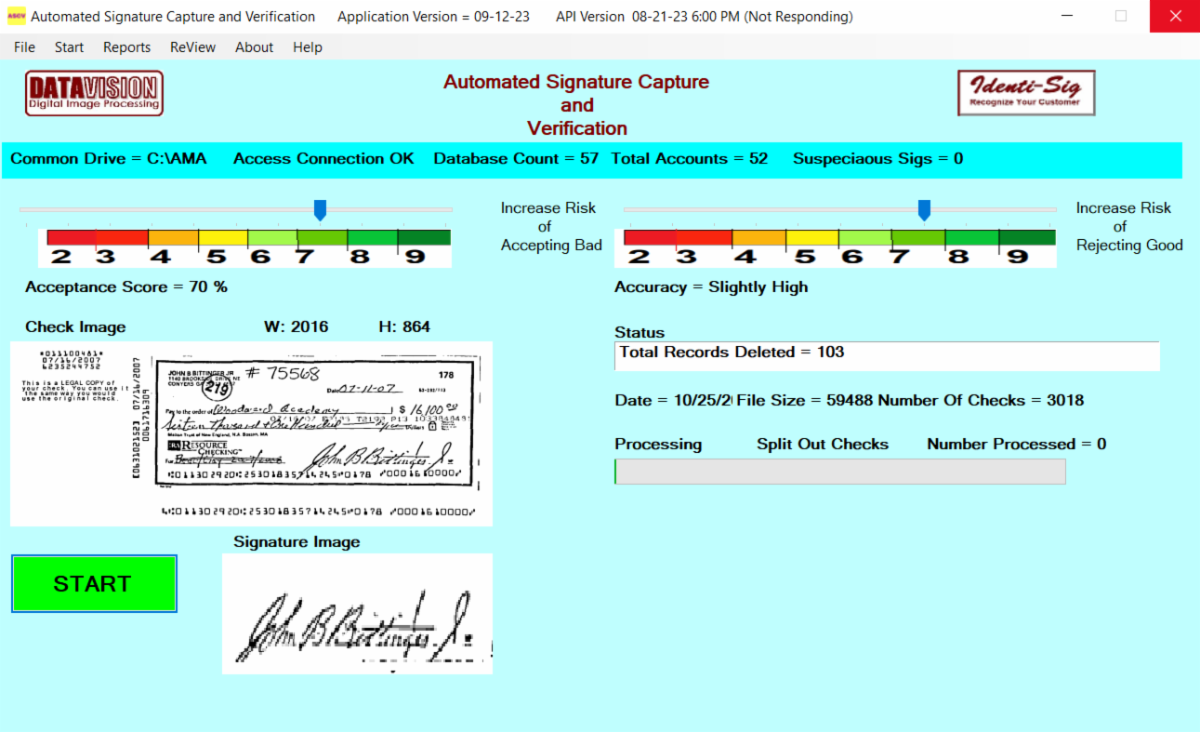
For example, one time I might sign “Robert J Briscoe” and another time I might sign “Bob Briscoe” and still another time when I am in a rush I might sign “RJB”. Many existing signature recognition systems rely on comparing the sample signature to a master signature, and when the names change their system produces an incorrect result. In the Identi-Sig process the user sets an “Acceptance Score” and all variations of the signature are considered.
As can be seen in Figure 1, the Identi-Sig system has an adjustable acceptance score. As you get results from the Identi-Sig system you can adjust this score to optimize performance.
|