|
Product Stewardship Updates
December 5, 2024
| |
|
THIS GIVING SEASON, HELP US
INVEST IN A BRIGHT FUTURE WITH EPR
| |
|
After 24 years leading the U.S. EPR movement, we can finally say that EPR is fully recognized as a powerful and transformative policy tool for achieving long-held goals of environmental sustainability and business innovation. This year alone, our Members and Partners introduced 77 distinct bills, established 6 new laws – including first-in-the-nation laws for EV Batteries, Boat Wrap, and Textiles – and passed 7 amendments, including significant expansions and improvements to laws for Carpet, Electronics, and Paint. These laws will protect our environment, help mitigate climate change, strengthen our economy, help address inequities, and improve the health of our communities.
To our dedicated Members, Partners, and Donors – some of whom have already kicked off our year-end campaign with generous named and anonymous contributions – thank you for being the foundation of our work these past 25 years.
PSI is a small, highly skilled nonprofit (501c3) with a robust network, and we depend on the generosity of donors like you to make investments in developing EPR policies. We know that many organizations will request your support this season, but we hope that when it comes to annual giving, you will also consider PSI. Together, we can continue to lead the development of policies that save governments and taxpayers money, reduce environmental impacts, and spark corporate innovation for years to come.
Thank you!
| |
|
UPDATE ON U.S. PACKAGING
EPR IMPLEMENTATION
| |
Oregon, Colorado, and California – the three states with packaging EPR laws that are furthest along the implementation process – are currently defining the materials categories on which producers must report the packaging they put on the market. State regulators are considering at least 150 material categories that producers would need to track and report on. Circular Action Alliance (CAA), the producer responsibility organization responsible for implementing these programs on behalf of producers, is working with state regulators to streamline and harmonize these categories to simplify reporting for producers. The detailed data collection they are conducting now will provide the information necessary to track the amount of packaging produced, calculate producer fees by material, and formulate effective eco-modulation incentives. Although the timelines for reporting will differ across the programs initially (for instance, Oregon producers will begin reporting by March 31, 2025), CAA is seeking to align reporting schedules across states in the future, fostering consistency to reduce the administrative burden on producers. | |
|
MASSACHUSETTS CLIMATE
BILL INCLUDES STUDY ON EPR
| |
Massachusetts recently passed a sweeping climate bill, S.2967 An Act Promoting a Clean Energy Grid, Advancing Equity, and Protecting Ratepayer, which also establishes a special legislative commission to recommend EPR policies for the Commonwealth. The EPR commission, which may be led by a third-party facilitator, will convene a multi-stakeholder group comprised of representatives from the Massachusetts departments of environmental protection, economic development, and public health; senate appointees from the utilities and environment committees; an expert in consumer protection; and individuals representing product or packaging producers, retailers, waste haulers and material recovery facility operators, municipal officials, environmental protection and environmental justice organizations, recycling advocates, and environmental health and public health advocates. The commission will recommend EPR and other policy approaches on paint, mattresses, electronics, lithium-ion batteries, plastics and other packaging, and other products it believes warrant such an approach. The commission will also recommend specific policy elements, including covered materials; financial and managerial responsibility; and ways to incentivize materials reduction, reuse, and lifecycle extension. The commission must also assess the cost impacts of the policies on existing collection and processing operations, waste generation, and waste stream contamination. The commission will submit its recommendations and findings in a report to the legislature by January 15, 2026. | |
|
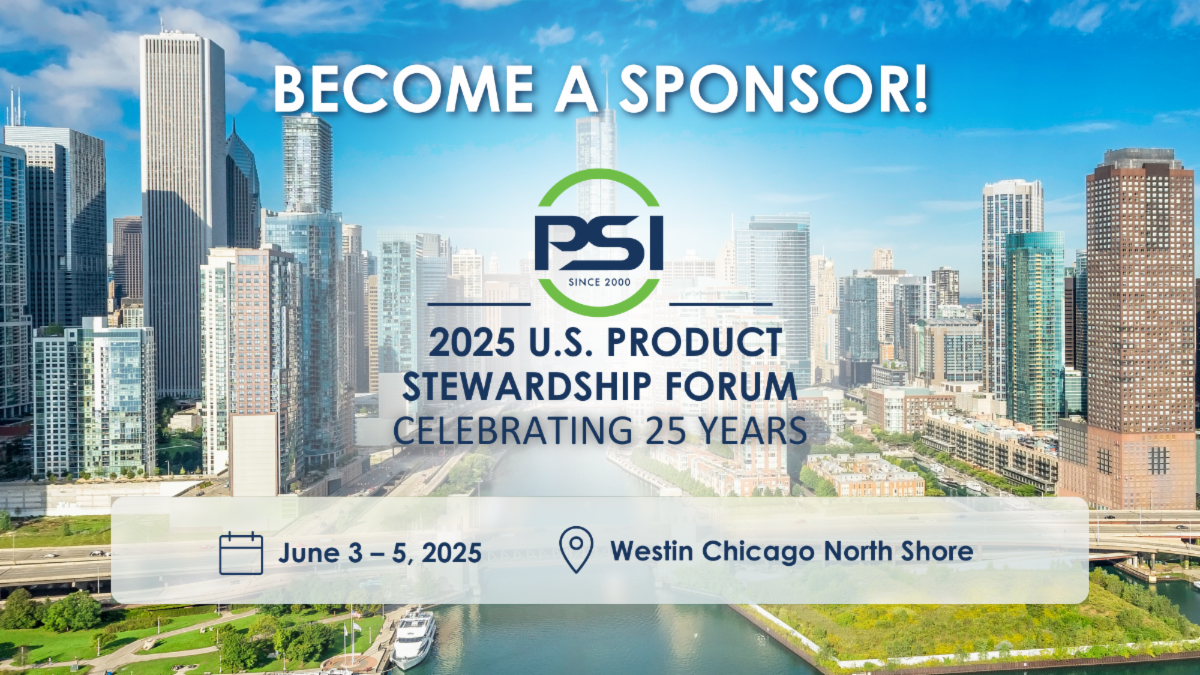
Celebrating 25 Years!
2025 U.S. PRODUCT STEWARDSHIP FORUM
June 3 - 5, 2025 | Westin Chicago North Shore
| |
|
For more than two decades, PSI’s U.S. Product Stewardship Forum has been the place to go for meaningful content and in-depth conversations on the EPR issues that matter most. The Forum is consistently ranked by participants as the best EPR conference in the U.S. for the caliber and expertise of speakers, and the breadth of stakeholder perspectives represented – including private industry (producers, PROs, waste management), U.S. governments at all levels, environmental groups, academics, and international companies and governments. Join 300+ EPR leaders from around the globe for information sharing, cutting-edge EPR solutions, and networking. We’ll see you there!
The PSI Forum is an excellent sponsorship opportunity to showcase your company’s leadership in EPR and the circular economy, and your commitment to environmental sustainability and stewardship. Contact Amanda Nicholson, PSI COO, at info@productstewardship.us to become a sponsor.
| |
A MUST-READ FOR ALL EPR PROFESSIONALS! | |
|
PERSPECTIVES ON PRODUCT STEWARDSHIP:
Navigating an extended producer
responsibility path to a circular economy
by Scott Cassel, CEO and Founder of PSI
| |
Learn about the emergence of the EPR movement in the U.S., Canada, and Europe; the basic elements of all effective EPR bills; how to build consensus with other stakeholders; and key definitions, terminology, and issues. Includes in-depth case studies on packaging, paint, and batteries. | |
|
If you are a PSI Member or Partner, contact
info@productstewardship.us for 30% discount code. Signed copies available.
Not a member or partner? Join online or email for more info.
| |
|
Liquid Solutions LLC cited a PSI statistic in a PS Newswire article introducing their new paint storage solution, called Steward™, highlighting that Americans discard more than 78 million gallons of leftover paint each year.
PSI’s CEO and Founder Scott Cassel was recently quoted in a Waste360 article about Illinois’ new battery EPR law, noting the trend of EPR laws expanding to cover a broader range of battery types, paving the way for improved safety and recycling. PSI Board Member Christina Seibert, who helped draft the law, is also featured prominently in the article discussing the importance of addressing battery disposal challenges and the collaborative effort behind the legislation.
A Waste Dive article discussing Massachusetts's recently signed climate law, which includes a study on EPR, features PSI’s CEO and Founder Scott Cassel. He expresses enthusiasm for this significant step for EPR in Massachusetts. EPR has been identified in the state’s solid waste master plan as a possible strategy for over 20 years, since he worked at the Executive Office of Environmental Affairs.
| |
|
US EPA PLASTICS STRATEGY: A Plastics News article highlights the EPA’s National Strategy to Prevent Plastic Pollution, which calls for a national EPR framework for plastics and emphasizes public health and environmental justice impacts. Read more.
US TIRE RECYCLING: A Resource Recycling article on tire recycling in the U.S. covers industry-backed efforts to increase tire recycling through rubber-modified asphalt and grant-funded local programs. These and other efforts will be needed to sustainably manage all used tires in the U.S.; in 2023, Connecticut enacted the first tire EPR law in the U.S. Read more.
BATTERY FIRES: Waste360 reports a record number of fires for the waste and recycling industry in 2024, with 37 fires in October alone. These dangerous and destructive fire events are caused primarily by lithium-ion batteries in the waste stream. PSI recently worked with our members in Illinois, Oregon, and New York, and industry and other stakeholders, to develop and advance battery EPR bills to improve safe recovery and recycling of batteries and prevent fires. Read more.
FEDERAL RECYCLING BILLS: Industry trade associations and some environmental organizations are urging Congress to pass two federal recycling bills this year. The Recycling and Composting Accountability Act and the Recycling Infrastructure Accessibility Act, both stalled in the legislature, aim to support rural recycling programs and increase data collection. Read more.
GLOBAL PLASTICS TREATY: The fifth session of the Intergovernmental Negotiation Committee (INC-5) on plastic pollution concluded on December 1. The meeting had the highest attendance of any of the meetings so far, but did not result in an agreement on a Global Plastics Treaty. Issues such as chemical phaseout lists and program funding require further negotiation. The Committee will resume in 2025 (INC-5.2). Read more.
| |
The Product Stewardship Institute is a policy expert and consulting nonprofit that pioneered product stewardship in the United States. Since 2000, PSI has helped enact 141 extended producer responsibility (EPR) laws across 20 product categories in 33 states — the bedrock on which the circular economy is built. We work with businesses, nonprofits, academia, and governments to ensure that products are responsibly managed from design to end of life. Join us at www.productstewardship.us. | |
|
The Product Stewardship Institute, Inc. is an equal opportunity employer and provider. Persons with disabilities who require alternatively formatted materials to ensure effective communication should contact Amanda Nicholson at info@productstewardship.us or 617.236.4855.
| | | | |