Basically, managing is about influencing action. Managing is about helping organizations and units to get things done, which means action. Sometimes, managers manage actions directly. They fight fires. They manage projects. They negotiate contracts.- Henry Mintzberg | | Leading Off: Fighting Fires | | |
In leadership, “fighting fires” refers to the constant need to respond to unexpected problems, operational disruptions, or performance issues that demand immediate attention.
These fires can involve people, customers, finances, productivity, or any number of other challenges. While some require urgent action, others simply feel urgent.
The danger is that leaders can become so consumed with responding to one problem after another that they spend more time managing symptoms than addressing root causes. They stay busy, but the same problems keep returning.
| | A Cup of Water and Five Fires | | |
Why great leaders solve problems instead of simply managing them
For many years, I supervised and trained regional managers in the restaurant business. Each regional manager was responsible for four to eight restaurants, along with the restaurant managers who operated them.
On any given day, something was going wrong somewhere. One restaurant was missing its sales projections. Another had a profitability problem. A third was struggling with employee turnover, while a fourth had a guest satisfaction issue that needed attention. Throw in an equipment breakdown, a manager resignation, or an unexpected visit from the health department, and you had a fairly typical week.
We called it putting out fires. And if you have ever supervised multiple locations, managed several departments, or led a team of people, you know exactly what I mean. There always seems to be another fire. Sometimes several are burning at once, and each one comes with someone who believes their problem deserves your immediate attention.
| |
I developed a simple exercise to demonstrate something I believed was fundamental to effective leadership. During a regional manager training session, I would place four or five index cards on the carpet. Each card represented a restaurant with a problem. Then I would hold up a full cup of water and explain that the water represented something every leader has in limited supply: time and energy.
I would walk over to the first index card and sprinkle a little water on it. That represented the time and energy a regional manager might devote to addressing the first problem. Then I would move to the second card and sprinkle a little more water. I repeated the process with the remaining cards until the cup was empty.
At that point, I would ask the participants to consider what we had accomplished. We had visited every restaurant. We had given every problem some attention. We had been busy, responsive, and involved. We had used all the time and energy available to us. But when we looked back at the first card, the fire was probably still burning. So were the others. We had sprinkled a little water on every fire without actually putting any of them out.
Then I would take a second cup, filled with water, walk back to the one of the index cards, and dump the entire cup onto it.
| |
Now the fire was out.
Of course, the other fires were still burning. Some might even have grown a little larger while we concentrated on the first one. But there was an important difference. We now had one fewer fire to deal with. We had accomplished something rather than simply spreading ourselves across a collection of unresolved problems.
That was the lesson I wanted the regional managers to remember. You can spend your entire career running from one fire to another, always busy, always responding, always exhausted, and never substantially reducing the number of problems demanding your attention. Or you can learn to concentrate your resources, solve problems completely, and gradually create an operation that requires less firefighting.
| |
Which Fire Do You Put Out First?
There was another important lesson embedded in the exercise. If you cannot put out every fire simultaneously, you had better become very good at deciding which one deserves your attention first.
My instinct was to focus on the biggest fire, but size alone isn't always the best measure of priority. A restaurant with a serious food safety issue obviously takes precedence over one that is missing its labor cost target. Some problems threaten the safety of employees or guests. Others have consequences that can quickly become irreversible. Those fires cannot wait. But once the immediate emergencies are addressed, leaders need to make thoughtful decisions about where concentrated attention will produce the greatest benefit.
That means distinguishing between the loudest fire and the most important one. The restaurant manager who calls three times a day may not have the most serious problem. Another manager, reluctant to ask for help, may be quietly dealing with a deteriorating business. Effective leaders must resist allowing the volume of complaints, the frequency of telephone calls, or the preferences of individual managers to determine their priorities.
I encouraged regional managers to consider several questions before deciding where to concentrate their energy. Which problem presents the greatest risk to the business, its employees, or its guests? Which is getting worse? Which has the greatest consequences if left unresolved? And which can we realistically solve with concentrated effort? Sometimes putting out a manageable fire completely creates the capacity to tackle a more difficult one next.
Choosing one fire does not mean abandoning the other restaurants. A regional manager still has responsibility for every location. Some situations require immediate containment, a temporary solution, or assigning responsibility to someone else while the larger problem receives attention. The objective is not to ignore the remaining fires. It is to stop pretending that giving every fire equal attention is the same as managing them effectively.
| |
Putting Out the Fire Means Finding Its Source
Another trap is confusing temporary improvement with a permanent solution. Consider a restaurant that is consistently missing its labor cost target. A regional manager might visit, examine the schedule, reduce a few hours, and get the numbers back in line for the week. The fire appears to be out. But if the restaurant manager doesn't understand how to forecast sales, schedule effectively, or manage productivity, the problem will be back next week.
The same thing happens with employee turnover. We can help a restaurant recruit replacements, fill the vacant positions, and move on. But if the turnover is being caused by poor supervision, inadequate training, or a workplace where employees don't feel respected, we haven't solved the problem. We've merely replaced the people who left. The fire is still burning beneath the surface.
Putting out a fire requires understanding why it started and what is keeping it alive. It may involve additional training, changing a process, establishing clearer expectations, or making a difficult personnel decision. It almost always requires more thought and sustained attention than a quick visit and a few suggestions.
There is also an important distinction between solving a problem for a restaurant manager and helping that manager learn how to solve it. A regional manager who personally fixes every problem may become very good at firefighting, but the restaurant managers remain dependent on that intervention. The best regional managers don't simply extinguish fires. They develop managers who can prevent them, recognize them early, and handle them independently.
That is where the long-term return on our investment of time and energy becomes significant. When you solve the underlying issue and strengthen the capabilities of the person responsible, you are not just putting out today's fire. You are reducing the probability of tomorrow's.
| |
Being Busy Isn't the Same as Being Effective
One of the things I observed over the years was how easy it was for leaders to measure their contribution by the amount of activity they generated. How many restaurants did I visit this week? How many telephone calls did I handle? How many problems did I address? How many hours did I work?
Those measurements might tell us how busy someone is, but it says very little about whether the business was getting better.
A regional manager could visit six restaurants in a day and accomplish very little beyond making an appearance and reminding everyone that the boss was watching. Another might spend most of the day in one restaurant, working alongside the manager to understand a persistent problem and develop a solution that would last. At the end of the day, the first regional manager could claim to have covered more territory. The second might have made a far greater contribution.
I'm not suggesting that visibility and routine visits aren't important. They are. Observing operations, talking with employees, recognizing good work, and identifying potential problems before they become serious are essential parts of the job. But there is a difference between maintaining awareness of everything and attempting to fix everything at the same time.
The leader who is constantly moving can create the illusion of progress. The leader who concentrates on meaningful outcomes is more likely to produce it.
| |
Stay With It Until the Problem Is Solved
The final part of the lesson is one I have come to appreciate even more over the years. Once you've identified the right problem and committed your resources to solving it, you have to stay with it.
Many problems survive because leaders lose interest before the solution has taken hold. A meeting produces a good plan, responsibilities are assigned, and everyone leaves feeling optimistic. Two weeks later, another issue has captured the leader's attention. Nobody follows up, accountability fades, and the original problem gradually returns.
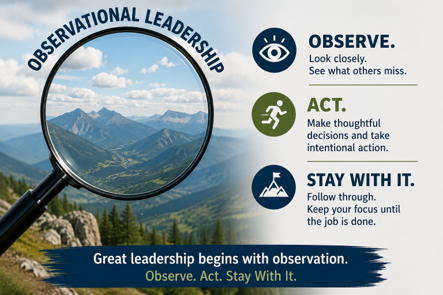
Solving a problem isn't an event. It's a process. It requires observation to understand what is happening, action to change it, and persistence to make certain the improvement lasts. Those three elements are at the heart of what I now call Observational Leadership: Observe. Act. Stay With It.
And sometimes an especially valuable thing happens when you really solve a problem in one location. You discover that the underlying issue exists in several others. A better scheduling process, an improved training system, or a more effective approach to employee retention can be applied across the entire region.
Suddenly, the investment you made in extinguishing one fire helps prevent fires in several other places.
That is when leadership begins moving from reactive to proactive. Instead of spending every day responding to what went wrong yesterday, you start creating the conditions for things to go right tomorrow.
| |
How Much Water Is Left in Your Cup?
I haven't forgotten that classroom exercise, and I suspect some of the regional managers who participated in it haven't either. It was deliberately simple. A few index cards, some water, and a carpet were enough to demonstrate a leadership mistake that otherwise might take years to recognize.
The lesson applies far beyond restaurants. It applies to executives managing departments, small-business owners juggling competing priorities, nonprofit leaders with limited resources, and even individuals trying to manage the demands of their personal lives. We all have fires. And we all have a limited amount of water.
The temptation is to give every problem a little attention, hoping that spreading our effort widely will somehow allow us to stay ahead of everything. But when we do that, we often end the day exhausted, with a long list of activities completed and the same collection of problems waiting for us tomorrow.
There will always be another fire. That's part of leadership. The goal isn't to create a world in which nothing ever goes wrong. It's to become more effective at deciding what matters, focusing our resources, developing the people around us, and solving problems in ways that last.
The next time you feel overwhelmed by the number of issues competing for your attention, imagine those index cards spread across the carpet. Picture yourself holding that cup of water. Before you start sprinkling, ask yourself a simple question:
Am I going to spend my energy touching every fire, or am I going to use it to put one out?
Because at the end of the day, leadership isn't measured by how many fires you visited. It's measured by how many are no longer burning.
| | Surprise Photo at the End: | | If you are reading this on a social media platform, click below and you'll automatically receive a 'different' story every week on Wednesday. | | |
The Roll Call of states and countries where readers reside: Arizona, California, Colorado, Connecticut, Delaware, Florida, Georgia, Hawaii, Illinois, Indiana, Iowa, Kansas, Kentucky, Louisiana, Maine, Massachusetts, Michigan, Mississippi, Missouri, Montana, New Hampshire, New Jersey, New Mexico, New York, North Carolina, North Dakota, Ohio, Pennsylvania, Puerto Rico, Rhode Island, South Carolina, South Dakota, Tennessee, Texas, Vermont, Virginia, Washington and Washington DC, Wisconsin plus Canada, Conch Republic, Australia and the United Kingdom.
| | |
Ed Doherty
774-479-8831
www.ambroselanden.com
ed-doherty@outlook.com
Forgive any typos please.
| | | | | |