|
A Fourth Dimension of the Great Turning
Part II
by Bill Plotkin
Friday, January 10, 2025
This is the second part of a multi-part Musing (one per week).
In indigenous ways of knowing, it is understood that each living being has a particular role to play. Every being is endowed with certain gifts, its own intelligence, its own spirit, its own story. Our stories tell us that the Creator gave these to us, as original instructions. The foundation of education is to discover that gift within us and learn to use it well.
~ Robin Wall Kimmerer, in Gathering Moss [6]
For years, I tried to locate our own work at Animas Valley Institute within the three dimensions of the Great Turning. I heard myself saying that our work can be seen in aspects of both the second and third dimensions: We are analyzing and demystifying how human development, in particular, is suppressed in industrialized societies, and we are creating alternative practices and models to support people to grow whole (this is an instance of the second dimension); and we are supporting a shift in worldview to one that is soulcentric as well as ecocentric (an instance of the third dimension). [7] And both of these things are true.
I now believe, however, that it would be clearer, more useful, and more illuminating to say that there is a fourth dimension of the Great Turning, one that is, in Joanna and Molly’s words, “mutually reinforcing [of the other three] and equally necessary.” But, unlike the first three dimensions, this fourth one is not already happening at any scale. Indeed, it has hardly begun. And yet I believe it is vital for the full unfolding of the Great Turning.
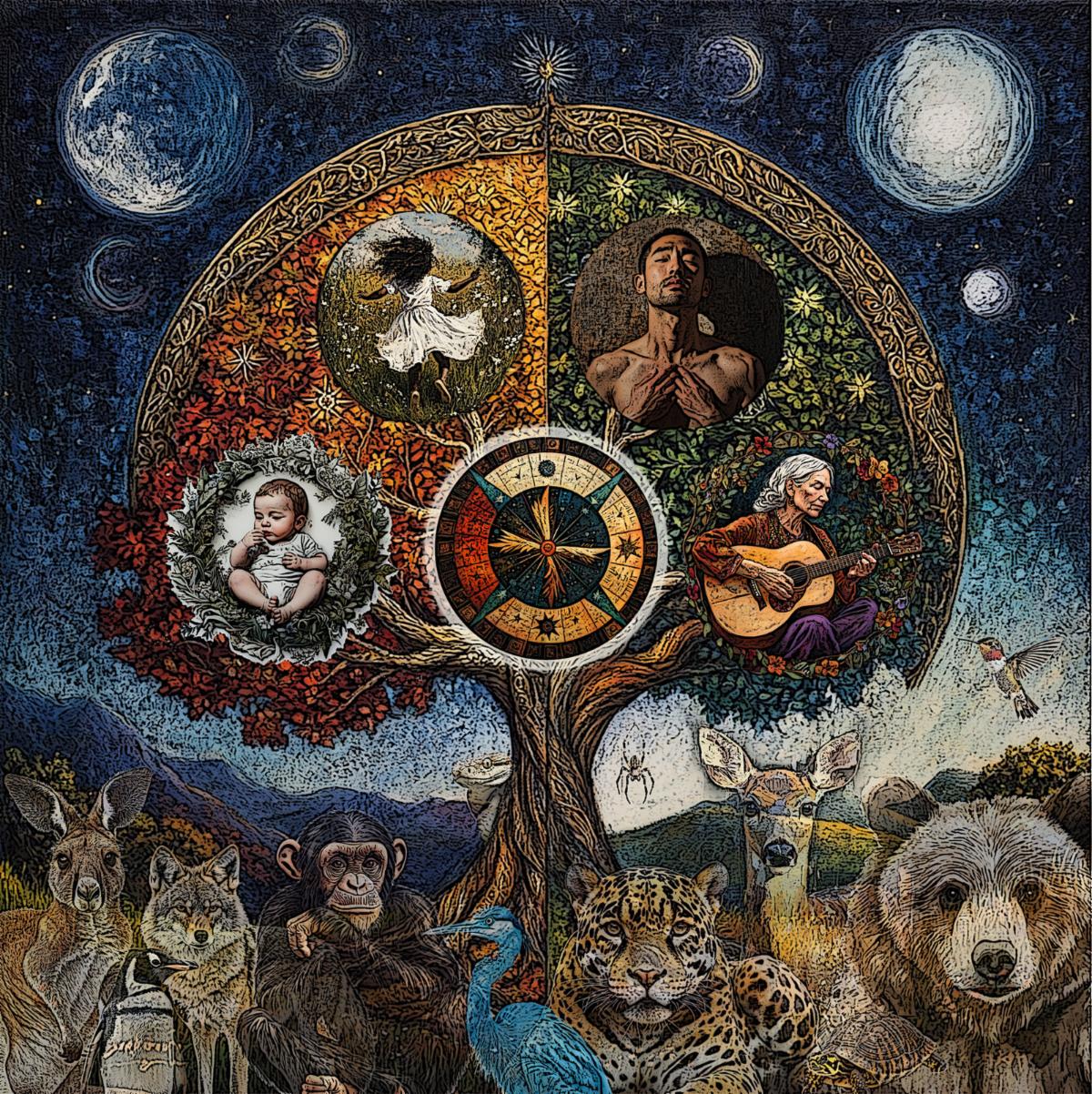
This fourth dimension is, simply put, the maturation of humans into true adults and genuine elders, an essential developmental journey that lies entirely beyond the maps of contemporary, industrialized societies. Eco-awakening (the third dimension) alone does not give rise to true adults. Rather, eco-awakening shifts us out of an unhealthy consciousness (egocentric) and returns us to a healthy one (ecocentric). This passage, as noted earlier, takes place within the stage of life that corresponds to early adolescence, the psychological stage that begins with the passage of puberty and ends (if ever) with the passage (“Confirmation”) into psychological late adolescence (the Cocoon) during which the journey of soul initiation takes place.
By “true adult,” I mean someone who has had one or more glimpses or visions of their unique place or niche in the web of life (their eco-niche) and is embodying that niche as a gift to both their people and to the greater Earth community. Our eco-niche is what I understand Robin Wall Kimmerer to mean by “our particular role to play,” which is made possible because we are each, in her words, “endowed with certain gifts, [our] own intelligence, [our] own spirit, [our] own story,” our own “original instructions.”
A true adult experiences their identity primarily through their relationship to (and role or function in) the more-than-human-world, an identity no longer centered or anchored in a social role, vocation, religion, or creative project. The way an adult consciously understands their eco-niche is through symbol or metaphor — through what we, at Animas Valley Institute, call mythopoetic identity. For example, I experience my soul identity, in part, as someone who helps other humans weave cocoons for their transformation from adolescence to true adulthood. This image of weaving cocoons is not something I chose or consciously fabricated but one that was revealed to me in a visionary experience.[8] Likewise, in a revelatory moment, Joanna came to understand her soul identity, in part, as being one stone in the bridge between the thoughtworlds of the east and west. [9] These are two examples of human identity rooted in ecology.
Soul identity is what is discovered during the journey of soul initiation. In the Western world, this is a genus of personal identity that has been lost or forgotten for thousands of years. [10] Remembering this journey now is essential to the Great Turning.
But for a contemporary society to make the passage from life-destroying to life-sustaining it doesn’t actually need to increase its numbers of true adults and elders. It “only” needs a significant percentage of its members to eco-awaken, to make the passage from egocentric to ecocentric early adolescence. We just need enough eco-awakened people to enable (or force) governments, corporations, and educational systems to function as if all of life is sacred and with the bedrock value that no actions are acceptable that undermine any Earth systems that make life possible. (One way this can happen is by eco-awakened people taking leadership positions in these systems.) This significant accomplishment alone will be a profound shift in society — from industrial growth to ecological sustainability. If and when we succeed, we will have shifted from a patho-adolescent culture to a healthy adolescent one, a shift it seems we must now achieve in the next decade or two if we are going to avert a massive, catastrophic collapse of our environmental and social systems. However, even if we do not evade the full cataclysms possible or likely in this century, we will still need, eventually, to make this societal shift from egocentric to ecocentric — if, that is, we shall continue to exist at all, if we shall continue to evolve as humans.
But I believe the Great Turning will not be complete if and when we achieve a healthy adolescent culture. Indeed, this will be just the foundation. We must then embrace the goal of creating truly mature societies, those that are not only life-sustaining but life-enhancing. Such a society is grown not through projects conjured with our strategic, rational, technology-oriented minds — no matter how brilliant and life-sustaining those projects may be — but by embodying the gifts we were each born to offer the Earth community, gifts we discover (not choose) during the journey of soul initiation.
As radical as such a transformation would be, inventing (or re-inventing) life-enhancing societies would simply place humanity in alignment with the rest of life on Earth. For other species, the fulfillment of their individual members’ lives is also and always a gift to the rest of life. Every species has evolved in ways that support the health, diversity, and evolution of life in its ecosystem. It’s not the survival of the fittest but the survival of those who fit best. Earthly life is inherently and fundamentally symbiotic.
The truth is that we, too, have evolved to enable us to enhance life in our unique human ways, but I believe our species entered an initiatory crisis several thousand years ago, a crisis marked by the gradual near elimination of mature, ecocentric cultures. We are, right now, at the tumultuous crux of that crisis. [11] If we navigate our species’ passage successfully, we will rejoin the rest of life as co-evolutionary partners. If we don’t, we are likely to go extinct — and, even more tragically, take a large portion of Earthly life with us, an even larger portion than we have already extinguished. The stakes could not be higher.
For humans to once again become conscious life-enhancing partners with evolution, we need to reclaim, revision, and reinvent social practices that support people to mature into true adults — and, eventually, genuine elders. These are the practices of the journey of soul initiation. This journey brings about not only a shift in worldview and values (as with the third dimension of the Great Turning) but a radical metamorphosis of the individual human ego and consciousness from healthy adolescent to true adult, from an identity embedded in social or vocational roles (even if life-sustaining) to an identity rooted in ecological roles within the greater web of life. This is as radical a change for individual humans as is the metamorphosis for Lepidoptera from adolescent caterpillar to adult moth or butterfly. This I propose as the fourth dimension of the Great Turning. [To be continued next week … ]
To read part one, click here.
|