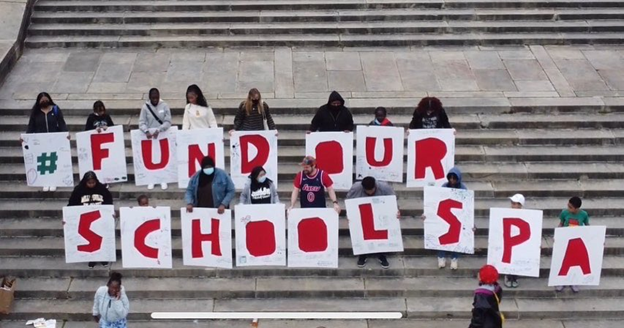
Philadelphia Student Union members protest on the steps of the Art Museum earlier this year.
This week, legislative leaders and Gov. Tom Wolf reached an agreement on a 2022-23 state budget with significant increases in public education funding. It includes:
- a $525 million increase in state funding for basic education,
- $225 million for a Level Up supplement to the 100 most deeply underfunded school districts,
- a $100 million increase in special education funding,
- an additional $79 million for preschool programs,
- a $19 million increase for early intervention funding,
- and $100 million each in grants to school districts for mental health and for school safety.
Read budget press coverage with ELC comments here and here.
We celebrate that these are bigger funding increases than we have seen before. They are significant new investments in education that will benefit many children.
But we remain focused on a bigger goal that this budget did not achieve. That is to implement a funding system in Pennsylvania that ensures that students in every community receive the high-quality education they’re entitled to under the state Constitution. Our work toward that fundamental goal continues on multiple fronts, including in Commonwealth Court (see the law centers’ statement on the budget).
This year’s budget increases were the fruit of years of work by ELC and our partners, encouraging Gov. Wolf to champion education funding as a budget priority and building a broad statewide coalition that advocated hard for these increased investments.
Our trial in the ongoing school funding lawsuit (we are back in court on July 26) certainly highlighted the urgent need. The powerful testimony from our witnesses has increased awareness that Pennsylvania has a huge problem with crumbling, understaffed, under-resourced schools in the state’s low-wealth communities, where most of the state’s Black and Brown students live. And students in those communities are falling behind as a result of the state’s failure.
We can’t overstate the scale of the problem. Pennsylvania has an average gap of $4,800 per pupil in how much is spent in high-wealth vs. low-wealth school districts. When factoring in the state’s weighting system to reflect student need, the gap is more than $7,800 per student. It’s an upside-down system – we should be spending the most in districts with greater need. And along with these inequities, there’s an estimated $4.6 billion statewide education adequacy gap.
The road ahead is steep. With inflation currently surging at 8.6% annually, schools will be confronting rising labor costs. Mandated costs for pension obligations and charter schools continue to rise as well. The legislature failed to take needed action to address charter school funding reform. But for once we are hopeful that the budgeted increases are significant enough to help ensure that school districts do not lose ground in the coming school year.
Our school funding lawsuit and our advocacy work to fix our funding system will continue until we're providing adequate and equitable funding to all students in every community. The state must make substantial, recurring multiyear investments in our schools as part of a long-term solution.
A bright spot that we can celebrate is that “Level Up” is in the budget again for the second consecutive year. ELC and our allies have worked hard to establish this funding stream for the 100 most underfunded school districts. The $225 million allocation is not a large amount for the districts in greatest need. But it is once again an acknowledgment by the legislature that targeted aid is needed for the state’s most underfunded districts because the state’s allocation of basic education funding hasn’t been sufficient to meet the basic needs of students and districts.
There are other points in the budget to celebrate: a funding stream for mental health, a record increase in special education funding that we worked hard to advocate for, a 25% increase in funding for pre-K and Head Start programs, a needed 26% increase in pupil transportation funding, and more.
But unfortunately, the budget includes its share of bad deals as well. We are particularly concerned about the vote for a massive, 45% increase ($125 million more) in the state’s programs providing tax credits for private school scholarships. Those programs and schools operate with no meaningful oversight and no assurance that these schools won’t discriminate in whom they serve. It is far from fiscally responsible to continue to expand a program that operates with zero transparency and accountability.
And so our fight goes on for adequate and equitable funding and a high-quality public education for all – with the budget’s billion dollars in new education funding providing an important acknowledgment by Harrisburg legislators of the depth of the hole that they dug for our students over decades of neglect.
So we celebrate the important gains in this budget, while keeping in front of mind that the disparities and deprivation faced by students in low-wealth communities remain unconscionable and unconstitutional. We will look for change through the courts and through continued advocacy, reminding our legislators that they do not have to wait for court orders to do what is necessary and what our constitution requires: to ensure a high-quality education for all children.
Thank you for your support of our work!