|
Today, we first meet Jesus as he enters Jerusalem, with followers lining the streets and welcoming him with, “Blessed is the king who comes in the name of the Lord.” We can imagine their excitement. We wave our palms in solidarity with what came before us and then, very quickly, we find ourselves cringing and maybe even tuning out as Jesus is captured, tortured, humiliated, and murdered at the hands of the state. This is a lot to take in on a Sunday morning.
As we move into Holy Week, when the passion and death of Jesus are slowly rolled out over a few days, offering more time for in-depth reflection, there might be a tendency to remain on the surface of the story or be distracted by things happening around us. After all, how many times have we attended Holy Thursday and Good Friday services? We know the words, the actions and the music. It is our story as Christians.
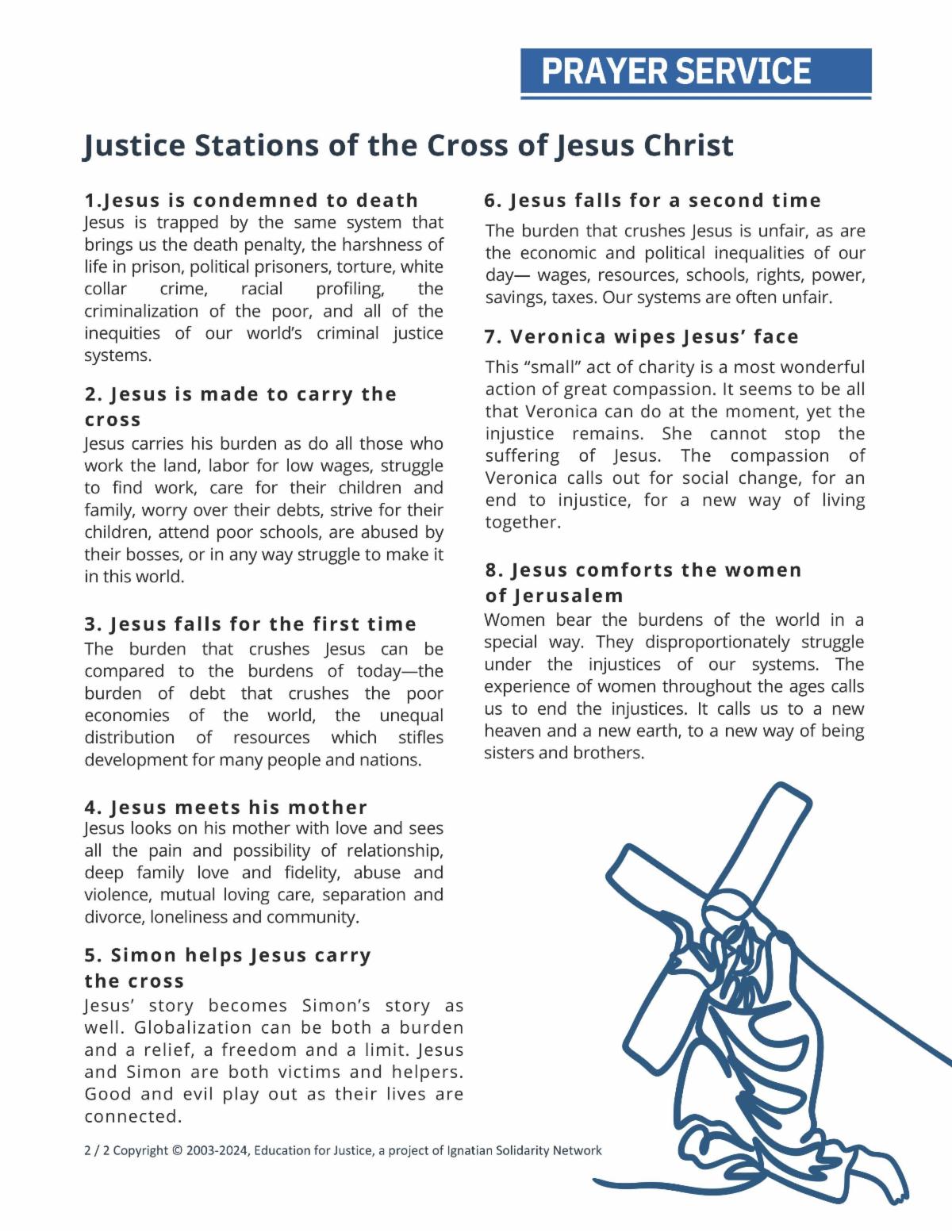
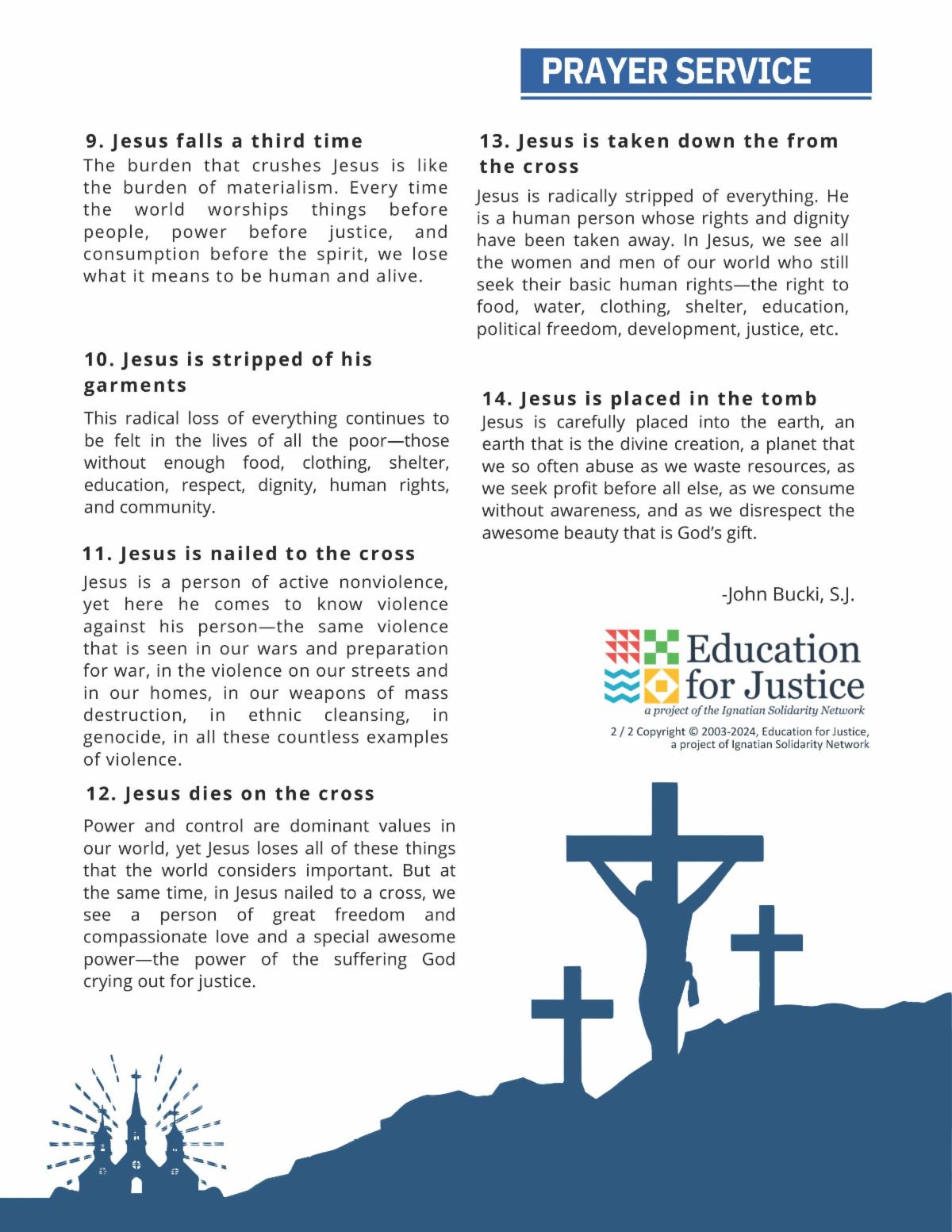
This week, the Ignatian volunteers spent time reflecting on the Stations of the Cross at our monthly meeting. The reflections, written by John Bucki, S.J., came from Education for Justice, a project of the Ignatian Solidarity Network (www.educationforjustice.org) and their theme was justice.
No station was assigned. A different volunteer read a station as the Spirit moved them. There were no props except a candle in the middle of the circle of chairs and no music, only the written word. As the voices of women and men led us through Jesus's journey, there was a real sense of being present to him and his suffering.
We shared insights from the experience, and the overall response was gratitude for Stations of the Cross that spoke to our lives and modern times. The stations addressed the death penalty, the plight of prisoners, racial profiling, and many other issues that the volunteers often bring to prayer. The time truly felt like walking the way of the cross. We were on the path with Jesus.
If distractions set in during this solemn week, and they often do, consider taking a breath and accompanying Jesus by choosing one of his companions in the story and putting yourself in their place. The other evening, during a prayer service, an older man was intrigued with Judas and how he might not be the pariah he had been labeled, but rather a broken man who gave into greed or whatever was offered him to betray Jesus. The man said that by focusing on Judas, he felt new connections to the story and ultimately to Jesus.
I am taken with the women, including the mother of Jesus, in this week's prayers. Who were these women who dared to stay and witness the horror of the death of this man who offered them a new way of being in the world based on love and a new way of relating to God? Where did they get their courage when women were not recognized as separate from their fathers or husbands? What prompted a woman, Veronica, to come forward and wipe the face of Jesus?
What was going on with Pilate as he urged the people to allow him to release Jesus? Who were the people in the crowd shouting, “Crucify him.”
Entering the story and into one of the characters brings new understanding and often a commitment to be a disciple or renew discipleship.
As we move this week from death to resurrection and ponder all that means, we will have distractions, including eggs to be colored and filled and Easter baskets to be created. As we attend to these things, let us keep in mind those who are marginalized, fearful, hunted, imprisoned, and those who came to our country seeking peace.
Remember that Jesus lived in a time that paralleled ours in many ways. May he be our guide.
Peace,
Anne
|