| Question: Dear Monty, For the past three years we have had a wonderful Haflinger mare at the farm I work at. She had a wonderful personality and loved being around people. We sold her in December and the woman who had bought her contacted us and said she was no longer working out for her. So we bought her back. As soon as I loaded her on the trailer I could tell something was not right about her. Our sweet, always calm mare was so nervous she was almost panting like a dog! When we look at her all we see is a shell of her. She has dead eyes and hides in the corner of her stall. My only guess is maybe she was being beat on. With health problems ruled out, do you have any suggestions how to help get her out of this slump and bring her spirit back? Thank you, Katie Answer:
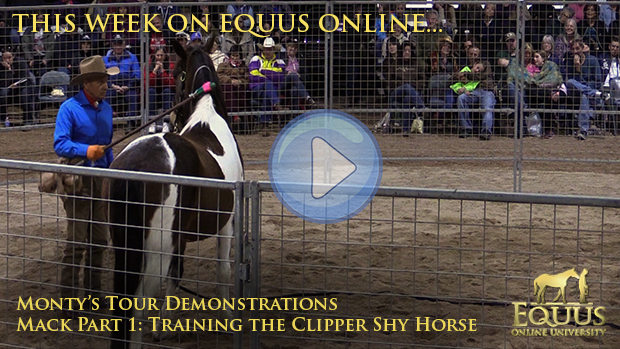
Dear Katie, In short, yes. In these kinds of cases, the horse is the only one who really knows the truth. As we find ourselves at this moment, the truth really doesn't matter. She has her condition and there is no way we can wave a wand and eradicate that condition. What I can do to help though is to suggest the only successful way that I have found to treat horses with this problem. It is quite coincidental that I had a horse with extremely similar circumstances just two days ago. This was a mare born, raised and trained in Argentina. She was brought to a high level as a Polo pony and while she did her work on the field she was totally separated from any trust or partnership with a human being. This eight-year-old Polo mare refused to be caught in a field and it required two-three people to catch her in a stable. Everything about the human was unacceptable to her. In the case of this particular mare, the changes came very rapidly. While this is not always the case, it often surprises me how quickly they return to an acceptable level. Without knowing all of the details in your particular case, I will attempt to advise you as to what might very well be successful on your Haflinger as well. The essence of the recommended procedure is to do my concepts in every way that I recommend them in my writings and my video material. Join-Up? is the first element recommended. It took me about 15 minutes to get Join-Up and Follow-Up when it normally requires about four and a half minutes. Once I achieved Join-Up, however, it was incredible how quickly she came around. After a good Join-Up and Follow-Up, I moved to plastic bags on a stick. I let her worry about the plastic bags and actually encouraged her to go away. I employed the Dually Halter and a 30-foot long line to stop down her retreat. When she came back to me, I took great effort to reward her and rub her all over. This procedure added about another 20 minutes to the round pen time. We then went to a paddock about five times the size of the round pen. I repeated the stick and bag routine for about another 20 minutes in that paddock. I could see the improvement building rapidly. At that point I took away the 30-foot line and began to approach her loose in the paddock, waving the plastic bags as I approached. She was perfectly happy for me to approach her, rub her and walk away. Soon she was following me and the look in her eyes seemed to let me know that she was 'beating her demons'. A call from her owner today indicates that she is catching her in the field, she is eating better and lying down to sleep which she would never do before. This particular training procedure was videotaped and I believe it will make about four wonderful lessons on my Equus Online University. I recommend that you watch for them and also that you read as much as possible to better educate yourself so as to implement this training in the most effective way. One thing I like to explain to owners is that the bag was the 'bad cop' and I was the 'good cop'. I also explain that horses don't behave without a reason for that behavior, and this recommended procedure will help her well into the future. It involves the following positive consequence each time she is caught. The procedure is simply to place a handful of grain where she is tied for grooming and saddling. I tell the owner to catch her horse, lead her to that spot and allow her to steal a handful of grain from a feeder on the floor. Give her a few strokes of brushing all over, put her out in the field and after five minutes or so repeat the process. After about three weeks or so, one should begin to do this 'stealing the grain' procedure about once in every five catchings. This will ensure that the horse has something positive to think about when being caught. ~ Monty |