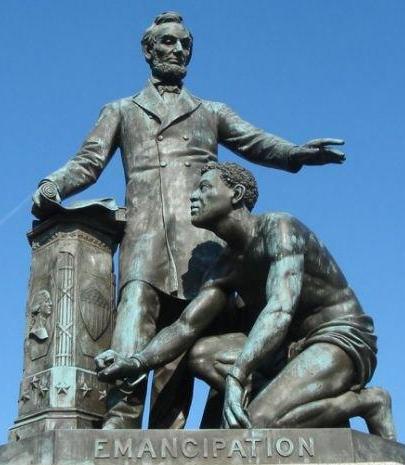
The Freedman's Memorial by Thomas Ball
Photo from Wikipedia
President Grant
was there, but it was the former slave and abolitionist
Frederick Douglass
who gave the principal oration. His speech that day is a remarkable document. It is not fawning, and it does not hide the racial divisions that existed even apart from slavery. At the outset of his talk, Frederick Douglass declared:
It must be admitted … even here in the presence of the monument we [black Americans] have erected to his memory, Abraham Lincoln was not, in the fullest sense of the word, either our man or our model. In his interests, in his associations, in his habits of thought, and in his prejudices, he was a white man.
Douglass went on to list a series of Lincoln decisions – including the priority of union over emancipation – that were hard to swallow for those who had suffered under slavery. Still, he said, they never lost faith in Lincoln. In Douglass’s words, “We [black America] were able to take a comprehensive view of Abraham Lincoln, and to make reasonable allowance for the circumstance of his position.”
It is clear that for Frederick Douglass, the preservation of the union and the abolition of slavery were not separable. Again, we quote:
His [Lincoln’s] great mission was to accomplish two things: first to save his country from dismemberment and ruin; and second to free his country from the great crime of slavery. … Had he put the abolition of slavery before the salvation of the Union, he would have inevitably driven from him a powerful class of the American people and rendered resistance to rebellion impossible.
A little later in the speech, Douglass contrasted Lincoln’s approach to the Union with that of his predecessor,
James Buchanan
, who, as Douglass put it, “had already decided the question in favor of national dismemberment, by denying it [the Union] the right of self-defense and self-preservation … .” He continued:
Happily for the country, happily for you and me, the judgment of James Buchanan, the patrician, was not the judgment of Abraham Lincoln, the plebeian.
We began with Frederick Douglass’s observation about the criticism leveled at Lincoln, and that is where we shall end. Here is a fuller rendition of the same passage:
Few great public men have ever been the victims of fiercer denunciation than Abraham Lincoln was during his administration. He was often wounded in the house of his friends. Reproaches came thick and fast upon him from within and from without, and from opposite quarters. He was assailed by abolitionists; he was assailed by slaveholders; he was assailed by the men who were for peace at any price; he was assailed by those who were for a more vigorous prosecution of the war; he was assailed for not making the war an abolition war; and he was most bitterly assailed for making the war an abolition war.