Rabbi Carl M. Perkins
Cantor Jamie Gloth
Melissa Rudman, Executive Director
Arlene Bryer, President
|
|
A Modern-Day Jewish Hero
|
|
November 23, 2020 | 7 Kislev 5781 |
|
Dear Friends,
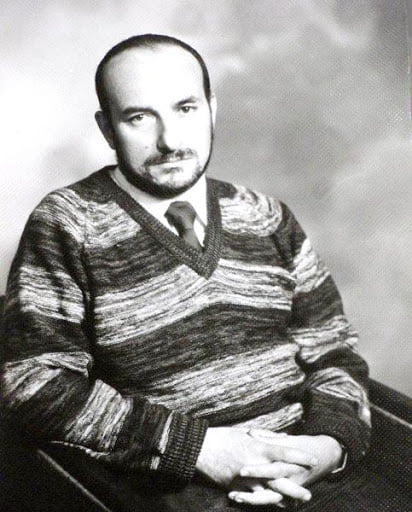
I would like to tell you about a true Jewish hero whom you may never have heard of. His name is Dr. Alexander Paritsky. He was born in Kharkov, in Ukraine, in 1938. Here’s a picture of him from about forty years ago:
|
|
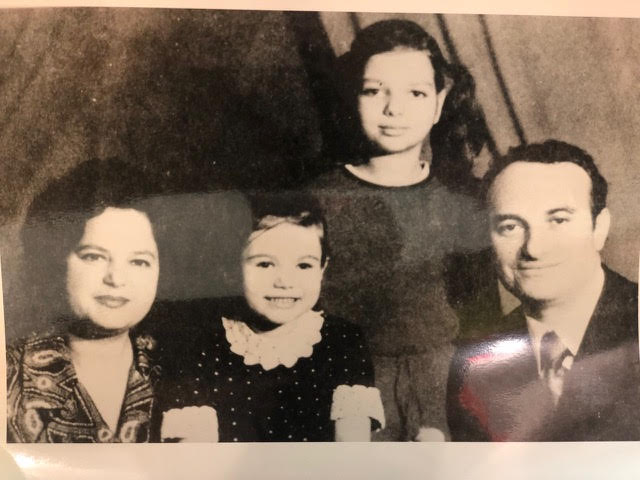
In the late 1970s, Alexander Paritsky and his wife, Paulina, were a Jewish couple living in Kharkov, Ukraine. Alexander ("Sasha") was an oceanographer, and Paulina was an engineer.
Here's a picture of the two of them with their two daughters, Anna and Dorina, taken during that time:
|
|
The Union of Soviet Socialist Republics, of which Ukraine was then a part, was an oppressive, totalitarian state. Judaism had long since been suppressed. There were many Jews in the Soviet Union, but antisemitism -- unabashed, state-sponsored and promoted antisemitism -- was never far from the surface.
One day, through their underground network of Jewish friends and colleagues, the Paritskys were given a book of essays by the influential Zionist leader Vladimir Jabotinsky. (Incidentally, because it was illegal to produce such a book in the USSR, it was a mimeographed, hand-written copy. For those who don’t remember mimeograph machines -- precursors to Xerox machines -- click here.)
The Paritskys stayed up all night reading that book. In the morning they realized that they didn’t belong in Kharkov anymore, and they resolved to go to Israel.
They applied for visas to leave the country ... and were immediately and summarily refused. They thereby became “refuseniks”-- the name given to those who had demonstrated their desire and resolve to leave the Soviet state but were prevented from doing so. Almost immediately, they began to pay a price for their independent thinking and courage. Both Alexander and Paulina were fired from their jobs and their daughters were harassed in school. The family became isolated and ostracized. The only job that Alexander—a PhD physicist and an expert in the transmission of sound waves in water—was able to get, was stoking the fires in the boiler room of a local school.
Around this time, thousands of miles away, a group of young Jews in the Boston area were trying to publicize the plight of Soviet refuseniks. Many of them had previously travelled surreptitiously to the Soviet Union to visit refuseniks, and had returned with a promise not to forget them or their struggle.
The group decided that the best way to help the refuseniks as a whole was to publicize and dramatize the plight of one particular refusenik family. The family they chose was the Paritskys, and so “The Committee to Free the Paritsky Family” was born. My wife, Elana, was one of its founding members.
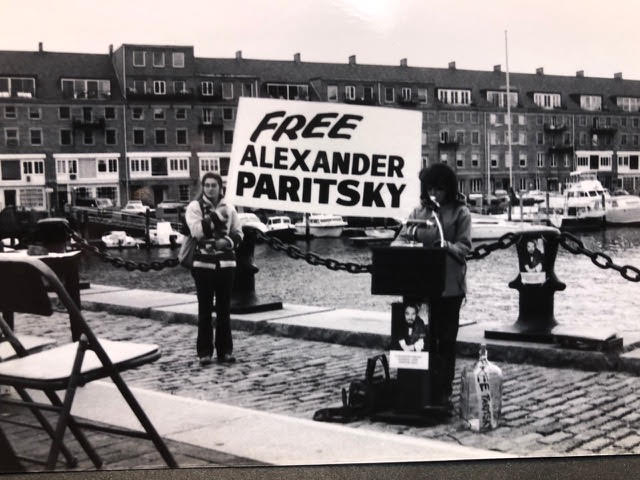
The group planned a series of events. One was a rally on the Boston waterfront at which the guest speaker was Congressman Barney Frank. As a publicity stunt, the group decided to “send a message to the Kremlin” by putting a card reading “Free Alexander Paritsky” into a bottle and then throwing it into Boston Harbor. You can see the bottle with the message, "FREE PARITSKY" clearly visible within it, to the right of the lectern in the photograph below:
|
|
By this time I had made Elana’s acquaintance, and so I was at that rally. Although Congressman Frank spoke strongly and effectively in support of the Paritskys, when the time came to throw that bottle into the water, I remember him moving out of the range of the camera lest he be accused of contributing to the pollution of Boston Harbor, which was then a serious concern. (PS: Not to worry: after the photo op, the committee retrieved the bottle from the harbor.)
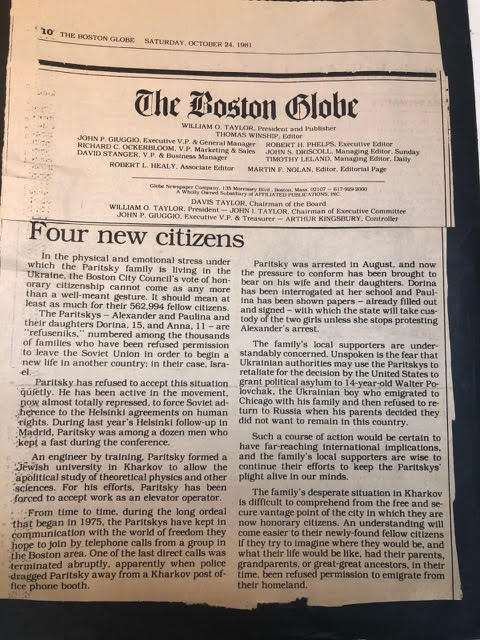
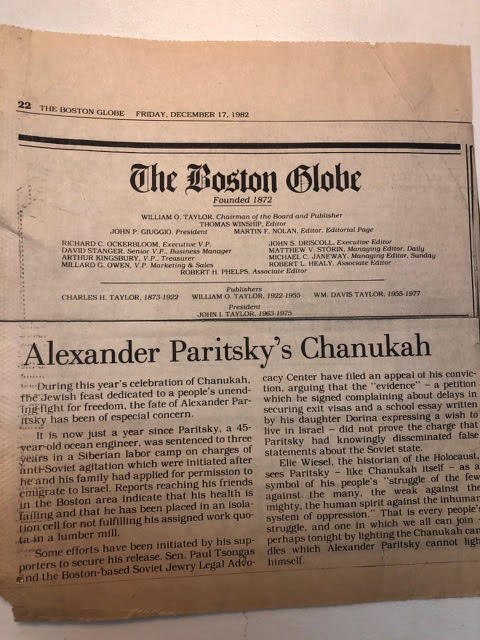
The group engaged in other activities to keep the Paritskys in the public eye. They successfully lobbied the Boston City Council to have the family named "Honorary Citizens of Boston," and they convinced the Boston Globe to run an editorial celebrating that step:
|
|
Every few weeks, the Boston Committee would call the Paritskys. Long-distance calls—particularly to a place like the Soviet Union -- were a big deal in those days. During one of those calls—and we still have the audiotape of it—Alexander was dragged away from the phone while talking to us by agents of the KGB (the Soviet secret police) and the phone line was abruptly cut off.
Some time later, one of the members of the committee, Peretz Rodman (a fellow Bostonian who later settled in Israel and became a Conservative rabbi), was able to travel to the Soviet Union. While there, he attempted to visit the Paritskys. He got as far as their front steps. The KGB, which was blocking all access to the family, wouldn’t let him go any further.
After setting up an open Jewish university, Alexander was arrested and convicted of “anti-Soviet slander,” and sentenced to three years of hard labor in Siberia. While there, he had a heart attack, and he spent about a year in solitary confinement. During his imprisonment, the committee couldn’t make contact with him but they would regularly call Paulina, who was also threatened with arrest. While Alexander was in prison, he was repeatedly told, “You will never get out of here.”
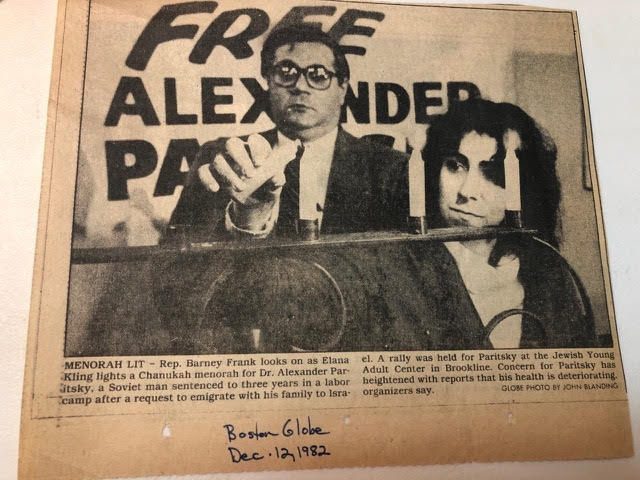
The Committee kept up its efforts, in order to keep alive the hope that the family would one day be freed.. When Hanukkah came around, Congressman Frank joined the Committee for a public Hanukkah candle-lighting. And this too received prominent attention in the press.
|
|
At one point, while he was still imprisoned in the Gulag (the term given to the system of labor camps holding political prisoners in the Soviet Union), the camp commandant asked Alexander why he had thrown away a successful Soviet life to pursue his hopeless quest to go to Israel.
Paritsky told the commandant the following story: When he was six years old, he was first called “Zhid” -- a pejorative Russian word for “Jew.” He’d never heard this word before and indeed, hadn’t even been aware that he was Jewish, so he ran home to speak with his father.
“Yes, we are Jews,” Paritsky’s father told him. Paritsky was intrigued by this. Other nationalities—such as Ukrainians and Armenians—had their own culture, their own language. Do we Jews have our own language?
“Yes,” said his father. “It’s called Hebrew.”
“What do the letters look like?” he asked.
His father took a piece of paper and a pencil and, with his son on his lap put the pencil to paper, to write out the aleph bet.
Alexander sat there watching the pencil poised motionless over the page. His father didn’t write anything. Instead, he began to cry.
“Papa,” he cried out, “why are you crying?”
“Because,” said his father, “I can’t remember how to draw the letters.”
It was those tears of his father, Paritsky said to the camp commandant, that motivated him to do what he did.
Alexander was eventually released from prison, though he continued to be refused permission to leave the country. Each time he reapplied, he was told to “come back again next year.” In 1984 he was told not to bother; that he wouldn’t be released until 1995.
The Committee to Free the Paritsky Family continued its work, publicizing the family’s plight and urging American leaders to use their influence with the Soviets to allow the family to go to Israel.
Finally, in 1988, after eleven years of waiting, the family was given permission to leave the Soviet Union. No reason was given, and it has always been unclear exactly what led to their release. They travelled to Vienna, and then to Rome, and then they made their way to Israel.
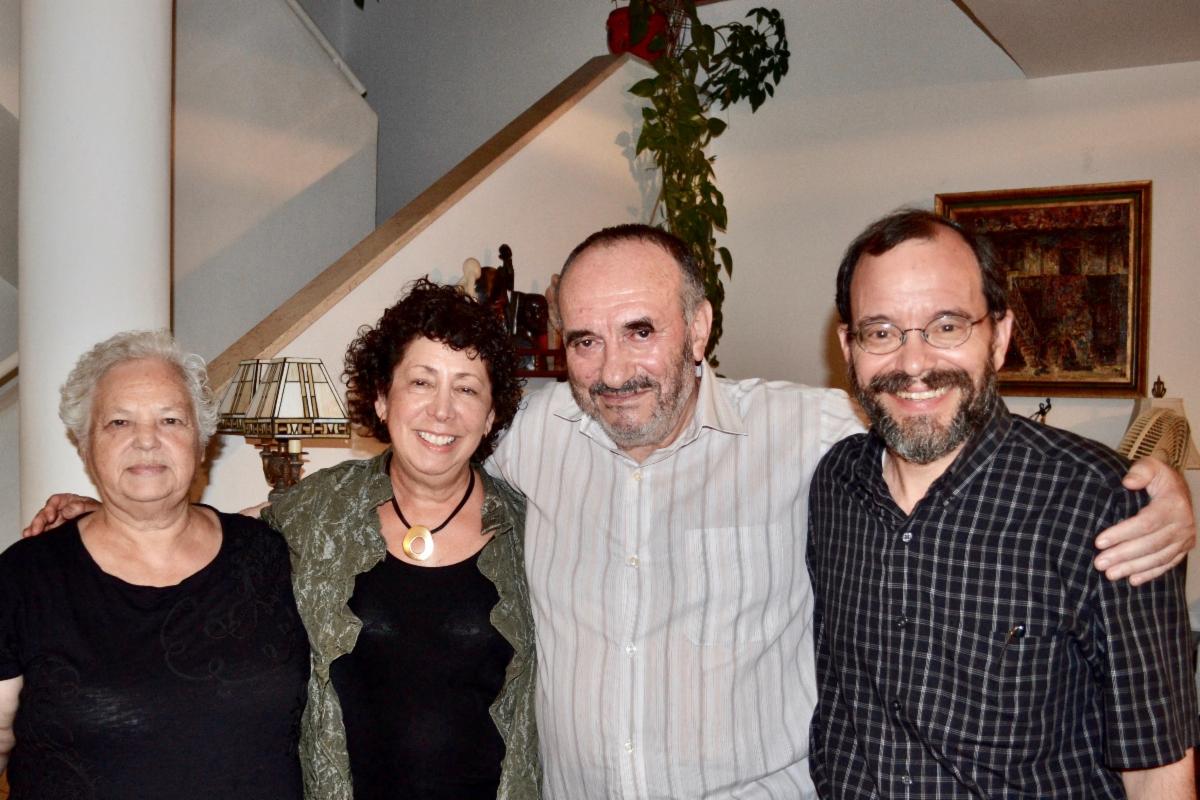
It wasn’t easy. Alexander couldn’t find work in his field. Neither could Paulina. But over time, they adjusted. In fact, they prospered. Eventually, they moved to Modi'in, and that is where Elana and I visited them in 2013.
|
|
The contrast, the transformation, couldn’t have been more dramatic. In the late 1970s, Elana and the rest of the committee had communicated with the Paritskys in English. By the time we met in Modi’in, Alexander and Paulina had learned Hebrew, and that was our common language. Back in the ‘70s, the Paritskys were, in essence, homeless Jews. Within a few years of arriving in Israel, they became thoroughly Israeli, and they now have Israeli grandchildren.
The Paritskys came from a place where it was a crime to behave like a Jew. They travelled in search of freedom: freedom to be Jewish and to study and practice Judaism. A few years ago, with great enthusiasm, Alexander started studying Genesis, and he began writing his own Bible commentary as well.
Just last week, while all of us were still watching the election returns intently, we learned of Alexander’s death. His wife Paulina, and his daughters Dorina and Anna -- and their children, Alexander's grandchildren -- survive him.
Let me end on a remarkable coincidental note.
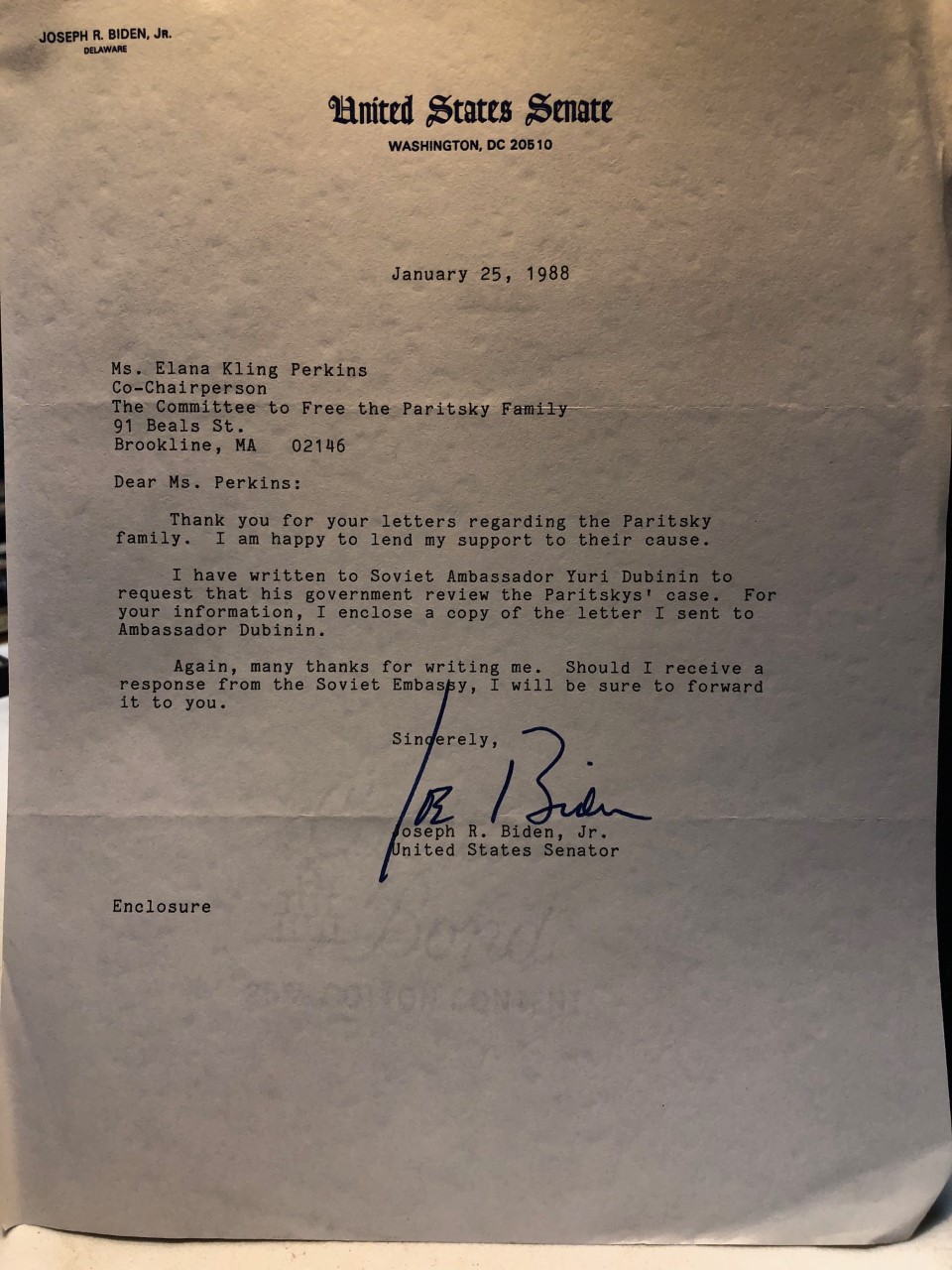
After Alexander’s death, my wife and other members of the Paritsky Committee went through their files and found photographs and documents from their decade-long struggle. One of those documents was a reminder of that struggle, and of the efforts taken on behalf of the Paritskys by influential people who were drawn to help them by the efforts of the Committee. Here’s that document, that we just happened to come across last week:
|
|
As I wrote above, it was never made clear exactly how and why the Paritsky family were permitted to leave the Soviet Union. But it is a fact that, within two days of this letter, the Paritskys were informed by local authorities that they would be granted exit visas for Israel.
May Alexander Paritsky’s courageous struggle -- and the struggles of so many other refuseniks -- never be forgotten, nor the determined efforts made on their behalf by so many men and women of goodwill, here and abroad.
May Alexander Paritsky’s memory long remain a blessing.
Sincerely,
Rabbi Carl M. Perkins
|
|
|
|
|
|
|