Ensuring Proper Planning for De-Energization
|
|
There are many safety initiatives underway at the California Public Utilities Commission (CPUC) as it works to assure Californians' access to safe and reliable utility infrastructure and services. Safety-related articles will be featured again in future issues
By Elizaveta Malashenko, CPUC Safety and Enforcement Division Director
|
As Director of the Safety and Enforcement Division at the CPUC, I understand that power outages of any period of time can be very disruptive to the local economy, impair access to essential services, and pose health and safety risks.
As such, state law allows utilities to shut off power to customers (called de-energizing) only when a utility reasonably believes that there is an "imminent and significant risk" to safety, such as when strong winds may topple power lines or cause major vegetation-related damage to power lines and lead to increased risk of fires. Proactive de-energization is a drastic step, but in certain conditions, it is also a step that can save lives, protect property, and prevent fires. While de-
|
|
energization may be necessary to prevent an incident that threatens public safety, loss of electric power can have particularly serious impacts on the elderly and those dependent on electricity for medical reasons. In addition, it can make evacuations and the work of first responders more difficult.
|
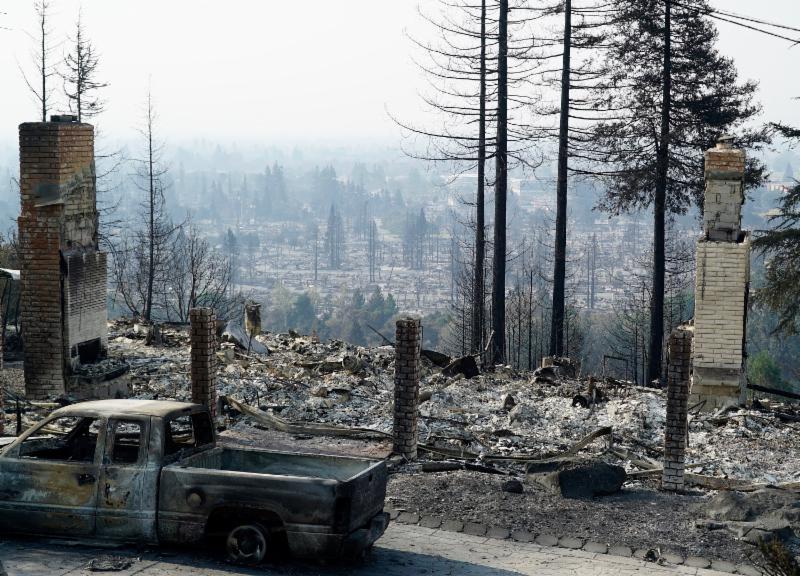
Larkfield Wikiup neighborhood devastation from the October 2017 Santa Rosa Tubbs Firestorm
|
At the CPUC, this is an issue we take extremely seriously. That's why this past July, as our state was dealing with a seemingly endless string of highly destructive wildfires, the CPUC put in place additional consumer protections for when utilities de-energize.
More
|
|
Providing Safe, Clean, Reliable Water for Monterey Peninsula
|
|
By Commissioner Liane Randolph
Few issues confronting California are more complex and contentious than water. Our job at the CPUC is to ensure that we have the safe, clean, and reliable water supply we need in a state that is home to approximately 40 million people. The difficulty of that task was driven home yet again by the lengthy CPUC proceeding that culminated last month with a unanimous vote clearing the way for a much-needed desalination plan on the Monterey Peninsula.
|
Old Fisherman's Wharf waterfront in Monterey Bay, California
|
"Monterey Peninsula residents and businesses have been struggling with water constraints since the 1940s," an earlier CPUC ruling noted..."Public
|
|
and private interests have a long and contentious history of trying to find a viable solution to this problem. Conflicting community values have rendered other proposals unworkable and unachievable. We have been addressing these concerns at this CPUC alone since 1997--well over a decade. It is evident and timely that we must arrive at a supply-based solution and approve a project."
After our Sept. 13, 2018, vote on the desalination plant, which also certifies the environmental work both on a state and federal level, one local newspaper called our action a "decision for the history books." That's because it takes so many turns and accomplishes so much.
The Monterey Peninsula is a beautiful and special place, but its longstanding water problems became particularly acute in 2009. That's when the State Water Resources Control Board (SWRCB) issued a cease and desist order against the local water provider, California-American Water Co., because Cal-Am had spent years diverting about four times the amount of water to which it was entitled from the Carmel River. Since that time, the communities on the Peninsula have worked hard to try to resolve this issue that is so critical to their quality of life. In September 2016, the CPUC approved Cal-Am's purchase agreement with the Pure Water Monterey recycled water project, which will provide additional supply once operational. But even that innovative project was not sufficient to meet demand and more supply is needed.
More
|
|
Addressing Biomass in California
|
|
By Michael Picker, CPUC President
With California's commitment to renewable energy and the growing concern about wildfires, biomass electrical generation has received a lot of attention recently as a tool for addressing both challenges, but for a number of reasons this approach still has a lot to overcome.
Both Senate Bill (SB) 901, signed recently by Governor Jerry Brown, and the May 2018 "California Forest Carbon Plan," put forward by the California Natural Resources Agency, CAL FIRE, and the California Environmental Protection Agency, call for increased state support for biomass, but the Carbon Plan also articulates part of the challenge.
"The costs of transporting forest biomass are significant relative to the material's value, so distance from source to processing site will determine commercial feasibility," the Plan states. "Regional and local approaches will also be better suited to discussions related to facility siting, economic development strategies, local impacts of forestry operations, and climate resilience of both natural resources and the human populations that depend on them.
|
|
Biomass timber removal down a forest footpath
|
Additionally, a clean energy policy has a different set of concerns than the issue of safety from wildfires. For clean energy, policymakers focus on emissions, price, and the ability of new resources to work together in ways that keep the lights on.
Fire safety revolves around reducing fuel, hardening communities to withstand ferocious fires, and clearing vegetation from near electric lines. While these policies are not contradictory, there are obstacles to making them work in harmony.
More
|
|
Docket: Proceedings Filed at the CPUC in Sept. 2018
|
|
Proceeding Number • Filed Date • Filer
|
|
Proceeding Number • Filed Date • Filer
|
|
A1611002 • 020-Aug-2018 (reopened) • ORA/MILEY/CPUC
Application of Southern California Edison Company (U338E) for Approval of the Results of its Second Preferred Resources Pilot Request for Offers. Application for rehearing of decision 18-07-023.
More
A1504012 • 04-Sept-2018 • ALJ/COOKE/CPUC
Decision on intervenor compensation claim of center for accessible technology.
More
P1809001 • 04-Sept-2018 • Direct Access Customer Coalition
Petition to adopt, amend, or repeal a regulation pursuant to Pub. Util. Code Section 1708.5.
More
A1608006 • 05-Sept-2018 • ALJ/ALLEN/CPUC
Decision granting compensation to Californians for Green Nuclear Power, Inc. For substantial contribution to decision 18-01-022.
More
|
|
A1809005 • 05-Sept-2018 • Hearsay Social, Inc.
Application of Hearsay Social, Inc. for Registration as an Interexchange Carrier Telephone Corporation pursuant to the Provisions of Public Utilities Code Section 1013.
More
A1712002 & A1712003 • 07-Sept-2018 • ALJ/STEVENS/CPUC
Decision approving energy storage agreements and associated cost recovery mechanisms.
More
A1701013, A1701014, A1701015, A1701016, A1701017• 07-Sept-2018 • ALJ/FITCH/CPUC
Proposed Decision addressing workforce requirements and third-party contract terms and conditions.
More
R1407002 • 07-Sept-2018 • ALJ/KAO/CPUC
Proposed decision correcting and clarifying decision 18-06-027.
More
|
|
This monthly newsletter is to keep you informed of proposals by the CPUC's Commissioners and Administrative Law Judges, as well as utility applications, and other issues and work of note. We also include a list summarizing the filings at the CPUC in the previous month.
We want to hear from you! If you have topics you'd like us to cover or if you'd like to make comment on our proceedings or work, please contact us at
outreach@cpuc.ca.gov or call (855) 421-0400. You can find information about events we are having at
www.cpuc.ca.gov/Events.
|
|
|
|
|
|
|