Newsom’s Final Budget: What It Means for Ag Education & CTE | | |
Governor Gavin Newsom’s proposed 2026-27 budget includes an unexpected $22 billion increase for K-14 education, raising the Proposition 98 guarantee to $125.54 billion for schools and community colleges. While much of the funding is one-time, it creates real opportunities to strengthen agricultural education and Career Technical Education (CTE).
Secondary Schools (K-12)
- Facilities & Construction: $1.5 billion in Proposition 2 bond funding supports school construction and modernization—eligible for ag mechanics shops, greenhouses, labs, and CTE classrooms.
- Local Flexibility: A $2.8 billion discretionary block grant allows districts to invest in equipment, facility upgrades, and program expansion aligned to local workforce needs.
- Pathway Development: $100 million one-time is dedicated to expanding college and career pathways, including dual enrollment/dual credit.
Community Colleges
- Facilities & Equipment: Bond and one-time funds support modernization of technical labs, shops, and training spaces critical to agriculture and CTE.
- Program Growth: Increased base funding and targeted investments help stabilize enrollment and expand high-demand ag workforce pathways.
- K-12 Partnerships: Resources support stronger dual-enrollment and articulated pathway work with high schools.
UC & CSU Systems
- University of California (UC): ~$350 million increase.
- California State University (CSU): ~$365 million increase.
- $250 million for Teacher Residency Programs (enhanced form of student teaching).
- Pipeline Impact: Investments enhance collaboration with K–12 and community colleges for pathway alignment and educator preparation.
The Bottom Line
With $125.54 billion in Proposition 98, $1.5 billion for facilities, $2.8 billion in flexible block grants, and $100 million for pathway expansion, this budget offers a rare chance to invest in ag education and CTE—especially in facilities, equipment, and career pathways.
A word of caution: The legislature still has a say in the final budget. It is likely that there will be pushback to things like the one-time money, accountability on the discretionary block grants, the built-in delays and withholding of funding, and what the long-term budget outlook will look like. The revised budget presented in May will likely look different from the current proposal.
CATA will continue advocating to ensure agricultural education remains a statewide priority as the legislature finalizes the budget.
| | |
New Teachers, the Advice is Not Criticism… it is to Help You Grow
By Travis Cardoso, Turlock High School
| | |
Stepping into your first classroom is exhilarating. It’s also a little terrifying. You’ve spent months—years—preparing lessons, observing master teachers, and collecting strategies. Yet the moment you close your door and face twenty-five (or thirty-five) diverse learners, everything becomes real in a way that no textbook or teacher prep program can simulate.
If you’re reading this, you’re likely already receiving advice—from mentors, administrators, veteran colleagues, parents, and even students. Some of it lands well; some of it stings. This “essay” is penned as a letter to you, a reminder that the feedback you receive is not an indictment of your talent or your worth; it’s an investment in your growth. The advice is not criticism. It is a hand on your shoulder, pointing you toward practices that will sustain you, protect your energy, and amplify your impact.
Below, you’ll find practical guidance organized into themes that matter most in your early years: mindset, planning, instruction, relationships, classroom culture, assessment, professional collaboration, and personal sustainability. Take what helps. Leave what doesn’t (for now). Revisit often. Teaching is cyclical, and your growth is worth protecting.
| | |
1) Adopt a Growth Mindset—For Yourself and Your Students
You’ll hear the phrase “growth mindset” everywhere—often directed at students. But it starts with you. Early-career teachers sometimes interpret feedback as evidence that they’re “not cut out for this.” Resist that narrative. Feedback is a set of coordinates, not a verdict. When a mentor notes that transitions are taking too long, they’re not saying you can’t manage a classroom; they’re saying, “Here’s a lever that, when adjusted, will give you minutes back and reduce stress.”
Practical moves:
- Normalize iteration. Treat each lesson as a prototype. After class, jot down two tweaks: keep and change. If you do that daily, you’ll compound improvements rapidly.
- Separate person from practice. “You are a caring, capable educator” and “your exit ticket needs to be clearer” can both be true.
-
Ask for specific, actionable feedback. “What would make my directions clearer in the first five minutes?” focuses advice on the practical, not the personal.
2) Plan Backward and Teach Forward
Planning is where you protect your future self. Backward design—starting with the learning goal and evidence of understanding—prevents you from crafting beautiful lessons that accidentally miss the mark. Teaching forward—breaking the goal into digestible steps, with daily checks—keeps students oriented and you responsive.
Practical moves:
- Clarify the destination. Write the unit’s “students will be able to…” statement in student-friendly language. Post it. Refer to it.
- Map the mile markers. Identify 3-5 key sub-skills students need (e.g., “identify claims,” “cite textual evidence,” “explain reasoning”). Build mini-lessons around each.
- Plan checks for understanding. Quick, low-stakes checks (thumbs to chest, one-sentence summaries, a two-question exit ticket) give you real-time data without derailing pacing.
| | |
What Makes Your Program Special?
By Gene Lieb, California FFA National Chapter Committee
| | |
Every year, it seems like the calendar gets fuller and fuller, while somehow the hours become fewer. In a time where the last thing people want is one more thing, I’m going to share one more thing that all of you should think about: The National Chapter Application. When you hear about the National Chapter Application and think of the glorious eighteen pages that encompass this application, you may want to run away, but I ask you to stick with me.
In 2019, I had my first opportunity to immerse myself in the National Chapter Application. I had the chance to travel to Indianapolis in the summer for a week. I had no idea what to expect, but I ended up gaining insight and friendships that have lasted since that week. The challenging part was sitting in a hotel conference room for eight-plus hours a day for four consecutive days. I never read about so many fruit sales and corn donation events in my life. During that event, I learned what creative activities really look like and the difference between an amazing application and an average application.
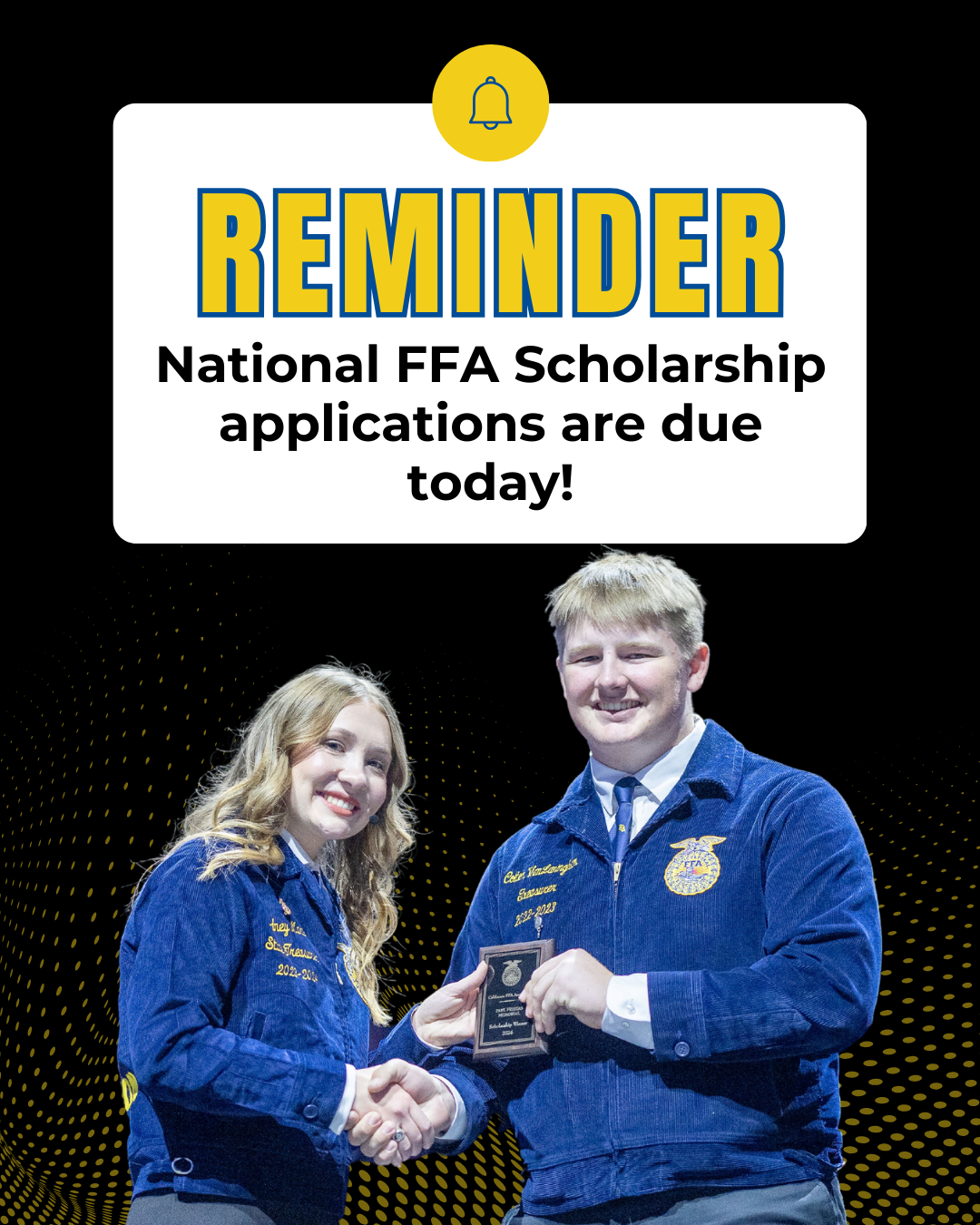
| | 2026-27 National FFA Scholarship Application Closes TODAY! | | | | Encourage your students to submit their National FFA Scholarship applications before today's deadline. These scholarships support FFA members pursuing trade schools, vocational certificates, and two-year or four-year degrees. With just one application, eligible high school seniors and college-aged FFA alumni are considered for multiple scholarship opportunities totaling nearly $2.5 million. Applications are due today, Thursday, January 15, so remind your students to submit before time runs out. | | Apply to Be a National Teacher Ambassador for FFA | | |
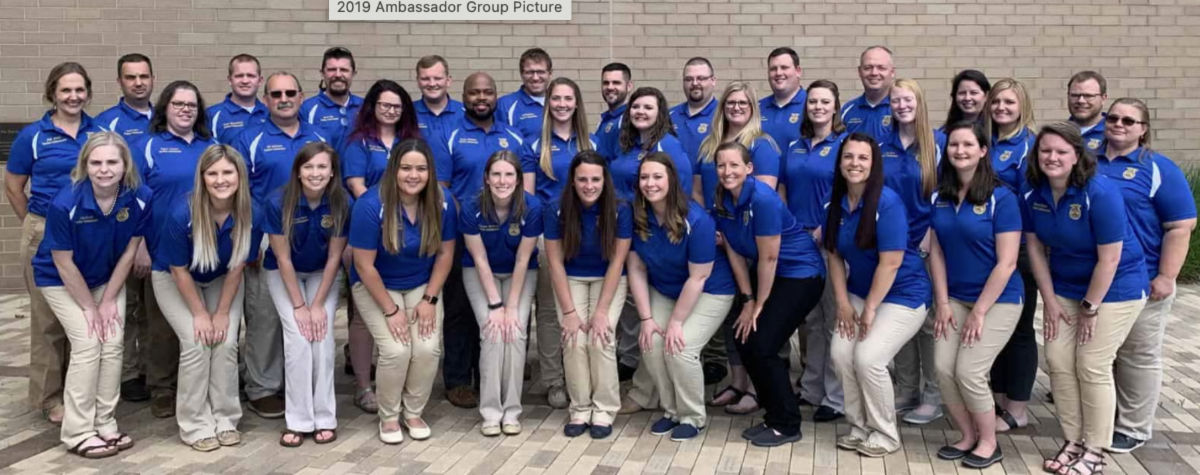
Applications are open for the 2026–27 National Teacher Ambassadors for FFA cohort. This program recognizes agriculture teachers who are committed to supporting and strengthening the profession. Selected ambassadors receive training from National FFA on educator resources, programs, and experiences, and then serve as a trusted resource for fellow teachers in their home state. Ambassadors share best practices, answer questions, and help connect educators to national opportunities.
Applications are due March 1. Learn more and apply: https://www.ffa.org/teacherambassadors/
| | Save the Date: 2026 CATA Summer Conference | |
Mark your calendars for the 2026 CATA Summer Conference, taking place June 21–25. This annual event brings together agricultural educators from across the state for professional learning, collaboration, and celebration of the work happening in ag classrooms every day.
As part of the conference, AgriSkills sessions will be offered on June 21 (two sessions) and June 25 (one session), providing hands-on opportunities to build skills and share best practices.
Registration opens on February 6, 2026. Be sure to visit the CATA Summer Conference page for the latest updates and access to the registration link as it becomes available.
Thank you for your continued dedication to agricultural education. We look forward to celebrating your accomplishments and connecting with you at the 2026 CATA Summer Conference.
| | |
Thank You Corporate Members!
The California Ag Teachers' Association appreciates the commitment of our corporate members who support agricultural education.
| | CATA Awards: Applications Now Open | | |
CATA is excited to announce that applications are now being accepted for CATA awards. We encourage all eligible members to consider applying and sharing the incredible work happening in your programs.
All applications will be submitted through Cognito Forms, and no other submission methods will be accepted. All award applications must be submitted by February 15, 2026, at 11:59 p.m.
To explore both ongoing and new award categories, and to access application information, visit:
https://www.calagteachers.org/awards-and-applications
| | Last Chance To Nominate An Outstanding Colleague | | Nominations for the 2026 Golden Owl Award closes on January 16 at 5:00 PM. Take five minutes to nominate a fellow ag teacher, and help them win $3,000 and receive national recognition. The Golden Owl Award Program, a partnership between Nationwide, California Farm Bureau, and California FFA, is designed to recognize teachers who go above and beyond. Nominate a colleague today! | | Request Blue Jackets for Deserving FFA Members | |
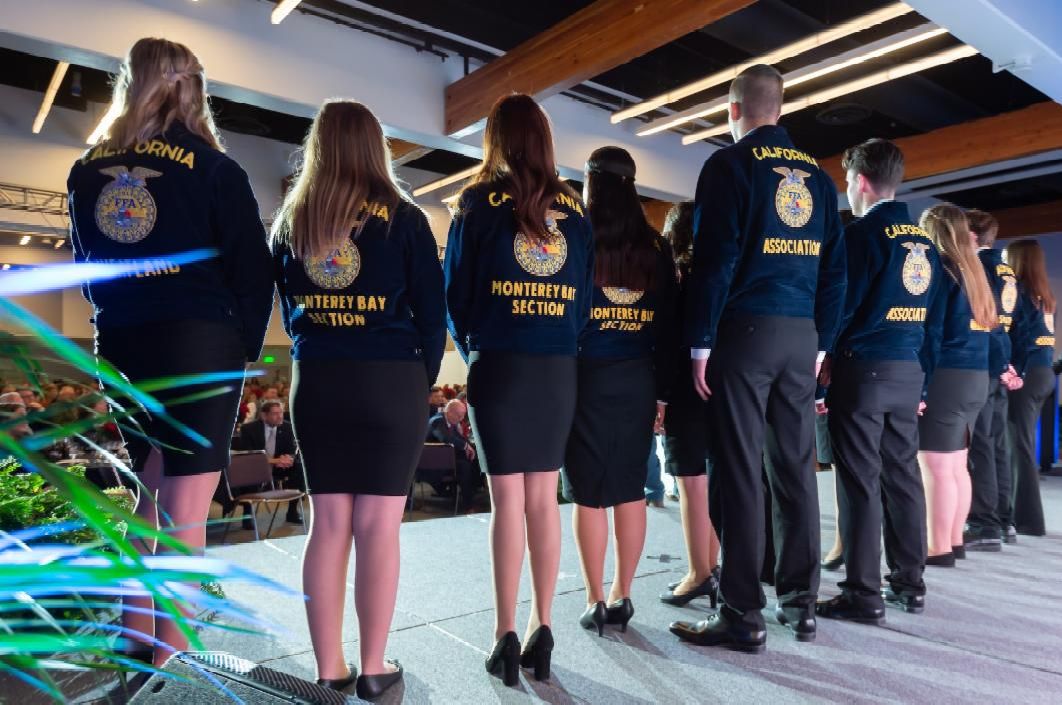
Every student who competes, shows, or serves in FFA deserves access to official dress, including their own FFA jacket. Each Giving Tuesday, the California FFA Foundation, Blue Diamond Growers, and generous alumni and supporters raise funds to help make that possible.
All California FFA chapters are eligible to request up to two FFA jackets per month, along with a gift card for additional uniform essentials. These items are intended for dedicated FFA members who may not be able to afford official dress on their own.
Chapters may submit one Jotform application each month, and the FFA Foundation will place the order with National FFA on your behalf. Please have your chapter number, shipping address, jacket types and sizes, and scarf and tie preferences ready before beginning the form.
Questions can be directed to Heather Casjens at hcasjens@californiaffa.org
| |
Applications for INFLUENCE Program Due Tomorrow! | |
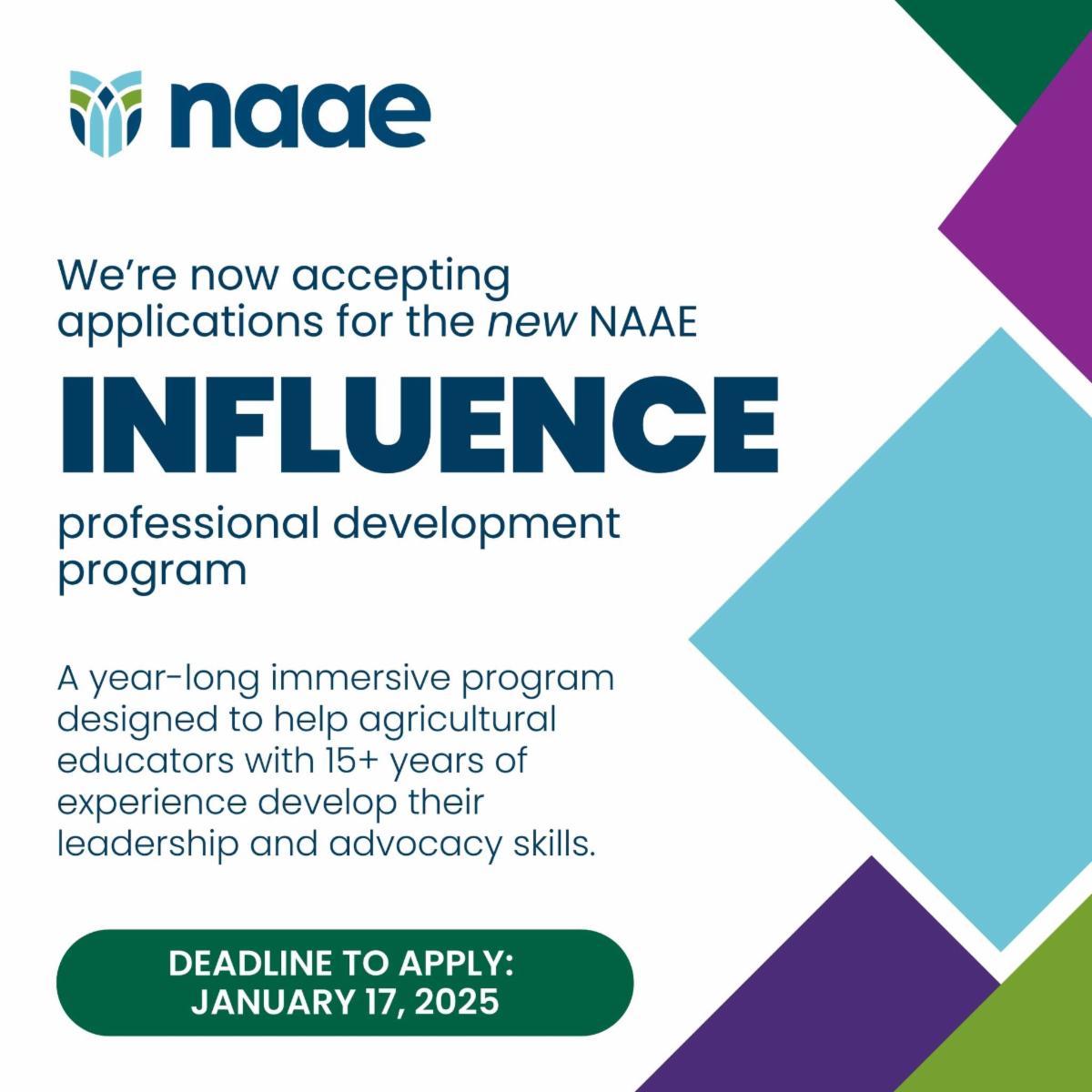
Applications for INFLUENCE, NAAE's new year-long immersive program for agricultural educators with 15+ years of experience, are due tomorrow! This program is designed to help seasoned educators enhance their leadership and advocacy skills, empowering them to build and sustain influence within their local communities, schools, state agricultural teachers’ associations, other state organizations, and at regional and national levels. Applications are due Friday, January 16.
| Wilco’s Chapter Grant Program | |
Wilco’s FFA grants support chapters that need funding for special projects that will make an impact on their FFA chapter or the greater community. Selected projects will receive $250 - $4,000 grants, and ALL active California FFA chapters are eligible. Previously funded projects have included chapter equipment and facility improvements like greenhouses and land labs, educational activities, and service projects. The next application period opens on January 20 and closes on February 27.
Learn more: https://www.wilco.coop/community/ffa-forever/grant-request/
| | |
National FFA News and Updates
Compiled by Audrey Lent, Ag Teacher at Lakeside Middle School and National FFA Teacher Ambassador
Reach out to Audrey with any questions, alent@lsusd.net.
| | |
New SAE Video Lesson Plans Available
New SAE videos recorded in North Carolina showcase a wide range of student Supervised Agricultural Experiences, including school-based enterprises and middle school SAEs. Each video includes accompanying lesson plans that can be used to strengthen SAE instruction and student engagement.
New Century Farmer Conference
FFA Alumni ages 18–24 who are interested in production agriculture are encouraged to apply for the 2026 New Century Farmer Conference, taking place July 18-22 in Indiana. Applications to attend or facilitate are open through February 15.
Blue Room Interviews
The Blue Room Gallery features over 100 video interviews with national FFA award winners. Educators and students can search by name, chapter, state, or award category to explore inspiring examples of excellence in agriculture, leadership, and innovation.
National FFA Week is February 21-28
Celebrate National FFA Week in your program with confidence. The 2026 National FFA Week Implementation Guide provides ready-to-use ideas, activities and tips to help you showcase FFA in your classroom and community. Make this week impactful and fun for your students.
| | | | |