Campaigning for Democracy And Socialism | | |
June 20, 2025: The Week in Review
A Pretty Good Start:
What 10 Million in the Streets Means to Us
| |
|
We will need more than a week to absorb the full impact and meaning of the 'No Kings' elemental rising last weekend. Suffice it to say, we've never been here before.
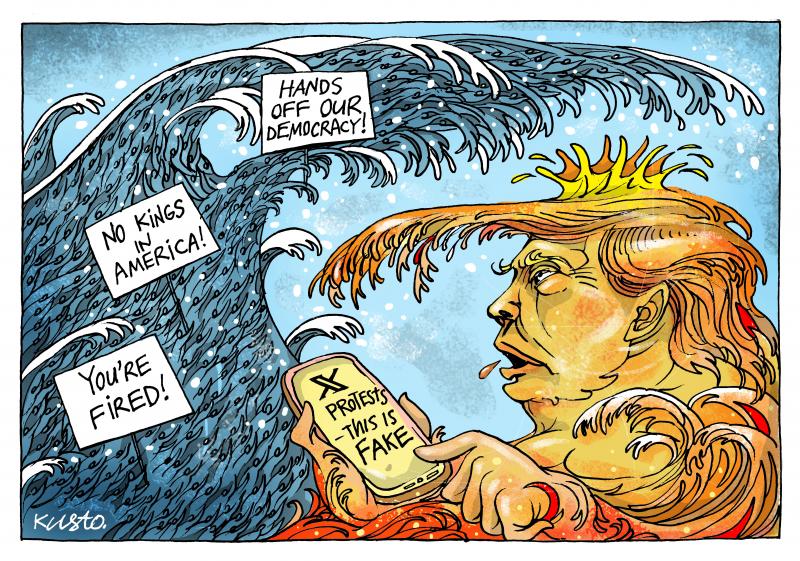
Somewhere between 5 and 10 million Americans took to the streets on June 14 with a sharp message: 'We're sick of facing the dangers of fascism and war, so stop Trump and all of his enablers now! We're a democracy, not an autocracy! No Kings!'
Looking at their scope, the June 14 events occurred in over 2,200 cities, towns, county seats, and small villages. They were in every state, whether the political terrain was viewed as blue, red, or purple. Every color of the rainbow and every nationality, every sex and gender, young, middle-aged, and senior citizens were proudly waving homemade signs and banners. Many unions were present, alongside a great many non-union workers who would love to be part of one. But people from all walks of life, including from the middle strata and upper classes, found ways to join in and speak out. And while militant and rowdy at times, it was entirely nonviolent on a scale not seen before.
Examining recent history, some compared it to the massive turnout in 2020, angered by the police killing of George Floyd, a huge rising against white supremacy and police brutality. African Americans took the lead, but they were quickly joined by young people of all nationalities. These insurgencies, which spread over two weeks, occurred in more than 100 cities. Protestors engaged in many battles with police, and in Minneapolis, the police station where it all started was burned to the ground. In the end, some 14,000 people were arrested; however, over 92 percent of the protests remained nonviolent.
Some also looked back to the massive rise of women in January 2017, marked by all the pink hats, following Trump's Inauguration. It was huge, with a turnout of 500,000 in DC, 400,000 in NYC, 250 in Chicago, and thousands more in every major city. The events were entirely peaceful and unprecedented, and with a clear message: No retreat on women's rights!
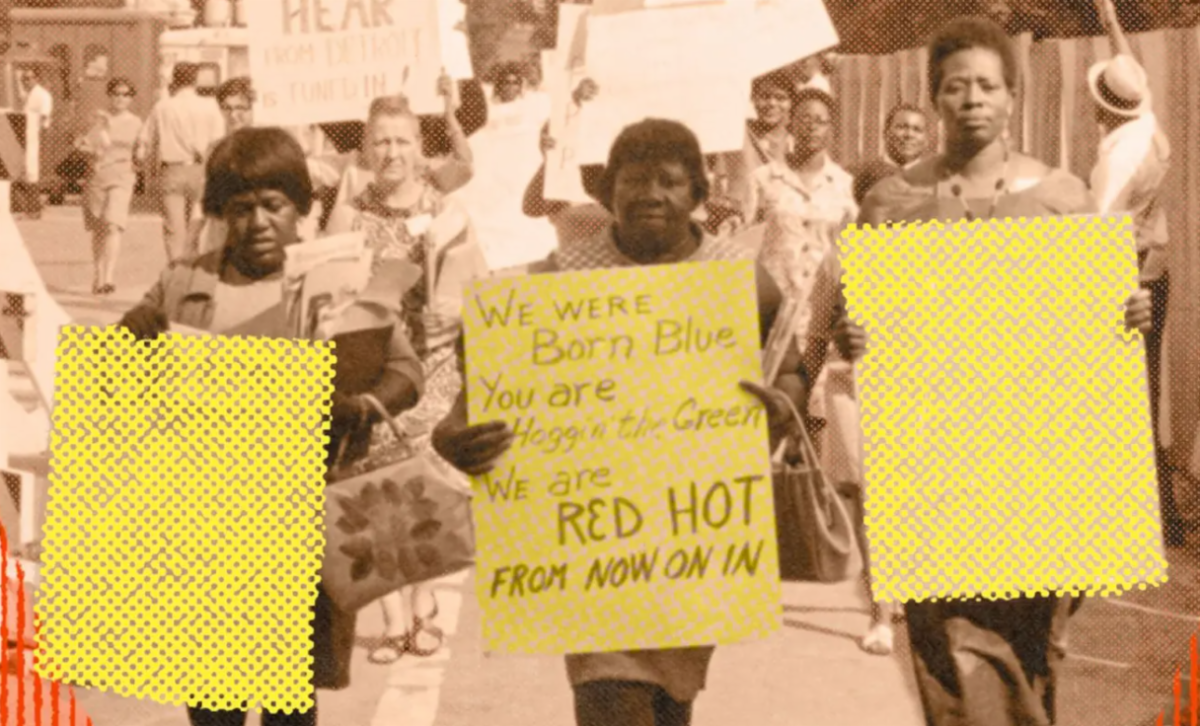
These were all impressive, but in the end, their numbers and scope didn't come near No Kings Day. The only mass protest going beyond the scope of June 14 was the Black Revolt in the wake of the assassination of Rev. Martin Luther King, Jr.
In the days following April 4, 1968, now a dreadful date, somewhere between 15 and 20 million people, mainly African Americans, took to the streets in over 150 cities. There was no organization leading it all. Everyone took part. Intense battles quickly broke out with the police, with buildings set afire and businesses looted. Forty-three people were killed, another 3000 were seriously injured, and more than 20,000 were arrested. Only when President Lyndon Johnson nationalized the National Guard and called out the U.S Armed Forces to occupy the country's 'inner cities' did the revolt subside.
In the wake of the Black Revolt, U.S. politics shifted rapidly. LBJ gathered all his allies and secured the quick passage of the Voting Rights and Civil Rights Acts. He also knew the cost of replacing the older ways of ruling. Blacks with voting rights in the South meant pro-segregation Democrats would desert en masse into the GOP, and Republicans would dominate the South and much of the West for decades to come.
We can draw a political line directly from the 'New Right' arising from the backlash to the gains of the Civil Rights campaigns to the rightwing populist, neoConfederate bloc assembled by Trump following the election of Barack Obama. The current GOP, where its traditional conservatives have been expelled or otherwise silenced, has now brought us to the cusp of fascism and war. At home, Trump's white nationalists have targeted immigrants with brown skin as their means of gutting the U.S. Constitution. Other targets are soon following: LGBTQ people, veterans, women, and insurgent workers. Abroad, Trump's 'Christian Reconstructionists' are using Israel's genocidal expansionism and the fear of Iran to put the wider and deadly wars of the 'Second Coming' Apocalypse on the horizon.
Only a few years ago, very few of us envisioned this conjuncture, or the vast left and progressive movement arising within it. The phrase "No Kings" encapsulates a rejection of absolute authority and unchecked power, whether wielded by oligarchs or autocratic leaders. In the context of mass demonstrations, it reflects a collective yearning for new systems that serve all citizens and residents, rather than elevating a select few against the many. It is not merely a cry against monarchy but a broader call for equity, transparency, popular participation, and justice in governance. While No Kings protestors defended old norms, most of them look forward to a new and more engaging democracy, to a 'Third Reconstruction,' as the Rev. William Barber and others frame it.
The No Kings events, at their best, awaken us to the innate power of solidarity. They are a testament to human resilience and the collective capacity to demand a better future. When people chant "No Kings," they are not only rejecting systems of excessive power but affirming their belief in self-governance, equality, and the fundamental rights of all citizens.
Our effectiveness, going forward, is shaped by three key factors:
" Clarity of Purpose: The goals of the ongoing 50501 demonstrations must be specific and achievable, whether seeking legislative change, raising awareness, or demanding accountability.
" Nonviolent Resistance: History has shown that peaceful demonstrations, while challenging to maintain in the face of oppression, call out greater public sympathy and international support.
" Persistence: A single day of protest may ignite conversation, but sustained effort is necessary to see tangible change.
Learning from Dr. King, our message is clear: history bends toward justice, but only when pushed by the efforts of a militant minority working to awaken a progressive and anti-fascist majority. Let us continue to rally, chant, and march together in this ongoing journey.
[All LeftLinks editorials, unless otherwise designated, express the views of our stalwart editor, Carl Davidson, and not necessarily any organizations he is connected with. Everyone, of course, is welcome to steal them and shamelessly pass them around, far and wide, with or without permission. A thank you note would be welcome, though!]
| | | | |
WE ARE INVITING FEEDBACK!
Please send us your letters, comments, queries, complaints, new ideas. Just keep them short and civil. Longer commentaries and be submitted as articles.
Click Here to send a letter
DIFFICULTY READING US?
View as Webpage
Food for thought: Our weekly format is missing too much of vital ideas in the news. What do you think of 'Daily Extras!' once or twice a week?
We're also considering 'Friday Night at the Movies' for 1940s Noir classics, as well as vital new films yet to gain top Hollywood status. Would you project us from a laptop onto your big screen TV and invite friends for popcorn and a 90-to-120 minute show?
Let us know.
|
We're going to try something new, and you are all invited.
Saturday Morning Coffee!
Started in August 2022, then going forward every week.
It will be more of a hangout than a formal setting. We can review the news in the previous days' LeftLinks or add a new topic. We can invite guests or carry on with those who show up. We'll try to have a progressive stack keeper should we need one.
Most of all, we will try to be interesting and a good sounding board. If you have a point you would like to make or a guest to invite, send an email to Carl Davidson, carld717@gmail.com
Continuing weekly, 10:30 to Noon, EDT.
The Zoom link will also be available on our Facebook Page.
Meeting ID: 868 9706 5843
Let's see what happens!
| |
'No Kings' Coverage Surveyed
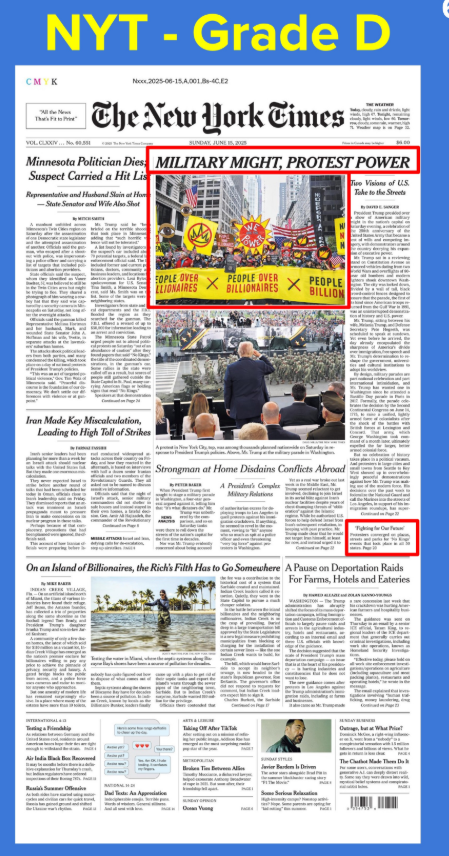
Local news outlets continue to outperform the national ones in covering the pro-democracy movement. Here, the Media and Democracy Project Blog shows all the front pages to make the point .
...Read More
| |
Indivisible
We Fight On, Together
Our democracy is under threat.
But we will not yield to fascism.
We will stand together and we'll fight back in defense of our rights, our communities, and our values.
Join Our Weekly Chat
Every Thursday, Indivisible co-founders Ezra Levin and Leah Greenberg help wade through the week’s news, answer your questions, and provide timely calls to action.
Upcoming Actions: April 19
Register for Event
| |
Join us in Chicago,
July 3-6, for
Socialism 2025!
Dear Pluto readers: The far right ascends around the globe amid war and wildfires.
The coming period promises more and deeper crises, but also to ignite mass social movements with increasing frequency. It is a crucial time for the left to come together and build durable organizations, coalitions, and relationships.
At this critical juncture, the Socialism 2025 Conference will be a vital gathering space for organizers and activists to sharpen analysis, hone strategy, and build community.
A four day conference featuring 100+ participatory discussions, lectures, debates, and workshops organized by groups from all over the country, the Socialism Conference will facilitate exchanges between existing activists and organizations while also welcoming people new to the left.
Featured speakers at Socialism 2025 will include: Pluto authors Micha Frazer-Carroll and Richard Seymour, as well as Boots Riley, Robin D.G. Kelley, Harsha Walia, Kim TallBear, Dean Spade, Sarah Schulman, Kali Akuno, Lorgia García Peña, Chenjerai Kumanyika, Sophie Lewis, Daniel Denvir, Adom Getachew, Jesse Hagopian, Eric Blanc, Glen Coulthard, Paisley Currah, Mikaela Loach, and many more.
The Socialism Conference is brought to you by Haymarket Books, Pluto Press and dozens of endorsing left-wing organizations and publications. Visit socialismconference.org to learn more and register today.
Register for Socialism 2025 by April 25 for the early bird discounted rate! Registering TODAY is the single best way you can help support, sustain, and expand the Socialism Conference. The sooner that conference organizers can gauge conference attendance, the bigger and better the conference will be!
Register Now
| |
HAMMER AND HOPE
NO. 6: Spring 2025
It’s morning again in America. Federal agents snatch students off the streets. The White House boasts of banishing hundreds of people to a Salvadoran prison. Head Start and domestic violence shelters await the chopping block. The Trump administration is repurposing antiracism into a grenade and lobbing it at the remnants of the welfare state. But regular people are providing the varied, creative, noncooperative opposition to the neo-fascist administrative takeover that we need.
SCROLL TO READ THE FULL ISSUE
| |  | |
Suzanne Crowell,
Presente!
From Portside: Suzanne Crowell passed away on June 15 in Maine at age 79. A lifelong activist, she took part in SNCC's Mississippi Freedom Summer Project in 1964 and was a member of Friends of SNCC and SDS while a student at Barnard.
After graduation, Suzanne came south in 1967 to work as the Appalachian correspondent for the Southern Patriot, the monthly publication of the Southern Conference Educational Fund. Almost immediately she was to play an important role in the campaign to free SCEF staff members Carl and Anne Braden and Al and Margaret McSurely, and Appalachian Volunteer Joe Mulloy.
The McSurelys and Mulloy were attempting to organize in Appalachia. They were targeted by the Kentucky Un-American Activities Committee, charged under the state’s sedition statute, and jailed after raids on their homes. Suzanne was responsible for organizing press coverage of the case, which drew nationwide attention. The sedition statute was later ruled unconstitutional.
Suzanne lived in Whitesburg, Kentucky, during her time at SCEF. She filed stories on coalfield struggles and wrote The Appalachian People’s History Book, which brought light to an area long ignored or poorly represented.
She moved to Washington DC in the late 1960s where she was a fixture in local politics for decades -- especially in the years when Marion Barry was Mayor. Suzanne, a member of AFSCME, was an active unionist and served as president for DC Coalition of Labor Union Women (CLUW) for several years. She was active in the Metro Labor Council and, after retiring, in the Maine AFL-CIO...
Suzanne was a member of the Democratic Socialists Organizing Committee and its successor organization, Democratic Socialists of America. She served as part of Metro DC DSA's local leadership in different capacities throughout the 1980s and 90s. She was elected to DSA’s National Political Committee, was part of national DSA's labor commission and anti-racism work and was on the editorial board of Democratic Left...
Throughout her life, Suzanne never wavered in her commitment to the struggle against racism, in her uncompromising commitment to the labor movement, to the struggle for peace and for a better world. She was a good friend and will be greatly missed by all who knew her.
For more information and how to make a contribution in Suzanne’s memory:
https://www.funeralalternatives.net/obituaries/obit-details.php?Crowell-3808
...Read More
| |
SECTION 2: INTERNATIONAL DEVELOPMENTS
2.1 Global Trends: Soaring Inflation, Populist Discontent, and a World at War
At a high level of generality, below are some key trends we witnessed in this three-year period.
A slowing global economy, soaring inequality and a cost-of-living squeeze
The economic rebound after the COVID pandemic was short-lived. What looked like a quick recovery turned out to be a “sugar rush”—a brief spike followed by slowing growth. In 2023 and 2024, global GDP growth dropped to just 2.6%, well below the pre-pandemic average of 3.5%, which itself was already down from pre-2008 norms. Despite faltering growth, financial markets soared: the Dow Jones bounced back from a dip in 2022 and continued hitting record highs. At the same time, global inflation jumped to nearly 8%. While it has since come down somewhat, it remains above pre-pandemic levels. Rising prices for energy, food, and other basics have caused a cost-of-living crisis, with three-quarters of people worldwide reporting concern about rising costs.1 According to Oxfam, nearly 800 million workers have seen their wages fall behind inflation, losing the equivalent of a month’s pay. Meanwhile, the very rich got even richer: the world’s five richest men have doubled their wealth since 2020, even as 5 billion people became poorer.
Increasing geopolitical tensions, state conflict, and extra-state violence
This period saw a sharp increase in war, conflict, and violence. Russia’s full-scale invasion of Ukraine in February 2022 triggered the largest military conflict in Europe since World War II. Israeli’s ongoing genocide in Gaza now threatens to expand into a broader regional conflict amid escalating tensions with Iran. In Ethiopia, the Tigray War led to the deaths of an estimated 300,000-600,000 people. Globally, the number of active state conflicts rose to 59—a record high. According to the Uppsala Conflict Data Program, the world has never experienced so many state-based conflicts at once. Deaths from conflict reached their highest levels since the 1994 Rwandan genocide, with civilian casualties making up an increasing share. Non-state violence—committed by rebel groups, militias, and organized crime—also remained at historic highs. The increasing use of drone attacks, including robotic and autonomous systems, is transforming the nature of modern combat. Meanwhile, in the South China Sea, disputes between China, the Philippines, and Taiwan raised fears of US-China tensions escalating into outright war.
Resurgent migration, hardening borders, and regional blocs
After falling sharply during the early COVID years, migration has returned to historic highs. While economic opportunity remains the main driver, forced displacement is also at record levels: by 2024, more than 120 million people had been forcibly displaced. ...Read More
| |
New class now open for enrollment in the
New York City DSA Academy:
The Long Popular Front
Application deadline: June 30, 2025 11:59 PM / Note: Course is in person only.
Instructor: Mary Reynolds
Dates: Alt. Mondays, 7–9pm
July 14, July 28, August 11,
and August 25, 2025
Location: TBA (Course is in-person only)
Course cost: $35 DSA members / $45 nonmembers
Course Description:
In our moment of desire and need for a ‘united front’ to fight authoritarianism and fascism, the American Popular Front’s history and legacy has a renewed resonance for the Left.
This course will go beyond the common understanding of the Popular Front as a short-lived, top-down Communist International policy of the mid-1930s. Instead, participants will explore it as an indigenous form and style of American revolutionary politics that took living shape within local grassroots campaigns for race, gender, and economic justice in the Depression decade, but survived far beyond it. ...Read More
| |
What to do if the
Insurrection Act is invoked
Here’s a starting point for how we’d respond:
1. Sound the alarm — If it happens, we move fast to make sure people know what it is and why it matters. No euphemisms. No hedging. Just the truth.
2. Push Democrats at every level to meet the moment — We’ll need every Democratic elected official using their platform to expose and challenge this abuse of power. That includes governors preemptively activating their National Guards (which may prevent federal takeover), press conferences, legal challenges, and public pressure campaigns.
3. Stay calm, disciplined, and united — Trump wants chaos. Our power is in joyful, defiant, nonviolent action. We protect each other, stay coordinated, and refuse to play into his narrative.
4. Flip the script — If Trump claims to be stopping “insurrectionists,” we remind people that he pardoned the actual ones. We shine a light on the real threat: a president using military force to suppress dissent.
5. Use ridicule to deflate his power — Strongmen hate being mocked. So we mock. Through memes, theater, satire, and creativity, we show how ridiculous and weak this play really is.
6. Plan for the long haul — This may be the opening move in a broader power grab. So we stay ready. We build legal infrastructure, strengthen communication channels, and invest in our communities’ ability to respond.
...Read More
Go HERE and HERE for more.
| | | Last Week's Saturday Morning Coffee | |
News of the Week, Plus More
| | |
The Full Context of the Tucker-Cruz
Confrontation Makes It Even Worse
By Joy-Ann Reid
Jun 19, 2025 - So many people, including myself, are sharing this very telling, quite humiliating exchange between Texas Senator Ted Cruz and Tucker Carlson, on Tucker’s podcast.
| |
Video: Massive Anti-Israel Protests In Tehran, Missile Strikes Intensify On Eight Day
Hundreds of Thousands March Against
US-Backed Israeli Aggression in Tehran
'Since day one of these strikes, we've seen this strong sense of anger from ordinary citizens. Now they're taking to the streets to express that.'
By Jake Johnson
Common Dreams
Jun 20, 2025 - Hundreds of thousands of people took to the streets of Tehran and other cities across Iran on Friday to protest Israel's illegal and escalating assault as the U.S.—Israel's top ally and arms supplier—considers entering the war, which killed or wounded more than 2,600 Iranians during its first week.
Reporting from Tehran, Al Jazeera's Tohid Asadi called Friday's demonstra-tions "unprecedentedly large."
"We have to keep in mind that a considerable proportion of Tehran's population has decided to get out of the city amid the attacks, but still we see huge numbers," said Asadi. "Since day one of these strikes, we've seen this strong sense of anger from ordinary citizens. Now they're taking to the streets to express that."
Protests also broke out in the capitals of Iraq and Lebanon as Israel and Iran traded missile strikes, and Iran's foreign minister, Abbas Araghchi, arrived in Geneva for talks with European Union and United Kingdom officials.
In an interview ahead of the talks, Araghchi called the United States "a partner in this crime" and said that Iran is unwilling to engage in negotiations "until this aggression stops."
Citing an unnamed senior Iranian official, Reuters reported that Iran "was ready to discuss limitations on uranium enrichment but that any proposal for zero enrichment—not being able to enrich uranium at all—would be rejected, 'especially now under Israel's strikes.'" ...Read More
| | |
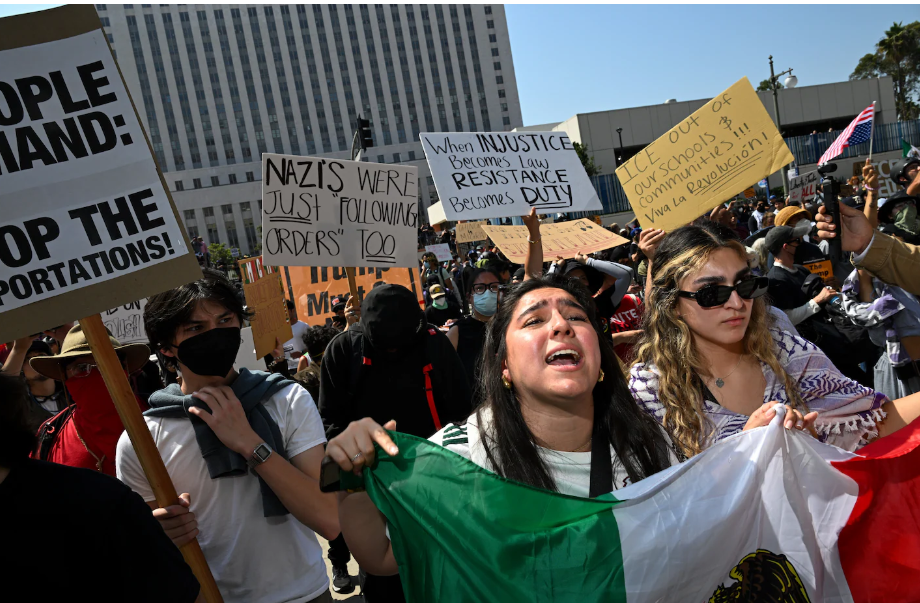
Photo: LA Protestors against ICE raids
From the Streets of LA to the National Stage:
The Left Must Win the Cultural War
Trump’s war on dissent can only be defeated by a left that challenges the values sustaining authoritarianism.
By Henry A. Giroux
Truthout
June 20, 2025 - On June 6, resistance ignited in the streets of Los Angeles to confront the Trump regime’s brutal campaign against immigrants, enforced by the brutality of ICE agents and the machinery of mass deportation. In a chilling escalation, Trump branded the protesters “insurrectionists” and threatened the use of military force — turning dissent into a crime and protest into a pretext for repression.
Stephen Miller, White House deputy chief of staff, called Los Angeles “occupied territory,” adding, “We’ve been saying for years this is a fight to save civilization.”
This is not merely the rhetoric of strongman fantasies; it is the language of fascist ambition, a calculated pretext to invoke the Insurrection Act and erect a police state.
Beneath this chilling facade lies something far more ominous: the weaponization of the war on immigrants as a means to orchestrate ethnic cleansing, veiled under the apparatus of law and the grotesque spectacle of state power. Moreover, as Kristi Noem and Trump have blatantly outlined, their assault on immigrants extends beyond individual lives — it’s a direct attack on the U.S.’s largest cities, like Los Angeles, Chicago, and New York, which stand as Democratic Party strongholds. When they claim to be liberating these urban centers from “socialists,” they are not just declaring war on ideological foes, they are also setting the stage for a fascist takeover, one rooted in division and destruction.
This is not about upholding law and order; it is the calculated weaponization of authoritarian culture to escalate state violence, instill terror, criminalize dissent, and legitimize white nationalist ideology. By framing defiance as treason, Trump attempts to cloak his own authoritarian crimes while constructing a political climate where any challenge to power is met with brutal retaliation. As Michelle Goldberg noted in The New York Times, “This is what autocracy looks like.”
The authoritarian dream is rooted in the belief that state violence should serve as the primary tool of governance.
When the guardrails of democracy are dismantled, violence shifts from being a last resort to a governing principle. This is precisely what unfolded in Los Angeles, where Trump deployed the National Guard and Marines to crush protests against his mass deportation policies, while mobilizing ICE as a modern-day Gestapo. What cannot be ignored is that the militarization of civil society is not merely an overreaction or illegal response to a fabricated insurrection; it is the very foundation upon which martial law is established, paving the way for a fully realized fascist state.
A rising to defend democracy
What unfolded in LA was not an insurrection; it was the people rising in defense of democracy. The true insurrection happened on January 6, with Trump as its chief architect. Yet once again, violence was being used not to protect democracy, but to crush it.
What we are witnessing is a spectacle of domination. The deployment of troops, the vigilante targeting of Democratic lawmakers, the planned grotesquerie of Trump’s military parade, and Trump’s order for ICE to target cities led by Democrats are not isolated events — they are scenes in the same authoritarian drama. Together, they represent a fusion of militarism and national identity, designed to normalize cruelty, fetishize strength, and recast obedience as patriotism. As Susan Sontag once warned, fascism cloaks violence in the aesthetics of spectacle — making submission not only palatable, but seductive. This is the pornography of power — where culture and repression merge in a theater of fear, scripted to extinguish political imagination and render dissent illegible.
If we are to reclaim democracy not as a slogan but as a living, breathing ethos, we must begin with culture.
In this moment of escalating violence, Trump’s use of force is more than a show of control — it is a pedagogical performance meant to normalize repression and etch it into public consciousness. This is fascist aesthetics reimagined for a media-saturated age, where power must not only be wielded but displayed as performance. Here, domination is choreographed, televised, and turned into a civic lesson.
The spectacle becomes a tutorial in submission, transforming images of state violence into instruments of mass indoctrination. Culture is not summoned to illuminate reality but to obliterate it, replacing historical memory with myth, dissent with loyalty, and resistance with silence. The convergence of Trump’s militarized crackdown in Los Angeles and his self-aggrandizing parade of force reveals a machinery of destruction no longer hidden but flaunted, a grotesque exhibition engineered to numb the senses and turn state terror into a national ritual. ...Read More
| | |
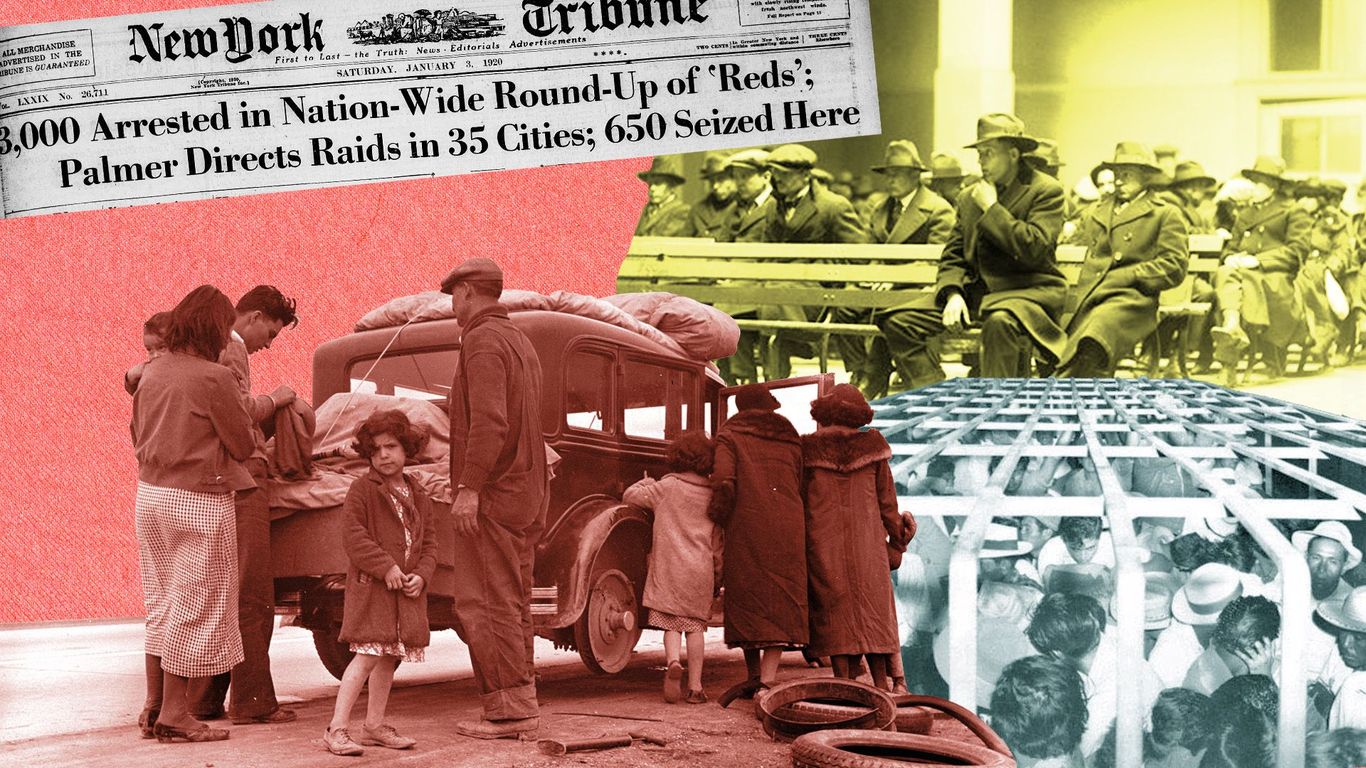
Operation Wetback 2.0: Now With Extra Hatred
By Desi Cortez
The Black Commentator
Why doesn’t Trump just cut the crap, rip off the red hat, and call it what they really call it behind closed MAGA doors?
Operation Wetback was a campaign by the U.S. government, primarily in 1954, to deport undocumented Mexican immigrants, particularly in the Southwest operation utilizing military/Gestapo-style tactics to remove Mexican immigrants - some of them American citizens - from the United States.
Yeah, that one. The phrase so racist, so dehumanizing, so soaked in Jim Crow-era bile that it makes your spine itch just hearing it. And yet - it’s the unofficial title of what’s being whispered, plotted, and now outright implemented in the darkest corners of MAGA Land.
Don’t believe me? Check the headlines.
“LA Public Schools to Shield Graduation Ceremonies from ICE Raids.”
You read that right. In the Year of Our Lord 2025, Los Angeles - one of the most diverse cities in the country - has to build a perimeter of human decency just to protect immigrant families from being snatched off school grounds while their kids walk the stage. Imagine needing a tactical defense line to graduate high school in the so-called land of the free. That’s not policy. That’s a domestic counterterrorism maneuver by your own damn government.
Who does this? Who thinks this stuff is not only acceptable but patriotic? Who likes this stuff? Who supports it? Who defends it?
Well, here’s your answer, and brace yourself - it’s not a mystery. It’s not subtle. It’s not even hidden anymore. There are two things MAGA is bankrupt of: a conscience and shame, they can’t be shamed ….that’s a trifling combination, no?
It’s the cult of Make America Great/White Again.
The same folks who think “compassion” is code for weakness. The same crowd who mourned when statues of Confederate traitors came down but cheer when brown babies get put in cages. They minimize it, rationalize it, meme it, and then spit-polish it into “border security.” And if you ask them? It’s not racism - it’s just “law and order,” baby.
Law and order. Right. The same phrase Bull Connor used before turning fire hoses on Black children. The same excuse ICE uses before they separate families at the border and throw toddlers in cages with mylar blankets. The same dog whistle-turned-foghorn that Trump has blasted from every podium he’s ever slithered behind.
And now, we’ve witnessed these ghouls construct graduation perimeters.
Let that marinate: Young people are throwing their caps into the air while ICE agents lurk in the shadows like damn wedding crashers from hell. And we’re supposed to pretend this is about protecting our borders? Please.
This is state-sponsored trauma. This is fascism cosplaying as homeland security. This is American cruelty on full display - streaming live, in HD, and proudly rebranded with a red, white, and blue bow.
Now I ask - am I lying?
Tell me I’m wrong. I dare you. I double-dog dare you. Because history says otherwise.
Let’s do a little roll call:
1. Japanese Internment Camps.
2. The Chinese Exclusion Act.
3. Operation Wetback (yes, that was its actual name - Google it, I’ll wait).
4. The Trail of Tears.
5 The Fugitive Slave Act.
6. Plantations - Cotton/tobacco,sugar you name the cash crop an industrial empire built with the enslaved blood, sweat, tears and years of people’s lives.
7 Reservations for Indigenous people
Cruelty isn’t an accident here. It’s not a glitch in the system. It is the system.
This is America’s operating system - Colonial Version 1.0, with racist updates delivered every election cycle.
But let’s not kid ourselves - it’s not just a few fringe hillbillies clutching shotguns and Confederate flags. No. The architects of this new era of terror are mainstream, buttoned-up, Bible-waving, regulation-cutting, golf-club Republicans. And before you even blink, yes, I mean White Anglo-Saxon Protestant, thank you very much.
They used to call themselves “Conservative.” Then “TEA Party.” Now it’s just “MAGA,” but it all spells the same four-letter word: FEAR. Fear of change. Fear of melanin. Fear of not being in control of every damn thing.
And that fear? It’s weaponized now. It’s the fuel for policies that punish the poor, criminalize the desperate, and terrorize the vulnerable.
Don’t get it twisted - this isn’t about national security. This is all about national purity. It’s about building a country where white grievance is government policy. And Trump, bless his dead-eyed soul, is just the mascot. He’s the bloated, gold-plated blow horn screaming what generations of White America have whispered for centuries.
And if we’re being honest - when folks show you who they are, best believe them.
This isn’t some shocking new development. This is an encore. A rerun. A sequel to the American Horror Story that never really ended.
We act surprised, like ICE just started doing this last week. But no - this is what America does. It’s what it’s always done. The only thing new is the way they’re marketing it now. They’ve updated the packaging. Added some QR codes. Tossed in a few evangelical talking points and Fox News chyron slogans. But the ingredients are the same. Racism, sexism, classim, basic xenophobia and white supremacy
And while we’re over here clapping at graduations and passing out diplomas, the stormtroopers in khakis and Ray-Bans are circling the parking lot, waiting for a family to exhale just long enough for them to strike.
So again, I ask: Who likes this … you know what?
Your neighbor. Your congressman. Your pastor. The guy two cubicles down who quotes Reagan like scripture but locks his doors when brown kids ride past on bikes.
They love it. They love every inch of it. Because it makes them feel powerful. It makes them feel safe. It reminds them that, even as the demographics shift and the truth grows louder - they can still win by breaking people.
So no, Trump doesn’t need to be subtle. He doesn’t need to dog whistle anymore. He’s got a bullhorn. And MAGA isn’t hiding this agenda - they’re selling it in 4K, with stadium rallies and PowerPoints.
Call it what it is: Operation Wetback 2.0: The Graduation Blitz.
Next, the Independence Day Raids: Yes. Unless we name it, shame it, and torch it under the blinding light of truth, we’ll keep living in a country where your child’s biggest graduation fear isn’t tripping on stage - it’s whether they’ll still have a parent to hug afterward.
Absolutely - I am pouring gasoline on that fire, I want to torch the hypocrisy in broad daylight.
Welcome to the United States of White People. Now do you believe me?
Desi Cortez also writes for BlackAthlete.com & NegusWhoRead.com. ...Read More
| |
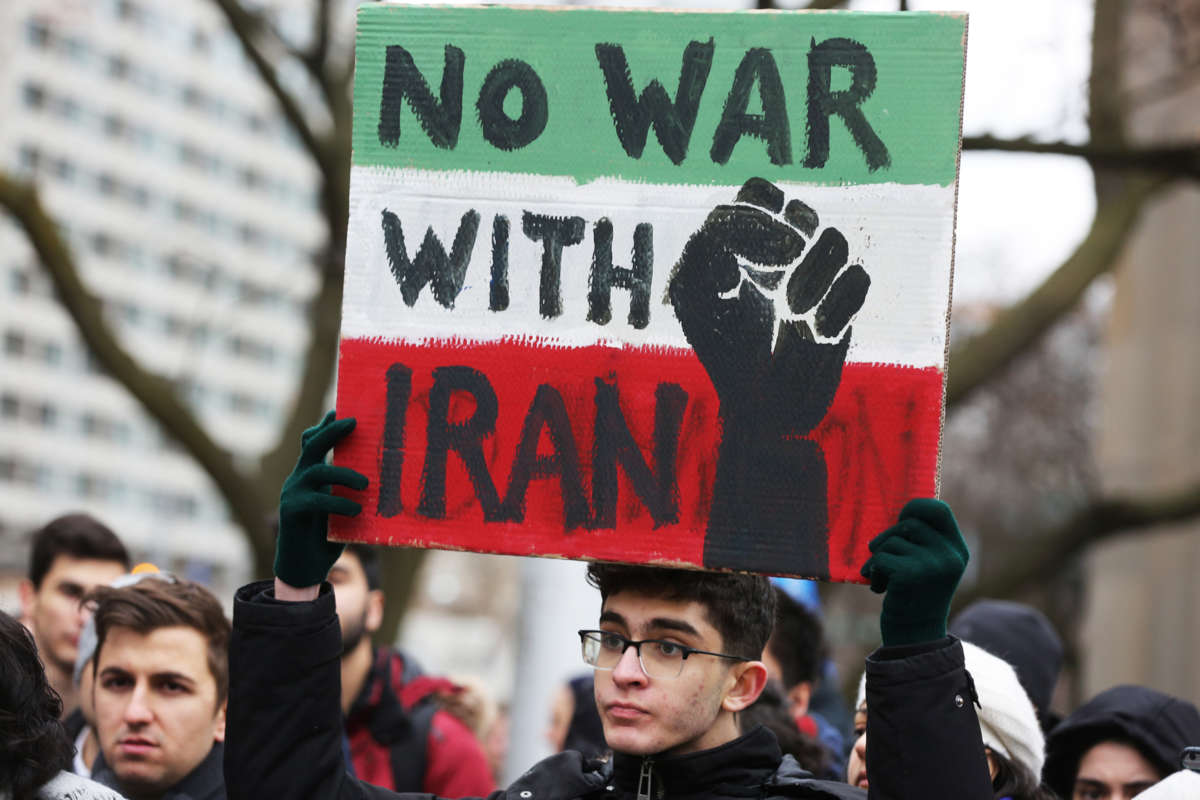
CCDS DEMANDS 'NO WAR ON IRAN'
Statement of the The Committees of Correspondence for Democracy and Socialism (CCDS)
On June 13, 2025, Israel launched surprise air attacks on Iran hitting military targets and assassinating Iranian leaders. Israel for years has called for the United States to support a war on Iran, alleging that Iran is building a nuclear arsenal that would be a threat to Israel’s survival.
Intelligence experts say that while Iran has large amounts of enriched uranium there is no evidence that Iran is moving toward building an atomic bomb. In fact, during President Trump’s first term, he withdrew the United States from an agreement (reached in the Obama administration) with Iran for the latter to not build an atomic weapon. Most diplomatic statements from Iran today indicate that they are prepared to resume negotiations.
But meanwhile, President Trump threatens to enter the war on the side of Israel, the Israeli air war on Iran continues and the year and a half long genocide of the Palestinians in Gaza continues, and Iran is hitting targets in Israel as well. Every sign is of an escalation of war in the Middle East and the step-by-step escalation of war that could lead to World War Three.
From the standpoint of the United States, Iran, until 1979, was a stalwart ally that served to extend US geopolitical and military presence to the Persian Gulf and closer to its real “enemy,” China. The US supported Iraq in its vicious war against Iran in the 1980s and imposed economic sanctions on Iran ever since.
The Committees of Correspondence (CCDS), along with the entire peace movement and a large percentage of the American people, demand that President Trump not enter the war against Iran but rather return to the negotiating table to reinstall the nuclear weapons treaty negotiated by President Obama.
| | |
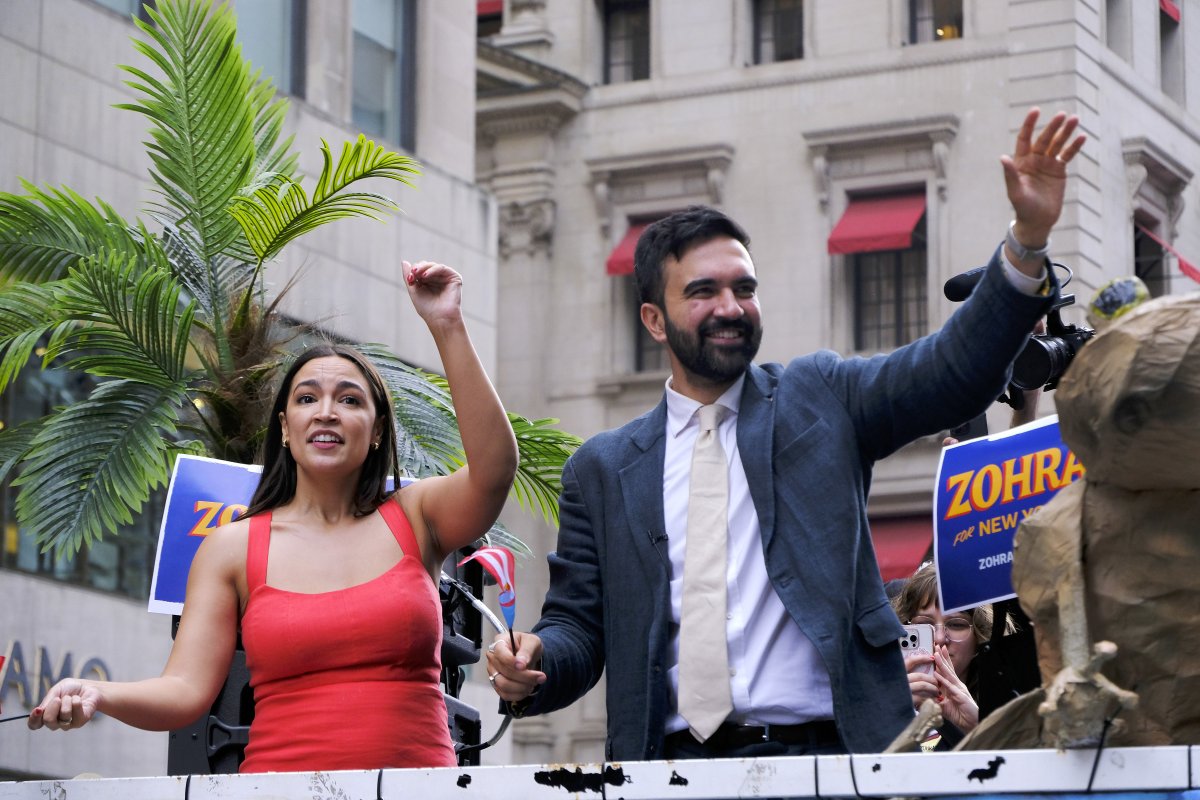
Photo: AOC recently endorsed Mamdani for Mayor in NYC
The Democratic Socialist Core to Zohran Mamdani’s Campaign
At a time when much of the left is in retreat or ducking for cover, Zohran Mamdani’s mayoral campaign is championing democratic socialist politics and raising expectations.
By Neal Meyer
Left Notes
Jun 19, 2025 - What does it mean to run as a democratic socialist for mayor? And what sets a socialist candidate for mayor apart from progressive candidates?
Those are the questions that many on the left are wrestling with as the momentum mounts for Democratic Socialists of America member Zohran Mamdani’s campaign for mayor of New York City.
Is Zohran’s platform indistinguishable from a progressive platform? In two important senses the answer is clearly no. First, Mamdani is running on a platform that puts rebuilding the public sector at its fore: most prominently through a plan for free and better buses, a test program to build publicly owned grocery stores, and an aggressive attack on the city’s wasteful dependence on private sector consultants. Mamdani also supports expanding the city’s childcare program and renovating and expanding public housing. This platform breaks with the center-left’s current submission to the belief that the private sector is the best means to deliver public goods.
It’s also a smart reply to the recent “abundance” arguments made by many in the party’s establishment. Yes, we need to build out transit and increase housing development, but the public sector should do those things. A strong defense of the public sector against privatization, and a willingness to push for its expansion instead of opting for “market-based solutions,” is an essential part of what it means to be a democratic socialist, and it’s a cause that Zohran has joined with force.
Second, for generations, all Democratic politicians in New York (including progressives) have pledged their fealty to the state of Israel. This is a game that Zohran (alone in the field of candidates) has refused to play. Not only is he the only candidate to refuse to make a symbolic trip to Israel, but he has popularized a true and damning criticism: that Israel is an apartheid state without equal rights for all its citizens. This combination of a vigorous case for the public sector and a solid commitment to international solidarity against the US-Israel alliance is the democratic socialist core of his platform.1
Raising Expectations
Those on the left who are primed to think that Zohran’s platform is “merely progressive” ignore the context in which that platform is being put forward. In a time of general retreat and demoralization, Mamdani’s campaign is reviving hope with a much more ambitious vision of left-wing politics. In a time when there is no precedent for left-wing governance in any major city in the country, his campaign is putting forward concrete pro-worker demands that are broadly popular, can test the bounds of what’s possible, and lay the groundwork for even bolder reforms to public transit, housing, and childcare, as well as the further expansion of the public sector.
Socialist platforms have historically followed the same logic. The Communist Manifesto includes demands that seem almost shockingly modest from our vantage point: the end of child labor, a progressive income tax, free public schools. The German Erfurt Program calls for the end of laws discriminating against women, universal suffrage, the separation of church and state, and free medical care (the last, alas, is still a radical demand in the United States). The socialist movement is “progressive” in this sense: it progresses as its power grows, moving from more modest to more radical reform fights. Zohran’s platform is the platform appropriate to a still very small and weak movement. Bigger reforms — say, a municipal version of single payer healthcare or a universally free public transit system — can be added to the agenda as our movement grows and our initial reforms are won.
None of this is to suggest that the pressure to adapt to mainstream politics and play by its rules isn’t a serious threat. If Zohran wins the Democratic nomination, and especially if he wins the general election in November, that pressure will become intense. Those on the left who scoff at these concerns as a “fear of power” or who exaggerate the power that a Mayor Mamdani would have are dangerously naive. Campaigns like Zohran’s are desperately needed — and if he won it would be an incredible opportunity — but the campaign and a potential administration will be much stronger if that threat is taken seriously.
Both the platform and the character of the campaign have had another beneficial and intended effect: both are raising expectations for what’s possible in electoral politics. The signs of this are clear. Zohran’s campaign has mobilized tens of thousands of people in a city where municipal politics are usually a dreary affair. The New York City chapter of the Democratic Socialists of America has grown by thousands of members. People are starting to believe again that left-wing politics can be about something more than playing defense against the onslaught from the far right. And for this reason, the campaign is starting to turn the screws on the centrist leadership of the party whose current strategy seems to be a return to Obama-era moderation.
When Progressives Echo Left-Wing Ideas
When left-wing activists and politicians raise people’s expectations, the effect is contagious. One reason I think a few of my friends and comrades on the left are skeptical of how radical Zohran’s platform really is is because key elements of it have been embraced in recent months by other progressives in the race. But months ago, the most prominent progressives running for mayor (including Brad Lander, who wanted to “see the data” first), refused to endorse the rent freeze Zohran first championed. As Zohran’s campaign took off and Lander’s straggled behind, Lander came on board. At last week’s debate, all except Andrew Cuomo and Whitney Tilson (the hedge fund manager who has served as Cuomo’s attack dog in the campaign while polling at 0 percent) endorsed the freeze.
That move is familiar. In the lead-up to the 2020 presidential election, many progressive (and faux-progressive) Democrats, hoping to catch up to the Bernie juggernaut, came out in favor of Medicare for All. Their support was conditional and in many cases more than a little duplicitous. The fact that they felt the need to endorse Medicare for All reflects the fact that progressive politicians and their staffers straddle the world of mainstream liberal politics on the one hand and the world of left-wing movement on the other. Torn between the two, they’re pulled in one direction or the other depending on where the energy is. The fact that progressive Democrats endorse left-wing demands in certain circumstances is a mark of progressives’ weakness; they do it only when the tide seems to be turning. It’s not a sign that the left is moderating its politics.
If nothing else, that makes progressives a good weathervane for knowing which way the wind is blowing. In 2025, those progressives are making a choice that ought to send us a clear signal: thanks to the work of the Zohran campaign and the New York chapter of DSA, the socialist left in the Big Apple has the wind at its back again.
1 For those wondering how a campaign like Zohran’s fits into the much longer struggle to build a socialist society, these two pieces of his campaign — expanding the public sector and international solidarity — are key. An economy in which the public sector plays the dominant role and a world order in which international solidarity replaces power blocs and inter-imperial struggles are two of the core building blocks of a socialist future. ...Read More
| | |
Photo: New York City mayoral candidate Brad Lander is placed under arrest by masked federal agents on Tuesday, June 17, 2025, in New York.
Masked Feds Arrest New York City Mayoral Candidate Brad Lander
The city's comptroller was standing up for a New Yorker after an immigration court date, and demanded to see a warrant when he was handcuffed
By Nikki McCann Ramirez
Rolling Stone
June 17, 2025 - Masked federal agents handcuffed and detained yet another Democratic lawmaker on Tuesday, this time in New York City.
Brad Lander, a mayoral candidate and New York City’s current comptroller, was arrested by federal agents, many of them masked, while accompanying another individual out of an immigration hearing at a courtroom in Lower Manhattan. Lander was released hours later.
In a video of the arrest that has gone viral, Lander has his arms linked with the man and demands proof that the arresting agents are following the law. “I would like to see the judicial warrant,” Lander repeatedly says as a gaggle of officers — including ICE agents and other members of federal law enforcement —ushered the pair down a hallway of a federal immigration court building. An officer can be heard saying “take him in” before Lander is pushed up against the wall by a smaller huddle of men, several of whom do not appear to be wearing regular uniforms, and handcuffed. Lander has been escorting migrants to and from immigration hearings in New York for several weeks now.
“You don’t have the authority to arrest U.S. citizens asking for a judicial warrant,” Lander said as he was cuffed. “I’m not obstructing, I’m standing right here in the hallway.” Hours later, Lander exited the courthouse in the company of New York’s Democratic Governor Kathy Hochul.
In a statement to reporters following his release, Lander said that the charges against him had been dropped. “You guys all saw it on video, so you know exactly what happened,” Lander said. “I certainly did not assault an officer.”
“I’m going to sleep in my bed tonight, safe with my family […] I’ve got a lawyer. I don’t have to worry about my due process rights,” Lander told reporters and the crowd of supporters protesting his arrest. “At that elevator, I was separated from someone named Edgardo […] Edgardo is in ICE detention, and he’s not going to sleep in his bed tonight. So far as I know, he has no lawyer. He has been stripped of his due process rights.”
“So I will be fine, but Edgardo is not going to be fine, and the rule of law is not fine, and our constitutional democracy is not fine,” Lander continued.
Governor Hochul, who called the arrest “bullshit,” earlier this afternoon told gathered protesters that earlier in the day she had been “walking the streets of little Haiti” to talk to migrant New Yorkers who were “scared” about their future under the Trump administration’s immigration policies.
The detention comes in the heat of the primary race for mayor, to be held on June 24. Zohran Mamdani, one of Lander’s opponents in the mayoral race, wrote a social media post in solidarity, insisting that Lander’s arrest “is fascism” and that “all New Yorkers must speak in one voice. Release him now.”
In a statement from the Department of Homeland Security, Assistant Secretary Tricia McLaughlin announced that Lander had been “arrested for assaulting law enforcement and impeding a federal officer.” She added: “No one is above the law, and if you lay a hand on a law enforcement officer, you will face consequences.”
Trump’s administration has brought similar charges against Rep. LaMonica McIver (D-N.J.). The member of Congress was indicted earlier this month after the administration accused her of assaulting an ICE officer after an oversight visit at a New Jersey detention center. The tour of the facility descended into chaos after agents arrested Newark, New Jersey, mayor Ras Baraka on charges of trespassing that were later dropped. McIver denies the accusations against her. ...Read More
| | |
Photo: HHS Secretary Robert F. Kennedy Jr. recently dismissed all 17 members of the CDC’s vaccine advisory panel and named eight new people to the committee.Mark Schiefelbein/AP
Radical Opacity and RFK Jr's Health Care Firings
The new leadership at FDA unveils a program that could lead to rapid approval of new drugs without public input.
By Merrill Goozner
Gooznews
Jun 18, 2025 - HHS Secretary Robert F. Kennedy Jr. at first promised “radical transparency” at all agencies within his department. Then he fired almost all the freedom of information staff at the Centers for Disease Control and Prevention, the Food and Drug Administration and the National Institutes of Health; cancelled meetings of FDA and CDC advisory committees that review vaccines and vaccine policies; and held meetings of his Make America Healthy Again Commission behind closed doors.
Marty Makary, the new head of FDA, boldly promised to purge all physicians and scientists on the agency’s 49 outside advisory committees with ties to private industry. The move, he said, heralded a new era where advisory committees with a diversity of opinions would offer advice free from industry influence.
Then, on Tueday, he announced a new program that will set up internal committees to rapidly approve experimental drugs within two months of receiving a company’s application. Given the short time frame, this will effectively bypass the agency’s advisory committee process.
The usual FDA review process often includes holding advisory committee meetings, especially when the clinical trial evidence on safety and efficacy for an experimental therapy is borderline. The review usually takes anywhere from ten months to a year.
As for speeding up the process, the agency already offers priority review vouchers for new drugs that meet unmet medical needs, treat rare diseases or are considered a breakthrough therapy. Those vouchers can then be used on any future drug application even if it doesn’t meet any of those criteria. It can also be sold to another company seeking rapid approval of a drug that isn’t critical.
Some products receiving priority reviews by agency scientists also benefit from the FDA’s accelerated approval process, where approvals are based an improvement in surrogate markers — biomarkers like elevated amyloid plaques in Alzheimer’s patients or tumor shrinkage in cancer patients that aren’t necessarily associated with a better outcomes when the final results of those clinical trials are in (which sometimes are never submitted because the drug companies fail to complete the trials).
The new program layers on an immediate rapid review to any company developing a new drug or device that meets one of four criteria: Does it address a health crisis; deliver an innovative cure; meet an unmet public health need; or increase the nation’s domestic drug manufacturing capacity?
The first three criteria are so vague as to be essentially meaningless. Virtually every drug and device company claims their new products are innovative and address unmet needs, even when they’re the sixth drug in a class that treats an already well-managed condition.
Giving out favors rather than regulating
As Aaron Kesselheim, a professor of medicine and member of the Center for Bioethics at Harvard Medical School, told STAT News yesterday: “It sounds like a way of giving out political favors rather than actually meaningfully changing or enhancing the regulatory process.”
The internal process for making decisions after awarding these new priority reviews will be equally problematic. Makary, a surgical oncologist, plans to convene experts from various FDA offices for a “1-day” team review that he compared to the tumor boards hospitals use when faced with a critically ill cancer patient. “This voucher harnesses that model to deliver timely decisions for drug developers,” he said in his statement.
That ignores the fact that many new drugs to treat chronic conditions like dementia, cancer, autoimmune disorders, and rare genetic diseases are often barely effective. They often have troubling safety profiles requiring careful weighing of minimal rewards against serious risks. These are the areas where FDA reviewers are most in need of advice from outside experts through the advisory committee process.
Prior to advisory committee meetings, the FDA publishes much of the data submitted by the companies seeking a new drug approval. It posts on its website its own analysis as well as the companies’ presentations of the data, which the public can review prior to the meeting. The meeting itself — often stretching over several days — are open sessions where the advisors hear from clinicians who treat patients suffering from the disease as well as consumer and safety advocates who urge the agency to give careful consideration to the risk-reward ratio.
Will these one-day “tumor board”-like sessions be open to the public? Will internal documents be published? Will they hear from interested parties?
If the goal of the new program is to shorten the FDA’s review time, the agency needn’t come up with another work around. The simplest solution is to hire additional staff.
Large staff cuts in the works
Instead, HHS at the urging of Elon Musk’s DOGE and the Russell Voight’s Office of Management and Budget announced the FDA will be laying off 3,500 of its 19,000 staffers, exempting for the time being new product reviewers. Why not use the savings to hire more internal reviewers? That’s the surest path to shortening review times.
This new program also ignores the fact that the FDA is already heavily dependent on industry user fees to fund its review staff, which is the biggest conflict of interest at the agency. Why don’t Kennedy and Makary go to Voight and his boss in the Oval Office to demand they include more taxpayer funding for FDA reviewers instead of giving more tax breaks to the wealthy and large corporations? ...Read More
| | |
Photo: A view of debris and damage from Hurricane Milton in St. Pete Beach, Florida, October 2024
Climate Change Will Bankrupt the Country
Climate-fueled disasters cost America almost a trillion dollars over the last year, far more than economists predicted.
By Ryan Cooper
The American Prospect
June 20, 2025 - Back in 2018, Yale economist William Nordhaus won the Nobel Prize for his work on his Dynamic Integrated Climate-Economy (DICE) model. The idea was to set up a picture of the global economy, add on some estimates of the economic costs of warming with a “damage function,” plus estimates of what climate policy would cost, and all adjusted with a discount term to account for how people value current production more than future production (according to economists, at least). That way you can calculate an “optimal” climate policy in the form of a carbon tax that would precisely compensate for warming damages without burdening the economy too much.
At the time, I wrote an extensive critique of the model, focused mainly on its damage function. For this, Nordhaus used a smooth quadratic equation, meaning it ruled out the possibility of any sharp upward breaks from tipping-point effects, like the Arctic Ocean becoming permanently ice-free or Siberian permafrost melting and releasing massive amounts of methane. Following Nordhaus’s advice to let warming drift up to 3.5 degrees Celsius, I argued, would be taking a hideous risk.
Fast-forward seven years, and it turns out that I was wrong: The economic damage of climate change is already much, much worse than DICE predicted, and the economic cost of policy to fix climate change is actually negative. I would like to apologize for the error.
On the first point, Bloomberg Intelligence has the details in a new report estimating that climate disasters cost America $955 billion in the 12-month period ending May 1 this year, or about 3 percent of GDP. This mainly comes from skyrocketing home insurance premiums, which have doubled since 2017, as well as expensive weather disasters, like the one-two punch of Hurricanes Helene and Milton ($113 billion) and the Los Angeles fires ($65 billion).
Now, some caveats are in order. This is just one year in one country, and damages are surely not uniform across the globe. Additionally, much of the disaster response shows up as more spending that is included in GDP. But undoubtedly most of it must be counted as damage, as it involves spending to replace structures or infrastructure that otherwise would have gone to productive business, particularly in the context of a low-unemployment, high-interest-rate economy. As the Bloomberg analysis argues, disaster spending is “crowding out consumer discretionary spending elsewhere in the economy and putting pressure on local governments to prioritize disaster repair over other infrastructure projects.”
Ultimately, the Bloomberg analysis is very straightforward and plausible. Home insurance is obviously in crisis because of weather disasters that are obviously caused by climate change. And however you slice it, 3 percent of GDP is wildly outside the range of the 2018 DICE model, which predicts a hit of just 0.5 percent of GDP from 1.47 degrees Celsius of warming (the global average of 2024). If we’re off by a factor of six in the world’s second-largest economy, then something is seriously amiss.
On the second point about the costs of climate action, we have a natural experiment in the form of Donald Trump attempting to tear up President Biden’s climate policy. A recent analysis from Yale’s REPEAT Project estimates that should this effort succeed, by 2035 it will raise American household and business energy costs by more than $50 billion per year, or $270 to $415 per household; reduce capital investment in electricity generation and clean fuels production by $1 trillion; threaten $522 billion in existing investment in clean energy and manufacturing; end the battery manufacturing boom; and seriously hinder new electricity generation projects, thus increasing average electricity bills by about 9 percent by 2030, or up to 17 percent in some states, including Pennsylvania and Texas. An analysis by Energy Innovation estimated that by 2030, Trump would destroy 1.7 million jobs and reduce U.S. GDP by $320 billion per year.
Renewables are the cheapest
The reason is obvious: Renewable energy is now the cheapest kind of energy, and it’s getting cheaper every year. Just since 2018, the price of lithium batteries has fallen by 47 percent; the price of solar panels has fallen by 35 percent. New green technology using that ever-cheaper power to produce carbon-free concrete, steel, and so on will clearly drive global economic growth for the rest of this century at least. Trump’s plan to force Americans to keep paying for uneconomical coal plants is not unlike the Soviet obsession with filth-spewing heavy industry that was already outdated by the 1950s. Trump’s administration will cede the industries of the future to China and Europe for the foreseeable future.
To Nordhaus’s credit, he published an updated version of DICE in 2023 taking critiques like mine into account, particularly raising much more caution about high levels of warming. “Note that the damage function has been calibrated for damage estimates with temperature increases up to 4 °C and is not well-suited for temperature increases above that range,” he writes in the instruction manual. Still, even this model only estimates a 1.6 percent hit to GDP for three degrees of warming—far too small.
I don’t think that Trump is much concerned with economic estimates of anything, least of all climate change. He isn’t ripping up the Inflation Reduction Act because of the DICE model. Like all fascisms, MAGA is a movement of irrational cultural grievance bent on evil for its own sake. Wind turbines, solar panels, and EVs are liberal-coded, and therefore must be destroyed, regardless of the heavy collateral damage to conservative regions like, again, Texas.
But it is still worth pointing out how gravely mistaken Nordhaus’s approach was. Economists commonly assume that any policy has trade-offs (“There is no such thing as a free lunch”), and that environmental regulation burdens the economy by definition. In the case of climate, neither assumption was correct. If we had pursued vigorous climate policy back in the 1980s when Carl Sagan and James Hansen were testifying before Congress in favor of it, we’d be richer, safer, and healthier.
Ryan Cooper is the Prospect’s managing editor, and author of ‘How Are You Going to Pay for That?: Smart Answers to the Dumbest Question in Politics.’ He was previously a national correspondent for The Week. ...Read More
| | |
Nuclear Options and Iran: Boasts of
Regime Change Have the Opposite Effect
By Tariq Ali
NLR Sidecar
17 June 2025 - The expansion of the war from Palestine to Iran, which began on 13 June, signals an Israeli obsession persisting for four decades. As the Trump administration was negotiating in bad faith with Iran over its nuclear programme, the Israeli regime took advantage of an interval to bomb Tehran, assassinating leading scientists, a senior general and other officials, some of them engaged in the talks.
After a few unconvincing denials, Trump admitted that the US had been informed of the attack ahead of time. Now the West is backing Israel’s latest onslaught, despite what Tulsi Gabbard, the Trump-appointed Director of National Intelligence, said as recently as 25 March: ‘The Intelligence Community continues to assess that Iran is not building a nuclear weapon and Supreme Leader Khamenei has not authorized the nuclear weapons programme he suspended in 2003.’
WMD sham revisited
The IAEA inspectors know full well that there are no nuclear weapons. They have simply been acting as willing spies for the US and Israel, providing pen-portraits of the senior scientists who have now been killed. Iran has belatedly realised that it was pointless letting them into the country and a parliamentary bill has been drafted to throw them out. The country’s leadership had nothing to gain from sacrificing this part of their sovereignty, yet they clung to the lame half-hope, half-belief that if they did as the Americans wanted, they might get the sanctions lifted and a US-guaranteed peace.
Their own historical experience should have taught them otherwise. Iran’s elected government was overthrown with covert Anglo-American aid in 1953 and its secular opposition destroyed. After a quarter of a century of Western-backed dictatorship, the Pahlavi dynasty was finally overthrown.
But a year after the 1979 Revolution, the West – as well as Saudi Arabia and Kuwait – funded Iraq to start a war against Iran and topple the new regime. It lasted eight years and left half a million people dead, mostly on the Iranian side. Hundreds of Iraqi missiles hit Iranian cities and economic targets, especially the oil industry. In the war’s final stages, the US destroyed nearly half the Iranian navy in the Gulf and, for good measure, shot down a civilian passenger plane. Britain loyally helped in the cover-up.
Since then, the Islamic Republic’s foreign policy has always put the regime’s survival at its centre. During the Iran–Iraq war, the clerics had no hesitation in buying arms from their avowed enemies, Israel included. Their solidarity with oppositional forces has been fragmentary and opportunist, devoid of any consistent anti-imperialist strategy, except in their lonely but crucial capacity as a defender of Palestinian rights, in a region where every single Arab government has capitulated to the hegemon. On 15 June, soon after the Israeli attack, there was a remarkable procession of over fifty donkeys in Gaza, the animals garlanded and covered with silk and satin robes; as they were led down the street, children stroked them with genuine affection. Why? ‘Because’, explained the organiser, ‘they have been more help to us than all the Arab states put together’.
Following the US-led invasions of Afghanistan and Iraq, the Iranians no doubt hoped that collaborating with Washington – clearing the path for the overthrow of Saddam Hussein and Mullah Omar – would win them some respite. In many respects, the ‘War on Terror’ was not a bad time for the Islamic Republic. Its standing in the region soared together with oil prices, its enemies in Baghdad and Kabul were brutally removed, and the Shia groups it had been backing since 1979 were brought to power in neighbouring Iraq. It’s difficult to imagine that neither the Bush politburo (Cheney, Rumsfeld, Rice) nor its unofficial US-based Arab advisers (Kanaan Makiya, Fouad Ajmi) could have foreseen this outcome, but that appears to have been the case. The first non-Western foreigner to visit the Green Zone as an honoured guest was President Ahmedinejad.
Both Sunni and Shia nationalists came together to oppose the occupying forces, firing rockets and mortar at the US embassy. It was Iranian state intervention that split this opposition, ensuring that a united Iraqi resistance movement descended into a futile and destructive civil war. Muqtada al-Sadr, a key Shia leader in Iraq, had been shocked by the atrocities in Fallujah and led a series of popular uprisings against the US coalition. At the height of the conflict, he was invited to visit Iran and ended up staying – or being kept there? – for the next four years. The subsequent entry of ISIS onto the battlefield strengthened this tactical US–Iran alliance, with the Pentagon providing air support to aid the assaults being carried out by the 60,000 strong Shia militants on the ground.
Beware of enemy flattery
Most of these forces were under the indirect command of Qassem Soleimani, who was in regular communication with General David Petraeus. Soleimani was a gifted strategist, yet susceptible to flattery, especially from the Great Satan. He was the main thinker behind the expansionist tactics deployed by Tehran after 9/11, but his tendency to boast to his US counterparts alienated some of them, especially when he explained accurately how the Iranians had foreseen and exploited most US mistakes in the region. Spencer Ackerman’s description rings true:
He was pragmatic enough to cooperate with Washington when it suited Iranian interests, as destroying the Caliphate did, and was prepared to clash with Washington when it suited Iranian interests, as with Soleimani’s backstopping of Syria’s Bashar el Assad or earlier with IED modifications that killed hundreds of US troops and maimed more. Soleimani’s impunity infuriated the Security State and the Right. His success stung.
Yet even as Iran’s regional power increased, social tensions at home were rising. The revolution had excited hopes at first, but the ensuing war with Iraq was debilitating. Partly for this reason, Iran took a tougher stance on the nuclear question, asserting its sovereign right to enrich uranium. Domestically, this was seen as a means of reuniting the population. Externally, it has a perfectly logical defensive purpose: the country was in a vulnerable position, encircled by atomic states (India, Pakistan, China, Russia, Israel) as well as a string of American bases with potential or actual nuclear stockpiles in Qatar, Iraq, Turkey, Uzbekistan and Afghanistan. Nuclear-armed US aircraft carriers and submarines patrolled the waters off its southern coast.
Totally forgotten in the West is the fact that the nuclear programme was an initiative first taken by the Shah in the 1970s with US support. One of the companies involved was a fiefdom of Dick Cheney, Bush’s sleazy Vice President. Khomeini halted the project when he came to power, considering it un-Islamic. But he later relented and operations restarted. As the programme ramped up in the mid-2000s, Iran and its supreme leader found that their attempts to placate Washington had come to nothing. They were still in the West’s crosshairs. The Bush White House gave the impression that either a direct US strike against Iran, or an attack via its tried-and-tested regional relay, Israel, might soon be on the cards. The Israelis, for their part, were virulently opposed to anyone challenging their nuclear monopoly in the Middle East. Iran’s leader was described by the Israeli government and its loyal media networks as a ‘psychopath’ and a ‘new Hitler’. It was a hurriedly manufactured crisis, of the sort in which the West has become a specialist. The hypocrisy was breathtaking. The US had nuclear weapons, as did the UK, France and Israel; yet Iran’s search for the technology required for the lowest grade of nuclear self-defence provoked moral panic.
In the scramble by European powers to enhance their standing with Washington following the invasion of Iraq, France, Germany and Britain were keen to prove their mettle by forcing Tehran to accept stringent limits on its nuclear activity. The Khatami regime immediately capitulated, imagining it was really being invited in from the cold. In December 2003, they signed the ‘Additional Protocol’ demanded by the EU3, agreeing to a ‘voluntary suspension’ of the right to enrichment guaranteed under the Non-Proliferation Treaty. Again, it made no difference. Within months, the IAEA condemned them for having failed to ratify it and Israel was boasting of its intention to ‘destroy Natanz’. In the summer of 2004, a large bipartisan majority in the US Congress passed a resolution for ‘all appropriate measures’ to prevent an Iranian weapons programme and there was speculation about an ‘October surprise’ in the run-up to that year’s election.
High-octane bullying
At the time, I argued in the Guardian that ‘to face up to the enemies ranged against Iran requires an intelligent and far-sighted strategy – not the current rag-bag of opportunism and manoeuvre, determined by the immediate interests of the clerics’. A number of liberal and socialist Iranian intellectuals wrote back from Tehran to express strong agreement, especially with my conclusion:
Clearing the way for the overthrow of the Iraqi Ba’ath and Afghan Taliban regimes and backing the US occupations has bought no respite. The US undersecretary of state has spoken of ‘ratcheting up the pressure’. Israeli defence minister Shaul Mofaz has said that ‘Israel will not be able to accept an Iranian nuclear capability, and it must have the capability to defend itself with all that this implies, and we are preparing.’ Hillary Clinton accused the Bush administration of ‘downplaying the Iranian threat’ and called for pressure on Russia and China to impose sanctions on Tehran. Chirac has spoken of using French nuclear weapons against such a ‘rogue state’. Perhaps it is simply high-octane rocket-rattling, the aim being to frighten Tehran into submission. Bullying is unlikely to succeed. Will the West then embark on a new war?
US foreign policy was aptly summarised by Bush’s laconic avowal in 2003, ‘if you’re not with us, you’re against us’. Britain, Canada, Israel, Saudi Arabia and Australia needed no convincing. To this day, Iraq has not returned to the social and economic stability that it had before ‘regime-change’. A million plus casualties and five million orphans was the price it was forced to pay after its government was mendaciously accused of harbouring WMDs. Western companies now siphon off the bulk of Iraqi oil.
Many who waged the Iraq war have since regretted it, but that has not stopped imperial strategists from carrying on in similar fashion elsewhere. In Gaza, the horror continues. Bombs, deaths, starvation and a callousness that evokes how the Wehrmacht treated the Slav Untermensch. The Israeli newspaper Haaretz has published an editorial, tougher than anything that has appeared in liberal dailies in the Euro-Atlantic zone, which attacks European leaders’ pathetic decision to sanction only the two outright fascists in Netanyahu’s government and instead demands total sanctions against Israel itself. This is what real friends of Israel should be demanding, rather than encouraging its kamikaze politics and genocidal campaigns.
After Israel’s near-complete success in levelling the Strip and exterminating tens of thousands of its people, the Netanyahu government clearly felt it was time to expand the war to other targets. First there was the IDF’s campaign against Hezbollah, which killed much of its leadership and left the organisation greatly weakened, bringing Lebanon to heel. (It is no surprise that young Lebanese have since climbed onto their roof terraces to cheer on the Iranian drones.) Then came Syria, where Israel launched multiple attacks without even pretending it was self-defence. In collaboration with NATO-member Turkey and remnants of the Ba’athist apparatus, Israel helped to install a puppet government under a well-trained US stooge, the former al-Qaida operative Jolani.
The stage was now set for the assault on Iran. As always, Western double-standards are at work when Israel is involved. Israel has not joined the Nuclear Non-Proliferation Treaty, has not signed the Biological Weapons Convention and the Ottawa Convention, has not ratified the Chemical Weapons Convention and has disregarded international law and UN resolutions for decades, with ICJ arrest warrants now issued against Netanyahu and Gallant for war crimes and crimes against humanity, plus an ongoing genocide investigation . . . This is what a rogue state looks like.
The two countries are currently communicating via drones, F35s and missiles. Both Tehran and Tel Aviv have suffered hits. The declared Israeli aim of destroying the nuclear reactors has not been accomplished and Netanyahu’s boast that he will bring about regime change has produced the opposite effect. Hijabless women have been demonstrating in the streets, chanting ‘Get an atom bomb’. One of them told a reporter: ‘In parliament, they’re discussing closing down the Hormuz Straits. No need to discuss. Just close them down.’ Trump is insisting that the war can only end once Tehran surrenders completely. Many Iranians now believe that the recent nuclear negotiations were always a feint. In 2020, Trump used similar tactics to carry out the assassination of Soleimani, persuading the Iraqi Prime Minister to act as a mediator in US–Iran talks so as to lure the General to Baghdad. So far, the Iranians have withstood the assault. The country that urgently needs regime change is Israel. ...Read More
| | |
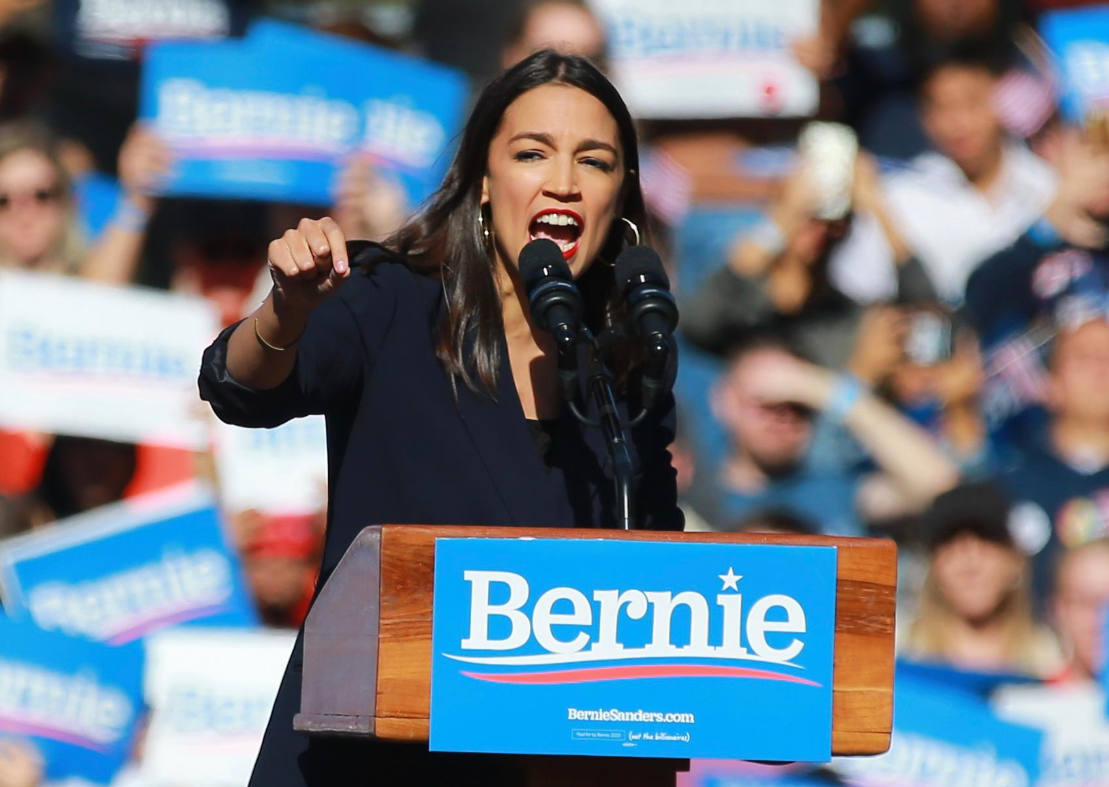
On the Road Again with Team Bernie
By Bernie Sanders
https://berniesanders.com/
The Fighting Oligarchy tour is on the road again. So far, we’ve held 198 events in 12 states - speaking to over 260,000 people. Now, we’re adding 3 more states to that list.
Tomorrow, I will be in Texas for the first of three events. We will also be doing events over the weekend in Louisiana and Oklahoma - including some very rural areas.
So. Why are we doing rallies in three very red states? The answer is obvious. We’ve got to educate, organize and mobilize working people in EVERY state in the country to fight oligarchy, authoritarianism, kleptocracy and the massive cuts to Medicaid, nutrition and education that Trump is proposing.
The truth is that the ruling class agenda is NOT popular. Very few Americans believe that it’s appropriate for one person to own more wealth than the bottom 52% of households; that we provide massive tax breaks to billionaires; and that we maintain a corrupt campaign finance system that allows the very rich to buy elections.
Most Americans understand, no matter where they live, that the current economic and political systems are rigged and broken in favor of the rich and that we need fundamental changes. They want a government and economic policies that benefit all, not just the wealthy few.
Sadly, the Democratic Establishment is incapable and uninterested in mounting grassroots working-class movements. Also, their economic agenda, to the degree that they have one, is very weak. Opposing Trump’s disastrous policies are enormously important. But it’s not enough. We need to provide a bold working class alternative agenda - based on economic, social, racial and environmental justice. And that’s what the Fighting Oligarchy tour is all about.
I also want you to know that we are not just doing rallies, as important as they are.
We are building organization
We have hired organizers in a number of states with Republican members of Congress who are now bringing people together to oppose Trump‘s “Big Beautiful Bill” and to lay the groundwork for a successful 2026 election.
We have mobilized thousands of volunteers in over a dozen states to do the same. We are also helping many hundreds of new candidates learn how to run for office for school board, city council, state representative and other local and statewide positions.
And we have recently been endorsing, and providing assistance, to a number of strong progressive candidates around the country - including Abdul El-Sayed for U.S. Senate in Michigan, Adelita Grijalva for Congress in Arizona, Robert Peters for Congress in Illinois, Troy Jackson for Governor of Maine, Donovon McKinney for Congress in Michigan, Rebecca Cooke for Congress in Wisconsin, Zohran Mamdani for Mayor of New York City and Justin Brannan for New York City Comptroller.
More endorsements will be coming in the near future.
In this pivotal moment in American and world history, when the stakes are so high for our country and the entire planet, we should not underestimate the difficult challenges that we face. But that should not make us pessimistic. If we stand together, we have the power to create a government and an economy that works for all of us, not just a handful of billionaires.
As Nelson Mandela, one of the great liberation leaders in modern history reminded us: “It always seems impossible until it is done.”
Let’s do it.
| | |
Aaron Reichlin-Melnick on Rachel Maddow
talking Trump Immigration Policy ...5.0min
| | Digging Deeper into the Current Conjuncture: | | |
Photo: FBI Director Kash Patel
Trump Administration Boosts Monitoring Of Possible Iran-Backed Cells In U.S., As Trump Weighs Strikes, Sources Say
By CBS News
June 19, 2025
As President Trump is contemplating potential U.S. strikes on Iranian nuclear facilities, law enforcement officials have stepped up surveillance of Iran-backed operatives in the United States, multiple sources told CBS News.
FBI Director Kash Patel has increased efforts to monitor possible domestic sleeper cells linked to Hezbollah — a U.S.-designated foreign terrorist organization backed by Iran — since Israel's Operation Rising Lion offensive began earlier this month, U.S. officials said.
Both the White House and FBI declined to comment.
The threat from Iranian operatives has worried current and former administration officials since Iranian General Qasem Soleimani was assassinated on Mr. Trump's orders in January 2020.
Late last year, federal prosecutors charged an operative of Iran's Islamic Revolutionary Guard Corps and two U.S.-based people with plotting to surveil and assassinate critics of the Iranian regime. The IRGC operative allegedly told investigators he was pushed by unnamed IRGC officials to plan an attack against Mr. Trump.
For years, U.S. law enforcement and intelligence officials have been concerned about Iran's ability to direct or inspire attacks within the United States — a concern that has ramped up since Soleimani's killing. The FBI, Department of Homeland Security and others have devoted significant resources to countering the threat.
There are a range of potential targets. In recent years, prosecutors have charged people with plotting to kill Mr. Trump's former national security adviser John Bolton and Iranian American journalist Masih Alinejad, both of whom are frequent critics of Iran's government. Bolton was granted Secret Service protection in 2021, but Mr. Trump revoked his protection this year.
Mr. Trump is considering whether to strike Iran's uranium enrichment facility at Fordo, joining Israel's weeklong campaign against Iranian nuclear and military targets, CBS News has previously reported. White House press secretary Karoline Leavitt said Thursday the president will make a decision within the next two weeks, citing "a substantial chance of negotiation that may or may not take place" with Iran.
Iran has threatened to retaliate if the U.S. decides to strike. ...Read More
| | | |
Photo: Steve Bannon at CPAC. Lev Radin/Shutterstock.com)
'They're Representing A Foreign Government': Bannon Wants Fox News Hosts Investigated
By Adam Lynch
Alternet.org
June 20, 2025 - MAGA podcaster and former White House chief strategist Steve Bannon called for an investigation into Fox News personalities for allegedly “representing” Israel over the needs of Americans, according to Mediaite.
Bannon’s demand, which he made on his June 20 ‘War Room’ podcast, represents another attack in the escalating MAGA civil war over President Donald Trump’s eagerness to involve the U.S. in Middle East violence. Bannon’s targets include Kayleigh McEnany, Sean Hannity and Mark Levin.
The former strategist played a clip of McEnany arguing for more U.S. involvement in the Iran/Israel conflict, claiming the Iranian government has taken American hostages and wreaked havoc on the world.
“To the isolationist crowd, my question would be: What makes your position materially different than the beach-side foreign policy of Joe Biden? Sticking your head in the sand is no different than sitting in the sandy beaches of Delaware,” said McEnany, Trump’s former press secretary.
“’America First’ is not sitting in a beach chair and using words,” McEnany added. “It’s taking decisive action when we can take out [Iran’s nuclear site] Fordow with one swoop of an airplane.”
Bannon showed no patience for McEnany’s version of “America First.”
“‘With one swoop of an airplane,’” Bannon sneered. “Of course, Kayleigh McEnany is infantile, let’s be blunt. That right there is dangerous. That is dangerous, and that is on Fox all day long. … [W]hy do you not think that they’re representing a foreign government? Hannity, Levin, the whole crowd. There should be an investigation.”
The Bannon and McEnany bout appears to represent two MAGA sides squaring off this week, with establishment MAGA, represented by the $22 billion Fox Corporation, adopting an interventionalist stance on one side and small-time independents and MAGA influences—including Bannon—on the other.
Bannon went on to question the degree of influence the American Israel Public Affairs Committee (AIPAC) has on McEnany’s side of the battlefield.
“Has there been intelligence? Are, you know, are the guys taking ads? You see the AIPAC ads all the time over there. I’m a supporter of Israel. And I believe in Israel first to do what they think is necessary. … But this is different scale. This is different level. And in history, scale matters.” ...Read More
| | | |
New Journals and Books for Radical Education...
Use Changemaker for Your Holiday Gifts,
Thus Lending Us a Hand, Too!
| | |
From Upton
Sinclair's 'Goose Step' to the Neoliberal University
Essays on the Ongoing Transformation of Higher Education
By Daniel Morris
and Harry Targ
Paperback USD 17.00
This is a unique collection of 15 essays by two Purdue University professors who use their institution as a case-in-point study of the changing nature of the American 'multiversity.' They take a book from an earlier time, Upton Sinclair's 'The Goose-Step A Study of American Education' from 1923, which exposed the capitalist corruption of the ivory tower back then and brought it up to date with more far-reaching changes today. time. They also include, as an appendix, a 1967 essay by SDS leader Carl Davidson, who broke some of the original ground on the subject.
Click HERE to Purchase
| |
The Man Who Changed Colors
By Bill Fletcher, Jr.
When a dockworker falls to his death under strange circumstances, investigative journalist David Gomes is on the case. His dogged pursuit of the truth puts his life in danger and upends the scrappy Cape Cod newspaper he works for.
Spend a season on the Cape with this gripping, provocative tale that delves into the
complicated relationships between Cape Verdean Americans and African Americans, Portuguese fascist gangs, and abusive shipyard working conditions. From the author of The Man Who Fell From The Sky.
“Bill Fletcher is a truth seeker and a truth teller – even when he’s writing fiction. Not unlike Bill, his character David Gomes is willing to put his life and career in peril to expose the truth. A thrilling read!” − Tavis Smiley, Broadcaster & NY TIMES Bestselling Author
| | |
New Studies on the Left, May 2025
Paperback $14.95
...is a journal of socialist theory and practice. It is the successor to ‘Dialogue and Initiative, published as an annual journal of the Committees of Correspondence for Democracy and Socialism in book form from 2012 to 2022. It will continue the CCDS policy of left unity, including articles with a variety of left perspectives, including debates.
This issue contains a dozen articles grouped under the headings of Analysis and Global Reach, Electoral campaigns, and Book Reviews. Some are reprinted from other sources, but many appear here for the first time.
Among the authors are C.J. Atkins, Carl Davidson, Steve Early, Bill Fletcher, Jr., Suzanne Gordon, Jerry Harris, Jay Jurie, Paul Krehbiel, Matthew Scott, Rod Such, Harry Targ, and Janet Tucker and Steve Willett.
Table of Contents
Click HERE to purchase
| |
A China Reader
Edited by Duncan McFarland
A project of the CCDS Socialist Education Project & Online University of the Left
244 pages, $20 (discounts available for quantity orders from carld717@gmail.com), or order at :
The book is a selection of essays offering keen insight into the nature of China and its social system, its internal debates, and its history. It includes several articles on the US and China and the growing efforts of friendship between the Chinese and American peoples.
| | | |
Digging Deeper into the Meaning
of Palestine
By Rod Such
Author's note: My initial decision to begin reviewing books on Palestine and the Palestinian liberation struggle was to write for political activists, rather than academics or the general public. This book, which collects dozens of reviews over a decade, might also be regarded then as a kind of wide-ranging primer or introduction to Palestine that will lead hopefully to an ongoing learning experience.
316 pages, $19.00 (discounts available for quantity), order at:
Changemaker Publications
https://www.lulu.com/spotlight/changemaker
| | | |
Illustration: Lau Ka-kuen
The More China Investigates Corruption,
The More It Finds. Will the Battle Ever Be Won?
Even as Xi Jinping’s anti-corruption purges go further and deeper, China’s legacy of corruption remains a widespread and serious problem
By Xinlu Liang in Beijing and William Zheng in Hong Kong
South China Morning Post
April 11, 2025 - In Beijing, jittery government officials and mid-level managers have been reaching out to a small pool of seasoned criminal lawyers.
“Usually it comes after a colleague or a close associate has been rounded up, and they want to be at least able to explain things the graft fighters may find suspicious,” said a veteran criminal lawyer in Beijing, who requested anonymity due to the sensitivity of the matter.
“That is something we hadn’t seen until these past few years.”
As the list of those rounded up in China’s years-long anti-corruption probes becomes longer, a growing number of mid-level officials across the country have started to consider the once unthinkable – what if they are next?
Recent amendments to China’s Supervision Law have added to the growing unease among the rank and file. Individuals detained for investigation could now be denied access to legal help for up to 16 months.
The anxiety has become more distinct since President Xi Jinping’s anti-corruption drive entered its second decade – with no signs of slowing down.
“As long as the soil and conditions for corruption exist, the anti-corruption struggle cannot stop for a moment. We must always sound the charge,” Xi declared at the 20th Party Congress in 2022.
In 2017, Beijing claimed that the campaign had been “an overwhelming success”. However, corruption remains a persistent blight on the Chinese political system, with the campaign netting record numbers of both senior officials and ordinary Communist Party members last year.
In 2024, the number of party members disciplined skyrocketed to 889,000, a staggering fourfold jump from 182,000 in 2013, according to an annual report by the party’s anti-graft watchdog, the Central Commission for Discipline Inspection (CCDI).
Last year alone, 92 vice-ministerial level officials or above were investigated, 25,000 officials turned themselves in, and 91,000 confessed to their crimes.
“Over a decade after Xi’s crackdown began, the CCDI sanctioned 800,000 party members, which suggests that indiscipline, including corruption, remains a widespread and serious problem,” said Andrew Wedeman, director of China Studies at Georgia State University.
Despite Xi’s calls to “maintain a high-pressure stance against corruption at all times”, experts have pointed to several causes fuelling persistent corruption in China: systemic flaws such as absolute, unchecked power; monopolisation of resources; and a lack of external oversight and transparency.
Legacies of corruption, particularly during the eras of Xi’s predecessors Jiang Zemin and Hu Jintao, were seen as threats to the party’s rule and to central authority, with many cases dating back decades and adding to the growing total, analysts said.
The disciplinary inspection and supervision system has also increased its powers and resources. The result has been more investigations, stemming from an increasing number of political offences under disciplinary codes, extended detention periods, and broader use of AI-driven investigative tools, according to observers and insiders.
There has been no shortage of milestones in Xi’s fight against corruption since it was launched in 2012, soon after he came to power.
In a typical case of “systemic, collapse-style corruption” during Xi’s first term, four of 13 provincial standing committee members in central Shanxi province who were appointed in 2011 were removed, as well as others further down the ranks.
In southwestern Yunnan, three provincial party bosses or deputy party chiefs were placed under investigation the same year.
Over a span of three years, the top corruption watchdog toppled senior officials from all of China’s 31 provincial-level regions.
Top security officials, executives from the powerful state-owned oil sector and multiple regional chiefs have been removed as investigations reached higher levels and extended to officials who had already retired.
In the military, more generals have been brought down by anti-graft campaigns than those who died in China’s civil war, including two former defence ministers. The latest casualty was Miao Hua, an admiral and former head of the Central Military Commission’s political work department, who was sacked last year.
But years after the high-pressure purge campaign began, corruption in China endures.
Experts have pointed to inherent flaws in China’s political system, including weak external supervision and unchecked, wide-ranging power in the one-party state.
A Beijing-based political scientist, who asked not to be named due to the sensitive nature of the topic, said China’s lack of an independent judiciary and weak external oversight contributed to systemic corruption.
The political system itself also contained defects, such as the bottom-up hierarchical responsibility model with limited channels for society to provide feedback and supervision, she said, adding that weak political institutions with unclear boundaries and roles further exacerbated the problem.
Alfred Wu, an associate professor at the Lee Kuan Yew School of Public Policy in Singapore, said effective anti-corruption strategies typically relied on government transparency, opposition oversight and media freedom, which China lacks.
Because China’s economy is dominated by state-owned enterprises, in which the ruling party has the biggest say over industrial policies and projects, “of course the officials in charge are facing temptations so hard to resist”, Wu said.
Under such circumstances, power can be easily abused, even by the lowest-level civil servants.
In December, China’s top court released details of what it said were typical corruption cases of six low-ranking officials. In one case, an official surnamed Qi, who served as a section chief in a local housing department, just above ordinary staff members, approved ineligible affordable housing projects in return for kickbacks worth 1.57 million yuan (US$215,000). In another case, the head of a small town embezzled more than 10.8 million yuan in state funds by manipulating tax incentives.
The “intertwining” of politics and business is another key factor driving corruption, according to Jingyuan Qian, a political scientist at the University of Chicago.
Bribery has long been used as a way to “establish trust” between local officials and private enterprises, he said. For instance, officials accept bribes to protect business interests, while businesses see it as a “guarantee of security” for their investments, Qian said. As local governments have prioritised economic growth, both politicians and businesses have been incentivised to use bribery to “grease the wheels” of those relationships, he added.
Another political scientist from eastern Shandong province, who also spoke on condition of anonymity, reasoned that no department or power was “inherently more transparent and fairer” than others, as “the nature of power tends to expand and be abused”.
He pointed to the fact that the disciplinary body itself was not an independent agency, as Hong Kong’s Independent Commission Against Corruption (ICAC) is.
“It … must also answer to higher authorities or leaders. In other words, it is merely a tool for executing the will of those in higher positions,” he said.
The CCDI is “subordinate to the party leadership at the same level” because the party’s internal supervision is influenced by political factors, Qian said. The hierarchy made it difficult to investigate higher-ranking officials because party chiefs could interfere in the inquiries, he added.
Corruption has plagued the Communist Party for decades.
In the eras of Jiang and Hu, bribery soared to such unprecedented levels that the widespread misappropriation of resources threatened not only the party’s legitimacy but also its very survival.
Jiangnan Zhu, an associate professor at the University of Hong Kong’s politics and public administration department, said corruption had “accumulated” over decades in the country, which had not established a strong “social culture of integrity”.
China airs 4-part anti-corruption series on prime-time TV amid renewed crackdown on graft
“It took ICAC many years to transform Hong Kong from a highly corrupt society to a clean society,” she said, noting that it was “natural” for the much larger mainland China to take a longer time.
Among the more formidable investigations in Xi’s sweeping campaign has been a “20-year accountability review” of Inner Mongolia’s coal sector, launched in 2020. By September 2022, nearly 800 cases involving 1,163 individuals had been investigated, resulting in disciplinary action against 942 people, according to the region’s disciplinary inspection commission.
Xie Maosong, a senior researcher at the National Institute of Strategic Studies at Tsinghua University, said the country’s method of fighting corruption was “the best option, given China’s current political structure”, and was essential to keep the party in power.
“The party has to push forward the anti-corruption campaign non-stop to provide the necessary momentum for China to make progress,” he said.
Data from the CCDI showed that Xi’s corruption crusade initially saw sharp increases in investigations but stabilised in 2018. In 2024, however, cases started to rise again as the number of party members disciplined shot up 45 per cent to 889,000 from 610,000 in 2023.
The rise was due to an intensified crackdown on rank-and-file officials, cadres and ordinary party members – known as the “flies” – who form the backbone of local governance, after many “tigers” or senior party or state leaders were brought down earlier.
In January, Xi urged the CCDI to boost efforts to go after “flies” and “ants”, the latter another reference to smaller players.
The rising number of officials facing disciplinary action was due to an “expansion of the anti-corruption campaign to lower level administrations and other institutions outside the traditional government departments … compared with the initial focus on ‘big tigers’ and core government ministries”, the Beijing-based political scientist said.
Qian said now that the anti-corruption drive was a “top political priority”, party leaders and disciplinary officials at the grass-roots level had begun using the campaign to “display loyalty and compliance with the central agenda”, such as in the financial, medical and military sectors, each of which saw tens of thousands of party members disciplined last year.
“These crackdowns coincided with Beijing’s current focus on stabilising the banking sector, mitigating financial risks and intensifying war preparations amid geopolitical tensions,” Qian said.
Still, questions remain about how effective the campaign has been as a deterrent.
According to research by Georgia State University’s Wedeman, three-quarters of accused officials at the county and department levels were already taking bribes before 2013, and continued to accept them after the anti-corruption drive was launched.
More than half of the lower-ranking officials charged with corruption in recent years became corrupt during the crackdown, and many mid-level functionaries promoted by Xi to replace previously corrupt officials were later themselves charged with corruption, according to the study.
Among 210 officials promoted to senior positions since 2013 who faced corruption charges, 134 were found to have been corrupt at the time of their promotion, Wedeman’s research showed.
The findings indicate that the intensified crackdown “has failed to convince many officials and cadres that they face a significant risk of getting caught”, said Wedeman, who is writing a book titled Hunting Tigers and Swatting Flies: Xi Jinping’s Battle with Corruption.
“Xi, in short, does not seem to have won the battle for the hearts and minds of officialdom.”
Ex-Interpol chief admits to bribery in China
Amid the years-long vortex of anti-corruption investigations, one agency has risen like a colossus: the CCDI. Its reach now extends into every corner of Chinese society – from the party to state-owned enterprises to university faculties.
Deng Yuwen, former deputy editor of Study Times, a newspaper published by the Central Party School, said more officials had been ensnared because the party’s disciplinary code was expanded under Xi and now included dozens of activities not considered offences before.
Disciplinary codes were revised three times; in 2015, 2018 and 2023, with the number of articles increased from 133 to 158.
The 2015 revision added new offences such as making irresponsible comments about government policies, forming political cliques and resisting investigations. In 2018, the code mandated loyalty to Xi through the “two safeguards”, requiring officials to uphold his authority and the centralised leadership of the party’s Central Committee, while adding punishments for factionalism and policy noncompliance.
The 2023 revision expanded disciplinary measures to target people associating with “political crooks”, seeking promotions through personal connections, refusing to implement major policies, and defying Xi’s development instructions.
“Before Xi, questioning Beijing’s policies or directions in private was considered ‘not so good’ but not punishable. Now, it is considered as an act of disloyalty, with very harsh punishment,” Deng said.
“With the disciplinary net cast much wider and the mesh becoming much smaller, of course more officials were caught.”
The disciplinary body’s own power has also grown since the National Supervisory Commission (NSC) was established in 2018. It replaced some functions of the CCDI – which could already question and detain party members without charge – with expanded powers to cover all public servants and village officials, prompting officials to seek advice from criminal lawyers in case they were questioned.
Last year, amendments to the Supervision Law further extended the liuzhi, or detention, to eight months from six months for county and prefecture level, and up to 16 months for cases handled by provincial and national supervisory committees.
Across the country, disciplinary agencies are also recruiting more detention centre guards, which analysts said could reflect stepped-up efforts to combat local corruption.
Based on the quota system the Chinese government typically uses to manage political goals, “ambitious CCDI officials would likely want to impress their supervisors and show their devotion to the anti-corruption campaign by over-delivering”, the political scientist in Beijing told the Post.
Advances in technology, including artificial intelligence (AI), may also be boosting corruption investigations, as investigators deploy new data techniques to uncover corruption, track funds and monitor the movements of officials.
Such methods have helped investigators uncover corruption in state enterprise bids and fraud in social welfare programmes, according to media reports.
In the city of Zhengzhou in central China, investigators have used AI to root out corruption in state enterprise bidding. Authorities in the city of Suifenhe in the northeastern province of Heilongjiang combined big data and DeepSeek’s AI models to detect fraud in social welfare programmes, according to local media reports.
An official source familiar with disciplinary work said big data and AI had “revolutionalised” corruption investigations, allowing officials to verify whistle-blower tips within just a few hours, compared with the weeks or months previously required.
“That is one major reason you see more people facing disciplinary actions,” he said.
Digital data can also help to uncover “corruption networks” more easily, the official said, highlighting his team’s ability to rapidly trace financial patterns and shareholding irregularities using AI, often identifying major shareholders within hours. “So far, no one has escaped my team’s thorough investigations in recent years,” the source said.
“In one extreme case, we even resorted to comparing the traffic data of an official’s vehicles to identify his regular hideouts for banquets and entertainment. Then we identified a few businessmen whose cars often appeared at the same time. We invited them to help in the corruption investigation, and we hit the bull’s eye.”
Additional reporting by Jun Mai and Sylvie Zhuang ...Read More
| |
CHANGEMAKER PUBLICATIONS: Recent works on new paths to socialism and the solidarity economy
Remember Us for Gift Giving and Study Groups
Interested in Studying Gramsci? In a Serious way? We have a group that meets Sundays via Zoom, 11am-12:30pm, facilitated by Piruz Alemi. We go paragraph by paragraph, even line by line, reading aloud, then discussing, through The Prison Notebooks, using an online PDF. If you are interested contact Carl Davidson at carld717@gmail.com
HERE'S ONE OF THE LATEST FROM CHANGEMAKER:
| | |
HOLIDAY SALE ON EVERY TITLE BEGINS TODAY!
Hard Ball & Little Heroes Press is sharing the holiday spirit by offering a 25% discount on ALL TITLES from November 15-December 25. Enter SOLIDARITY in the discount box when you order a book, 25% will be automatically taken off your cost.
Happy holidays! Tim Sheard, editor
For the children...
Good Guy Jake...An inspiring Children’s Christmas story for Labor!
Imagine young children reading a book about a union that wins back the job of a sanitation worker unfairly fired for taking toys out of the trash. That’s what they will discover in Good Guy Jake.
For years Jake has repaired and painted broken toys he pulled from the trash on his rounds and given them to the children in the local shelter at Christmas. But when an angry motorist reports Jake to the sanitation company, Jake is fired for breaking city regulations.
His union takes the case to arbitration. There, the union brings in a crowd of children, who show the judge the toys Jake gave them and tell her that he taught them the true meaning of Christmas.
| | |
History Lesson of the Week: The Dying Tecumseh and the Birth of a Legend
A sculpture in the Smithsonian collection reveals much about how the Indians of the West were viewed in the early ages of the United States
By Bill Gilbert
The Smithsonian
At the end of a long gallery in the Smithsonian's National Museum of American Art there is a ton of marble that, after nearly 20 years of intermittent work, was completed in 1856 by Frederick Pettrich, a German-born, Italian-trained sculptor. The subject is a reclining, heroically proportioned man whose dignified and noble demeanor is unaffected by a bullet hole in the right temple. If the wound and a tomahawk held in the right hand are overlooked, the figure could be that of one of the champions of classical legend — an expiring Hector or Siegfried — who so engaged romantic artists of 19th-century Europe.
In fact, the gleaming white sculpture is entitled The Dying Tecumseh, but any resemblance to the mortal Shawnee leader of that name is entirely coincidental. He died in battle and was disfigured by enemy soldiers 25 years before Pettrich began this work. While alive he posed for no known portrait. Nevertheless it is singularly appropriate that this is an imaginary figure, for no one else of Tecumseh's race and few of any other have had such a powerful and abiding impact on the collective American imagination.
The real Tecumseh was born circa 1768 in southern Ohio at the beginning of a sporadic but ferociously fought war that did not end until — and largely because — he was killed in 1813. In this conflict his Shawnee, the Miami, the Potawatomi and other nations of the Great Lakes and Ohio Valley region sought to defend themselves against the white settlers pioneering westward across the Appalachians.
Tecumseh was a warrior at 15; later he became a renowned field commander and a charismatic orator. By the early 1800s he had conceived of a Pan-Indian federation. In this union he hoped old tribal rivalries would be set aside so that the indigenous people of the Great Lakes and Mississippi Valley could act as one in resisting the advancing whites. From a base on the Tippecanoe River in northern Indiana, he traveled from Canada to the Gulf of Mexico promoting this federation. His ambition was probably an impossible one; the Indian population of this territory was then less than 100,000 and that of the United States nearly seven million. Still, rumors of what he was up to greatly alarmed many frontier whites, including William Henry Harrison, the federal governor of the Indiana Territory. Formerly a Regular Army officer, Harrison negotiated with Tecumseh face-to-face on two occasions and assessed him as "one of those uncommon geniuses who spring up occasionally to produce revolutions and overturn the established order of things." ...Read More
| | |
Mexican Labor Activism 2.0
Mexico Solidarity Project from June 18, 2025
| | |
Esmeralda Jazmín Alonso Guevara currently serves as the coordinator of Casa Obrera del Bajío, where they organize to counter the historic attacks that capitalism has inflicted on Mexico. Born in the city of Silao, Guanajuato, Mexico, the proud daughter and granddaughter of farmworkers and factory workers, she has witnessed the transition of her home from farmlands to an industrial center. Alongside her father, a worker at GM Silao, she has joined the fight for authentic union representation and a society of equity, justice and collective good.
Did your father work at GM when you were a child? How did his work affect the family?
Before GM, he worked at a soft drink factory and then a shoe factory in León. His dream was to work at GM, which came to Silao in 1995, and he was proud when they hired him — that was 28 years ago. The salary was good; he had job security and health insurance. It improved our family's life.
But since that time, things have changed. The CTM was the union from the beginning, and though the union representatives were workers, they were chosen by the union's top brass, led by PRI representative Tereso Medina.
The CTM was and is known for its “protection contracts” — that is, it protects the company! The contracts prevent workers from protesting anything the company does. CTM delegates at GM became more and more corrupt as they came to understand how the union could benefit them individually, rather than all the workers collectively. They collaborated with GM — the CTM even had an office at the plant — and working conditions deteriorated radically. Benefits were cut; wages didn’t rise. Workers who didn’t go along were threatened.
So the workers began organizing to replace the CTM, right? They named their group Generating Movement, or “the other GM!” Was your father involved?
He wasn't one of those who started the rebellion — GM fired the founders of Generating Movement. The company threatened and physically intimidated others; of course that frightened the rest of the workers. Alejandra Morales, who would become the future leader of the new union, was tracked down and got threatened at her home. If your children are in danger, it's much harder to keep fighting. But Alejandra, a single mother, didn't give up, and neither did other Movimiento members. ...Read More
| | |
Adelante #4 is out! A special on immigration for the closing days of the election. Use it everywhere!
Get it here: http://ouleft.org/Adelante-4.pdf
By Bill Gallegos, excerpted from our new fall issue of “¡Adelante!”
U.S. GOP presidential candidate Donald Trump demonized Mexicans and immigrants as a central part of his 2016 presidential campaign. In 2024, he has doubled down. If elected, he promises to unleash an ethnic cleansing campaign to deport the 12 million undocumented immigrants in the U.S. This is horrible enough as a complete violation of human rights. But this pogrom is only one piece of the larger anti-democratic ‘Project 2025’ of the Heritage Foundation. They are coming for all of us. While singling out Mexican immigrants, Trump aims at all immigrant communities, including growing communities in the South, Midwest, and East.
Thankfully the political energy has shifted since President Biden dropped out of the presidential race. Vice-President Kamala Harris is now the Democratic Party candidate, and the polls show a significant shift in her direction. More than a million new volunteers have signed up for Harris, and hundreds of millions of new dollars have been contributed to her campaign.
The Biden-Harris Administration has been mixed on immigration: on one hand, it continues to support the legalization of Dreamers (DACA) and pushes for a path to legalization for the spouses of immigrants with legal residency. On the other hand, it has denied asylum protections for refugees crossing the southern border and supported legislation for increased militarization as well as new administrative hurdles. While our most important fight is against the MAGA right, the fight for full rights and protections for immigrants is a long-term struggle beyond the November elections.
The Biden dropout also creates significant opportunities for the left and progressives to advance the fight against the fascist threat, to advance a progressive platform, and to put new pressure on both Biden and the Harris campaign to demand a ceasefire in Gaza. It enables us to push back strongly against Trump’s racist threats against immigrants while advancing a positive program for immigrant rights.
| | |
|
Our Amazing Resource for Radical Education
CURRENT FEATURE: In the 'Study Guides' Section
A 4-PART STUDY OF THE SHAPING OF THE
RUST BELT WORKING CLASS.
From the settlers to the present, and how its consciousness is conflicted. Prepared by Carl Davidson and Rebecca Tarlau,
with some help from the DSA Rust Belt group.
| |
There are hundreds of video courses here, along with study guides, downloadable books and links to hundreds of other resources for study groups or individuals.
Nearly 10,000 people have signed on to the OUL for daily updates, and more than 150,000 have visited us at least once.
Karl Marx's ideas are a common touchstone for many people working for change. His historical materialism, his many contributions to political economy and class analysis, all continue to serve his core values--the self-emancipation of the working class and a vision of a classless society. There are naturally many trends in Marxism that have developed over the years, and new ones are on the rise today. All of them and others who want to see this project succeed are welcome here.
NEW UPDATES...May 29 2025
New additions:
–Why Malcolm X Said More White People Should Be Like Abolitionist John Brown: Now on our blog page
League of Revolutionary Black Workers Archive, organized by Abdul Alkalimat, with links for all the RUM groups and leading individuals. Now in our Archives Section
Marxism and the Black Experience. All references by Marx, Lenin and others on African Americans, compiled by Abdul Alkalimat. Now in our Archives section.
David Schweickart: Collected Articles on Political Philosophy in the 21st Century. Now in our Philosophy Dept.
Sex Redefined: The Idea of 2 Sexes Is Overly Simplistic. By Claire Ainsworth & Nature magazine, Scientific American, 2018. Now in our Gender Studies Dept.
And finally, Donald Trump, The Treasonous Confederate Army's Last General, now on our home page, New Text material
To visit the OUL, go here: http://ouleft.org
Read More
|
| | |
Video for Learning:
AOC Delivers A MUST-SEE Response To MAGA's
Attacks On Sanctuary Cities ...5:20 minutes
| |
Harry Targ's 'Diary of a Heartland Radical' | |
This week's topic:
Click the picture to access the blog.
| | Tunes of the Week: Down To The River To Pray - Alison Krauss ...4:1 min | | |
Book Review: The Conservative Intellectual Who Laid the Groundwork for Trump
William F. Buckley Jr. was the erudite heart of American conservatism. But the political vision that he helped forge was—and remains today—focused less on adhering to principles and more on ferreting out enemies.
The January 2025 issue of National Review magazine featured, on its cover, a cartoon image of Donald Trump driving a campaign bus-cum-garbage truck into 1600 Pennsylvania Avenue, a handful of Harris-Walz campaign posters tumbling out of its tailgate. “After the Sweep,” read the triumphant headline. Over the course of eight-odd years, the publication that had once dedicated an entire issue to anathematizing Trump had moved from cool accommodation to warm, if not entirely reservationless, embrace. The February issue offered a study in dissonant juxtaposition: Gazing out beatifically from the cover was the magazine’s late founder, William F. Buckley Jr., rendered in schmaltzy watercolor to mark the centenary of his birth.
Sam Tanenhaus’s marvelous, decades-in-the-making biography, Buckley: The Life and Revolution That Changed America, begins with an epigraph from John Keats’s letters: “Man’s life of any worth is a continual allegory.” For many in the Trump era, looking back wistfully on an imagined past of comity and consensus, the Buckleyite allegory has been one of declension: from the sesquipedalian verbalist who gamely sparred with liberals on TV to the monosyllabic vulgarian occupying the White House. From Bach’s bouncy Brandenburg Concerto No. 2, with which Buckley’s Firing Line television show opened for more than 30 years, to the schlocky Trump-rally ballads of Lee Greenwood. From a movement helmed by a “responsible” leader who made conservatism respectable by (as the story goes) cleansing it of its kooks and antisemites to one led by a man who enthusiastically welcomed them back in.
Tanenhaus’s biography complicates this narrative. It offers a deeply affectionate portrait of Buckley’s personal life: of his munificence, his sense of humor, his extraordinary loyalty and capacity for friendship—what the ex-Communist intellectual (and early National Review staffer) Whittaker Chambers, the subject of Tanenhaus’s first biography, called Buckley’s “special grace.” Yet Tanenhaus also methodically surfaces the darker strains of the movement that flourished even, and sometimes especially, in its most rarefied precincts. The political vision that Buckley helped forge was, as it is now, concerned not primarily with advancing a particular set of principles but with defining and rooting out perceived enemies. When Donald Trump rails against the “Radical Left Lunatics, Communists, Fascists, Marxists, Democrats, & RINOS” who comprise the “enemy within,” he inherits Buckley’s legacy far more than he blasphemes it. ...Read More
| | |
TV Review: The Second Season of 'Andor' Stands Tall
By Brian Tallerico
Rogerebert.com
April 21, 2025 - “Andor” opens its second season with a micro version of what it does so well: a scene of sharp intellect about becoming who you are when you stand up for what you believe in, before pivoting to a larger-than-life “Star Wars Action Sequence” that comes out of nowhere and unfolds unexpectedly.
It’s a great ten-minute season overture: Messaging that feels timelier than ever blended into grandiose sci-fi action storytelling that’s riveting within its own universe. This 12-episode arc, which really unfolds more like four interconnected feature films, is the best season of television so far this year, and one of the best of the current decade. It is what “Star Wars” (and all sci-fi TV) can be at its peak, and I hope it’s a roadmap to the future of this entire franchise. Let Andor lead the way.
The very structure of “Andor” this season is artful. Disney+ is dropping three episodes for four consecutive weeks, unfolding like a “quadrilogy” of feature films. Each night has a different writer. And, as most people know, the season takes place over four years. So, the first night debuts three episodes written by creator Tony Gilroy himself, set in BBY 4. The next week launches three episodes written by first-season Emmy nominee Beau Willimon set in BBY 3. Like a great film series, these chapters stand on their own while also folding their thematic concerns into each other. And the writers don’t completely dismiss the episodic structure either, with some chapters, especially 8 and 10, both masterful, standing on their own. It’s like a nesting doll of creative storytelling.
Director Orson Krennic (Ben Mendelsohn) in Lucasfilm’s ANDOR Season 2, exclusively on Disney+. ©2025 Lucasfilm Ltd. & TM. All Rights Reserved
And creative it is. “Andor” avoids the common prequel problems by twisting and turning Diego Luna’s Cassian Andor from the first season to the one we know in “Rogue One” in unpredictable ways. It’s a show about the development of a rebel leader, but how Gilroy and company get from the first season premiere to the character’s introduction in “Rogue One” cosnsistently fascinates. Some complained that Luna was a bit too subdued in season one, but rewatching season one as a prelude to this review reveals how subtle his work is through the 24 episodes, as Andor goes from hesitant believer to a passionate leader of a Resistance.
What a Resistance it is. A lot will be written about the timeliness of “Andor” in an age when unchecked power and political resistance are in the headlines, but this is no mere “good vs. evil” piece of storytelling. It is about the complexity of resistance. It is about how what we do defines who we are, particularly in times of great conflict. The characters who suffer in this season of “Andor” are the ones who try to have it both ways, who give lip service to action but thrive off corruption. There are so many lines that I scribbled down in my notes, but one that stuck out was “It’s not up to us what we save and what we lose” when we choose to fight back. It’s a show about sacrifice and trauma, and how narratives are crafted, told more effectively than any political drama in years. As someone says, “one person’s rebel is another person’s terrorist.” It is so thematically rich that it can almost be overwhelming, and there are even more scenes of political machinations than the first year, but be patient with the slow burn of every plot thread. They all eventually ignite.
Bix Caleen (Adria Arjona) in Lucasfilm’s ANDOR Season 2, exclusively on Disney+. ©2025 Lucasfilm Ltd. & TM. All Rights Reserved.
What really elevates “Andor” is the blend of theme and plot. The speeches about fascism and resistance turn words into action and convey the difficulty of doing so. We’re in a time of great amplification of rhetoric, but this show understands the power of both the message and the fist, the pace of both resistance and fascism. How do you use rebellions to further fascism? How does human frailty impact both? What about emotional connections? Are you willing to give up less when you have so much to lose?
It’s not all speechifying. Within these deeper themes, the writers of “Andor” take the time to unpack and examine how human beings respond to things like trauma and instability. The former comes through in Adria Arjona‘s phenomenal work as Bix, who was tortured last season and carries the weight of that into this one. She’s a major part of the sophomore outing and does the best work of her growing career. ...Read More
| | |
Initiated by CCDS
522 Valencia St.
San Francisco, CA 94110
415 863-6637
| | | | | |