Center for Dispute Resolution
ADR Quarterly - Summer 2021
|
|
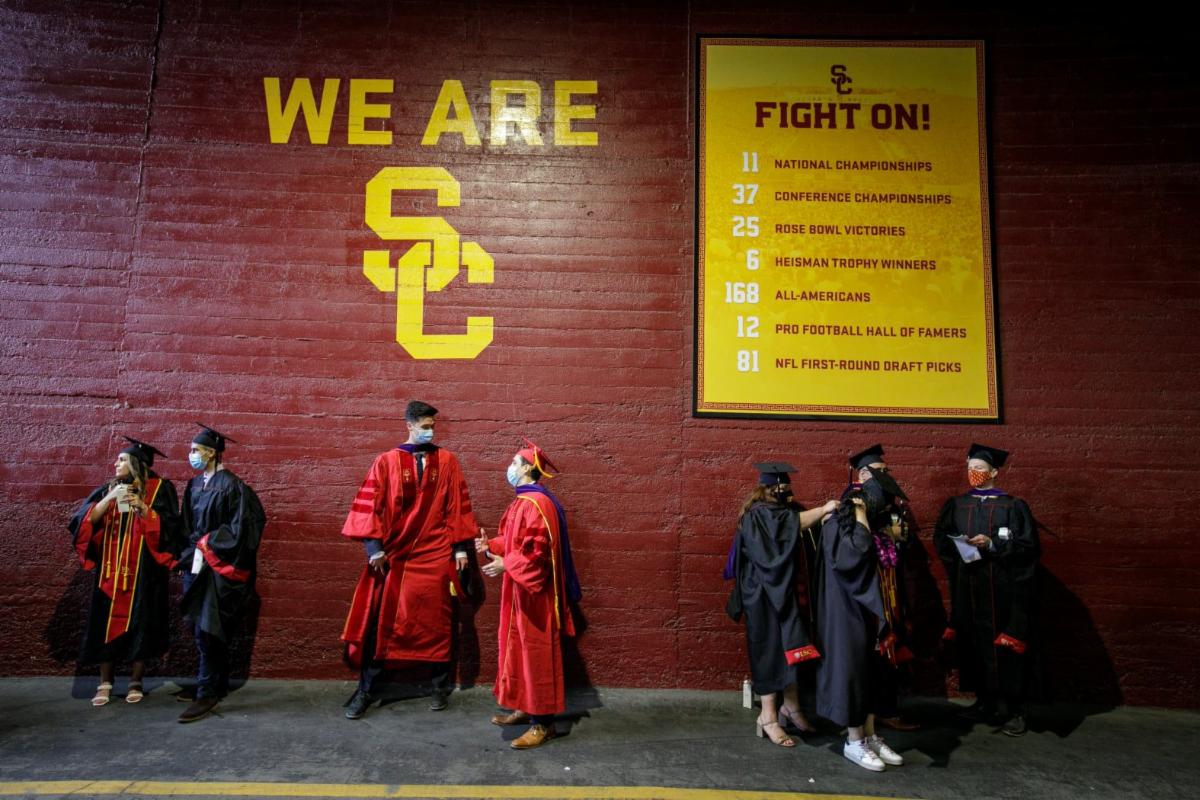
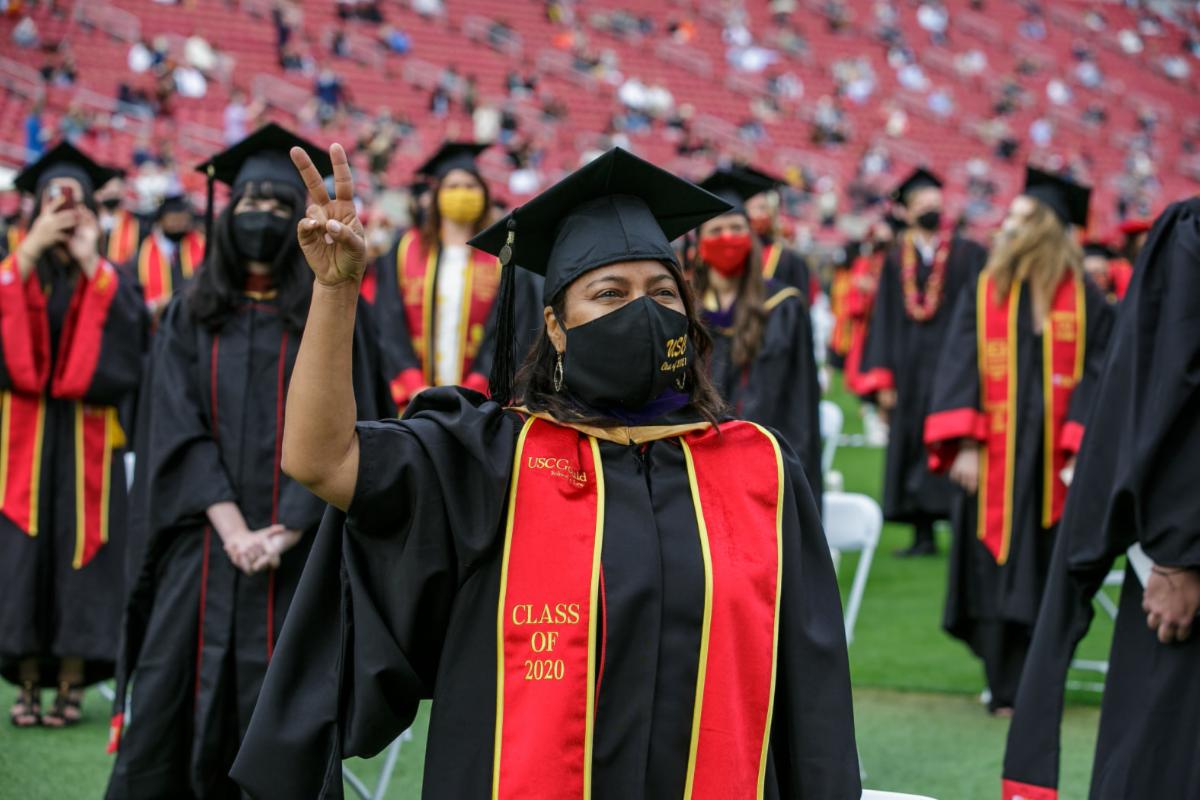
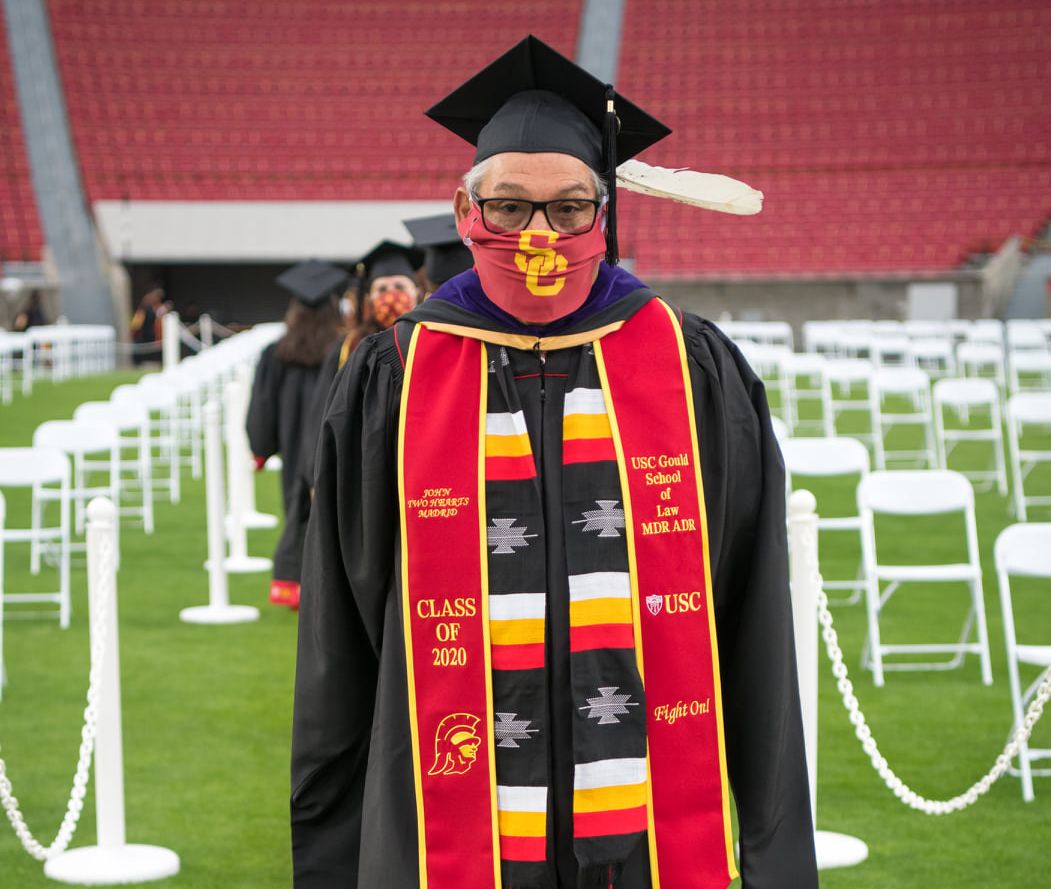
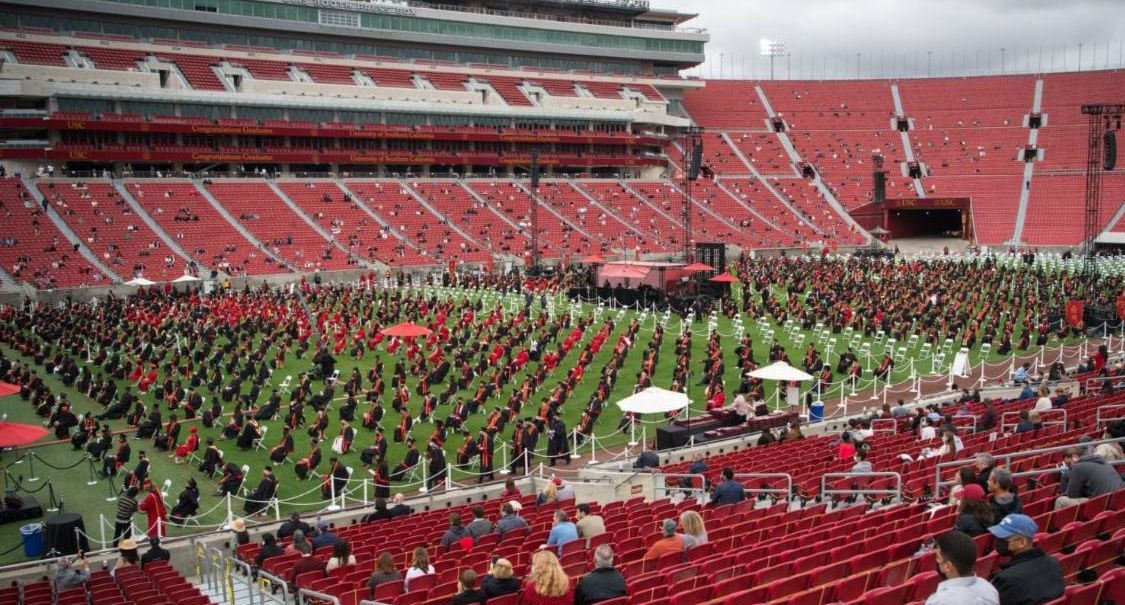
This May, the USC Gould School of Law Center for Dispute Resolution celebrated the achievements of our fourth graduating class during the 138th Commencement Ceremony at the University of Southern California, held virtually and in-person at the Los Angeles Coliseum. Our ADR graduates join our worldwide Trojan Family with more than 437,000 living alumni, including over 14,000 USC Gould alumni.
In this issue, we invite you to read about some of the Center’s symposia and offerings from this spring that moved the discussion forward and provided our students and the greater ADR community with access to the knowledge and expertise of accomplished ADR practitioners from around the world.
|
|
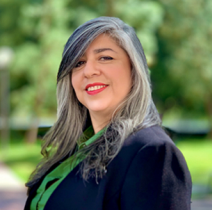
Graduate Profile: Maria De La Garza (MDR 2021)
As the Director of Human Resources for USC Gould School of Law, Maria De La Garza has seen firsthand the benefits and potential of applying mediation skills to her work. Below she shares some memorable experiences from her program and her advice for others looking to pursue a degree in ADR.
Why did you choose to pursue your degree at USC Gould?
I chose to pursue my degree at USC Gould because I knew that this degree would offer me real-life practical experience and that I would learn from top leaders in the mediation field.
What sparked your interest in the law?
I have always had an Interest in law, but when I learned about the mediation program from other work colleagues, I knew that I wanted to enroll in this program because it would enhance my career in Human Resources as well as open other doors.
Can you tell us about your current work in dispute resolution?
My career in human resources often offers opportunities to mediate work-related conflict. Not every situation has the potential to arrive at a resolution through mediation, but having the tools for when parties are open to resolving matters, and then actually arriving at a positive result for them, is very rewarding.
What is the most memorable experience or learning from your USC studies?
There are too many to mention. The most memorable experiences were the creation of long-lasting relationships with my classmates. We laughed over study breaks and gave each other constructive feedback on our mock mediations. Some of the mock mediations were oftentimes realistically played out, entertaining and always engaging. Many of our professors are quite entertaining! I really enjoyed learning from them and what they learned from their cases. Allowing us to learn in a safe and supportive environment made for an excellent experience. I was happy but sad that I was nearing the end of my program during my last semester.
How has your degree from USC Gould given you an advantage in your career? What do you want to do next?
My education at Gould has given me the confidence and tools needed to navigate through difficult situations ripe for mediation both in my professional and personal life. Looking to the future, I would love to mediate for the courts and eventually mediate family dispute cases.
What advice do you have for students who may be interested in following a similar path to yours?
I would tell them that it is a rewarding field. Mediation is an artful skill, and if you have the passion for wanting to be a sort of peacemaker and guiding light towards conflict resolution, this is an excellent and exciting growing field. It also has the potential for creativity and entrepreneurship. I would tell them to make an appointment with our wonderful admissions staff so that they can learn more about the different branches of mediation.
|
|
USC Gould & JAMS Arbitration Institute
The Center and JAMS recently completed two symposia—the Entertainment ADR Symposium, and the Fifth Annual International Arbitration Symposium—with networking sessions following each program.
|
|
Entertainment ADR Symposium
The Entertainment ADR Symposium: Is There Still No Business Like Show Business? – ADR Challenges and the Evolution of New Media, was held on June 8, 2021. The symposium began with a keynote address entitled “The Brave New World of Entertainment” by Jeffrey Cole, research professor and Director of the Center for the Digital Future with USC’s Annenberg School for Communication and Journalism.
Mr. Cole then joined a panel on “Managing Risk in the Era of New Media” moderated by Patricia L. Glaser of Glaser Weil picking up from the keynote and discussing how to identify risk in the era of new media.
|
|
Other panelists included Dan Nabel of Riot Games, Tammy Brandt of FaZe Clan, entertainment/media insurance expert Cassandra Franklin, Linda Burrow of Netflix, and Yakub Hazzard, a partner in Mitchell Silberberg & Knupp's Entertainment and IP Litigation Practice Group.
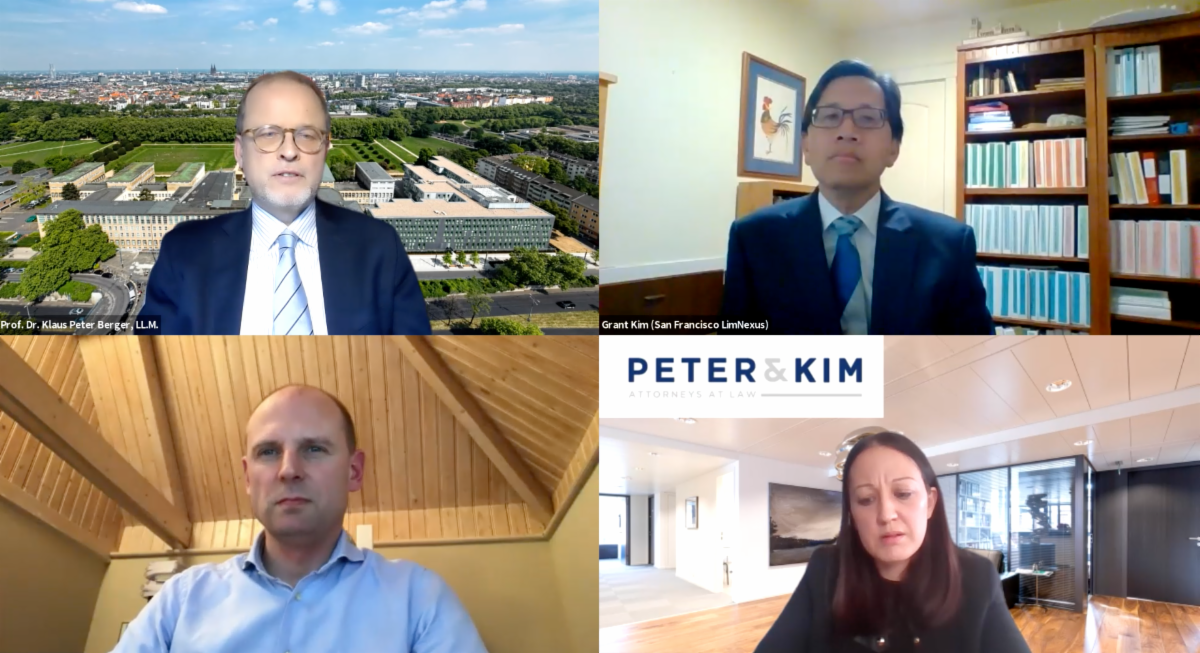
A second panel on “Drafting Skills in New Media – Recognizing and Minimizing Risk” was moderated by Richard Chernick, Mediator and Arbitrator with JAMS in Los Angeles, and Symposium Chair for the USC Gould Center for Dispute Resolution Advisory Board. Panelists Kelly Klaus of Munger Tolles & Olson, Bob Cohen (formerly 20th Century Fox/Disney counsel), Scott Edelman of Gibson, Dunn & Crutcher, and Hilary Ware of Netflix discussed how to manage risks in new media, including those identified in the prior panel, and drafting new media dispute resolution clauses.
|
|
Fifth Annual International
Arbitration Symposium
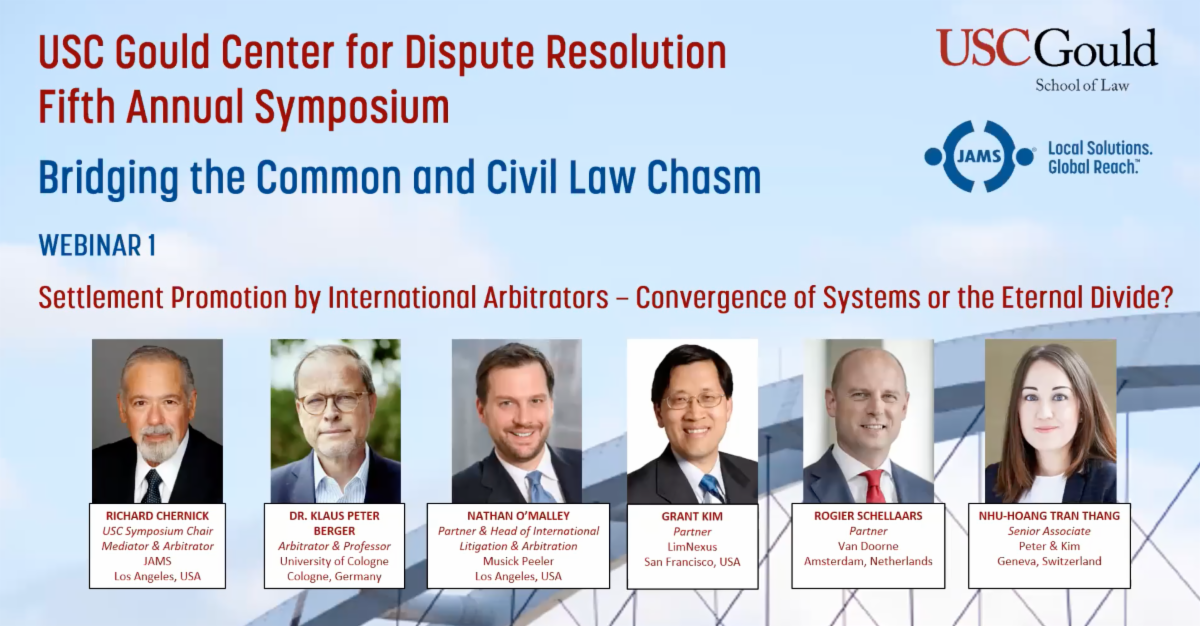
The third of three webinars comprising the Fifth Annual International Arbitration Symposium: Bridging the Common and Civil Law Chasm was held on May 19, 2021. Hiro Aragaki, FCIArb, Mediator and Arbitrator with JAMS in Los Angeles, began the final installment with a keynote address on “The Singapore Convention and the Rise of Cross-Border Commercial Mediation: Challenges and Opportunities.”
|
|
Howard B. Miller, FCIArb, Mediator and Arbitrator with JAMS in Los Angeles, then moderated a panel discussion featuring Mr. Aragaki, Josephine Hadikusumo (International Mediator and Director, Asia Mediation Centre – Sabah, Malaysia), Michael McIlwrath (Former Vice President - Litigation, Baker Hughes Company; Chair – ICC Governing Body for Dispute Resolution Services – Florence), Nina Mocheva (Senior Financial Sector Specialist [Dispute Resolution and Insolvency], World Bank Group – Washington DC), and Laila Ollapally (Mediator and Founder, Centre of Advanced Mediation Practice – Bangalore).
The recording and materials from that webinar are available here.
|
|
Furthering Career Development |
|
USC Gould School of Law Center for Dispute Resolution offers one of the nation's longest-standing and most comprehensive programs in arbitration and mediation. In addition to the Center’s academic and clinical programs, the Career Development Team offers a wide variety of workshops, expert panels and individual speaker events. In this way the Center provides students with access to the experience and expertise of accomplished ADR practitioners from around the world.
Spring '21 Career Events & Opportunities
In Spring 2021, the Center again offered its ADR Speaker Series. This series of intimate, informal conversations included experts in youth conflict resolution education, administrators with prominent arbitration providers, and several Gould ADR alumni. Joseph Jeong (2018) and Brooke Cavanaugh (2020) who currently apply their LLM in ADR degrees at the Financial Industry Regulatory Authority (FINRA), shared how they help parties in securities disputes navigate the arbitration or mediation process. Seth Chavez of the Los Angeles County Bar Association (LACBA) discussed the association’s fee arbitration program and offered insight into how attorneys and clients navigate such disputes and available opportunities for ADR graduates to contribute.
The Center also hosted Julie Ware, private mediator and Assistant Manager for the downtown Los Angeles Resolution Center of JAMS, Inc, who offered unique insights as a mediation practitioner and arbitration administrator. Trojan alum Valerie Harragin also joined the Series to discuss her years of experience as a Federal Mediator dealing with labor and employment disputes.
Our ADR students also heard from Gould Lecturer and ADR alum Justin Hoyt. In addition to teaching ADR Clause Drafting and Arbitration in the U.S. at Gould, Justin maintains a private practice as an arbitrator, discovery referee, and mediator of commercial, employment and personal injury disputes. Finally, Shaune Gatlin and Arturo Magaña from the Western Justice Center spoke with students about their work overseeing youth conflict resolution programs and education in LA-area middle schools, as well as internship opportunities for students.
This Spring, we again offered a Building Your Mediation Practice Workshop. In this live webinar, Wendy Kramer of ADR Services, Inc., taught students to build a mediation business from the ground up. Students learned how to enhance their professional development, develop tools necessary to market their practices, network to develop clientele, and identify day-to-day mediation business practices.
|
|
USC Unifying Values Community Panel on Open Communication
This June, USC’s Culture Transformation team under the Office of Culture, Ethics and Compliance hosted a community-wide event to generate excitement around USC’s Unifying Values: Integrity, Diversity, Equity and Inclusion, Well-being, Accountability, Open Communication, and Excellence, that discussed how we can embed them further in our everyday work and school life.
|
|
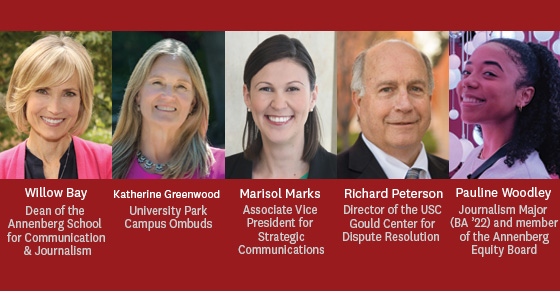
On June 16th, USC hosted a panel focusing on the value of “Open Communication” that featured the Center's Director, Prof. Richard Peterson, alongside other staff, students and administrators for all schools and units. He brought a unique perspective to enrich the conversation about how we as individuals and as an institution can live out the value of “Open Communication” as it relates to conflict resolution. |
|
ADR Faculty: News & Notes |
|
Jennifer Winestone
This Spring, Jennifer Winestone was profiled in the Daily Journal in an article entitled "The Human Element." The article can be found on the front page of the Verdicts and Settlements section of the journal for members. |
|
Alumni & Student Spotlights |
|
Lydia Liberio (LLM in ADR 2018)
As Associate Dean at Abraham Lincoln University, Lydia Liberio applies skills earned through a career dedicated to law and mediation to resolve disputes and inform programming, amplified by her education and experiences at USC Gould.
Why did you choose to pursue your degree at USC Gould?
After years of litigating, I was inspired to pursue my LLM in ADR during its inaugural year because alternative dispute resolution can leave parties feeling greater satisfaction, empowerment, comfort, and compliance with solutions they have voices in crafting, compared to litigation. My father earned his MSW at USC, and I took my first baby steps at USC at his graduation, not realizing I’d be returning to USC for an LLM – though he passed away before my LLM, I felt his presence every time I was near the School of Social Work, figuratively walking in his steps among the spectacular architecture. When I enrolled, I was thrilled with Gould’s ADR clinics, its in-depth degree program (when other schools were only offering certificates), and relationship with the international Chartered Institute of Arbitrators that allows you to apply your course credit to the arbitral certification, unique among law schools.
What sparked your interest in the law?
Growing up, I didn’t know any lawyers, mediators or judges, but I sure loved courtroom dramas, reading mysteries and mock trial. En route to becoming an attorney, I became a criminologist at UC Irvine, and enjoyed forensics, legal history, and most importantly, being able to use the law as a tool to make a positive impact in people’s lives.
Can you tell us about your current work in dispute resolution?
As an Associate Dean at ALU, I use my ADR skills in an ombudsperson way, resolving issues that arise, including student concerns with other students or faculty and regrade petitions, and I am also working towards an ADR clinic course for online law students. My private practice work relates to administrative law issues, non-profit trade group organization issues, employment, and family law matters, wherein I mediate or advocate, as needed. After I graduated from Gould, L.A. Superior Court expanded the judge pro tem program I volunteer with to include Mandatory Settlement Conferences, and I serve there as well as with the Online Dispute Resolution branch of the L.A. Dept. of Consumer and Business Affairs. During the pandemic, L.A. Superior Court has migrated its Daily Settlement Officer program to a Virtual Settlement Officer program, and assisting families in both formats has been personally rewarding.
What is the most memorable experience or learning from your USC studies?
There were so many memorable experiences, including time spent with my capstone paper advisor, Professor Garman, the half class role playing team finals in Professor Kaye’s Negotiation class (a few factors turned out to be non-negotiable and the surprise point allocations for resolving specific issues), and the clinical experiences. I also really enjoyed the time when, at the Children’s Court, working with onsite mediators Stacey and Drew, we resolved an intractable parent dissociation with an amazing adoption arrangement that permitted the parent to engage in supervised visits at an appropriate age, and the power of how an apology changed the dynamic, mood and outcome.
How has your degree from USC Gould given you an advantage in your career? What do you want to do next?
USC Gould was transformational in my career – obvious advantages are world class faculty, motivating classmates, a deep alumni network and ADR clinics. The more subtle advantages include the clinical insights that would otherwise take years to accrue post-graduation, the strong connections to the CIA arbitral credentials and SCMA (Southern California Mediation Association) network (with special USC campus events), and top-notch guest speakers. For example, I didn’t just learn Employment Law with Professor Latham, I heard from a past member of the National Labor Relations Board live in class! I suspect USC was a factor in my recent LACBA Board of Trustees process, receiving IALA’s nomination and making it through the Nominating Committee Process – at one point sharing the draft ballot with Professor Vincent! My ADR training proved invaluable for selection into the 2019-2021 Project Management Institute’s Leadership Institute Master Class (global top 32 project managers) – my research focus is risk management through ADR for non-profit groups. In 2019-2020, I worked on the State Bar’s CAPA Work Group studying how attorneys actually spend their time and reviewing bar exam subjects, and promoted ADR skills as possible area of study, and I’m currently exploring MC3 certification.
What advice do you have for students who may be interested in following a similar path to yours?
My advice would be to take advantage of every clinical program you are interested in, attend conferences in ADR, pick classes that involve experiential learning, and join relevant bar associations and trade groups. USC’s ADR clinics were great chances to mediate with the Children’s Court, U.S. EEOC and DEFA LAMP Settlement program, and I continued pro bono mediation with the latter two after graduation. USC also offered free conference attendance for students at its ADR and other conferences – definitely attend these! I joined the SCMA as a student, and they have a super mentorship program every student should apply for (great faculty and great mediators to shadow with). Both the ABA and LACBA have ADR Sections that offer solid programs and networking opportunities. After graduation, I joined the CIA and secured my MCIArb based upon my career experience and educational experience – be sure to apply if eligible as soon as possible (Professor O’Malley’s super International Arbitration class is a requirement). Recently, I learned about Arbitral Women, which has a strong mentorship program and a helpful registry worth exploring too.
|
|
Anthony Keen-Louie (MDR, graduating in December 2021)
As Program and Community Development Manager for Graduate and Family Housing at UC San Diego, Anthony Keen-Louie models conflict resolution skills and directly applies learnings from his classes at USC Gould to serve over 5,000 students.
Why did you choose to pursue your MDR at USC Gould?
Enrolling in USC Gould MDR program was a natural progression for me. My passion for ADR started early. As a peer mediator in 7th grade, I helped to resolve conflicts between other students on campus. As a professional, I continue to gravitate toward roles that deal with interpersonal conflict. After working in higher education for several years, I decided to seek more formal dispute resolution training. I considered USC Gould’s MDR Program due to the school’s well-established reputation and national ranking, but it was my interaction with faculty and the program’s emphasis on practical skills development that cemented my choice.
Can you tell us about your current work in dispute resolution?
In my professional life, I deploy mediation skills and process in both formal and informal ways. At UC San Diego, I serves as the Program and Community Development Manager for Graduate and Family Housing. While supervising professional and student staff, as well as serving a population of over 5,000 campus residents, I regularly models and teaches conflict resolution communication and skills. Courses in the MDR program have enabled me to communicate ideas more effectively to diverse audiences. Additionally, I serves as a community mediator with the National Conflict Resolution Center (NCRC). I can directly apply concepts and skills from the classroom. Specifically, Gould has helped expand my toolbox to be a more effective mediator, incorporating methods from the facilitative and evaluative styles of mediation.
How does your ADR degree from USC Gould give you an advantage in your current work or future prospects?
The MDR program has heavily influenced my career outlook. Previously, I had a set of strong professional interests in conflict resolution, but not necessarily how to develop those interests to further develop my career. Through coursework and advising in the MDR program, I now sees many exciting opportunities for professional growth in my current role and beyond. At UCSD, I anticipate expanding my current role to create mediation opportunities for campus residents, as well as provide more conflict resolution skills trainings for students and staff.
In your experience, how can ADR students at USC Gould work on career development while they are at USC? What are crucial steps ADR students can take prior to graduation?
I urge students to start thinking early on about how to leverage the MDR alongside their accrued professional experience and education. The degree is a great fit for those who have already identified at least a few ways to apply the degree professionally or opportunities to advance in their current positions. I suggest branching out with specialized courses like Employment Mediation, which helped expand my awareness of mediation beyond just my experience and introduced new means of applying mediation in the future. Definitely get to know the faculty as well. Professors are generous with their time and more than willing to mentor individual students and alumni. Finally, I took full advantage of ADR Career Development events. I met many professionals from across the ADR spectrum through the ADR Speaker Series, helping to unpack the diversity of focus areas and opportunities in the field.
What surprised you most about your time in the MDR Program?
I was pleasantly surprised by how directly applicable the concepts and skills learned in class proved to be to my current work. Through role plays and discussion, I was able to breakdown and brainstorm thorny problems from my professional and volunteer work and apply the new approaches and ideas to great effect. Additionally, I was surprised by the diversity of professional roles and practice areas in ADR. With the examples of professors, speakers and even other students, I will complete my degree later this year with many exciting professional paths to pursue.
|
|
The Transformative Power of Meaningful Apology
Richard Peterson, Director of the USC Gould School of Law Center for Dispute Resolution
|
|
Some years ago, a parent brought her eight-year-old daughter to her law school contracts class when child-care arrangements fell through at the last minute. The professor was discussing a dispute involving a vendor’s manufacture of defective “widgets” and the customer’s refusal to pay when delivery of the product was tendered. A discussion ensued about breach of contract, substantial performance, and the relative rights and obligations of the parties under the particular facts presented by the professor.
In the midst of an engaging discussion about who was right and who was wrong, the professor asked the class what they would say to the customer if they were the vendor. Several students offered possible responses asserting substantial performance and arguing that the customer was obligated to make payment in spite of the defects complained of by the customer. The attentive child then raised her hand. The professor, not wanting to pass up an opportunity to hear what this young girl might have to say, invited her to answer the question. Confidently and without hesitation, she simply said, “I would say I’m sorry!”
Research and studies have provided convincing evidence of the healing power of sincere and appropriate apology, for both the giver and the recipient, in the processes of dispute resolution... read the full article here. |
|
|
|
|
|
|