A Tale of Two Decades:
Lessons for Long‑Term Investors
|
|
The first decade of the 21st century, and the second one that’s drawing to a close, have reinforced for investors some timeless market lessons:
- Returns can vary sharply from one period to another.
- Holding a broadly diversified portfolio can help smooth out the swings.
- Focusing on known drivers of higher expected returns can increase the potential for long‑term success.
- Having a sound strategy built on those principles—and sticking to it through good times and bad—can be a rewarding investment approach.
THE LOST DECADE
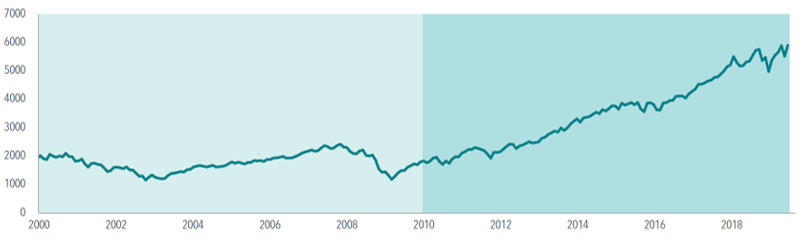
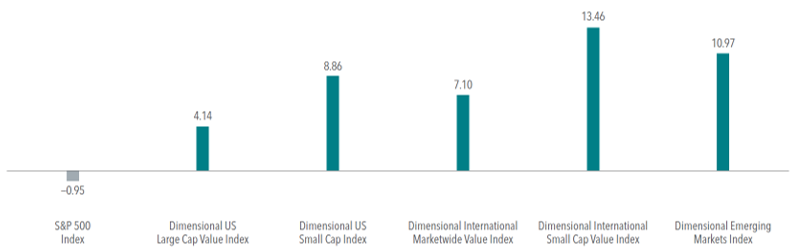
Looking at a broad measure of the US stock market, such as the S&P 500, over the past 20 years, you could be forgiven for thinking of Charles Dickens: It was the best of times and the worst of times. For US large cap stocks, the worst came first. The “lost decade” from January 2000 through December 2009 resulted in disappointing returns for many who were invested in the securities in the S&P 500. An index that had averaged more than 10% annualized returns before 2000 instead delivered less‑than‑average returns from the start of the decade to the end. Annualized returns for the S&P 500 during that market period were −0.95%
(Exhibit 1)
.
|
|
Exhibit 1. S&P 500 (Total Return)
January 2000-June 2019, monthly levels
|
|
Performance data represents past performance and does not predict future performance. Indices not available for direct investment. Performance does not reflect the expenses associated with the management of an actual portfolio. S&P data © 2019 S&P Dow Jones Indices LLC, a division of S&P Global.
|
|
Yet it was a good decade for investors who diversified their holdings globally beyond US large cap stocks and included other parts of the market with higher expected returns—companies with small market capitalizations or low relative price (value stocks). As
Exhibit 2
shows, a range of indices across many other parts of the global market outperformed the S&P 500 during that time span.
|
|
Exhibit 2: The 2000s
Annualized returns (%): January 2000-December 2009
|
|
In US dollars. Performance data represents past performance and does not predict future performance. Indices not available for direct investment. Performance does not reflect the expenses associated with the management of an actual portfolio. S&P data © 2019 S&P Dow Jones Indices LLC, a division of S&P Global. See Index Descriptions in the appendix for descriptions of the Dimensional index data.
|
|
FLIPPING THE SCRIPT
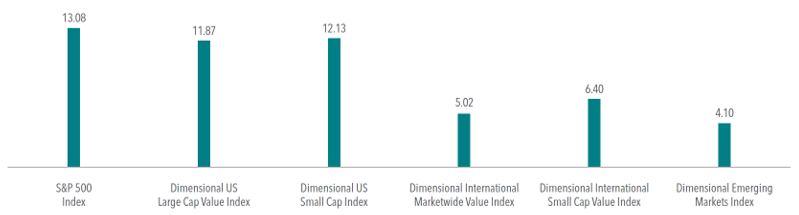
The next period of nine‑plus years reveals quite a different story. It has looked more like best of times for the S&P 500, as the index, when viewed by total return, has more than tripled since the start of the decade in the bounce‑back from the global financial crisis. US large cap growth stocks have been some of the brightest stars during this span. Accordingly, from 2010 through the first half of 2019, many parts of the market that performed well during the previous decade haven’t been able to outperform the S&P 500, as
Exhibit 3
displays. Since many of these asset classes haven’t kept pace with the S&P, these returns might cause some to question their allocation to the asset classes that drove positive returns during the 2000s.
|
|
Exhibit 3. The 2010s
Annualized returns (%): January 2010-June 2019
|
|
In US dollars. Performance data represents past performance and does not predict future performance. Indices not available for direct investment. Performance does not reflect the expenses associated with the management of an actual portfolio. S&P data © 2019 S&P Dow Jones Indices LLC, a division of S&P Global. See Index Descriptions in the appendix for descriptions of the Dimensional index data.
|
|
THE CASE FOR GREAT EXPECTATIONS
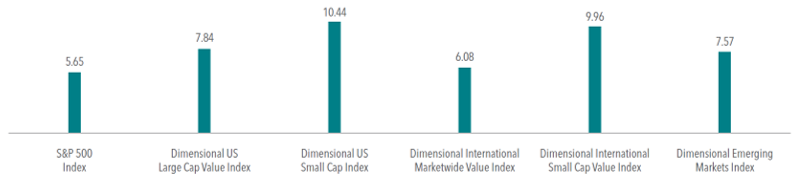
It’s been stated many times that investors may want to take a long‑term perspective toward investing, and the performance of stock markets since 2000 supports this point of view. Over the past 19½ years
(Exhibit 4)
, investing outside the US presented investors with opportunities to capture annualized returns that surpassed the S&P 500’s 5.65%, despite periods of underperformance, including the most recent nine‑plus years. Cumulative performance from 2000 through June 2019 also reflects the benefits of having a diversified portfolio that targets areas of the market with higher expected returns, such as small and value stocks. And it underscores the principle that longer time frames increase the likelihood of having a good investment experience.
No one knows what the next 10 months will bring, much less the next 10 years. But maintaining patience and discipline, through the bad times and the good, puts investors in position to increase the likelihood of long‑term success.
|
|
Exhibit 4. 2000-2019
Annualized returns (%): January 2000-June 2019
|
|
In US dollars. Performance data represents past performance and does not predict future performance. Indices not available for direct investment. Performance does not reflect the expenses associated with the management of an actual portfolio. S&P data © 2019 S&P Dow Jones Indices LLC, a division of S&P Global. See Index Descriptions in the appendix for descriptions of the Dimensional index data.
|
|
APPENDIX: Index Descriptions
Dimensional US Large Cap Value Index
is compiled by Dimensional from CRSP and Compustat data. Targets securities of US companies traded on the NYSE, NYSE MKT (formerly AMEX), and Nasdaq Global Market with market capitalizations above the 1,000th-largest company whose relative price is in the bottom 30% of the Dimensional US Large Cap Index after the exclusion of utilities, companies lacking financial data, and companies with negative relative price. The index emphasizes securities with higher profitability, lower relative price, and lower market capitalization. Profitability is measured as operating income before depreciation and amortization minus interest expense scaled by book. Exclusions: non-US companies, REITs, UITs, and investment companies. The index has been retroactively calculated by Dimensional and did not exist prior to March 2007. The calculation methodology for the Dimensional US Large Cap Value Index was amended in January 2014 to include direct profitability as a factor in selecting securities for inclusion in the index. Prior to January 1975: Targets securities of US companies traded on the NYSE, NYSE MKT (formerly AMEX), and Nasdaq Global Market with market capitalizations above the 1,000th-largest company whose relative price is in the bottom 20% of the Dimensional US Large Cap Index after the exclusion of utilities, companies lacking financial data, and companies with negative relative price.
Dimensional US Small Cap Index
is compiled by Dimensional from CRSP and Compustat data. Targets securities of US companies traded on the NYSE, NYSE MKT (formerly AMEX), and Nasdaq Global Market whose market capitalization falls in the lowest 8% of the total market capitalization of the eligible market. The index emphasizes companies with higher profitability. Profitability is measured as operating income before depreciation and amortization minus interest expense scaled by book. Exclusions: non-US companies, REITs, UITs, and investment companies. The index has been retroactively calculated by Dimensional and did not exist prior to March 2007. The calculation methodology for the Dimensional US Small Cap Index was amended in January 2014 to include direct profitability as a factor in selecting securities for inclusion in the index. Prior to January 1975: Targets securities of US companies traded on the NYSE, NYSE MKT (formerly AMEX), and Nasdaq Global Market whose market capitalization falls in the lowest 8% of the total market capitalization
of the eligible market.
Dimensional International Marketwide Value Index
is compiled by Dimensional from Bloomberg securities data. The index consists of companies whose relative price is in the bottom 33% of their country’s companies after the exclusion of utilities and companies with either negative or missing relative price data. The index emphasizes companies with smaller capitalization, lower relative price, and higher profitability. The index also excludes those companies with the lowest profitability and highest relative price within their country’s value universe. Profitability is measured as operating income before depreciation and amortization minus interest expense scaled by book. Exclusions: REITs and investment companies. The index has been retroactively calculated by Dimensional and did not exist prior to April 2008. The calculation methodology for the Dimensional International Marketwide Value Index was amended in January 2014 to include direct profitability as a factor in selecting securities for inclusion in the index.
Dimensional International Small Cap Value Index
is defined as companies whose relative price is in the bottom 35% of their country’s respective constituents in the Dimensional International Small Cap Index after the exclusion of utilities and companies with either negative or missing relative price data. The index also excludes those companies with the lowest profitability within their country’s small value universe. Profitability is measured as operating income before depreciation and amortization minus interest expense scaled by book. Exclusions: REITs and investment companies. The index has been retroactively calculated by Dimensional and did not exist prior to April 2008. The calculation methodology for the Dimensional International Small Cap Value Index was amended in January 2014 to include direct profitability as a factor in selecting securities for inclusion in the index. Prior to January 1990: Created by Dimensional, the index includes securities of MSCI EAFE countries in the top 30% of book-to-market by market capitalization conditional on the securities being in the bottom 10% of market capitalization, excluding the bottom 1%. All securities are market capitalization weighted. Each country is capped at 50%; rebalanced semiannually.
Dimensional Emerging Markets Index
is compiled by Dimensional from Bloomberg securities data. Market capitalization-weighted index of all securities in the eligible markets. The index has been retroactively calculated by Dimensional and did not exist prior to April 2008. Exclusions: REITs and investment companies.
|
|
Ascend Wealth Management Inc. is a Registered Investment Adviser. We serve as an independent, fee-only wealth management firm for individuals, families and institutions to help them achieve their investment goals. To learn more about us and our services, please visit our website or contact us at
info@ascendwealth.com
.
This newsletter is solely for informational purposes. Advisory services are only offered to clients or prospective clients where Ascend Wealth Management Inc. and its representatives are properly licensed or exempt from licensure. Past performance is no guarantee of future returns. Investing involves risk and possible loss of principal capital. No advice may be rendered by Ascend Wealth Management Inc. unless a client service agreement is in place.
|
|
Ascend Wealth Management Inc
.
700 Larkspur Landing Circle, Suite 199
Larkspur, CA 94939
(415) 569-7909
|
|
If you were forwarded this email and would like to receive future editions of
The Astute Investor
in your mailbox, please subscribe here:
|
|
|
|
|
|
|