|
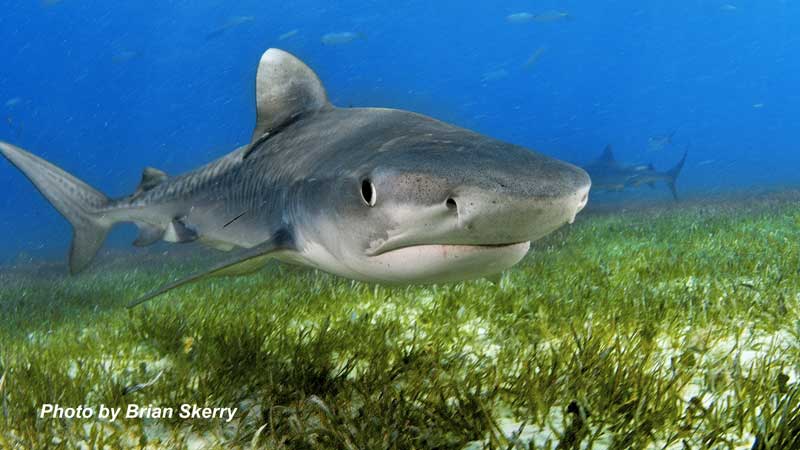
Tiger Sharks Help Map Seagrass Meadow in the Bahamas
Seagrass meadows sequester loads of ocean-bound carbon dioxide and are feeding and nursery grounds for an abundance of marine species including sharks and rays. A team of researchers from several institutions used satellite tags to track individual tiger sharks with bio-logging camera as they crossed the Bahamas. The satellite-tagged tiger sharks swam more than 2,485 miles in both regions of The Bahama Banks and revealed the tiger sharks spent around 70% of their time swimming over seagrass meadows. The tiger sharks helped the team map out a seagrass meadow that was even bigger than they had imagined. The seagrass meadow of the Bahama Banks is one continuous ecosystem that spans 35,521 square miles.
Read more
| |
|
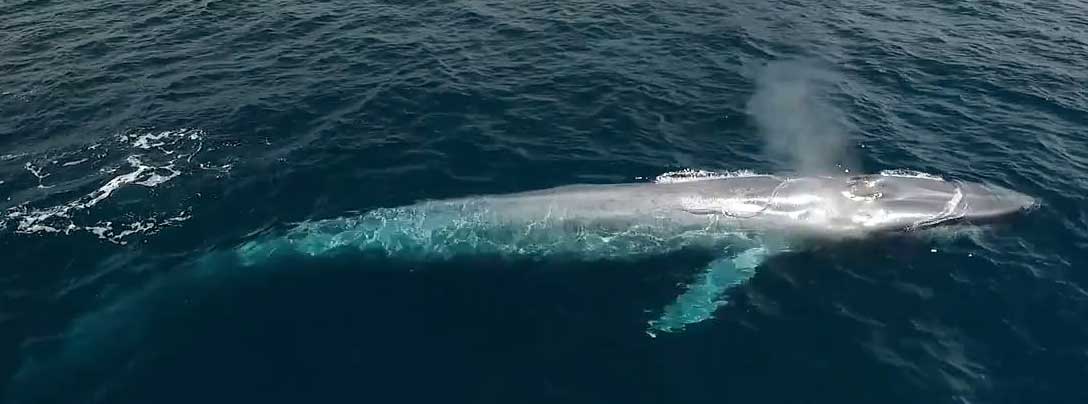
Feeding Rhythm of Blue Whales Puts them in Harm's Way
Each year in late summer, hundreds of blue whales (Balaenoptera musculus) migrate to rich feeding grounds in the cold California Current where upwellings trigger an explosion in phytoplankton. Ship strike is one of the major sources of human-induced mortality of blue whales along the coast, reports Elliott Hazen of NOAA who studies the blue whale movements, "but we also believe we’re only detecting 1 in every 10 ship strikes. A lot of ship-struck whales sink to the bottom before they’re detected.” Tracking whales with directional hydrophones in real time allowed Hazen and other researchers to know where the whales were at any given moment. They found when strong winds drove upwellings along the shore, whales quickly moved from deeper water to forage in the bay. Once the wind died down and the upwelling abated, the whales moved back out to sea. These movements indicate the whales are crossing shipping lanes every time the winds transition, putting them in danger of ship strikes.
Read more
Additional research published earlier this week in the journal Nature Communications highlights another threat to the whales: their consumption of microplastics and the toxic chemicals they carry. The study combined depth-integrated microplastic data from the California Current Ecosystem with high-resolution foraging measurements of blue, fin, and humpback whales, including the plastic ingestion rates and routes of exposure of each species. They found krill-obligate blue whales may ingest 10 million pieces of microplastic per day, five times the amount consumed by whales that feed on fish.
| |
|
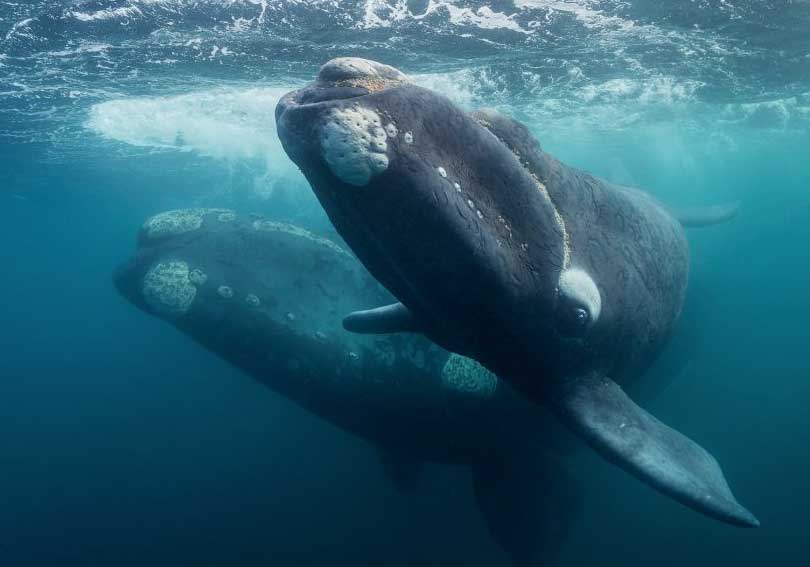
Facing Extinction?
The North Atlantic Right Whale (Eubalaena glacialis) is one of the most endangered species of large whales in the world. Although listed on the Endangered Species Act for more than 50 years, the species has been slow to recover. In 2010, the there were 480 whales remaining. At the start of 2018, it was estimated that only 72 females capable of breeding were still alive. In 2020 the population of the whales was 348 but dropped to only 340 in 2021. In October 2022 the North Atlantic Right Whale Consortium released its annual report card on the status of the whales; it confirms the dire future of this species.
| |
|
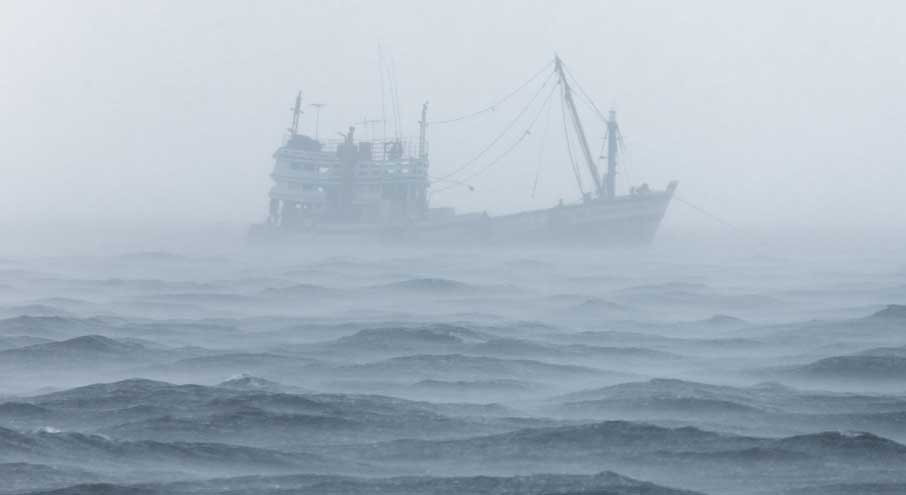
Illegal Fishing Results in Billions Lost by Developing Countries
More than 90% of global fisheries stocks are being fully exploited, overexploited or depleted, according to the United Nations. An analysis finds the global practice is a major driver of marine ecosystems’ destruction and is estimated to run up to $50 billion. Illicit trade as defined in marine fisheries resources is trade that involves money, goods, or value gained from unreported fishing of stocks by foreign and domestic industrial fishing fleets. It is estimated that 8 to 14 million metric tons of illegal, unreported unregulated catches are traded yearly, suggesting gross revenues of US$9 to US$17 billion alone are associated with these catches. The catch and gross revenue losses are not distributed equally across the world; an analysis suggests that Asia, Africa, and South America suffer the biggest losses in catch due to likely illicit trade resulting in food and nutritional insecurity, loss of jobs, and loss of revenue to local and national economies.
Learn more
| |
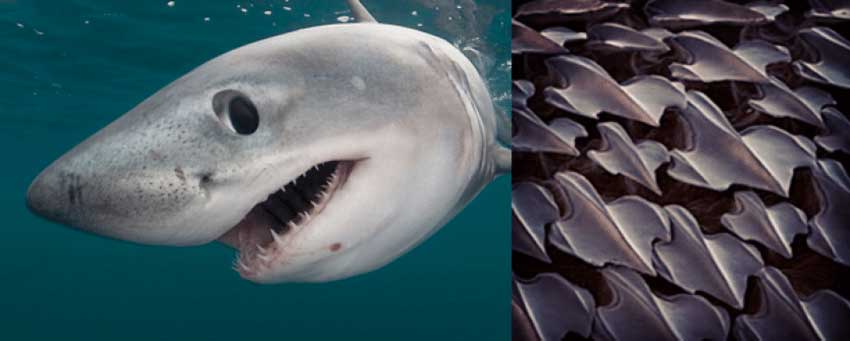
Shark Skin Substitutes : Works in Progress
When you run your hand from a shark’s head to its tail its skin feels smooth. Reverse direction and it’s skin is as rough as sandpaper. Viewed under a microscope, shark skin is composed of dermal denticles, hard enamel structures layered like shingles on a roof. Made of dentin and enamel, their ribbed and layered pattern directs water across the shark’s back, reducing friction and drag allowing a shark to glide through the water. To mimic sharks’ impressive hydrodynamic prowess, materials scientists have designed shark-inspired surfaces for the hulls of boats, wind turbines, and even high-end swimsuits, all in an attempt to maximize efficiency.
A new study researchers from Harvard University, using a technique called surface profilometry, compared proportions of denticles and spacing of the riblets in the skin samples from 17 different shark species with engineered materials that attempt to mimic shark skin. Although the engineered materials have a long way to go, the updated information on the 3D structure of shark denticles may bring engineers one step closer to mimicking one of nature’s most efficient swimmers.
Read more
| |
|
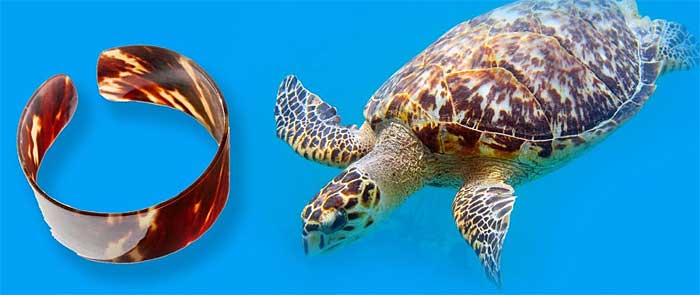
Maryland Bans Trade in 17 Endangered Species
The state of Maryland now bans the sale, purchase, possession with intent to sell, and the offer to sell products associated with 17 different species of animals, including sea turtles. The new law went into effect in October, 2022. Violation of this new law includes forfeiture of the illegal item and a first-offense fine of $3,000, second and subsequent offenses come with a fine of $10,000, according to the Maryland Department of Natural Resources. There are some exceptions to the new law.
Learn more
| |
|
COP27
DATES: November 6 to 18, 2022
LOCATION: Sharm el-Sheikh, Egypt
COP27, the annual UN Climate Conference, at which governments agree on steps to limit the rise in global temperatures, will focus on three main areas: reducing emissions, helping countries to prepare and deal with climate change, and securing technical support and funding for developing countries for these activities.
Our planet is warming because of emissions produced by humans, mostly from burning fossil fuels like oil, gas and coal. Carbon dioxide emissions remain the biggest threat; they are the main drivers of climate change and associated extreme weather. They will continue to affect climate for thousands of years through polar ice loss, ocean warming and sea level rise.
“Isn’t the evidence already overwhelming that the world stands on a climate precipice?”, says philosopher, logician, linguist, cognitive scientist, activist and political commentator Professor Noam Chomsky. He describes policies that promote fossil fuels as part of a “resolute march toward suicide.”
| |
Nudi November
DIVE IN with Liz, Sylvia and Rebecca Johnson
DATE: November 10, 2022
TIME: 3 pm, Pacific Time
Rebecca Johnson is a co-director of the Center for Biodiversity and Community Science at the California Academy of Sciences and a Research Associate in the Department of Invertebrate Zoology and Geology. For most of her academic career she has focused on color pattern evolution and untangling the evolutionary history of nudibranchs, She supports and grows a community of naturalists working together to discover nature and collect important species occurrence data.
DIVE IN with Liz and Sylvia is a casual, free-flowing, and educational conversation and encourages ocean and nature enthusiasts of all ages to join. Sylvia, Liz, and Rebecca will take questions via Q & A text from the attendees. Get your questions ready!
Register for the Webinar here
| |
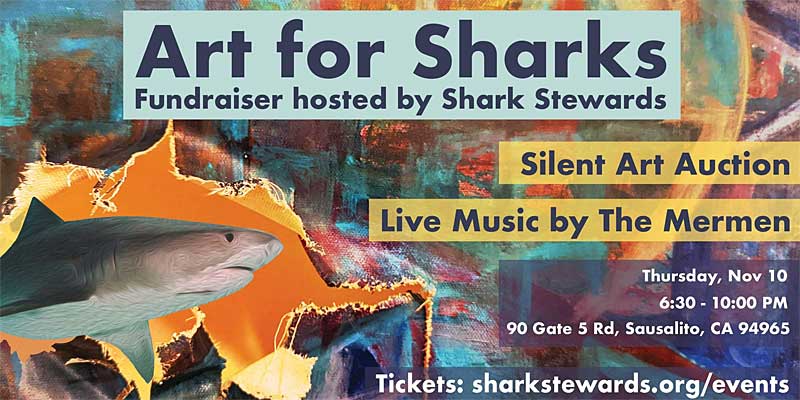
Art for Sharks
DATE: Thursday November 10, 2022
TIME: 6:30 to 10 pm
LOCATION: 90 Gate 5 Road, Sausalito, CA
Join ocean artists in support of sharks and ocean health. Ocean art, surf music, libations and silent auction to support Shark Stewards international shark conservation campaign.
Tickets
| |
|
Sea Stories
DATE: Saturday November 12, 2022
TIME: 9:00 am - 7 pm. The event includes continental breakfast, lunch and cocktails in the evening.
LOCATION: The Explorers Club, 46 East 70th Street, New York.
Book well in advance for Sea Stories! It is an entire day focused on ocean exploration, conservation, scuba diving, shipwrecks, and marine life. This event also offers opportunities for those interested in ocean exploration to interact with leading field professionals and like-minded explorers.
Featured Speakers
Joe Fiorentino : "During Queen Anne’s war, the 32-gun British HMS Feversham sailed from New York in 1711 to escort three transports to join the British fleet in Cape Breton, Nova Scotia, to attack French-controlled Quebec but the ship wrecked in bad weather on Scatarie Island, Cape Breton with the three transports and her payroll of coins. According to coin experts, her treasure represents great diversity spanning from Spanish pieces of eight to early American, pre-Revolutionary War colonial coins."
Alexandra Rose : "From Pole to Pole: Exploration with a Purpose."
Victor Vescovo : "In 2020 Vescovo piloted history’s deepest ever submarine dive in the Pacific’s Mariana Trench. He did it twelve times and in August 2019 became the first person to visit “The Five Deeps,” the deepest point in all five of the world’s oceans. He also made three dives to the Titanic including the only solo dive ever made there, and in 2022 completed the deepest wreck dive in history at the site of the USS Samuel B. Roberts in 22,600 feet (4.3 miles) of water."
Jennifer Idol : "Close up and Comfortable with Sharks"
Marti Broen : "Discovery Journey of the Underwater Cave Systems of Yucatan. This award-winning photographer captures the beauty and secrets of the underworld."
Tickets are $80 for Members and the General Public, $40 for children (16 years of age or younger). After November 4th, the cost of all tickets will increase by $10 Tickets will NOT be sold at door.
CLICK HERE TO PURCHASE TICKETS
| |
|
Notes
SRI Headquarters will be closed November 14-25/26. SRI staff and scientists will be attending the Convention on International Trade in Endangered Species in Panama, supporting the listing of more shark and ray proposals.
Amazon.com is offering an opportunity to generate donations to the Shark Research Institute at no extra cost to you. Simply start your shopping at smile.amazon.com/ch/22-3110087, confirm "Shark Research Institute, Inc." as your charity of choice, and Amazon will make a donation to our organization.
Consider a tax-deductible year-end gift to the Shark Research Institute. Just mail a check to SRI at PO Box 40, Princeton, NJ 08542, USA, or go to the link on our website.
You may join or renew your membership in the Shark Research Institute, or make a donation of any size at https://www.sharks.org/donate
Note: All donations are tax-deductible from U.S. federal income taxes as
charitable donations and help fund our field research, advocacy and education programs.
| |
Please share this free weekly newsletter with your friends and family to help grow our audience. All they need to do to receive the newsletter is simply sign up on our website’s home page (https:www.sharks.org)
We all have a lot of work ahead to protect sharks and the ocean,
and combat climate change while there is still time.
| | | | | |