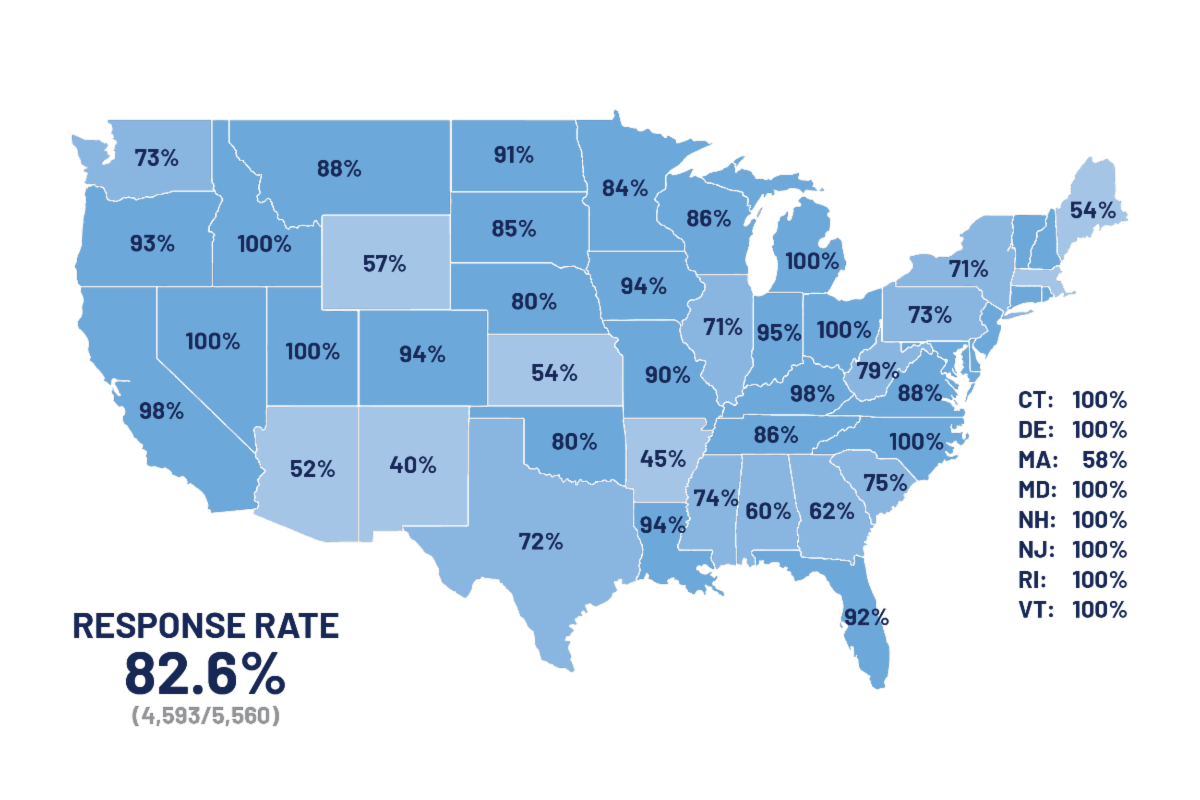
More than 4,500 EDs Participate in the NPRP Assessment!
Thank you to the record-breaking number of EDs that participated in the 2026 National Pediatric Readiness Project (NPRP) Nationwide Assessment. Your time, effort, and commitment are essential to supporting improvements in care for children both in your community and across the country.
We also appreciate the support of the numerous partners, champions, and organizations that helped promote participation and encourage ED engagement nationwide.
For EDs interested in continuing to assess and strengthen their Pediatric Readiness, the NPRP Open Assessment is expected to launch in the next week or so. The open assessment will be available year-round to help EDs evaluate their readiness and identify opportunities for improvement at any time.
Ready to dive into improvements? Check out the recently redesigned NPRP Toolkit, which includes more than 100 resources, examples, templates and more to help you address gaps. EDs that participated in the assessment should focus on Section 4. Looking for more help getting started on your gaps? Join a June 24 webinar: “From Assessment to Action: Improving Pediatric Readiness at Your ED."
| |
Celebrating EMS Clinicians’ Commitment to Children
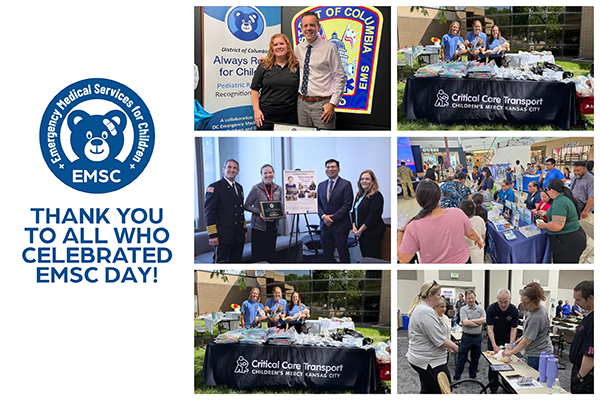
On EMS for Children (EMSC) Day, during National EMS Week, EMSC Program grantees and national partners once again came together to recognize the critical role of EMS clinicians in caring for ill and injured children. The 2026 EMS Week theme, “Improving Outcomes, Together,” highlighted the dedication, compassion, and expertise EMS professionals bring to every patient encounter.
To mark the occasion, EMSC hosted a webinar, “Rethinking Spinal Motion Restriction in Children: Evidence-Based Strategies for Prehospital Care,” in partnership with the National Association of EMTs. Nearly 800 participants joined the session to learn about evidence-based spinal motion restriction based on research from the Pediatric Emergency Care Applied Research Network (PECARN).
Across the country, EMSC State Partnership Programs celebrated EMSC Day through a variety of activities, including awards ceremonies, state capitol recognitions, open houses, educational outreach, and community engagement events honoring EMS clinicians and promoting Pediatric Readiness. View a gallery of EMSC Day photos from states and territories here.
|
EMS Agencies Can Now Assess Pediatric Readiness Year-Round
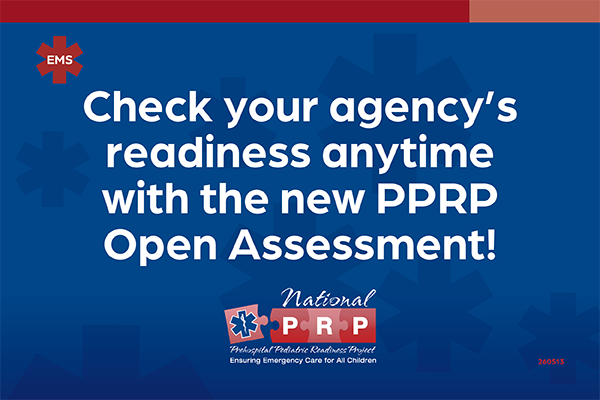
EMS and fire-rescue agencies can now assess their Pediatric Readiness anytime through the National Prehospital Pediatric Readiness Project (PPRP) Open Assessment, available at EMSPedsReady.org. Designed to help agencies evaluate their preparedness for caring for children during emergencies, the assessment provides an ongoing opportunity to identify strengths, address gaps, and support quality improvement efforts in pediatric prehospital care.
Agencies that participated in the 2024 nationwide assessment can use the open assessment to track progress and reassess their pediatric capabilities. Agencies that did not participate now have an opportunity to establish a baseline and better understand areas for growth in pediatric emergency care.
After completing the assessment, agencies receive a gap report summary that can be used to support planning, education, policy development, and other improvements. The open assessment may be completed and repeated as often as needed.
Take the assessment today at EMSPedsReady.org.
| |
New Resource: PMHCA Technical Assistance Toolkit 2.0
Just in time for May as Mental Health Awareness Month, the EMSC Innovation and Improvement Center recently released the Pediatric Mental Health Care Access (PMHCA) Technical Assistance Toolkit 2.0.
The toolkit provides practical tools, workflows, and quality improvement strategies to support state-based PMHCA programs, supported through HRSA, in strengthening collaboration between EDs, pediatricians, and mental health providers and improving responses for children experiencing mental and behavioral health crises.
The resource builds on work from the PMHCA Quality Improvement Collaborative, which brought teams together over the past three years to improve pediatric mental health care in emergency settings. PMHCA programs can explore the toolkit step by step or adapt individual sections to meet their program’s needs. Explore the PMHCA Technical Assistance Toolkit.
|
Upcoming Pediatric Sepsis Webinar
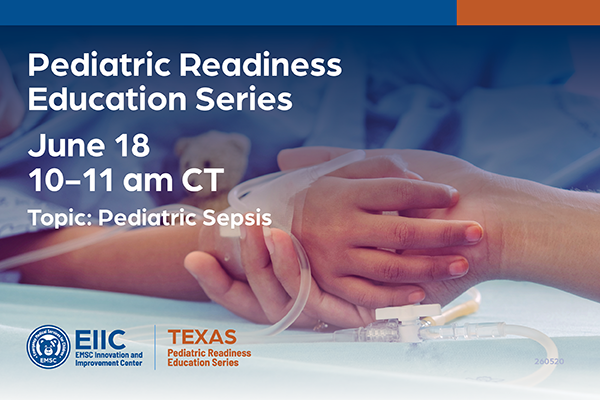
Join the next Pediatric Readiness Education Series webinar on June 18 at 10 am CT, featuring Fran Balamuth, MD, PhD, MSCE, of the Pediatric Emergency Care Applied Research Network (PECARN) and Division Chief of Emergency Medicine at Children’s Hospital of Philadelphia, presenting on pediatric sepsis. This free national webinar series, hosted in collaboration between the EMSC Innovation and Improvement Center and the Texas Pediatric Readiness Education Series, provides practical education focused on pediatric emergency care for ED clinicians and staff across disciplines, including nurses, physicians, advanced practice providers, and pediatric emergency care coordinators (PECCs). EMS clinicians are also welcome to attend.
Participation is free and limited to the first 1,000 attendees. Joint accreditation CE available for physicians and nurses, and recordings will be available for those unable to attend live. Register here.
| |
New resource: The 2026 EMSC Liaison Report is now available.
Learn more about EMSC’s recent work and progress.
| |
State Snapshots
-
District of Columbia: This month more than 80 clinicians from 6 states came together for the Pediatric Readiness Symposium, an interactive, hands-on day advancing pediatric emergency care. Thanks to DC EMSC, PPN, and Children’s National Hospital for strengthening regional collaboration!
-
Florida: A new FL EMSC Pediatric, Trauma, and Maternal Services Dashboard is now available to support Florida’s emergency, pediatric, and disaster healthcare community. The purpose of the dashboard is to assist in rapid identification of EDs and hospitals with pediatric (inpatient and PICU), maternal (OB, newborn nursery, and NICU), and trauma (trauma and burn centers) services including transfer contact information. To learn more email: FLPEDReadyED@jax.ufl.edu.
| | The Health Resources and Services Administration (HRSA), Department of Health and Human Services (HHS) provided financial support for this and other communications projects. The award totaled $2.5M with 18% of this total used to support this and other educational works. The contents are those of the author. They may not reflect the policies of HRSA, HHS, or the U.S. Government. | | | | |