| | |
POLICY & ADVOCACY UPDATE
Issue #76, 23 July 2026
| | | |
- From the AA CEO James Goodwin
- Skilled visa processing delays worsen
- Proposed changes to discretionary trusts
- NSW AA Award winners announced
- Digital travel declaration to modernise Australia's border experience
- Hotel performance for June
- Economy hotels hit hardest in last three months
- Overseas arrivals for May 2026
- Debit and credit card changes: Prepare for 1 October 2026
| |
| |
From the AA CEO
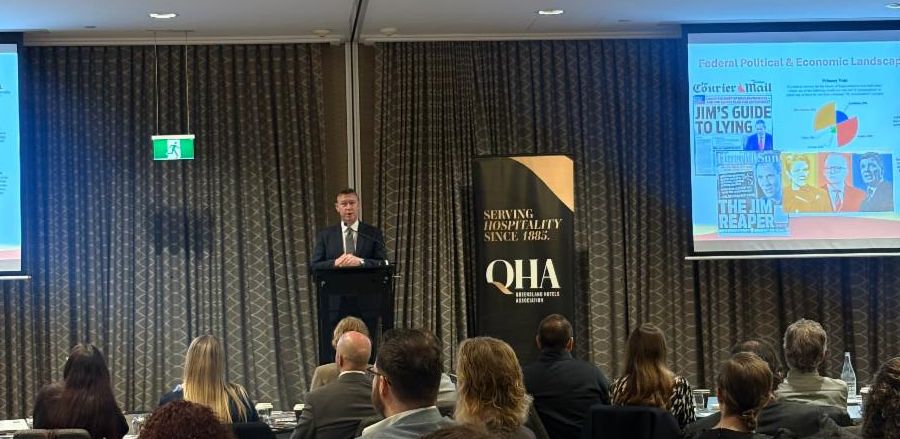
One of the highlights of this week was attending the Queensland Annual Hotel Market & Economic Outlook event, pictured below. It was a valuable opportunity to connect with members, hear firsthand about the opportunities and challenges facing properties, and discuss the key issues shaping our industry.
| | | |
|
Not surprisingly, workforce and skills issues remain front and centre but there was optimism in the room about leveraging the opportunities the upcoming Olympics will bring. Importantly though, attention is turning to making sure the benefits for the industry extend beyond the games in 2032 but also into the years ahead, with new infrastructure to support future sporting and cultural events in Queensland.
I finish the week in Adelaide at the Australian Labor Party National Conference, where I’ll be engaging with political leaders and stakeholders to promote the priorities of the accommodation sector and reinforce the important role our industry plays in Australia's economy, tourism success and thriving local communities. Jenny and I have a range of formal engagements and meetings with the Prime Minister, as pictured above, and a range of Ministers, but being at the event there are also equally important opportunities to have less formal conversations with a broad range of people in government so Accommodation Australia can continues to advocate strongly on behalf of members across the country.
James Goodwin
Chief Executive Officer
| | | | |
Skilled visa processing delays worsen
In last week's regular quarterly meeting held between the Department of Home Affairs and AHA/AA, we learned that it is now not unusual for employers to experience a nine-month delay in having their skilled migrant sponsorship application finalised. The department indicated that this delay had worsened due to a range of factors including the increasing demand to sponsor migrants, the resources available to the department, and the difficulty in processing incomplete applications. They acknowledged that due to the extra information made available to employers as a result of our engagement, the employer applications had improved significantly. However, applications that visa applicants (ie. the potential skilled migrant) were incomplete in up to 60% of cases. They strongly encouraged AHA and AA to provide additional information to members to encourage the migrant they wished to sponsor was ensuring their application was complete at the time that it was submitted. DHA provided us two guides, one for the employer and one for the visa applicant. If you are planning to sponsor a migrant, please use the employer checklist for your own benefit and pass on the visa applicant checklist to the person you wish to sponsor. Both of these guides can be found in the links below:
| |
Proposed changes to discretionary trusts
The Federal Government has released a consultation paper outlining how it intends to implement its proposed 30 per cent minimum tax on discretionary trusts. If introduced as proposed, the reforms will take effect from 1 July 2028 and are expected to have significant implications for many family-owned businesses that operate through discretionary trust structures.
An estimated 350,000 Australian small businesses currently use discretionary trusts, including many accommodation businesses. While the Government has proposed three years of tax rollover relief for businesses that choose to restructure, industry groups have expressed concern that the reforms could increase tax liabilities, create substantial restructuring costs, and reduce the competitiveness of small businesses compared with employees on similar incomes.
The Government estimates the measure will raise over $4 billion in additional revenue in its first year of operation, making it one of the more significant tax changes currently under consideration for small business.
| | |
NSW AA Award winners announced
Over 750 hoteliers, colleagues and industry friends came together at The Fullerton Hotel in Sydney to celebrate New South Wales's top accommodation providers and hospitality professionals. Among the night's major award winners, Park Hyatt Sydney was named Luxury Hotel of the Year, while Meriton Suites Sussex Street took out Best Apartment Style Accommodation. Le Méridien Sydney was awarded Luxury Lifestyle Accommodation Hotel of the Year, and Berrima Bakehouse Motel won Best Budget Style Accommodation. Regional properties also enjoyed strong recognition, with Powerhouse Hotel Tamworth by Rydges named Regional Superior Hotel of the Year and Spicers Sangoma Retreat awarded Regional Deluxe Hotel of the Year. For a full list of winners, see here.
| | National AA Chair David Mansfield and AA CEO James Goodwin at the NSW AA Awards night last week. | | All of the winners at the AA NSW Awards for Excellence. | | |
Digital travel declaration to modernise Australia's border experience
Accommodation Australia has welcomed the announcement that the government will invest $56.1 million over four years to modernise Australia’s border processing systems and deliver the digital Australian Travel Declaration, following a successful trial on Qantas flights into Brisbane, Sydney, and Melbourne. It is expected to be rolled out over the next 12 to 18 months. The digital declaration will provide a faster, paperless option for millions of Australian residents and international visitors arriving by air or sea. AA CEO James Goodwin said the long-awaited change was a win for travellers and the industry. “We are competing with destinations around the world that have already modernised their airport experience. This is the first impression travellers have of our country and we all know first impressions matter." For the AA media release see here.
| | |
Hotel performance for June
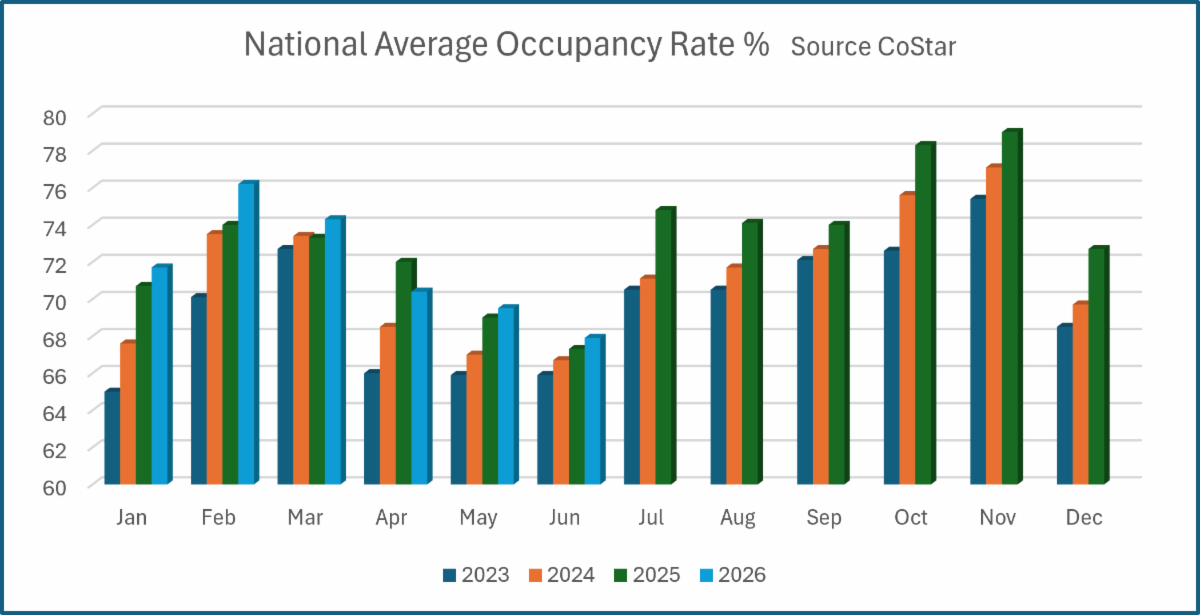
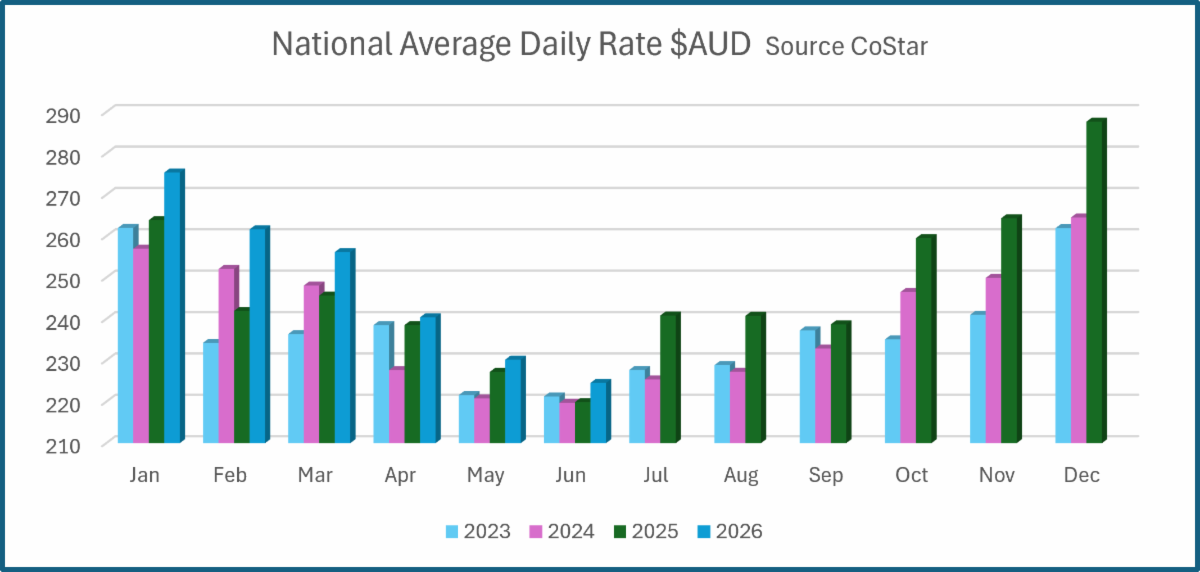
CoStar data for June 2026 shows hotel performance improved across Australia, with higher occupancy and room rates supporting stronger revenue growth. Most states recorded gains, particularly Tasmania, Victoria, and South Australia, while Western Australia and the Northern Territory were the only markets to experience notable declines in occupancy.
- National average occupancy was up 1.1% to 67.9% for June, ADR slightly up 2% to $224.57 resulting in a RevPAR increase of 3.2%. Across the first six months, occupancy was up 0.9% and ADR up 3.7%.
- NSW experienced an average occupancy of 68.9%, up 0.6% compared with June last year, with ADR up 2.9% to $233.57. In the first six months, occupancy was up 1.2% and ADR up 4.9%.
- Victoria's occupancy rose 3.8% to 64.5%, and ADR stayed consistent at $195.81. Year to Date (YTD) occupancy was up 0.7% and ADR up 1.4%.
- Queensland occupancy rose by 0.8% to 68.2%, and ADR rose by 3.8% to $243.40. YTD occupancy rose 0.9% and ADR up 3.4%.
- SA occupancy up 3.5% to 66.9% for June, and ADR up 3% to $188.80. YTD occupancy was up 2.5% and ADR up 6.2%.
- WA occupancy down 3.2% to 72.4%, and ADR down 0.9% to $235.64. YTD occupancy was up 0.1% and ADR up 4.7%.
- Tasmanian occupancy up 4.5% to 65.9%, and ADR up 4.1% to $209.70. YTD occupancy down 0.2% and ADR up 6.6%.
- NT occupancy down 6.2% to 64.4% but ADR up 3.4% to $262.89. YTD Occupancy down 2.6% but ADR up 2.2%.
- ACT & Canberra occupancy up 3.6% to 70% and ADR also up 0.2% to $188.78. YTD occupancy up 0.2% and ADR down 0.4%.
Preliminary capital city CoStar data for the month to July the 18th highlights differing market conditions across Australia's capital cities, with some destinations recording stronger occupancy and average daily rates while others experienced softer trading conditions:
- Sydney saw a 0.6% decline in occupancy to 79.5%, while ADR increased 1.3% to $247.70.
- Melbourne occupancy rose 0.8% to 73.8% and ADR fell 0.9% to $196.80.
- Brisbane occupancy remained steady at 80%, while ADR declined 4.9% to $257.73.
- Adelaide occupancy fell 1.9% to 74% and ADR fell 7.1% to $187.53.
- Perth occupancy fell 3.9% to 77.4% but ADR was up 2.7% to $231.67.
- Hobart occupancy rose 4.7% to 78.4% and ADR increased 6.1% to $190.79.
- Darwin occupancy fell 3.6% to 81% but ADR rose 10% to $291.73.
- ACT and Canberra occupancy increased 1.8% to 84.4% but ADR down 5.6% to $191.99.
- Gold Coast occupancy was down 1.4% to 75.1% and ADR up 8.5% to $317.62.
The graphs below derived from the CoStar data show the monthly average performance of occupancy and ADR across Australia since January 2023.
| | |
Economy hotels hit hardest in last three months
A deep dive into CoStar data for the last twelve months has confirmed that the impact of the disruption to tourism has been most keenly felt by economy and midscale properties in the last three months. Overall, across all hotel types, in 2025-26 average occupancy was 73.6% with an ADR of $251.89, an improvement of 2.3% and 4.9% respectively compared to 2024-25. For the six months to June 2026, average occupancy was 71.7% and ADR $248.41, and for the 3 months to June, this had fallen further to 69.3% which was 0.2% lower than for the corresponding period in 2025. ADR did not keep pace with inflation, only rising 1.4% in the three months to June compared to 2025, with the economy hotels' ADR declining by 0.6%. Economy, midscale and upper midscale hotels all saw declines in average occupancy when comparing the last 3 months with the corresponding period in 2025, with luxury hotels faring the best with a 1.9% improvement in average occupancy.
| |
Overseas arrivals for May 2026
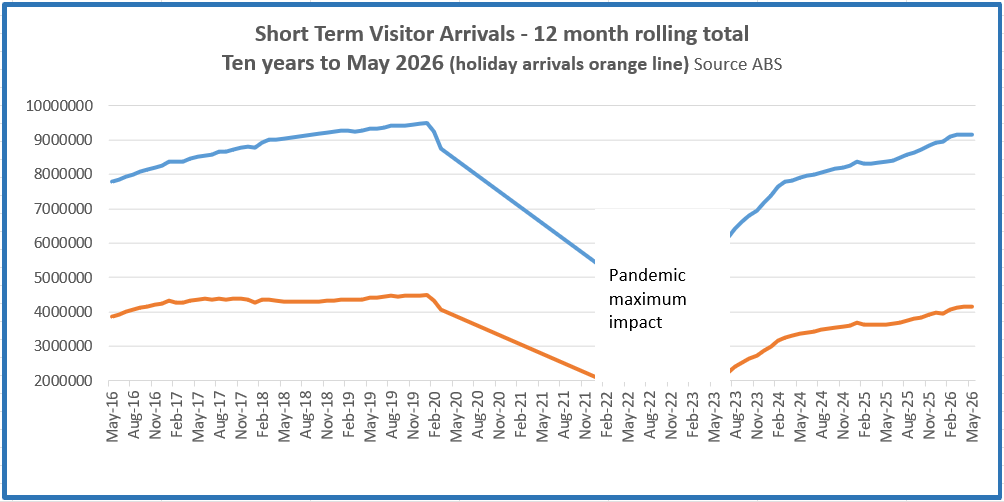
Reflecting the travel difficulties created by the middle east crisis and consequent global economic conditions, according to ABS data released last week, short-term visitor arrivals in Australia decreased by 0.4% in May 2026 to 609,040 compared with May 2025. This is the lowest monthly total since June 2024. However, holiday arrivals rose by 6.7% to 277,540, suggesting that leisure travel held its own to partially offset weakness in other visitor categories. New Zealand remained the largest source market, contributing 111,120 visitors, followed by China with 69,940 and Singapore with 48,510. Among the top ten source countries, only Singapore, Japan, South Korea and the Philippines recorded arrival volumes above their May 2019 levels.
The 12-month rolling total provides a clearer picture of underlying trends by smoothing monthly fluctuations and highlighting both the recent recovery and the remaining gap to pre-COVID visitation levels, particularly among holidaymakers. In the 12 months to May 2026, total arrivals reached 9,158,720, an increase of 9.5% compared with the year to May 2025. Holiday arrivals totalled 4,160,840, up 14.8% over the same period. For context, annual holiday arrivals peaked at 4.48 million in the year to December 2019, indicating that while the sector continues to recover, it has not yet fully returned to pre-pandemic levels.
| | |
Debit and credit card changes:
Prepare for 1 October 2026
American Express, together with other payment providers, has confirmed it will implement the Reserve Bank of Australia's recommendations on merchant card payment costs and surcharging, including the removal of card surcharges from 1 October 2026.
As accommodation businesses prepare for these changes, American Express has outlined the support and resources available to help merchants navigate the transition while continuing to engage its Card Members, who represent a significant segment of Australia's travel and accommodation market. For more information, click here.
| | |
| | |
3 things for you to do today to support the industry's jobs and careers platform eeger.com.au:
- Register on eeger to build your employer profile
-
Follow eeger on LinkedIn to stay in touch
- List your job vacancies on the site that has been developed for industry by industry
| | | | |
Drop me an email at policy@accommodationaustralia.org or give me a call on 0418 277 919 if you have any national policy issue that you think AA should be following up. If you know an AA member who is not receiving this advocacy report but wants to, then encourage them to email me and we can add them to the distribution list. Back issues of the fortnightly advocacy updates can be found here.
Kind Regards
Jenny Lambert OAM
National Policy Director
Accommodation Australia
| | | | |