| | |
POLICY & ADVOCACY UPDATE
Issue #65, 26 February 2026
| | | |
- From the AA CEO James Goodwin
- Continuing to address the Chef shortage
- Improving the chance of migrant sponsorship applications
- RBA briefing - things to watch
- Hotel performance in January 2026
- Hostplus focus on superannuation for women
| |
| |
From the AA CEO
The AA National Board held it’s first meeting of the year last week and it struck me the enormous amount of policy and advocacy work we’ve done collectively in only the first two months of the year. Jenny has important updates and insights below, particularly on visas and migration. Member insights and data are vital to our advocacy success so thank you.
| | | |
|
The Board meeting had a guest presentation from our corporate partner AMEX, sharing insights on consumer spending trends and we discussed what broader economic conditions will mean for the accommodation and tourism sectors. There is a positivity amongst members, but challenges remain - exchange rates, rising inflation and finding the right workforce to meet demand.
Politically, things are starting to settle into a more normal rhythm with the new Coalition leadership in place. Parliament resumes next week and we have a range of engagements including with the Prime Minister and Skills Minister where we will be making the case for the support or sector needs.
James Goodwin
Chief Executive Officer
| | | | |
Continuing to address the chef shortage
Members may recall that last August, AA put together a consultation paper exploring options on how we could address the current crisis in the shortage of chefs. We are grateful to the many members who participated in the consultation including sharing thoughtful contributions via email. The core document has now been updated and the possible solutions needing to be explored expanded to reflect ideas contributed by members. This updated document and a summary of the consultations can be found here. Key solutions are centred around apprenticeship incentives, a restructuring of the apprenticeship qualification itself, migration, innovative training approaches and most dominantly in all the consultations, the importance of promoting chef as a career.
AA will now be taking these suggestions forward both in its advocacy to governments and working through issues with industry stakeholders. At our encouragement, the industry's Jobs and Skills Council SaCSA has set up an alliance of industry stakeholders to address the crisis and to coordinate advocacy. We will keep members updated on progress. It is a long-term problem which is not easily fixed so we will need to stay focused on how vital it is to address it as skilled cooks and chefs are at the heart of almost every hospitality business.
| | | |
Improving the chance of migrant sponsorship applications
In response to a significant increase in concerns raised by members of migrant sponsorship applications taking a long time to process and more concerningly being refused for reasons that do not reflect our understanding of migration policy and the law, the AHA and AA have had extensive engagement over the last month with the Department of Home Affairs (DHA) which processes the applications,. It has been recognised in those meetings that it is in the interests of both AHA/AA members and the Department of Home Affairs (DHA) that we help the DHA delegates making the decisions become more aware of the needs of the hospitality industry as well as identify common shortcomings in applications from the industry, which if addressed can help speed up the process and minimise the number of rejections and appeals. We also discussed the importance of educating not just members but migration agents.
As a first step, the department shared with us some of the more prevalent shortcomings in the applications from our accommodation and food service industry and these are covered below. Please note that from DHA point of view, our industry includes the restaurant sector, which is largely small business so some of the issues will have less relevance to us. Please share the list with your migration agents.
- in order to be successful, the sponsor must demonstrate that the position is genuine and that it fills a legitimate gap in the business's workforce. This is to address the integrity problem of some businesses sponsoring someone who is seeking to migrate here but not genuinely going to work in the business. To address this, DHA recommends that an organisational chart be included in the sponsor's application so the delegate can understand where the role fits into the business.
- the application needs to clearly set out which entity is the employer, and should not be made in the trading name, if the employing entity is different. Often there are complex trust structures in place, and it takes the delegate a long time to understand the corporate arrangements. Sponsors should expect that DHA will go to the business's website and other sources and the information in the application should be relatable to the information obtained elsewhere. The clearer it is the quicker the delegate can process the application and also the least likely to raise suspicions.
- When there are multiple trading names, or multiple sites operated by the employer, the application should state clearly at which location the migrant is going to be working.
- Position descriptions need to be clear and directly relevant to the list of duties in ANZSCO published by the ABS which relate to the specific occupation that the migrant is going to be employed as. Although the ABS has upgraded to a new occupational classification system called OSCA, the DHA delegate is still using the duties listed in ANZSCO. All of this is available on the ABS website. The occupation being sponsored needs to be one included on the Core Skills Occupation List, including Chef, Cook, Hotel or Motel manager. As has been covered in past advocacy updates, restaurant manager is currently not on the CSOL.
- Employment contracts between the employer and the visa applicant need to be clear, current and signed. DHA report this is a common error.
- If employers include photos of the workplace they need to be relevant to the role being performed.
- Applications require financial documents such as BAS statements to demonstrate the scope and legitimacy of the employer's business. These need to be as current as possible, and if there is a long delay in the processing of the application, sponsors are encouraged to upload updated financial statements.
- Visa applicants require police clearance certificates from their origin country. These can take a while in some countries so the applicant is encouraged to apply for them in a timely way.
- Visa applicants also require evidence of work experience, and often this evidence is insufficient. Letter of employment are often not sufficient and should where possible be backed up by copies of pay slips or other evidence.
- Proposed salary - this is a major issue in the application. The closer the proposed salary is to the Core Skills Income Threshold (CSIT - previously known as the TSMIT) the closer the delegate will look at whether the salary is the market rate for that role. The sponsor application should make it clear that similar roles in their organisation or within their region are being paid similar salaries to what is proposed for the migrant. In most of the cook and chef roles, particularly those below Chef de Partie, the award rate plus the 25% for salaried roles in not sufficient to be above the CSIT. Members need to provide evidence that similar roles are being paid above the award in order to meet labour market demand. It is critically important to understand that promising to pay someone above the CSIT is not sufficient - the market rate for the role also needs to be above the CSIT, and the application needs to include evidence of that.
Importantly, this list is not exhaustive and addressing these issues does not guarantee application success. Also, this exchange of information with DHA is only the first step. DHA have expressed a strong and welcome desire to work with AHA/AA to improve the two-way understanding. A more complete list of issues and an updated checklist suitable for our industry is going to be developed and when completed we will share it with members. We also both recognise the critical role of migration agents some of which are clearly better than others. We would be keen to hear from members with any concerns they have about particular agents or just as importantly any agents who demonstrate a clear understanding of the hotel industry and generally are successful in having applications approved.
| | |
RBA Briefing - things to watch
AA last week attended an economic briefing by the Reserve Banik which served to reinforce key factors that our industry should watch out for. Of course, top of that list is what interest rates will do and in that regard the RBA did nothing to disabuse the notion that there will be a couple more interest rate increases in the coming months in order to keep inflation in check. This will impact domestic discretionary spending which could well negatively impact domestic tourism. A rise in interest rates also results in an improvement in the exchange rate, where we have seen a significant change over the last 12 months. At the current exchange rate of close to 71 cents US to each Aussie dollar, the rate is edging towards the highest rate it has been since 71.5 cents in February 2023 and is over 18% higher than less than a year ago in April 2025 when it was only 59.8 cents. Higher interest rates attract foreign investment dollars which in turn increases the exchange rate, and although the next two increases are likely to be largely factored into the current exchange rate, we should not ignore the possibility of international tourism being impacted by the increased costs of travelling here.
At the briefing it was also clear that the RBA, in commenting on the current political focus on migration, were looking at it largely through a population and housing lens. AA took the opportunity to highlight the potential negative economic impact on industries such as our should any steps be taken to significantly cut either the temporary or permanent migration numbers.
| | |
Hotel performance in January
CoStar data (previously referred to as STR) for January 2026 shows that hotel performance remained relatively strong for most States and Territories compared to January last year with South Australia and the ACT the best improvers in occupancy, while Tasmania saw the best improvement in ADR.
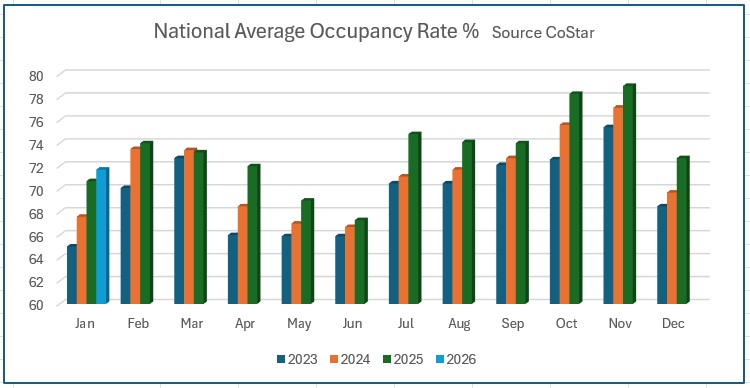
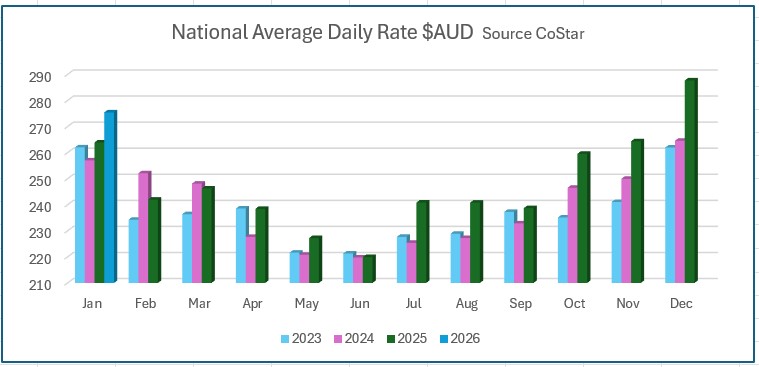
- National average occupancy was up 1.2% to 71.7% for January, ADR up 4.4% to $275.41 resulting in a decent rise in RevPAR of 5.7%;
- NSW experienced an average occupancy of 75.5%, up 1.7% compared with last year, with ADR up 5.1% to $294.05;
- Victoria's occupancy rose 3.2% to 74.5%, and ADR also up 4.9% to $262.52;
- Queensland occupancy fell 2.6% to 67.2%, but ADR rose by 3.2% to $300.78;
- SA started the year with the same positive momentum they finished in 2025 with occupancy up 5.7% to 71.7% for January and ADR up 5.1% to $220.24;
-
WA occupancy up 1.6% to 75.0% and ADR up 6.4% to $271.07;
- Tasmanian occupancy up 1.4% to 76.9% and ADR up 7.5% to $257.63;
-
NT occupancy was down 2.7% to 34.1% and ADR marginally down 0.8% to $166.88; and
-
ACT & Canberra occupancy up 4.3% to 64.4% and ADR flat at $184.81.
Preliminary capital city CoStar data for the month to February 21st shows that hotel occupancy improved against the same period last year in most cities, with Adelaide doing particularly well.
- Sydney experienced a 2.8% improvement in occupancy to 88.2%, and ADR rose strongly by 12.6% to $339.19.
- Melbourne's occupancy rose by 4.1% to 79.6% and ADR rose 3% to $225.97,
- Brisbane occupancy fell by 1.6% to 76.7%, but ADR was up strongly by 15.9% to $272.59;
- Adelaide occupancy up by 6.4% to 81.6% and ADR strongly up 12.5% to $243.92;
- Perth occupancy up 3.3% to 86.2% and ADR up 11.0% to $262.05;
- Hobart occupancy up 4.9% to 92.2% and ADR up 5.3% to $259.44;
- Darwin occupancy marginally rose 0.2% to 42.5% and ADR rose 2.4% to $149.29;
- Canberra occupancy marginally rose 0.2% to 74.8% but ADR down 5.2% to $187.71; and
- Gold Coast occupancy down 1.9% to 66.4% but ADR up 7.2% to $261.40.
The graphs below derived from the CoStar data show the monthly average performance of occupancy and ADR across Australia since January 2023. The continued upward trend in national occupancy over the past four years is clearly illustrated in the January figures for the last four years.
| |
Hostplus focus on super for women
As part of International Women’s Day 2026, Hostplus is hosting a free educational webinar designed to help women close the super gap and feel more confident about their superannuation and retirement outcomes.
Recent research highlights just how significant the confidence gap is for women approaching retirement: only 41% of Australian women feel financially prepared, compared with 59% of men.
| | | |
To support this, Hostplus is offering two live webinar sessions on 3 and 4 March, leading into International Women’s Day on 8 March.
For more information and to register click here.
| |
| | |
3 things for you to do today to support the industry's jobs and careers platform eeger.com.au:
- Register on eeger to build your employer profile
-
Follow eeger on LinkedIn to stay in touch
- List your job vacancies on the site that has been developed for industry by industry
| | | | |
Drop me an email at policy@accommodationaustralia.org or give me a call on 0418 277 919 if you have any national policy issue that you think AA should be following up. If you know an AA member who is not receiving this advocacy report but wants to, then encourage them to email me and we can add them to the distribution list. Back issues of the fortnightly advocacy updates can be found here.
Kind Regards
Jenny Lambert OAM
National Policy Director
Accommodation Australia
| | | | |