| | |
POLICY & ADVOCACY UPDATE
Issue #67, 26 March 2026
| | | |
- From the AA CEO James Goodwin
- Industry skill shortages highlighted to government
- Industry migrant demand remains high
- ACCC alerts the industry to merchant charge case
- Hotel performance in February
- Overseas arrivals for January 2026
- Tourism expenditure and visitor nights growing
- Tourism jobs growth outpaces economy average
| |
| |
From the AA CEO
As the conflict in the Middle East continues, the focus has moved to domestic fuel supply and what it means for international and domestic travel. The approaching Easter and school holidays will be the first real measure of how the conflict and associated fuel costs, airfares and travel certainty are affecting the Australian accommodation sector.
| | | |
|
There are some signals of softening in demand in hotel occupancy but the capital cities are still maintaining relatively good occupancy given the situation. However, we know that most people will have booked accommodation many weeks or months in advance.
The AA has held briefings with a range of government, tourism and aviation stakeholders including fuel representatives and Qantas. We are being told that fuel supply – aviation and road vehicle – is assured for the medium term but there are definite supply chain challenges with a near 400% increase in fuel being sold as people panic buy.
Our current priorities to government are that we need to maintain travel certainty and confidence through guaranteed fuel supply. Encourage new or increased international aviation routes and carriers through transit hubs that avoid the middle east and promote and encourage domestic tourism through the Australian autumn/winter.
But we also need to be bold, and Australia should leverage any opportunities to host business, sporting or cultural events that can no longer take place elsewhere.
Let’s hope for a good Easter period and thanks for the calm response across the sector in these challenging times.
James Goodwin
Chief Executive Officer
| | | | |
Industry Skill Shortages highlighted to government
Last week, AA provided input to Jobs & Skills Australia to identify occupations experiencing shortages. As reported previously in Advocacy Update, JSA last year downgraded chefs in Australia from national shortage to regional shortage on their Occupational Skill Shortage List. The list informs government decisions on training funding as well as migration, so the higher the rating the more likely will be access to funding and migration. AA in its submission reiterated the severe shortage for senior chefs, chefs and cooks and urged JSA to rate them as in national shortage. We also made the case for shortages to be identified for hotel manager, restaurant manager and hospitality supervisors.
As a continuation of our engagement with JSA, we are meeting with them next week to discuss concerns about employment data as well as the inconsistency in their employment forecasts for the accommodation sector.
| | | |
Industry migrant demand remains high
Migration data for the six months to December 2025 indicate that industry demand for key occupations remains high. Across all industries, there were 34,366 primary temporary skilled visas granted which is just over half of the 68,197 that were granted in 2024/25. The relativity was similar for chefs, where in the six months to December 2025, 3,279 visas were granted, compared to 6,362 for the full year 2024/25. Of these, 1,586 were from Nepal and 1,239 from India in 2024/25 and 856 and 826 respectively in the six months to December 2025. Another major source country was the Philippines with 633 and 264 respectively. In the six months to December, 711 visas were granted to cooks, compared with 1,555 for 2024/25. 132 hotel manager visas were granted, compared with 267 for 2024/25. Only 383 restaurant manager visas were granted in the six months, and these would all have been finalised under the old TSS visa as they are not currently eligible for temporary skilled sponsorship. To illustrate the grown in demand for skilled migrants, by way of comparison, in 2023/24 only 2,279 chefs were sponsored, and 670 cooks.
In relation to another important source of labour for our industry, as at 31 January 2026, there were a record number of 236,188 working holiday makers in Australia. This compares to 206,187 WHM that were in country at the end of December 2024 and just over 170,000 a year earlier. There are also over 386,000 people on bridging visas which is just short of the historic high of 405,150 in September 2025.
| | |
ACCC alerts the industry to merchant charge case
Last week the Australian Consumer and Competition Commission (ACCC) wrote to the AA CEO stating that on 13 March 2026, the it had announced that it had finalised an investigation into an accommodation hotel in Sydney regarding alleged excessive card payment surcharges. The letter highlighted that the ACCC has undertaken an education and compliance campaign to inform businesses of their card payment surcharging and price display obligations and help them to comply with the relevant laws. The ACCC has also been actively monitoring business compliance with card payment surcharging laws and has investigated several businesses for alleged excessive payment surcharging.
In this case, the ACCC was concerned that the hotel was charging card payment surcharges for debit cards at a rate above its costs of accepting those debit cards. This was particularly the case where consumers used contactless methods of payment. All hotels in that group have now implemented technological and policy changes to ensure debit and credit cards are treated differently, regardless of how a card interacts with a payment terminal.
Following this outcome, the ACCC is reminding businesses in the accommodation sector to ensure they are complying with card payment surcharging laws. While it recognised that the Reserve Bank of Australia (RBA) has recommended the removal of card payment surcharges in its review to date of merchant card payment costs and surcharging, until any final policy decisions (currently scheduled for next week) have been made and implemented, the existing laws in relation to card payment surcharges continue to apply.
In particular, when considering compliance with the existing laws, the ACCC encourages accommodation providers to ensure that:
-
staff members and payment systems are able to distinguish between different card types, including where payment is made via mobile wallet.
-
staff members have sufficient training and guidance available to ensure they are aware of the legal requirements around card payment surcharging.
-
card payment surcharges for applicable card types are clearly disclosed in writing through customer-facing notifications as good practice, or at least verbally to customers at the point of sale.
- they review their costs of acceptance to ensure that any card payment surcharge they are applying for any card payment type is not higher than the cost of acceptance for that card type.
| | |
Hotel performance in February
CoStar data for February 2026 shows that hotel performance remained positive for most States and Territories compared to February last year with South Australia and Western Australia the best improvers in occupancy, and SA and NSW experiencing the best improvement in ADR.
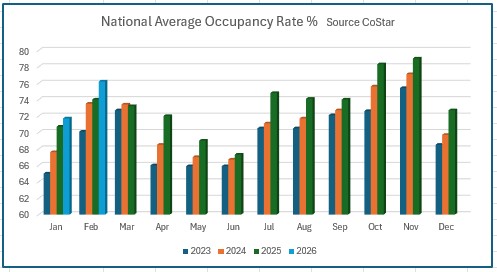
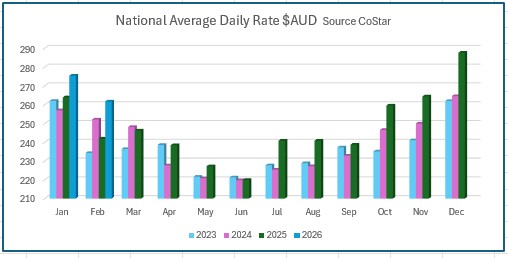
- National average occupancy was up 3.0% to 76.2% for February, ADR up 8.5% to $261.66 resulting in a strong rise in RevPAR of 11.7%. In the first two months of 2026, occupancy rose 2.0% and ADR up 6.2%
- NSW experienced an average occupancy of 82.3%, up 3.1% compared with last year, with ADR up 5.1% to $294.05. In the first two months, occupancy was up 2.4% and ADR up 8.2%
- Victoria's occupancy rose 4.1% to 78.1%, and ADR also up 4.3% to $226.16; For the first two months, occupancy was up 3.5% and ADR up 4.5%.
- Queensland occupancy rose marginally by 0.5% 2 to 67.0%, but ADR rose by 3.2% to $249.62. For the first two months occupancy fell1.2% but ADR rose 4.8%.
- SA has continued its positive momentum with occupancy up 7.8% to 78.9% for February and ADR strongly up 11.6% to $238.74. For first two months occupancy was up 6.7% and ADR up 8.4%.
-
WA occupancy up 4.5% to 83.3% and ADR solidly up 10.3% to $258.61. For first two months, occupancy was up 3,0% and ADR up 8.2%.
- Tasmanian occupancy up 1.5% to 88.2% and ADR up 8.1% to $260.66. For first two months, occupancy up 1.8% and ADR up 8.7%.
-
NT occupancy slightly up 0.6% to 43.9% and ADR marginally up 0.8% to $165.18. Occupancy down 0.9% for first two months and ADR flat.
-
ACT & Canberra occupancy down 1.3% to 74.0% and ADR also down 4.8% to $190. 25. For first two months occupancy up 1.4% but ADR down 2.5%.
Preliminary capital city CoStar data for the month to March 21st shows that hotel occupancy has held up so far in face of the worsening geopolitical and fuel crisis, although forward bookings are starting to show some softness.
- Sydney experienced a 1.0% improvement in occupancy to 86.3%, and ADR rose by 6.8% to $310.99.
- Melbourne's occupancy slightly fell by 0.7% to 80.2%but ADR rose 5.5% to $287.56,
- Brisbane occupancy rose 9.3% to 74.9% (noting impact of cyclone the previous year, and ADR up slightly by 0.8% to $237.74;
- Adelaide occupancy up by 1.6% to 83.2% and ADR up 7.9% to $238.81;
- Perth occupancy up 5.6% to 86.3% and ADR up 9.7% to $260.22;
- Hobart occupancy was slightly down 0.8% to 88.4% but ADR strongly up 11.7% to $262.21, with ADR close to or above $300 in the last three days ie. 19th to 21st of March;
- Darwin occupancy rose 4.2% to 49.7% and ADR rose 3.4% to $152.71;
- Canberra occupancy marginally rose 7.9% to 76.8% and ADR up 5.5% to $181.92; and
- Gold Coast occupancy up 17.9% (noting last year Cyclone Alfred) to 62.8% and ADR up 11.9% to $256.92.
The graphs below derived from the CoStar data show the monthly average performance of occupancy and ADR across Australia since January 2023. The continued upward trend in national occupancy over the past four years is clearly illustrated in the January figures for the last four years.
| |
Overseas arrivals for January 2026
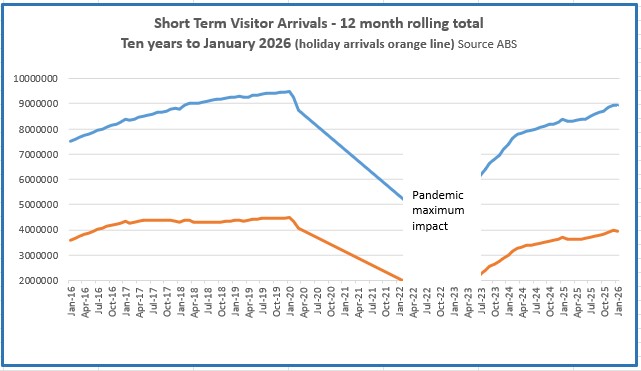
According to the ABS data released last week, there was only a 0.9% in short-term visitor arrivals in November 2025 to 716,680 compared to January 2025, and 50,000 less than the last of the pre-COVID months of January 2020. Holiday arrivals were even more disappointing, down 8.4% compared with January 2025, which compares unfavourably with the 11% to 28% increases seen in the six months to December 2025. New Zealand was the largest source country for overall short-term arrivals in January 2026, accounting for 102,470 or 14% followed by the UK (79,470 thanks to the Ashes series) and then China coming in third with 78,400 visitors. Of the top ten origin countries, New Zealand, the UK, USA, India, South Korea, Canada and Indonesia all had arrivals greater than January 2019.
The 12-month rolling total arrivals tell a more useful story, illustrating the recent improvement as well as the difference with pre-COVID visitors, particularly for holidaymakers. In the 12 months to January 2026, there were 8,944,030 arrivals up by 6.8% on the year to January 2025, with holiday arrivals at 3,947,350, up 6.9% on the previous year. Holiday arrivals historically peaked at 4.48 million in the year to December 2019. Given the geopolitical and resulting fuel uncertainty, it is hard to predict what will happen to holiday arrivals in the remaining months of this financial year. The graph below shows rolling 12-month totals for total short-term arrivals and holiday arrivals.
| | |
Tourism expenditure and visitor nights growing
The latest international visitor survey (IVS) data was released by Tourism Research Australia showed that in the year to December 2025 international visitors spent $39.2 billion in Australia, up 19% on the previous year. The number of trips increased by 8% to 8.3 million and nights increased by 6% to 312 million. Importantly, holiday trips rose 11% to 3.6 million trips and spend by holidaymakers rose 18% to $12.9 billion. The good news for the accommodation sector is that commercial hotels, motels and resorts are continuing to increase their share of international visitor nights, with a record number of 28.1 million holiday visitor nights and 47.9 million total visitor nights spent in hotels in the 12 months to December 2025. A full break down of international visitor nights will be included in the next advocacy update.
TRA also released the domestic expenditure information but comparisons remain limited due to the transition from the survey to a more holistic use of data. For the December quarter 2025, overnight spend was $27.3 billion by domestic overnight travellers, down 3%. The number of overnight trips was similar to December quarter 2024, but the number of nights was up 1% to 96.2 million. of those nights, 26.9 million were spent in a hotel, compared to 7.2 million in a rented unit and 10.9 million at a commercial camping or caravan park. The biggest share remains with staying in a friend or relative's property at 32.8 million. This reflects that 36 million to total domestic visitor nights relate to people who stated that VFR was their main purpose in travel, compared to 45 million for a holiday.
| | |
Tourism jobs growth outpaces economy average
ABS data released last week showed that in the December quarter 2025 there were 736,800 tourism jobs which was 2.9% more than the September quarter and 4.7% more jobs than December 2024. This compares with jobs growth across all industries of 1.3% over the year. The outstanding contributor to jobs growth over the year was the accommodation sector, which saw a 19.3% increase in tourism jobs to 135,100. Most tourism related sectors saw an increase in tourism jobs, with the exception of the retail and casino/gambling services sectors. Importantly overall tourism jobs growth was higher for full time (up 4.8% compared with part time (up 4.6%). Although there are more female related tourism jobs overall, in the year to December the number of male jobs rose 6.7% compared with female 3%.
| |
| | |
3 things for you to do today to support the industry's jobs and careers platform eeger.com.au:
- Register on eeger to build your employer profile
-
Follow eeger on LinkedIn to stay in touch
- List your job vacancies on the site that has been developed for industry by industry
| | | | |
Drop me an email at policy@accommodationaustralia.org or give me a call on 0418 277 919 if you have any national policy issue that you think AA should be following up. If you know an AA member who is not receiving this advocacy report but wants to, then encourage them to email me and we can add them to the distribution list. Back issues of the fortnightly advocacy updates can be found here.
Kind Regards
Jenny Lambert OAM
National Policy Director
Accommodation Australia
| | | | |