| | |
POLICY & ADVOCACY UPDATE
Issue #70, 7 May 2026
| | | |
- From the AA CEO James Goodwin on the AA Board meeting this week
- International visitor forward bookings soften
- Tourism Ministers meet to discuss current situation
- Call for a national app for fuel pricing and availability
- Submitting 'decision ready' visa sponsorship applications
- Capital city hotel performance for April
- Well attended AHICE a great success
- Overseas visitorsl key driver of growth in services exports in 2025
| |
| |
From the AA CEO
The impact of the Middle East Conflict on travel and the accommodation sector was top of the agenda when the national board of Accommodation Australia met in Adelaide this week.
The Board received an important update from AA partner CoStar STR on the latest occupancy and forward booking data and it’s clear consumers have less confidence to travel but the numbers are resilient despite the headwinds.
| | | |
|
The Board agreed that we need all governments to work with operators to continue to promote Australia to new and existing international markets and maintaining clear messaging and improved fuel price and availability information will go a long way to improve consumer confidence and get people back out on the road.
To that end we recently partnered with Tourism and Transport Forum and the Caravan Industry Association to draw attention to the issue (see story below).
The Board noted that workforce pressures remain, emphasising the importance of the AA managed ‘eeger’ platform which now has close to 16,000 registered job seekers. The sector relies on migration, and the Board also received an update on the political context and measures to improve visa processing.
The board meeting was held in Adelaide to coincide with the AHICE Conference, and it was great to see so many people and hear important discussions about the state of the industry. A media release relating to the board meeting can be found here.
James Goodwin
Chief Executive Officer
| | | | |
International visitor forward bookings soften
The latest Inbound Tourism Pulse and forward sentiment surveys from the Australian Tourism Export Council (ATEC) reveal that while inquiry levels remain strong across key markets including the US, China, India and Southeast Asia, 64% of tourism exporters now expect demand to soften from July onwards. Media last week reported comments from ATEC CEO Peter Shelley that although the survey results do not indicate a collapse in demand and people still want to come to Australia. However, they are taking longer to commit and are more sensitive to price and the middle east situation. The data shows traveller hesitation is the single biggest emerging risk, cited by 56% of operators, while broader global pressures are also weighing on sentiment. Cost-of-living pressures in key markets (35%), reduced confidence in international travel (19%) and challenges converting demand (16%) were all identified as major concerns heading into the peak season. At the same time, fuel uncertainty and aviation costs are adding further pressure, with 65% of operators reporting concerns around future fuel supply and pricing, and flight costs continuing to impact Australia’s competitiveness. Industry respondents identified aviation pricing, government support and sustained international marketing as the most important levers to support recovery. ATEC commented that sustained investment in international marketing, including Tourism Australia, more important than ever.
| | |
Tourism Ministers meet to discuss current situation
Last week federal and state tourism ministers met to discuss the impact of the current and emerging crisis arising from the middle east situation. Key takeouts were:
-
Ministers discussed the conflict in the Middle East and that the impact on global fuel security remained dynamic and evolving
-
Australia’s fuel supply remained stable
-
Ministers agreed on the importance of visitors having confidence in fuel supply and the confidence to travel, including interstate.
-
Ministers noted current public information on national fuel availability, and advocated for improvement on what information is available and how it is presented to provide confidence to domestic travellers. The Fuel Supply Taskforce asked to explore ways to increase awareness of current fuel information
-
Tourism Ministers noted an update from Tourism Australia. Ministers noted that consumer sentiment varied significantly between markets, but that perceptions of Australia’s safety and security were holding up well.
-
Ministers recognised the importance of the tourism industry to the Australian economy. They agreed to continue collaborating to address challenges and maximise opportunities.
Last week AA, along with other industry representatives, attended a digital pre-meeting organised by officials from the Federal Office of the Visitor Economy (within Austrade). It is clear that there are growing concerns from regional and remote tourism operators as traveller confidence declines due to cost and availability of liquid fuels and some cuts to domestic aviation routes. Most cities are also down but appear to be managing the downturn.
In addition, AA also last week attended a digital roundtable with the shadow tourism ministers and Leader of the Nationals Matt Canavan. There was a lot of emotion on the call from regional and remote operators with many declaring the situation a “crisis”. The Opposition issued a media statement to coincide with the Tourism Minister’s meeting, calling for more support for the sector.
| | |
Call for a national app for fuel pricing and availability
In an effort to promote confidence to travel, particularly amongst the “road tripper” market, AA supported a call from Tourism and Transport Forum and the Caravan Industry Association to improve cross border consumer information about fuel availability. The organisations called for the immediate establishment of a working group made up of the states, territories and industry players in the tourism and automobile sectors to deliver this outcome urgently. AA CEO James Goodwin said Australia’s current fuel information landscape is difficult to navigate, particularly for those travelling across state borders. "We would like to see a single, nationwide platform that makes it as easy as possible for people to get out on the road and explore our great regional areas. The tourism industry remains a critical national asset, but this is particularly so for regional Australia, where road travel is a key driver of visitation and economic activity”. Media Release can be seen here.
| | |
Submitting 'decision ready' visa sponsorship applications
Members are invited to attend an online information session on submitting decision ready employer nominations and visa applications. This webinar is targeted to Australian business employers with the aim to improve the quality of employer nominations and visa applications. The session will include practical guidelines to help employers prepare and submit complete applications.
The webinar sessions are open nationally and will be held on:
Tuesday 19 and Thursday 21 May at the following time:
11:00 -12:00 (ACT, NSW, TAS, QLD, VIC)
10:30 - 11:30 (NT, SA)
09:00 - 10:00 (WA)
Monday 25 and Wednesday 27 May at the following time:
14:00 -15:00 (ACT, NSW, TAS, QLD, VIC)
13:30 - 14:30 (NT, SA)
12:00 - 13:00 (WA)
Please register your interest to attend through this link.
| | |
Capital city hotel performance for April
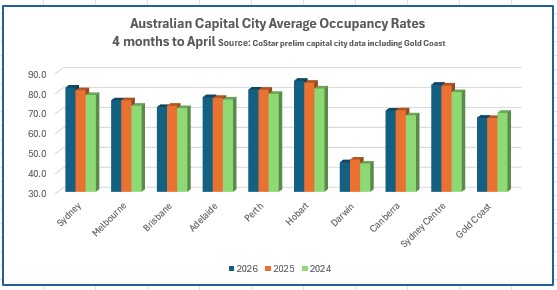
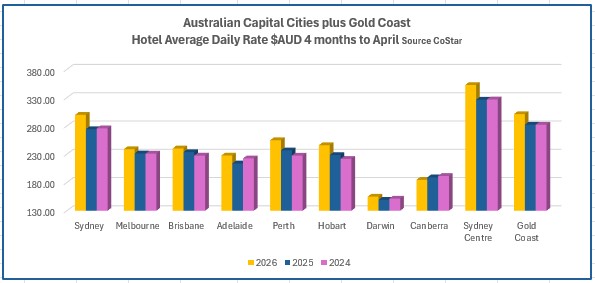
Preliminary capital city CoStar data for the month April 2026 continues the trend of mixed experiences in the face of the geopolitical and fuel crisis with Darwin, Canberra and Adelaide the cit6ies hardest hit. For April compared to April 2025:
- Sydney experienced a 1.1% rise in occupancy to 78.0%, and ADR marginally rose by 0.1% to $256.83. City centre occupancy experience was similar up 1.7% and ADR up 0.1%.
- Melbourne's occupancy fell by 3.0% to 69.5% and ADR fell 2.8% to $199.18,
- Brisbane occupancy marginally rose 0.1% to 72.7% and ADR up by 2.5% to $236.71;
- Adelaide occupancy down by 5.4% to 73.5% but ADR up 4.7% to $242.81;
- Perth occupancy down 4.1% to 76.2% but ADR up 2.5% to $243.01;
- Hobart occupancy was down 3.6% to 77.7% but ADR up 4.0% to $241.50,
- Darwin occupancy fell by 10.1% to 52.6% but ADR rose 5.2% to $169.02;
- Canberra occupancy down 8.5% to 65.2% and ADR down 7.1% to $172.94; and
- Gold Coast occupancy down 3.6% to 65.7% but ADR up 5.6% to $301.81.
NSW regional information covering the month to April 25th illustrates the even stronger regional impact, with Blue Mountains occupancy down over 20%, Hunter Valley down 9% and Newcastle down 7.1%. Wollongong and Central Coast fared better down 4.9% and 2.1% respectively. Information supplied by members in the NT indicates that forward bookings for the usually dominant dry season are down by as much as 40% due to uncertainty about availability and price of petrol.
| | |
Well attended AHICE a great success
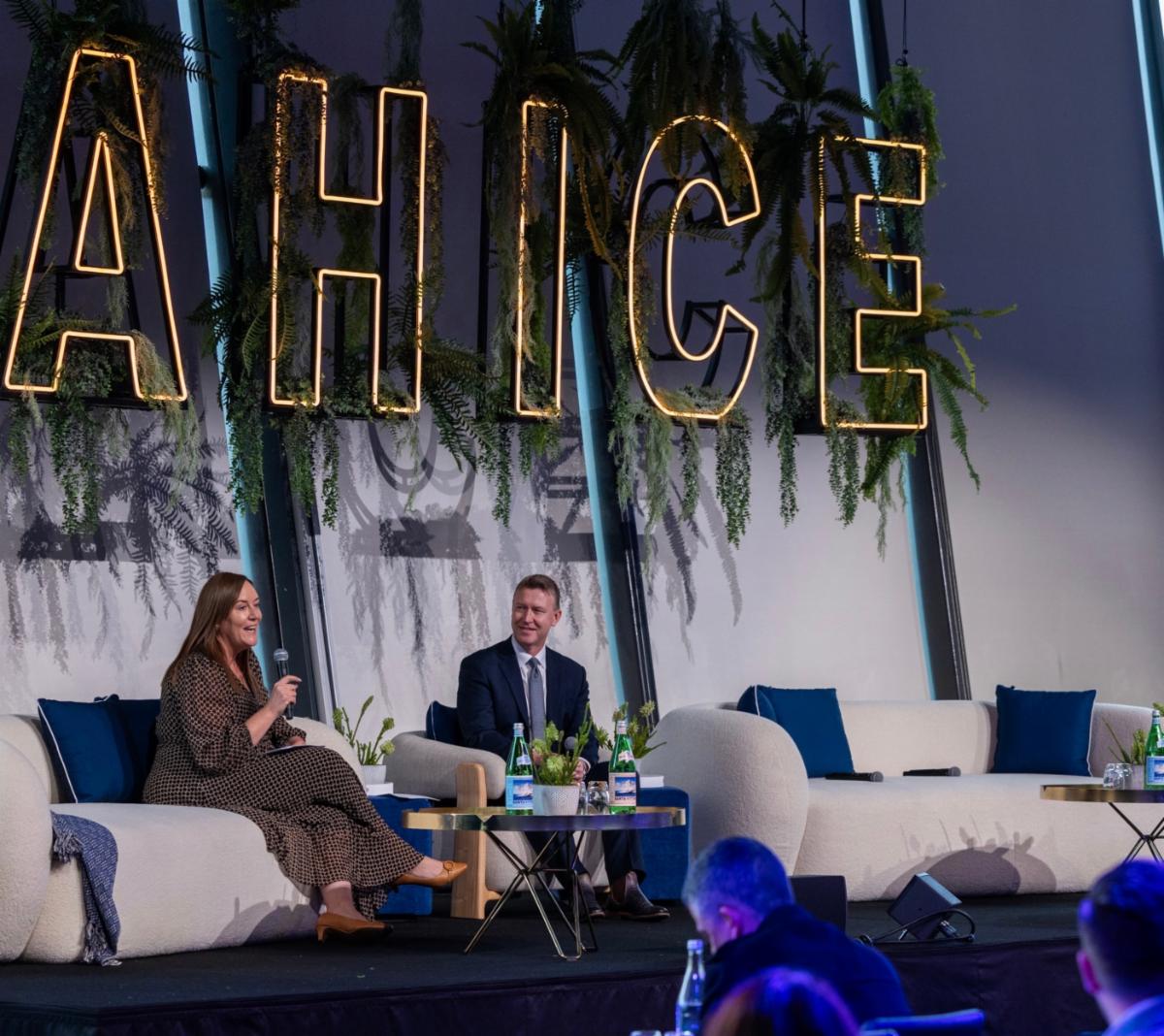
AHICE Asia Pacific, currently happening in Adelaide this week, is strongly attended by owners, managers and other sector stakeholders. Attendees heard about the mixed impact of the current situation on bookings and also on hotel investment. South Australian Premier, Peter Malinauskas, made a spirited presentation yesterday on the opportunities for his state and the potential presented by mining and defence industries. He also acknowledged the important role of the hotel sector not just in leisure tourism but in accommodating the growing business interest in the State and emphasised his commitment to facilitating more hotel investment. AA CEO James Goodwin (pictured on the AHICE stage speaking with Emma Hynes AA Vice Chair and Director of Operations at IHG) discussed the key issues affecting the industry and the role AA is playing in regularly briefing the government on the current situation as well as addressing the main constraints on the industry.
| | |
Overseas visitors key driver of growth in services exports in 2025
In a trade summary for 2025 released by the ABS last week, the value of international tourism was specifically called out as a key driver of the improvement in Australia's trade position. For 2025, Australia's balance on goods and services was a surplus of $6.9 billion. Travel service exports (inbound tourism) rose by 9.2% to $86 billion. Imports of travel services (outbound tourism) rose 6.7% to $74 billion. China accounted for $18 billion of this total, followed by India, Nepal and the UK. This mix of key exports is an indication of the influence of international education on the travel services exports as educated related travel exports accounted for $55 billion in the total. Indonesia (14% of the total and likely to be mostly trips to Bali), New Zealand and Japan are the top three countries for the import of travel services.
| |
| | |
3 things for you to do today to support the industry's jobs and careers platform eeger.com.au:
- Register on eeger to build your employer profile
-
Follow eeger on LinkedIn to stay in touch
- List your job vacancies on the site that has been developed for industry by industry
| | | | |
Drop me an email at policy@accommodationaustralia.org or give me a call on 0418 277 919 if you have any national policy issue that you think AA should be following up. If you know an AA member who is not receiving this advocacy report but wants to, then encourage them to email me and we can add them to the distribution list. Back issues of the fortnightly advocacy updates can be found here.
Kind Regards
Jenny Lambert OAM
National Policy Director
Accommodation Australia
| | | | |