| | |
POLICY & ADVOCACY UPDATE
Issue #68, 9 April 2026
| | | |
- From the AA CEO James Goodwin
- Card surcharges to be abolished
- Junior wage rate decision
- Capital city hotel performance in March
- Accommodation share of international visitor nights
- Real picture of accommodation sector employment
| |
| |
From the AA CEO
Firstly, a big thank you to all of you who worked over the Easter weekend. Too often we can forget to acknowledge those working over this period, giving up their time so that others can enjoy a break or time with family. So, thank you.
The Easter period was certainly one of the first real tests of the impact of the middle east conflict on consumer confidence to travel. Fewer international tourists, high fuel costs and lack of availability for guests and staff all remain causes for concern and despite some indications of talks to end the conflict, all signals suggest the disruptions to fuel supplies are here for weeks or months to come.
| | | |
|
Last week the Prime Minister made a rare address to the nation to try to ease community concerns and I was at the National Press Club in Canberra with Anthony Albanese on Thursday as he repeated his message that people, if they can, should continue to travel and holiday. The message might have been later than we hoped, and still not as clear as we might have hoped, but it was encouraging that he was thinking about our sector and the broader tourism and hospitality industries when he spoke. To this end I’ve been briefing the Tourism Minister Don Farell and Assistant Minister Nita Green and their department every few days.
We are seeing mixed reports on how successful Prime Minister Albanese’s message to the public and the start of the school holidays have been. Across the country – regional areas and capital cities – you ask different properties and we hear different messages on pace of bookings, cancellations and occupancy. The full data is still coming in but it is clear that Easter 2026 will be a lot worse than last year. The pressure has been stark on locations relying on road-trippers but capital cities are also down. We need to work together to continue to talk up our sector where we can to promote affordable and sensible travel but we must also be honest with government on the pressures the conflict and the disruption to fuel supplies are having on demand and the cost of doing business.
James Goodwin
Chief Executive Officer
| | | | |
Card surcharges to be abolished
Last week, the RBA released a conclusions paper which set out decisions relating to the review of merchant card payment costs and surcharging. The conclusions were that a package of reforms that include removing surcharging, reducing interchange fees and increasing transparency would be in the public interest and promote competition and efficiency in the payments system. The statement further said "that the surcharging framework, introduced more than two decades ago, is no longer achieving its intended purpose of steering consumers towards making more efficient payment choices. The increased prevalence of businesses surcharging all cards at the same rate, challenges with enforcing the current surcharging framework, and consumers using less cash have reduced the effectiveness of the surcharging regime. Removing surcharging would make card payments simpler, more transparent and increase competition among payment service providers. Removing surcharging also aligns with the preference of most consumers for payment costs to be incorporated into advertised prices." Most of these changes will come into effect on 1 October 2026, including the removal of surcharging and reductions in the interchange caps for domestic card transactions. The introduction of an interchange cap on foreign cards and some changes to payment cost transparency will come into effect later, on 1 April 2027, to ensure the payments industry has sufficient time to implement these more complex changes.
This decision was a disappointment to the hotel industry where we mounted a strong and consistent argument that the focus should be on the costs through the system, and that credit card surcharge should remain given the extensive use of loyalty schemes. Implementation of the decision will directly hit every accommodation hotel's bottom line and exacerbates already complex financial arrangements with OTA's. In a media release, AHA CEO Stephen Ferguson said the big winners out of the new RBA rules will be foreign-owned company providers like Visa, Mastercard and the big banks. “The RBA’s decision today doesn’t pass the pub test - instead of backing consumers and small businesses, the RBA has backed the banks, Visa, Mastercard and payments companies. the full media release can be seen here.
| | | |
Junior wage rates decision
The Fair Work Commission last week handed down its decision on the SDA’s application to abolish junior rates for 18-20 year olds and to vary the rates for employees aged 17 and under. The Full Bench agreed with the abolition junior rates for over 18 yos except for their first six months of employment. For junior employees aged under 18, the Full Bench noted various distinguishing factors including restrictions on child employment, availability constraints, legal constraints, and accepted that the work value of minors was less. The Full Bench considered that those factors, and the risks to them if they failed to participate in either employment, education or training, outweighed considerations in favour of variation, and retained the current arrangement of a gradual increase in rates from age 15 (or under) to adulthood at age 18. The abolition of the junior rates for over 18 year olds will be phased in over three years so that by 1 July 2029 an 18 year old under one of the three awards affected will be on the full adult rate. This decision does not automatically flow through to the hospitality awards, but it will set an important precedent. In its decision the Full Bench made it clear that any further decisions will be on an award-by-award basis based on evidence.
| | |
Capital city hotel performance in March
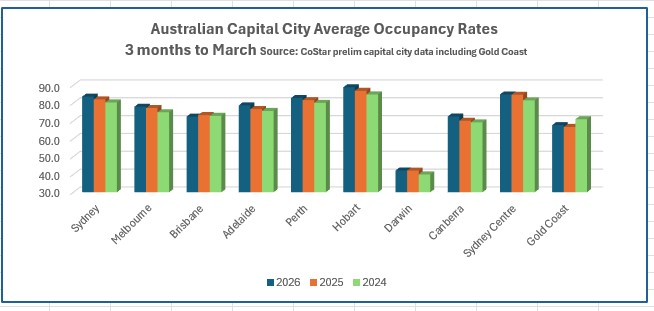
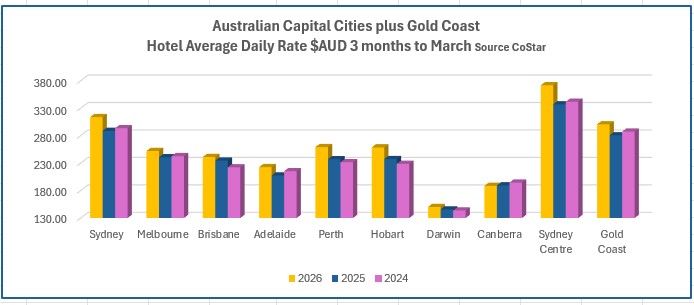
Preliminary capital city CoStar data for March shows that although there have been some mixed experiences, hotel occupancy continues to hold up reasonably well in most cities in the face of the worsening geopolitical and fuel crisis.
- Sydney experienced a 1.1% improvement in occupancy to 84.9%, and ADR rose by 5.8% to $304.3 although the city centre occupancy was slightly down 0.2%.
- Melbourne's occupancy fell by 3.5% to 80.2% but ADR rose 2.2% to $287.56,
- Brisbane occupancy rose 3.9% to 74.4% and ADR up slightly by 0.1% to $239.58;
- Adelaide occupancy down by 1.8% to 83.2% but ADR up 5.9% to $227.94;
- Perth occupancy up 3.1% to 85.6% and ADR up 8.7% to $260.30;
- Hobart occupancy was down 1.7% to 86.1% but ADR strongly up 11.3% to $255.52,
- Darwin occupancy fell slightly by 0.1% to 49.3% and ADR rose 3.7% to $152.81;
- Canberra occupancy rose 8.2% to 76.7% and ADR up 5.4% to $196.41; and
- Gold Coast occupancy up 9.1% (noting last year Cyclone Alfred) to 61.4% and ADR up 10.2% to $257.33.
Very early data for the beginning of the Easter weekend shows mixed results. In Sydney, occupancy for Good Friday and Easter Saturday were in the 79-84% range compared with 87-92% last year. For Melbourne, occupancy for the equivalent nights were 71-77% this year compared with 81-84% last year. In contrast regions around Sydney appeared to do well, with occupancies over 90% in the Wollongong and Blue Mountains regions and in the mid 80s for Newcastle and the Hunter regions.
The graphs below show the average occupancy rate and ADR experienced in the capital cities in the first three months for each of the last three years.
| |
Accommodation share of international visitor nights
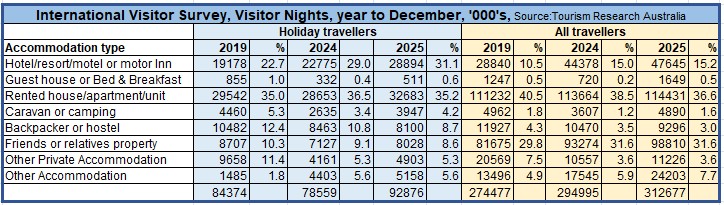
In the last issues of Advocacy Update we published the headline results of the international visitor survey for the year to December 2025. Importantly, even though the number of international holiday visitors has not returned as yet to previous levels, the number of visitor nights is now at record levels of 92.9 million for the year to December 2025. The table below provides a more detailed picture of where our international visitors are spending their nights. It is pleasing to note that the share of nights spent in a hotel, motel or resort continues to increase both for the holiday traveller and overall, such that in the year to December 2025, over 31% of all nights are spent in our sector. The rise in the share of holiday visitor nights for hotels comes largely at the expense of caravan parks, hostels and other private accommodation.
| | |
Real picture of accommodation sector employment
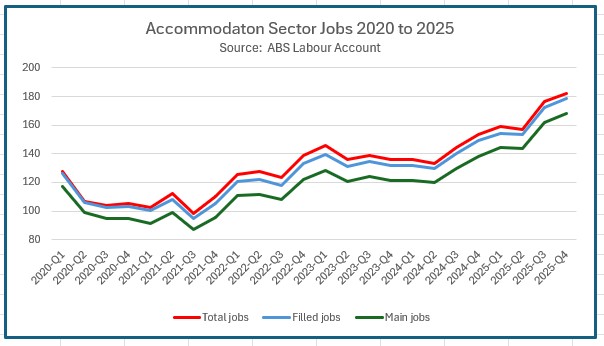
Accommodation Australia, along with representatives from SaCSA (Skills Council) and other tourism stakeholders, met with the ABS and Jobs & Skills Australia (JSA) last week to express our concern about the inconsistencies and inexplicable movements in employment data for tourism related sectors. We particularly focused on the monthly labour force data (that informs the unemployment rate) as well as JSA's employment projections. AA provided examples of the February 26 labour force data which indicated that accommodation employment was only 97,000 compared to 117,000 in February 2025. This 20,000 drop in employment numbers is not in any way reflective of the industry on the ground where occupancy rates and turnover have risen compared to the previous year. It was relatively more striking for the club sector which, according to the Labour Force data, last year had 38,000 employment compared to February 26 at 68,000. The ABS admitted that due to the sampling, the Labour Force data was not suitable for reliably providing industry sector jobs data and recommended that the Labour Account was better as it used data from businesses where the industry sector is attached to the business name. The graph below illustrates the different picture that the labour account provides for our sector. In December 2025, there were 168,000 people employed in their main job in accommodation, up from 161,500 the previous quarter and 138.000 in December 2024. When you include people working in our sector for their second or third job, as well as job vacancies as well as filled jobs, the number rises to 182,000 as at December 2025.
| |
| | |
3 things for you to do today to support the industry's jobs and careers platform eeger.com.au:
- Register on eeger to build your employer profile
-
Follow eeger on LinkedIn to stay in touch
- List your job vacancies on the site that has been developed for industry by industry
| | | | |
Drop me an email at policy@accommodationaustralia.org or give me a call on 0418 277 919 if you have any national policy issue that you think AA should be following up. If you know an AA member who is not receiving this advocacy report but wants to, then encourage them to email me and we can add them to the distribution list. Back issues of the fortnightly advocacy updates can be found here.
Kind Regards
Jenny Lambert OAM
National Policy Director
Accommodation Australia
| | | | |