Pediatric COVID-19 infections increase as kids head back to school
Child COVID-19 cases increased 14% over two weeks prior,
a new report shows.
|
|
ABC News (Sept. 6, 2022) - As children head back to the classroom for the academic year, new data shows that pediatric COVID-19 infection rates have increased for the second consecutive week.
Last week, more than 90,600 additional child COVID-19 cases were reported, an increase of 14% from two weeks prior, when just under 80,000 cases were reported, according to a new report from the American Academy of Pediatrics (AAP) and the Children's Hospital Association (CHA).
The increase comes despite an overall plateauing of COVID-19 infections nationally.
Overall, totals remain significantly lower than during other parts of the pandemic. Since mid-May, data shows that new cases have plateaued, fluctuating between a high of about 68,000 to 112,000 cases.
However, many Americans who are taking at-home tests are not submitting their results, and thus, experts say daily case totals are likely significantly higher than the numbers that are officially reported.
More than 14.5 million children have tested positive for the virus since the onset of the pandemic, and since the beginning of 2022, approximately 6.65 million reported cases have been added. Children represent about a fifth of all reported cases on record.
Despite the uptick in infections, with COVID-19 vaccine mandates in schools still virtually nonexistent, millions of children remain completely unvaccinated.
Overall, about 43.1 million eligible children remain completely unvaccinated, according to federal data.
Most of the nearly 30 million children who have received at least one shot are older children. The vast majority of the youngest Americans under the age of 5 -- or just 1 million out of the 19.5 million children in that age group -- have yet to receive a COVID-19 shot, according to federal data.
AAP and CHA said there is an "urgent" need to collect more age-specific data to assess the severity of illness related to new variants, as well as potential longer-term effects.
"It is important to recognize there are immediate effects of the pandemic on children's health, but importantly, we need to identify and address the long-lasting impacts on the physical, mental and social well-being of this generation of children and youth," the organizations wrote.
|
|
Better air in classrooms matters beyond COVID. Here's why schools aren't there yet |
|
Open windows and portable air cleaners can help improve ventilation, but many schools in the U.S. are more than 45 years old and need a complete overhaul of their HVAC systems.
Michael Loccisano/Getty Images
|
|
by Maria Godoy
Senior Editor/Correspondent, NPR Science Desk
Originally published March 14, 2022
|
|
September 6, 2022 - Not many people can say the pandemic has made their jobs easier. But in some ways, Tracy Enger can.
"You know, it is such a hallelujah moment, absolutely," says Enger, who works at the Environmental Protection Agency's Indoor Environments Division. For more than 25 years, she's been fighting to improve the air quality inside of America's schools.
But there are lots of competing demands for limited school budgets. And in the past, getting school districts to prioritize indoor air quality hasn't been easy. Often, she says, it took some kind of crisis to get schools to focus on the issue – "when they found the mold problem, when their asthma rates were kind of going through the roof."
Then came the COVID-19 pandemic — spread by virus particles that can build up in indoor air and linger, sometimes for hours. Key to clearing out those infectious particles: good ventilation and filtration. For example, one study of Georgia schools linked improved ventilation strategies, combined with HEPA filtration, to a 48% lower rate of COVID.
"It matters more to people right now," says Heming. "COVID is this immediate threat that has made air quality immediately relevant."
That's why she and other indoor air-quality experts say the Biden administration's new National COVID-19 Preparedness Plan is a step in the right direction: It specifically highlights the need to help schools upgrade their ventilation systems for the long term, using funding from the American Rescue Plan Act.
Heming says in the past, it's been hard to make a health case for improving air quality in schools, because the health impacts tend to be longer term. But a whole body of research shows the health and academic benefits are substantial — and go beyond COVID. When a room is better ventilated, influenza rates, asthma attacks and absenteeism go down, reading and math test scores go up. Less carbon dioxide builds up in a room, which helps students think more clearly.
"It's well documented across all different countries and all different ages," says Joseph Allen, director of the Healthy Buildings program at Harvard University. "We see benefits in kindergarteners, we see benefits in high school, we see benefits in college students and middle schoolers — every age group."
Allen says understanding these long-term benefits of upgrading ventilation is vital, "because an investment right now is not just a short-term investment for COVID. If a school does this right, they can expect not only years, but decades of benefits to health beyond reductions in infectious disease transmission."
And experts say those investments are desperately needed, because most U.S. schools are poorly ventilated to begin with. The average American school is over 45 years old, and many have HVAC systems that are outdated or need repairs, according to a 2020 report from the Government Accountability Office. Some schools are so old, they don't even have mechanical ventilation systems.
"I don't think a lot of people recognize that the design standards [that govern ventilation rates in schools and other buildings] are bare minimums. They were never actually set for health," says Allen.
Carl Thurnau knows all too well just how bad deferred school maintenance can get. Several years ago, a classroom ceiling actually collapsed at a school in the City School District of New Rochelle, N.Y. That's when the district recruited Thurnau, an engineer, to become its director of facilities to oversee a $106 million overhaul of buildings — a process that was already funded and in motion when COVID struck. That money meant the school district could quickly pivot to implement ventilation upgrades in response to COVID.
Having funding in place "is why we were able to get ahead of this — and in my opinion, stay ahead," Thurnau says. But "there's no doubt that districts with less financial resources are struggling to find the money to solve some of these problems."
Ventilation and green building experts have been offering schools guidance on how to improve their air quality to reduce COVID risk since the early days of the pandemic, even before the Centers for Disease Control and Prevention acknowledged the virus could spread through the air. Broadly speaking, Allen says, the advice boils down to three major things: increasing the amount of outdoor air in a classroom; using higher-efficiency MERV filters in HVAC systems; and supplementing these measures with portable air cleaners with HEPA filters.
But two years in, it's unclear how many schools have actually made these changes. That information isn't tracked at the federal level, though some reports hint at the challenges schools have faced. What's clear, says Allen, is that while a lot of schools have taken steps to improve ventilation, many others haven't. "Some haven't done the basic measures, the stopgap measures," Allen says.
Heming says schools have been able to tap federal funds for ventilation upgrades since late December 2020, and the American Rescue Plan Act, passed in March 2021, made a lot more money — $122 billion — available to schools for this and other pandemic-related purposes.
So why have many schools been slow to act when it comes to indoor air quality? Last year, the Center for Green Schools published a survey of more than 47 school districts representing 2.5 million students in 24 states. The vast majority of them said they prefer to invest in long-term solutions rooted in revamping or replacing their HVAC systems.
But with so many old and outdated school buildings, Heming says "these strategies that schools need to use require that they do pretty major renovations."
That kind of work takes many months to plan and contract. In many cases, she says, those plans are only being firmed up now. And a recent survey found many school districts are worried that they won't be able to complete the work by a September 2024 deadline under the law, especially because of supply chain issues and labor and material shortages.
Stopgap measures like opening windows or using portable air cleaners really do work to improve indoor air quality, Heming says, but they can only take schools so far. For example, open windows aren't realistic when outdoor temperatures are freezing, she says, and in humid regions, they can pull in more humidity, promoting the growth of mold.
|
|
And while many school districts have invested in stand-alone portable air cleaners, they come with their own headaches, says Heming: The units can be disruptively noisy and they need to be stored and maintained over time.
In general, she says, the school districts that were able to move quickest to improve their air ventilation and filtration in response to the pandemic were those that already had money available to upgrade their facilities, and in many cases, they'd already assessed their buildings and knew which ones needed work.
But there are some encouraging signs that more schools may be catching up soon. An analysis released in February by FutureEd, a think tank at Georgetown University, found that school districts already had plans in place to spend about $4.4 billion on HVAC updates, and if trends continue, that could reach nearly $10 billion. Another FutureEd analysis found that high-poverty districts are more likely to plan to use federal funds to upgrade aging ventilation systems.
The EPA's Enger says interest in the agency's guidance on indoor air quality for school has skyrocketed over the last year. "What we are seeing is this moment turning into a movement for improving indoor air quality in schools and creating healthier learning spaces," she says.
Heming says she's also optimistic, but her enthusiasm is tempered. She notes that the $122 billion of American Rescue Plan funds designated for schools has to pay for a host of pandemic-related needs — from hiring more staff to summer school programs — not just ventilation upgrades.
Even if every last dime of the American Rescue Plan funds for schools were spent on facilities, "it's still a big gap between that and what's actually needed," Heming says. A 2021 report found that each year, districts spend $85 billion less than what's needed to get schools into good condition.
------
Maria Godoy is a senior science and health editor and correspondent with NPR News. Her reporting can be heard across NPR's news shows and podcasts. She is also one of the hosts of NPR's Life Kit.
|
|
Most Districts Have Spent at Least Half Their Federal COVID Aid. What This Means for K-12 Companies |
|
School districts around the country are making progress when it comes to spending emergency federal funding.
That’s the takeaway from a recent survey conducted by the EdWeek Research Center that examines how much districts have spent from the massive amount of emergency aid injected into the K-12 education system to mitigate financial pain caused by the pandemic.
A nationally representative survey conducted between late June and mid-July found the vast majority of districts have already plowed through at least half of their federal relief funds — and, in many cases, a substantial portion more.
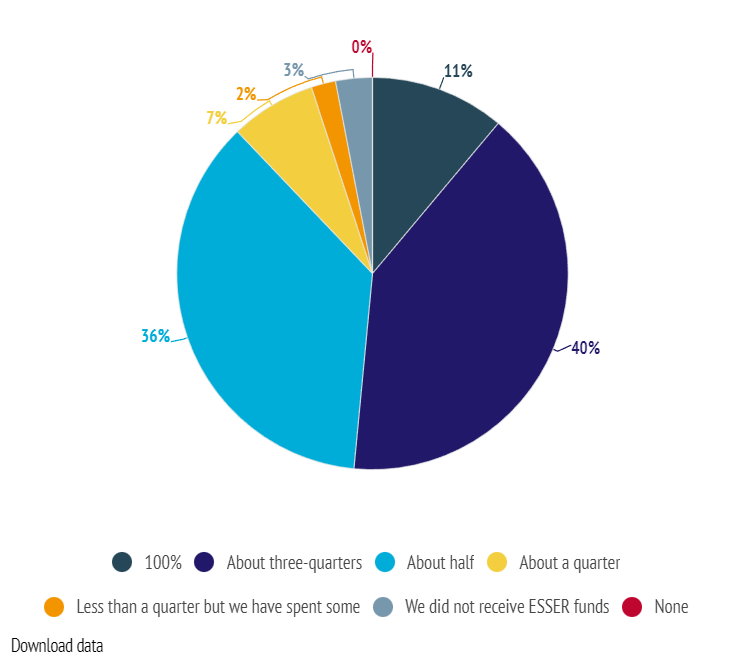
Of the 535 district leaders and principals who responded to the survey, 40 percent said they have spent three-quarters of their federal stimulus dollars. Another 36 percent said they’ve spent about half of their emergency funds.
And a small slice of districts — 11 percent — said they have exhausted their allotment of relief money. Data from the survey first appeared in Education Week.
District Spending Relying Heavily on Emergency Aid
The survey findings are of particular importance for education companies, given that district purchasing has largely revolved around the emergency federal funding since the start of the pandemic — and will continue to do so at least for the next couple of years.
Over the last two years, districts have received roughly $190 billion of stimulus funds from three separate relief measures. The largest chunk, about $123 billion Congress approved last March through the American Rescue Plan, has to be spent by September of 2024.
So far, the funding has supported everything from student mental health to educational technology to massive tutoring initiatives for struggling learners. It has also paid for COVID-mitigation measures such as personal protective equipment, cleaning supplies, new construction, and upgraded ventilation systems.
Flush with cash, school systems have been criticized for not spending those dollars quickly enough.
Reg Leichty, a founder and partner of Foresight Law + Policy, a law firm with clients that include K-12 school systems, said districts are moving in the right direction, taking careful steps to identify areas to spend that money.
“Clearly, a lot of decisions have been made leading up to this school year about how to best use those funds,” he said.
The pace of spending has been a lingering question for districts.
An EdWeek Market Brief survey from last year of 280 district administrators asked when they planned to spend the money from the two most recent stimulus measures. That includes a $54 billion infusion for schools approved by President Trump in December 2020, known as ESSER II, and $122 billion of relief funds signed into law by President Biden in March 2021 known as the American Rescue Plan.
That survey found 52 percent of districts planned to spend most of their share of ESSER II money by the end of 2021-22 academic/fiscal year.
But districts’ timeline for spending money through the American Rescue Plan was slower.
A substantial portion of K-12 officials surveyed — 32 percent — said they didn’t anticipate spending the majority of the money they received until the 2022-23 academic/fiscal year. Thirteen percent predicted spending it during 2023-24 or later.
|
|
Majority of Districts Have Gone Through
at Least Half of Their Stimulus Funding
QUESTION: How much of your Elementary and Secondary School Emergency Relief (ESSER) funds have you spent?
|
|
SOURCE: EdWeek Research Center nationally representative June/July survey of 535 district administrators. |
|
What Will Happen When the Federal Funds Run Out
Another looming issue for districts: how to use those federal emergency relief funds now without leaving their school systems scrambling in two years to find funding for positions and programs created with one-time pandemic-era funding.
School finance experts have warned of an impending funding cliff once the stimulus dollars run out.
Some districts are using those relief funds in a way that commits their school system to spend money beyond the next two years, and that means future cuts are likely unless new money can be found to cover those costs.
Leichty, the K-12 consultant, said while many districts have not invested the one-time money into new staff and programs that will incur recurring costs moving forward, some clearly have. And those districts “are going to be in a position to need to find more funding” once the federal money dries up, he said.
See also:
------
|
|
‘When We Fight, We Win’ — A Clarion Call For Fair Redistricting in Mississippi |
|
By Khalil Abdullah, Ethnic Media Services |
|
August 16, 2022 - Community leaders in Mississippi are pressing their case for fair political representation at county and local levels. The efforts are aimed at the state’s redistricting process, which remains in the hands of a GOP-dominated legislature advocates say marginalizes voters of color.
While the challenges remain formidable, many say there is a growing groundswell of engagement with implications for the rest of the nation.
“Republican legislators who are responsible for proposing redistricting maps for the full legislature’s adoption… met three times in public for a total of 45 minutes,” noted Voting Special Counsel Amir Badat with the NAACP Legal Defense Fund.
“They convened the committee, appointed its members, adopted criteria, and adopted maps,” Badat continued. “Almost all of the work that went into producing these maps happened behind closed doors, without the involvement of Mississippi’s Black legislators.”
“And as you might predict, the maps that came out of this process were very unfair and not representative of the state as a whole.”
Badat joined other redistricting rights advocates in a media briefing on how communities in Mississippi — birthplace of the Civil Rights Movement and home to the largest percentage of African Americans in the country — are working to drive more representation upward from the grassroots level. The briefing was hosted by Ethnic Media Services.
Redistricting happens after each decennial census and is used to determine congressional and state legislative districts. According to Badat, the ramifications of Mississippi’s redistricting fight aren’t limited to that state alone.
“Mississippi has historically been almost a predictor of what happens in other parts of the country,” he said, pointing to the Mississippi Plan of the late 1800s, when white supremacists embarked on a campaign of “intimidation, violence, and a plan that used legal tactics to try to suppress the Black vote and Black civic participation during Reconstruction.”
“We’re seeing the same things happening today,” Badat said. “We need to be paying attention to Mississippi.”
|
|
Voting Special Counsel Amir Badat with the NAACP Legal Defense Fund on why the fight
for representation in Mississippi matters for the rest of the country.
|
|
Drawing on the legacy of the Civil Rights Movement
Nsombi Lambright-Haynes, executive director of One Voice, a statewide leadership development and policy advocacy organization, agreed with Badat, referencing the legacy of the Civil Rights Movement as an organizing principle in galvanizing local efforts.
“A lot of our work is grounded in organizing done during the Mississippi Civil Rights Movement being based in civic engagement and understanding that voting rights is at the core of any sort of social justice work in Mississippi,” she said, adding there is now a “growing infrastructure of civil rights and social justice organizations” across diverse communities in the state.
One of those organizations is Boat People SOS, representing Asian Americans in Mississippi of whom Vietnamese are the largest group. Daniel Le, the organization’s director, said it was a public works project in Biloxi that really impressed on the community the need to be more politically engaged.
“There was no way to get around,” said Le, describing how the city began tearing up sections of roadway without any outreach to area residents. “So people, you know, were having a hard time getting from one point to another.” Le said the elderly were affected and that torn up roadways caused significant damage to vehicles.
“We as a community got together and went to the city and basically voiced our complaint,” Le said. “Unfortunately, the city just turned away, you know, never really responded to our needs or our concerns.”
Le said the experience increased his sense of urgency and that he has since initiated programs to begin developing leaders who understand the political process from within his community. “We have to have someone in the community to step up and be that voice.”
Pastor Jose Rodriguez of One Voice shared a similar experience from within Mississippi’s growing Latino community, where two years ago ICE raids on poultry plants led to the detention of hundreds of immigrant workers.
“It was terrible devastation for the families, a separation also between the kids and the parents and husbands and wives,” Rodriguez said. “How can you explain to somebody, when they are five, six years old, your parents, they are in an immigration detention center? They don’t know.”
Rodriguez, who has spent the past two years focusing on Covid outreach to Latinos in the state, said that is when he became engaged. “I started to open my eyes and see; we really don’t have representation here in Mississippi.”
|
|
Nsombi Lambright-Haynes, executive director of One Voice, on the fight for fair maps
for Harrison County school district.
|
|
An uphill climb for fairer representation
None of the panelists described the path forward as easy.
Monica McKinnis of One Voice recalled how after the 2010 census an increase in the African American population in her own city of Clinton, outside Jackson, led to increased civic engagement as residents became more aware of the need to master their political environs. But that was before the gutting of the Voting Rights Act, she noted.
“We have had some small victories,” McKinnis said, acknowledging the difficulties of securing fairer representation in the face of proponents of gerrymandering — whereby districts are drawn to favor one party over another — are continually elected to the legislature.
“But those small victories will become big victories over the next 10 years,” she continued. “I know that a lot of people focus on the congressional and state level, but I think that the most important part of redistricting is on the local level.”
Badat agreed.
“When you think about your school board, when you think about your city council, those are the entities that are making decisions that will impact your child’s education, whether or not the pothole on your road is fixed, or whether or not the garbage is being picked up on time,” he said.
“And those are the policies and the issues that really, really have a huge impact on people’s lives. And a lot of people don’t know that those entities are also subject to redistricting.”
|
|
Khalil Abdullah
Khalil Abdullah is Contributing Editor for Ethnic Media Services. He joined New America Media as its first Director in the Washington D.C. office. He has also served as the Lead Facilitator and Editor of the Beat Within, Washington D.C. edition, and Managing Editor of the Washington Afro-American Newspaper.
|
|
50 Years of Financing Moments that Frame Freedom |
|
The Monkeypox Outbreak:
What School Leaders Need to Know
|
|
August 5, 2022 - Though federal health officials have declared monkeypox a public health emergency, there’s no cause for panic among school and district leaders, epidemiologists told Education Week Friday.
The COVID-19 pandemic may have primed public expectations about such an emergency declaration, but the monkeypox outbreak remains smaller and—unlike COVID-19—unlikely to be spread through brief incidental contact or interactions, experts said.
Just five of the 7,000 confirmed cases of monkeypox in the United States were children, according to the latest data from the Centers for Disease Control and Prevention.
While there are likely to be additional pediatric cases as the country works to contain the outbreak, school leaders should be informed, not alarmed, said Wafaa El-Sadr, professor of epidemiology and medicine at Columbia University.
“It’s really important to distinguish that this is not COVID-19. I would allay that anxiety,” El-Sadr said. “Obviously, there is always a concern when there is an outbreak of any infectious disease, but at the same time, there is no cause for panic.”
Here’s what school leaders need to know about monkeypox and about the emergency declaration.
What is monkeypox? Can children get it?
Monkeypox is a rare disease that was first documented in humans in 1970 and has caused occasional outbreaks since, according to the CDC. Symptoms include a blister-like rash that lasts for two to four weeks, fatigue, fever, aches, nasal congestion, and cough. The virus is rarely fatal, the agency said in guidance to physicians.
The virus is spread primarily through direct, person-to-person contact or through contact with items like towels and bed linens that have touched an infected person’s rash, the CDC says.
Children who are at higher risk of severe illness include those 8-years-old and younger, children with compromised immune systems, and those with skin conditions like eczema or severe acne. Health officials expect they will identify additional cases in children as testing becomes more widely available.
Though federal health officials have declared monkeypox a public health emergency, there’s no cause for panic among school and district leaders, epidemiologists told Education Week Friday.
The COVID-19 pandemic may have primed public expectations about such an emergency declaration, but the monkeypox outbreak remains smaller and—unlike COVID-19—unlikely to be spread through brief incidental contact or interactions, experts said.
Just five of the 7,000 confirmed cases of monkeypox in the United States were children, according to the latest data from the Centers for Disease Control and Prevention.
While there are likely to be additional pediatric cases as the country works to contain the outbreak, school leaders should be informed, not alarmed, said Wafaa El-Sadr, professor of epidemiology and medicine at Columbia University.
“It’s really important to distinguish that this is not COVID-19. I would allay that anxiety,” El-Sadr said. “Obviously, there is always a concern when there is an outbreak of any infectious disease, but at the same time, there is no cause for panic.”
Here’s what school leaders need to know about monkeypox and about the emergency declaration.
What is monkeypox? Can children get it?
Monkeypox is a rare disease that was first documented in humans in 1970 and has caused occasional outbreaks since, according to the CDC. Symptoms include a blister-like rash that lasts for two to four weeks, fatigue, fever, aches, nasal congestion, and cough. The virus is rarely fatal, the agency said in guidance to physicians.
The virus is spread primarily through direct, person-to-person contact or through contact with items like towels and bed linens that have touched an infected person’s rash, the CDC says.
Children who are at higher risk of severe illness include those 8-years-old and younger, children with compromised immune systems, and those with skin conditions like eczema or severe acne. Health officials expect they will identify additional cases in children as testing becomes more widely available.
"Obviously, there is always a concern when there is an outbreak of any infectious disease, but at the same time, there is no cause for panic. -Wafaa El-Sadr, Professor of Epidemiology and Medicine, Columbia University
|
|
The current outbreak has spread to the United States and Europe, and the vast majority of documented cases have been in LGBTQ patients—specifically men who have sex with men, federal health officials said Thursday. The disease is not believed to be sexually transmitted, but it has spread through intimate, skin-to-skin contact, the CDC health guidance said.
The White House, in coordination with other federal agencies, is focusing much of its messaging efforts on that affected population while acknowledging that the virus can spread in the general population. Agencies have ramped up vaccinations and testing, and officials plan to work with LGBTQ advocates and community groups to spread messaging about risks and symptoms of monkeypox.
Could monkeypox spread in schools?
When Illinois officials announced that an adult worker at a Champaign child-care facility tested positive for monkeypox Friday, they stressed that the virus does not spread as easily as COVID-19. Children who attend the center will be screened for the illness, but none had tested positive Friday, they said.
The CDC and other federal agencies have not released any official guidance for school and district leaders about monkeypox as children have represented very few cases.
The pediatric cases documented in the United States have been transmitted between members of the children’s households at home, said El-Sadr, of Columbia.
“While COVID-19 is transmitted by casual contact and by people who have no symptoms at all … with monkeypox it’s quite different,” she said. “The main route of transmission requires prolonged skin-to-skin contact.”
Although it’s possible that contact could occur in school settings or through contact sports like wrestling, it’s still likely to be a relatively rare occurrence, El-Sadr said.
School and district leaders should listen to local health officials and encourage children with bumps, rashes, or lesions to consult a doctor, she said.
And, because transmission is largely through direct contact, it’s unnecessary for school leaders to prepare detailed contact tracing plans like they did for COVID-19, El-Sadr said.
Schools can play a role in combatting monkeypox stigma
Monkeypox “is not nearly as contagious as some other diseases children routinely pass from one person to another, but it has happened, and school administrators should be aware it could happen,” said Gigi Gronvall, a senior scholar at the Johns Hopkins Center for Health Security at the Bloomberg School of Public Health.
Because the disease has largely been associated with LGBTQ people, a population that is subject to stereotype and discrimination, school leaders should be prepared to confront misinformation and stigma if parents become aware that student has contracted a case.
That may mean providing basic information about the illness, clarifying that it can be spread through non-sexual contact, and connecting families to resources from trusted sources, she said.
For example, in San Francisco, one of the cities that has seen rising cases of monkeypox, school district officials have shared information from the local health department on the school system’s website.
Why declare a public health emergency?
U.S. Health and Human Services Secretary Xavier Becerra declared a public health emergency Thursday.
Such a declaration will allow federal officials to more easily direct resources like vaccines and therapeutics and to collect and share state-level information about cases.
“We are applying lessons learned from the battles we’ve fought—from COVID response to wildfires to measles, and will tackle this outbreak with the urgency this moment demands,” he said in a statement.
------
|
|
Evie Blad is a reporter for Education Week who covers issues important to school and district leaders. Blad has covered a range of issues, including state and federal policy, child well-being, civil rights, and school safety. Before coming to Education Week in 2013, she worked at the Arkansas Democrat-Gazette, the statewide newspaper in Arkansas, where she covered K-12 education, higher education, and health care.
|
|
It’s Complicated: Understanding the Complexities of COVID, Motherhood, and Mental Health in the Black Community |
|
By Josephine McNeal, Guest Columnist
JULY 29, 2022 - Creating life and starting or growing a family can bring pure joy to a woman’s life. It can also be a source of anxiety and hidden fear. In addition to the physical changes that occur during pregnancy and post-delivery, approximately 20% of Black women may experience mental health challenges. Unfortunately, the rates worsened during the COVID-19 pandemic as Black communities, including pregnant women, have been disproportionately impacted by the disease.
The disparity has resurfaced as a pressing issue for both lawmakers and health care providers after multiple bills to combat the crisis were introduced in Congress in 2021. Data also show that Black women continue to face a greater risk of childbirth complications than white women.
Regardless of factors such as lifestyle and socioeconomic status, Black women have historically had higher rates of medical complications, including hypertension and hemorrhaging, poorer practitioner-patient advocacy and communication, and less postpartum mental and physical health care support. These inequities put Black mothers at a higher risk for perinatal and postnatal mood and anxiety disorders (PMADs) such as depression, anxiety, obsessive compulsive disorder, and post-traumatic stress disorder. It is estimated that Black mothers' risks for PMADs is twice that of the general population.
All too often, the insufficient access to quality and culturally sensitive physical and mental health care discourages Black mothers from seeking appropriate prenatal care. There is a direct correlation between higher infant mortality and lower levels of postnatal care for both the mother and baby.
While bringing more awareness to maternal mental health needs has led to various national efforts to improve maternal health care, Black mothers disproportionately face disparities in accessing and receiving appropriate health services. In the United States, Black women are three times more likely to die from childbirth, and Black infants are two times more likely to die before their first birthday.
Available Resources
In addition, health fairs in Black communities are critical for preventive care, such as the Stay Well Health Fairs that are part of the We Can Do This Public Education Campaign. These events provide more accessible health screenings, in-person access to Black healthcare professionals, and COVID-19 testing, vaccinations, and boosters to Black communities, including moms.
Screenings and preventive care, especially for Black women entering motherhood, are valuable for overall health. The Stay Well events are an innovative way to reach the Black community by creating a space for health access and equity where the need is greatest.
“I made the decision to get myself and my children both vaccinated and boosted to protect their health,” said Josette Brown, a mom of two and panelist at the Stay Well Health Fair in Washington, D.C.
The Stay Well Health Fairs take place across the country, and the latest locations can be found here. Stay Well Health Fairs will make stops in Florida and South Carolina in the coming months.
Stay Well Tallahassee | July 23, 2022 | 10am – 2pm
Florida A & M University
2101 Wahnish Way
Tallahassee, Fl 32310
Stay Well Myrtle Beach | August 13, 2022 | 10am - 2pm
Smith Jones Recreation Center
1700 Smith Jones St. Conway, SC 29527
The health screenings offered are just one way to keep Black moms and their loved ones happy and healthy.
------
|
|
Josephine McNeal is a Public Relations Specialist at CMRignite, a strategic communications agency that specializes in developing cause and behavior change marketing for major nonprofits and government agencies. CMRignite, a subcontractor for Fors Marsh Group, works directly on the Health and Human Services’ COVID-19 public education campaign, We Can Do This, a national initiative to increase public confidence in and uptake of COVID-19 vaccines while reinforcing basic prevention measures
|
|
Boost Now or Wait? Many Wonder How Best to Ride Out Covid’s Next Wave
Many undervaccinated Americans have lost interest, and others aren’t sure whether to get boosted again now or wait for vaccines reformulated to target newer strains of the virus.
|
|
by Sam Whitehead and Arthur Allen, Kaiser Health News |
|
July 25, 2022 - Gwyneth Paige didn’t want to get vaccinated against COVID-19 at first. With her health issues — hypertension, fibromyalgia, asthma — she wanted to see how other people fared after the shots. Then her mother got colon cancer.
“At that point, I didn’t care if the vaccine killed me,” she said. “To be with my mother throughout her journey, I had to have the vaccination.”
Like Paige, who said she doesn’t currently plan to get another booster, some Americans seem comfortable with the protection of three shots. But others may wonder what to do: Boost again now with one of the original vaccines, or wait months for promised new formulations tailored to the latest, highly contagious omicron subvariants, BA.4 and BA.5?
The rapidly mutating virus has created a conundrum for the public and a communications challenge for health officials.
“What we’re seeing now is a little bit of an information void that is not helping people make the right decision,” said Dr. Carlos del Rio, a professor of infectious diseases at the Emory University School of Medicine.
Del Rio said the public isn’t hearing enough about the vaccines’ value in preventing severe disease, even if they don’t stop all infections. Each new COVID variant also forces health officials to tweak their messaging, Del Rio said, which can add to public mistrust.
|
|
"Officials are worried about the surge of BA.4 and BA.5, which spread easily and can escape immune protection from vaccination or prior infection. |
|
About 70% of Americans age 50 and older who got a first booster shot — and nearly as many of those 65 and older — haven’t received their second COVID booster dose, according to data from the Centers for Disease Control and Prevention. The agency currently recommends two booster shots after a primary vaccine series for adults 50 and older and for younger people with compromised immune systems. Last week, multiple news outlets reported that the Biden administration was working on a plan to allow all adults to get second COVID boosters.
Officials are worried about the surge of BA.4 and BA.5, which spread easily and can escape immune protection from vaccination or prior infection. A recent study published in Nature found BA.5 was four times as resistant to the currently available mRNA vaccines as earlier omicron subvariants.
Consistent messaging has been complicated by the different views of leading vaccine scientists. Although physicians like Del Rio and Dr. Peter Hotez of Baylor College of Medicine see the value in getting a second booster, Dr. Paul Offit, a member of the FDA’s vaccine advisory committee, is skeptical it’s needed by anyone but seniors and people who are immunocompromised.
“When experts have different views based on the same science, why are we surprised that getting the message right is confusing?” said Dr. Bruce Gellin, chief of global public health strategy at the Rockefeller Foundation and Offit’s colleague on the FDA panel.
Janet Perrin, 70, of Houston hasn’t gotten her second booster for scheduling and convenience reasons and said she’ll look for information about a variant-targeted dose from sources she trusts on social media. “I haven’t found a consistent guiding voice from the CDC,” she said, and the agency’s statements sound like “a political word salad.”
|
|
"The FDA on June 30 recommended that drugmakers Pfizer-BioNTech and Moderna get to work producing a new, bivalent vaccine that combines the current version with a formulation that targets the new strains. |
|
On July 12, the Biden administration released its plan to manage the BA.5 subvariant, which it warned would have the greatest impact in the parts of the country with lower vaccine coverage. The strategy includes making it easier for people to access testing, vaccines and boosters, and COVID antiviral treatments.
During the first White House COVID briefing in nearly three weeks, the message from top federal health officials was clear: Don’t wait for an omicron-tailored shot. “There are many people who are at high risk right now, and waiting until October, November for their boost — when in fact their risk is in the moment — is not a good plan,” said Dr. Rochelle Walensky, head of the CDC.
With worries about the BA.5 subvariant growing, the FDA on June 30 recommended that drugmakers Pfizer-BioNTech and Moderna get to work producing a new, bivalent vaccine that combines the current version with a formulation that targets the new strains.
The companies both say they can make available for the U.S. millions of doses of the reformulated shots in October. Experts think that deadline could slip by a few months given the unexpected hitches that plague vaccine manufacturing.
“I think that we have all been asking that same question,” said Dr. Kathryn Edwards, scientific director of the Vanderbilt Vaccine Research Program. “What’s the benefit of getting another booster now when what will be coming out in the fall is a bivalent vaccine and you will be getting BA.4/5, which is currently circulating? Although whether it will be circulating in the fall is another question.”
|
|
"Too much tailoring of vaccines to fight emerging variants could allow older strains of the coronavirus to resurface. |
|
The FDA on July 13 authorized a fourth covid vaccine, made by Novavax, but only for people who haven’t been vaccinated yet. Many scientists thought the Novavax shot could be an effective booster for people previously vaccinated with mRNA shots from Pfizer-BioNTech and Moderna because its unique design could broaden the immune response to coronaviruses. Unfortunately, few studies have assessed mix-and-match vaccination approaches, said Gellin, of the Rockefeller Foundation.
Edwards and her husband got COVID in January. She received a second booster last month, but only because she thought it might be required for a Canadian business trip. Otherwise, she said, she felt a fourth shot was kind of a waste, though not particularly risky. She told her husband — a healthy septuagenarian — to wait for the BA.4/5 version.
People at very high risk for covid complications might want to go ahead and get a fourth dose, Edwards said, with the hope that it will temporarily prevent severe disease “while you wait for BA.4/5.”
The omicron vaccines will contain components that target the original strain of the virus because the first vaccine formulations are known to prevent serious illness and death even in people infected with omicron.
Those components will also help keep the earlier strains of the virus in check, said Dr. David Brett-Major, an infectious disease specialist at the University of Nebraska Medical Center. That’s important, he said, because too much tailoring of vaccines to fight emerging variants could allow older strains of the coronavirus to resurface.
|
|
"Even scientists are at a bit of a loss for how to effectively adapt to
an ever-changing virus.
|
|
Brett-Major said messages about the value of the tailored shots will need to come from trusted, local sources — not just top federal health officials.
“Access happens locally,” he said. “If your local systems are not messaging and promoting and enabling access, it’s really problematic.”
Although some Americans are pondering when, or whether, to get their second boosters, many people tuned out the pandemic long ago, putting them at risk during the current wave, experts said.
Dr. Georges Benjamin, executive director of the American Public Health Association, said he doesn’t expect to see the public’s level of interest in the vaccine change much even as new boosters are released and eligibility expands. Parts of the country with high vaccine coverage will remain relatively insulated from new variants that emerge, he said, while regions with low vaccine acceptance could be set for a “rude awakening.”
Even scientists are at a bit of a loss for how to effectively adapt to an ever-changing virus.
“Nothing is simple with covid, is it? It’s just whack-a-mole,” said Edwards. “This morning I read about a new variant in India. Maybe it’ll be a nothingburger, but — who knows? — maybe something big, and then we’ll wonder, ‘Why did we change the vaccine strain to BA.4/5?’”
|
|
KHN (Kaiser Health News) is a national newsroom that produces in-depth journalism about health issues. Together with Policy Analysis and Polling, KHN is one of the three major operating programs at KFF (Kaiser Family Foundation). KFF is an endowed nonprofit organization providing information on health issues to the nation.
|
|
This invisible Covid-19 mitigation measure is finally getting the attention it deserves |
|
By Amanda Sealy, CNN, 4/10/22 |
|
(CNN) - Two-plus years into the Covid-19 pandemic, you probably know the basics of protection: vaccines, boosters, proper handwashing and masks. But one of the most powerful tools against the coronavirus is one that experts believe is just starting to get the attention it deserves: ventilation.
Respiratory backwash
"The challenge for organizations that improve air quality is that it's invisible," said Joseph Allen, director of the Healthy Buildings Program at the Harvard T.H. Chan School of Public Health.
It's true: Other Covid tools are more tangible. But visualizing how the virus might behave in poorly ventilated spaces can help people better understand this mitigation measure.
Allen likens it to cigarette smoke. "If I'm smoking in the corner of a classroom and you have low ventilation/filtration, that room is going to fill up with smoke, and everyone is breathing that same air."
Then apply that to the outdoors.
"I could be smoking a cigarette, you could be a couple of feet from me, depending which way the wind was blowing, you may not even know I'm smoking."
If you're indoors, you could be breathing in less fresh air than you think.
"Everybody in a room together is constantly breathing air that just came out of the lungs of other people in that room. And depending on the ventilation rate, it could be as much as 3% or 4% of the air you're breathing just came out of the lungs of other people in that room," Allen said.
He describes this as respiratory backwash.
"Normally, that's not a problem, right? We do this all the time. We're always exchanging our respiratory microbiomes with each other. But if someone's sick and infectious ... those aerosols can carry the virus. That's a problem."
It's airborne
"We've known for decades how to keep people safe in buildings from infection, from airborne infectious diseases like this one," Allen said.
From the beginning of the pandemic, Allen and other experts have waved red flags, saying that the way we were thinking about transmission of Covid-19 -- surfaces, large respiratory droplets -- was missing the point.
"Hand washing and social distancing are appropriate but, in our view, insufficient to provide protection from virus-carrying respiratory microdroplets released into the air by infected people. This problem is especially acute in indoor or enclosed environments, particularly those that are crowded and have inadequate ventilation," hundreds of scientists stated in an open letter in July 2020.
Eventually, the World Health Organization and the US Centers for Disease Control and Prevention acknowledged what the experts had been saying all along: that Covid-19 could also spread by small aerosolized particles that can travel more than 6 feet.
The coronavirus itself is very small -- about 0.1 microns -- but that doesn't affect how far it can travel.
"The size of the virus itself doesn't matter because, as we say, the virus is never naked in air. In other words, the virus is always traveling in respiratory particles that develop in our lungs. And those are all different sizes," Allen said.
Singing or coughing can emit particles as large as 100 microns (almost the width of a human hair), he said, but the virus tends to travel in smaller particles -- between 1 and 5 microns.
The size of these particles affects not only how far it can travel but how deeply we can breathe it into our lungs, and how we should approach protecting ourselves from this virus.
"When you're talking about an airborne disease, there's the what's right around you, you know, the sort of the people who you know can cough in your face, the 6 feet thing, and then there's the broader indoor air, because indoor air is recirculated," said Max Sherman, a leader on the Epidemic Task Force for the American Society of Heating, Refrigerating and Air-Conditioning Engineers.
Dilute and clean
"Outdoors is safer than indoors" has become an accepted mantra with Covid-19. Allen points out that protecting ourselves indoors is where our focus should always be, even beyond the pandemic.
"We're [an] indoors species. We spend 90% of our time indoors. The air we breathe indoors has a massive impact on our health, whether you think about infectious disease or anything else, but it just has escaped the public consciousness for a long time," he said.
Making sure our indoor air is healthy is not that complicated, Sherman said. "You just want to reduce the number of particles that might be carrying Covid or any other nasty [virus]."
The way you do that is through ventilation and filtration.
Filtration -- just like it sounds -- is filtering or cleaning the air, removing the infected particles. But think of ventilation as diluting the air. You're bringing more fresh air in to reduce the concentration of those particles.
Dilution is exactly why we haven't seen superspreader events outdoors, Allen says.
"We have hardly any transmission outdoors. Why is that? Unlimited dilution, because you have unlimited ventilation. And so, even in crowded protests or outdoor sporting events like the Super Bowl, we just don't see superspreading happening. But if we did, we'd have the signal be loud and clear. We just don't see it. It's all indoors in these underperforming, unhealthy spaces."
|
|
Healthy spaces
Even before the advent of HVAC systems, ventilation was integrated into many building designs.
The 1901 Tenement Housing Act of New York required every tenement building -- a building with multifamily households -- to have ventilation, running water and gas light.
Builders added ventilation to many of these buildings with a shaft in the middle that runs from the roof to the ground, allowing more airflow.
"In the late 19th century, people are finally starting to understand how disease spreads. So airshafts and the accompanying ventilation were seen as a solution to the public health crises that were happening in tenement buildings," said Katheryn Lloyd, director of programming at the Tenement Museum. "There were high cases of tuberculosis, diphtheria and other diseases that spread. Now we know that spread sort of through the air."
Today, we're facing the same challenge.
"Getting basic ventilation in your home is important, full stop," Sherman said.
One of the easiest, cheapest ways to do that is to open your windows.
Open doors or windows at opposite ends of your home to create cross-ventilation, the Environmental Protection Agency advises. Opening the highest and lowest windows -- especially if on different floors -- of a home can also increase ventilation. Adding an indoor fan can take it even further.
"If a single fan is used, it should be facing (and blowing air) in the same direction the air is naturally moving. You can determine the direction the air is naturally moving by observing the movement of drapes or by holding a light fabric or dropping paper clippings and noting which direction they move," the EPA says.
Just cracking a window can help a lot, Allen says: "Even propping a window open a couple inches to really facilitate higher air changes, especially if you do it in multiple places in the house, so you can create some pressure differentials."
It's important to note that if you have an HVAC system, it must be running to actually circulate or filter the air. The EPA says that these systems run less than 25% of the time during heating and cooling seasons.
"Most of the controls these days have a setting where you can run the fan on low all the time. And that's usually the best thing to do because that makes sure you're getting you're pushing air through the filter all the time and mixing the air up in your in your home," Sherman advised.
This could be something to keep in mind if you're going to have visitors or if someone in the household is at higher risk for severe illness.
Choose the most efficient filter your HVAC system can handle, and make sure you routinely change the filters.
Filters have a minimum efficiency reporting value, or MERV, rating that indicates how well they capture small particles. The American Society of Heating, Refrigerating and Air-Conditioning Engineers recommends using at least a MERV-13 filter, which it says is at least 85% efficient at capturing particles from 1 to 3 microns.
If that's not an option, portable air filters can also work well, but the EPA says to use one that is made for the intended room size and meets at least one of these criteria:
- Designed as high-efficiency particulate air (HEPA)
- CADR rated
- Manufacturer says the device will remove most particles below 1 micron
Finding a safe space
When you walk into a space, there's no good rule of thumb to look around and gauge how well-ventilated it might be, and that can be a challenge when people have been tasked with assessing their own risk.
Allen suggests starting with the basics: Make sure you're up to date with vaccinations and aware of where Covid-19 numbers stand in your community.
But then it gets harder. Even the number of people in a space isn't a giveaway of a higher-risk situation.
"The more people in there could be higher-risk because you're more likely to have someone who's infectious, but if the ventilation is good, it really doesn't matter."
Ventilation standards are based on "an amount of fresh air per person, plus the amount of fresh air per square foot," Allen explained. "So if you have a good system, the more people that enter the room, the more ventilation is brought in to the room."
One tool that can help you assess ventilation in a room is a CO2 monitor, something Allen wishes he saw more in public spaces. He likes to carry a portable one, which you can order online for between $100 and $200.
"If you see under 1,000 parts per million, generally, you're hitting the ventilation targets that are the design standard. But remember, these are not health-based standards. So we want to see higher ventilation rates."
Allen prefers to see CO2 at or under 800 parts per million. He also notes that just because a space has low CO2 levels, it might not be unsafe if filtration is high, like on an airplane.
|
|
A gamechanger for schools
Atlanta Public Schools Superintendent Lisa Herring says the installation of 5,000 air filtration units -- enough for every classroom -- in her school district is "a gamechanger."
The district had begun upgrading HVAC systems in several schools even before the pandemic, but federal funding allowed it to add filtration units during a crucial time when masks have become optional.
"It gives a greater level of confidence for us as a system to know that our air filtration systems are in place," Herring said.
School districts all over the country have been jumping at the opportunity for ventilation upgrades made possible by an influx of federal funding.
An analysis in February by FutureEd, a think tank at Georgetown University's McCourt School of Public Policy, found that public schools had earmarked $4.4 billion for HVAC projects, which could grow to almost $10 billion if trends continued.
New Hampshire's Manchester School District is pouring almost $35 million into upgrading HVAC systems, and interim Superintendent Jennifer Gillis says federal funding is "absolutely key."
"You think about a district of our size with all the competing demands and the need to be fiscally responsible, a $35 million project, that's a large project to introduce to our budget. Having those funds available to us lets us do 19 projects -- and 19 projects in a very short span of time."
For Gillis, ventilation has been an important mitigation strategy and an unobtrusive way to keep people safe.
"It's something that most in the building don't think about, but it's a very passive way for us to create safety within the schools. Since the beginning, the goal was always 'let's get our kids in, let's get our staff in, but let's do it in a way that's safe for all of them.' "
Good ventilation isn't only about keeping students safe from Covid-19, Sherman says. It can also improve their performance in school.
"They're going to learn better; they're going to be awake more; they're going to be more receptive. They're going to be healthier if they've got good indoor air quality," he said.
|
|
Finally front and center
Helping solidify ventilation's role in the Covid-19 battle, the Biden administration announced a Clean Air in Buildings Challenge last month.
The challenge calls on building operators and owners to improve ventilation by following guidelines laid out by the EPA.
The main actions include creating a clean indoor air action plan, optimizing fresh air ventilation, enhancing air filtration and cleaning, and engaging the building community by communicating with occupants to increase awareness, commitment and participation.
The message may seem overdue, but it's one that Allen enthusiastically welcomed.
"The White House used its pulpit to say unequivocally that clean air and buildings matter. That's massive. Regardless of what you think about what will happen next with implementation or what happens with the funding. That is a crystal-clear message that is already being heard by businesses, nonprofits, universities and state leaders. I see these changes happening already."
|
|
Operational Guidance for K-12 Schools and Early Care and Education Programs to Support Safe In-Person Learning |
|
Center for Disease Control and Prevention, MAY 27, 2022 |
|
Introduction
Schools and early care and education (ECE) programs are an important part of the infrastructure of communities as they provide safe, supportive learning environments for students and children and enable parents and caregivers to be at work. Schools and ECE programs like Head Start also provide critical services that help to mitigate health disparities, such as school lunch programs, and social, physical, behavioral, and mental health services. This guidance can help K-12 school and ECE program administrators support safe, in-person learning for K-12 schools, and keep ECE programs open, while managing the spread of COVID-19. Based on the COVID-19 Community Levels, this guidance provides flexibility so schools and ECE programs can adapt to changing local situations, including periods of increased community health impacts from COVID-19.
K-12 schools and ECE programs (e.g., center-based child care, family child care, Head Start, or other early learning, early intervention and preschool/pre-kindergarten programs delivered in schools, homes, or other settings) should put in place a core set of infectious disease prevention strategies as part of their normal operations. The addition and layering of COVID-19-specific prevention strategies should be tied to COVID-19 Community Levels. This CDC guidance is meant to supplement—not replace—any federal, state, tribal, local, or territorial health and safety laws, rules, and regulations with which schools and ECE programs must comply.
Schools and ECE programs play critical roles in promoting equity in learning and health, particularly for groups disproportionately affected by COVID-19. People living in rural areas, people with disabilities, immigrants, and people who identify as American Indian/Alaska Native, Black or African American, and Hispanic or Latino have been disproportionately affected by COVID-19. These disparities have also emerged among children. School and ECE administrators and public health officials can promote equity in learning and health by demonstrating to families, teachers, and staff that comprehensive prevention strategies are in place to keep students, staff, families, and school communities safe and provide supportive environments for in-person learning.
Though this guidance is written for COVID-19 prevention, many of the layered prevention strategies described in this guidance can help prevent the spread of other infectious diseases, such as influenza (flu), respiratory syncytial virus (RSV), and norovirus, and support healthy learning environments for all. The next section describes everyday preventive actions that schools and ECE programs can take.
|
|
For more information on CDC COVID-19 Community Levels, visit:
|
|
Strategies for Everyday Operations
Schools and ECE programs can take a variety of actions every day to prevent the spread of infectious diseases, including the virus that causes COVID-19. The following set of strategies for everyday operations should be in place at all COVID-19 Community Levels, including low levels.
Staying Up To Date on Vaccinations
Staying up to date on routine vaccinations is essential to prevent illness from many different infections. Vaccines reduce the risk of infection by working with the body’s natural defenses to help safely develop immunity to disease. For COVID-19, staying up to date with COVID-19 vaccinations is the leading public health strategy to prevent severe disease. Not only does it provide individual-level protection, but high vaccination coverage reduces the burden of COVID-19 on people, schools, healthcare systems, communities, and individuals who are not vaccinated or may not develop a strong immune response from the vaccines. Schools, ECE programs, and health departments can promote vaccination in many ways:
- Provide information about COVID-19 vaccines and other recommended vaccines taking into account the needs of persons with limited English proficiency who require language services, and individuals with disabilities who require accessible formats.
- Encourage evidence-based trust and confidence in vaccines.
- Establish supportive policies and practices that make getting vaccinated easy and convenient, for example a workplace vaccination program or providing paid time off for individuals to get vaccinated or assist family members receiving vaccinations.
- Make vaccinations available on-site by hosting school-located vaccination clinics, or connect eligible children, students, teachers, staff, and families to off-site vaccination locations.
Staying Home When Sick
People with symptoms of infectious diseases, including COVID-19, influenza, respiratory syncytial virus (RSV), and gastrointestinal infections should stay home and get tested for COVID-19. People who are at risk for getting very sick with COVID-19 who test positive should consult with a healthcare provider right away for possible treatment, even if their symptoms are mild. Staying home when sick can lower the risk of spreading infectious diseases, including the virus that causes COVID-19, to other people. For more information on staying home when sick with COVID-19, including recommendations for mask use for people experiencing symptoms consistent with COVID-19, see Quarantine and Isolation.
In accordance with applicable laws and regulations, schools and ECE programs should allow flexible, non-punitive, and supportive paid sick leave policies and practices. These policies should encourage sick workers to stay home without fear of retaliation, loss of pay, loss of employment, or other negative impacts. Schools should also provide excused absences for students who are sick, avoid policies that incentivize coming to school while sick, and support children who are learning at home if they are sick or in quarantine. Schools and ECE programs should ensure that employees are aware of and understand these policies and avoid language that penalizes or stigmatizes staying home when sick.
|
|
Hand Hygiene and Respiratory Etiquette
Washing hands can prevent the spread of infectious diseases. Schools and ECE programs should teach and reinforce proper handwashing to lower the risk of spreading viruses, including the virus that causes COVID-19. Schools and ECE programs should monitor and reinforce these behaviors, especially during key times in the day (for example, before and after eating and after recess) and should also provide adequate handwashing supplies, including soap and water. If washing hands is not possible, schools and ECE programs should provide hand sanitizer containing at least 60% alcohol. Hand sanitizers should be stored up, away, and out of sight of younger children and should be used only with adult supervision for children ages 5 years and younger.
Schools and ECE programs should teach and reinforce covering coughs and sneezes to help keep individuals from getting and spreading infectious diseases, including COVID-19.
Cleaning and Disinfection
Schools and ECE programs should clean surfaces at least once a day to reduce the risk of germs spreading by touching surfaces. If a facility has had a sick person or someone who tested positive for COVID-19 within the last 24 hours, the space should be cleaned and disinfected. For more information, see Cleaning and Disinfecting Your Facility. Additionally, ECE programs should follow recommended procedures for cleaning, sanitizing, and disinfection in their setting such as after diapering, feeding, and exposure to bodily fluids. See Caring for Our Children... |
|
Long COVID Could Do Serious Damage in the Black Community
An estimated 7% percent of people who get COVID-19 may not get better, and past trends suggest Black people could be among those hardest hit.
|
|
by Alexa Spencer, Word In Black
May 12, 2022
|
|
(MAY 18, 2022) - Black people continue to be among the communities hit hardest by COVID-19. But with more research on Long COVID coming to the surface, experts say the nature of the pandemic is changing.
Dr. Carol Oladele, director of research at Yale’s Equity Research and Innovation Center, says while experts don’t have all the answers about the long-term COVID condition, studies are underway and past trends suggest the Black community could be heavily affected.
“All the studies are all trying to figure out what are the factors that cause people to continue to have symptoms beyond four weeks after infection. People thought that Black Americans would be most affected by Long COVID because they were disproportionately affected by COVID,” she says.
“The State of Black America and COVID-19, ” a report released by the Black Coalition Against COVID in March details how Black families were impacted by primary infections during the pandemic.
For example, 1 in 310 Black children experienced the loss of a parent or caregiver compared to 1 in 738 white children between April 2020 and June 2021, according to the report.
But once the acute phase of the virus — with its accompanying fever, sore throat, body aches and other symptoms — has passed, too many Americans aren’t getting better.
"Black people are more likely to work in essential worker positions, live in crowded conditions, and be incarcerated — which increases the risk of contracting the virus."
THE STATE OF BLACK AMERICA AND COVID-19, BLACK COALITION AGAINST COVID
|
|
An estimated 7% of people who contracted COVID are expected to experience Long COVID — 4.4% of people who weren’t hospitalized, 21.7% of people who were hospitalized, and 36.5% of people who were admitted to intensive care, according to report from Nature.
“The evidence so far shows that Black Americans and folks who are Hispanic are more likely to experience symptoms that are characterized as Long COVD,” says Oladele, who contributed to the Black Coalition Against COVID’s two-year assessment.
People with Long COVID are dealing with fatigue, shortness of breath, and headaches — among other symptoms — for weeks or months after contracting the virus. The report from Nature shows Black people are more likely than other demographics to experience acute kidney injury, diabetes, chest pain, and cough.
“It was sort of masking the continued burden that Black Americans were continuing to experience in a negative way,” she says. “The hospitalization rates were high, meaning people were sick enough to need the hospitalization.”
|
|
"60% of Black people seeking COVID care feel they’re less likely than white people to have everything done to save their lives in the hospital."
2020 COVID-19 POLL OF AFRICAN AMERICAN VOTERS, NAACP
|
|
The disproportionate impact of COVID on the Black community is due in part to preexisting social and structural inequities. Black people are more likely to work in essential worker positions, live in crowded conditions, and be incarcerated — which increases the risk of contracting the virus.
And while Black folks continue to work and live in places with dense populations, mask mandates are being lifted.
These factors could also contribute to disparities in Long COVID, Oladele says. To reduce the potential of this happening, she says it’s important for the Black community to be represented in studies. And in order for that to happen, barriers keeping Black people from participating must be addressed.
“It’s really important to include communities in these studies that are seeking to identify novel treatments because they were hardest hit,” Oladele says. “And they’re the ones that stand to benefit since they were hardest hit. So, thinking about ways to increase representation by addressing those social and structural barriers to clinical trial participation or study participation.”
"I think it’s particularly important for Black people to know that it’s important to seek treatment and share that you’re symptomatic with your providers."
DR. CAROL OLADELE, DIRECTOR OF RESEARCH AT YALE’S EQUITY RESEARCH AND INNOVATION CENTER
|
|
Oladele says a part of this is addressing transportation and childcare issues. “A lot of Black Americans are overrepresented in essential worker jobs and work jobs that involve hourly wages,” Oladele says. “So, you know, maybe compensating people for missing hourly wages and embedding study sites within communities that were hardest hit.”
On top of high rates of infection, Black folks faced discrimination and bias while seeking COVID care, a poll conducted by the NAACP reveals.
64% of Black people who participated said they’re less likely than white people to be offered testing and 60% felt they’re less likely to have everything done to save their lives in the hospital.
Now researchers are saying the burden of Long COVID is falling heavily on non-hospitalized people. With that, the medical system could be challenged with surges in acute infections and caring for COVID-19 survivors who will require substantial support.
Still, Black people must keep care in mind when considering Long COVID.
“I think it’s particularly important for Black people to know that it’s important to seek treatment and share that you’re symptomatic with your providers — if you have a primary care provider,” Oladele says. “We don’t yet know the long-term consequences of Long COVID, but it’s really important to share that you’re continuing to have symptoms.”
|
|
How Are Schools Spending ESSER Funds? 4 Takeaways From a New Report |
|
by Mark Lieberman, Education Week
MAY 16, 2022 - The waterfall of one-time federal funds that deluged schools in 2020 and 2021 is driving big investments and posing steep challenges for the school leaders tasked with managing them, a new report by the Association of School Business Officials finds.
School districts invested the first two of three rounds of pandemic aid (known colloquially as ESSER I, II, and III, for “Elementary and Secondary Schools Emergency Relief”) in equipment to mitigate the spread of COVID-19 and help students stay connected to school while stuck at home.
The report also says they’re concentrating attention for the third and largest round of funding on helping students recover from the pandemic and making long-overdue improvements to technology and facilities.
Some districts, like the Lincoln County schools in Oregon, are waiting to use their full set of ESSER funds in hopes that the pandemic and acute labor shortages relax in the near future. The report quotes an anonymous official from that district:
“We very much want to provide additional afterschool learning opportunities, targeted tutoring, targeted supports for underserved students, and mental health support staff, but cannot hire enough support staff and substitutes to run our schools at normal levels, much less add these programs.”
But the federal government is urging schools to move quickly and invest in other ways if staffing is proving too difficult right now, said Robert Rodríguez, assistant secretary for planning, evaluation, and policy development.
“These dollars need to be put to use now to meet the urgent needs of our learners, and to help support the environments in which they’re recovering and growing and reacclimating to their learning,” Rodríguez told Beth Frerking, Education Week’s editor-in-chief, during a virtual conversation at the 2022 Education Week Leadership Symposium on Wednesday.
|
|
Here are four takeaways from the school business officials association’s report, which reflects a survey of 154 districts across 35 states:
1. Many districts have already allocated their ESSER funds. Others just recently got access to them.
Some school funding advocates and media outlets have criticized districts for taking their time spending the funds. But 42 percent of respondents said more than three-quarters of their funds are already obligated, which means they’re legally or contractually committed to be spent on certain concrete items. More than half of that group said all of their funds are already obligated.
Still, a similar proportion—37 percent—of districts said less than half their ESSER allocation was obligated as of Jan. 31. That number has likely shrunk since then. But a sizable chunk of districts are still working out how to make the most of this unprecedented federal investment.
That’s not always because districts are dragging their feet, though. Eight percent of respondents said that as of the end of January, their state still hadn’t approved their ESSER plan document, which meant they couldn’t proceed with spending the money. Florida and Missouri, for instance, waited until a year after Congress approved the American Rescue Plan funding package in 2021 before allowing districts to access their entire allocation.
2. Addressing unfinished learning means everything from enrichment to technology and flexible scheduling.
More than half of respondents said they’re using ESSER II and III funds to address unfinished learning. That’s not surprising. Lost instructional time has been one of the major talking points in the fallout from the pandemic, even if not everyone agrees on how severe the problem is. For ESSER III, the most recent funding package that was approved in March 2021 districts are required to spend at least 20 percent of their allocation addressing it.
The range of approaches to addressing unfinished learning is vast. The most common one, with 63 percent of respondents, is expanding summer and enrichment opportunities for students. Just over half of districts using ESSER funds to address unfinished learning are adding specialist staff to support student needs.
More than a third of respondents are investing ESSER funds in each of the following categories under the umbrella of addressing unfinished learning:
- Expanding access to broadband and digital technology tools (47 percent)
- Investing in professional development for teachers (45 percent)
- Expanding extracurricular programs before and after school (38 percent)
- Investing in high-quality curricula (38 percent)
- Offering tutoring (34 percent)
A smaller subset of districts is hiring staff to reduce class sizes (18 percent); extending the school day or year (17 percent), offering flexible timing for classes on weekends or evenings (12 percent), and expanding early childhood programs (7 percent).
|
|
3. Facilities projects are more than just HVAC.
Proponents of improving school facilities during COVID-19 emphasized the importance of improving air quality by upgrading HVAC systems. Many districts are years or even decades behind on HVAC repairs, and 47 percent of districts that answered the survey used ESSER funds to catch up.
The next most common facilities upgrade, though, is one that’s flown under the radar: providing safer drinking water (28 percent).
The water crisis in Flint, Mich., last decade brought renewed attention to high levels of lead and other toxic chemicals in school water fountains. Since then, many districts have sought to convert fountains to touchless water bottle refilling stations, which tend to curb the use of plastic water bottles that harm the environment, and reduce the spread of bacteria and germs. West Virginia recently passed a bill requiring all newly constructed or renovated public schools to be outfitted with water refilling stations.
ESSER has helped pursue that goal for districts in DeKalb County, Ga., Meridian, Miss., and Shelby County, Tenn.
Other facilities improvements include repairs to existing facilities (19 percent), building outdoor learning spaces (17 percent), and new construction (4 percent).
But while some critics of ESSER spending have blasted districts that have spent that money to upgrade athletic facilities, only 3 percent of districts have done so.
4. Districts are conflicted on spending strategies and constrained by bureaucracy.
Facing competing pressure to spend quickly and produce strong results, more than half of districts (53 percent) said figuring out whether to spend quickly or to strategically extend the funds over a long period of time is a major challenge. More than half (56 percent) also said they’re concerned about the fiscal cliff that will appear in a couple years, when ESSER money runs out and key spending priorities might not be sustainable in the long term.
Slightly more than a third of responding districts said labor shortages are a major challenge; 34 percent cited supply chain effects on product shipment delays; and 21 percent said they feel constrained by timelines that may prevent facilities projects from coming to fruition.
-----
Mark Lieberman is a reporter for Education Week who covers school finance. He previously covered technology and online learning for Education Week and, before that, for Inside Higher Ed.
|
|
Key steps to keep indoor air clean in classrooms |
|
January 18, 2022 - Indoor air quality is paramount to a pandemic response plan--learn how a multi-layered approach can help your district.
The COVID-19 pandemic has presented education with challenges and opportunities. On one hand, the massive move to digital learning and one-to-one programs has accelerated districts’ plans for edtech adoption. On the other, state and district leaders must ensure safe learning environments as schools strive to remain open—and paying attention to indoor air quality is critical.
Mandatory mask mandates, social distancing, routine handwashing, hybrid learning—schools are juggling a number of safety protocols. And while these steps are important, COVID-19 is airborne, meaning air purification and indoor air quality are of the utmost importance.
Providing healthier air can significantly reduce the anxiety levels of students, faculty, and staff—and students who are less stressed are able to learn better.
A layered approach to protection is recommended and can help school leaders ensure safe learning environments, according to Brooke Pitcher, Director of Facilities at Marin Country Day School, and Kelly Hayes of Surgically Clean Air.
Air quality was always a concern at Pitcher’s school, which has a mix of buildings from mid-1950’s and new buildings. But the pandemic escalated that concern.
“It was never on the forefront as far as an urgent concern, then obviously, like everybody else, the pandemic hit and we were swamped,” he said during an eSchool News webinar. “All of a sudden that secondary air quality conversation immediately came to the forefront.
A layered approach to clean and healthy air, focusing on air purification and indoor air quality, includes:
- Using portable HEPA fans and filtration systems to enhance air cleaning
- Using ultraviolet germicidal irradiation as a supplemental treatment
- Using filters with higher MERV ratings
- Realizing that HEPA filters are effective in removing 99.97 percent (or better) of all particle sizes
|
|
And while HVAC improvements and attention to indoor air quality are important, school leaders also need to focus on the classroom at the “source” of potential infections and outbreaks. Portable air cleaners give schools flexibility to increase air purification whenever and wherever needed.
Each school should evaluate its specific needs based on its number of classrooms, shared areas, capacity, etc.
------
Laura Ascione is the Editorial Director at eSchool Media. She is a graduate of the University of Maryland's prestigious Philip Merrill College of Journalism.
|
|
Brookings Institute: The importance of clean air in classrooms—during the pandemic and beyond |
|
by Michael Gilraine, 10/28/2020 |
|
BROWN CENTER CHALKBOARD - The COVID-19 pandemic has brought about an increased focus on public health, particularly in school settings. From social distancing to testing regimes, education leaders are making serious changes to ensure that schools are safe for students, staff, and teachers. As the school experience continues to be reinvented, research points to an overlooked but potentially critical factor when thinking about reopening: air quality. While we have known for some time about the negative effects of air pollution on child health, recent evidence indicates that pollution also has detrimental effects on student learning. In turn, these relationships suggest the potential for some highly cost-effective interventions to raise student performance—and keep kids safer during the pandemic.
EVIDENCE ON THE EFFECTS OF POLLUTION ON COGNITION
To date, most research has linked pollution to student learning using variation in outdoor air pollution. Researchers (see here and here) have documented significant declines in test scores when students take tests on days with high levels of particulate pollution. Another study compared students attending schools downwind relative to upwind of highways and found that increased air pollution from being downwind lowered test scores and raised behavioral incidents and absences. Similarly, in a recent working paper, a co-author and I use year-to-year variation in power production combined with wind direction to show that pollution from coal-fired power plants lower students’ test scores. |
|
Several recent papers have been able to link indoor air quality to reduced cognitive performance. Research from chess tournaments found that a player’s probability of making an erroneous chess move (as determined by a chess engine) increased when particulate matter at the tournament venue was higher. An economist at the London School of Economics also linked indoor air quality to test performance. To do so, he collected air particulate readings in exam rooms at a university in London. He found that exam rooms at the university varied considerably in terms of air quality, and that students performed worse when they were assigned to exam rooms with higher levels of air pollution.
REDUCING CHILDREN’S POLLUTION EXPOSURE
Naturally, this evidence should spur policymakers to reduce children’s exposure to airborne pollutants. In general, the news has been positive on this front, with the average exposure to airborne pollutants in the United States declining by almost a third since 2000, according to satellite- and ground-based measures. These improvements have been driven by environmental regulations such as the Clean Air Act, along with the striking decline in coal use due to cheaper and cleaner alternatives, especially natural gas.
While the improvements in ambient air quality are commendable, children are also exposed to high levels of airborne pollutants indoors. Indoor air quality is a result of complex interactions between local meteorology, surrounding structures, and building characteristics (e.g., building ventilation, location of air intakes, etc.). Given this, indoor air pollution is highly spatially and temporally variable. For example, one of the key drivers of indoor air pollution is human movements causing the resuspension of settled dust, making it so that classroom air quality is worst when students enter/exit classes for recess or lunch. Researchers in London found that air quality inside classrooms was worse than the air quality outside. Given that students spend one-half of their waking time on weekdays at school, such evidence spotlights schools as a natural location to reduce students’ exposure to air pollution.
In that vein, one way to improve air quality inside classrooms is to upgrade aging schools. Research in this area has been promising, with one study in Texas looking at mold and ventilation remediation projects and finding that these renovations substantially raised test scores by about 0.1-0.15 of a standard deviation. These projects were costly, however, with the average remediation project costing between $300,000 and $500,000. Similar beneficial effects on test scores have been found using new school construction, although these entail even higher costs. |
|
How clean air in schools improves children's health and learning ability
WORLD ECONOMIC FORUM (11/21/2021)
|
|
Russ Carnahan, Senior Policy Advisor, Bryan Cave Leighton Paisner, LLP
Rasha Hasaneen, Vice President, Innovation and Director, Center for Healthy & Efficient Spaces, Trane Technologies
|
|
- Air pollution has long been a threat to health, but COVID-19 has highlighted the need to improve indoor air quality.
- Schools around the world should use COVID-19 relief funding to upgrade indoor air infrastructure.
- Studies show that clean air leads to improved learning environments.
Clean air may be a basic human right, but unfortunately it’s not a reality for many school children around the world – putting them at greater risk of exposure to airborne illnesses and pollutants. Despite mitigation efforts, COVID-19 will be with us for a long time, not to mention future viruses and other illnesses that keep children out of school, such as the common cold, flu and respiratory syncytial virus (RSV). While we can’t eliminate germs, we can curb their spread in schools by addressing air filtration and overall air quality.
Air pollution has long been a threat to human health, but the global pandemic has escalated the urgency associated with indoor air. Given that the average American student spends more than 14,000 hours in a classroom over their lifetime – more than a quarter of their life – the air inside schools matters. It’s also important to note that schools tend to be densely populated, with typically four times as many occupants than office buildings with a similar floor plan and square footage. Yet, educational infrastructure in most countries around the world has long been underfunded and over-extended.
Prioritize the physical space
With many schools receiving pandemic relief funding, there is an unprecedented opportunity to invest in long-lasting changes that will improve current learning environments and benefit future generations of students. School infrastructure has been low on the list of priorities in many countries for years, but the pandemic has helped to boost it higher on the global agenda, shining a light on the indoor air problem.
Governments must earmark relief funding for school infrastructure upgrades and school districts must commit to implementation, with a renewed focus on modernizing heating, ventilation, and air conditioning (HVAC) systems. It may be tempting to spend relief funds on the latest tech gadgets, but first, we need to prioritize the most basic need: upgraded physical buildings that provide healthy and safe spaces where children can learn.
|
|
The pandemic has forced school administrators around the world to experiment with a variety of measures for keeping schools safe. While not as attention grabbing as mask mandates and vaccine innovations, air quality improvements through ventilation and filtration, have emerged as an effective way to curtail the spread of airborne illness. One study, for example, conducted by the CDC and Georgia Department of Health found that COVID-19 cases were 39% lower in schools that improved air ventilation.
Communication and transparency are key, and currently many parents and teachers feel uninformed. Whether a school is working to address air quality now or plans to in the future, the status of upgrades and efforts should be reported regularly to discourage parents and teachers from taking air quality monitoring into their own hands, like sneaking CO2 monitors into school buildings.
Distance learning is a temporary fix
Teachers surveyed across eight countries consistently reported that their students had lost educational ground while forced to learn remotely during the pandemic, revealing that online learning is not as effective as in-person teaching. And not surprisingly, children from poorer households were disproportionately impacted and suffered from greater learning loss, exacerbating existing educational inequalities. Teachers working in high-poverty schools found virtual classes to be especially ineffective, rating it 3.5 out of 10.
Technology provided a way for students to stay engaged while the world battled the pandemic but now, two years in, it’s clear that kids are better off in the classroom. Not only is the educational cost of online learning too high but the social, emotional and mental impacts of remote learning are too devastating. As teachers work to catch kids up academically, governments and school administrators must address the air quality, which is fundamental to keeping children healthy and schools open.
Clean air will benefit students during the pandemic and beyond
In addition to slowing the spread of airborne viruses, schools need to mitigate the impacts of climate change, including upgrading aging facilities to keep occupants safe and comfortable in the face of increasing pollution and extreme temperatures. For schools struggling to meet current standards, it will only get more challenging so they must act now. Inefficient school buildings cost more in the long run, leading to high utility bills. If air systems worked better, saved resources could be reinvested in technology, books, teachers’ salaries, etc.
Upgrading to modern HVAC systems that monitor air quality, maintain comfortable temperatures and ensure proper filtration will also likely improve academic performance. An economist from the London School of Economics makes the case that air quality impacts test scores, with students performing worse when assigned to classrooms with higher levels of air pollution and better when in classrooms with air purifiers. Indoor air pollution has also been linked to an increased likelihood of increased absenteeism from school.
While we may not be able to thwart the increasingly transmissible COVID-19 variants, one thing we can control quite easily is the air, and we should do it now on a global scale. Our children’s education and health depend on it.
|
|
Better air in classrooms matters beyond COVID. Here's why schools aren't there yet |
|
NPR - Not many people can say the pandemic has made their jobs easier. But in some ways, Tracy Enger can.
"You know, it is such a hallelujah moment, absolutely," says Enger, who works at the Environmental Protection Agency's Indoor Environments Division. For more than 25 years, she's been fighting to improve the air quality inside of America's schools.
But there are lots of competing demands for limited school budgets. And in the past, getting school districts to prioritize indoor air quality hasn't been easy. Often, she says, it took some kind of crisis to get schools to focus on the issue – "when they found the mold problem, when their asthma rates were kind of going through the roof."
Then came the COVID-19 pandemic — spread by virus particles that can build up in indoor air and linger, sometimes for hours. Key to clearing out those infectious particles: good ventilation and filtration. For example, one study of Georgia schools linked improved ventilation strategies, combined with HEPA filtration, to a 48% lower rate of COVID.
"It matters more to people right now," says Heming. "COVID is this immediate threat that has made air quality immediately relevant."
That's why she and other indoor air-quality experts say the Biden administration's new National COVID-19 Preparedness Plan is a step in the right direction: It specifically highlights the need to help schools upgrade their ventilation systems for the long term, using funding from the American Rescue Plan Act. |
|
Heming says in the past, it's been hard to make a health case for improving air quality in schools, because the health impacts tend to be longer term. But a whole body of research shows the health and academic benefits are substantial — and go beyond COVID. When a room is better ventilated, influenza rates, asthma attacks and absenteeism go down, reading and math test scores go up. Less carbon dioxide builds up in a room, which helps students think more clearly.
"It's well documented across all different countries and all different ages," says Joseph Allen, director of the Healthy Buildings program at Harvard University. "We see benefits in kindergarteners, we see benefits in high school, we see benefits in college students and middle schoolers — every age group."
Allen says understanding these long-term benefits of upgrading ventilation is vital, "because an investment right now is not just a short-term investment for COVID. If a school does this right, they can expect not only years, but decades of benefits to health beyond reductions in infectious disease transmission."
And experts say those investments are desperately needed, because most U.S. schools are poorly ventilated to begin with. The average American school is over 45 years old, and many have HVAC systems that are outdated or need repairs, according to a 2020 report from the Government Accountability Office. Some schools are so old, they don't even have mechanical ventilation systems.
"I don't think a lot of people recognize that the design standards [that govern ventilation rates in schools and other buildings] are bare minimums. They were never actually set for health," says Allen.
Carl Thurnau knows all too well just how bad deferred school maintenance can get. Several years ago, a classroom ceiling actually collapsed at a school in the City School District of New Rochelle, N.Y. That's when the district recruited Thurnau, an engineer, to become its director of facilities to oversee a $106 million overhaul of buildings — a process that was already funded and in motion when COVID struck. That money meant the school district could quickly pivot to implement ventilation upgrades in response to COVID.
Having funding in place "is why we were able to get ahead of this — and in my opinion, stay ahead," Thurnau says. But "there's no doubt that districts with less financial resources are struggling to find the money to solve some of these problems."
Ventilation and green building experts have been offering schools guidance on how to improve their air quality to reduce COVID risk since the early days of the pandemic, even before the Centers for Disease Control and Prevention acknowledged the virus could spread through the air. Broadly speaking, Allen says, the advice boils down to three major things: increasing the amount of outdoor air in a classroom; using higher-efficiency MERV filters in HVAC systems; and supplementing these measures with portable air cleaners with HEPA filters.
But two years in, it's unclear how many schools have actually made these changes. That information isn't tracked at the federal level, though some reports hint at the challenges schools have faced. What's clear, says Allen, is that while a lot of schools have taken steps to improve ventilation, many others haven't. "Some haven't done the basic measures, the stopgap measures," Allen says.
|
|
Heming says schools have been able to tap federal funds for ventilation upgrades since late December 2020, and the American Rescue Plan Act, passed in March 2021, made a lot more money — $122 billion — available to schools for this and other pandemic-related purposes.
So why have many schools been slow to act when it comes to indoor air quality? Last year, the Center for Green Schools published a survey of more than 47 school districts representing 2.5 million students in 24 states. The vast majority of them said they prefer to invest in long-term solutions rooted in revamping or replacing their HVAC systems.
But with so many old and outdated school buildings, Heming says "these strategies that schools need to use require that they do pretty major renovations."
That kind of work takes many months to plan and contract. In many cases, she says, those plans are only being firmed up now. And a recent survey found many school districts are worried that they won't be able to complete the work by a September 2024 deadline under the law, especially because of supply chain issues and labor and material shortages.
Stopgap measures like opening windows or using portable air cleaners really do work to improve indoor air quality, Heming says, but they can only take schools so far. For example, open windows aren't realistic when outdoor temperatures are freezing, she says, and in humid regions, they can pull in more humidity, promoting the growth of mold.
And while many school districts have invested in stand-alone portable air cleaners, they come with their own headaches, says Heming: The units can be disruptively noisy and they need to be stored and maintained over time.
In general, she says, the school districts that were able to move quickest to improve their air ventilation and filtration in response to the pandemic were those that already had money available to upgrade their facilities, and in many cases, they'd already assessed their buildings and knew which ones needed work.
But there are some encouraging signs that more schools may be catching up soon. An analysis released in February by FutureEd, a think tank at Georgetown University, found that school districts already had plans in place to spend about $4.4 billion on HVAC updates, and if trends continue, that could reach nearly $10 billion. Another FutureEd analysis found that high-poverty districts are more likely to plan to use federal funds to upgrade aging ventilation systems.
The EPA's Enger says interest in the agency's guidance on indoor air quality for school has skyrocketed over the last year. "What we are seeing is this moment turning into a movement for improving indoor air quality in schools and creating healthier learning spaces," she says.
Heming says she's also optimistic, but her enthusiasm is tempered. She notes that the $122 billion of American Rescue Plan funds designated for schools has to pay for a host of pandemic-related needs — from hiring more staff to summer school programs — not just ventilation upgrades.
Even if every last dime of the American Rescue Plan funds for schools were spent on facilities, "it's still a big gap between that and what's actually needed," Heming says. A 2021 report found that each year, districts spend $85 billion less than what's needed to get schools into good condition.
----------------
|
|
Maria Godoy is a senior science and health editor and correspondent with NPR News. Her reporting can be heard across NPR's news shows and podcasts. She is also one of the hosts of NPR's Life Kit.
|
|
"State of The Air" Report Finds People of Color are 61% More Likely to Live in Areas With Poor Air Quality |
|
NATIONWIDE - The 2022 “State of the Air” report, released earlier this month by the American Lung Association, finds that despite progress, an unacceptable number of Americans are still living in areas with poor air quality that could impact their health. Nearly 9 million more Americans are affected by deadly particle pollution than last year’s report; and the burden of air pollution is unevenly shared as communities of color continue to be disproportionately exposed to unhealthy air.
The Lung Association’s 23rd annual air quality “report card” tracks and grades Americans’ exposure to unhealthy levels of short-term spikes in particle pollution (also known as soot), annual particle pollution, and ground-level ozone air pollution (also known as smog) over a three-year period.
“This year’s ‘State of the Air’ report shows an alarming number of people are living in areas with poor air quality that could impact their health. As a pulmonologist living in Southern California, I see first-hand the impacts of air pollution, and specifically particle pollution from wildfires, on my patients,” said Cedric "Jamie" Rutland, M.D., national volunteer medical spokesperson for the American Lung Association. “In addition, communities of color are disproportionately exposed to unhealthy air. The report found that people of color were 61% more likely than white people to live in a county with a failing grade for at least one pollutant, and 3.6 times as likely to live in a county with a failing grade for all three pollutants, which means more asthma that can be life-threatening in children and adults.”
The report continues to show long-term improvement in the nation’s air quality thanks to decades of work to reduce emissions. However, this has been partially offset by the negative impacts of hotter, drier conditions caused by climate change. Wildfires in the western U.S. were responsible for a sharp rise in particle pollution spikes in several states. Overall, the report finds that 2.1 million more Americans live in counties with unhealthy air than in last year’s report, and exposure to deadly particle pollution has worsened. And people of color are also more likely to be living with one or more chronic conditions that make them more vulnerable to the health impact of air pollution, including asthma, diabetes, and heart disease.
For the first time, the 2022 “State of the Air” report lists pregnant people as a population at high risk for health impacts from air pollution. More than 1.5 million pregnancies were recorded in 2020 in counties that received at least one F for particle pollution. Of those, 210,000 were in counties that received failing grades for all three measures. Adverse impacts from air pollution have been shown both for those who are pregnant as well as for the developing fetus. Exposure to both ozone and particle pollution during pregnancy is strongly associated with premature birth, low birth weight, and stillbirth. These risks are amplified in pregnancies where the mother is already at higher risk, such as in people of color and those with chronic conditions, especially asthma.
The addition of 2020 data to the 2022 “State of the Air” report gives a first look at air quality trends during the COVID-19 pandemic. Regardless of the shutdowns in early 2020, there was no obvious improvement. It found more days with “very unhealthy” and “hazardous” air quality than ever before in the two-decade history of this report.
The American Lung Association calls on the Biden administration to strengthen the national limits on short-term and year-round particulate matter air pollution. Stronger standards will educate the public about air pollution levels that threaten their health and drive the cleanup of polluting sources in communities across the country. The full report covers 2018-2020 and is available at Lung.org/SOTA. |
|
About the American Lung Association
The American Lung Association is the leading organization working to save lives by improving lung health and preventing lung disease through education, advocacy and research. The work of the Ameri-can Lung Association is focused on four strategic imperatives: to defeat lung cancer; to champion clean air for all; to improve the quality of life for those with lung disease and their families; and to create a tobacco-free future. For more information about the American Lung Association, a holder of the coveted 4-star rating from Charity Navigator and a Gold-Level GuideStar Member, or to support the work it does, call 1-800-LUNGUSA (1-800-586-4872) or visit Lung.org. |
|
Apply for an account online
At Liberty Bank, we're passionate about helping more people achieve more freedom.
There's real freedom here-the freedom you have as an individual to attain your goals, as a business to achieve your idea of success or even as a community that is gathering strength to reach its full potential.
By investing in the development of personal goals, business objectives and communities, we're making a difference by making the word "bank" a verb rather than a noun, using our resources to get things done.
We work hard. Play hard. Invest where our heart lives. And pursue freedom for all.
Trust Liberty Bank. There's freedom here.
|
|
The National Urban League
The mission of the National Urban League movement is to enable African Americans to secure economic self-reliance, parity, power and civil rights.
|
|
Marc H. Morial, President & CEO |
|
EXCELLENCE INNOVATION RESPONSIVENESS
Metro Service Group, located in New Orleans, Louisiana is a multi-faceted corporation with specific expertise and certifications in the areas of Environmental Services, Construction/Demolition and Disaster Response and Recovery. Metro Service Group is a licensed Contractor, certified in Building Construction; Heavy Construction; Highway, Street and Bridge Construction; Municipal and Public Works Construction and Solid Waste Management.
|
|
Stephanie Jordan
"Lady Jazz!"
"Every so often a new voice stands up and proclaims itself, but few do so
with such supreme depth and understated soul."
- Ted Panken, Jazz at Lincoln Center Playbill
|
|
Jazz Vocalist Stephanie Jordan is a proud user of Audix Microphones!
Available for Bookings:
Vincent Sylvain
504-232-3499
Vincent@SylvainSolutions.com
|
|
Pick It Up New Orleans!
An Anti-Litter Campaign by
The New Orleans Agenda and Metro Service Group
|
|
Your Alternative Newsletter - News, Arts, Culture & Entertainment |
|
Newswire Service
The New Orleans Agenda newsletter is the leading local alternative for information on New Orleans and the Gulf Coast Region. A provider of turnkey Web-Based Internet Marketing Services, we specialize in servicing community and faith-based entities, corporate and professional organizations, and arts & cultural interest events.
The New Orleans Agenda newsletter has received more than 12 Million Page Views!
Let us introduce you to our audience.
#TheNewOrleansAgenda
|
|
Public Relations
The Internet has fundamentally changed the way we do business with our customers. As such, 21st Century promotion requires a balance of e-technology with the art of persuasion. Using years of Web experience; the latest best-practice approaches; a responsive support system; and a proven database; market share is optimized.
We implement creative customized communication campaigns designed to impact our clients' specific goals. We have a history which is unmatched and unparalleled! Let us introduce you to our audience.
Vincent T. Sylvain, President
The New Orleans Agenda
Expert Solutions for Your Communication Needs!
|
|
Opinions expressed on this mailing are not necessarily the views of The New Orleans Agenda, POLICAMP, Inc., or Vincent Sylvain unless explicitly stated.
Copyright © 2015. All Rights Reserved.
|
|
The New Orleans Agenda | 5627 Paris Avenue, New Orleans, LA 70122 |
Email: Vincent@SylvainSolutions.com
|
|
|
|
|
|
|