- ACA OPEN ENROLLMENT IS UNDERWAY: DON'T OVERLOOK MEDICAL COST SHARING
- PAYING FULL PRICE FOR ACA COVERAGE? A PRIVATE PLAN MAY COST MUCH LESS
- PRICE TRANSPARENCY IS GETTING REAL: WHAT IT MEANS FOR YOU
|
| ACA OPEN ENROLLMENT IS UNDERWAY: DON'T OVERLOOK MEDICAL COST SHARING | | |
Open enrollment for 2027 ACA Marketplace coverage began November 1. In the states that use HealthCare.gov, it runs through January 15, 2027, and you must enroll by December 15 for coverage starting January 1. States that run their own exchanges set their own deadlines, so check yours. For many Americans, this year's decision is harder than ever. Insurers nationwide are raising rates by a median of about 15% before subsidies, following a 20% median increase for 2026, which means typical premiums are up by more than a third in two years. The enhanced subsidies expired after 2025, and people earning more than 400% of the federal poverty level, about $62,600 for a single person, no longer receive any subsidy at all.
If you're facing full-price ACA premiums, medical cost sharing deserves a serious look as an alternative.
What is medical cost sharing? Medical cost sharing programs are membership organizations whose members agree to share one another's eligible medical bills. Each month you contribute a set amount. When you have a medical expense, you pay an initial amount yourself, similar to a deductible, and eligible costs above that are shared by the membership. Many programs also negotiate discounts with providers and help members find lower prices.
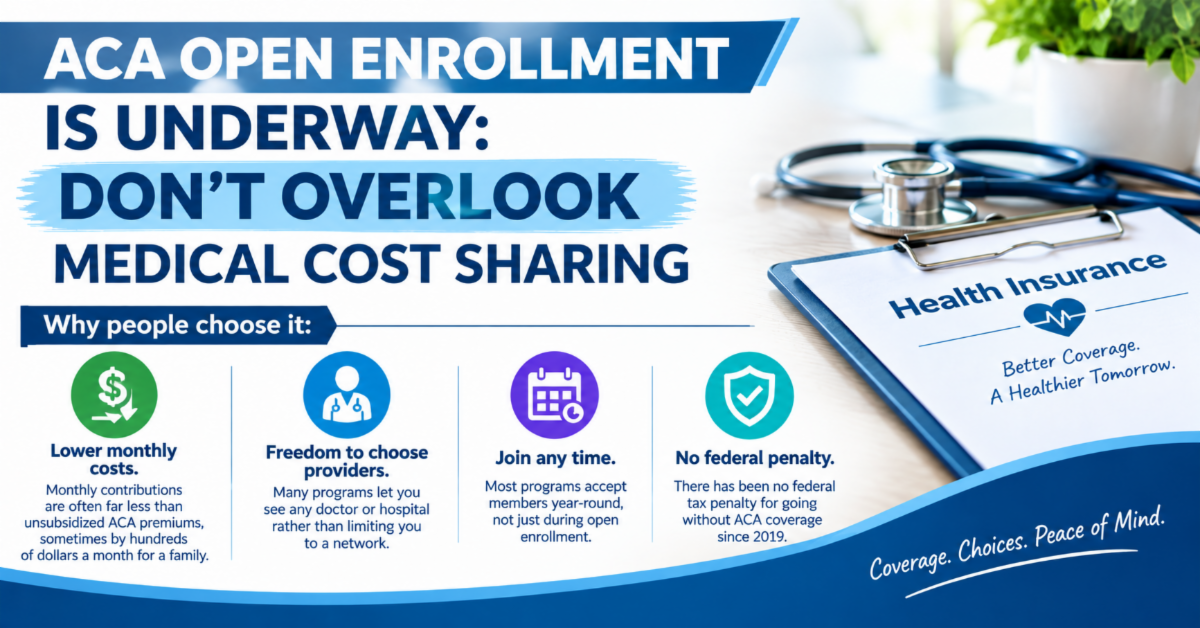
Why people choose it:
-
Lower monthly costs. Monthly contributions are often far less than unsubsidized ACA premiums, sometimes by hundreds of dollars a month for a family.
-
Freedom to choose providers. Many programs let you see any doctor or hospital rather than limiting you to a network.
-
Join any time. Most programs accept members year-round, not just during open enrollment.
-
No federal penalty. There has been no federal tax penalty for going without ACA coverage since 2019.
State penalties. Five places still charge a tax penalty for not having health coverage: California, Massachusetts, New Jersey, Rhode Island, and Washington, D.C.
-
California, New Jersey, Rhode Island, and D.C.: You generally won't owe a penalty if your sharing program includes a qualifying MEC plan, or if you belong to a recognized health care sharing ministry and claim the exemption.
-
Massachusetts: The rules are stricter. A sharing program usually won't protect you from the penalty, even if it includes a MEC plan.
If you live in one of these places, ask the program before you join whether it will protect you from your state's penalty.
What you need to understand: Medical cost sharing is not insurance, and payment of medical bills is not guaranteed. Most programs limit sharing for pre-existing conditions, often for the first few years of membership, and almost all have guidelines members agree to follow. Each program is different, so it's important to read the guidelines carefully before joining.
Who it fits best: Medical cost sharing tends to work best for healthy individuals and families who don't qualify for a meaningful subsidy, including many self-employed people and early retirees. If you receive a large subsidy, have significant ongoing health conditions, or are pregnant or planning to be, an ACA plan may be the better choice.
Decide before open enrollment ends. If you're considering cost sharing as an alternative to the ACA, make your decision before open enrollment ends: January 15 in HealthCare.gov states, or your state's own deadline if it runs its own exchange. Once it closes, you generally can't enroll in an ACA plan for 2027 without a qualifying life event. Call me to compare a medical cost sharing program side by side with your ACA options.
| | PAYING FULL PRICE FOR ACA COVERAGE? A PRIVATE PLAN MAY COST MUCH LESS | | |
With the enhanced subsidies gone and premiums rising again nationwide, many people earning too much for a subsidy are paying the full ACA price. For healthy individuals and families, private plans can be a lower-cost alternative. Other options include short-term medical and limited benefit plans.
What are private plans? Private plans are health plans sold outside the ACA Marketplace. Unlike ACA plans, most are medically underwritten: you answer health questions, and you are either approved or not approved. The private plans I offer don't exclude or limit coverage for pre-existing conditions once you're approved, but if you don't pass underwriting, you won't be eligible for the plan. In exchange, premiums are often significantly lower than for unsubsidized ACA plans. Many of the plans I write are PPOs that use Cigna's largest PPO network, while others use the PHCS Extended PPO or First Health networks, and many can be purchased any time of year rather than only during open enrollment. Plan availability varies by state.
Other private options include:
-
Short-term medical plans. Temporary coverage that can bridge a gap, such as between jobs or until other coverage starts. These plans require health questions and don't cover pre-existing conditions.
-
Limited benefit plans. These pay set dollar amounts for things like doctor visits, hospital stays or surgery. They can lower costs but are not a full replacement for major medical coverage.
Who they're best for:
- People who earn too much to qualify for a premium tax credit, or whose subsidy is small.
- Healthy individuals and families who can answer the health questions.
- Self-employed people and small business owners. About 70% to 80% of the people who buy private plans have a business EIN, and I can offer EIN holders, even a business of one, plans that cost significantly less than other private plans.
Who should stick with the ACA: If you receive a sizable subsidy, have significant health conditions, or are pregnant or planning to be, an ACA plan is usually the better choice. ACA plans can't turn you down because of your health, and subsidies are only available on Marketplace plans.
Timing matters. Private plans require approval. If you're considering one, apply well before your state's open enrollment deadline, which is January 15 in HealthCare.gov states. That way, if you aren't approved, you can still enroll in an ACA plan for 2027. Call me to compare a private plan side by side with your ACA options.
| | PRICE TRANSPARENCY IS GETTING REAL: WHAT IT MEANS FOR YOU | | |
A free market works only when buyers can see prices. For years, hospital and insurer price data were incomplete, hard to find, or full of placeholder numbers. Two federal rules are changing that, and they make it easier than ever to shop for care, especially if you pay cash, have a high deductible, or belong to a medical cost sharing program.
Hospitals must now post actual prices. Since April 1, 2026, CMS has been enforcing tougher hospital price transparency rules. Hospitals can no longer post vague “estimated” amounts. Instead, they must publish real dollar figures based on what insurers actually paid them over the past year, including the typical (median) price and the low and high ends of the range. A hospital's CEO or a senior official must also attest that the posted prices are true, accurate and complete. CMS has fined twenty-eight hospitals for violating transparency rules so far and has stepped up enforcement.
Insurers face new rules, too. On October 5, federal regulators finalized an overhaul of the price transparency rules for insurers and self-insured employer plans. The rule takes effect December 5, with most changes phased in during 2027. Key changes include:
-
Cleaner data. Insurers must remove “ghost rates,” prices listed for services a provider would never actually perform, which have made files enormous and hard to use.
-
More out-of-network prices. Insurers will report out-of-network payment amounts more often and over a longer period, giving a better picture of what care costs outside a network.
-
Accountability. Each file must include an attestation of accuracy and the name of the plan's CEO or senior executive responsible for it.
-
Cost estimates by phone. Starting with plans that begin on or after January 1, 2027, members can get personalized cost-sharing estimates by phone, in addition to online and paper options.
-
Drug prices coming. Insurers will begin posting what they pay for prescription drugs, including prices after rebates and discounts, starting in December 2027.
How to use price transparency:
-
Shop before scheduled care. For imaging, lab work, surgery and other planned services, compare prices at several hospitals and surgery centers. Prices for the same service can vary by thousands of dollars.
-
Ask for the cash price. Many providers offer discounted cash prices that are lower than insurance rates. This is especially valuable for medical cost sharing members and people with high deductibles.
-
Use the tools. Hospitals must offer an online price estimator or a list of shoppable services. Your insurer must offer a cost estimator as well.
-
Negotiate. Published prices give you leverage. If one facility charges far more than another nearby, say so and ask for a better price.
Price transparency puts more power in the hands of patients. The more people shop, the more pressure providers face to compete on price.
| | |
Paul Cholak is the Principal of Control Your Healthcare Costs, LLC (dba Control Your Healthcare Costs) and is an endorsed vendor of the Free Market Medical Association, which promotes transparency in healthcare costs and programs. He's also a Partner/Supporter of the Direct Primary Care Coalition, which promotes the direct primary care provider concept.
He constantly seeks to find new and innovative products that incorporate transparency and focus on reducing costs of the total healthcare bill.
He's a Healthcare Advisor for MPB.Health, a certified affiliate with Sedera and Zion Healthshare, and is also appointed by insurance carriers who offer insured products that promote healthcare transparency (for example Health Indemnity Insurance). He's also a member of the Holistic Chamber of Commerce.
He offers or refers you to medical cost sharing and insured healthcare products on either an individual, association, or group basis, as applicable, that promote healthcare cost transparency and can result in significant overall healthcare savings to participants. He guides you through the steps of obtaining membership in the applicable program and is always available to help you both BEFORE and AFTER you've enrolled.
| | | | |