Wednesday, April 15, 2026

One Vision, One Mission. Community Banks.

Sponsored by: SHAZAM | First National Bankers Bank | BHG Financial | 

Sawyers & Jacobs | Celerit | DD&F Consulting Group | The Baker Group


No copyright infringement intended

Having trouble viewing? " View as Webpage"

Vendor * Spotlight

Click logo to hear more or click

here visit their website

The Baker Group is a
News
Watch 2026 Sponsor

SHAZAM is a NewsWatch 2026 Sponsor

BHG Financial is a
News
Watch 2026 Sponsor

Celerit is a NewsWatch 2026 Sponsor

DD&F is a NewsWatch 2026 Sponsor

FNBB is a NewsWatch 2026 Sponsor

Sawyers & Jacobs is a 
News
Watch 2026 Sponsor

 Current Issue of the "Arkansas Community Banker"

EO order requiring banks to collect citizenship proof


US Treasury Department Secretary Scott Bessent confirmed that an executive order requiring banks to collect citizenship proof from customers is underway, Semafor reported, citing a 23-minute interview at the Semafor World Economy’s inaugural Treasury Secretary Dinner at the Library of Congress, Bessent weighed in on a range of subjects, including a forthcoming executive order requiring banks to collect citizenship information on their customers:

“It’s in process. And I don’t think it’s unreasonable, because: Why don’t we have information on who’s in our banking system? I have a place in the UK; they want to know who lives in every apartment — and how do we know that it’s not part of a foreign terrorist organization?”


The policy would be retroactive, which means banks would have to solicit documentation from current customers as well as future ones. REAL IDs, which do not prove citizenship, would not be considered eligible.


Already, the industry is pushing back out of concern that the potential move — via presidential order, not legislation — would be costly and complicated to implement. Illicit finance laws require financial institutions to collect some personal information on their customers, but not citizenship details specifically.


One financial services lobbyist called the idea a “complete nightmare” logistically. The lobbyist also warned of potential pushback from GOP voters: “The admin might think this is a good idea until Joe MAGA in Alabama is asked to present his papers.”


“Verifying every bank customer’s citizenship status would be unworkable,” said another person familiar with the recent talks. “Such a mandate could force every bank in America to solicit documentation that many everyday Americans do not have on hand. To put that into perspective, the US government has spent the last 20 years trying to encourage adoption of the REAL ID, and even that form of documentation does not constitute proof of citizenship.”


Source:Semafor

An article from Forvis/Mazars 


Federal Rulemaking Shifts Shaping Current Compliance Priorities


“Agencies such as the Consumer Financial Protection Bureau (CFPB), FDIC, the Office of the Comptroller of the Currency (OCC), and the Financial Crimes Enforcement Network (FinCEN) are refining compliance frameworks, reporting expectations, and supervisory focus areas.”


In this article by Forvis/Mazars, an ACB Associate Member, Mark Burnside and Mark Devers discuss these rulemaking shifts and specifically target: What Are CFPB Proposed Revisions to Regulation B?; How Has CFPB Narrowed the Approach to Section 1071 Data Collection?; and What Are FinCEN’s Updated FAQs on SAR Filing & AML/CFT Expectations?. 


Click here to learn more.

Source: Forvis/Mazars

Administration releases withheld CDFI funds


2025 funding for the Community Development Financial Institutions Fund that had been held up since it was appropriated by Congress are being released.


As reported by Politico, the White House’s Office of Management and Budget has begun to release the $289 million in funds approved by Congress for fiscal 2025. The funding for the two-year cycle was scheduled to expire Sept. 30.


The news came as the Treasury Department separately announced:

  • The CDFI Fund will issue rules designed to prevent funding from going to immigrants in the country illegally.
  • It is adding a new provision to CDFI Fund agreements to ensure certified CDFIs do not engage in practices that violate federal anti-discrimination law.
  • The anti-discrimination standards will require certified CDFIs to implement policies and procedures to ensure compliance, certify these policies each year, and make them available for review upon request by the CDFI Fund.


The 2027 budget proposal calls for cutting $204.5 million in discretionary awards from the CDFI Fund, though the president’s budget is a nonbinding recommendation to Congress.


ICBA has persistently worked to ensure full funding for the CDFI Fund amid efforts to cut its resources, citing the important role of CDFIs in supporting economic development in rural and underserved communities.


ICBA Advocacy:

  • The Consolidated Appropriations Act (H.R. 7148) signed into law in February allocates $324 million for the CDFI Fund this year, the same amount as 2025.
  • Following advocacy from ICBA and other groups, members of Congress in December strongly supported 
    CDFIs in budget discussions.
  • More than 100 congressional Republicans last year pushed back on a decision to fire CDFI Fund employees during the government shutdown.
  • The Treasury Department responded that all CDFI Fund reductions in force were rescinded as part of November's legislation reopening the government.

Source: ICBA

FDIC rescinds guidance update on re-presentment fees


The FDIC rescinded its June 2023 guidance on how banks assess fees on items that are repeatedly rejected for insufficient funds.


Some financial institutions charge multiple nonsufficient-funds fees for the same transaction when a merchant re-presents an ACH payment or check more than once after the transaction has been declined.


The 2023 Financial Institution Letter (FIL-32-2023) said the agency will not ask institutions to conduct a lookback review without the likelihood of substantial consumer harm.


In a new FIL, the FDIC said the 2023 guidance is overly broad in scope and has raised uncertainty regarding when re-presentment disclosures may result in “unfairness” concerns under Section 5 of the Federal Trade Commission Act. As a result, the agency said it is rescinding FIL-32-2023 effective immediately.

Source: FDIC

SBA faces 67% budget cut 


The proposed fiscal 2027 budget would sharply reduce discretionary funding for the US Small Business Administration and impose a new administrative fee on lenders that participate in the agency's guaranteed business lending programs, according to the White House budget document.


The budget requests $329 million in discretionary budget authority for the SBA in 2027, a roughly 67% reduction from the 2026 enacted level, according to the document released April 3.


Alongside the funding cut, the proposal would create an administrative fee on lenders in SBA's guaranteed business loan programs. The budget says the fee is intended to shift program administration costs away from taxpayers.


The proposal is not final policy and would require congressional action.

S&P Global Market Intelligence

Agencies warn Iran targeting industrial systems


The FBI, Cybersecurity and Infrastructure Security Agency, and other agencies warned that Iran-affiliated threat actors are targeting internet-facing operational technology devices used by local municipalities, water and wastewater systems, and energy sectors.


The agency bulletin says threat actors are targeting programmable logic controllers—industrial computers used to control manufacturing processes—manufactured by Rockwell Automation/Allen-Bradley. It offers tactics, techniques, and procedures to reduce the risk of compromise.


Source: CISA

FDIC, OCC finalized rule to eliminate reputational risk reviews


The Federal Deposit Insurance Corp. and the Office of the Comptroller of the Currency (OCC) finalized a rule that formally eliminates reputation risk from their supervisory review processes.


The final rule prohibits the FDIC and OCC from issuing formal or informal criticism, downgrades, licensing denials or other adverse actions against financial institutions solely on the basis of reputation risk. It also prevents the agencies from pressuring banks to alter, refuse or terminate customer or third-party relationships due to reputational concerns.


Source: FDIC

CSBS survey: Community bankers optimistic

Community bankers remain optimistic about the future, though their outlook on the impact of monetary policies and regulation is waning, according to the Conference of State Bank Supervisors’ latest quarterly poll.


Source: CSBS

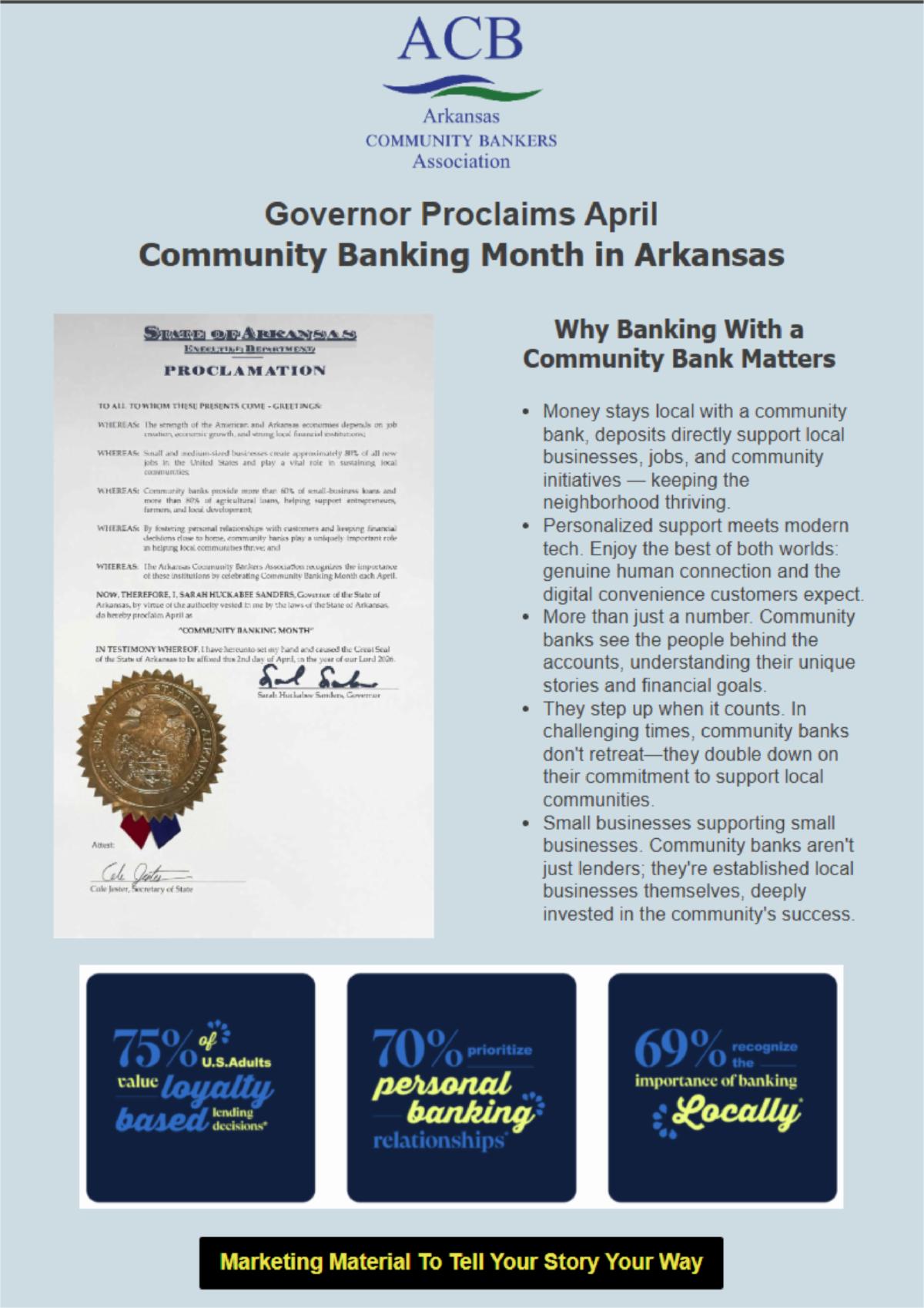
April is......

Click here for resources to "Tell Your Story".