Wednesday, October 14, 2026

One Vision. One Mission. Community Banks.

Sponsored by: SHAZAM | First National Bankers Bank | BHG Financial | 

Sawyers & Jacobs | Celerit | DD&F Consulting Group | The Baker Group


No copyright infringement intended

Having trouble viewing? " View as Webpage"


Community bankers worry about Stablecoin impact


Nearly 60% of community bankers are concerned about stablecoins' potential impact on deposits and lending capacity, according to the Conference of State Bank Supervisors' 2026 survey of 330 community bankers from 35 states. More than half are actively piloting AI programs, while cybersecurity remained the top internal risk for the ninth consecutive year.


"Stablecoins are creating new competitive pressures, cybersecurity threats are raising the stakes and AI is opening new possibilities and new risks for how banks operate and serve their customers," CSBS President and CEO Brandon Milhorn said in a statement.


Source: S&P Global; CSBS

Fed rate hike pours fresh fuel on deposit battle  


The Federal Reserve's recent rate hike has poured fresh fuel onto an already fierce deposit battle, abruptly halting the fleeting funding cost relief that US banks captured earlier this year. While back-book fixed-rate asset repricing continues to support earning-asset yields, persistent deposit competition and heavy reliance on wholesale borrowings will keep net interest margins capped near current levels. At the same time, normalizing credit quality, mounting commercial real estate stress and rising provisions will narrow the runway for earnings growth. 


The window of rapid deposit cost relief that banks had at the start of 2026 has slammed shut. After falling 13 basis points and 17 basis points sequentially in the fourth quarter of 2025 and first quarter of 2026, respectively, the industry's aggregate cost of deposits reversed course in the second quarter, rising 3 basis points to 1.85%.


The spread between the federal funds rate and the industry's cost of deposits has narrowed significantly from the peak of 323 basis points in mid-2023 to 178 basis points in the second quarter of 2026. We expect the spread to increase modestly to 182 basis points in 2026 and 185 basis points in 2027 as banks compete with higher-yielding alternatives.

Source: S&P Global

FHA updates policy for implementing alternative credit scores


The Federal Housing Administration published updated minimum decision credit score methodology to formalize the addition of the VantageScore 4.0 and FICO Score 10T as acceptable credit score models alongside Classic FICO.


The FHA said the policy—which applies to Title II mortgage programs for FHA case numbers assigned on or after Jan. 1, 2027—establishes guidance for determining the MDCS at the transaction level when multiple models are submitted.


The FHA last month announced an implementation date of Jan. 1, 2027, to add VantageScore 4.0 and FICO Score 10T to the existing Classic FICO as eligible credit score models for FHA-insured mortgage underwriting. It also issued a preparedness guide for mortgage holders and other stakeholders regarding the addition of the alternative models.


  • ICBA last week met with Federal Housing Finance Agency officials to discuss implementation of the new scoring models.
  • In March 2025 recommendations, ICBA and other groups said the FHFA’s Credit Score Models and Reports Initiative is overly complex, costly to consumers, and missing key requirements for a successful transition.
  • In a previous letter to FHFA Director Bill Pulte, ICBA called on the agency to reconsider the implementation of policies, projects, and initiatives that could be harmful for the housing finance industry, such as the credit score models.
  • Source: FHA

Ban on mortgage ‘trigger leads’ paying off


Legislation enacted last year can reduce the drawbacks of mortgage “trigger leads” while preserving opportunities for comparison shopping, according to a new report from the Government Accountability Office.


The GAO’s study of the effects of the Homebuyers Privacy Protection Act in 2025, which was signed into law last September and took effect in March of this year, found:

  • Trigger leads previously flooded some homebuyers with mortgage solicitations, creating confusion and other risks.
  • The potential benefits of trigger leads in comparison shopping appeared limited.
  • The HPPA may reduce drawbacks of trigger leads while preserving opportunities for comparison shopping.


The Homebuyers Privacy Protection Act restricts credit reporting agencies from selling consumers’ contact information when they apply for a residential mortgage. These trigger leads result in a deluge of solicitations for prospective homebuyers, leading to hassles and confusion for consumers.

ICBA worked closely with lawmakers in support of the legislation, including in a letter of support ahead of the House markup, during testimony before the House Financial Services Committee, and in an open letter to the 119th Congress.


In a message to community bankers after the bill signing last year, ICBA said its passage as standalone legislation—a rarity in Congress—reflects the community banking industry’s effective grassroots advocacy.

  Source: ICBA

An Article from
First National Bankers Bank


When Your Customer’s AI Agent Starts Banking, Who Exactly Are You Transacting With?


"I have been thinking about agentic AI a lot lately, and not just from the perspective of how financial institutions might deploy GenAI tools internally to make employees more efficient. I am thinking about what happens when our customers have their own agents and those agents begin interacting with the bank on the customer’s behalf. I believe that will represent a very different proposition."


In this article by David Peterson, Chief Innovation Officer at ACB Associate Member First National Bankers Bank he explores: What happens when the AI agent doesn’t belong to the bank? 


Click here to learn more.

Source: First National Bankers Bank

Americans support strengthening reporting rules for credit unions


New ICBA polling data shows strong public support for requiring federal credit unions to join the vast majority of nonprofits and file 990 forms.


The new polling follows the closure of a tax-exempt credit union after its former CEO pleaded guilty to a multimillion-dollar embezzlement scheme. It also comes as the Treasury Department continues its Form 990 initiative to enhance transparency and strengthen reporting at nonprofit organizations.


In a national news release, ICBA President and CEO Rebeca Romero Rainey said the polling shows consumers are fed up with policies favoring tax-exempt credit unions. “As Treasury reviews Form 990 requirements, there is no better time for policymakers to start standing up to credit union mission creep,” she said.


The ICBA polling of adults conducted by Morning Consult in July found:

  • 63% agree that credit unions should be required to file annual informational reports like other tax-exempt organizations, agreeing by nearly a 5-1 margin.
  • 58% agree that the federal government should reconsider this reporting exemption as part of the current Treasury Department review, agreeing by more than a 3-1 margin.
  • 57% say the alleged embezzlement by the former credit union CEO makes them more likely to support Congress reviewing the federal tax exemption for credit unions.


ICBA recently told Treasury that federal credit unions should be required to file Form 990, the annual information return required of nearly all tax-exempt organizations. Responding to Treasury’s Form 990 Transparency Initiative, ICBA’s letter aligns with its repeated calls for Congress to require federal credit unions to file 990s.


With a billion-dollar credit union announcing its second community bank acquisition in as many months, ICBA in September reiterated its call for Congress to end the federal tax exemption for credit unions over $1 billion in assets.


ICBA’s The Illusionists campaign features a video, frequently asked questions, and additional information on how community banks outperform credit unions in meeting the needs of local communities and the policy disparities that demand reform.


Source: ICBA

Deposit flight concerns expressed in meeting on GENIUS Act


ICBA met with federal officials to discuss concerns with GENIUS Act implementation.


In a meeting with the Office of Management and Budget as it finishes its review of the OCC's final rule to implement the GENIUS Act, ICBA reiterated concerns about the potential disintermediation of community bank deposits and the resulting impacts to small-business and agricultural credit if the yield prohibition in the legislation is ineffective.


The Federal Reserve last month proposed two rules related to establishing a regulatory framework for payment stablecoin issuers under the GENIUS Act.


In response to earlier proposals by the OCC and FDIC, ICBA advocated for a strict interpretation of the GENIUS Act's prohibition on the payment of yield or interest by issuers and called on regulators to consider the potential impacts of payment stablecoin growth on community bank deposits and lending. 

Source: ICBA

Bank credit card profits could suffer


The White House is backing a credit card bill that could dent banks' profits and erode Visa Inc. and Mastercard Inc.'s market dominance, The Wall Street Journal reported. The Credit Card Competition Act, originally introduced in 2022 with bipartisan support from Sens. Dick Durbin (Democrat-Illinois) and Roger Marshall (Republican-Kansas), has been picked up as part of efforts on affordability for the public, according to the report.

Source: S&P Global

Vendor * Spotlight

Click logo to hear more and here to

visit their website

The Baker Group is a
News
Watch 2026 Sponsor

SHAZAM is a NewsWatch 2026 Sponsor

BHG Financial is a
News
Watch 2026 Sponsor

Celerit is a NewsWatch 2026 Sponsor

DD&F is a NewsWatch 2026 Sponsor

FNBB is a NewsWatch 2026 Sponsor

Sawyers & Jacobs is a 
News
Watch 2026 Sponsor

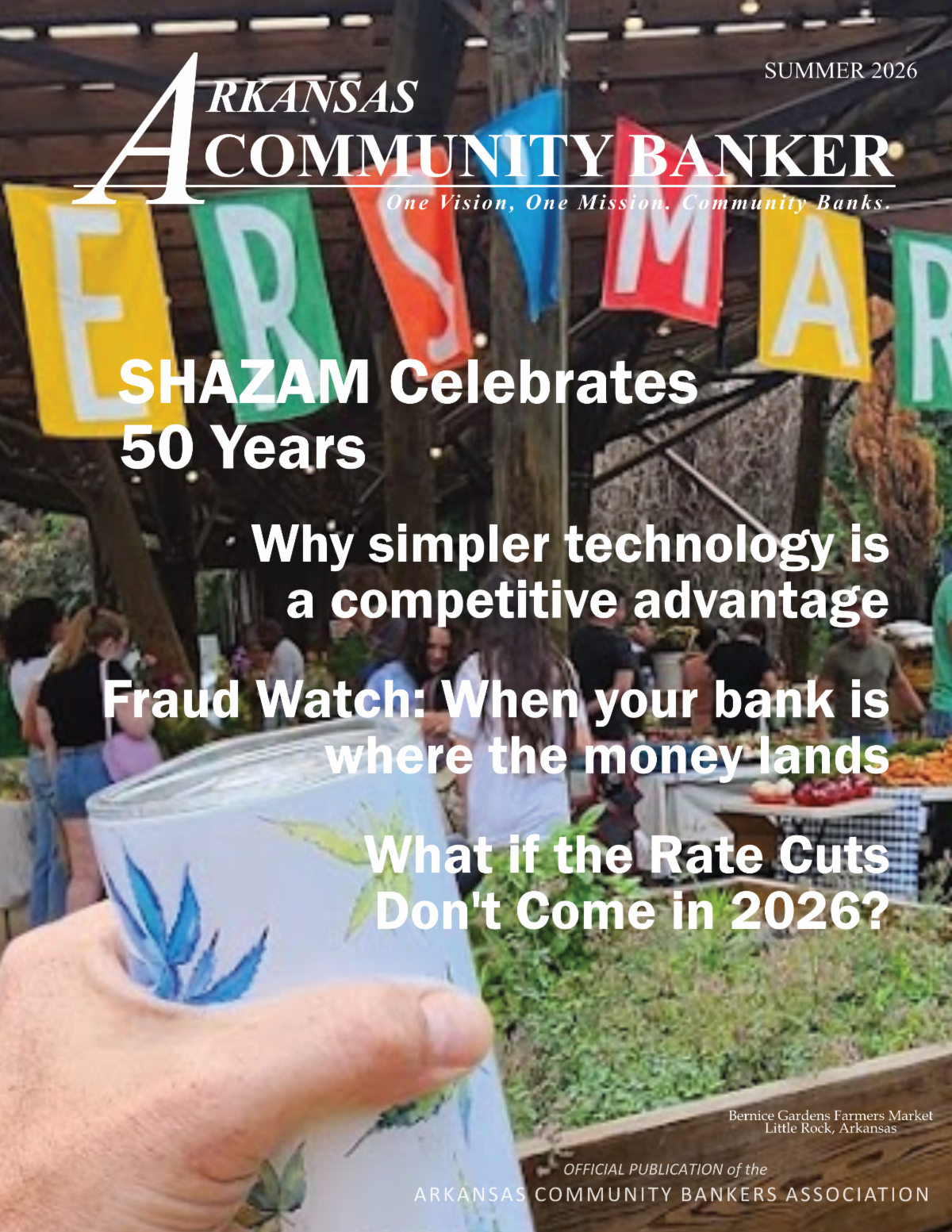
 Current Issue of the "Arkansas Community Banker"