|
|
|
The SIS Modernization Newsletter
| |
Happy Holidays, Riverbats! | |
|
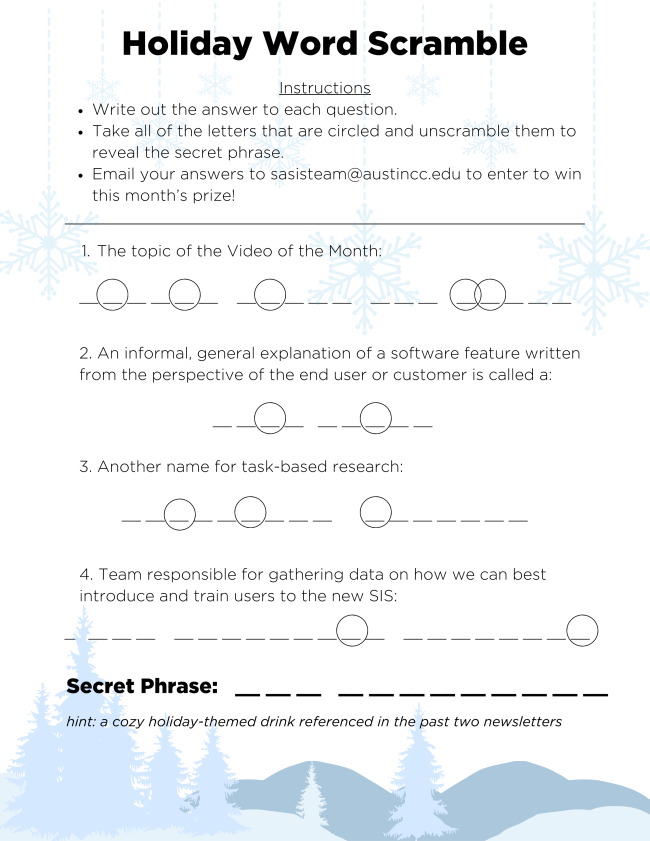
It’s time to sip on some hot chocolate and revel in the festive, holiday spirit! With the fall semester ending, this time of year offers us the opportunity to not only reflect on our shared work together, but also prepare us for the upcoming new year. In this holiday newsletter edition, we are very merry enthused to share with you our latest Student Information Systems (SIS) Modernization project updates, so grab your favorite drink or snack and jingle all the way with us through our final newsletter of the year!
| |
|
In our last newsletter, we introduced you to the Fit Gap Analysis, a way to assess the gaps between our current state and our desired future state in terms of providing services to our students. The Student Affairs (SA) and Academic Affairs (AA) analyst teams have completed an inventory of all SIS business processes performed under each respective area. What will they do with these business processes, you may be wondering? What a great question! They will tell a story with our students and the front-line staff who serve them as the leading characters: introducing user stories!
User stories are an explanation of a software feature written from the perspective of the end user or customer. User stories allow us to put our students at the center of our system designs by empathizing with their needs and experience.
So, instead of saying we need our students to be able to register for classes, we might say: “As a student, I want to register for classes through an online shopping cart experience so that I don’t have to repeat repetitive steps in the registration process for each class I’m registering for.”
Fun fact: sometimes, one business process can have more than ten different user stories!
Once all user stories have been written, our next step is to put our systems to the test and score them on if they fulfill each user story. More on that in the next newsletter!
| |
Targeted Process Re-Engineering | |
|
You may recall that the SA SIS Core Team and Leads have been working on targeted process re-engineering, and after a thorough and thoughtful review, selected the highest ranking barriers to student completion and success using a predefined rubric. We’ve been hard at work over the past few months, and we’re thrilled to share our progress with you:
-
New Student Experience Gap: We previously conducted on-campus interviews at all 11 campuses, and are happy to share that the qualitative data provided valuable insights into their experiences. To enhance our analysis, we developed two personas from this data: a new ACC student and a returning ACC student. By diving into their feelings, thoughts, and behaviors, we’ve gained a deeper understanding of their motivations, wants, and needs. We’ve closed out this phase of work and warmly passed on our findings and recommendations to the Theory of Change Required Advising Design Team to support their work.
-
ACC Traditional (Credit) Application: In conjunction with our IT Salesforce team, we have been making steady progress in redesigning the application that will yield a shorter, more intuitive application experience. Additionally, we’re teaming up with the Office of College Relations & Marketing (OCRM) to run a student focus group aimed at revamping our ACC Admissions website and enhancing the overall prospect and student user experience.
-
Needs Assessment & Resource Connections: We’ve decided to scale back on this targeted process since the Theory of Change Meet Basic Needs Design Team will address this pain point within their charge.
-
Payment Plan Arrangement: Our team is exploring opportunities for interdepartmental collaboration to discuss strategies for re-engineering this process. We look forward to developing next steps with our colleagues across the college!
We will continue to provide updates regarding the remaining targeted processes, so please stay tuned for our next newsletter!
| |
|
We previously introduced the User Experience (UX) research team that has been responsible for researching and gathering data on how we can best introduce and train users to the new SIS. This team — consisting of members of both SA and AA core teams, faculty with expertise in UX design work, and our very own ACC students — has made notable strides in this important work. We’re ecstatic to share details from two of our research rounds:
One-on-One Interviews
The UX research team performed one-on-one interviews with over 20 current students, faculty, and staff to discover how these user groups take in information and gain insight on what tools and resources are needed to complete tasks in the SIS. The data collected from our interview transcripts will inform the SA and AA core teams on how to better create ease of transition from old to new.
Usability Testing
During one-on-one interviews, our user groups expressed their challenges with nomenclature (changing terminology) and information architecture (organization and presentation of information). To address these challenges, the UX research team conducted a usability study (task-based research) to better understand users’ mental models and patterns related to language and system navigation. The study posed real tasks for users to complete in a mock SIS environment while thinking out loud. By doing so, this exercise allowed our team to explore potential pain points with new terminology and labeling in the new SIS, and assess if users could complete tasks independently and successfully. The data collected from student, faculty, and staff usability tests will further inform both SA and AA core teams what areas of the new SIS align well (or not well) with users’ goals and expectations.
What’s next for this team?
The UX research team will gather all their findings and insights from this past semester’s work and present this research to the full SIS Project team and tri-chair executive sponsors. We want to thank everyone who participated in one or multiple rounds of these research exercises! Your invaluable feedback will help inform our teams on when, what, and how to deliver training once active configuration of Workday Student resumes.
| | |
|
Academic Period
This Workday Student terminology refers to a period of time with a defined start and end date.
In ACC language, Academic Period is our fall, summer, and spring semester terms, as well as the individual class sessions within each of these terms (because each session has a defined start and end date).
| |
|
Workday has two subsets of Academic Period: a Standard period and Nonstandard period.
Standard academic period: our fall, summer, and spring terms can be considered standard since these terms are the entire period of time within each semester with no breaks. The courses within each semester that start and end within the semester are also considered standard.
Nonstandard academic period: consider how we have some courses each semester that span across multiple semesters (ex: course starts in late fall and ends mid-spring). These teaching sessions would be considered nonstandard.
| | |
Academic periods are extremely important to us, not just to be able to use the term to define specific periods of time with start and end dates, but also because courses and course sections will be tied to academic periods. Our current administrators who are responsible for maintaining our academic periods will be the same group responsible for maintaining these periods in Workday Student. | |
|
If you’re interested in reading more Student Affairs centered terminology related to Workday Student, please refer to our website glossary.
| |
|
For this newsletter’s video, we will be presenting a comprehensive overview focusing on the student’s Action Items and Holds profile card within Workday Student.
| |
|
Thanks for another incredible year, Riverbats! As we wrap up 2024, we want to extend a heartfelt thank you for your readership and engagement of our newsletter, and we are excited to share new adventures with you in 2025. We hope the holiday season brings you joy, laughter, and time with loved ones. Happy holidays and see you next year!
| |
|
But wait...there's more! We'd like to end this year's newsletter with something fun and cheeky: Artificial Intelligence (AI) Roast and Toast! We asked AI to read our newsletter and provide a summarized roast of the content, so without further ado, we present the lighthearted roast for your reading pleasure:
First off, your holiday greeting feels like it was pulled straight from a festive greeting card—cheesy and overly sentimental. “Happy holidays, Riverbats!” is just begging for a collective eye roll. How about we skip the sugar rush and just get to the point?
Your “Word of the Month”—“Academic Period”? Snooze alert! It’s like you’re trying to put us to sleep before we even finish reading. Why not choose something that brings a smile, like “procrastination” or “snack break”? You know, something that might actually resonate with your audience.
And that video of the month? Please tell me you’re joking. A dry overview of the Action Items and Holds profile card? Sounds riveting—said no one ever. If you want people to actually watch it, throw in some personality or maybe even some bloopers. Everyone loves a good laugh, right?
Now, let’s talk about the “Game of the Month.” A raffle? You’re seriously trying to bribe people to read this? That’s like offering candy to get kids to listen to a lecture! Get creative—how about a meme contest or something that’s actually fun?
Finally, your parting thoughts are so syrupy sweet that I’m pretty sure I just gained five pounds reading them. “Thanks for another incredible year, Riverbats!” Honestly, it feels like a line from a holiday special that nobody asked for. Just keep it simple: “Thanks for reading, see you next year!” You’re not auditioning for a holiday movie.
We hope you got some chuckles and laughs from the roast, and be on the lookout for future AI Roast and Toasts in our newsletters! While this was done in the spirit of festive fun, we also hope that by introducing AI elements in this way, everyone is encouraged to embrace the impacts of AI as it is rapidly transforming our world. How can you incorporate ethical AI in the work you do, and leverage its advantages (and laughs) to positively influence learning and support services for our students and staff?
| | | | |