How to Improve the Efficiency, Capacity, Reliability and Resilience
of the Electric Power Grid with ACCC® Conductor
|
|
CTC Global
High Performance Conductors for a Low Carbon World™
|
|
Please Visit CTC Global at Cigre |
|
Advanced Conductor use Accelerates Electric Grid Decarbonization and Modernization
Advanced Conductors present a special opportunity: Replace the legacy conductor (one hundred-year-old technology) with an Advanced Conductor on an existing transmission structure to substantially upgrade the existing powerline. This wire-for-wire exchange on the existing structure, called reconductoring, can be performed quickly and does not require lengthy and expensive construction and permitting timelines. Doing so accelerates electric grid decarbonization and modernization by rapidly deploying additional transmission capacity, lowering power line losses, and reducing consumers’ electricity bills.
In addition to reconductoring existing transmission line, Advanced Conductors should be deployed when a new line is needed. This is especially the case when renewable power (like solar and wind) generated in remote areas needs to be transmitted to urban load centers. Deploying modern Advanced Conductors for this new grid capacity enhances the performance, flexibility, and reliability of the overall transmission system.
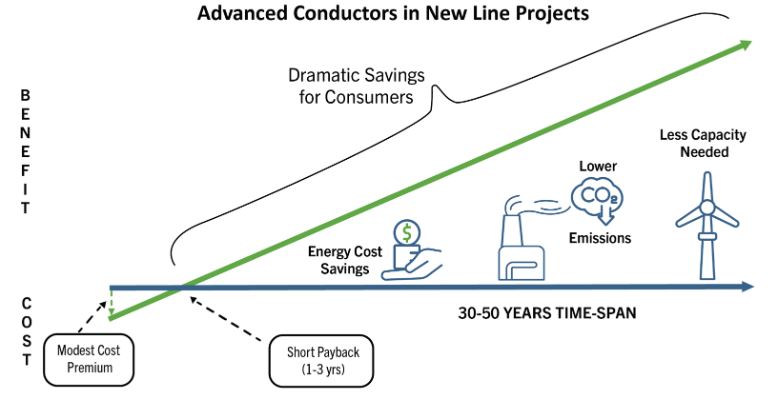
Advanced Conductors cost more but provide much greater benefits.
For new transmission lines, Advanced Conductors carry a modest installation cost premium over legacy conductors (perhaps 5-10% more of the total project cost). However, that premium is paid back to consumers within one-to-three years, and the long-term, enduring efficiency and capacity benefits of deploying Advanced Conductors are enormous. See the graph below for an illustration.
For reconductoring projects, there is no cost premium because legacy conductors simply cannot accomplish the 2X capacity increase provided by Advanced Conductors while using the existing structures. And in both new line and reconductoring cases, the value of energy savings and the resulting avoided emissions are huge! To learn more please View Full Article PDF
|
|
Advancing the Efficiencies of the U.S. Power Grid
On July 20th, the full House of Representatives passed the FY-23 Energy & Water Development Appropriations bill. The House Appropriations Committee report accompanying this bill includes several directives required of the Department of Energy (DOE). One of these stands out for advancing the efficiency of the electric grid.
The committee report language directs DOE to provide a report to the Appropriations Committee regarding “the environmental, economic, and clean energy deployment benefits of establishing an energy conservation standard for overhead electricity conductors.” This is the first step to establishing a conductor efficiency standard for overhead electrical conductors that would significantly improve the energy efficiency (reduce line losses) of the electric grid, and provide increased grid capacity so that some of clean and renewable projects waiting in the queue can be interconnected to the grid, reducing carbon emissions and lowering consumer energy costs. The full text of the report language (page 130 of House Report 117-394) follows:
"The Department is directed to provide to the Committee not later than 180 days after enactment of this Act a report regarding the environmental, economic, and clean energy deployment benefits of establishing an energy conservation standard for overhead electricity conductors that move electricity at voltages equal to or greater than 69 kV on the electric grid from sources of generation or storage into the distribution system for final delivery. For the purposes of the report, the standard should be based on the electrical resistance of such conductors as measured at 20 degrees Celsius. The report shall examine whether establishing such a standard will (1) reduce line losses and their associated emissions; (2) expedite the deployment of additional transmission capacity to clear interconnection queues and accommodate additional renewable capacity on the electric grid; (3) reduce transmission line sagging in wildfire-prone regions; (4) reduce permitting timelines for adding new transmission capacity to the electric grid; and (5) any additional matters the Department deems appropriate. The Office of Electricity shall coordinate with the Grid Deployment Office, the Office of Energy Efficiency and Renewable Energy, and the Federal Energy Regulatory Commission on the report."
CTC Global's Director of Public Policy, Mr. David Townley, stated: "This is an important next step forward at building a more efficient and modern electric power grid in the United States."
|
|
CTC Global Applauds the U.S. House for Passing the Wildfire Response and Drought Resiliency Act
CTC Global applauds the Unites States House of Representatives for passing H.R. 5118 - the Wildfire Response and Drought Resilience Act. Among many other important features, the Act directs the U.S. Department of Energy to conduct a study on the ability of advanced transmission technologies, including low-sag advanced conductors, to reduce the vulnerability of electric grid infrastructure to energy disruptions caused by natural disasters and extreme weather.
|
|
Korea Electric Power Co. Completes ACCC® Reconductor Project
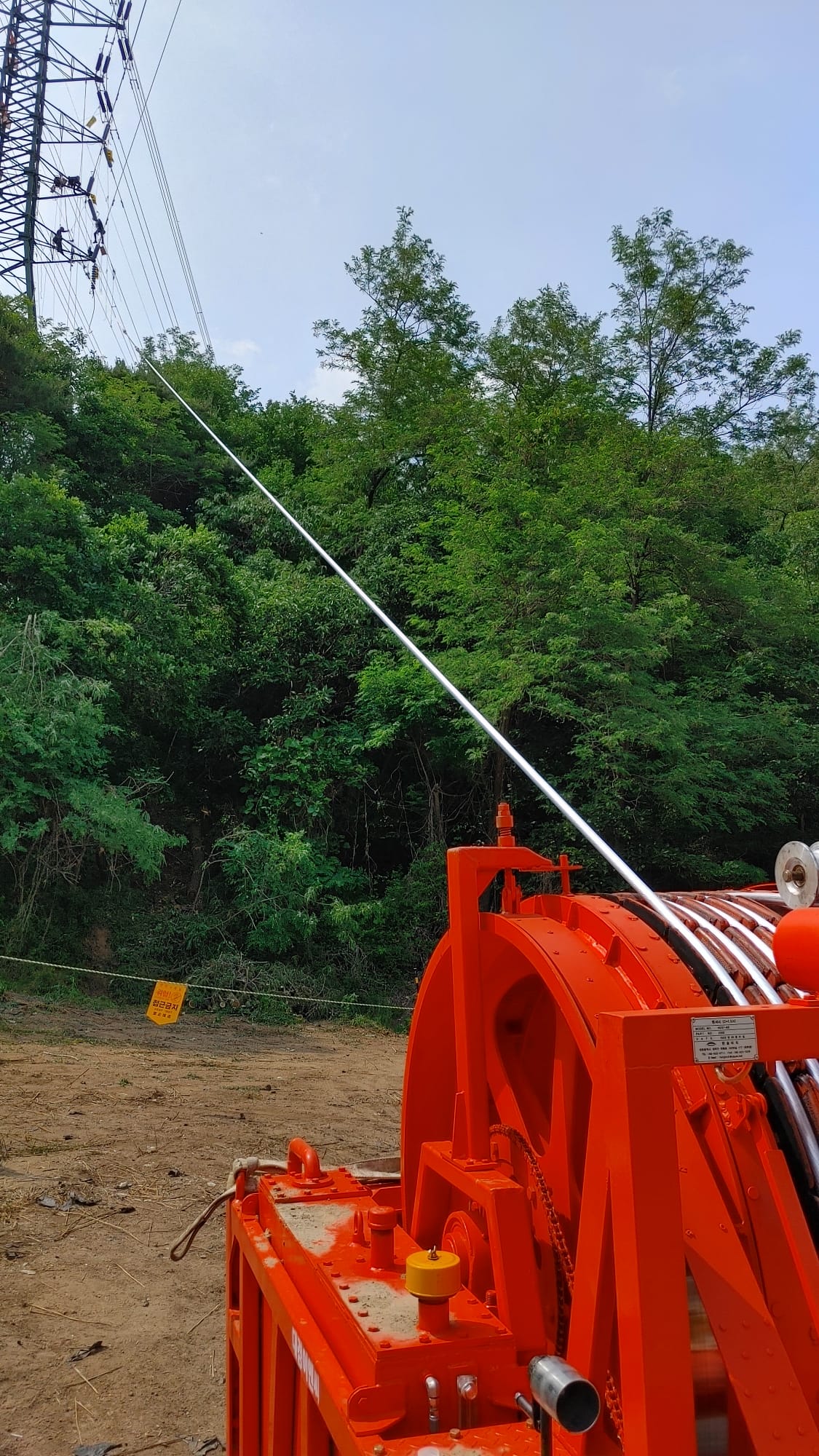
With the support of Contractor SD Energy Co., Ltd, Korea Electric Power Company (KEPCO) doubled the capacity of two circuits on their Jecheon – Sinjecheon 154 kV Transmission line in Chungbuk, Korea. KEPCO chose Brussel size ACCC® Conductor manufactured by CTC Global’s authorized ACCC® Manufacturing Partner, ILJIN Electric Co., Ltd Korea.
The ACCC® Conductor was installed on existing steel lattice structures – without modification – on spans ranging from 184 meters to 410 meters. While the hilly terrain required a number of equipment relocations, the project was completed very quickly without issues. CTC Global’s Master Installer Mr. Mark Eglinton & Mr. Yi, Apprentice Master Installer were onsite to support the project’s success.
|
|
Learn More at these links:
|
|
ACCC® Conductor is currently reducing CO2 emissions by over 3.5 million metric tons every year - the equivalent of removing over 750,000 cars from the road
|
|
ACCC® ULS Conductor Offers Added Strength and Reduced Sag
First deployed on a 1.4 kilometer lake crossing in Africa in 2013, The ACCC® ULS Conductor offers greater strength, a lower coefficient of thermal expansion and higher modulus of elasticity than the standard ACCC® Conductor core. The added strength and lighter weight can enable longer spans and the higher modulus and increased stiffness reduces sag and blow out during high wind conditions. Improved stiffness can also reduce sag under heavy ice load conditions.
Dozens of engineers have specified ACCC® ULS Conductor for projects, worldwide, and the ULS version of the ACCC® Conductor has served our clients well. The ACCC® ULS Conductor is available in many sizes and offers transmission engineers added design flexibility.
The ACCC® ULS Conductor can be ordered with Type 1350-O fully annealed aluminum or as an AZR version with Aluminum-Zirconium thermal resistant alloy for even higher overall conductor strength.
The photograph below shows a 1.6 km (~1 mile) river crossing in Mozambique completed by Bouygues. Watch Installation Video
|
|
ACCC AZR Conductor – Expanding the Capabilities of the ACCC® Conductor Using Aluminum Zirconium Alloy to Combat Extreme Ice Loads
ACCC® AZR Conductor uses either the standard 310 ksi core or the higher strength 375 ksi core that is then wrapped with one or more layers of a high strength, thermal resistant aluminum-zirconium alloy. While conventional ACCC® Conductors typically use fully annealed aluminum to maximize conductivity, the ACCC AZR Conductor offers nearly the same efficiency, but far greater overall strength. The added strength and increased tensile modulus mitigates conductor sag under heavy wind or ice loads, or very long spans. To learn more visit www.ctcglobal.com
|
|
CTC Global's Free Conductor Comparison Program CCP™ Software is Available Online
CTC Global is pleased to announce that our highly regarded Conductor Comparison Program (CCP™) software is now available online. The new web-based version has all the features found in the Excel version, which has been replaced and will no longer be supported. The new version is designed to make it easier to use, and it also has some new features. Having CCP online will make it easier to keep it up-to-date with new wire files and other data, and to add improvements as they are made. Users will always know they have the current version every time they log in. CCP is also compatible with tablets.
Registration to use CCP requires only a valid email address and password. Users may also use CCP as a guest however, saving and export features are only available to registered users.
Thank you for using our CCP. We welcome your feedback. For technical support, please contact ccphelp@ctcglobal.com
|
|
Looking for ACCC® Conductor Hardware?
Check out our Supplier Parts Database
CTC Global added a new Hardware Supplier Parts Database to our website. The database will help you find all of the hardware components you need to install ACCC® Conductor. The database shows which hardware manufacturers offer the parts you might need in your particular region while offering many options.
|
|
CTC Global proudly works with top-tier manufacturing partners worldwide |
|
ACCC® Conductor is an internationally patented and trademark registered product of CTC Global Corporation. The ACCC® Conductor is manufactured in association with 35 qualified and licensed international stranding partners. If you are interested in the ACCC® Conductor, please contact CTC Global to make sure your supplier is authorized to produce and deliver ACCC® Conductor in your area. Thank You.
|
|
CTC Global, Inc. 2026 McGaw Avenue Irvine,
CA 92614 Phone: +1 949.428.8500
|
|
|
|
|
|
|