February 16, 2024
Volume 15, Issue 6
|
|
ACCG Policy Agenda Items Advance
in the General Assembly
|
|
Several items from the ACCG Policy Agenda have been under consideration this legislative session. This week, attention was focused on three significant bills - House Bill 1044 (Public Works Projects: Increase Required Bid Threshold), Senate Bill 499 (Service Delivery Strategies’ Revision) and Senate Bill 349 (Ad Valorem - Statewide Floating Homestead Exemption). House Bill 1044, by Rep. Victor Anderson, successfully passed out of the House. This legislation increases the dollar amount from $100,000 to $250,000 by which counties and cities must bid out public works projects. This change is expected to save counties and vendors time and effort by eliminating the need to bid out small projects. Similar legislation was passed last year but was vetoed by the Governor.
Senate Bill 499, sponsored by Sen. Frank Ginn, is a direct outcome of the 2023 Joint Study Committee on Service Delivery Strategy (SDS), where ACCG and the Georgia Municipal Association (GMA) were instrumental. The bill includes several provisions such as requiring a written analysis from cities and counties on the services to be provided in specific areas, establishing statewide SDS mapping standards, requiring mediation for local governments unable to reach agreements, and setting a hard deadline for agreements to be reached. Failure to reach agreements within the specified timeframe would result in cities and counties facing state sanctions.
The Senate also voted 42-7 to approve Senate Bill 349, which provides for comprehensive property tax reform. This legislation is taxpayer-friendly and will protect homeowners. The bill includes many items from ACCG’s Legislative Priority “Property Tax Assessment and Appeal Reform,” including the removal of the confusing tax estimate on the assessment notice, the tightening of the three-year lock statute to prevent frivolous appeals, and the closure of the settlement conference loophole. ACCG commends Sen. Chuck Hufstetler for his dedicated efforts in addressing these complex issues.
|
|
Major Housing Legislation Introduced: The CHOICE Act
House Bill 1266, by Rep. Dale Washburn, creates the Community Housing Options Income Cost Efficiency Act (CHOICE Act). This legislation aims to incentivize local governments to adopt zoning and land use policies that promote affordable housing within their respective jurisdictions. While participation is not required, local governments attaining certain designations will receive preferential treatment when applying for some or all state grants and loans through the Department of Community Affairs (DCA), the Georgia Environmental Finance Authority (GEFA), the Department of Natural Resources (DNR), and the Georgia Department of Transportation (GDOT).
Staff Contact: Deputy Director of Governmental Affairs Todd Edwards; tedwards@accg.org
|
|
Click on "This Week's Bills" to review the bills included in this week's Legislative Update. |
Access the Legislative Tracking Database for a compilation of all bills ACCG is following. |
|
ACCG Request: FY 2025 Budget Appropriations for EMS
On Tuesday, ACCG testified before the House Appropriations Health Subcommittee and requested that the General Assembly appropriate $6.6 million in the FY 2025 budget to increase the EMS Medicaid reimbursement rate to the Rural and Urban Medicare rate. This item is one of ACCG’s 2024 Legislative Priorities.
Legislation to Restrict the Use of Speed Detection Cameras Progresses
House Bill 348, by Chairman J. Collins, was heard in the Senate Public Safety Committee on Thursday. This lengthy bill seeks to limit the hours that speed detection cameras can operate to specific times at the start and dismissal of school. Local governments that violate this provision will face a $1,000 fine and the revocation of “all speed detection device permits for such jurisdiction”. Based on the language in this bill, the revocation would also include radar guns used by law enforcement.
ACCG encourages counties to reach out to their legislators and urge them to vote NO on this bill.
|
|
Revenue and Finance
Legislation to Increase Personal Property Tax Exemption Passes Subcommittee
House Bill 808, authored by Rep. Mike Cheokas, advanced through the Ways and Means Ad Valorem subcommittee this week. A new substitute was introduced, altering the initial proposal. Instead of granting a full exemption from personal property tax, the bill now increases the exemption from $7,500 to $20,000, instead of the $50,000 sought in the original draft. The bill intends to provide relief to small businesses, so ACCG is working with the author to ensure that boats, planes, and centrally assessed personal property are excluded.
Bill to Line Up Sales Tax Referenda with Major Election Dates Passes Ethics Committee
Senate Bill 413, sponsored by Sen. Randy Robertson, passed the Senate Ethics Committee this week. The legislation limits local sales tax referenda to the November general election each year, the May primary in even numbered years, and the presidential preference primary every four years. This means that local governments will lose one referendum date in May of odd numbered years. In addition, the new sales tax will begin in the next calendar quarter starting at least, 50 days after the referendum date, instead of 80-day requirement under current law. This means that local sales taxes passed during the November referendum dates will take effect on January 1 instead of April 1.
|
|
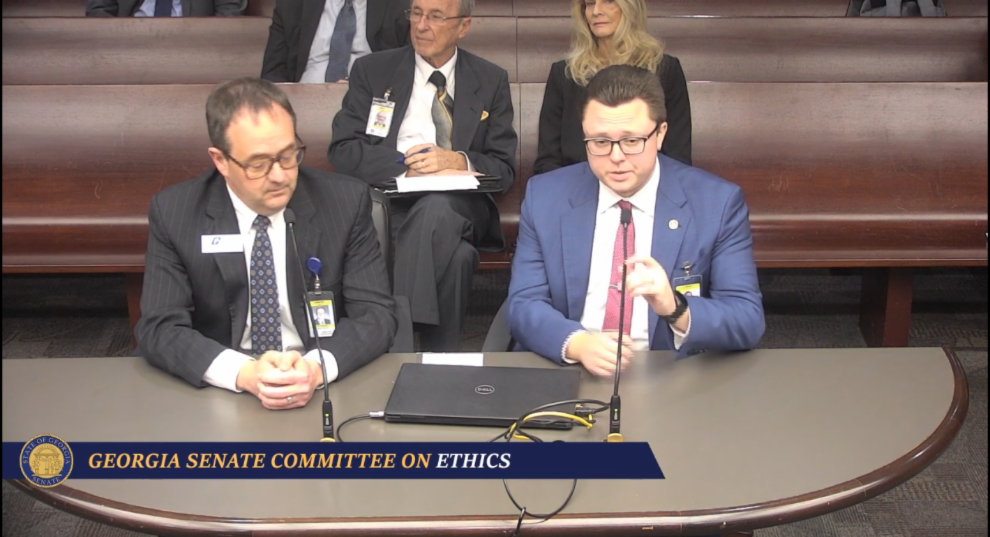
ACCG Governmental Affairs Associate Dante Handel and GMA Director of Governmental Relations Jim Thornton testify on SB 413 before the Senate Ethic Committee.
|
|
ACCG Legislative Agenda Item From 2023 Session Advances
The Senate Banking and Financial Institutions Committee passed a substitute to Senate Resolution 82, which is authored by Sen. Carden Summers. The resolution is nearly identical to the language passed by the committee last session, which unfortunately did not receive a Senate floor vote on Crossover Day. This legislation is a constitutional amendment to allow local governments to waive delinquent taxes at a tax sale, which they are currently unable to do. County commissioners may waive penalties and interest, but not the underlying taxes, which results in blighted or abandoned properties staying on the tax sale rolls indefinitely. ACCG commends Sen. Summers for his leadership on this issue.
Bill Allowing Absent Counties in LOST Introduced
House Bill 1225, authored by Rep. Chuck Martin, extends the same provisions that currently apply to absent municipalities in local option sales tax (LOST) negotiations to counties, allowing the county to be absent from the process and receive a population share. ACCG is working with the author on this issue.
Bill to Curb TAVT Abuse Filed in House
House Bill 1234, carried by Rep. John Corbett, seeks to curb the current abuses of the temporary operating permit (TOP) and dealer plate systems, which are adversely impacting local title ad valorem tax (TAVT) revenues. The legislation gives the Department of Revenue additional mechanisms to fight this abuse, including increased fines and the authority to suspend offenders. ACCG is supportive of this legislation.
Constitutional Amendment Proposed to Allow Alternative Valuation Method
House Resolution 1041, introduced by Rep. Dale Washburn, offers county governments the choice to adopt a new property tax valuation method. This approach sets the fair market value of a property at its most recent sale price until a subsequent sale occurs. This resolution raises concerns about large tax disparities between neighbors, an unequal playing field for businesses, and potential stagnation in the real estate market. Although permissive, ACCG is opposed to this legislation.
|
|
Natural Resources and the Environment
Staff Contact: Associate Director of Governmental Affairs Martha Revelo; mrevelo@accg.org
Bill Passes out of Natural Resources Subcommittee
House Bill 1146, sponsored by Rep. Ron Stephens, advanced out of the Natural Resources and Environment Subcommittee on Resource Management. This bill proposes significant changes to groundwater regulation in the coastal aquifers of the state, particularly concerning private wells. It suggests that the Environmental Protection Division (EPD) issue water permits to private companies if public service cannot be provided within 18 months. Private companies seeking to utilize water resources for their operations or expansion within these designated “coastal aquifers of the state” would be eligible to apply directly for a permit with the EPD. While the intent may be to streamline processes and increase access to water resources, there are several concerns about potential impacts on public health, environmental conservation, service delivery and local government planning. Martha Revelo, ACCG Associate Director of Governmental Affairs, testified against the bill, along with GMA.
|
|
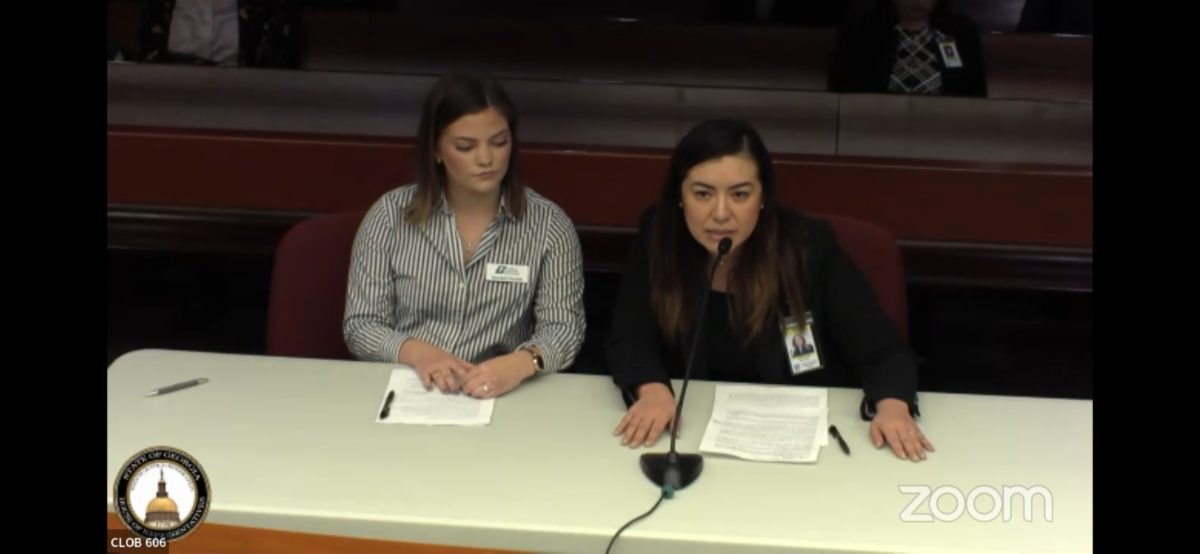
ACCG Associate Director of Governmental Affairs Martha Revelo and GMA Government Outreach Specialist Kendall Daniells testify against HB 1146 before the Natural Resources and Environment Subcommittee on Resource Management.
|
|
Public Safety and the Courts
Anti-Poaching Bill for Law Enforcement Agencies Progresses in the House
House Bill 1188, by Rep. Jodi Lott, advanced through the House Public Safety and Homeland Security Committee. This bill requires any state, county, or municipal law enforcement agency that hires a law enforcement officer from another agency prior to 36 months after their mandated training to provide reimbursement to that agency for the total cost of training. Training costs may include equipment, materials, housing, meals, transportation, and salary paid during the officer's basic or field training course.
Senate Bill Addresses Secondary Metal Recyclers Registration Fee
On Tuesday, Senate Bill 479 by Sen. Bo Hatchett, passed out of the Senate Regulated Industries and Utilities committee. This bill codifies how the $200 secondary metal recyclers registration fee is dispersed. In this bill, $100 would go to the Georgia Sheriffs’ Association (GSA) to maintain the database of all secondary metal recyclers. The other $100 is deposited into the county treasury.
“Back the Blue Fund” Progresses
Senate Bill 110, by Chairman Larry Walker, passed out of House Motor Vehicles. This bill creates a fund that is generated through contributions from voluntary donations given during motor vehicle tag registration. The Department of Revenue will collect the funds and transfer them to the GSA. GSA will then disperse them equally among all 159 sheriffs as bonuses rather than salary supplements. ACCG is concerned about the accountability of these funds and the proper withholding of payroll taxes. With the tax ID being in the county’s name, the county may be responsible for paying any penalties or interest assessed if taxes are not being paid on these bonuses.
|
|
Health and Human Services
EMS Reform Legislation Receives First Hearing
On Monday, Senate Bill 16 sponsored by Chairman John Albers was heard in the Senate Health and Human Services Committee. This bill allows counties to opt out of the service area established by the Department of Public Health and create their own EMS service area (EMS zones). This bill also includes a provision specific to counties that are 95% municipalized, which currently only applies to Fulton County. It grants cities within Fulton the same authority to establish their own service area. ACCG testified in favor of this bill.
Progress on House Bill Requiring Government Buildings to Offer Opioid Overdose Treatment
House Bill 1170, by Chairman Lee Hawkins, passed out of the House Public Health Committee. This bill requires each state and local government building, court houses, and state university buildings that have a defibrillator to also maintain a supply of at least three “opioid antagonists” such as Narcan. This medication inhibits the effects of opioid overdoses. Each government entity is required to establish and implement an internal training and implementation policy for opioid antagonist administration.
|
|
Economic Development and Transportation
Staff Contact: Associate Director of Governmental Affairs Martha Revelo; mrevelo@accg.org
Community Development Districts Bill had its First Hearing in Committee
Senate Bill 435, sponsored by Sen. Frank Ginn, underwent its first hearing in the Senate Regulated Industries: Infrastructure & Community Development Subcommittee. This legislation, known as the ‘Infrastructure and Community Development Act,’ aims to establish community development districts (CDDs). These districts act as independent community districts and serve as a financing tool for managing and funding services related to community and economic development. The infrastructure needs covered by CDDs include roads, water and sewer systems, school facilities, utilities, conservation areas, and parks, among other amenities. Clint Mueller, Legislative Director of Governmental Affairs for ACCG, testified in support of the bill.
|
|
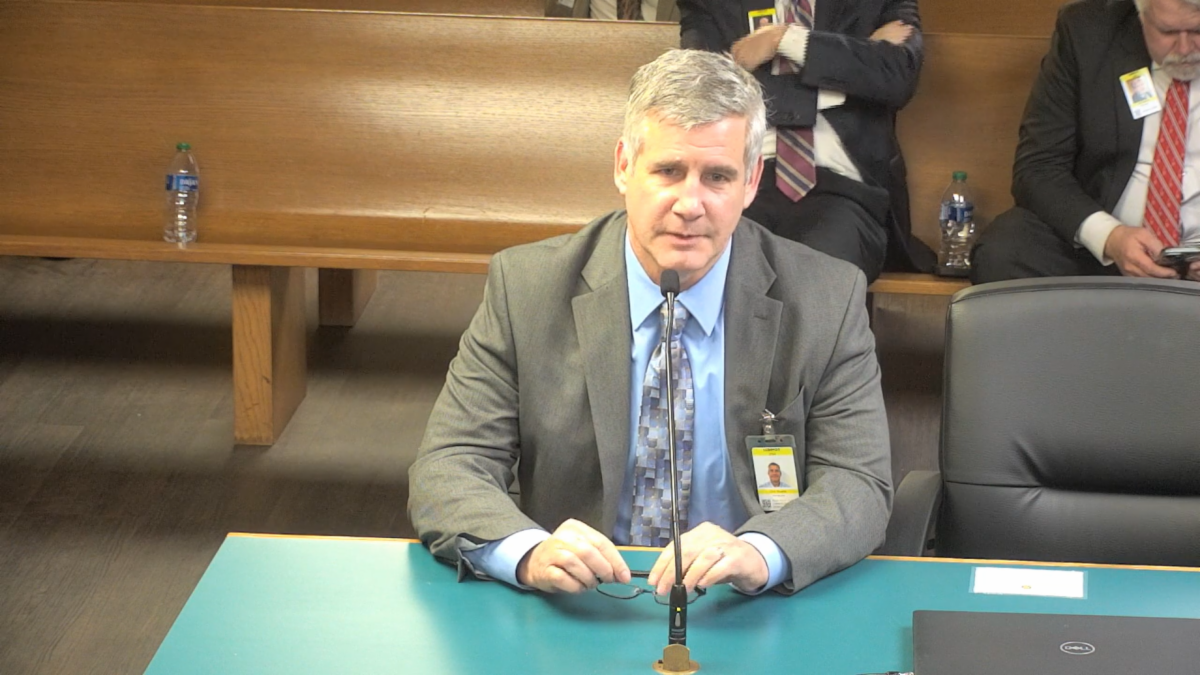
ACCG Director of Governmental Affairs Clint Mueller testifies on SB 435 before the Senate Regulated Industries Committee. |
|
Legislation Requires Counties to Utilize QBS Procurement for Certain Professional Services
House Bill 1228, by Rep. Tyler Paul Smith, requires that all local governments utilize the qualified-based selection (QBS) process for procuring professional engineering, architectural and landscaping services, with some exceptions. QBS is a process in which a city or county must evaluate firms based on proposals they submit without prices and then negotiate a price with the best-scoring firm. Currently, cities and counties have discretion in selecting consultants or other professional contractors unless they are receiving federal funds for projects. ACCG opposes this legislation under its Home Rule Guiding Principle.
Please contact your House members with any concerns you may have on this bill.
|
|
General County Government
Staff Contact: Deputy Director of Governmental Affairs Todd Edwards; tedwards@accg.org
Legislation to Remove Probate Judges from their Election Responsibilities Passes Senate
Senate Bill 212, by Sen. Max Burns, passed the Senate today. Currently, there are about 25 counties where the probate judge administers elections. This legislation removes probate judges’ election responsibilities, effective January 1, 2025, following the completion of the 2024 general election. These counties are required to establish an election board and supervisor by December 15, 2024, to meet the specified deadline.
Other Election Bill Updates:
-
House Bill 977 passed the House, requiring counties to conduct additional risk-limiting audits,
-
House Bill 1207 passed the House committee, requiring ballots to be proofed before printing,
-
House Bill 1254 was introduced, allowing counties to charge reasonable fees for reviewing challenged electors, and
-
House Bill 1256 was introduced, allowing electors to vote by hand-marked paper ballots.
Scaled Back Passport Fee Bill Approved by House Committee
On Thursday, Senate Bill 19 by Sen. Kay Kirkpatrick passed out of the House Judiciary Committee. This legislation, scaled back significantly from its 2023 version, now only requires clerks of court and probate judges to provide a quarterly written report to county governing authorities that discloses the amount of all passport application or processing fees, sums, or other remuneration received during the previous quarter.
Proposal Would Change the Make-up of Regional Commission Governing Councils
House Bill 1253, by Rep. Victor Anderson, changes the composition of the governing council for Georgia’s regional commissions. Starting January 1, 2025, each regional commission’s council would consist of the chief elected official of each county governing authority in the region; a number of chief elected officials of municipalities located within the region equal to the number of counties; and other members, equal to the number of counties in the region, who shall be appointed by the Governor in consultation with DCA.
|
|
Register for the 2024 Legislative Breakfast |
|
Join us at the 2024 Legislative Breakfast to get the latest updates and learn more about trending state issues. House Speaker Jon Burns, Georgia Department of Behavioral Health and Developmental Disabilities (DBHDD) Commissioner Kevin Tanner and Georgia Department of Transportation (GDOT) Commissioner Russell McMurry are the latest confirmed speakers that will address county officials during this year's Legislative Breakfast. Legislation passed during the 40-day session can have a direct impact on county government operations. For this reason, it is important for county officials to stay involved and engaged.
Visit the ACCG website for updates on the agenda and registration.
|
|
Stay Connected and Engaged! |
|
Please Remember to Update Your County Legislative Coordinator (CLC)
It is time for counties to review and update, if necessary, their ACCG County Legislative Coordinator (CLC). The CLC’s primary responsibilities are to relay pertinent information about current legislation to county commissioners and county management and to maintain an open line of communication with ACCG to ensure county-specific information is readily available for legislators. ACCG encourages all counties to participate in this network and designate a CLC prior to the legislative session. To confirm, update, or appoint your county’s CLC, please contact Tottianna Davis at tdavis@accg.org or 404-522-5022.
Click here to review your county's CLC from the 2023 session.
|
|
Virtual Legislative Update Replay
Watch the replay of the Virtual Legislative Update here. As a reminder, join the ACCG Governmental Affairs team every Friday at 9:00 a.m. during the legislative session. This is a recurring event, so county officials can access the meeting each week through this link.
|
|
Policy Communication Tools
Don't forget about the various communications tools that will help keep you informed and engaged. Click here to read all about them!
|
|
News You Can Use - Articles Related to ACCG Policy Issues
Articles covering some of ACCG's major policy issues are found here. Click the hyperlinked title to begin reading.
AJC Politics - February 15, 2024
11 Alive - February 13, 2024
Fresh Take Georgia - February 13, 2024
Capitol Beat - February 12, 2024
State Affairs - February 9, 2024
Capitol Beat - February 9, 2024
|
|
|
|
Questions? Email the
ACCG Governmental Affairs team:
|
|
ACCG is YOUR county association. We are here to advance all Georgia county governments. Please feel free to contact a member of the Governmental Affairs team if they can assist in any way. |
|
|
|
|
|
|