ACCRF Research Update 2025

Dear Colleagues,


As the Director of Research at the Adenoid Cystic Carcinoma Research Foundation, I am thrilled to share an overview of our network's research advancements over the past year. The publications, datasets, and other resources described below highlight ACCRF's ongoing commitment to advancing our molecular understanding of the disease and finding better therapies and a cure for ACC patients.


Looking ahead to 2025, we are excited to follow early-stage clinical trials in recurrent/metastatic ACC patients and assist in generating preclinical data that will keep replenishing the pipeline of clinical trial concepts rooted in exceptional science. ACCRF will continue to fund projects focused on developing new ACC models, expanding our molecular understanding of ACC tumors, and facilitating registry efforts geared towards biomarkers and natural history patterns of ACC. 


We look forward to engaging with the research community at our upcoming research conference this autumn and at meetings throughout the year. I also encourage you to follow our new LinkedIn page for regular research updates from the foundation. Please do not hesitate to contact me or Executive Director Jeff Kaufman with research ideas. We love to hear from you and look forward to finding ways to support your efforts.

Sincerely,


Nicole Spardy Burr, PhD

Director of Research

ACCRF Research Conference 2025

Save the date for the ACCRF Research Conference 2025, September 18-19 in Boston, MA, USA.


This two-day event will feature presentations and discussions on the latest in ACC research. Event details forthcoming.


We hope to see you there!

Add to Your Calendar

2024 Research Highlights

Grants

ACCRF awarded 14 grants in 2024, providing $513,000 in funding for ACC research. These grants focused mainly on four categories:


  • molecular characterization of ACC tumors
  • novel drug design
  • reviews of clinical care in ACC
  • prognostic biomarker discovery


You can learn more about ACCRF grant mechanisms here and review the list of previously awarded ACCRF grants here.

ACCRF is proud to announce Dr. Renata Ferrarotto of MD Anderson Cancer Center as the recipient of the 2025 Kara Gelb Memorial Grant for her research project "Multicenter Validation of P63 Immunohistochemistry (IHC) as a Prognostic Marker for Adenoid Cystic Carcinoma".


Dr. Ferrarotto has orchestrated a collaboration among hospitals from around the world to analyze p63 levels and survival data from 500+ ACC patients. The network currently includes 12 institutions across 8 countries. We are excited to watch as this infrastructure may be used for new impactful studies in the future.

Publications

ACCRF grantees published 25 articles in 2024, including work describing the ACC immune landscape and intratumor microbiome, prognostic biomarkers and the first report describing an assay that detects MYB transcripts in the blood.


A full list of ACCRF grantee publications can be found here.


Clinical Trials

Twenty systemic therapy trials were open to recurrent/metastatic ACC patients in 2024, including trials testing two novel MYB inhibitors and antibody-drug conjugates targeting B7-H4, TROP2 and AXL. Results were published from phase 2 clinical trials testing PSMA radioligand therapy (also see related dosimetry work) and Regorafenib in r/m ACC, as well as a case report describing the first ACC type II patient treated with an AXL-targeting ADC.


An updated list of open studies and completed studies can be found on our website. 

You can keep up to date on the latest developments in ACC research by following the ACCRF LinkedIn Page.

Follow us on LinkedIn

ACCRF Resources

MYB Antibodies

Important work published by ACCRF grantees at Massachusetts General Hospital (Drs. William Faquin, Adam Fisch, John Iafrate, and others) compared four commercially available MYB antibodies used for immunohistochemistry against RNA sequencing methods for the detection of MYB-NFIB gene fusions and MYB expression levels across 35 ACC tumors.


The anti-c-myb antibody (Abcam, catalog #117635) had the highest diagnostic sensitivity (when using a 30% tumor cell staining threshold) of 97%Although less diagnostically sensitive (66%),the frequently cited anti-c-MYB (phospho S11) antibody [EP769Y] was the only tested antibody to show a positive correlation between IHC staining and MYB RNA expression. Please keep in mind that this antibody is designed against epitopes reported to be lost in N-terminal truncated forms of MYB previously described in ACC.


Preclinical Drug Screening

ACCRF maintains 20+ ACC patient-derived xenograft (PDX) models at XenoSTART in San Antonio, TX, USA, that faithfully recapitulate ACC tumors' histology and molecular features. ACC PDX models can be used to develop preclinical drug screening data (including studies assessing tolerability, PK/PD, and tumor growth inhibition or delay) and molecular target exploration from individual model samples (blood, or flash-frozen or FFPE tumors) or tissue microarray slides containing cores from 10+ PDX models and normal salivary tissue. During 2024, 6 preclinical studies were conducted across 4 models testing 8 anticancer agents.


ACCRF has signed agreements with 40+ drug companies to screen 100+ anti-cancer drugs, with much of that work leading to publications and clinical trials. Learn more about the ACCRF PDX drug screening platform here. If interested in testing a drug or accessing samples, please email nspardyburr@accrf.org.


Traditional 2-dimensional (2D) cell line development in ACC continues to pose challenges for the field. As part of our mission to generate in vitro models that are widely accessible to the research community, ACCRF partnered with Kiyatec (Greenville, SC, USA) in 2020 to develop ACC PDX-derived short-term 3-dimensional (3D) cultures that possess suitable growth for drug sensitivity profiling and retain expression of MYB and other biomarkers in culture. You can see our preliminary results here.


Unfortunately, Kiyatec discontinued their ACC PDX-related work in 2024, and ACCRF is currently exploring new CROs to partner with on this vital work. More to follow.


ACC Bioinformatic Datasets

A listing of published bioinformatic datasets generated from ACC tumors may be accessed here. ACC PDX whole exome and RNA sequencing datasets can be made available upon request by emailing nspardyburr@accrf.org.


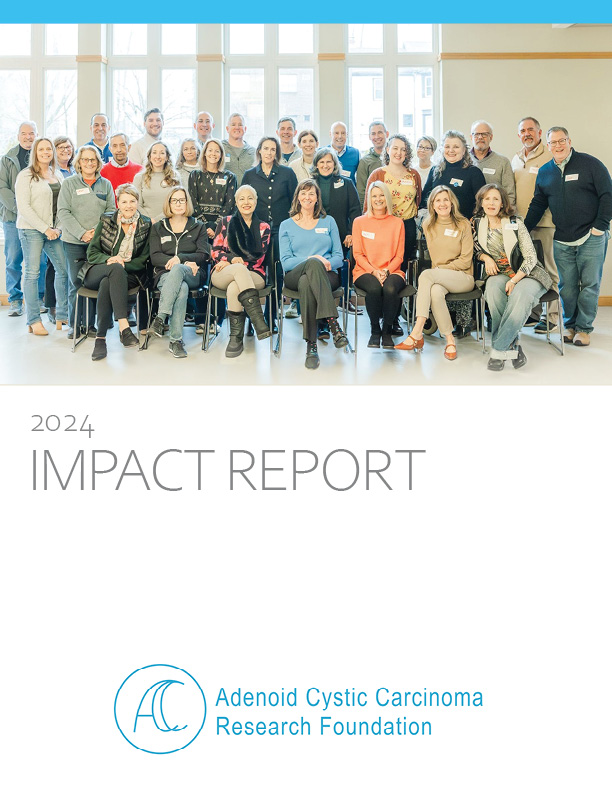
2024 Impact Report

The 2024 ACCRF Impact Report is now available. This inaugural report highlights the foundation's achievements over the past year as well as the advances made in ACC research and treatment.


We are incredibly grateful to the many members of our research and patient communities whose hard work, care, and dedication made 2024 an exceptional year for ACC research and ACCRF.


We hope this report offers a reflection of their remarkable efforts and a renewed energy to continue building toward new treatments and a cure in 2025!

Read the Report Here

ACCRF Home Page


Connect with us on LinkedIn


Find us on Facebook