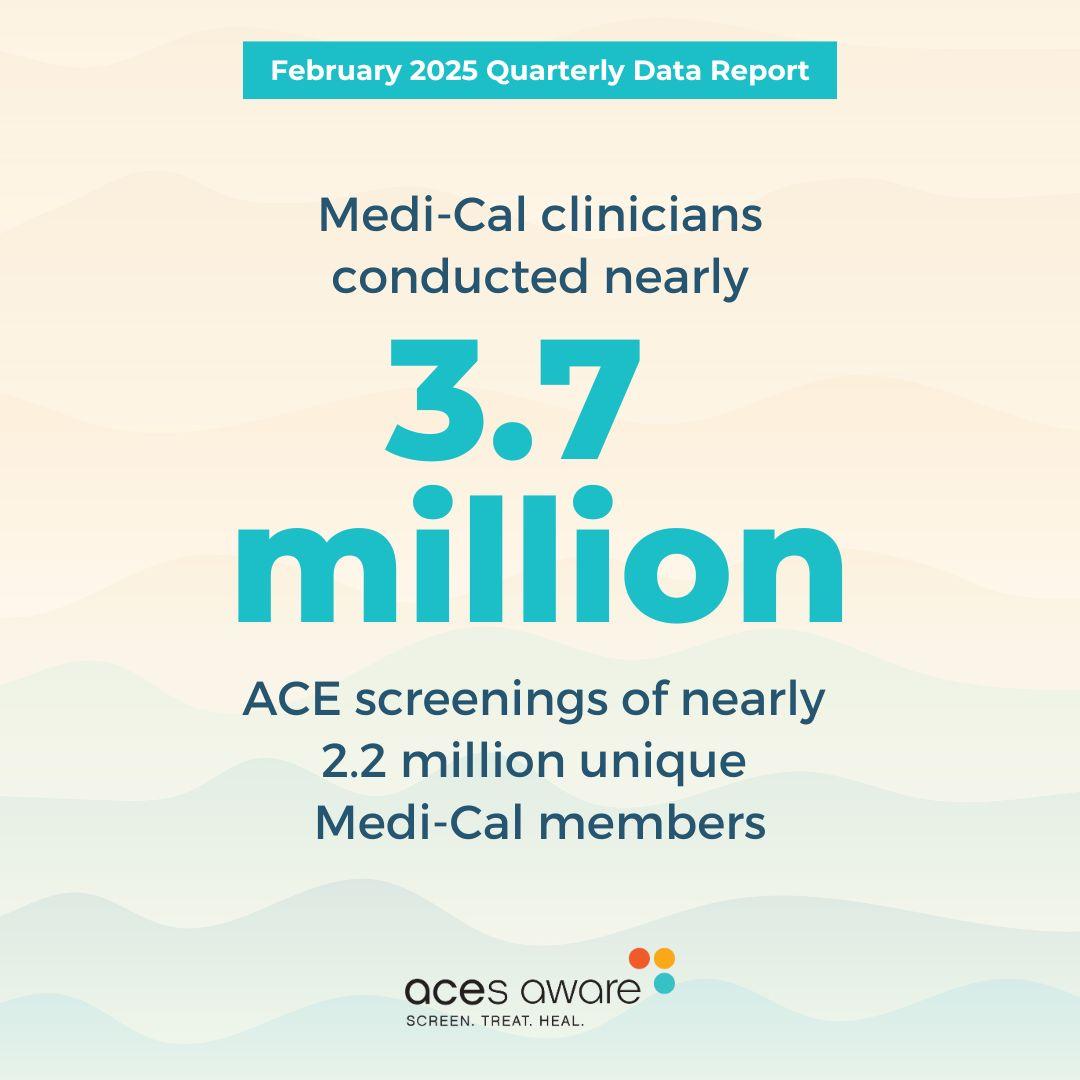
February 2025 Quarterly Data Report: Health Care Teams Have Conducted Nearly 3.7 Million Adverse Childhood Experiences (ACEs) Screenings of Nearly 2.2 Million Medi-Cal Members | |
|
The ACEs Aware initiative released the February 2025 quarterly data report detailing the number of ACE screenings conducted for Medi-Cal members (children and adults) and the number of individuals who completed the Becoming ACEs Aware in California online training.
Between January 1, 2020, and March 31, 2024, Medi-Cal clinicians conducted 3,668,710 ACE screenings of 2,187,040 unique Medi-Cal members. Between December 4, 2019, and December 31, 2024, more than 43,870 individuals completed the Becoming ACEs Aware in California training, including approximately 20,720 Medi-Cal clinicians who are ACEs Aware-certified and eligible to receive Medi-Cal payment for conducting ACE screenings.
| |
|
Visit the ACEs Aware Data Reports webpage for easy access to Medi-Cal screening data and all past ACEs Aware data reports, interactive data visualizations of screening data by age and county, and county-level data for completions of the Becoming ACEs Aware in California core training. | |
|
Upcoming Community Spotlight Webinar:
EMS Corps: Shifting Agency and Power in Health Care
| | |
|
|
Young people who have experienced adversity can be among the most competent healers, protectors, and lifesavers in a community, yet they are historically underrepresented in the emergency medical services (EMS), fire service agencies, and allied health workforce.
Join us on March 6, 12 – 1 pm, for this Community Spotlight webinar, which will be presented by Michael Gibson, MPA, PCC, and Alex Briscoe. It will focus on how the EMS Corps program combines rigorous emergency medical technician (EMT) training with counseling, healing circles, professional development, and an earned stipend to train young people facing barriers to employment, including people in foster care and involved with the justice system, for careers in health care and fire service agencies.
| |
Referrals to Free and Low-Cost Community Programs – An Important Part of the ACE Screening Response | | |
|
Free and low-cost recreational, educational, and social programs that can help youth and adults improve their health and well-being are widely accessible throughout California. Referring patients and clients to these programs and activities can be an important part of the clinical response to an ACE screen. These programs provide opportunities for people impacted by ACEs to mitigate the toxic stress response through physical activity, supportive relationships, and experiencing nature, among other Stress Buster strategies.
Widely available free or low-cost programs in California include:
| |
|
|
For Youth:
National nonprofit that creates and supports one-on-one mentoring relationships between adult volunteers ("Bigs") and children ("Littles") ages 5 through young adulthood.
National nonprofit that provides after-school programs and services to youth, aiming to help them reach their full potential as productive, caring, and responsible citizens.
- Departments of Parks and Recreation
Local parks and recreation departments offer youth enrichment programs, day camps, sports leagues, classes, and more.
Libraries across California are a great community resource for reading programs, story time, and family bonding experiences.
National nonprofit committed to strengthening community by empowering young people, improving the health and well-being of people of all ages, and inspiring action in and across communities.
For Adults:
Browse hiking clubs across California to find the one that’s best for you.
- Departments of Parks and Recreation
Local parks and recreation departments across California offer recreational opportunities for adults, such as sports leagues.
Many libraries across the state, such as the Los Angeles County Library, offer programs for adults, including book club gatherings.
Search thousands of volunteer opportunities in your city to connect with your community, strengthen your sense of purpose, and make an impact.
Visit the ACEs Aware website to learn more about the clinical response to an ACE screen. To learn more about evidence-informed stress mitigation strategies – Stress Busters – that can help manage day-to-day stress and counter toxic stress from ACEs, visit our Manage Stress website.
| |
ACEs Aware Councils: Spotlight on Youth and Young Adult Council | |
|
The ACEs Aware initiative’s programs and activities are informed by four councils comprised of youth and adults from across California. The Youth and Young Adult Council, Community Council, Patient Advisor Council, and Science Council provide valuable input to the ACEs Aware initiative, ensuring that the lived experiences of individuals and communities throughout the state are reflected in the initiative’s work.
This month, we spotlight our Youth and Young Adult Council.
| | |
|
|
Six young adult patient advisors and facilitators from communities disproportionately impacted by ACEs co-design and co-facilitate the ACEs Aware 15-member youth and young adult council, which meets monthly. Together, they form a group of 21 youth and young adults who represent all regions in California and represent lived experiences, including being immigrants, undocumented, living in rural communities, or system-impacted through foster care, incarceration, or being unhoused.
The council has traveled all over California for ACEs Aware and supported the Children and Youth Behavioral Health Initiative’s (CYBHI) Live Beyond campaign to spread the word about ACEs, share insights from the young adult perspective, emphasize the importance of youth co-creation with providers, design campaign resources, and more.
| |
Learn more about members of the Youth and Young Adult Council, who are profiled on the Live Beyond campaign website at LiveBeyondCA.org/stories. | |
Events, Resources, and Research | | |
|
|
Upcoming ACEs Aware Webinars
March 6, 12 – 1pm
Community Spotlight: EMS Corps: Shifting Agency and Power in Health Care
Michael Gibson, MPA, PCC
Alex Briscoe
Register →
March 13, 12:30 – 1:30pm
Science and Innovation Speaker Series: Youth Engagement in Child Maltreatment Research
Nicole Racine, PhD
Katelyn Greer
Register →
March 20, 12 – 1pm
Clinical Pilots Series: Using Human-Centered Design to Advance Trauma-Informed Care in Emergency Surgery
Amanda Sammann, MD, MPH
Marissa Boeck, MD, MPH
Maxwell Presser, MD, MPH
Jon Friese, MD, MPH
Register →
March 27, 12 – 1pm
Implementation with Intention: Practical Tools for Building Resilient Communities
Rachel Gilgoff, MD
Register →
ACEs Aware Webinars on Demand
We provide Continuing Education credit for live webinars and the on-demand versions that are posted a few weeks after the live sessions. Visit the ACEs Aware Learning Center to access past webinar trainings.
| | |
|
|
Model for Adaptive Response to Complex Cyclical Disasters
Vibrant Emotional Health
Precipitated by the chronic, recurring disaster of the COVID-19 pandemic, and natural disasters, forest fires and mass casualty events, this framework aims to make sense of and stage responses to the increasingly frequent and complex array of disaster events we face in contemporary society, superimposed atop chronic psychosocial and socioeconomic stressors.
Access →
Youth Suicidal Behaviors: Where Do We Go from Here
NIH Director's Innovation Speaker Series
A fireside chat that provides an overview of the state of youth suicide and suicidal behaviors and the path forward for research, prevention, and intervention.
Access →
Managing Stress
Centers for Disease Control and Prevention
An overview of how stress can impact everyday life and lead to worsening health problems, as well as healthy ways to cope with stress with supporting resources.
Access →
Youth Mental Health Resources
National Alliance on Mental Illness
Resource page offering a variety of mental health resources for kids, teens, and young adults, including BrightLife Kids and Soluna.
Access →
| | |
|
|
Mental Health Disparities Among LGBTQ People in the US —Time to End the Stigma
January 2025 | JAMA Network
Examines the significant mental health disparities experienced among sexual and gender minority individuals in the U.S. today.
Read→
Is Intimate Partner Violence a Risk Factor for Alzheimer’s Disease?
November 2024 | Cambridge University Press
Explores whether Alzheimer’s Disease is an unacknowledged consequence of intimate partner violence.
Read→
Adverse Childhood Experiences, Brain Function, and Psychiatric Diagnoses in a Large Adult Clinical Cohort
October 2024 | Frontiers in Psychiatry
This study aims to evaluate how patient-reported ACEs are associated with brain function in adults, across diagnoses.
Read→
| |
|
Are You Ready to Become ACEs Aware?
Becoming ACEs Aware in California is a free, two-hour online course for clinics to become trauma informed and launch an ACE screening initiative. Join more than 43,000 people who have completed the training, and learn about ACE screening, toxic stress risk assessment, trauma-informed care, and evidence-based strategies to mitigate the toxic stress response.
After completing this training, qualified Medi-Cal clinicians are certified to receive $29 for each eligible ACE screening they conduct. Continuing Education credit is also available. Visit the ACEs Aware Learning Center to take the training today.
This activity is approved for AMA PRA Category 1 Credit™ and other continuing education credit.
| |
Follow ACEs Aware on Social Media | |
Don't forget to add questions@acesaware.org to your safe sender list. | | | | |