View as Webpage

Monthly NEWSLETTER

April 2025

April Membership Meetings Recap

The April 3rd best practice training focused on legislative advocacy, current policy issues, and state-level behavioral health initiatives. ACMHAI lobbyists Liz Brown-Reeves and Kristin Rubbelke led the advocacy training session. Liz provided an overview of legislative advocacy, emphasizing the importance of grassroots engagement and personal relationships with legislators, noting that advocacy is most effective when community members are involved. Liz and Kristin also discussed the key players in Illinois government, including the roles of the Governor’s office, legislative leaders, and committee chairs, and highlighted the importance of understanding who influences mental health policy. Members were encouraged to become trusted sources of information for legislators and to use the Illinois General Assembly website to track bills and legislative developments. They explained how to interpret bill statuses, such as “re-referred to rules” meaning a bill is likely dead, and stressed the importance of strategic advocacy by focusing on priority issues rather than reacting to every bill. View the slide deck


Representative Lindsay LaPointe stressed that behavioral health is a bipartisan issue and outlined recent state efforts to improve access and affordability. She highlighted major legislative priorities, including removing prior authorization for outpatient behavioral health, improving insurance network adequacy and reimbursement rates, building out the crisis response system (988), addressing workforce challenges, and emphasizing the need for sustainable funding and continued advocacy for harm reduction and criminal justice reforms.


Ryan Rollinson, Chief of Staff at DMH - IDHS, discussed the integration of mental health and substance use divisions, workforce investments, and the Beacon portal for youth behavioral health. He addressed challenges from federal funding cuts and the need for sustainable state funding, and provided updates on 988 system performance and ongoing efforts to improve crisis response, especially in rural areas.


Senator Laura Fine provided an update on the Senate’s behavioral health committee and the legislative push for 988 funding. She outlined a 10-year plan for building out the crisis response system, emphasizing the need for responsible, phased implementation and sustainable funding sources.


April 4, 2025 – Business Meeting

On April 4th, attendees participated in the April Business Meeting, which included regular standing business meeting reports as well as several presentations.


During the Transportation Summit Roundtable, Deborah Humphrey, Executive Director of the Madison County Mental Health Board, facilitated a discussion about the transportation summit co-hosted by Madison and St. Clair Counties. The summit aimed to address barriers to accessing behavioral health services by focusing on resource mapping, stakeholder engagement, and education about available transportation services.


In the Community Reports section, Jim Russell, Executive Director of the Vermilion County Mental Health Board, highlighted the board’s success in increasing funding and the importance of maintaining strong relationships with local government. Teena Mackey, Executive Director of the Will County Community Mental Health Board, provided an overview of the formation and early work of the Will County Community Mental Health Board.


Regarding Bylaw Amendments, Amanda Teachout, Mental Health Board Manager of Hanover Township, reviewed several proposed changes on behalf of the work of the Executive Committee. These amendments were designed to reflect current practices, clarify voting procedures, committee participation, and contract review requirements. The proposed amendments for 2025 were approved by the membership.


Stay tuned for information about the August membership meetings, which will be held virtually, and be sure to mark your calendar for the in-person meeting at the Hyatt in Schaumburg on December 4-5, 2025.


Upcoming ACMHAI Standing Committee Meetings


  • I/DD Committee: May 13, 2025 at 10:00 am | Zoom Link
  • Legislative Committee: May 20, 2025 at 9:00 am | Zoom Link
  • Children's Behavioral Health: May 22, 2025 at 10:00 am | Zoom Link
  • Membership Committee: May 27 at 10:00 am | Zoom Link


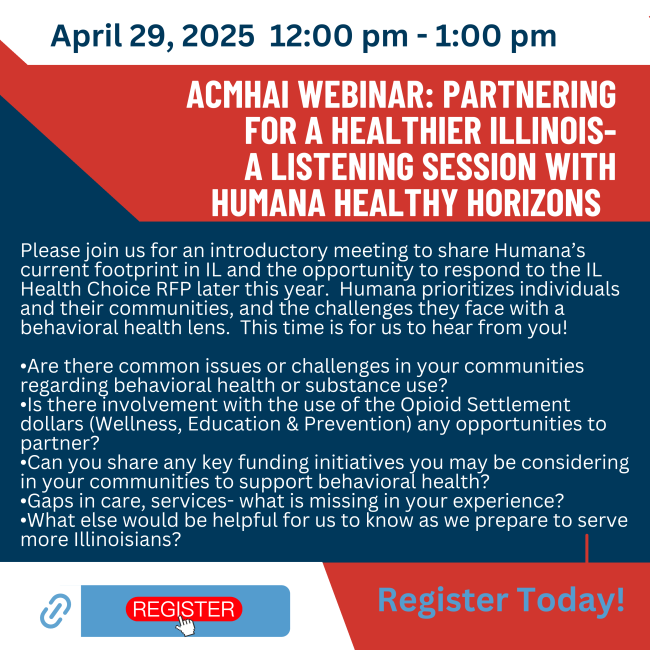
Download the Humana IL Footprint Document

ACMHAI Archived Webinars


ACMHAI recently hosted a webinar on the "Jail Based Mental Health Program Pilot" presented by Dr. Sharon Coleman, Deputy Director of Forensics and Justice Services, IDHS. If you were unable to attend the webinar, click here to view the archived recording and view the Slide Deck.


ACMHAI also hosted a webinar presented by two of our members, Deborah Humphrey, Madison County Mental Health Board and Amy Hopper, McLean County Health, focusing on leveraging opioid settlement funds. Click here to view the archived recording and view the slide deck.


Stay tuned for more updates as the Membership Committee finalizes the 2025 webinar schedule!


We are delighted to extend a warm welcome to the Sangamon County Mental Health Commission as a new member joining the ACMHAI community!

PARTNER NEWS


Chief Behavioral Health Officer Update

The Office of Medicaid Innovation has scheduled a virtual Town Hall with Chief Behavioral Health Officer Dr. Burnett-Zeigler on June 4, 2025, from 12:00 to 1:30 p.m. Dr. Burnett-Zeigler and other state agency leaders will discuss strategic priorities for behavioral health in Illinois and are seeking input from residents through a statewide survey. Register here.


SUPR Update

During the recent SUPR Advisory Council meeting, Interim Director Rafael Rivera provided updates on the contract right-sizing process, upcoming budget finalization, and funding allocations, including a $2 million increase tied to the IABH rate and $9 million for the women’s block grant. Director Rivera assured providers that SUPR is committed to reinvesting funds and collaborating with other agencies to address federal funding uncertainties.


DHS Update

The Illinois Department of Human Services has released a Notice of Funding Opportunity for the Community Youth Services Grant Program, aimed at preventing youth delinquency and violence through community engagement and service coordination. Applications are due by noon on May 7, 2025, and questions can be submitted until May 1. Applications must be submitted to DHS.PositiveYouthDevelopment@illinois.gov


Behavioral Health Workforce Center Advisory Council Meeting

The Behavioral Health Workforce Center (BHWC) Advisory Council recently convened to review ongoing projects, survey results, and strategies aimed at strengthening Illinois’ behavioral health workforce. The Council discussed findings from a statewide survey on the preparation of early-career behavioral health providers, which will help inform future recruitment, training, and retention initiatives. View survey report


Transforming Behavioral Health Workforce Retention: Innovative Strategies for Illinois Providers


The Illinois Behavioral Health Workforce Center is hosting a virtual training event on April 20, 2025, focused on innovative strategies to improve retention of behavioral health providers. This interactive session will highlight successful approaches used by organizations in Illinois, encourage collaboration, and support the co-creation of a Retention Toolkit with practical steps any provider can implement. Register for Training


National Council for Mental Wellbeing

An internal federal Department of Health and Human Services document has been circulated by several organizations, which details $30 billion in proposed FY26 cuts and major restructuring to agencies, including the proposed elimination of Certified Community Behavioral Health Clinics (CCBHCs). In summary, these proposed cuts would significantly reduce funding for mental health and substance use disorder services and eliminate the CCBHC program, a critical model for comprehensive behavioral health care. Link


Congress is currently in recess until April 28, with major legislative action expected upon their return. The House Energy and Commerce Committee is preparing to draft legislation that would cut $880 billion from programs under its jurisdiction, including Medicaid, with committee leadership indicating that $500 to $600 billion of these cuts could come from health care programs. While GOP leaders have stated that Medicaid will not be targeted beyond addressing “waste, fraud, and abuse,” there is significant uncertainty about what the final proposals will include, and some Senate Republicans have expressed opposition to any package that significantly impacts Medicaid. The House aims to complete a reconciliation bill by the end of May, but there is skepticism about meeting that timeline, and the Senate’s approach remains unclear. Proposals to reduce Medicaid spending have included work requirements, changes to provider tax policies, and adjustments to the federal matching formula, with advocates and stakeholders closely watching for developments. Medicaid Reform Proposals: The Impact of Changes to FMAP and States’ Use of Provider Taxes

Latest Published News


Raoul urges Congress to take action on PBM regulations


Whitehorn says HFS moving forward with initiatives amid uncertain federal support


Zero Suicide Model Implementation and Suicide Attempt Rates in Outpatient Mental Health Care


2 Illinois teens’ push for expanded mental health education in schools spurs new bill in General Assembly


Proposed Cuts to Medicaid Deeply Unpopular Across Party Lines, New NAMI-Ipsos Poll Finds


Decoding the HHS Reorganization


DMH Communication Alert – BHWC: Free Behavioral Health Training Opportunities


Budzinski Introduces Bipartisan Legislation to Expand Telemedicine, Behavioral Health Treatment in Rural Communities

View Latest News

ACMHAI | acmhai.org