Latest news


AI and the future primary care workforce


Working with ACT Center and Mathematica, the California Health Care Foundation explores AI technologies in primary care

As the use of artificial intelligence (AI) in health care becomes more prevalent, it's important to understand how AI technologies might influence the primary care workforce. In an ongoing project led by the California Health Care Foundation, ACT Center Collaborative Scientist Jess Mogk helped distill key insights on the future of AI in primary care into a new issue brief intended to inform state policies and investments that strengthen the team-based primary care workforce in California.


Leveraging research capabilities to advance social health


How Kaiser Permanente works with SONNET and ACT Center to address members’ social needs in Washington and beyond

With a growing understanding of the role social health plays in people's overall health, Kaiser Permanente is tapping into its research capabilities in Washington and nationwide to learn how best to identify members' social needs and help resolve them. In this blog, Meagan Brown shares highlights from her work as director of Kaiser Permanente's Social Needs Network for Evaluation and Translation (SONNET) and leader of the ACT Center's social health projects at Kaiser Permanente Washington.


Learning Health System Program spotlight


Improving Medicare Annual Wellness Visits


In partnership with health system leaders at Kaiser Permanente Washington, the ACT Center is leading a Learning Health System (LHS) Program project to help improve the experience and quality of care for members with Medicare 

The objective

Improving care quality and experience for members covered by Medicare is a top priority for Kaiser Permanente Washington in 2025. To meet this goal, a comprehensive support system is being implemented, including the Personal Assessment of Total Health (PATH) — a questionnaire to collect and track health status information from members with Medicare — and Annual Wellness Visits (AWVs) tailored to deliver personalized care for members age 65 and up.


The work

The ACT Center is partnering with care delivery teams to provide targeted implementation support for the PATH and AWV initiatives. This includes developing a logic model, defining outcome metrics, optimizing workflows, improving electronic health record and reporting tools, and developing provider education and training. We will test and refine implementation supports at 2 pilot clinics starting late this summer. The team is focused on building practical, evidence-based implementation tools that can be spread systemwide.


What we’re learning

Challenges have surfaced in implementing the PATH and AWV initiatives, including the need for continuous iteration with operational teams to ensure that care team and patient experiences are seamless. The logic model, workflow analyses, and a deep dive into reporting and metrics have highlighted important opportunities to increase specificity and align goals. Insights from implementation are helping health system leaders identify ways to sustain and strengthen efforts to roll out these initiatives across primary care clinics.


What we’re hoping to achieve 

By the end of the year, Kaiser Permanente Washington aims to complete 32,500 PATH assessments and fully embed the PATH and AWV initiatives into ongoing operations and clinical care. The overarching goal is to create a scalable model that reliably improves care experiences and outcomes for Medicare members.


Conference highlights


AcademyHealth's Annual Research Meeting features ACT Center findings on improving long-term pain care and boosting cancer screening rates

In June, the ACT Center's Claire Allen and Jess Mogk presented findings from 2 Kaiser Permanente Washington LHS Program projects at the 2025 AcademyHealth Annual Research Meeting in Minneapolis:


  • Claire was selected for a podium presentation on the theme of improving safety, quality, and value. She shared results from the ACT Center's evaluation of the Integrated Pain Management Program, which implemented patient-centered Opioid Safety Committees to improve the safety of opioid prescribing for members with ongoing pain. (view PDF of presentation slides)


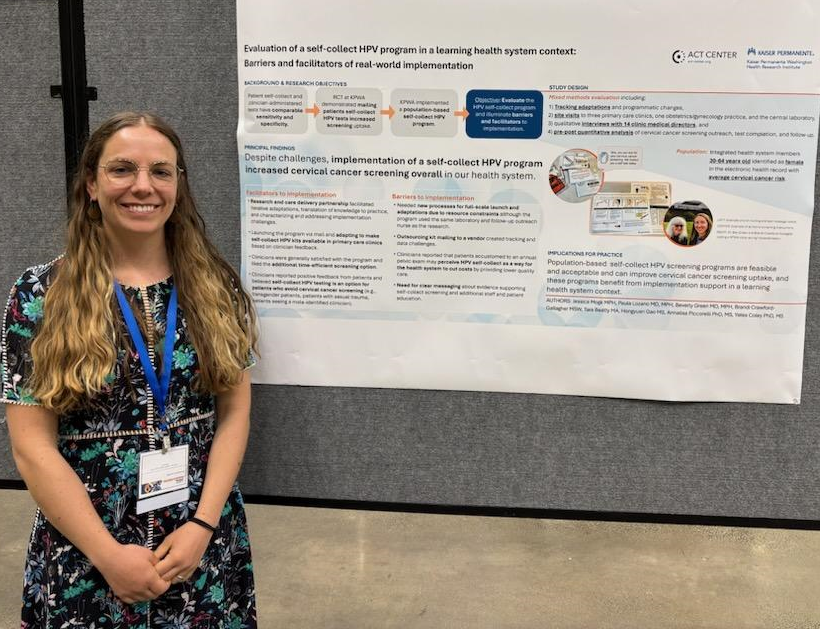
  • Jess presented a poster describing the ACT Center's evaluation of the Self-Collect HPV Program, which increased cervical cancer screening rates — especially among members who were overdue for screening. Her poster provided insights on various facilitators and barriers to implementing self-collect HPV screening across a health system. (view PDF of poster)

Paula Lozano, Claire Allen, and Jess Mogk


Jess Mogk with her poster


Resource library


Find rapid evidence scans in the ACT Center resource library


Among the many resources available in the ACT Center’s online library are more than a dozen rapid evidence scans that briefly summarize published research findings to help health care organizations answer timely questions in an evidence-based way. Visit the resource library to find evidence scans on important topics such as:


More from the library


Check out the patient-authored Toolkit for Managing Persistent Pain, available in English and Spanish.


Stay in touch


We'd love to hear what you're working on! Email us at act-center@kp.org.


Did you miss our last newsletter? Read the previous issue.


Follow us on LinkedIn or share this email with your network:

LinkedIn
LinkedIn Share This Email


We at the Center for Accelerating Care Transformation would like to acknowledge that we are on the ancestral lands and traditional territories of the Puget Sound Coast Salish People.


© 2025 Center for Accelerating Care Transformation (ACT Center)


Masthead photography and design by Robert Frazier.