Latest news


Improving pain care by restoring patient-clinician trust 


New ACT Center paper explores how health systems can improve opioid prescribing safety with patient-centered care

Since 2019, the ACT Center has been working alongside patients and clinicians at Kaiser Permanente Washington to design, implement, and evaluate the Integrated Pain Management (IPM) Program, which aims to improve the safety of prescription opioids while still providing whole-person care for people who live with ongoing pain. Their new paper in The Journal of Pain explores how health systems and clinicians can rebuild trusting patient-clinician relationships, provide patient-centered pain care, and include patient perspectives in opioid safety processes.

Read more
 

Learning Health System Program spotlight


Helping care teams identify pediatric growth failure


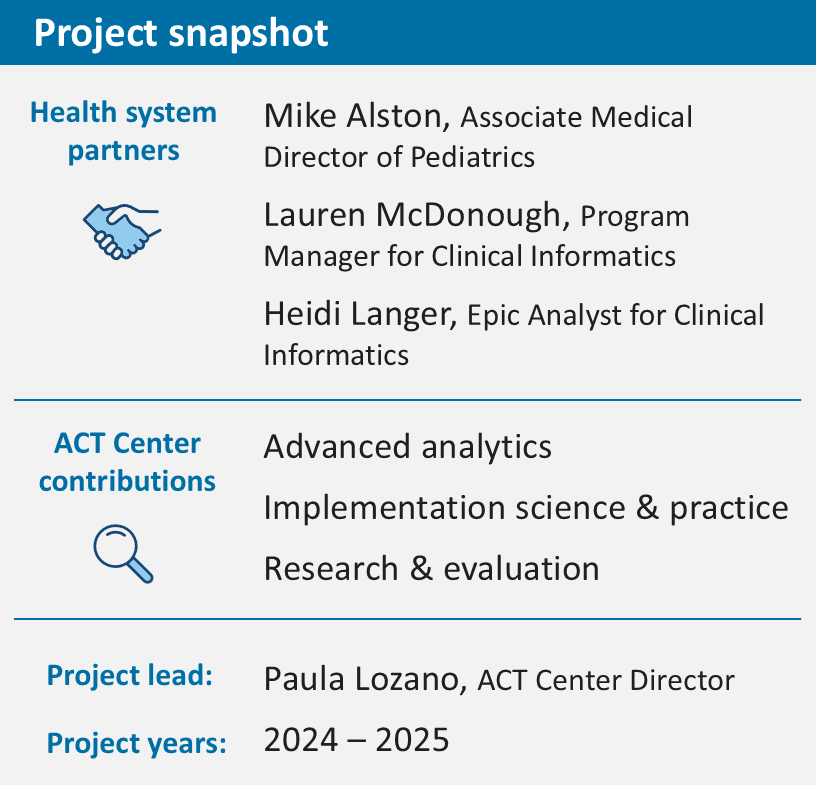
In partnership with health system leaders, the ACT Center is working to develop a reliable way to alert clinicians when children aren't meeting growth targets

The objective

Kaiser Permanente Washington’s Pediatric Growth Curve Project aims to optimize an electronic health record (EHR) function that alerts clinicians when infants, children, and adolescents are not meeting growth targets. The project envisions an accurate and timely “best practice advisory” (BPA) prompt for clinicians to intervene when EHR data indicates a child may not be meeting targets.


The work

ACT Center researchers and health system leaders are partnering to explore the feasibility of using the Z score of the slope in weight-for-age to trigger alerts. (The Z score is a numerical value indicating deviation from the expected value.) This involves learning how weights are collected and how Z scores are calculated and reported in the EHR. The team has worked to define a set of growth failure diagnoses to validate the alert, as well as a set of diagnosis codes that are associated with acute weight loss. Either type of abnormal growth pattern could warrant medical intervention.  


What we’re learning

The team is assessing how different metrics vary when different Z score thresholds are used. This allows them to test how steep a weight loss (or how marked a decrease in weight gain) needs to be to ensure that the BPA identifies the children who warrant intervention for growth failure. By evaluating a range of thresholds, we hope to miss as few growth failure cases as possible while avoiding falsely activating the alert for children who don’t have growth failure. 


What we’re hoping to achieve 

The team is working on determining a reasonable threshold for the Z score change to test and ultimately implement as a BPA to help identify children as soon as possible who may not be meeting growth targets — while also avoiding alert fatigue among clinicians.


Featured publication


New paper sheds light on how social health is linked to intersecting identities of age, income, and race and ethnicity

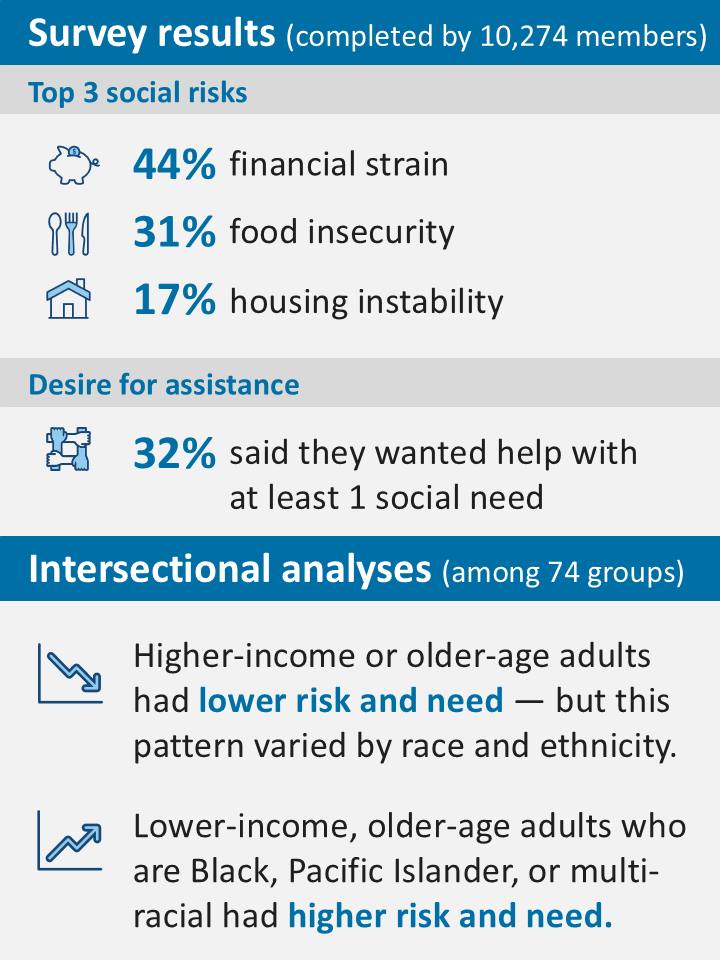
Longtime ACT Center partner Meagan Brown recently led a paper sharing results from a social health survey among more than 10,000 adult members of Kaiser Permanente nationwide. Published in the February 2025 issue of AJPM Focus, the paper found that the top 3 social risks faced by members were: financial strain (44%), food insecurity (31%), and housing instability (17%). In addition, nearly one-third of members said they would welcome assistance with at least social need.


Importantly, Brown and her team also used intersectional analyses to examine how the intersecting social identities of age, income, gender, and race and ethnicity were associated with social risk and need. “We found that risk and need were higher among specific intersectional groups — and in particular among lower-income, older-age adults who are Black, Pacific Islander, or multi-racial,” she explained. “This points to the importance of investing not just in social needs screening but also in upstream changes to improve the social safety net and advance policies to reduce racial and economic inequities.”


Brown, who directs Kaiser Permanente's Social Needs Network for Evaluation and Translation (SONNET), led the survey with funding from the Kaiser Permanente Office of Community Health.


Conference highlights


ACT Center shares insights on social health, advanced analytics, and health equity at national conferences

Recently the ACT Center had exciting opportunities to share our work at 2 national conferences: the AcademyHealth Annual Conference on the Science of Dissemination and Implementation (D&I) and the Social Interventions Research and Evaluation Network (SIREN) National Research Meeting.


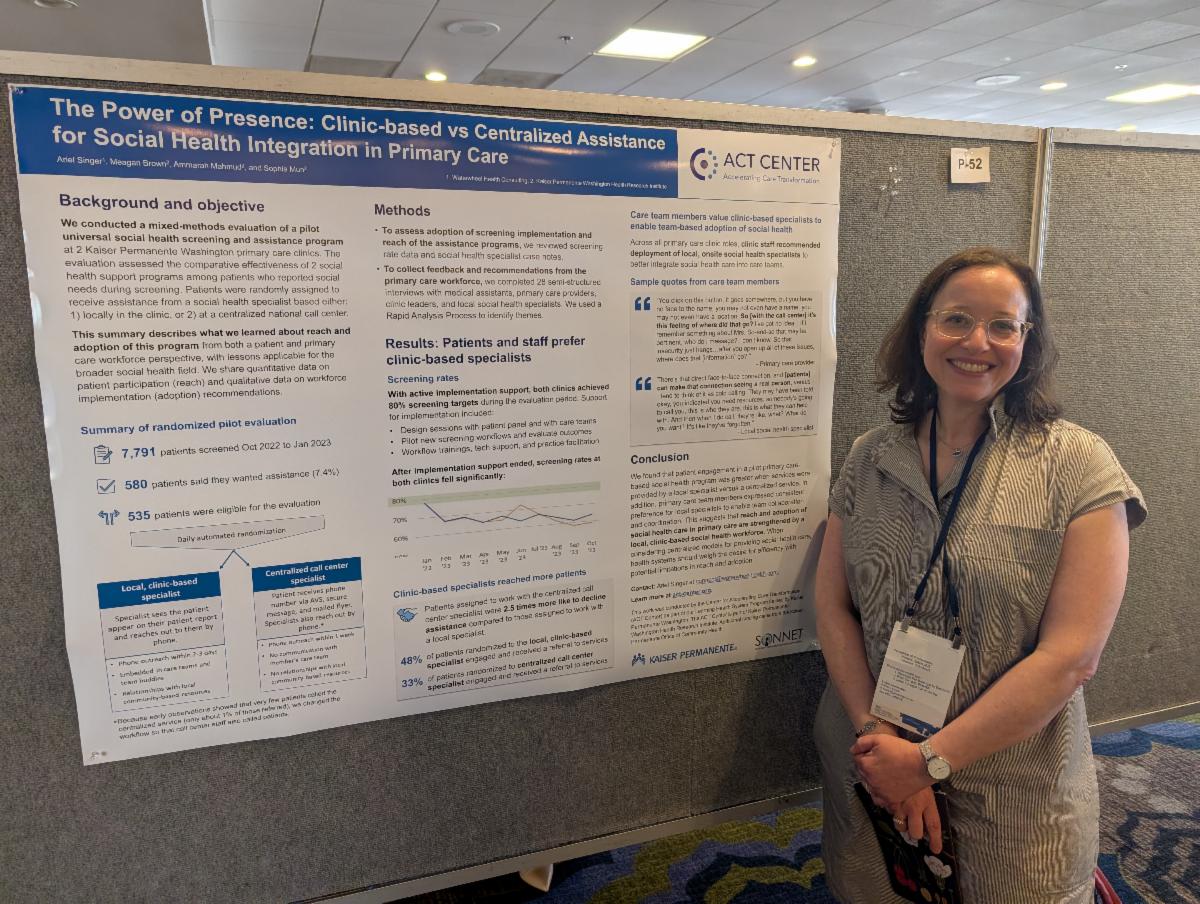
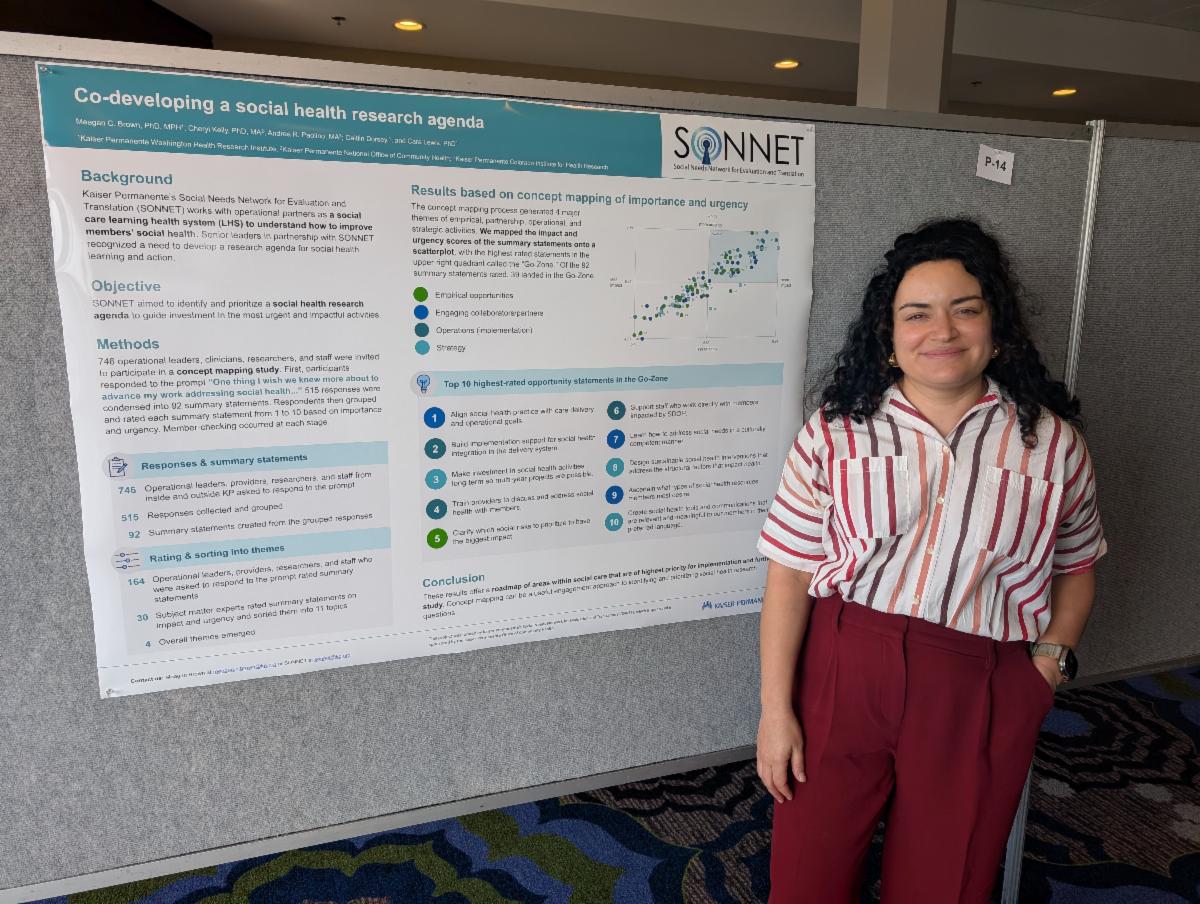
Cosponsored by Kaiser Permanente, the SIREN National Research Meeting on Advancing the Science of Social Care took place earlier this month in San Diego. The poster sessions featured several projects from both the ACT Center and Kaiser Permanente’s Social Needs Network for Evaluation and Translation (SONNET), including:

  • ACT Center Consultant Ariel Singer shared insights from the Social Health Integration Pilot she helped implement at Kaiser Permanente Washington, focusing on the reach and adoption of clinic-based versus centralized assistance for social health in primary care (view poster).
  • SONNET Director and ACT Center team member Meagan Brown summarized results from a concept-mapping process to codevelop a social health research agenda for Kaiser Permanente (view poster).
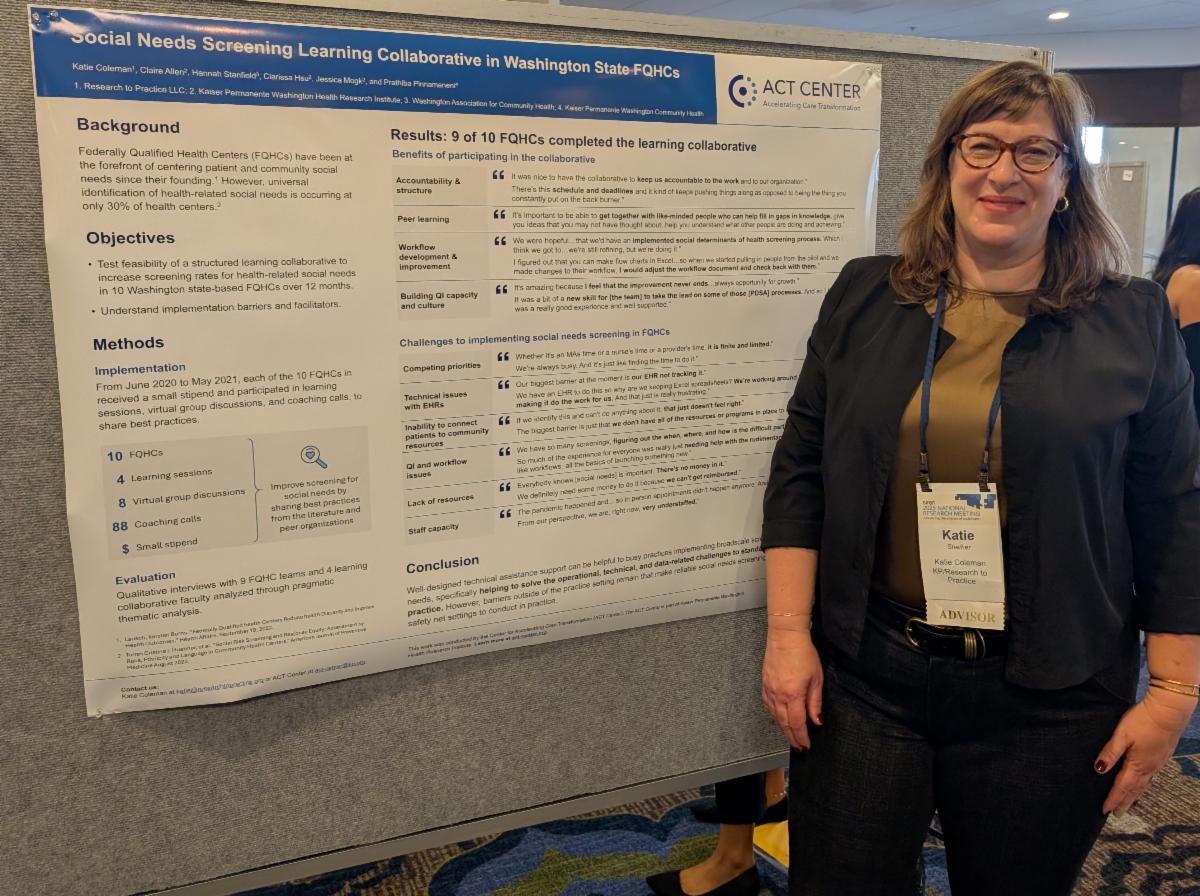
  • Former ACT Center and SONNET Director Katie Coleman presented two posters — one describing SONNET’s evolution and capabilities (view poster) and another focused on the ACT Center’s work to develop and evaluate a social needs learning collaborative in federally qualified health centers in Washington state (view poster).


The AcademyHealth D&I conference in Arlington, Virginia, in December featured 3 posters from ACT Center team members:

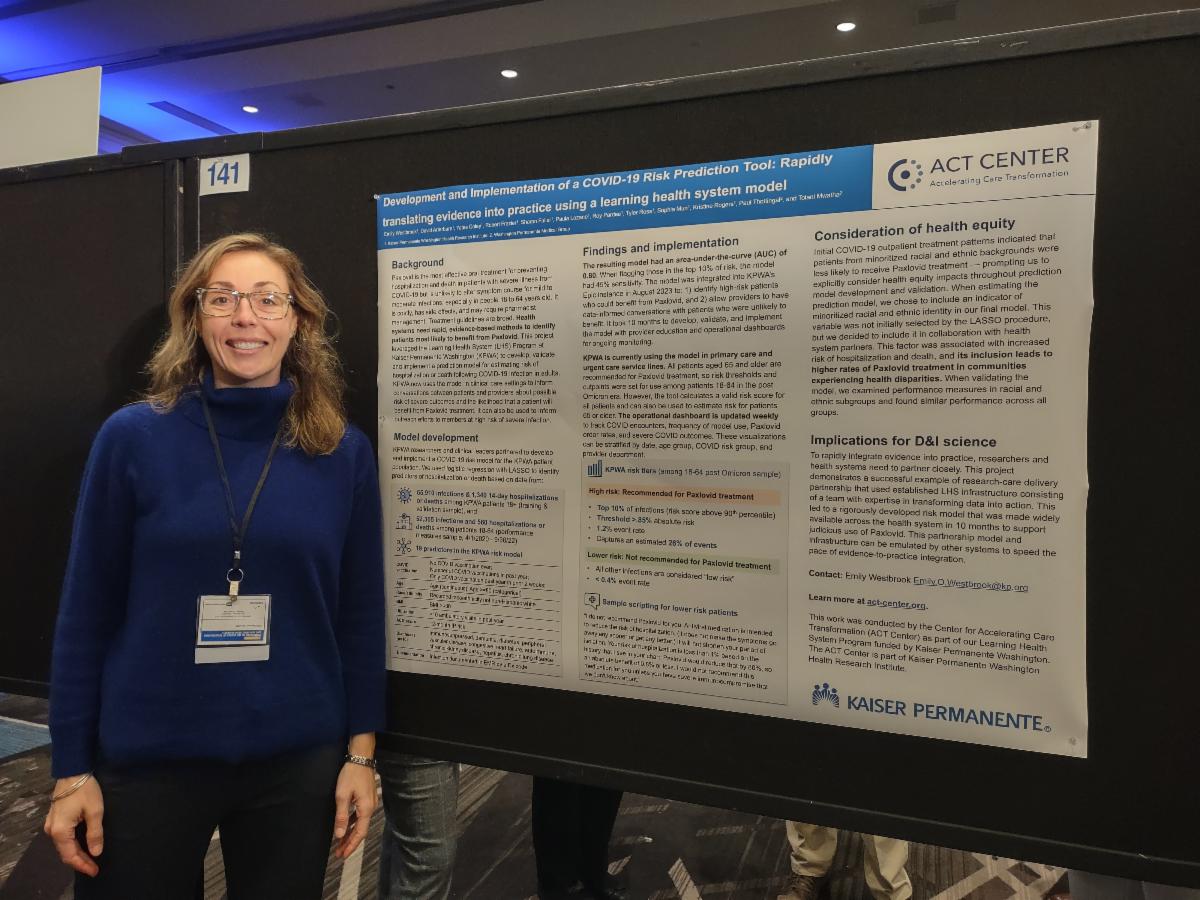
  • Director Emily Westbrook presented a poster from the ACT Center’s advanced analytics work to develop and implement a COVID-19 risk prediction tool using the learning health system model at Kaiser Permanente Washington (view poster).
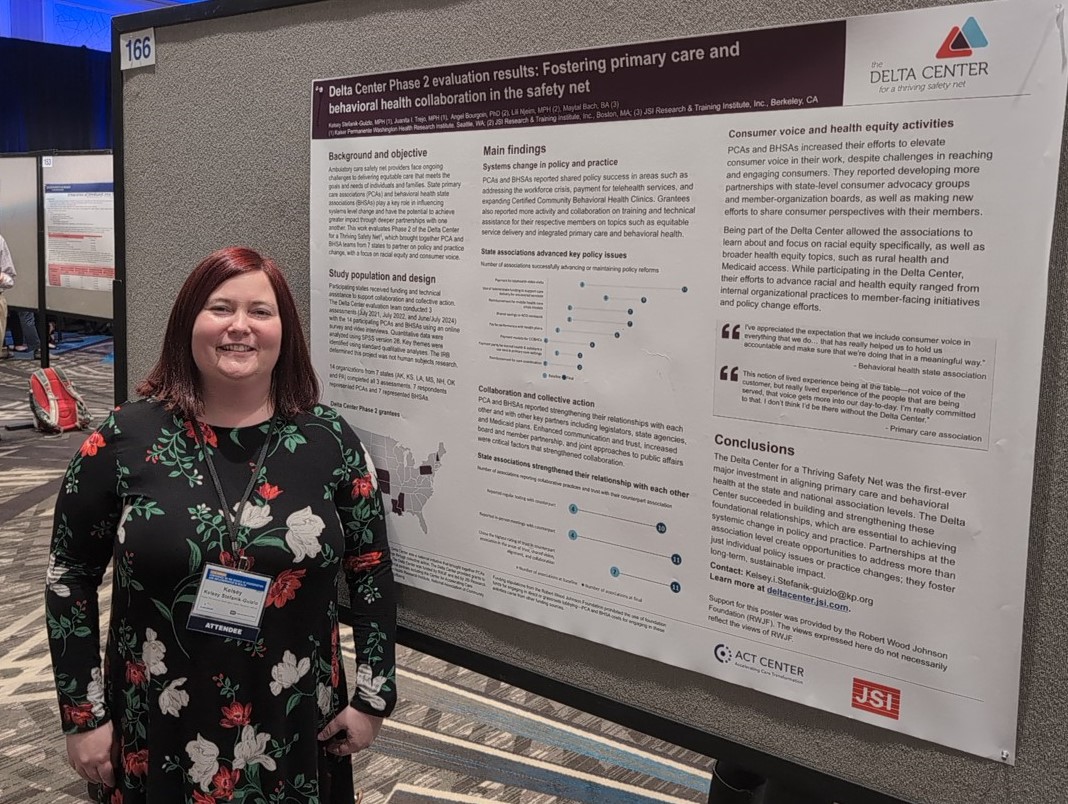
  • Collaborative Scientist Kelsey Stefanik-Guizlo shared insights from the Delta Center for a Thriving Safety Net in two posters — one focused on strategies for advancing health equity policy in conservative states (view poster) and another that shared evaluation results from the Delta Center’s effort to foster primary care and behavioral health collaboration in the safety net (view poster).

SIREN poster presenters (top to bottom): Ariel Singer, Meagan Brown, and Katie Coleman.

AcademyHealth D&I poster presenters (top to bottom): Emily Westbrook and Kelsey Stefanik-Guizlo.


Stay in touch


We'd love to hear what you're working on! Email us at act-center@kp.org.


Did you miss our last newsletter? Read the previous issue.


Follow us on LinkedIn or share this email with your network:

LinkedIn
LinkedIn Share This Email


We at the Center for Accelerating Care Transformation would like to acknowledge that we are on the ancestral lands and traditional territories of the Puget Sound Coast Salish People.


© 2025 Center for Accelerating Care Transformation (ACT Center)


Masthead photography and design by Robert Frazier.