Provided by the American Dairy Science Association® (ADSA®) in cooperation with Feedstuffs. If you received this issue of ADSA Dair-e-news from a friend and would like to receive your personal copy in the future, please contact keolson@prodigy.net
Opinion and editorial content included in the Dair-e-news represent the views of the authors. Publication does not represent endorsement of any position by the ADSA. Depending on your email preview settings, all text may not be visible. If you find that to be the case, simply click to open the email or use the link at the top to open the web version.
|
|
SPECIAL ADSA ANNUAL MEETING COVERAGE |
|
Welcome to our special edition of the ADSA Dair-e-news featuring coverage of the 2022 Annual Meeting. Attendance both in-person and virtual is excellent with registration now over 1,650 from 45 countries. If you are at the meeting, stop by the ADSA Booth (203,302) to say hello and get added information.
Special thanks to our undergraduate and graduate student writers for their coverage of sessions throughout the meeting. Their work makes the newsletter possible.
Below are a few of the highlights from this week:
|
|
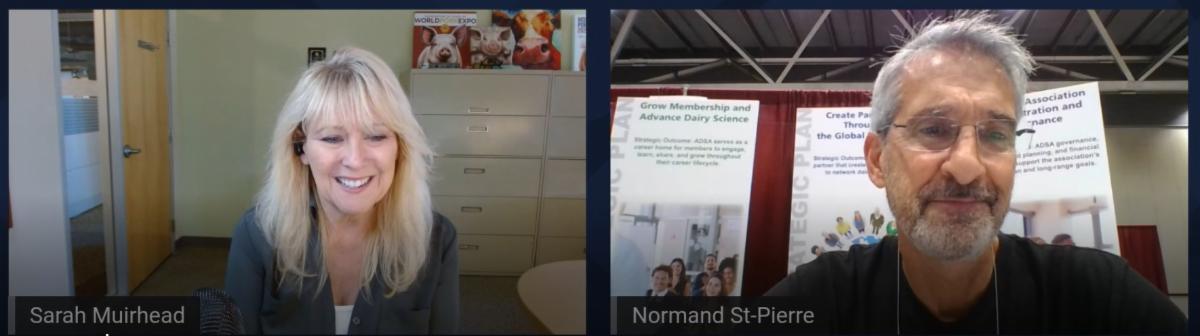
We caught up with ADSA incoming president Norman St-Pierre to get his thoughts on what' ahead for the organization and its members. Among topics we talked about was ADSA strategic initiative to drive growth and unite the global dairy community. To view.
|
|
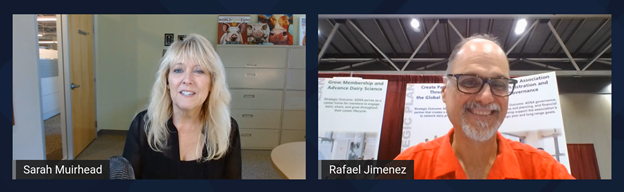
ADSA board member and Ohio State University professor Dr. Rafael Jiménez-Flores joins us to talk about FASS and how it, along with ADSA, works to create the best meeting experience for ADSA members. We also get his perspective on what it’s like to be back face to face with colleagues from around the globe. To view.
|
|
Share your insights on policy priorities
The 2023 USDA budget and the coming Farm Bill have major impacts on priorities areas for agricultural research and the funding that will be available to do the work. ADSA wants to be the strongest advocate possible and is seeking member input on priorities for:
· The Farm Bill,
· Funding for science,
· Climate change and
· The future workforce.
The FASS Science Policy Committee (SPC) is hosting a session titled “Farm Bill and Science Policy Discussion with USDA NIFA.” It will be held from 8:00 to 9:00 AM on Wednesday June 22 in room CC 2201. This is a great time to share your insights
Deb Hamernik, PhD, Deputy Director, Institute of Food Production & Sustainability (IFPS) for NIFA will be at the session to provide updates on NIFA. Members of the FASS SPC will provide an overview of the committee and its activities, updates on the current status of the Farm Bill and FY23 budget as they seek your input on policy priorities for ADSA and FASS to pursue.
If you can’t make this session, stop by the FASS Booth (#315) and share your policy priorities during the meeting. What areas of research can have the greatest potential impact for producers and consumers in the short and long term?
What are the three issues that you feel to be of greatest importance for ADSA to work on as the Farm Bill and Budget move forward and why they are they important?
|
|
ADSA-SAD Dairy Foods Oral Competition focused at several topics
By Rebecca R. Rahn
Six students presented various topics in the ADSA Student Affiliate Division Dairy Foods Oral Competition at ADSA 2022.
The session began with the University of Georgia's Renee Hutton presenting on the legalization of raw milk sales. According to research, consumers have incorporated raw dairy products into their diets for possible health benefits. As a result, consumers have sought loopholes, such as purchasing raw milk sold as pet food for personal consumption. Currently, some states have regulations on raw milk sales, however, these vary across the country. Pushing to legalize testing and inspection of these products can help minimize the risk for those who want to consume raw dairy products.
Josh Becker from Virginia Tech presented on quality control methods for detecting the A1 variant. Individuals with milk sensitivities are usually sensitive to the A1 variant in milk, so companies are beginning to produce A2 variant milk so those with sensitivities can enjoy consuming milk. However, there are no guidelines at the production plant on the acceptable levels of A1 variant allowed in milk marketed as A2 milk. Through methods such as SNP genotyping, ELISA, and Liquid Chromatography and Mass Spectrometry, the levels of A1 variant in a milk sample can be detected, therefore allowing for the beginning of guidelines created so consumers can be confident in the product they are purchasing.
Cessna Langford from the University of Kentucky discussed whether dairy foods are healthy. Conflicting literature exists on the health benefits of dairy products, making it difficult for consumers to make an educated decision on dairy product consumption. She touched on a few different medical diagnoses such as hypertension, diabetes, obesity, and colorectal cancer and how milk has been shown to help. A few examples are how the beta-lactoglobulin found in milk can act as a vasodilator and how calcium can help decrease uncontrolled cell growth that causes colorectal cancer.
Sara Hettinger from the University of Florida presented on synthetic milk and the emergence of cellular agriculture. She went over the in-vitro synthesis of how they create the animal milk protein and culture them in plant fats and sugars. In addition to milk, companies are beginning the production of cheese. However, by definition, these products cannot be called milk. There have also been some studies to see if there is an environmental impact.
Rebecca Rahn from the University of Tennessee presented how milk components affect cheese quality. After reviewing the importance of casein to cheese production, she reviewed the casein micelle structure and how it impacts the coagulatory ability during the cheese-making process. She discussed a study that classified milk samples into four categories and how those milk categories affected the rennet clotting time, curd firming time, and curd firmness. Continuing with a study conducted on the impact of the addition of calcium and calcium with citrate on the size of the casein micelle, rennet coagulation time, and critical coagulation concentration.
Wrapping up the session, Caroline Arrowsmith from The Pennsylvania State University discussed the importance of postbiotics. She explained how postbiotics result from prebiotic digestion and how they can have positive health benefits.
Rebecca R. Rahn is with the University of Tennessee, Herbert College of Agriculture, Animal Science, with a Pre-Veterinary Concentration, Major in Chemistry and Food and Agricultural Business, Minor.
|
|
Growth and Development Symposium: 41st Discover Conference: Health Management of Calves - From Intrauterine Life to Successful Weaning
By Abby McCalmon
The Growth and Development Symposium: 41st Discover Conference (DC): Health Management of Calves - From Intrauterine Life to Successful Weaning was held on Tuesday at the ADSA Annual Meeting.
Dr. Sabine Mann from Cornell University presented and summarized the fetal development and early life session from DC. The objective of this presentation was to summarize the ramifications of late-gestation status on the production of colostrum and its effect on calf health, growth, and survival pre-weaning. More research on this topic can help develop management practices to advance calf health and future cow productivity.
The second speaker was Dr. Micheal Steele from the University of Guelph in Canada, who spoke on new concepts in preweaning and weaning nutrition and management. He summarized the pre-weaning nutrition and the transition to the ruminating calf sessions from DC. The purpose of this presentation was to show the possibility to adopt new precision nutrition and management during the pre-weaning and weaning time period for short- and long-term importance on lifetime performance.
The final speaker Dr. Dave Renaud from the University of Guelph in Canada discussed lessons learned in calf health and welfare. The objective of this presentation was to show the importance of calf health and strategies to decrease disease as well as discuss the challenges of the public’s perception of animal welfare.
Abby McCalmon is starting her second year as a masters student in the Department of Animal Science at the University of Tennessee under Dr. Elizabeth Eckelkamp. She holds a B.S. in Animal Science with a minor in Biology from the same institution. She works with Precision Technology in the Dairy Industry especially Automatic Milking Systems and fetch cow status.
|
|
Original Research Competition allows for research sharing
By Savannah Jones
There were seven participants in the ADSA-SAD Original Research Competition.
The first participant, S. Puda, from Michigan State, gave a thought-provoking presentation on the relationship between dairy cows and the human food supply. The study was focused on if cows could increase or maintain their milk yields while being fed a diet of byproducts only. Cows being fed the byproducts produced 1kg less milk, but more milk fat. Overall they converted feed to protein efficiently.
Alexie Holhenshell from University of Missouri, gave a presentation on disbudding in holsteins calves and its effect on the expression of immune genes. She found that the stress of disbudding at a young age has a chemical effect on the way the calves' immune systems will work later in life.
The third presentation was done by Anna Cappellina from Virginia Tech on the effects of plant maturity on yield and nutritional variables of small grain silage. This study noted that boot stage harvested small grains are of better nutritional quality.
The fourth presentation was done by Jessica Brasier from University of Guelph. She studied cow behavior and its relation to robotic milkers and partuition. She found that there is some positive relation between the cows behaviors and their production in automatic milking systems.
Mikel Shabloski from Penn State University gave a presentation on haptoglobin levels and dry period. The results from her study suggest that management during dry period may affect cow inflammation, and that inflammation during the dry period may be associated to important calving events.
Savannah Jones from the University of Tennessee did a study on the impact of region and year on profitability across the U.S. Her findings were that some regions are more profitable than others due to the rise in input prices and several other factors.
N. Pace from Utah State University gave a talk about age and shape and it’s effect on waste and damage in the slicing process of cheddar. He found that .05mm squares receive the least damage and cause the least waste.
Savannah Jones in an undergraduate student in food and agricultural business at The University of Tennessee, Knoxville.
|
|
The ARPAS Symposium: Artificial Intelligence and Machine Learning in Dairy Production Systems
By Abby McCalmon
The ARPAS Symposium: Artificial Intelligence and Machine Learning in Dairy Production Systems was conducted Tuesday at the ADSA Annual Meeting. This hybrid forum pertained to opportunities for Precision Livestock Farming (PFL) in the dairy industry.
Dr. Joao Doreo from the University of Wisconsin-Madison started the symposium by defining AI technology and how it affects the world today. The objective of the talk was to show how AI has the potential to revolutionize the entire livestock industry. Some examples include computer vision systems, speech to text and mixed reality.
The second speaker was Dr. Albert De Vries from the University of Florida, who talked about examples and opportunities for artificial intelligence on the dairy farm. The goal of this talk was to give examples of AI on dairy farms and focus on some emerging opportunities. He mentioned the challenges of data collection from these systems but continued to explain solving this would advance the dairy industry far more than we could imagine.
Dr. Catie McVey from the University of California - Davis was our third speaker presenting on Livestock Informatics toolkit with visualizing complex behavior patterns across multiple PLF sensors using unsupervised machine learning. She introduced the LIT toolkit as a new open source code package through R that visualized complex nonlinear patterns in livestock data streams. This model showed evidence of a competing behavior mechanism linking time budget and entry order that would be overlooked in a linear model.
The final speaker was Dr. Juan Steibel, of Michigan State University, who talked on computer vision and machine learning for phenotyping. Steibel went over two real life examples of novel phenotyping using data collected on pig production systems: (1) the prediction of interactions at the feeder using video recording and (2) the use of statistical and machine learning methods to predict animal interactions using genomics data.
This session informed viewers on past, present, and future research regarding AI systems as well as vocalized the challenges that AI overcomes and the challenges it may cause.
Abby McCalmon is starting her second year as a masters student in the Department of Animal Science at the University of Tennessee under Dr. Elizabeth Eckelkamp. She holds a B.S. in Animal Science with a minor in Biology from the same institution. She works with Precision Technology in the Dairy Industry especially Automatic Milking Systems and fetch cow status.
|
|
Thanks to our Corporate Sustaining Members |
|
We appreciate your ongoing support of ADSA and the Journal of Dairy Science®
Ag Processing Inc.
ANDHIL LLC
Arm & Hammer Animal Nutrition & Food Production
Darling Ingredients Inc.
Diamond V
Global Agri-Trade Corporation
Grande Cheese Company
Lallemand Animal Nutrition
Pioneer
Quali Tech, Inc.
Renaissance Nutrition Inc.
Zinpro
Zoetis
Zook Nutrition & Management Inc.
|
|
Did you know that your ADSA Professional Membership, which is the least expensive of all national animal-related professional societies, includes all of the following benefits with no additional fees, charges or suggested donations?
* Electronic access to the Journal of Dairy Science®
* ADSA Annual Meeting registration at reduced member rates
* Discover Conference registration at reduced member rates
* Large Dairy Herd Management 3rd edition e-book at reduced member rates
* S-PAC: Free access to ADSA Annual Meeting, past JAM and ADSA divisional abstracts
* S-PAC subscription at reduced member rates
* A strong voice of advocacy for the animal sciences, animal agriculture and research
* Access to ADSA's large and growing recorded symposia library
* ADSA News (semi-annual association newsletter)
* ADSA Dair e-news (ADSA weekly industry newsletter)
* Access to member directory
* Peer recognition through ADSA, Foundation and Sponsored Award Program
* Discounted page charges in Journal of Dairy Science®
* Broad author recognition through ADSA/Elsevier press release program
* Linked In and You Tube sites for ADSA
* Quality networking with academic, government and industry professionals
* Travel awards for all graduate students attending Discover Conferences
* Opportunity to serve peers via committee and officer positions
|
|
American Dairy Science Association
1800 South Oak St., Suite 100, Champaign, IL 61820
|
|
|
|
|
|
|