Top 3 Client Questions: 2025 in Perspective, Job Market Slowdown, and Venezuela


January 2026

Pat McFawn | Financial Advisor - Registered Representative

Dale White | Financial Advisor - Registered Representative

Steve McFawn | Financial Advisor - Registered Representative

How did markets perform in 2025?


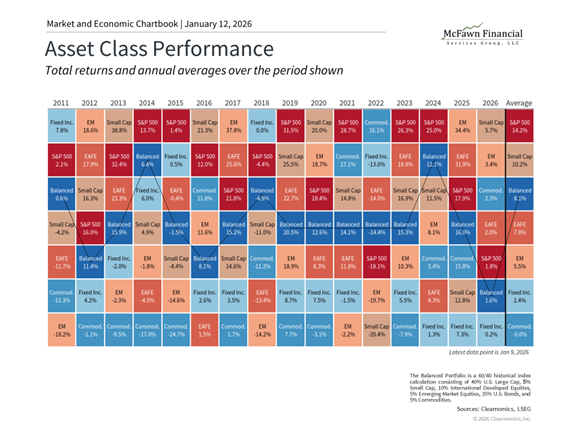
2025 was historically strong for financial markets despite significant events including April's tariff announcements, developments in artificial intelligence, and fiscal policy changes. The S&P 500 has now delivered double-digit returns in six of the past seven years, demonstrating the resilience of long-term investing. Here are some key highlights from 2025:


  • U.S. stocks performed exceptionally well, with the S&P 500 gaining 17.9%, the Dow rising 14.9%, and the Nasdaq returning 21.2%. The S&P 500 reached 39 new all-time highs during the year, while the VIX measure of volatility remained relatively low at 14.95 by year-end despite spiking to 52.33 in April.


  • International markets outperformed U.S. stocks in 2025, with developed markets and emerging markets each gaining over 30% in dollar terms. The U.S. dollar weakened by 9.3% during the year, which benefited international investments for U.S. investors.


  • Bonds rebounded strongly with the Bloomberg U.S. Aggregate Bond Index gaining 7.3%, its best performance since 2020, as the 10-year Treasury yield declined from 4.57% to 4.17%. Gold and silver also had exceptional years, with gold rising 64% to $4,341 per ounce.


The included chart shows the strong performance across major asset classes in 2025, illustrating how diversification across stocks, bonds, and alternative investments can benefit portfolios.


These results remind us that staying invested and maintaining a long-term perspective helps investors capture gains even during periods of uncertainty and volatility.

Why did the job market cool considerably in 2025?


The latest report by the Bureau of Labor Statistics confirms that the job market cooled significantly in 2025, with much slower job growth, rising unemployment, and several months of actual job losses for the first time since 2020. That said, it's important to maintain perspective since many other parts of the economy have been beating expectations.


Here are some key factors to consider:


  • Job creation slowed dramatically in 2025, with only 584,000 jobs added for the year compared to 2.0 million in 2024. There were three months of negative job growth, the most since 2020. This means that the average job growth per month was only 49,000, far lower than the average of 168,000 in 2024. Because there was a significant negative revision to October (173,000 jobs lost), the monthly average over the fourth quarter of 2025 was a loss of 22,000 jobs.


  • The unemployment rate finished the year at 4.4%, but rose as high as 4.5% in November. While this was its highest level in over four years, it is still low by historical standards. Some data was delayed or unavailable due to the government shutdown in October and early November.


  • The BLS revises these data each year, and the latest figures suggest there will be a major revision of 911,000 fewer jobs from the period of March 2024 to March 2025. This means the job gains were overstated over this period when they were initially reported.


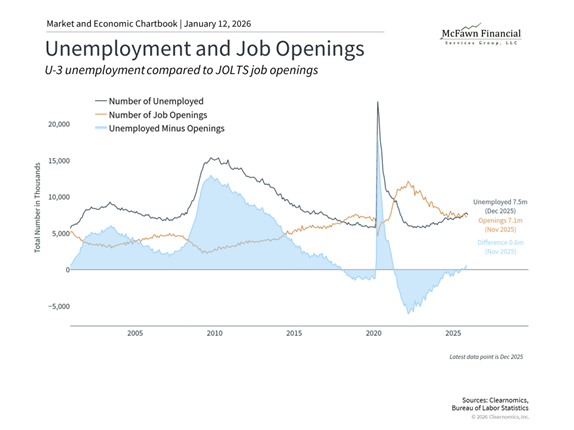
  • A separate report showed that job openings have declined to 7.1 million. This means that there are now fewer job openings than unemployed people, a reversal of the trend of the last several years. This suggests that companies may be hiring less due to economic uncertainty.


The included chart shows recent trends in unemployment and job openings, illustrating how job growth has slowed over time. This matters because employment is a key driver of consumer spending and economic growth, so weakening job creation can signal broader economic challenges.


While a cooling job market creates near-term uncertainty, long-term investors should remember that economic cycles are normal, and markets have historically recovered from periods of weakness by focusing on fundamental growth drivers over time.

How does Venezuela affect portfolios?


You've likely seen recent news coverage about the arrest of Venezuelan President Nicolás Maduro by U.S. forces. This geopolitical development has captured headlines and raised questions about what it might mean for your portfolio.


While the humanitarian consequences are most important, there are also questions about how this might affect financial markets. Below is a thoughtful perspective on how to think about this situation in the context of your financial plan. The short answer is that history shows us these events rarely have lasting market impact, even when they feel significant in the moment.


What Happened and Why It Matters


The U.S. military conducted an operation that detained Maduro on charges related to drug trafficking and corruption. There is a long history of U.S. involvement in Latin American countries, including in Panama exactly 36 years ago. The Biden administration had previously placed a bounty on Maduro, which was increased by the Trump administration last year.


From an investor viewpoint, the most important lesson from history is that geopolitical shocks tend to create short-term volatility but don't typically change the direction of markets over the long run. We've seen this pattern repeatedly in recent years with conflicts in Ukraine and the Middle East. This is because geopolitical events can temporarily affect sentiment and commodity prices, but they rarely alter the underlying drivers in a lasting way.


The Oil Price Connection


President Trump has also stated that the United States will work to expand Venezuela's oil production. For context, Venezuela possesses the world's largest proven oil reserves, even more than Saudi Arabia. However, decades of mismanagement have reduced the country's oil production to less than 1 million barrels per day, compared to the U.S. at nearly 14 million.

The primary way geopolitical events affect portfolios is through commodity prices, particularly oil. This situation is different from Russia's invasion of Ukraine in 2022, which disrupted existing supply and pushed oil prices to nearly $128 per barrel. That crisis worsened inflation and sent gasoline prices above $5 per gallon.


In contrast, increased Venezuelan production would likely place downward pressure on oil prices over time, which could actually be positive for consumers and the broader economy. Current oil prices remain subdued, trading around $60 per barrel, well below historic peaks. Major U.S. oil companies may also benefit as they access these reserves, but this will also take time to play out.


Your Portfolio Is Not Directly Exposed to Venezuela


Venezuela plays essentially no role in global financial markets. The country's stock market is small and illiquid, and it's not included in major emerging market indices. Most investors have minimal or zero direct exposure to Venezuelan stocks.


Additionally, Venezuela has been in default on its bonds since 2017, so there's minimal exposure through fixed income markets. Any portfolio effects would come indirectly through oil price movements or broader market sentiment rather than direct holdings.


What This Means for Your Financial Plan


The situation in Venezuela will continue to evolve, and there may be additional developments that capture headlines. Rather than trying to predict exactly how things will unfold, investors should focus on what can be controlled.


Specifically, your portfolio is invested across asset classes, sectors, and geographies to weather geopolitical uncertainty. Similarly, your financial plan is built for the long term and designed to navigate periods of uncertainty without requiring reactions to every news event.


Geopolitical risk is a normal part of investing. What matters most is maintaining perspective and staying focused on your long-term goals rather than responding to short-term headlines.

The information contained in this report does not purport to be a complete description of the securities, markets, or developments referred to in this material.

As always, if you have any questions, please do not hesitate to call us at (248) 619-0090.


This information, developed by an independent third party, Clearnomics, has been obtained from sources considered to be reliable, but Raymond James Financial Services, Inc. does not guarantee that the foregoing material is accurate or complete. This information is not a complete summary or statement of all available data necessary for making an investment decision and does not constitute a recommendation. The information contained in this report does not purport to be a complete description of the securities, markets, or developments referred to in this material. This information is not intended as a solicitation or an offer to buy or sell any security referred to herein. Investments mentioned may not be suitable for all investors. The material is general in nature. Past performance may not be indicative of future results. Raymond James Financial Services, Inc. does not provide advice on tax, legal or mortgage issues. These matters should be discussed with the appropriate professional. There is no guarantee that these statements, opinions or forecasts provided herein will prove to be correct. Investing involves risk and you may incur a profit or loss regardless of strategy selected, including diversification and asset allocation. Bond prices and yields are subject to change based upon market conditions and availability. If bonds are sold prior to maturity, you may receive more or less than your initial investment. Holding bonds to term allows redemption at par value. There is an inverse relationship between interest rate movements and bond prices. Generally, when interest rates rise, bond prices fall and when interest rates fall, bond prices generally rise. Prior to making an investment decision, please consult with your financial advisor about your individual situation. Raymond James is not affiliated with nor sponsors or endorses Clearnomics or any of the aforementioned organizations.


Leading Economic Indicators are selected economic statistics that have proven valuable as a group in estimating the direction and magnitude of economic change. The S&P 500 is an unmanaged index of 500 widely held stocks that is generally considered representative of the U.S. stock market. Inclusion of this index is for illustrative purposes only. Keep in mind that individuals cannot invest directly in any index, and index performance does not include transactions costs or other fees, which will affect actual investment performance.


The Bloomberg U.S. Aggregate Bond Index is a broad-based benchmark that measures the investment-grade, U.S. dollar-denominated, fixed-rate taxable bond market. The MSCI EAFE Index represents the performance of developed markets outside of the U.S. and Canada (Europe, Australasia, and the Far East). The MSCI Emerging Markets Index captures large and mid-cap representation across 24 Emerging Market (EM) countries. The U.S. Dollar Index measures the value of the U.S. dollar relative to a basket of foreign currencies. The Consumer Price Index (CPI) measures the average change over time in the prices paid by urban consumers for a basket of goods and services. It is one of the most widely used indicators for inflation.