Correction: see section below about the book: Characteristically American: Memorial Architecture, National Identity, and the Egyptian Revival for update. | |
Association for Gravestone Studies E-Newsletter | |
July 2023 / Issue 244
ISSN 2833-4892
| |
|
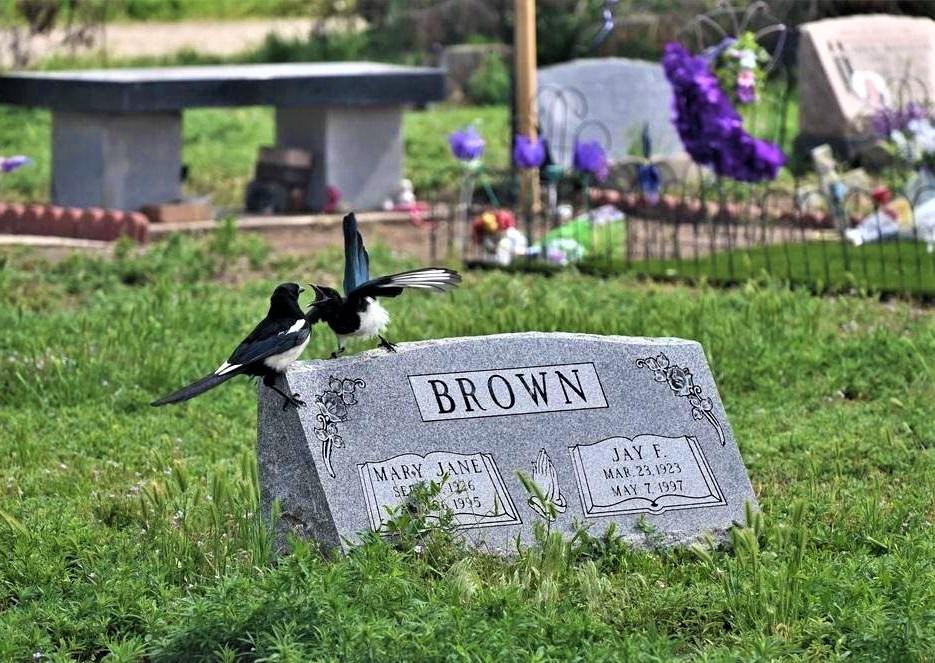
Magpies – Riverside Cemetery, Denver CO
Photo by Dana Laird, taken during the 2023 AGS Conference in Denver.
The bird on the left is probably an adult, the bird on the right, a fledging who wants to be fed.
| |
The Association for Gravestone Studies (AGS) was founded in 1977 for the purpose of furthering the study and preservation of gravestones. AGS is an international organization with an interest in gravemarkers of all periods and styles. Through its publications, conferences, workshops and exhibits, AGS promotes the study of gravestones from historical and artistic perspectives, expands public awareness of the significance of historic gravemarkers, and encourages individuals and groups to record and preserve gravestones.
If you're not an AGS member already, we want you to join! If you become a member, you will receive:
-The AGS Quarterly
-The next published issue of Markers
-Discounts on AGS conferences
-News and Notes about Chapter meetings
To join, renew, or for more information, visit
| |
Past AGS Conference program books have been digitized and can be viewed on the UMass, Amherst Library website:
Also, some back issues of the AGS Quarterly and Markers can be viewed here:
| |
|
AGS 2023 Forbes Award winner acceptance spech
Peggy Barriskill Perazzo was the 2023 Harriette Merrifield Forbes Award recipient. Following is her acceptance speech.
"I want to thank you for awarding the Harriette Merrifield Forbes Award to me. I am honored to be counted amongst the other cemetery stone researchers in the AGS, and I very much appreciate being considered for this award. It feels wonderful to be a part of such an important group that provides the world with valuable knowledge about cemetery stones and their carvers and manufacturers.
I started researching the early marble cemetery stones here in the San Francisco Bay area and northern California in 1997 when I asked my late husband, Patrick Perazzo, to create a web site so I could share my research. This research has provided me with many intriguing puzzles that led to information about the lives of the early northern California stone carvers, monument companies, and quarriers. (Many people here in California do not even realize we have historical stone quarries.) In the beginning, I naively thought I could learn how to ascertain where a stone came by from its appearance. Unfortunately, the only stone here that I've found possibly recognizable is the marble/limestone from Indian Diggings in El Dorado Co., CA, which can be seen in many of our California cemeteries.
Mary-ellen Jones, here in the S.F. Bay Area, and Leeanna Rossi, who once led stone carver tours at the Old City Cemetery in Sacramento, were both my inspiration. They researched, photographed, and uncovered a great deal of knowledge about the beautiful, old signed marble/limestone cemetery stones and their creators here in California and the many cemetery stones shipped to California from eastern quarries. I hope the research and material that I present on my web site will be of assistance and value for those researching the intriguing history of old cemetery stones.
Thank you, Peggy B. Perazzo
Stone Quarries and Beyond Continues:
https://quarriesandbeyondcontinues.com/
https://www.facebook.com/StoneQuarriesAndBeyond"
| |
|
AGS Virtual Book Club
Many of our AGS members are avid readers and have shelves full of cemetery/gravestone related books. If that is you, please join us for our AGS Virtual Book Club. Each month, we'll focus on a book about cemeteries, gravestones, mourning customs, funerary practices and death & dying. We hope to include books written by AGS members, classics in our field, newly published books, as well as novels that feature the subjects mentioned above. Grab a coffee or a tea, cozy up, and join our conversation!
***
Details for our next book club meeting:
When: Sunday, August 20th
Time: 7 p.m. Eastern Time
Where: Please register here: https://ags.wildapricot.org/event-5363837
We'll send a Zoom link to the registrants on the day of the book club meeting.
Our selection for August 2023: Grave Landscapes: The Nineteenth-Century Rural Cemetery Movement by James R. Cothran & Erica Danylchak
During the Industrial Revolution people flocked to American cities. Overcrowding in these areas led to packed urban graveyards that were not only unsightly, but were also a source of public health fears. The solution was a revolutionary new type of American burial ground located in the countryside just beyond the city. This rural cemetery movement, which featured beautifully landscaped grounds and sculptural monuments, is documented by James R. Cothran and Erica Danylchak in Grave Landscapes: The Nineteenth-Century Rural Cemetery Movement.
The movement began in Boston, where a group of reformers that included members of the Massachusetts Horticultural Society were grappling with the city’s mounting burial crisis. Inspired by the naturalistic garden style and melancholy-infused commemorative landscapes that had emerged in Europe, the group established a burial ground outside of Boston on an expansive tract of undulating, wooded land and added meandering roadways, picturesque ponds, ornamental trees and shrubs, and consoling memorials. They named it Mount Auburn and officially dedicated it as a rural cemetery.
This groundbreaking endeavor set a powerful precedent that prompted the creation of similarly landscaped rural cemeteries outside of growing cities first in the Northeast, then in the Midwest and South, and later in the West. These burial landscapes became a cultural phenomenon attracting not only mourners seeking solace, but also urbanites seeking relief from the frenetic confines of the city. Rural cemeteries predated America’s public parks, and their popularity as picturesque retreats helped propel America’s public parks movement.
This beautifully illustrated volume features more than 150 historic photographs, stereographs, postcards, engravings, maps, and contemporary images that illuminate the inspiration for rural cemeteries, their physical evolution, and the nature of the landscapes they inspired. Extended profiles of twenty-four rural cemeteries reveal the cursive design features of this distinctive landscape type prior to the American Civil War and its evolution afterward. Grave Landscapes details rural cemetery design characteristics to facilitate their identification and preservation and places rural cemeteries into the broader context of American landscape design to encourage appreciation of their broader influence on the design of public spaces.
https://www.goodreads.com/book/show/39283469-grave-landscapes?from_search=true&from_srp=true&qid=XYKLo9ibfr&rank=2
***
For a list of upcoming and past reads, go to the book club page on the AGS website at: https://gravestonestudies.org/welcome/book-club
Looking forward to seeing you!
Your hosts: Alma Sinan and Ashlynn Rickord Werner
| |
|
Call for Papers: Markers: Annual Journal of the Association for Gravestone Studies
We are currently seeking article submissions for the 2024 issue of Markers, the scholarly journal of the Association for Gravestone Studies.
The subject matter of Markers is defined as the analytical study of gravemarkers, monuments, tombs, and cemeteries of all types and encompassing all historical periods and geographical regions. Markers is of interest to scholars in anthropology, historical archaeology, art and architectural history, ethnic studies, material culture studies, American studies, folklore and popular culture studies, linguistics, literature, rhetoric, local and regional history, cultural geography, sociology, and related fields. Articles submitted for publication in Markers should be scholarly, analytical, and interpretive, not merely descriptive or entertaining, and should be written in a style appropriate to both a wide academic audience and an audience of interested non-academics.
Authors are encouraged to send a query email outlining a project before sending a manuscript to editor Elisabeth Roark, Professor of Art History and Museum Studies at Chatham University, at roark@chatham.edu.
Manuscript submissions for Markers 2024 are due by September 15, 2023.
| |
|
Characteristically American: Memorial Architecture, National Identity, and the Egyptian Revival -- Now in paperback and e-book
*NOTE: This book is not newly published as we previously indicated. It was originally published in 2014 in hardcover. It is now available in paperback and e-book.
Characteristically American: Memorial Architecture, National Identity, and the Egyptian Revival by AGS Member and Pennsylvania Chapter Chair, Joy Giguere, is now available in paperback and as an e-book.
Book Description:
Prior to the nineteenth century, few Americans knew anything more of Egyptian culture than what could be gained from studying the biblical Exodus. Napoleon’s invasion of Egypt at the end of the eighteenth century, however, initiated a cultural breakthrough for Americans as representations of Egyptian culture flooded western museums and publications, sparking a growing interest in all things Egyptian that was coined Egyptomania. As Egyptomania swept over the West, a relatively young America began assimilating Egyptian culture into its own national identity, creating a hybrid national heritage that would vastly affect the memorial landscape of the nineteenth and twentieth centuries.
Far more than a study of Egyptian revivalism, this book examines the Egyptian style of commemoration from the rural cemetery to national obelisks to the Sphinx at Mount Auburn Cemetery. Giguere argues that Americans adopted Egyptian forms of commemoration as readily as other neoclassical styles such as Greek revivalism, noting that the American landscape is littered with monuments that define the Egyptian style’s importance to American national identity.
Of particular interest is perhaps America’s greatest commemorative obelisk: the Washington Monument. Standing at 555 feet high and constructed entirely of stone—making it the tallest obelisk in the world—the Washington Monument represents the pinnacle of Egyptian architecture’s influence on America’s desire to memorialize its national heroes by employing monumental forms associated with solidity and timelessness. Construction on the monument began in 1848, but controversy over its design, which at one point included a Greek colonnade surrounding the obelisk, and the American Civil War halted construction until 1877. Interestingly, Americans saw the completion of the Washington Monument after the Civil War as a mending of the nation itself, melding Egyptian commemoration with the reconstruction of America.
As the twentieth century saw the rise of additional commemorative obelisks, the Egyptian Revival became ensconced in American national identity. Egyptian-style architecture has been used as a form of commemoration in memorials for World War I and II, the civil rights movement, and even as recently as the 9/11 remembrances. Giguere places the Egyptian style in a historical context that demonstrates how Americans actively sought to forge a national identity reminiscent of Egyptian culture that has endured to the present day.
https://utpress.org/title/characteristically-american/?fbclid=IwAR34gnJcYv3Wy5PW-tlifQV190x3DGarBqfxGKLmyK1cfWlRYRVtnxlot98_aem_AUPT0ukUfpmtE4WMnYqEZy3P2OGMGol_BSG-Wm9KtqRU_wYEh9thA3l75pb9BUwff78
| |
Cemetery Talk and Walk: Brunswick, Maine
August 20, 2023
1:00 pm
The tour begins with the slideshow at the Pejepscot History Center, 159 Park Row, Brunswick.
Ron Romano, author of Early Gravestones of Southern Maine: The Genius of Bartlett Adams, shares his deep dive in the art and architecture of gravestones and burial grounds with a short slideshow, followed by a walk around First Parish Cemetery on outer Maine Street. You’ll learn about different burial landscapes from backyards to churchyards to burying grounds to traditional cemeteries; stone materials used including slate, marble, granite; the iconography of skulls, willows, and hands/fingers; information about epitaphs; and a brief foray into the life and work of Bartlett Adams given that he is well represented at First Parish.
https://pejepscothistorical.org/event/gravestone-artwork-and-first-parish-cemetery/
| |
Course: Lichens, Biofilms, and Stone
Eagle Hill Institute
Steuben, Maine
August 6 - 12, 2023
Maine’s rocky shorelines and inland outcroppings are rich with diverse lichen and biofilm covers. Grave markers made of local granite, and of marble, slate, and sandstone from other New England states and foreign countries also host these lichens and biofilms. In this seminar, we will study the physical, chemical, and ecological relationships between lichens, biofilms, and stone.
https://www.eaglehill.us/programs/sems-weeklong/flyers-weeklong-pdfs/2023-JacobSchmull.pdf
AGS members receive a 10% discount.
| |
|
Letter Writing Campaign: Moses African Cemetery, Bethesda, Maryland
The Bethesda African Cemetery Coalition (BACC) is organizing a letter writing campaign to Montgomery County Maryland officials as BACC continues to demand an end to the desecration of Moses African Cemetery in Bethesda, Maryland. For more information:
https://bethesdaafricancemeterycoalition.net/831-2/
| | |
The Association for Gravestone Studies
278 Main St., #209
Greenfield MA 01301
www.gravestonestudies.org
| |
| | | |