Association for Gravestone Studies E-Newsletter | |
November 2023 / Issue 248
ISSN 2833-4892
| |
|
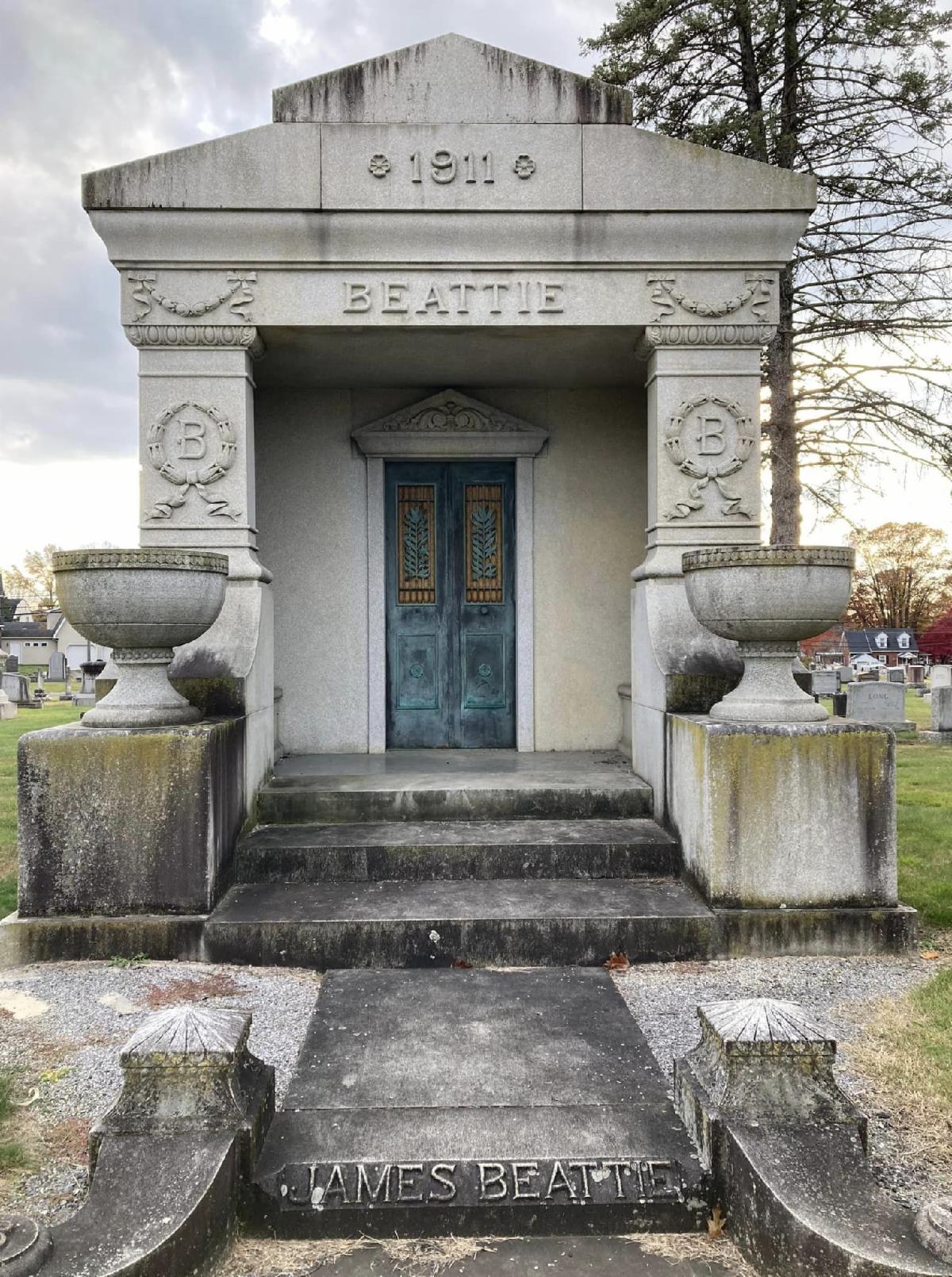
James Beattie Monument, Spring Hill Cemetery, Shippensburg, PA
Photo by Joy Giguere
| |
The Association for Gravestone Studies (AGS) was founded in 1977 for the purpose of furthering the study and preservation of gravestones. AGS is an international organization with an interest in gravemarkers of all periods and styles. Through its publications, conferences, workshops and exhibits, AGS promotes the study of gravestones from historical and artistic perspectives, expands public awareness of the significance of historic gravemarkers, and encourages individuals and groups to record and preserve gravestones.
If you're not an AGS member already, we want you to join! If you become a member, you will receive:
-The AGS Quarterly
-The next published issue of Markers
-Discounts on AGS conferences
-News and Notes about Chapter meetings
To join, renew, or for more information, visit
| |
Past AGS Conference program books have been digitized and can be viewed on the UMass, Amherst Library website:
Also, some back issues of the AGS Quarterly and Markers can be viewed here:
| |
|
AGS Virtual Book Club
Many of our AGS members are avid readers and have shelves full of cemetery/gravestone related books. If that is you, please join us for our AGS Virtual Book Club. Each month, we'll focus on a book about cemeteries, gravestones, mourning customs, funerary practices and death & dying. We hope to include books written by AGS members, classics in our field, newly published books, as well as novels that feature the subjects mentioned above. Grab a coffee or a tea, cozy up, and join our conversation!
*********
Details for our next book club meeting:
When: Sunday, December 17th
Time: 7 p.m. Eastern Time
Where: Please register here: https://ags.wildapricot.org/event-5502900
We'll send a Zoom link to the registrants on the day of the book club meeting.
Our selection for December 2023: Necropolis: London and Its Dead by Catharine Arnold
Layer upon layer of London soil reveals burials from pre-historic and medieval times. The city is one giant grave, filled with the remains of previous eras. The Houses of Parliament sit on the edge of a former plague pit; St Paul's is built over human remains; Underground tunnels were driven through forgotten catacombs, thick with bones. A society can be judged by the way it treats its dead, and this is especially true of London. From Roman burial rites to the horrors of the plague, from the founding of the great Victorian cemeteries to the development of cremation and the cult of mourning that surrounded the death of Diana, Princess of Wales - Necropolis leaves no headstone unturned in its exploration of our changing attitudes towards the deceased among us.
*********
For a list of upcoming and past reads, visit the book club page on the AGS website at: https://gravestonestudies.org/welcome/book-club
Looking forward to seeing you!
Your hosts: Alma Sinan and Ashlynn Rickord Werner
| |
|
Call for book reviewers for Markers
To bring Markers in line with other peer-reviewed journals, we will be adding a book reviews section featuring reviews of new scholarship. We are currently seeking individuals who are interested in serving as reviewers.
If you would like to be added to the list of possible reviewers, please reach out to Markers book review editor, Joy Giguere at jmg66@psu.edu.
| |
Report: AGS Pennsylvania Chapter, Fall Meeting, Nov. 11th
The PA Chapter of AGS met on a gorgeous November day at Shippensburg University. In the morning, AGS President Dennis Montagna kicked things off with his presentation on the mausoleum for the Reverend Divine. This was followed by newcomer Jonathan Hoppe’s talk about Philadelphia’s potters fields and then Paul Sookiasian’s photographic tour of Armenia’s historic cemeteries.
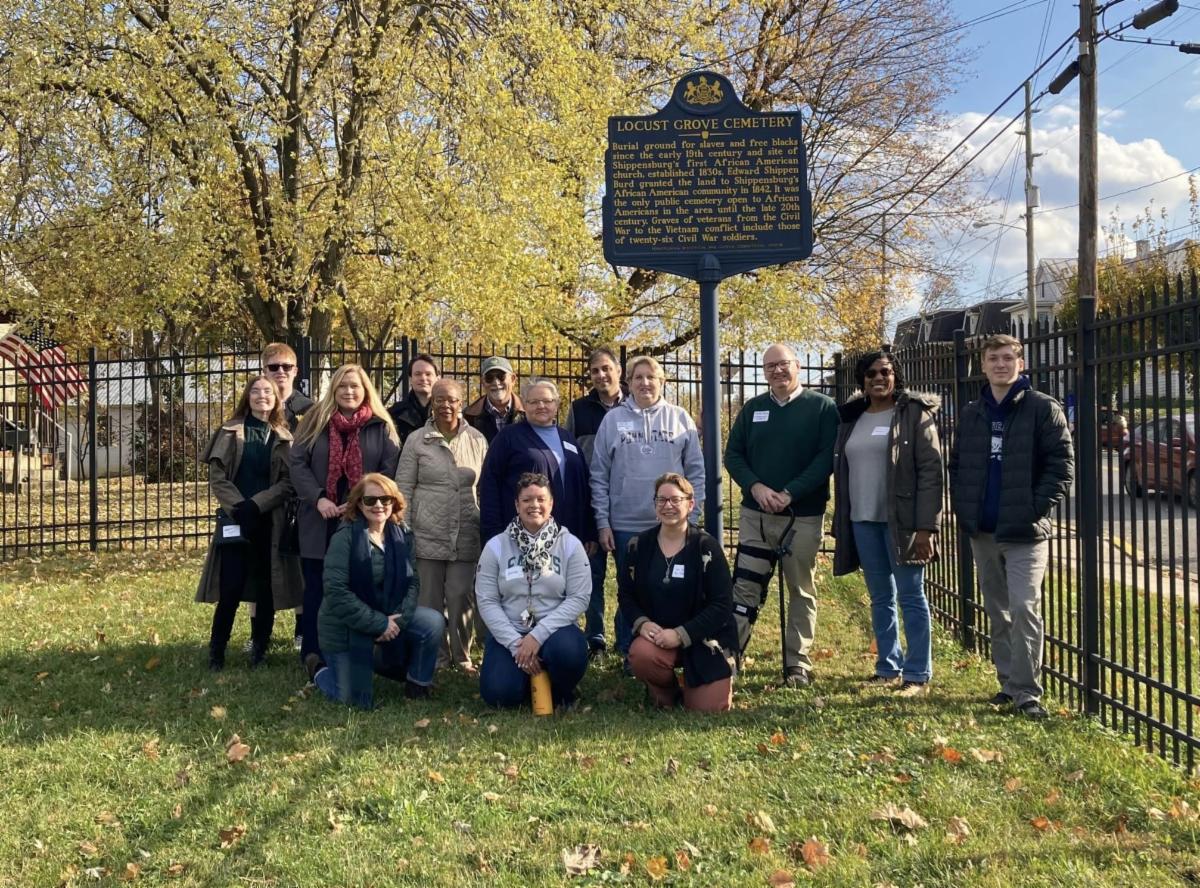
In the afteroon we visited Locust Grove Cemetery, Shippensburg’s historic African American burying ground. Our meeting host, Dr. Steven Burg gave us a wonderful history and tour of the cemetery. Their final stop was Shippensburg’s Spring Hill Cemetery.
| The AGS Pennsylvania Chapter at Locust Grove Cemetery, Shippensburg, PA | |
|
Report: Talks and Tour, Whately MA, Nov. 11th
On Saturday Nov. 11th several members of AGS and a number of local residents met at the Whately Town Hall to hear talks about some of the stonecutters who worked in the Connecticut Valley during the 18th and early 19th centuries. Bob Drinkwater led off with a brief introduction to New England gravestone studies. Al and Betsy McKee then offered a progress report on their research on the Lathrop family – Connecticut stonecutters who moved to Longmeadow, MA soon after 1800. The morning session concluded with Bob’s presentation, “Who Made the Gravestones in Whately’s Old Burying Grounds?” and after lunch, we re-convened for an informal tour of the Whately Center Cemetery where we saw, first-hand, many of the stones featured in Bob’s PowerPoint presentation.
Many thanks to Neal Abraham, President of the Whately Historical Society and member of the Whately Cemetery Commission, for hosting this event.
| |
|
New Publication: Grave History: Death, Race, and Gender in Southern Cemeteries
Grave History is a new book edited by Kami Fletcher and Ashley Towle.
Grave sites not only offer the contemporary viewer the physical markers of those remembered but also a wealth of information about the era in which the cemeteries were created. These markers hold keys to our historical past and allow an entry point of interrogation about who is represented, as well as how and why.
Grave History is the first volume to use southern cemeteries to interrogate and analyze southern society and the construction of racial and gendered hierarchies from the antebellum period through the dismantling of Jim Crow. Through an analysis of cemeteries throughout the South—including Alabama, Florida, Georgia, Kentucky, Maryland, Missouri, and Virginia, from the nineteenth through twenty-first centuries—this volume demonstrates the importance of using the cemetery as an analytical tool for examining power relations, community formation, and historical memory.
Grave History draws together an interdisciplinary group of scholars, including historians, anthropologists, archaeologists, and social-justice activists to investigate the history of racial segregation in southern cemeteries and what it can tell us about how ideas regarding race, class, and gender were informed and reinforced in these sacred spaces.
Each chapter is followed by a learning activity that offers readers an opportunity to do the work of a historian and apply the insights gleaned from this book to their own analysis of cemeteries. These activities, designed for both the teacher and the student, as well as the seasoned and the novice cemetery enthusiast, encourage readers to examine cemeteries for their physical organization, iconography, sociodemographic landscape, and identity politics.
https://ugapress.org/book/9780820365800/grave-history/
| |
|
New Publication: Brooklyn Arcadia: Art, History & Nature at Majestic Green-Wood
Brooklyn Arcadia: Art, History & Nature at Majestic Green-Wood is a new book by Andrew Garn.
'Life affirming' is probably not the first phrase that springs to mind when thinking of a cemetery, but Green-Wood is no ordinary cemetery... ! I began visiting this uncommonly beautiful place during those first dark, frightening months of the Covid pandemic. Seeking solace, I was compelled to go back often and photograph its ever-changing and inspiring majesty.
The result is my new book, Brooklyn Arcadia: Art, History & Nature at Majestic Green-Wood, highlighting a place of final repose that is bursting with life and nature.
As popular today as when it first opened almost 200 years ago, Green-Wood attracts over 500,000 living visitors a year, with roughly an equal number of interments. (Among those buried at Green-Wood are Leonard Bernstein, Jean-Michel Basquiat, and Boss Tweed.)
While Green-Wood is an historic burial ground, it's also very active in the present, offering over 300 live events per year, including bird and tree walks, fungi counts, concerts, monument restoration projects, "death cafes" and explorations of all things historic. Green-Wood appeals to New Yorkers of all ages and interests—not only those seeking tranquility, and a communion with flora and fauna, but also those seeking entertainment and knowledge!
To order:
Bookshop.org
Barnes and Noble
Amazon
| |
|
Call for papers: Cemeteries, Graveyards and Massacre Sites
The Public Historian (TPH), calls for papers for a special issue: Cemeteries, Graveyards, and Massacre Sites. Proposals, which should be no longer than one double-spaced page, should be submitted to TPH at shcase@ucsb.edu. The deadline for submission is December 1, 2023.
This special issue endeavors to put into conversation places of burial, cemeteries, graveyards, and massacre sites within public history and historic preservation.
What are the politics of preserving these sites?
How do they change over time and vary over space?
What is the role of the public historian in doing so?
How can a consideration of the involvement of local community members, faith groups, historic societies, and professional caretakers in the creation and maintenance of burial sites help us reimagine community-based commemoration, preservation, and memory in understudied sites and communities?
How might transnational comparisons help understand practice, policy, and local history?
What is the role of technology and digital history in documenting and preserving the history and legacy of our departed?
For Details: https://ncph.org/news/tph-call-for-papers/
| |
|
Podcast: "What Stories Do Gravestones Tell?"
This podcast is hosted by Kim Pate. AGS Trustee Ron Romano was interviewed.:
"Let's dive into the world of gravestones and what they mean! In an interview with cemetery historian and author Ron Romano learn all about the symbolism on gravestones, how they’ve changed, and the impact of an 18th-century stonecutter on Eastern Cemetery in Portland, Maine."
https://open.spotify.com/episode/4s2JJp1CLTxY8N069qJadY?si=862e2b3291ee4104
The accompanying social media posts can be found on Instagram: https://www.instagram.com/muddledmemory/
| |
|
Video: Virtual Meeting about Cemetery Preservation in Massachusetts
AGS President Dennis Montagna participated in a virtual meeting about Cemetery Preservation on October 19, co-hosted by the Western MA Historical Commission Coalition (WMHCC), the Central MA Historical Commission Coalition (CMHCC), and the Eastern MA Historical Commission Coalition (EMHCC) along with the Franklin Regional Council of Governments (FRCOG), the Berkshire Regional Planning Commission (BRPC), the Pioneer Valley Planning Commission (PVPC), Preservation MA, and the MA Historical Commission.
https://www.youtube.com/watch?v=O9Sts-cDi2o
| |
If you enjoy receiving this newsletter, please consider making a donation to AGS. | | |
The Association for Gravestone Studies
278 Main St., #209
Greenfield MA 01301
www.gravestonestudies.org
| |
| | | |