CEO's e-Bulletin
2020 #12
I
11 June
|
|
|
Dear Colleagues,
The financial challenges of COVID-19
Last week I caught up with former AHISA member Dr David Mulford in his role as interim CEO of the Independent Schools Council of Australia. ISCA’s briefings on national issues for independent schools, always valuable, are made particularly rich with the added insights of David’s nearly 30 years as a Principal.
Even as schools return to on-campus provision and the nation transitions to a ‘new normal’, federal funding arrangements for independent schools have thrown up challenges which, as long as they remain unresolved, must add to the complexity of day-to-day decision making of school leaders and their longer-term planning.
ISCA continues to press for resolution of issues that have a significant impact on federal funding for independent schools, including the reference date for the 2020 Non-government School Census. It is also seeking a review of the Direct Measure of Income (DMI) methodology for calculating schools’ capacity to contribute under the federal general recurrent funding model, with a particular focus on issues the methodology raises for regional schools.
Any decision about the Non-government School Census date must be agreed by the Education Council, which comprises all state and territory ministers for education. While ISCA has suggested using a different date – enrolments as per February 2020 to give schools certainty for forward planning was one possibility – it is likely that the jurisdictions will opt to keep the Census to its August date, with a provision for special circumstances set for this year. There may also be some adjustment to NCCD data collection rules, including a shorter reference period to allow for extended times when students were not at school.
The federal Minister has so far rejected a request that introduction of the DMI be delayed for those schools projected to lose funding under the new methodology. ISCA continues to argue that the full impact of the coronavirus pandemic on many schools may not be known for some time, and that 2020 DMI scores may not accurately reflect the changed circumstances of families whose children attend independent schools.
While ISCA’s request for emergency loans for schools in crisis was also rejected by the Minister, ISCA reports a Financial Vulnerability working group has been set up with expert representation from the state Associations of Independent Schools and the federal Department of Education, Skills and Employment. The group’s focus is on longer term measures once greater financial impacts are experienced by schools.
One of the most negative effects of the uncertainty created by the delay in resolving financial issues is the amplification of stress around the continual decision making that is a feature of crisis management. And that means increased risk of burnout.
A recent
McKinsey article
advises that, to avoid burnout, CEOs need to ‘tap into new sources of energy’. While even reading the word ‘new’ might trigger an alarm response for Heads who have been responding to or supporting the creation of the ‘new’ for weeks on end, the suggestions collected from CEOs around the globe do not require life-changing regimes. One, for example, is to identify those moments when you especially need an energy booster: ‘If it’s after lunch, set up a regular early-afternoon call with someone you like,’ is one suggestion. Other suggestions are positively homely, like making more time for the family, getting a good night’s sleep or picking up a book for 30 minutes.
Whatever strategies you adopt, it is important as Heads of independent schools to recognise and act on the need to sustain your energy in order to meet the challenges of the economic fallout of the COVID-19 pandemic. I know many Heads are considering all options for the future sustainability of their school, including the streamlining of school management structures. Even though the necessity of trimming and reshaping a school’s staffing profile can be an opportunity for renewal, the decision making is no less difficult or emotionally wearing.
As reported in the
AHISA Board e-Bulletin
distributed last week, directors valued the economic and social briefing provided by AHISA partner NAB. NAB has kindly agreed to deliver a briefing via webinar for all AHISA members on Wednesday 17 June at 4pm EST. Members are free to invite their school governors, business managers or executive team to also register to attend.
The webinar will be a source of data-based insights to assist financial decision making, as well as covering historical and current economic impacts on student and staff wellbeing. It is my hope that access to quality information will help relieve some of the stress of revising school budgets, and I encourage you all to register for the webinar.
Kind regards,
BETH BLACKWOOD
T
02 6247 7300
M
0417 180 842
|
|
Correction
In the latest e-Bulletin from the AHISA Board, sent on Thursday 4 June 2020, we incorrectly stated that Mr Michael Hannah, Principal of Lakes Grammar School, NSW, was departing from the school at the end of 2020.
Michael had announced his retirement at the end of this year, but made the decision to go through into next year, to give stability to the school during the COVID-19 pandemic. He will now retire sometime next year or at the end of 2021.
We apologise for this error and for any confusion it may have caused.
|
|
Government
National decision on the release of ATAR results
On consideration of advice from the Australasian Curriculum, Assessment and Certification Authorities (ACACA
)
,
federal, state and territory Ministers for Education have
announced th
at the release of individual ATAR results for students completing Year 12 in 2020 will occur within a nationally consistent window from 15 to 31 December 2020. The Ministers also agreed a nationally consistent set of messages "to ensure all Year 12 students, their families and teachers across Australia are confident in, and clearly understand, the university admissions processes for 2021". The messages and further detail on the announcement are contained in this
Education Council communique
.
CRICOS and ELICOS delivery
The Australian Skills Quality Authority (ASQA) has announced a temporary relaxation of some training package requirements for CRICOS providers delivering VET or ELICOS courses to accommodate distance delivery of training and assessment. ASQA reminds providers that they should seek students’ consent if they move to online delivery and that where delivery arrangements have been varied in response to COVID-19, all adjustments made should be documented in each student’s record. Further details are available on the websites of
ASQA
and the
Department of Education, Skills and Employment
.
Further support for youth mental health
NBN Co extends support for increased data usage
NBN Co has
extended its offer
to provide internet providers additional data capacity at no extra cost until 19 August 2020. The offer helps underwrite increased consumer data use. The offer of increased download data limits for the Sky Muster service has also been extended until the end of August.
|
|
Our news
AHISA/NAB webinar: COVID-19's economic implications for schools
The world is currently experiencing one of the biggest social experiments in history. While the full implications of the virus remain uncertain, there is a broad understanding among Australians that life is going to be very different, perhaps forever. Economists are expecting the biggest fall in global GDP since at least the 1950s, and most likely since the Great Depression. However this doesn’t paint the whole picture — it tells us little about the human cost of coronavirus. Join Dean Pearson, head of behavioural economics at NAB, for an AHISA-hosted webinar on Wednesday 17 June at 4pm, to learn more about the economic and social changes likely post COVID-19 and the implications for our schools.
Registration is now now open
for AHISA members, and their board members, senior executive staff and business managers.
Queen's birthday honours
AHISA would like to offer its congratulations to Josie Crisara, Simon Gipson and Elizabeth Jameson, who each received awards in this year's
Queen's birthday honours
.
|
|
Ms Crisara was awarded an OAM for service to education and professional associations. Ms Crisara is a current AHISA member and has been the Principal of Aitken College in Victoria since 2009. She served on the AHISA board from 2015 to 2019, and was also chair of the AHISA Victorian Branch Executive Committee from 2015 to 2017.
Mr Gipson was also awarded an OAM for service to education. Mr Gipson is an honorary member of AHISA and was Principal of St Michael’s Grammar School in Victoria from 2000 to 2017. He was a member of the AHISA Victorian Branch Executive for six years from 2011, and also
led The Song Room, a national not-for-profit organisation delivering tailored high quality music and arts programs to Australia’s most disadvantaged children, as CEO from 2018 to 2019.
AHISA members may also be familiar with the work of Elizabeth Jameson, who has volunteered her time and expertise on many occasions for AHISA Chair and Head Forums. Ms Jameson was awarded an AM for service to business, education, the arts and community. Elizabeth was Chair of the Board of Trustees at Brisbane Girls’ Grammar School from 2006 to 2019 and currently Chairs the Queensland Theatre Company. Elizabeth, a corporate and commercial lawyer, is the founder and director of Board Matters.
|
|
AHISA members in the news
Genazzano FCJ College has been named as a finalist in four categories of
The Educator's
Australian Education Awards this year, including Best Co-Curriculum Program, Best Professional Learning Program, Best Use of Technology and School Principal of the Year - Non-government. School Principal and AHISA member Karen Jebb was
interviewed by the publication
about the pioneering work the College is doing, and some innovative new programs soon to be launched for students and staff.
AHISA member and Principal of St Philip’s Christian College Cessnock, Darren Cox, was also
interviewed by
The Educator
recently, regarding a trial Year 7 Mathematics class being implemented at his school, where students are able to continue to learn via an online mode of delivery. The class is providing opportunities for students to excel through self-paced learning.
|
|
Governance
COVID-19 and health and safety law requirements
On returning to school, the risk of a student or staff member being tested positive for COVID-19 is a foreseeable workplace hazard that schools must address, or they may be found in breach of workplace health and safety legislation.
This piece
by
School Governance
includes a step-by-step guide to assessing the risk and implementing controls.
|
|
Awards, events & courses
Student engagement webinar
Cut Through Coaching are
hosting a free webinar on 17 June
, featuring Tim Perkins discussing the power of Self Determination Theory in order to authentically engage students in the classroom. Perkins was a primary school teacher and a senior lecturer in education, and is now a private educational consultant with Cut Through.
Hot List nominations now open
The Educator
is taking nomination for its Hot List 2020 Report, which aims to spotlight the most influential educators over the past 12 months. Readers are invited to put forward deserving individuals through the
online nomination form.
Staff Wellbeing Toolkit
The National Excellence in School Leadership Institute (NESLI) have created a Staff Wellbeing Toolkit to increase levels of wellbeing and social capital in schools. It was developed in response to the excessive uncertainty, burnout and duress faced by Australian educators. The five-module course is currently being offered for a fee per staff member, and is available for either face-to-face or online delivery.
Limited enrolments and expressions of interest
are now being accepted.
The Why of Change webinar
EduTECH are
hosting a free webinar on 18 June
titled
The Why of Change
, led by staff from Haileybury in Victoria (Principal and CEO Derek Scott), including Deputy Principal for Teaching and Learning Anna Sever, Director of Digital Learning Lauren Sayer, and Director of HaileyburyX Peter Thomas. Participants will hear about how Haileybury are developing not just crisis responses, but new best practices for the future of learning and teaching. The school's HaileyburyX project will be discussed, as well as its support of
digital learning, and
enabling practices and processes.
|
|
Leadership & management
Motivating with empathy and authority
Leaders are constantly processing the future, and their employees are watching to see how confident they are and how clearly they see the situation. Employees look to leaders for emotional fuel and signs everything will be OK, according to Nancy Duarte, author and communications firm CEO.
Here
she outlines five communication techniques that have helped her build trust and motivate her employees during high-pressure times.
Spotting a struggling employee
Worried a staff member might be at risk of burn-out?
This article from Insead
explores a three step "emotional triaging" technique that can help managers identify early warning signs of COVID-19 burn-out and take appropriate actions. The authors provide advice on how to broach difficult conversations, and advise managers to check-in with the team, do individual deep dives, show compassion and know their limits.
Psychological safety in the workplace
Psychological safety is the feeling people have when they can bring their whole self to work, speak up and come up with ideas — and according to UNSW Business School's Frederik Anseel, it's extremely important for performance. As we look towards the recovery phase of COVID-19, many workers are feeling fragile. But by
using some basic principles to rebuild psychological safety
in the workplace, Professor Anseel says leaders can support their workers to get back to their best — boosting organisational outcomes.
|
|
Resources
Supporting children impacted by bushfire
The Mental Health Foundation Australia has produced a free webinar with the support of the MHFA Patron and Child Psychiatry Emeritus Professor Bruce Tonge, on the effects of the devastating bushfires Australia experienced last summer on children's mental health. The webinar is appropriate for parents, teachers and all who care for children, in navigating the effects of the traumatic bushfire events. A
recording of the webinar
is now available.
|
|
#BlackLivesMatter in the classroom
|
|
Teaching algorithms
An algorithm is by definition a process or set of rules to be followed in problem-solving. We tend to associate the word with the kind of complex computer algorithms that help us find information online, but the humble cooking recipe is also an example of an algorithm. The Australian Computing Academy is hosting a
free webinar on 15 June
, providing an introduction and deep dive into teaching algorithms for Years 5-12. The webinar will examine how teachers already use algorithms in their teaching, and how to adapt that thinking to solve all kinds of problems in a systematic way.
Australians and the recovery from COVID-19
|
|
Research & reports
Educator perspectives on the impact of COVID-19
Eighty per cent of teachers in Australia and New Zealand believed students would need extra instructional support when they got back to school following remote learning, according to survey conducted in April. The Pivot report,
Educator perspectives on the impact of COVID-19 on teaching and learning in Australia and New Zealand
, found teachers were anxious about a loss of social connection with their students and a decrease in the effectiveness of their teaching. It also found teachers reported big increases in demands on their time under remote learning, with written responses including references to an “exponential” workload increase.
Remote learning may deepen achievement gaps
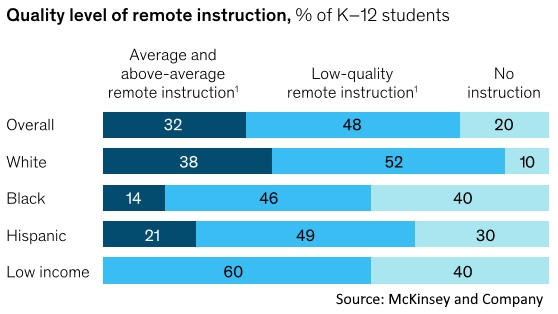
Evidence from the United States shows the shutdowns caused by COVID-19 could exacerbate existing achievement gaps, according to a new report from McKinsey and Company. Using statistical modelling, McKinsey have estimated the potential impact of school closures in three epidemiological scenarios (virus contained, virus resurgence and pandemic escalation) on the learning of three types of students: those with average-quality remote learning; those getting lower-quality remote learning; and students getting no instruction at all. The
results of the modelling
are troubling, and indicate learning loss will be probably greatest among low-income, black, and Hispanic students.
|
|
MMG's home-based learning survey results
|
|
Wellbeing
Growing resilience
Some people seem to have an uncanny knack of seeing their way through difficult circumstances and finding a positive path forward — even managing to make uncertainty work for them. Associate Professor of strategy at Insead Nathan Furr has identified the approaches such people use to navigate turbulent times and to uncover their own potential.
In this article,
he discusses tools for building this capacity, including reframing the impossible, considering all options, and thinking in probabilities, not binary outcomes.
|
|
Parenting
Helping kids handle the loss of important school social events
Like everyone, our children have been forced to sacrifice many pleasures this year in the name of flattening the coronavirus curve and saving lives. Many performances, balls, camps and championships have gone by the wayside — and important rites of passage like formals and graduations may also need to be cancelled. This means kids may miss out on rare and special opportunities to be acknowledged as "growing up".
In this article from ideas.ted.com,
Christine Carter equips parents with ideas for softening the blow.
Protecting children from online sexual abuse
Last week's news about the
busting of an alleged child sex offender network
operating in Australia came with this disturbing warning from the Australian Federal Police: "child exploitation in Australia is becoming more prolific … this type of offending is becoming more violent and brazen".
This article
from
The Conversation
outlines how common the problem is, who the perpetrators are, and the kind of children most at risk. If also offers tips for parents and carers on how to best protect their children.
|
|
Provocations
Forcing education into the future
The COVID-19 crisis will force – and is forcing – education a decade into the future, according Sean Slade, in
this article
from
ASCD Inservice.
Slade says during COVID-19 remote learning, the most successful schools have been the ones that have developed a sense of student agency and ownership over their own learning — and educators must push forward with this kind of thinking.
"
We have an opportunity here to move expeditiously into a future stage, of utilising this crisis to upend an antiquated system, and to replace it with one that engages the learner in learning and teaches them to learn how to learn," he writes.
|
|
|
|
|
|
|