|
Traceable Ballots
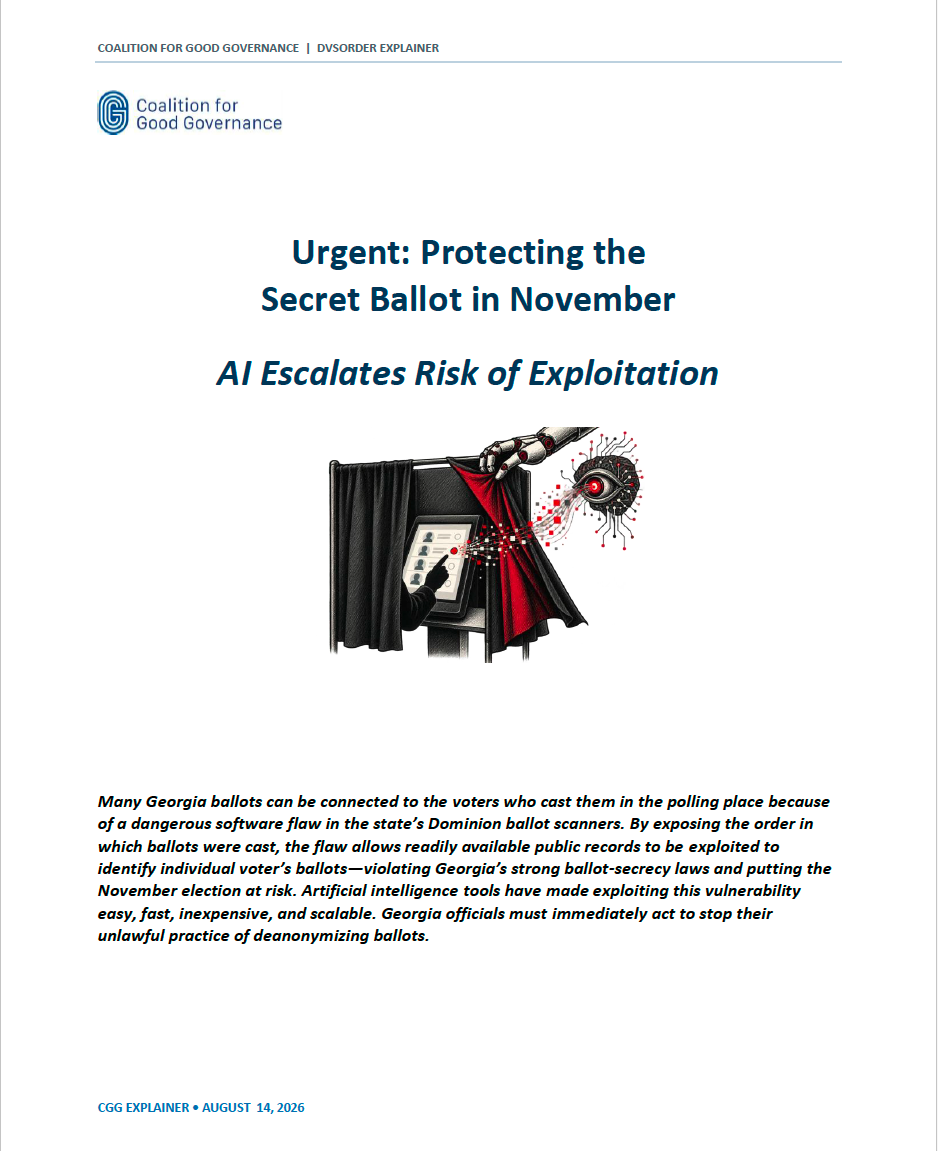
Georgia ballots can be traced back to voters in many cases because of a long-known flaw in the Dominion scanner software used throughout the state, which the Secretary of State and State Election Board have refused to address. The flaw exposes the order in which ballots were scanned, making the ballot records exploitable. When that information is combined with other public information such as voter check-in times, security video, scanner counters, or other readily available data, individual voters can often be matched with their ballot choices. That exploit can now happen rapidly on a massive scale with common AI tools and basic public election records.
The Supporting Research
The attached report explains the problem, known as DVSorder (cleverly dubbed “Devious Order”) and the urgent steps Georgia officials must take before the November election. Recent research by Max Springer, a Princeton University AI expert demonstrated that ballot order could be recovered for approximately 1.52 million polling-place ballots from Georgia’s May 2026 primary—98.9 percent of the in-person ballots examined across 139 counties where necessary public information was readily available. No access to voting equipment, voting-system software, or confidential data was required. See his August 14 letter to the State Election Board and the Secretary of State.
Absolute Secrecy is Mandated
Georgia law promises voters “absolute secrecy,” meaning that no person may see or know how another voter voted. That protection is not satisfied merely because traceable records are held as “sort of confidential” records by election officials or vendors rather than released publicly. The State and counties must prevent the very creation and retention of records that can connect voters to their ballots. The Secretary of State has concluded that the ballot traceability should continue and that the traceable ballot data be held by insiders and vendors—an obviously naïve and unlawful plan.
Simply redacting Record IDs from public records is not a solution. The underlying records would remain traceable in election-system files, ballot images, cast vote records, scanner logs, and copies held by officials, vendors, contractors, or others. Redaction also threatens election transparency by withholding ballot-level records needed for audits, public oversight, and verification of reported results.
The answer is to stop creating unlawful traceable ballots—not to conceal the audit trail.
Urgent Action is Essential
Failure to act before November creates a serious risk of election disruption and legal challenge. Once voters understand that their choices may not remain secret, some may be discouraged from voting or fear retaliation, coercion, or public exposure. But the answer is not to keep this insidious truth from unsuspecting voters who have been assured that they can vote their conscience without fear of being called to account for their private choices. That is true in many states, and for Georgia’s mail ballots, but not true in Georgia’s polling places. Georgians have state constitutional rights to a secret ballot, but that right is a hollow promise now. Georgia officials must do better.
Further, counties could face litigation over the use of systems that do not provide the ballot secrecy required by Georgia law. Last-minute court orders or improvised election procedures could create confusion for officials and voters alike. Post-election challenges with claims of an unconstitutional election would be extremely disruptive. The system software simply must be fixed.
Georgia’s election officials and policymakers should act immediately:
🚨1. The State Election Board should adopt emergency rules prohibiting the continued creation or recording of electronic ballot identifiers that permit scanned ballots to be restored to voter order.
⚙️ 2 . The Secretary of State should promptly authorize and deploy corrected Dominion software—version 5.17 or later (after testing)—on every scanner and supporting component that will be used in November.
🧑🏻🏫 3. Independent experts should test the corrected software before deployment to verify that ballot identifiers can no longer be used to reconstruct scan order.
⚖️ 4. Counties should consult their attorneys now and prepare lawful backup procedures that guarantee ballot secrecy if corrected software is not deployed and tested before voting begins. Those measures should include the use of hand-marked paper ballots and secure, bipartisan procedures for physical shuffling of ballots that irreversibly randomize ballots before scanning.
🧹5. Election officials should use appropriate sanitizing software for records from prior elections. The sanitization process should eliminate or replace traceable identifiers while preserving ballot-level records, cast vote records, and the audit trail needed for public oversight and verification.
🔍 6. Election transparency must be preserved. Properly anonymized ballot-level records should remain available to candidates, the press, researchers, and the public without the ability to expose individual voters.
We urge Georgia lawmakers and political leaders to raise this issue immediately with their local county election boards, the Secretary of State, and the State Election Board. Please ask what specific corrective measures will be in place before November and insist upon a public timetable for implementation and independent testing.
Georgia officials have known about DVSorder for years. What has changed is the speed and scale at which readily available AI tools can exploit it. The State should not wait until named voters’ choices are exposed, voters are deterred from participating, or litigation disrupts the election.
Please review the full report and share it with the officials responsible for election administration in your community. If you have questions or would like additional technical or legal information, please contact us.
|