|
14 August 2026 (New York, NY) - This story has been well told.
When Nan Zhong decided to sue four universities for racial discrimination after they rejected his son Stanley despite his having a 3.97 grade point average and a SAT score of 1590, he couldn't find an attorney to take on the cases.
Some of the about 80 lawyers and legal organizations Zhong reached out to didn't want to go up against institutions with far more legal resources, and others worried that they might even receive threats if they handled the suits alleging discrimination against Asian American applicants.
So Zhong, who is a software engineering manager at Google, and his son turned to artificial intelligence to draft and file their complaints in early 2025:
"For people like me, who speak English as a second language and have no formal legal training whatsoever, AI is a game changer. With AI, we are now able to draft and file legal briefs, and navigate the legal system".
While Zhong has had some early success in his suits, he and other pro se litigants face what some scholars have presented as a surprising paradox: AI appears to have contributed to a dramatic spike in pro se litigation - with self-represented litigants' share of federal court filings roughly doubling since ChatGPT was first released - but the technology isn't necessarily helping these litigants find success in court.
Some research indicates that the technology has had little effect on case outcomes, while other data suggests that AI-drafted lawsuits are dismissed earlier and more often than lawsuits filed without the aid of large language models. Joshua Y. Levy, an economics Ph.D. student at the University of Southern California, and co-author of a massive new paper about AI's impact on federal court filings, said:
"More people are walking into court, so it seems like access has gone up. Now, how are these cases turning out? It's still very, very, very rare that a pro-se litigant wins their case. So, in a substantive sense, whether people are receiving greater access to justice is sort of unclear".
A dramatic increase
AI appears to be the driving force behind a substantial rise in the number of federal court filings from self-represented litigants. According to the done research done by from Levy and Massachusetts Institute of Technology Ph.D. student Anand V. Shah, the numbers break out as follows:
- Pro se litigants filed an average of about 23,000 new federal lawsuits each year between 2005 and 2022, the year ChatGPT was first released to the public
- But pro se litigants filed:
- 27,370 suits in 2023
- 31,478 in 2024
- 41,490 in 2025
- 29,323 so far in 2026
Levy and Shah found that non-prisoner, self-represented litigants accounted for about:
- 11% of civil federal court filings in the years between 2005 and 2022
- 14.5% of those filings in 2024
- 16.8% of them in 2025
Shah noted:
"There's undoubtedly an increase in filings. And moreover, it seems like these filings themselves are also heavier. So, there are more motions per each case, maybe the cases themselves have more pages".
Similarly, pro se litigants accounted for 11.3% of federal civil filings before 2022, according to a June 2026 paper by Or Cohen-Sasson, director of the Miami Law & AI Lab at the University of Miami School of Law. By the final quarter of fiscal year 2025, their share of those filings roughly doubled to 22.3%, the paper shows.
It's difficult to pinpoint AI as the specific cause of this increase in filings, but there are two major indications that the technology is largely responsible:
- For starters, the increase in pro se cases is most obvious in what Shah and Levy refer to as "simple" cases, such as lawsuits involving credit consumer disputes, civil rights violations, foreclosures and employment discrimination, rather than more "complex" cases like patent and product liability suits. Cohen-Sasson also found the biggest increases in pro se-filed litigation in cases involving civil rights, torts, and property and tax disputes.
- Secondly, a growing percentage of pro se filings bear the signature of AI-generated text, according to scholars. Levy and Shah ran a random sample of 1,600 federal civil complaints - 200 from each year between 2019 and 2026 - through the AI-text detection service provided by Pangram Labs. They found that just 0.1% of the filings analyzed were found to contain AI-generated text during the period from 2019 to 2022. That rate increases to 3.5% of filings in 2024, 10.5% in 2025 and 18% in early 2026.
These results are overwhelmingly only really consistent with a general-purpose technology providing some large technological shift. And they're co-timed with the drop of powerful AI models. It has to be something to do with the emergence of AI.
But Shah and Levy's research doesn't prove a causal link that a pleading wouldn't have been filed but for AI, according to Jason Tashea, director of technology, data and knowledge management at the National Center for State Courts. Shah said:
"And that's by and large true in all of the analysis that has tried to make similar claims".
The increase in pro se litigation that some scholars point to hasn't just coincided with the rise of AI, but has also come during a time of economic turmoil for much of the country. There have been increases in consumer debt and defaults, which could also drive more pro se litigants into court.
Legal industry analysts point out that federal court filings from pro se litigants also increased during the Great Recession. In fact, filings from self-represented litigants jumped nearly 13% from 2007 to 2013, according to data from the Administrative Office of the U.S. Courts. Those increases clearly weren't driven by AI, which wasn't widely available at the time.
The thing that the Shah-Levy paper can say is most likely people are using AI more in the drafting of filings. And I mean the answer there is "of course" because everyone's using AI to write everything.
But I think the important question is: Is AI driving litigation that otherwise would not have come to court? And no one has been able to answer that question.
"Not seeing AI pay off"
Just because pro se litigants are increasingly turning to AI to file lawsuits and draft pleadings doesn't mean the tools are helping them win in court, according to scholars. In fact, pro se cases are taking about the same amount of time to resolve, and the distribution of case outcomes - how many cases are dismissed, settled and won or lost at trial - remains largely unchanged, according to Shah and Levy's research. Interesting bits from the Levy/Shah study:
-
Judges dismissed approximately 60% of pro se cases before the advent of AI and 63% of pro se cases in the years since AI was widely introduced
-
Roughly 20% of pro se cases were settled before AI and about 23% are post-AI
- Self-represented litigants still win fewer than 1% of cases - just as they did before the AI era
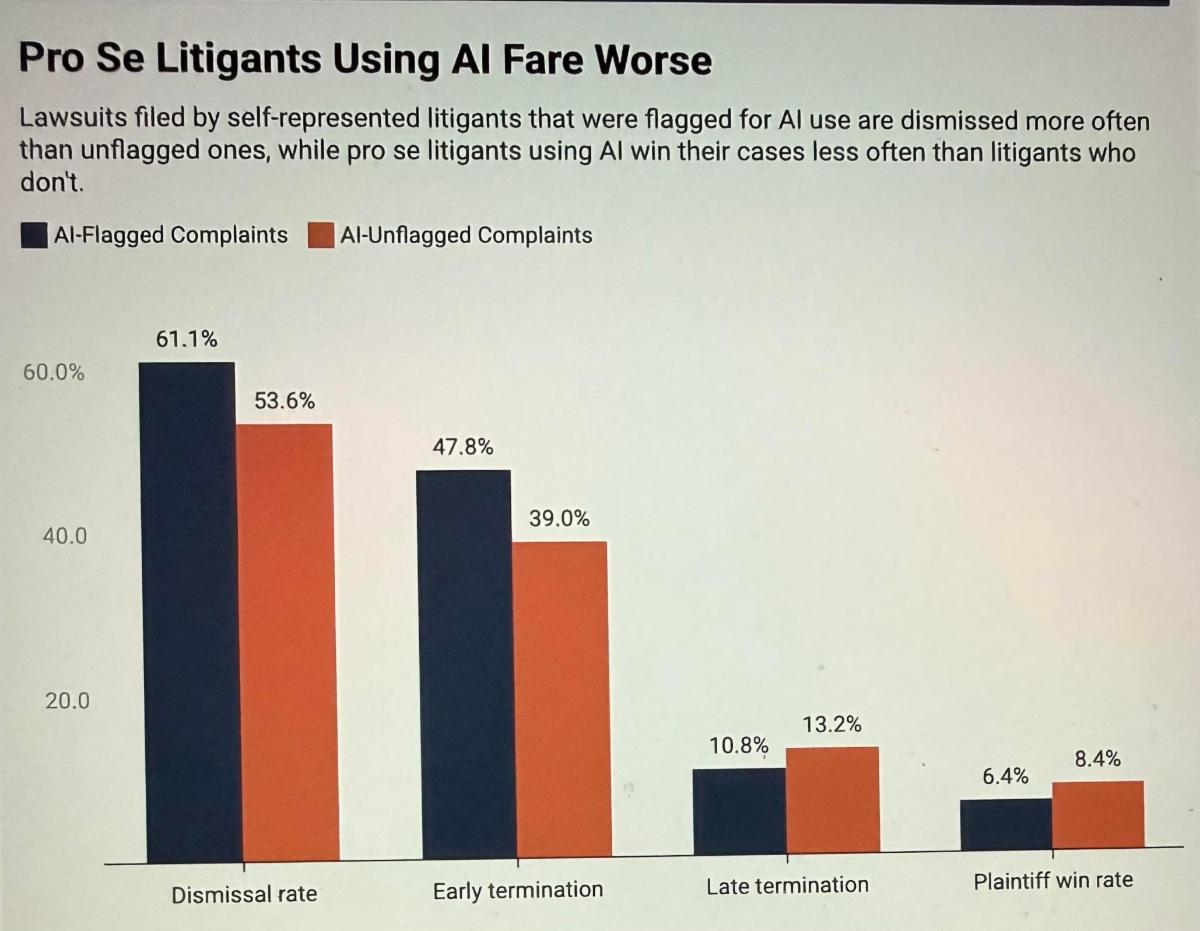
And AI-drafted filings are actually faring worse by at least some measures according to a study by the Miami Law & AI Lab at the University of Miami School of Law. Their research shows:
- 61.1% of complaints containing a signature of AI-generated text are dismissed, compared to 53.6% of complaints without an AI signature
- Suits filed using AI ended before the defendant answered the complaint 47.8% of the time, compared with 39% of complaints that weren't flagged for AI use
- Plaintiffs won lawsuits filed using AI at a rate of 6.4%, while they won 8.4% of those cases filed without AI
|