|
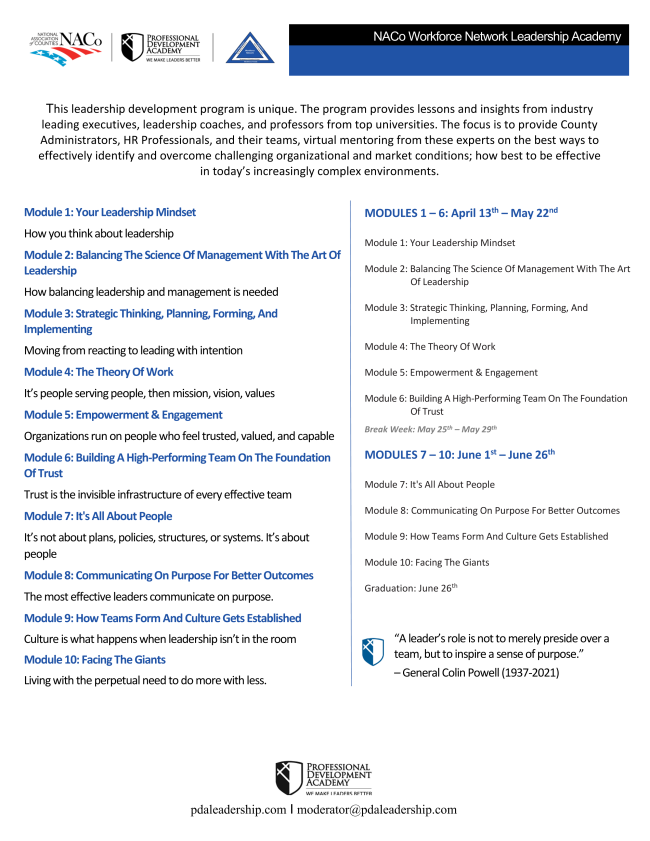
National Association of Counties Leadership Development: Learn from the best!
Congratulations 2025 Graduates!
Scholarships are still available for you and your team.
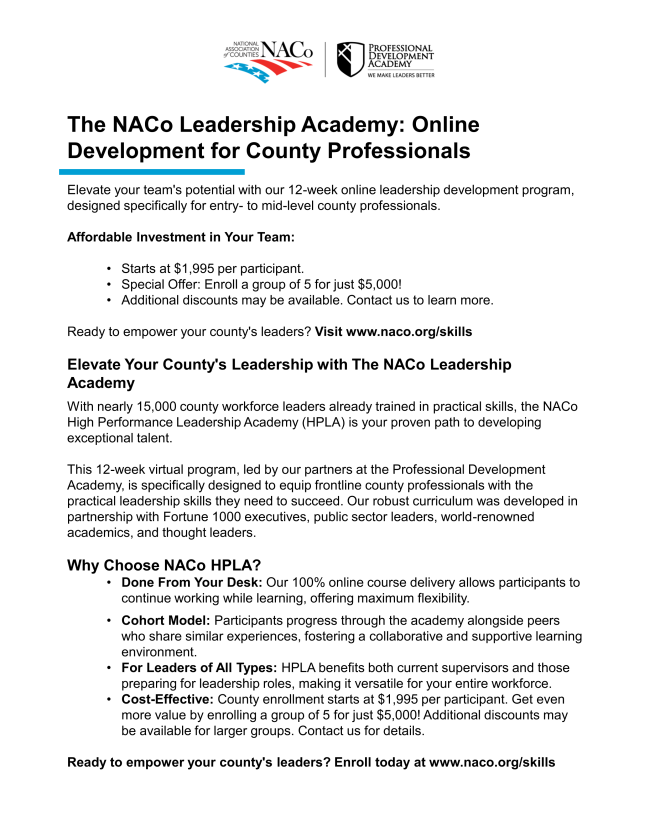
Join over 15,000 county leaders already benefiting from the effectiveness of the NACo Leadership Academy, the 10-week, online leadership program founded by General Colin Powell.
We would like to acknowledge and congratulate the Indiana graduates of 2025:
Allyson Caselberry, Dentist, Elkhart County
Baysah Korti, IS Director, DeKalb County
Brian Singleton, Enterprise Security Manager, Indianapolis - Marion County
Courtney Mathews, Deputy Director of Administration and Support, Elkhart County
David Wiegner, Community Services Manager, Elkhart County
Debra Settle, Chief Deputy Recorder, Bartholomew County
DeWayne Hines, Chief Deputy, Bartholomew County
Gerald Ransom, Supervisor, Highway Department, Wabash County
Jennifer Gregory, Senior Records Controller, Allen County
Jennifer Lampert, Chief Probation Officer, Dubois County
Matt Overholt, Deputy Director of Operations, Elkhart County
Matthew Bottoms, Environmental Health Supervisor, Elkhart County
Natosha Messmer, Volunteer Supervisor, Dubois County
Nicole Keesling, Recorder, Allen County
Ryan Craig, County Council, Dubois County
Sandy Beatty, Chief Deputy Treasurer, Bartholomew County
Shawn Werner, Administrative Director, Dubois County
Trish Reel, Chief Deputy Recorder, Hamilton County
Enroll now for April 2026!
Our April Cohorts are right around the corner. Join us in investing in the workforce – empowering them to become better leaders today and into the future.
CLICK HERE TO LEARN MORE AND ENROLL
Developed by General Colin Powell, the Professional Development Academy and NACo, the High Performance Leadership Academy is an online 10-week program that helps your workforce develop fundamental, practical leadership skills to deliver results for counties and our residents.
| | |
Across Indiana’s 92 counties, Soil and Water Conservation Districts (SWCDs) serve as the local backbone of conservation—bringing farmers, landowners, and communities together to protect the state’s soil, water, and natural resources. Established under Indiana Code Title 14, Article 32, SWCDs exist in every county across the state and serve as a bridge between local conservation priorities, state programs, and federal conservation resources.
Each SWCD is governed by a locally led board of five elected and appointed supervisors, all of whom are public officials, who guide conservation efforts based on the needs of their county, and SWCD staff are typically county employees. While SWCDs collaborate closely with partners like the Indiana State Department of Agriculture (ISDA), the USDA Natural Resources Conservation Service (USDA-NRCS), and the Indiana Association of Soil and Water Conservation Districts (IASWCD), their mission remains focused on improving local soil health, water quality, and sustainable land management.
Funding for SWCDs comes from several sources. The State of Indiana provides operational support through annual appropriations guided by by the State Soil Conservation Board and administered by ISDA. Many districts also receive county appropriations, which is critical to support staff and local programming. In addition, SWCDs frequently secure competitive state and federal grants, coordinate tree sales, equipment rental programs, cost share programs, and more that bring conservation dollars directly into their counties.
That grant funding can be significant. SWCDs help farmers, foresters, graziers, landowners, and communities access programs that support scientifically proven conservation practices such as cover crops, erosion control, nutrient management, and watershed protection. These programs often bring outside funding, for example from state initiatives like Clean Water Indiana, or federal conservation programs, into the county economy while improving local natural resources.
For county officials and commissioners, SWCDs can be a valuable partner and an excellent investment. By connecting local landowners with conservation resources and leveraging external funding, districts help stretch local dollars while addressing issues like drainage, soil loss, invasive species mitigation, and water quality. In many cases, a modest county investment in its SWCD helps unlock far greater conservation funding and technical assistance for residents across the county. If you are not familiar with your local SWCD, reach out to them and set up a time to meet over coffee, present at an upcoming meeting, or even join a SWCD-led event.
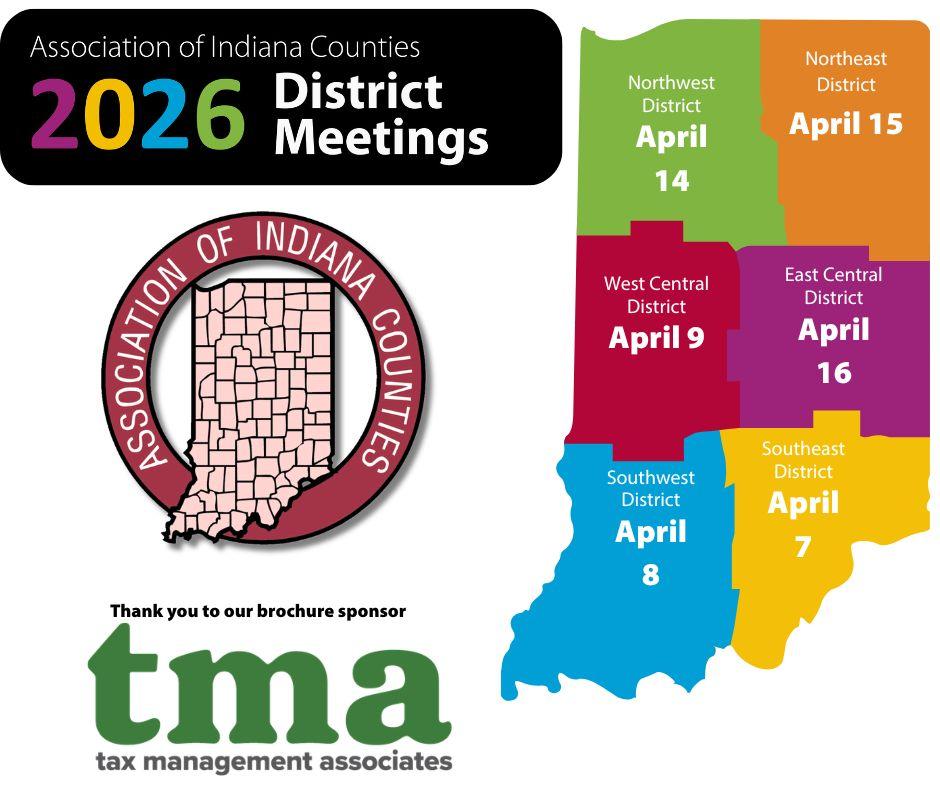
| | 2026 AIC's Legislative Minute | | Check out AIC's Jamie Bolser and Camden Murrell latest Legislative Minute. The team gives a Legislative wrap up from the 2026 whirlwind session. | | Register Now for the 2026 District Meetings and Budget and Finance I Institute Classes | | |
AIC's Conversation with Policymakers -
Graig Lubsen, IOT
| | Check out the latest Conversation with Policymakers episode. AIC's David Bottorff sits down with Graig Lubsen of IOT to discuss DOJ's Digital Accessibility Rule and other items. | | |
AIC Institute for Excellence in County Government
Legal and Ethical
| |
AIC Institute for Excellence in County Government
Legal and Ethical
3- AIC Credits; $75
Tuesday, April 21, 2026
Sheraton at Keystone
8787 Keystone Crossing
Indianapolis, IN 46240
Registration 8:30 am
Class 9:00 am - 12:00 noon
This class provides a clear and practical overview of the rules and ethical standards surrounding the use of public resources, political activity, transparency, and conflicts of interest. Attendees will learn how to properly manage county assets, avoid the misuse of staff time or equipment, and recognize the boundaries between official duties and political involvement. The class also emphasizes the importance of open government, covering public access requirements, documentation practices, and transparency expectations. Additionally, conflicts of interest and potential financial gain, gaining guidance on disclosure, recusal, and ethical decision-making will be discussed. The class equips county officials with the knowledge needed to uphold public trust and maintain high standards of integrity.
| | |
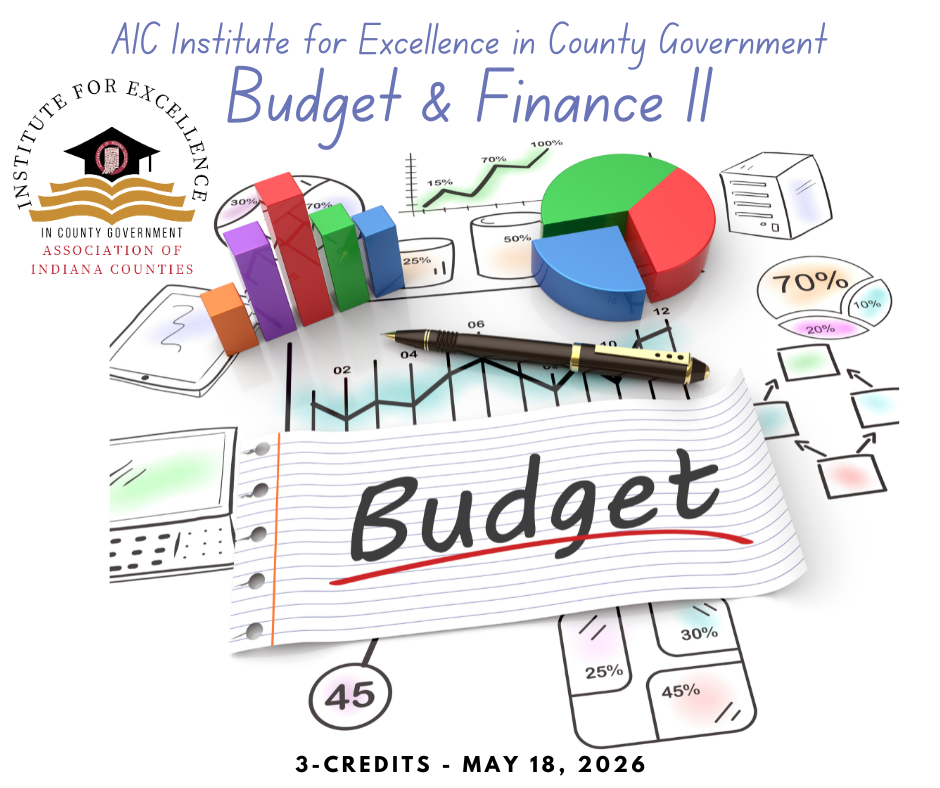
Budget & Finance II
3- AIC Credits; $75
Monday, May 18, 2026
Sheraton at Keystone
8787 Keystone Crossing
Indianapolis, IN 46240
Registration 8:30 am
Class 9:00 am - 12:00 noon
Since the passage of Senate Enrolled Act 1 (SEA 1), several Indiana counties are reporting real strain on their budgets. For instance, county leaders have warned that shrinking income-tax distributions and declining property-tax receipts under the new law could force cuts to essential services like public safety and infrastructure. These fiscal pressures stem in part from SEA 1’s overhaul of local income tax (LIT). To minimize further disruption, counties can hear options to proactively model their revenue under the new LIT regime, engage with state legislators to advocate for technical fixes, and explore adjustments to local fee structures
| |
|
March 24 - IOT Cyber Connect
Join IOT in person on March 24 from 10 a.m. to noon (CDT) for the Northwest Indiana IOT Cyber Connect, a gathering designed for local government and K12 IT leaders who want to stay ahead of the fast‑moving cybersecurity landscape.
Hosted in partnership with the Purdue Northwest Center for Cybersecurity, this session focuses on learning first, followed by collaboration, networking, and real conversations about the challenges and opportunities facing your organizations. The Indiana Cyber Network (ICN) and the Indiana Executive Council on Cybersecurity (IECC) will join us to discuss new cybersecurity standards, upcoming legislative requirements, and their implications for your teams.
Come ready to share your needs, compare notes with peers, and help shape future state-local IT partnerships. We’re here to listen and learn right alongside you.
Location:
Commercialization and Manufacturing Excellence Center
7150 Indianapolis Blvd
Hammond, IN 46324
Register for the March 24 Cyber Connect - Hammond
| | |
The Indiana Department of Health, Maternal and Child Health Division, is accepting applications for Moms Helpline Prenatal Care Referral Network grants and partners. The purpose of this opportunity is to establish a network of prenatal care partners that will allow Moms Helpline to seamlessly connect pregnant women with early prenatal care. Applicants can request to join the referral network now, or can request funding for implementation or planning grants.
| | | |
IN R-STEP Local Government/Planning Webinar: The Economic Effects of Local Renewable Energy Restrictions
April 8, 2026
2:00-3:00 pm ET
Dr. Michael Hicks, Director of the Center for Business and Economic Research at Ball State, will share findings from a recent research project examining the economic effects of local renewable energy regulations in Indiana counties.
This webinar is designed for local officials, plan commission members, and community leaders navigating renewable energy proposals. More details can be found in the attached flyer, and you can register here.
-----------------------------------------------------------------------------------------------
IN R-STEP Landowner Webinar: Land Stewardship: Agrivoltaics for Indiana
April 9, 2026
1:00 - 2:00 PM ET
Agrivoltaics, which can pair a solar development with active agriculture, offers new pathways for keeping land productive, resilient, and economically viable. This landowner-focused webinar explores how dual-use systems can support long-term farm viability while preserving working lands. More details can be found in the attached flyer, and you can register here.
| |
Community Development Block Grants now open for applications
The Office of Lieutenant Governor Micah Beckwith and the Indiana Office of Community and Rural Affairs announced the first round of Community Development Block Grants for 2026 is now open for applications.
The following programs are accepting applications.
- Blight Clearance
- Main Street Revitalization
- Public Facilities
- Stormwater Improvements
- Wastewater/Drinking Water
Detailed information on 2026 Round 1 updates can be found on the CDBG Resources page.
Proposal submissions will be collected via the electronic Grants Management System. Instructions on how to submit proposals can be found at in.gov/ocra/cdbg/cdbg-construction-grants/.
2026 Round 1 proposals are due on Sunday, April 5, by 11:59 p.m. ET via eGMS. Communities are encouraged to submit their proposals prior to 3 p.m. on April 3, as technical assistance will not be available after that time.
2026 Round 1 applications are due on Sunday, June 7, by 11:59 p.m. ET also via eGMS. Applicants are encouraged to submit their applications prior to 3 p.m. on June 5, as technical assistance will not be available after that time.
Important Notes:
The deadline for in-kind request submission has changed to the proposal due date. Request for the use of in-kind match should be emailed to cdbg@ocra.in.gov no later than Sunday, April 5, at 11:59 p.m. ET. All requests are to be made in accordance with CDBG Policy Notice 2025-005: In-Kind Contribution Policy.
All income survey documentation should be submitted final approval in eGMS by the proposal due date. This change is to confirm the National Objective of Low-to-Moderate Income Area Benefit is being met by applicants using an income survey.
The deadline for all bonus point submissions has changed to the application due date. Request for bonus points should be uploaded with the application on eGMS no later than Sunday, June 7, at 11:59 p.m. ET.
Funding for all CDBG programs comes from the U.S. Department of Housing and Urban Development and is administered by OCRA. The State of Indiana distributes CDBG funds to rural communities to assist units of local government with various community projects like improving infrastructure, downtown revitalization, public facilities improvements and economic development.
For further information on these programs, visit in.gov/ocra/cdbg or contact the assigned OCRA regional community liaison .
| | |
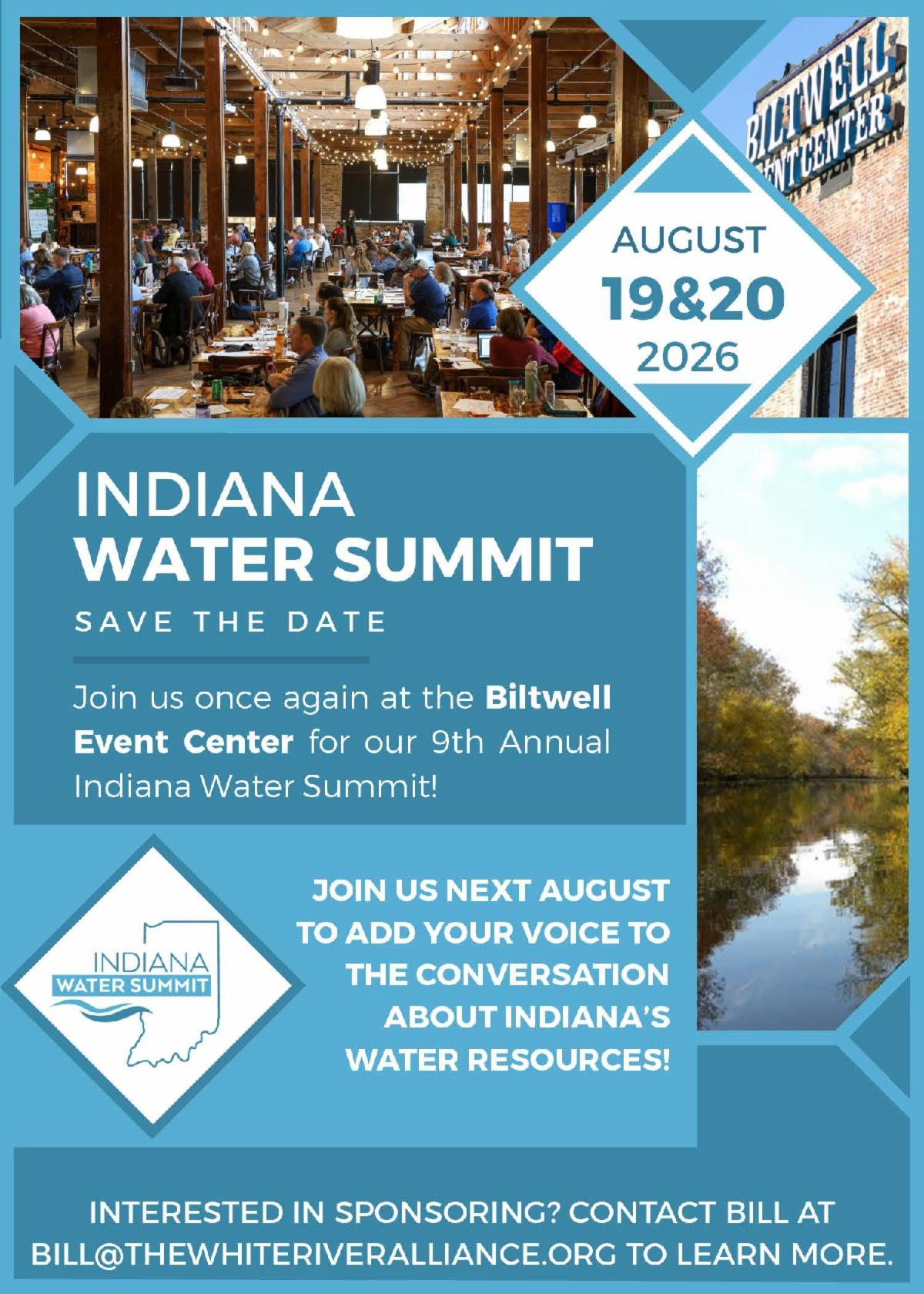
The Indiana Department of Natural Resources is inviting stakeholders to participate in a series of water planning workshops across the state.
The purpose of the workshops is to collect stakeholder input, ideas, and information to help inform the development of a statewide water inventory and management plan under Governor Braun’s Executive Order 25-63: Statewide water inventory and management plan.
Attendees will be updated on the progress of the effort. They will be asked for input on developing a regional water planning framework, enhancing Indiana’s water monitoring networks, and creating an online water data and management platform.
Who should attend?
The types of stakeholders will vary by region, but representatives of the following groups are encouraged to attend and provide input:
• City/Town/County Officials
• Economic Development Groups
• Basin Commissions, Drainage Boards
• Soil and Water Conservation Districts
• Non-Government Organizations
• Academic and Research Institutions
• Federal Agencies
• Water and Wastewater Utilities
• Power Generation
• Industrial and Commercial Users
• Agricultural Users
• Domestic Users
• Fish and Wildlife Interests
• Recreational Users
April 7, 10 a.m. - 1 p.m.
Allen County Public Library – Main
900 Library Plaza, Fort Wayne, IN 46802
RSVP for this event
April 16, 1 - 4 p.m
Beck Agricultural Center, West Lafayette, IN
RSVP for this event
May 12, 1 - 4 p.m.
Knox Community Building, 55 East Lake Street, Knox, Indiana 46534
RSVP for this event
TBD - May
Virtual
This session is in the scheduling process. Follow this link to sign up to be notified when the information is available.
| | |
The Indiana Office of Energy Development announces an approximately $1 million funding opportunity for Indiana’s Energy Efficiency and Conservation Block Grant (EECBG) Program.
This program will fund efforts to increase energy efficiency and conservation to support energy affordability for local governments and their communities. Grant funds will support energy planning, energy audits and building upgrades, and electric transportation for communities.
Funding for this opportunity is available only to units of local government in Indiana that were not allocated EECBG formula funds directly from the U.S. Department of Energy.
Application Opens: February 2, 2026
Deadline: Applications must be submitted to grants@oed.in.gov by April 5, 2026
Award Amount: Maximum award of $200,000 in federal grant funds per award. With match or other support, total project cost cannot exceed $250,000.
Eligible Applicants: Local units of government (cities, towns, and counties) in Indiana.
Duration: Projects should be completed within a period of twelve months.
Match: Applicant match is not required but is encouraged.
Program Objectives & Priorities:
IOED uses the five pillars of electricity policy: affordability, reliability, resiliency, stability, and environmental sustainability, in the development and implementation of grant programs. Energy efficiency supports the five pillars in multiple ways, including maintaining affordability through reducing energy consumption, increasing reliability, resiliency, and stability by reducing demands placed onto the electric grid, and providing environmental benefits. The four key categories supported by this funding are:
· Energy planning
· Energy efficiency audits and building upgrades
· Electric transportation and infrastructure
· Workforce development
Additional Information and Application may be found online:
www.in.gov/oed/grants-and-funding-opportunities/eecbg-program/
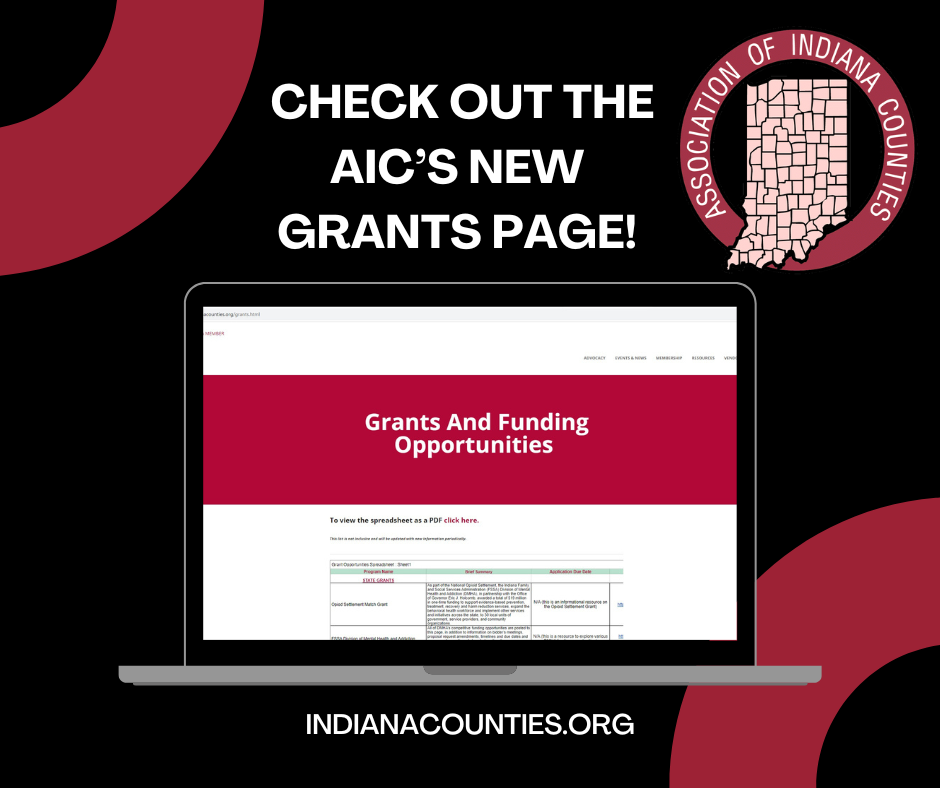
| | There is no water problem we can't solve together. | | Check out the AIC's new grants page on our website. We will be updating it periodically. If you have a grant for us to include or have any questions, please contact Janet Dunmyer at jdunmyer@indianacounties.org. | | Join more than 150 county leaders across Indiana who have utilized the NACo High Performance Leadership Academy. The 12-week virtual program is not only an opportunity to build and refine leadership capabilities, but it's also a chance to collaborate with local government peers in the region for the sharing of ideas and best practices. Request more information for your county at www.naco.org/skills today! | |
County Job Postings
AIC maintains a list of county job openings as a resource for our members. Here you’ll find the latest job postings from counties across the state.
To request that a job posting be added or removed, please contact Elizabeth Mallers, 317.829.3656
Click here to see the job postings
| | | | | | |